 by Tom Gurney
Tom Gurney BSc (Hons) is an art history expert with over 20 years experience
Published on June 19, 2020 / Updated on October 27, 2026
Email: tomgurney1@gmail.com / Phone: +44 7429 011000
The Icebergs: Introduction
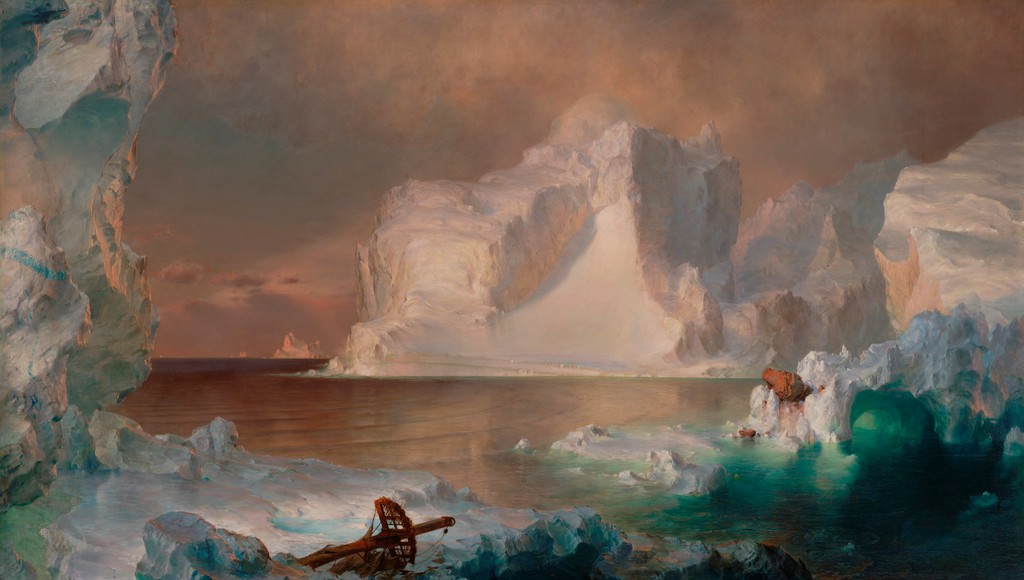
An immense dome of ice rises above a dark sea in Frederic Edwin Church’s The Icebergs. At the left, a fractured wall presses close to the spectator; at the right, green water enters a luminous grotto. A broken mast lies across the foreground. The painting belongs to the Dallas Museum of Art, a gift of Norma and Lamar Hunt. Its canvas measures approximately 163.8 × 285.8 cm, making the scene nearly three metres wide. [1]
Church completed this oil painting in 1861 after a summer journey to Newfoundland and Labrador in 1859. His companion, the Reverend Louis Legrand Noble, published an account of their encounters with the ice. The museum identifies the work as accession 1979.28. [2] Observation supplied Church with colours, surfaces and shapes, but the final picture also depended on prolonged decisions in the studio. Its subject could appear monumental and almost architectural while remaining unstable, exposed to currents, sunlight and the breaking sea.
The mast adds a further complication. It was absent from the painting’s first public appearance and entered the foreground before the London exhibition. That change gives the scene a visible human remnant where the earlier version offered ice, water and sky alone. The work’s history therefore helps explain the image: its composition and presentation continued to develop after its 1861 debut. [3]
At a Glance
- ArtistFrederic Edwin Church.
- Date1861; foreground mast added between mid-1862 and early 1863.
- MediumOil on canvas.
- DimensionsApproximately 163.8 × 285.8 cm, height × width.
- CollectionDallas Museum of Art.
- CreditGift of Norma and Lamar Hunt, 1979.28.
- Source journeyNewfoundland and Labrador, summer 1859.
- First public exhibitionGoupil’s Gallery, New York, 24 April 1861.
- Early exhibition titleThe North—Church’s Picture of Icebergs. [1] [2] [3]
This work across Church’s career
Tamaca Palms
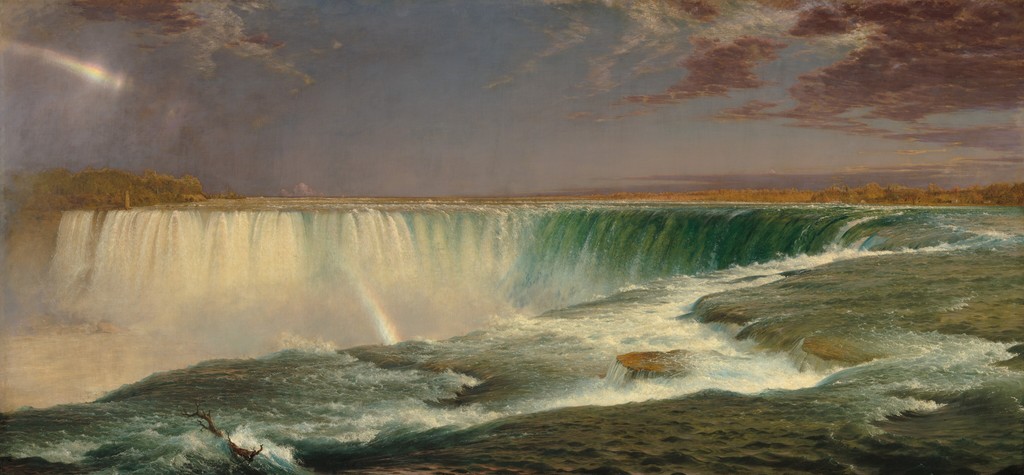
1854Niagara
1857The Icebergs (current work)
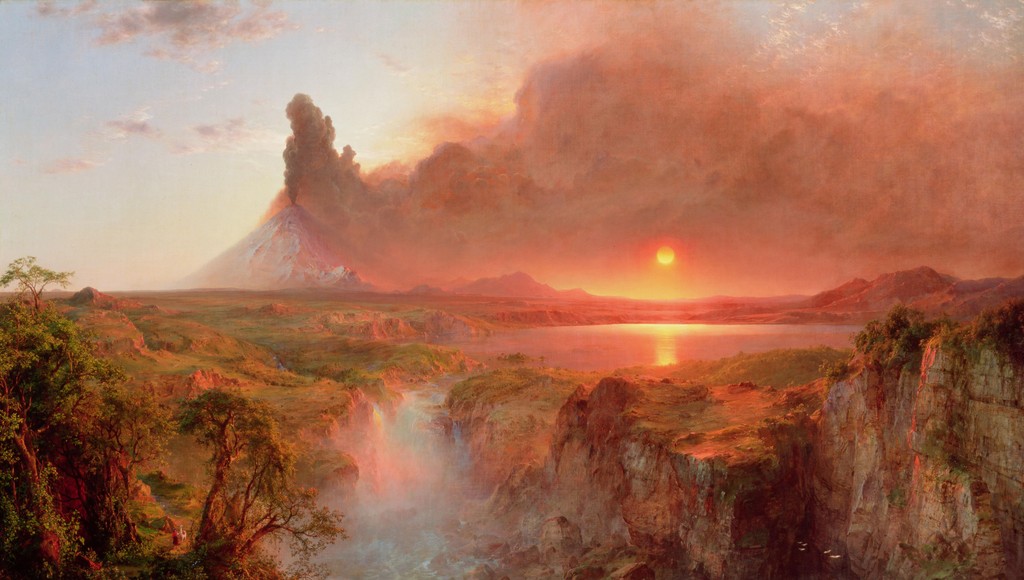
1861; foreground mast added between mid-1862 and early 1863Cotopaxi
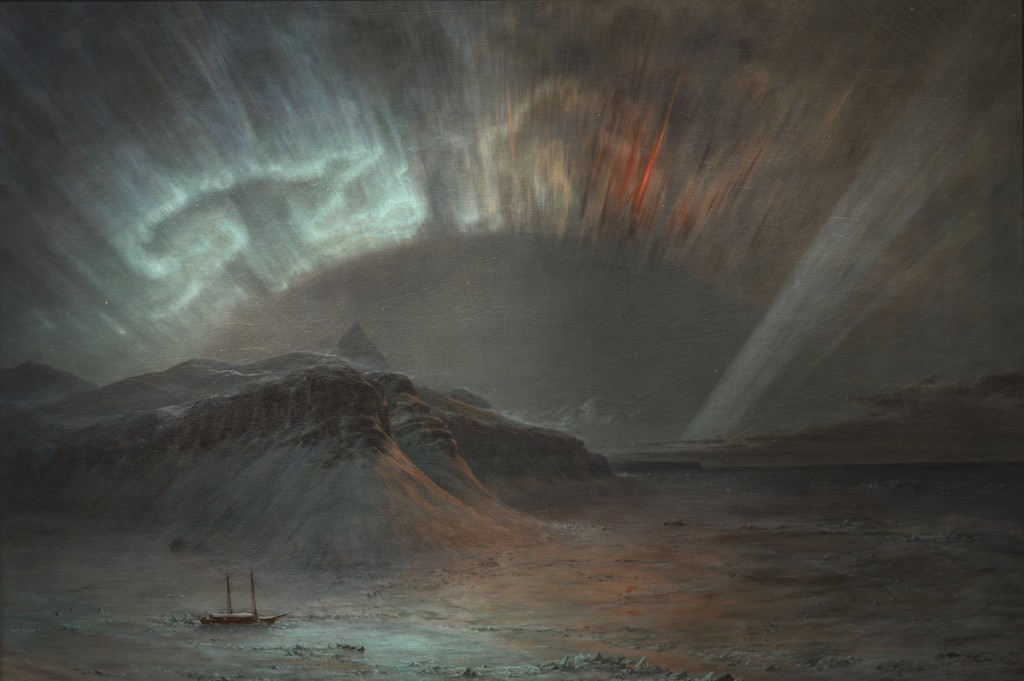
1862Aurora Borealis
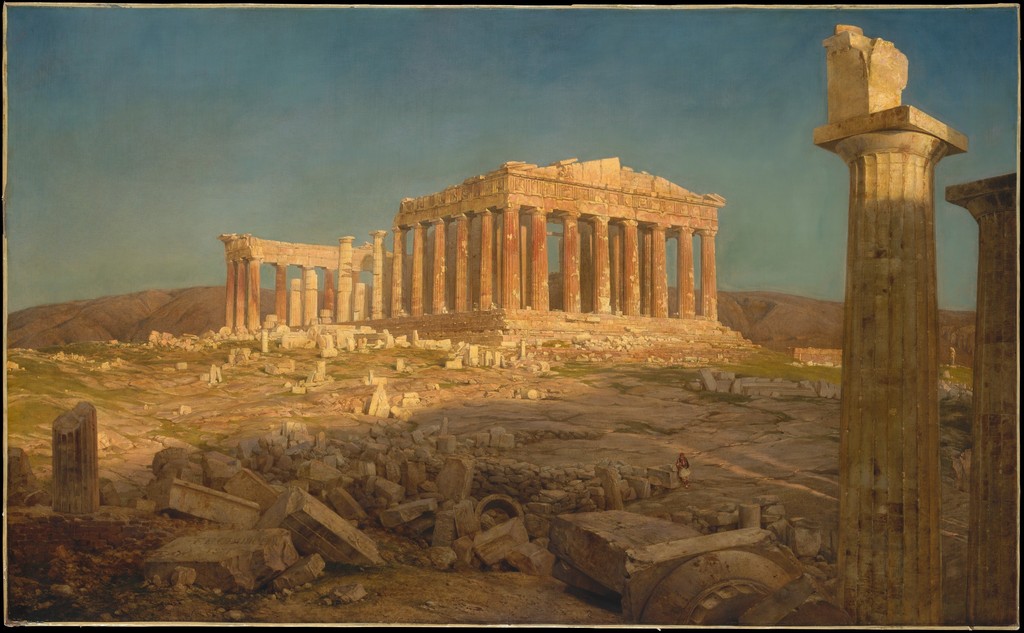
1865The Parthenon
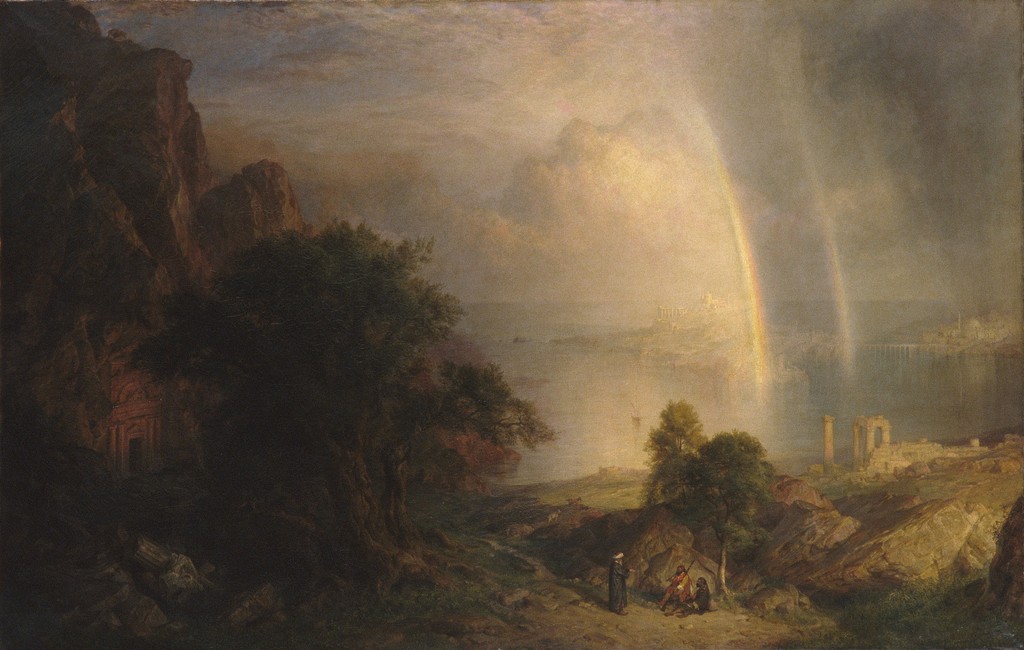
1871The Aegean Sea
About 1877Contents
- A summer voyage in search of ice
- Painting from a moving boat
- What the small studies preserve
- Turning observations into a composition
- The central berg and its monumental scale
- The left wall and the coloured grotto
- Water, the boulder and late-afternoon light
- The mast changes the foreground
- Nature and religious attention
- Annotated details
A summer voyage in search of ice
Church’s journey followed the spectacular reception of The Heart of the Andes. Having recently presented an expansive tropical landscape, he turned towards a very different range of forms and colours. Gerald L. Carr’s catalogue places this decision within a period of strong public interest in Arctic exploration. Accounts of polar voyages, the fate of Sir John Franklin’s expedition and explorers’ lectures made northern ice a subject of curiosity, danger and competing scientific expectations. [3]
Church’s own undertaking was a sketching journey along the North Atlantic coasts. Carr follows the travellers through Halifax to St John’s, then aboard the hired schooner Integrity towards northern Newfoundland and Labrador. The distinction matters: the painter gathered observations of drifting icebergs during summer rather than travelling to the North Pole or accompanying Franklin’s expedition. His material came from an accessible coastal voyage, although approaching and working near the ice could still be uncomfortable and hazardous. [3]
Noble brought a writer’s attention to the same encounters. He had been Thomas Cole’s pastor and biographer and was already involved in explaining Church’s work to readers. Carr describes After Icebergs with a Painter, published in 1861, as both a record of the journey and part of the anticipation surrounding the new painting. Its descriptions preserve a companion’s response to changing scenery; they also help readers understand why a painter might find an apparently restricted subject so abundant. [3]
Annotated Details from The Icebergs
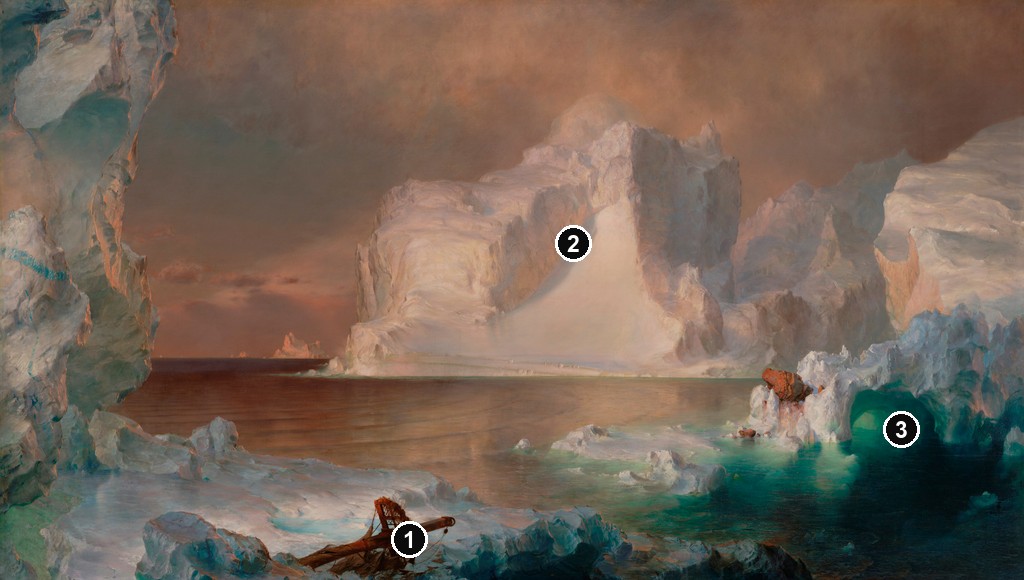
The numbered points draw attention to visible features discussed in this article. Look from each detail back to the full composition. Each image keeps its own identity, date and medium in the caption below.
The Icebergs
Frederic Edwin Church, The Icebergs, 1861; foreground mast added between mid-1862 and early 1863. Oil on canvas, approximately 163.8 × 285.8 cm. Dallas Museum of Art, gift of Norma and Lamar Hunt, 1979.28. Faithful reproduction via DMA Uncrated / Wikimedia Commons.. Source image. Public domain / faithful reproduction of historic two-dimensional artwork. Numbered overview resized; detail crops added from the source master. No recolouring.
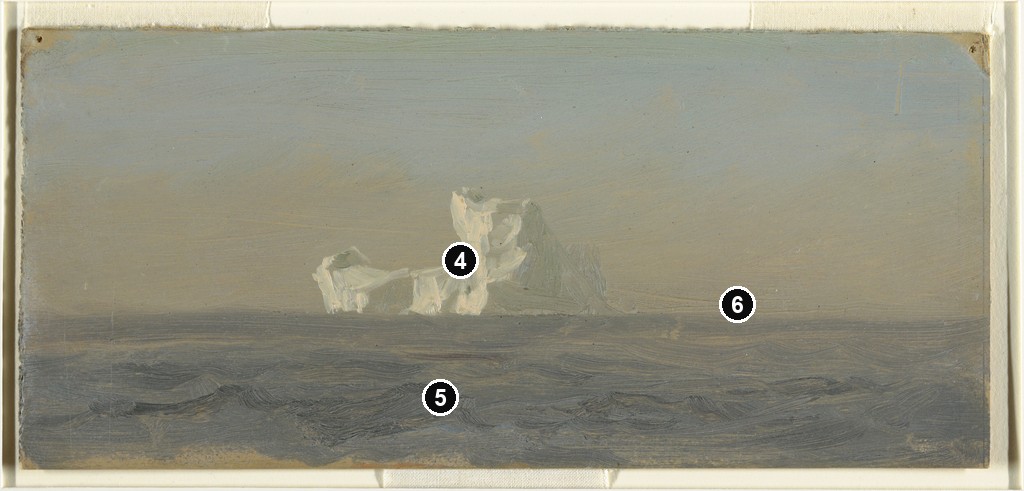
Off Iceberg, Newfoundland
Frederic Edwin Church, Off Iceberg, Newfoundland, June 1859. Oil and graphite on paperboard. Cooper Hewitt, Smithsonian Design Museum, gift of Louis P. Church, 1917-4-714-b. Catalogue photograph via Wikimedia Commons.. Source image. Public domain / faithful reproduction of historic two-dimensional artwork. Numbered overview resized; detail crops added from the source master. No recolouring.
Details from THE ICEBERGS
These crops come directly from the verified source images. They preserve the original colours or printed tones; the numbered overview is a separate aid to looking.
The Icebergs
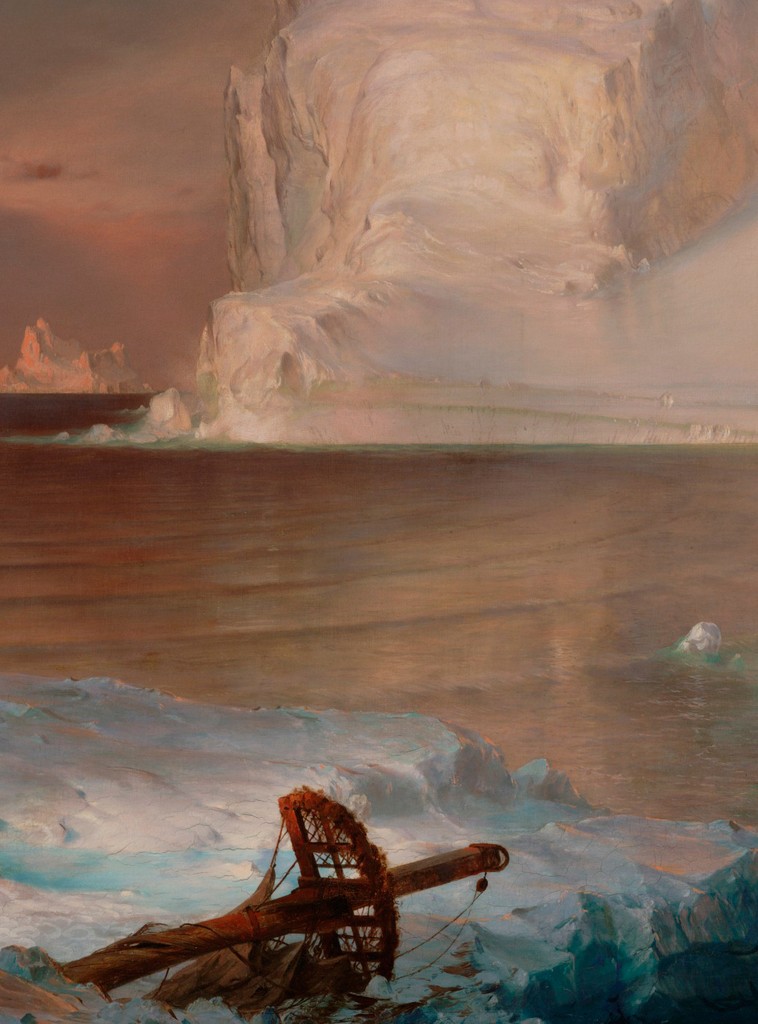
Broken mast
The broken mast lies across the near ice. Its recognisable human scale changes the relationship between the spectator and the larger forms.
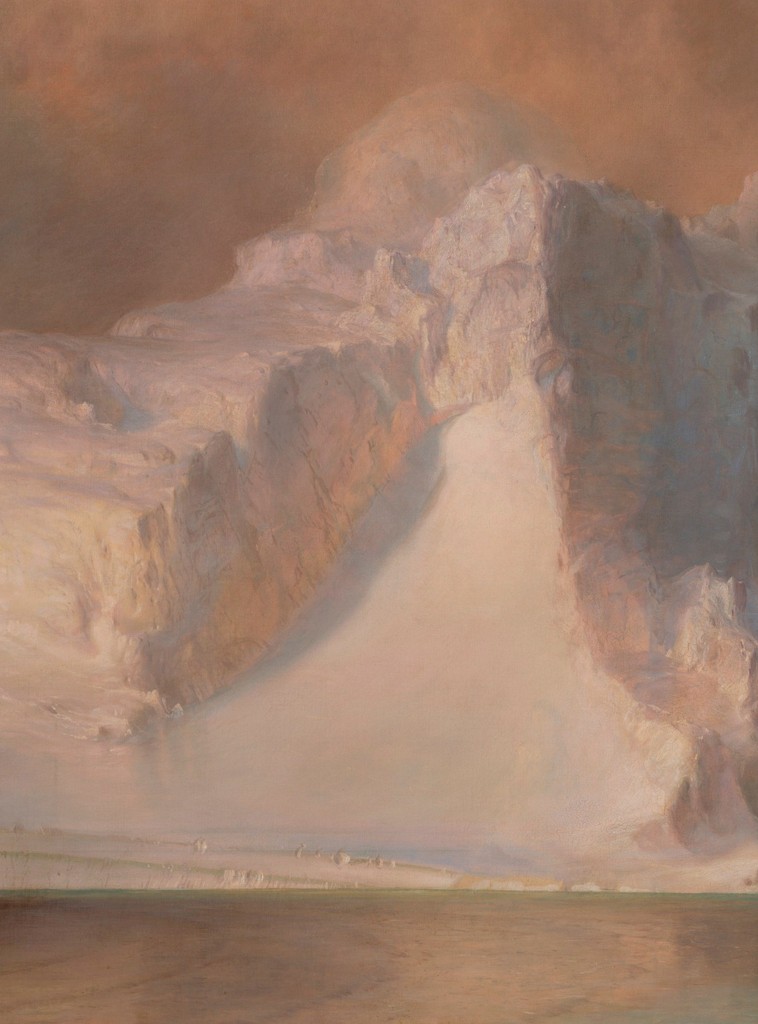
Central ice mass
A broad pale slope rises above the water. Look at the transitions among lit surfaces, shadow and smaller irregular edges.
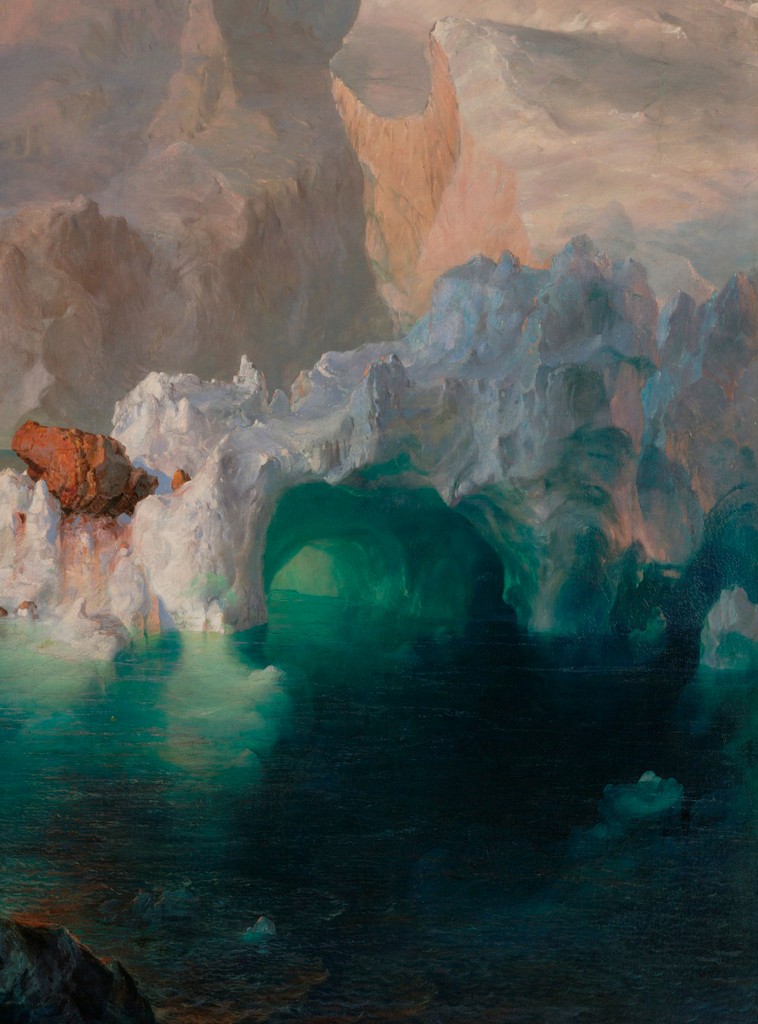
Green opening
A darker opening appears within green-blue ice at the right. The enclosed colour differs from the pale central mass and the open water.
Off Iceberg, Newfoundland
Distant ice
A pale ice mass rises beyond the water. Its small scale within the sheet differs from the dominant ice in the later exhibition picture.
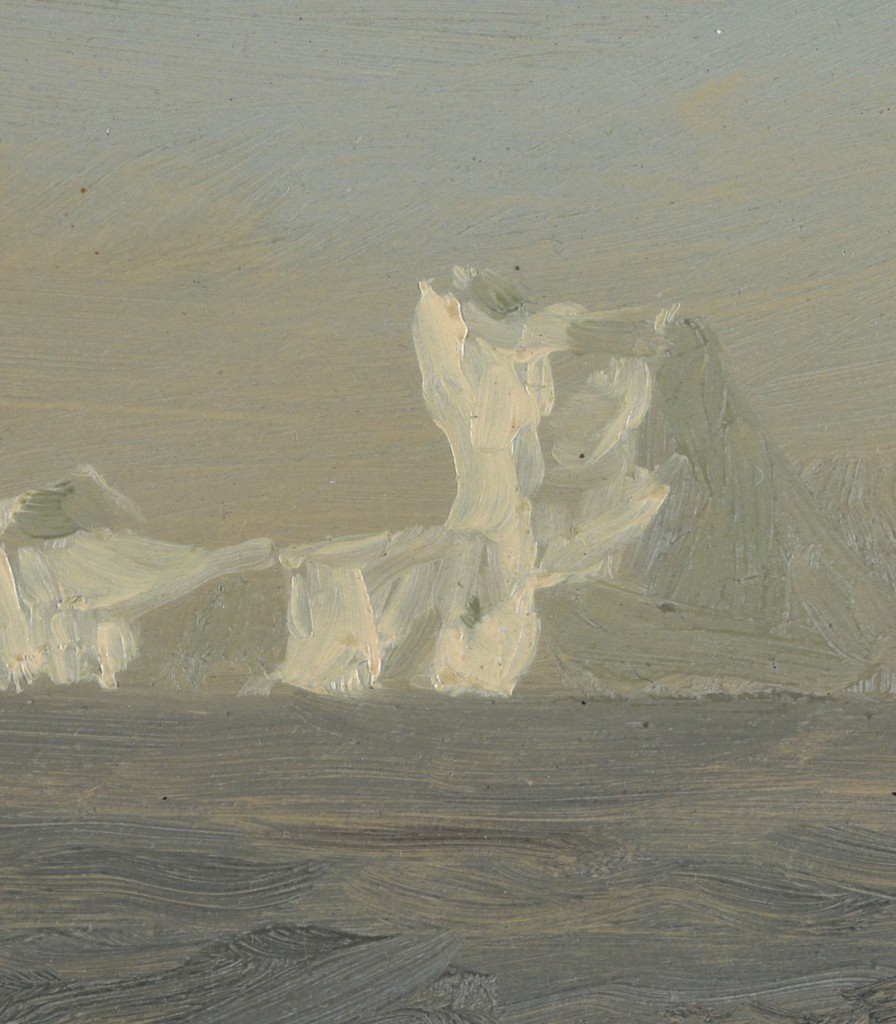
Water strokes
Broad strokes describe the moving sea. They record surface and light without the finish of the large canvas.
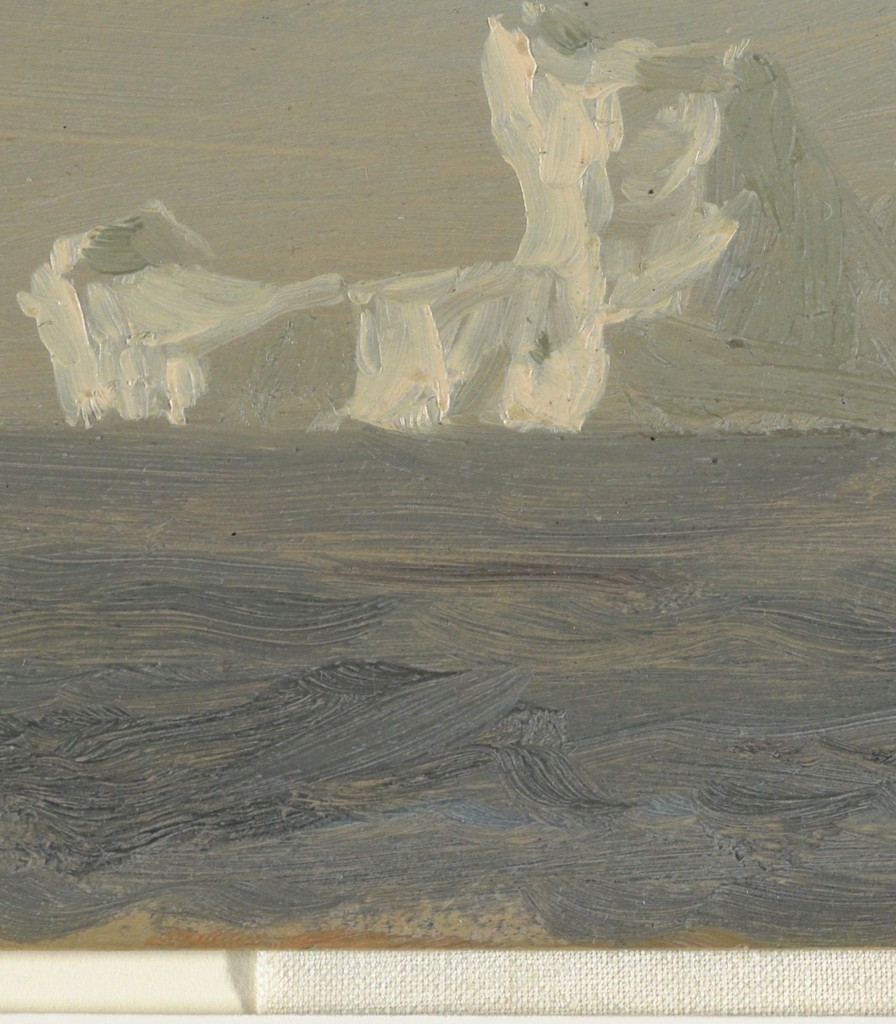
Horizon and sky
A subdued sky meets a comparatively level horizon. The quiet tones leave the small iceberg as the principal bright form.
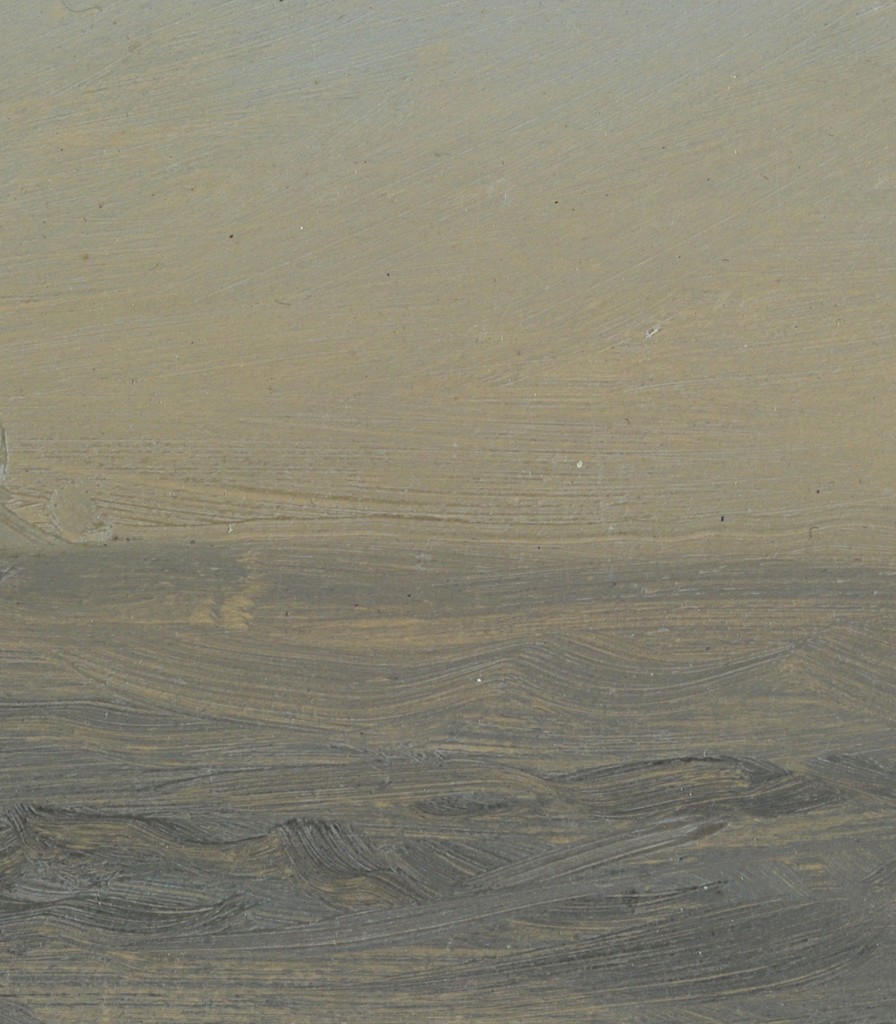
Painting from a moving boat
Chapter XII of Noble’s book describes the practical difficulty of obtaining a useful view. Church prepared his painting equipment while fishermen rowed towards an iceberg, then worked rapidly during an opening in the fog. The boat had to be held sufficiently steady for him to continue. Visibility changed, and the travellers eventually abandoned the hope of waiting nearby for sunset. This was observation conducted through intervals, with weather and movement controlling what could be recorded. [4]
The passage also describes differences between the iceberg’s faces as the boat moved away: pale blue, green fissures and warmer light could appear within the same encounter. Such observations offered more than an outline to be copied. They showed how a large white object changed with orientation, illumination and surrounding water. A studio painting could draw upon those differences even when the artist could no longer return to the precise moment that had first revealed them.
At Twillingate, on 4 July, Noble watched Church work after establishing an outline in graphite. His account notices small streams running down the iceberg, blue seams within the pale mass, emerald water near submerged ice and the sounds of waves entering cavities. Falling ice interrupts the spectacle. Beauty and change belong to the same experience: the object looks impressively solid while repeatedly demonstrating its capacity to break apart. [4]
What the small studies preserve
The surviving Off Iceberg, Newfoundland, dated June 1859, offers a useful comparison with the finished canvas. The catalogue photograph identifies it as a Cooper Hewitt work in oil and graphite on paperboard, given by Louis P. Church. A pale iceberg occupies the middle distance beneath a grey sky, with broad passages of paint registering the sea. Its small format concentrates attention on the relationship between the floating mass, horizon and atmosphere. [5]
The study’s visible brushwork differs from the large canvas’s elaborate description. Sea and sky can be established with relatively few strokes while the iceberg receives the changes of tone needed to make it stand out. This economy is useful for preserving an encounter. The finished painting has another task: it must sustain looking across an extensive surface, bring several kinds of ice into relation and keep near details connected to distant space.
Carr describes Church’s working material as a combination of sketchbook drawings, larger sheets and oil studies. Some sheets gathered observations made on different days; some painted studies brought separate sightings into one arrangement. The process therefore involved selection and combination before the final canvas was begun. An individual study can illuminate Church’s methods without serving as the exact model for a particular peak or cavity in the Dallas painting. [3]
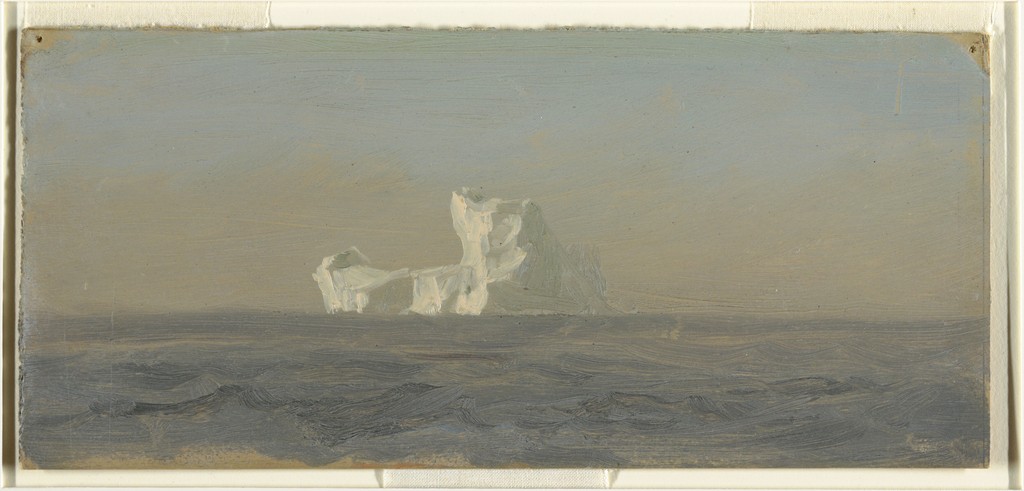
Frederic Edwin Church, Off Iceberg, Newfoundland, June 1859. Oil and graphite on paperboard. Cooper Hewitt, Smithsonian Design Museum, gift of Louis P. Church, 1917-4-714-b. Catalogue photograph via Wikimedia Commons.. Image source. Public domain / faithful reproduction of historic two-dimensional artwork. Resized; full source proportions retained.
Turning observations into a composition
The large painting did not immediately follow Church’s return. Carr traces a sequence of trial compositions in which the ice, open water and suggestions of wreckage shift position. Some early arrangements were more fantastical, with sharp peaks and conspicuous narrative elements. Later studies give the central berg a clearer identity, enlarge the water around it and organise the picture’s breadth more effectively. The final composition emerged through these changes rather than through enlarging a single field sketch. [3]
Church began work on the great canvas in December 1860 and brought it to public exhibition the following April. During the intervening period, anticipation was already circulating in the press. Carr’s account describes the pressure created by Church’s previous successes and the difficulty of producing an imposing landscape from a narrow range of materials. There were no trees, settlements or richly varied vegetation to distribute across the scene. Ice had to provide both the principal structure and much of the detailed interest. [3]
The completed arrangement makes these restrictions productive. Near ice offers broken edges, water-filled depressions and abrupt changes of colour. The central mass supplies height and a sustained sweep of pale surface. The right-hand grotto creates an opening within the solid forms, while the sea separates and connects them. Church gives a limited subject a varied sequence of distances, textures and directions.
The central berg and its monumental scale
The central iceberg first commands attention through its height and rounded summit. Its pale upper dome rises against a comparatively subdued sky, making the boundary between ice and atmosphere unmistakable. Lower down, broad slopes divide into ledges, ribs and broken projections. The eye moves from a large, readily grasped silhouette towards an increasingly complicated surface, so the mass remains legible while also rewarding close inspection.
Its form invites comparison with a mountain or a building. A summit, flanking peaks and descending planes give it apparent stability. Yet the dark water around its base removes the familiar ground beneath such comparisons. The berg occupies the sea rather than a continuous mountain range. Church allows monumental form and precarious situation to coexist, producing a scene that can feel imposing even where no storm is taking place.
The breadth of the canvas strengthens this effect. Smaller formations at the sides and pieces near the water establish a succession of scales, but no standing figure measures the main berg for us. The spectator must compare one part of the ice with another. This gives the central form a commanding presence without providing a simple numerical estimate of its imagined height.
The left wall and the coloured grotto
The nearest wall at the left partly exceeds the frame. Its broken surface appears close enough to interrupt a wider view, giving the scene an immediate obstacle as well as a distant spectacle. Blue seams and colder shadows run through passages of pale ice. Their irregularity prevents the wall from becoming a plain border; it remains a substantial object with its own fissures, projections and changes of plane.
At the right, the grotto offers a different kind of space. Its opening takes the eye beneath an arch and towards intensely coloured water. Green becomes especially conspicuous here, surrounded by paler and darker surfaces that make the cavity luminous. The passage appears inviting as a place to explore with the eye, while its setting within shifting ice makes imagined physical entry less comfortable.
The contrast between wall and grotto gives the two sides distinct roles. One presses outwards towards the viewer; the other opens inwards. Between them, the main berg supplies a broad central surface. These opposing spatial effects keep the composition from becoming a row of similar white objects. Church makes ice behave as barrier, enclosure, distant summit and floating fragment within the same prospect.
Water, the boulder and late-afternoon light
Dark water provides intervals between the pale masses. It makes their lower edges visible and gives the eye a quieter area after the crowded foreground. Farther away, the sea and horizon open the scene beyond the immense central berg. Small distant forms suggest that the visible ice belongs to a larger environment rather than filling a closed chamber.
The reddish-brown boulder at the right introduces another material and a conspicuously warmer colour. It rests among pale ice above the grotto, connecting the floating formation with the kind of rocky ground otherwise absent from the prospect. Its solidity differs from the wet, translucent and fractured surfaces around it. Church makes this small area disproportionately useful to the scene’s variety.
Carr summarises an explanatory broadside Church prepared for exhibition visitors. It described the amphitheatre as one great weathered iceberg, while explaining that its varied forms had been drawn from several specimens. The account identified the foreground as wet after rising from the water, contrasted freshly fractured and more weathered surfaces, and explained the coloured seams and water. It also specified late-afternoon illumination as the occasion for multiplying the colours of the ice. [3]
That explanation gives the painted calm a particular character. The quiet sea and declining light create an opportunity to examine the ice, while the forms retain evidence of movement and breakage. The boulder recalls contact with land; wet surfaces suggest a changing relationship with the waterline. Church’s presentation brings natural history into looking without requiring the scene to reproduce a mapped, continuous viewpoint.
Watch: Frederic Edwin Church
Choose a film to explore the artist’s work, its interpretation and its wider setting.
Frederic Edwin Church's "The Icebergs" on the Move at the DMA
Follow the Dallas Museum of Art as it moves Church’s large painting The Icebergs.
Watch on YouTubeThe mast changes the foreground
The broken mast lies diagonally across the nearest ice, contrasting its brown wood with the surrounding pale surface. Attached remnants and damaged edges give the object a history different from that of the glacier. It suggests human construction subjected to forces larger than itself. A viewer encountering the painting in its final state may therefore notice danger before exploring the remote horizon or the green grotto.
Carr dates the addition between mid-1862 and early 1863, before the painting travelled to London. The New York and Boston audiences had seen a foreground without this explicit remnant of a vessel. The alteration did more than supply another colour: it changed the spectator’s relationship to the scene by placing evidence of human activity within an otherwise uninhabited environment. [3]
The identity of the implied vessel remains open. Carr discusses David C. Huntington’s proposal that the mast might pay tribute to Franklin, alongside the possible significance of its cross-like form. These are interpretations of a suggestive addition. The visible wreckage carries associations of loss and vulnerability, but it does not identify a named ship, a particular casualty or a single required meaning. [3]
Nature and religious attention
Noble’s Twillingate account gives attentive observation a religious purpose. He describes a sailor beginning to look with renewed interest at icebergs that had previously seemed chiefly obstacles to navigation. For the writer, patient study reveals divine power and beauty within a familiar part of maritime life. The passage connects close looking with reverence, rather than separating the iceberg’s material properties from its spiritual significance. [4]
Carr finds related language in the painting’s Boston reception, where religious reviewers compared the luminous ice with cathedrals and visionary architecture. Such responses help explain how nineteenth-century spectators could perceive a spiritual subject in a landscape without represented worshippers. They also preserve a distinction between the picture and its reception: Noble’s prose and a reviewer’s interpretation disclose particular responses, while Church’s exhibition description concentrated on the ice, water, light and the scene’s repose. [3]
The North and the outbreak of war
The first exhibition opened at Goupil’s Gallery in New York on 24 April 1861, shortly after the outbreak of the American Civil War. Carr records the two-part title The North—Church’s Picture of Icebergs as a patriotic identification with the Union. The artist’s support for the Patriotic Fund formed part of the exhibition’s public reception. A landscape gathered before the war acquired a new national setting when it was presented. [3]
This connection is clearest in the title and exhibition circumstances. The painting contains no represented battle, and its ice does not need to become a code in which every formation stands for a political actor. The title directed attention towards a contemporary allegiance while the subject retained its associations with travel, scientific curiosity and unfamiliar natural beauty. Those kinds of meaning could operate together.
Favourable criticism did not guarantee a sale or a smooth exhibition tour. Carr records enthusiastic notices alongside responses that found the scene initially difficult to comprehend. The war disrupted the intended business arrangements, and the canvas remained unsold. It subsequently appeared at the Boston Athenaeum in 1862. Church’s status as a celebrated painter gave the work an expectant audience, but the subject and circumstances made its path less straightforward than those of his earlier successes. [3]
London, publication and a buyer
The London exhibition at the German Gallery ran from 22 June to 19 September 1863. The patriotic reference to The North was dropped, and the painting was shown as The Icebergs. Its audience included people with particular interests in exploration and glaciers: Carr records Lady Franklin, several Arctic explorers and the scientist John Tyndall among those at the preview. The painting entered an existing British conversation about northern voyages and their dangers. [3]
The mast made the scene more readily connected with maritime experience, although Carr treats the reasons for its insertion as questions rather than settled facts. London responses also attended to the extraordinary colours and the effort involved in observing unfamiliar nature. The subject could attract scientific, poetic and imaginative attention within the same exhibition. Carr’s survey includes some critical reservations as well as the many favourable notices. [3]
Sir Edward William Watkin, a railway magnate, purchased the painting. A chromolithograph published by Day and Son subsequently extended its circulation beyond the gallery. This separates two parts of its afterlife: a reproduced image could continue to reach viewers while the original entered private ownership. The London success resolved the long wait for a buyer, but it did not ensure the canvas’s continuing visibility as a celebrated public exhibit. [3]
A northern counterpart to The Heart of the Andes
Franklin Kelly places The Icebergs in dialogue with The Heart of the Andes. The canvases are similar in scale and offer sharply contrasting environments: abundant tropical vegetation and human habitation in one, immense ice and open water in the other. Their relationship suggests Church’s ambition to make distant regions available through large, encompassing pictures. It is a comparison between works rather than a requirement that they were always exhibited together. [6]
The contrast also reveals a shared method. Both paintings depend on accumulated observation organised into a new composition. Details encourage close looking, while the whole arrangement offers a prospect broader than an individual study. In The Icebergs, variety comes principally through form, illumination and different states of a single material. The restricted palette of subjects makes its abundance especially striking.
The later Aurora Borealis offers another northern scene, dominated by a different kind of light. Kelly explains that Church used material from Isaac Hayes’s expedition for its distant landscape, beyond the country he had seen himself. Keeping the works separate allows a more useful comparison: northern subjects could sustain quite different compositions, from the bright surfaces of a floating berg to an atmospheric display above a dark landscape. [6]
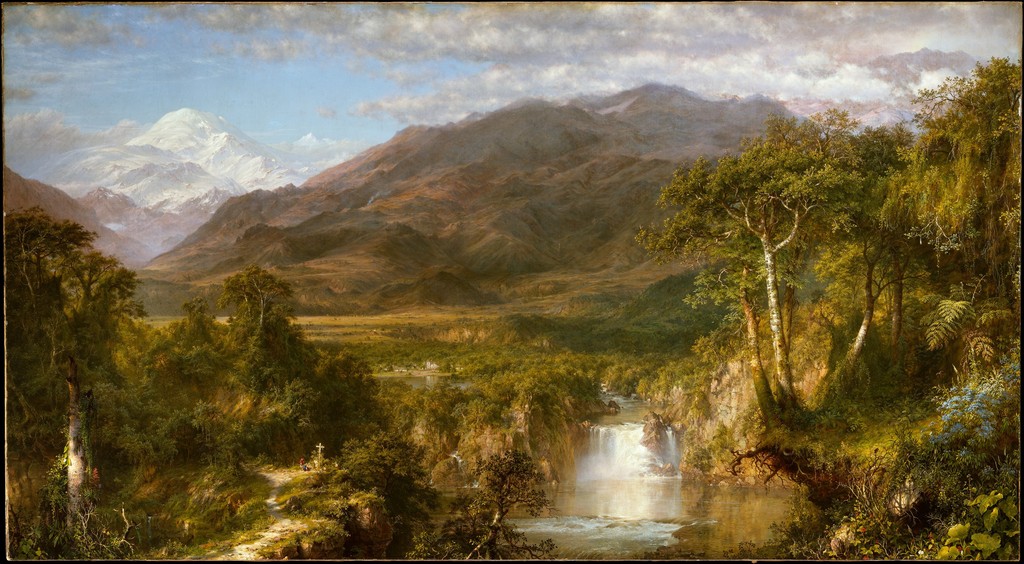
Frederic Edwin Church, Heart of the Andes, 1859. Bequest of Margaret E. Dows, 1909. Image source. CC0 / Met Open Access public-domain image. Resized; full source proportions retained.
Obscurity, rediscovery and Dallas
The painting’s later history moved away from the international attention of its London showing. Carr traces it through Watkin’s estate at Rose Hill near Manchester and subsequent ownership. It was given to a local church room in 1915, then returned to Rose Hill in 1921. These movements complicate the familiar description of the picture simply disappearing: it remained a physical presence, but its identity and artistic importance received little sustained attention. [3]
The Dallas Museum’s account of Eleanor Jones Harvey’s The Voyage of the Icebergs emphasises the cycle of fame, neglect and renewed interest. That publication places the 1979 sale within a broader revival of appreciation for Church and nineteenth-century American landscape painting. The rediscovery belongs to the work’s reception history, revealing how sharply an artist’s reputation and the public visibility of a major painting can change. [7]
Huntington’s introduction to the 1980 exhibition catalogue identifies the auction at Sotheby Parke Bernet in New York on 25 October 1979. The painting subsequently became the Hunts’ gift to Dallas. Today, its museum identity brings the immense original back into the account of Church’s career. Looking at it joins several histories: a summer’s observations, a carefully revised composition, changing exhibition audiences and the recovery of a work whose extraordinary foreground had once become unfamiliar. [8] [1]
Artworks directory
A documented selection of Church’s works discussed across these articles, together with identified prints after his designs. This is not a catalogue raisonné. Repeated titles and aliases are reconciled; studies remain distinct from finished paintings. Some dates remain unconfirmed. Other makers are named where a print adapts Church’s work.
| Name | Date | Medium |
|---|---|---|
| Above the Clouds at Sunrise | 1849 | Oil on canvas |
| The Aegean Sea | About 1877 | Oil on canvas |
| The Andes of Ecuador | 1855 | Oil on canvas |
| Aurora Borealis | 1865 | Oil on canvas |
| Autumn in North America | Circa 1856 | Oil on board |
| Coast Scene | 1852 | Oil on canvas |
| Cotopaxi | 1862 | Oil on canvas |
| A Country Home | 1854 | Oil on canvas |
| El Khasné, Petra | 1874 | Oil on canvas |
| El Rio de Luz | 1877 | Oil on canvas |
| The Heart of the Andes | 1859 | Oil on canvas |
| The Icebergs | 1861; foreground mast added between mid-1862 and early 1863 | Oil on canvas |
| Jerusalem from the Mount of Olives | 1870 | Oil on canvas |
| Mount Ktaadn | 1853 | Oil on canvas |
| Our Banner in the Sky | 1861 | Oil paint over lithograph on paper, laid down on cardboard |
| The Parthenon | 1871 | Oil on canvas |
| Rainy Season in the Tropics | 1866 | Oil on canvas |
| Storm in the Mountains | 1847 | Oil on canvas |
| Syria by the Sea | 1873 | Oil on canvas |
| Tamaca Palms | 1854 | Oil on canvas |
| Tropical Scenery | 1873 | Oil on canvas |
| Twilight in the Tropics | 1874; signed and dated, according to Bonhams’ catalogue | Oil on canvas |
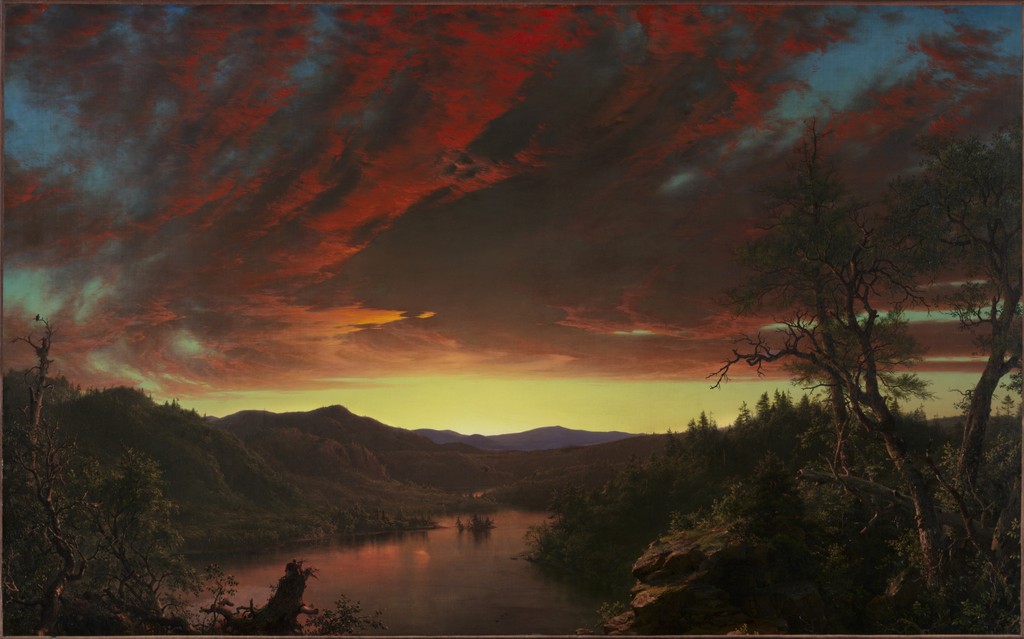
| Twilight in the Wilderness | 1860 | Oil on canvas |
| View of Cotopaxi | 1857 | Oil on canvas |
| Niagara | 1857 | Oil on canvas |
| Magdalena River, New Granada, Equador | 1853 | Graphite heightened with white on wove paper |
| Tamaca Palm, Colombia or Ecuador | May–October 1853 | Graphite on gray laid paper |
| Mixed Sketches with a Champan, Río Magdalena, Colombia | May 1853 | Graphite on gray laid paper |
| Study for Rainy Season in the Tropics | 1865–1866 | Graphite on ruled notepad paper |
| Al-Khazneh, Petra (study) | February–March 1868 | Oil and graphite on tan paperboard |
| The Great Fall, Niagara (Charles Risdon, after Church) | 1874 impression | Hand-coloured chromolithograph on paperboard |
| The Heart of the Andes (William Forrest, after Church) | 1862 | Engraving in black on wove paper |
| Our Heaven Born Banner (William Bauly, adapting Church’s motif) | circa 1861 | Colour lithograph |
| A Tropical Moonlight (wood engraving after Church) | 1879 publication | Wood engraving in American Painters |
| Off Iceberg, Newfoundland | June 1859 | Oil and graphite on paperboard |
| Parthenon at Night, Athens | April 1869 | Oil and graphite on tan paperboard |
| Jerusalem from the Mount of Olives (study) | 1 April 1868 | Oil and graphite study |
| Horseshoe Falls (study) | December 1856–January 1857 | Oil on paper mounted to canvas |
| Niagara Falls, from the American Side | 1867 | Oil on canvas |
| Study for The Heart of the Andes | 1858 | Oil study |
| Mount Chimborazo through Rising Mist and Clouds | 1857 | Oil study |
| Cotopaxi Erupting, Viewed from Quito, Ecuador | June 1857 | Oil and graphite on tan paperboard |
| Cotopaxi (painted for Cyrus Field) | 1855 | Painting |
| Chimborazo | 1864 | Painting |
| Twilight, A Sketch | 1858 | Oil on canvas |
| View of Baalbek | 1868 | Oil and pencil on board |
| Three Bedouins | Date unconfirmed | Oil study |
| Coast Scene, Mount Desert (later canvas) | 1863 | Painting |
| The Wreck | Date unconfirmed | Painting |
| Grand Manan Island, Bay of Fundy | Date unconfirmed | Painting |
| Summer in South America | circa 1853 | Painting |
| Evening in Vermont | Date unconfirmed | Painting |
| Home by the Lake | Date unconfirmed | Painting |
| Storm in the Blue Mountains, Jamaica | August 1865 | Painting |
| The Natural Bridge, Virginia | 1852 | Painting |
| The Vale of St. Thomas, Jamaica | 1867 | Painting |
| Tequendama Falls, near Bogota, New Granada | Date unconfirmed | Painting |
| Sunrise in Syria | Before the 1876 exhibition | Painting |
| Cuernavaca (oil study; descriptive title) | 1898 | Oil study |
| Olana window design (descriptive title) | Date unconfirmed | Watercolour and graphite |
| Olana dining-room stencil sketch (descriptive title) | Date unconfirmed | Oil and graphite |
| Olana house (with Calvert Vaux) | 1870–1872; later additions | Architecture |
| Olana designed landscape | From 1860; developed over decades | Designed landscape |
Frequently Asked Questions
He gathered studies in Newfoundland and Labrador in summer 1859, then developed the large canvas in his studio. Work on the final painting began in December 1860, and it opened to the public in April 1861. [3]
No. Carr places its addition between mid-1862 and early 1863, before the London exhibition. The New York and Boston presentations showed the scene without it. [3]
The New York exhibition used the patriotic title The North—Church’s Picture of Icebergs after the outbreak of the Civil War. The reference to The North was removed for London in 1863. [3]
Church’s exhibition description presented the scene as a great weathered iceberg whose forms were gathered from several specimens. The completed arrangement combines observation with decisions made during studio preparation. [3]
Discussion
Look again at the images and ideas explored in The Icebergs. These editorial prompts invite your own observations.
- How does the mast change your response to the ice compared with imagining the foreground without it?
- Which part seems most solid, and which details suggest movement or change?
- How does the small Newfoundland study alter your understanding of the finished canvas?
Reader Insights
Which edge or opening in the ice gives you the strongest sense of depth?
How does the broken mast alter the scale or mood of the composition?
What do the small voyage studies reveal that the finished canvas leaves less explicit?
Join the Conversation
Share a detail, comparison or question about The Icebergs below.
References
- Dallas Museum of Art, The Icebergs, museum-supplied record on Google Arts & Culture. Identity, date, dimensions and Hunt provenance.
- Jenny Marvel, Dallas Museum of Art Uncrated, “The Tip of the Iceberg”, 23 March 2010. Painting caption, accession, medium and voyage context.
- Gerald L. Carr, Frederic Edwin Church: The Icebergs, Dallas Museum of Fine Arts, 1980. Especially pp. 21, 25, 28–30, 42–46, 52–54, 59–61, 68–73, 82–85, 88–93 and 103–107. Journey, studies, compositional development, Church’s exhibition description, title and mast changes, reception and later history. Historic press, broadside and correspondence discussed through Carr’s account.
- Louis Legrand Noble, After Icebergs with a Painter: A Summer Voyage to Labrador and Around Newfoundland, D. Appleton, 1861. Chapters XII, pp. 52–59, and XXIV, pp. 106–111. Boat-based observation, colour, weather and the Twillingate encounter.
- Cooper Hewitt catalogue photograph and imported object metadata, Off Iceberg, Newfoundland, June 1859, 1917-4-714-b, via Wikimedia Commons.jpg). Gift of Louis P. Church; oil and graphite on paperboard.
- Franklin Kelly, “Church and the National Landscape,” in Frederic Edwin Church, National Gallery of Art, 1989, pp. 58–63. Northern journey, relationship with The Heart of the Andes and the later Aurora Borealis.
- Dallas Museum of Art, publication synopsis for Eleanor Jones Harvey’s The Voyage of the Icebergs: Frederic Church’s Arctic Masterpiece. Fame, neglect and the 1979 sale; the museum synopsis rather than the book’s full text.
- David C. Huntington, introduction to Frederic Edwin Church: The Icebergs, Dallas Museum of Fine Arts, 1980, p. 9. Sotheby Parke Bernet sale in New York, 25 October 1979.
- Splash image source.
Frederic Edwin Church, The Icebergs, 1861; foreground mast added between mid-1862 and early 1863. Oil on canvas, approximately 163.8 × 285.8 cm. Dallas Museum of Art, gift of Norma and Lamar Hunt, 1979.28. Faithful reproduction via DMA Uncrated / Wikimedia Commons.. Image source. Public domain / faithful reproduction of historic two-dimensional artwork. Resized; full source proportions retained.