 by Tom Gurney
Tom Gurney BSc (Hons) is an art history expert with over 20 years experience
Published on June 19, 2020 / Updated on October 27, 2026
Email: tomgurney1@gmail.com / Phone: +44 7429 011000
El Rio de Luz: Introduction
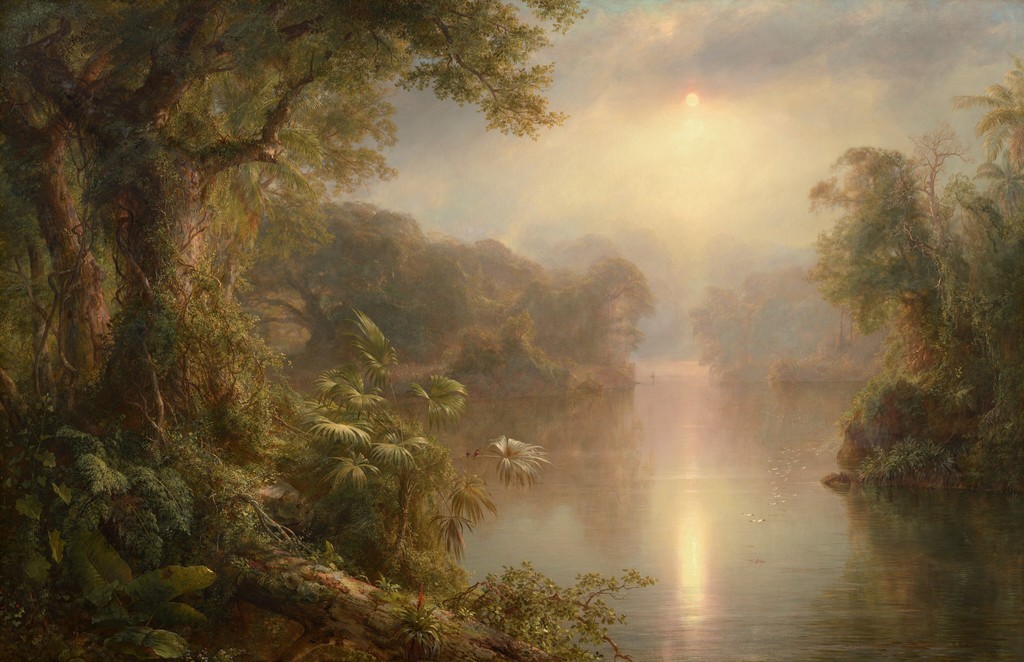
Frederic Edwin Church’s El Rio de Luz, or The River of Light, places a quiet tropical river beneath a low sun and a sky filled with luminous mist. Painted in 1877, it belongs to the National Gallery of Art in Washington, accession 1965.14.1, through the gift of the Avalon Foundation.[1] Dense vegetation encloses the water on either side, while a distant canoeist and small birds introduce movement into a scene otherwise organised around stillness, reflection and the gradual disappearance of forms.
At a Glance
- ArtistFrederic Edwin Church (1826–1900)
- TitleEl Rio de Luz (The River of Light)
- Also known asMorning in the Tropics
- Date1877
- MediumOil on canvas
- Dimensions138.1 × 213.7 cm, overall
- CollectionNational Gallery of Art, Washington
- Accession1965.14.1
- CreditGift of the Avalon Foundation
- SignatureLower right, “F. E. CHURCH / 1877”
- LandscapeComposed tropical river scene drawing on earlier South American observations
This work across Church’s career
Tamaca Palms
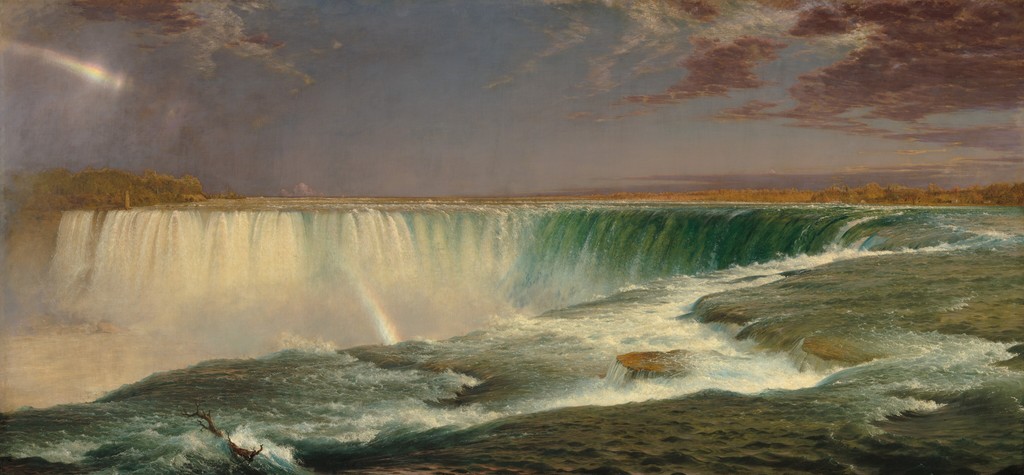
1854Niagara
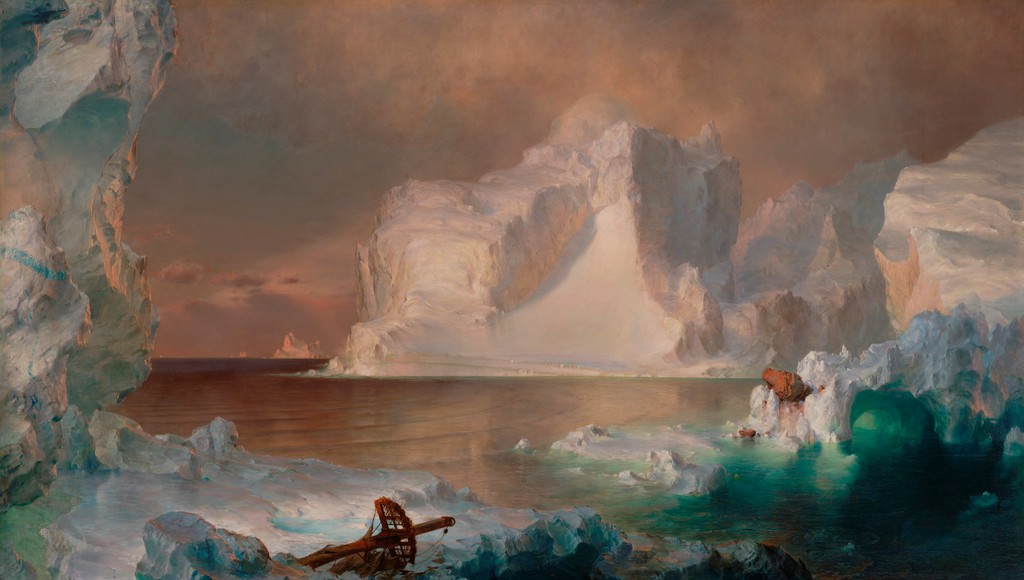
1857The Icebergs
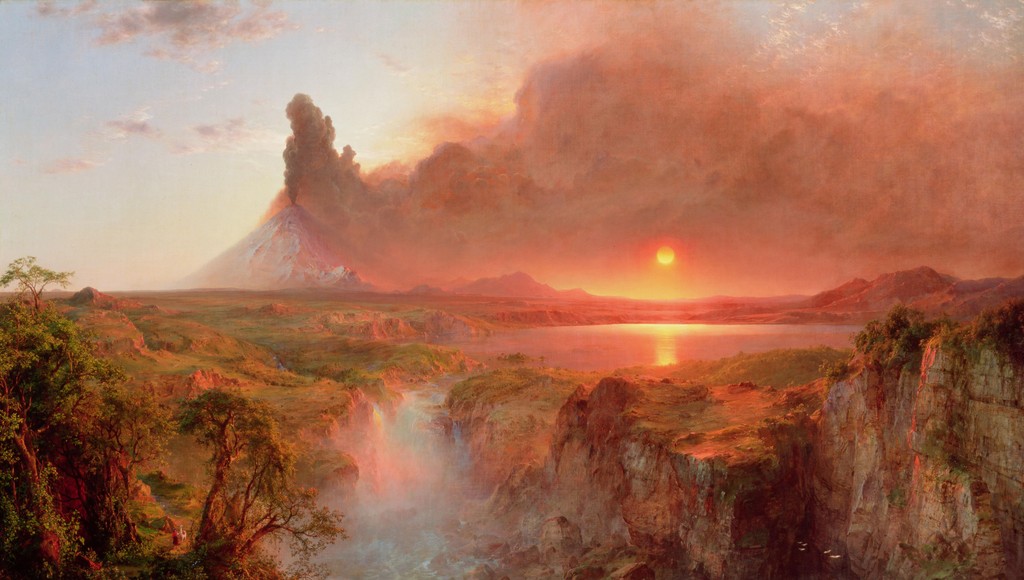
1861; foreground mast added between mid-1862 and early 1863Cotopaxi
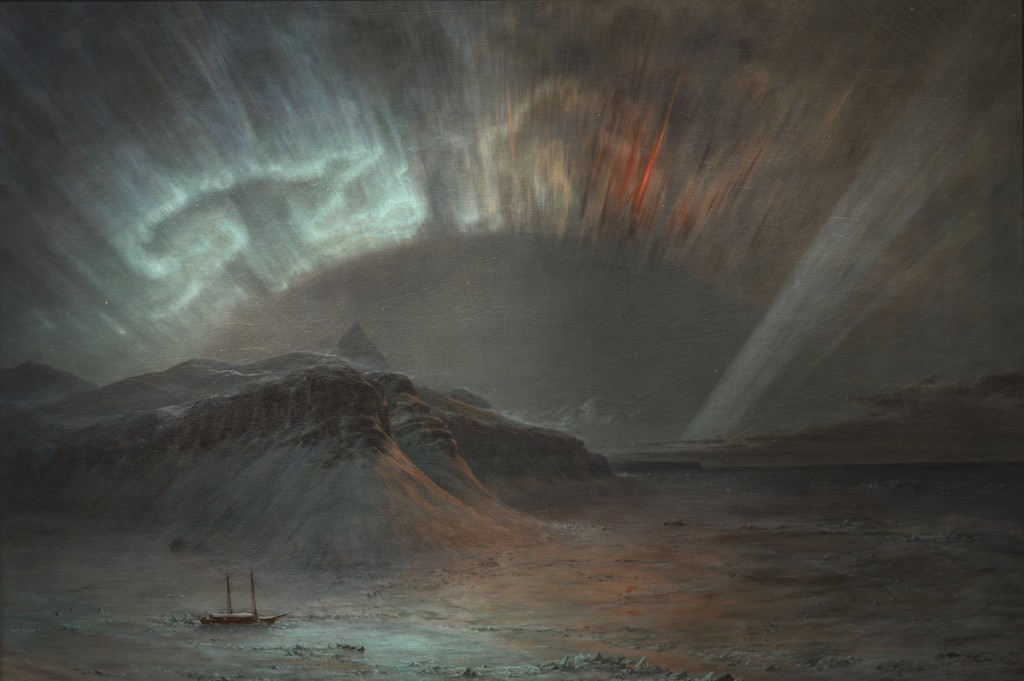
1862Aurora Borealis
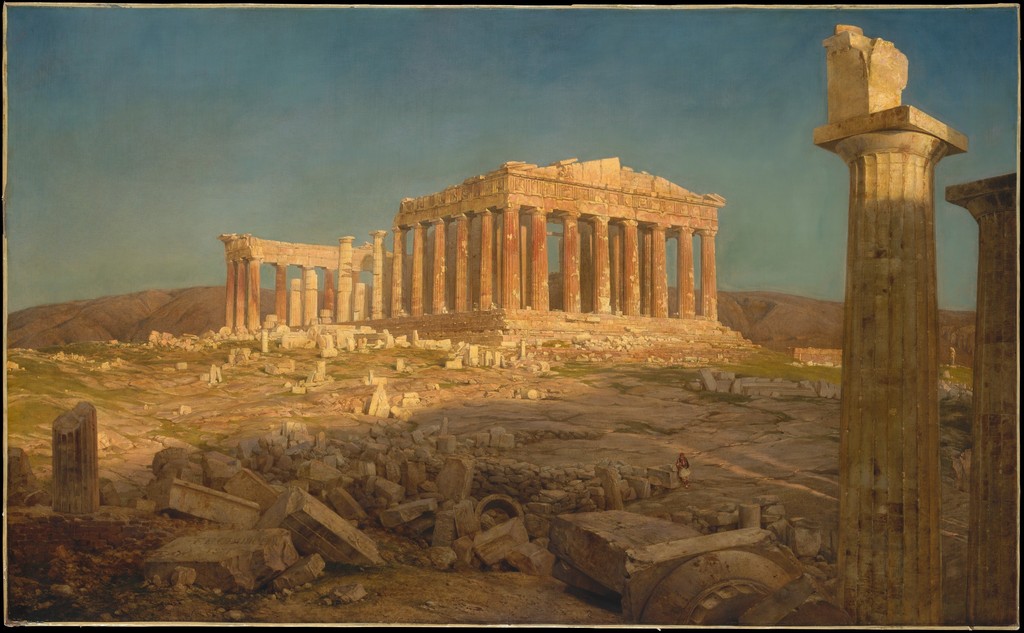
1865The Parthenon
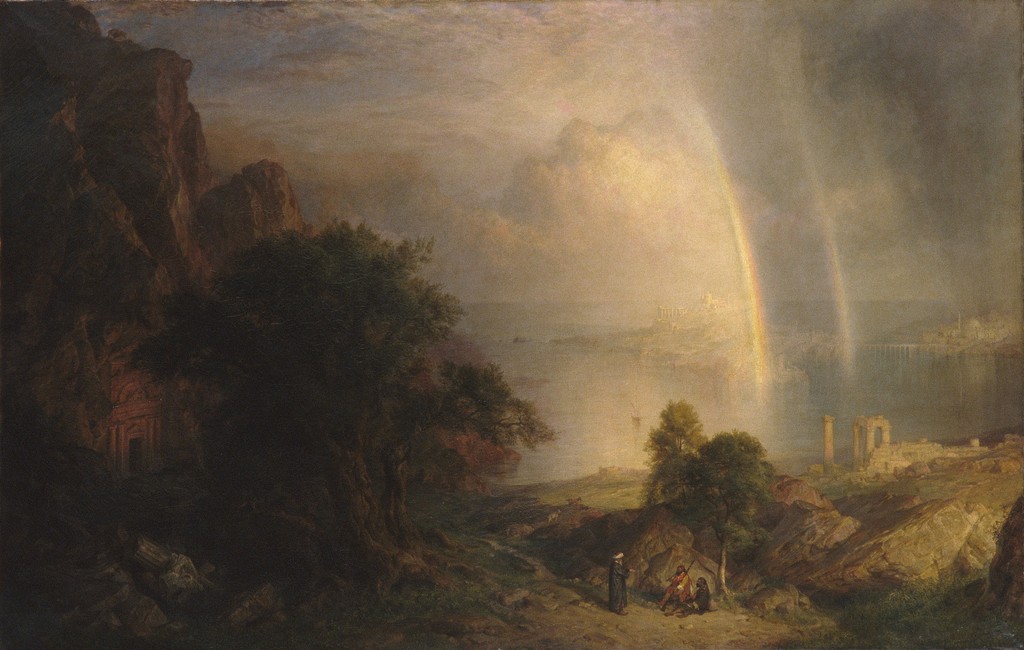
1871The Aegean Sea
About 1877Contents
- Entering the scene from the riverbank
- Palms, climbing growth and small birds
- The sun and its reflection
- Earlier studies and a later studio painting
- A closer view than The Heart of the Andes
- A comparison with Martin Johnson Heade
- Comparing the river with a modern photograph
- Birds, the canoeist and the journey into mist
- Paint layers and the 1988 conservation treatment
- Annotated details
Entering the scene from the riverbank
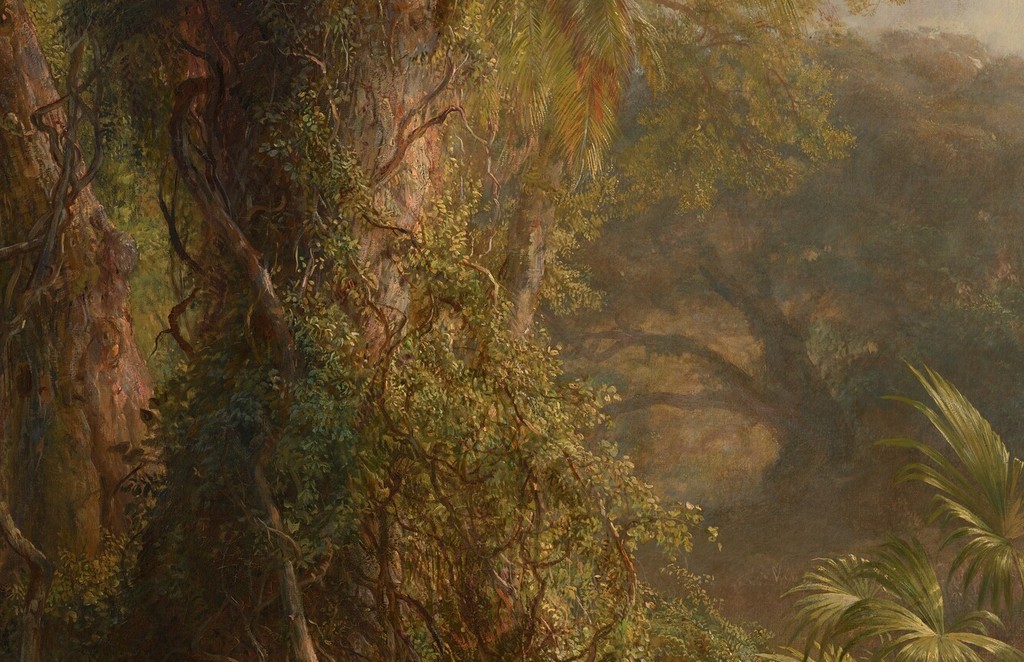
The nearest part of the painting is heavily wooded. A substantial trunk rises on the left, surrounded by climbing growth and smaller branches. Its canopy extends across the upper edge, setting a dark, irregular boundary above the brighter sky.
A fallen trunk crosses the lower foreground diagonally. Plants accumulate around it, with broad leaves near the bottom left and more delicate stems reaching toward the water. The direction of the fallen wood carries the eye away from the edge of the canvas and into the scene.
On the opposite bank, trees gather in a more distant group. Their crowns and branches remain distinct in places, but light and haze reduce their contrast as the river recedes. Church presents the foreground as a place close enough to inspect, while leaving the farther course of the water increasingly uncertain.
Annotated Details from El Rio de Luz
The numbered points draw attention to visible features discussed in this article. Look from each detail back to the full composition. Frederic Edwin Church, El Rio de Luz (The River of Light), 1877, oil on canvas, 138.1 × 213.7 cm. National Gallery of Art, Washington, Gift of the Avalon Foundation, 1965.14.1. NGA Open Access, CC0. Source image. CC0 / NGA Open Access. Numbered overview resized; detail crops added from the source master. No recolouring.
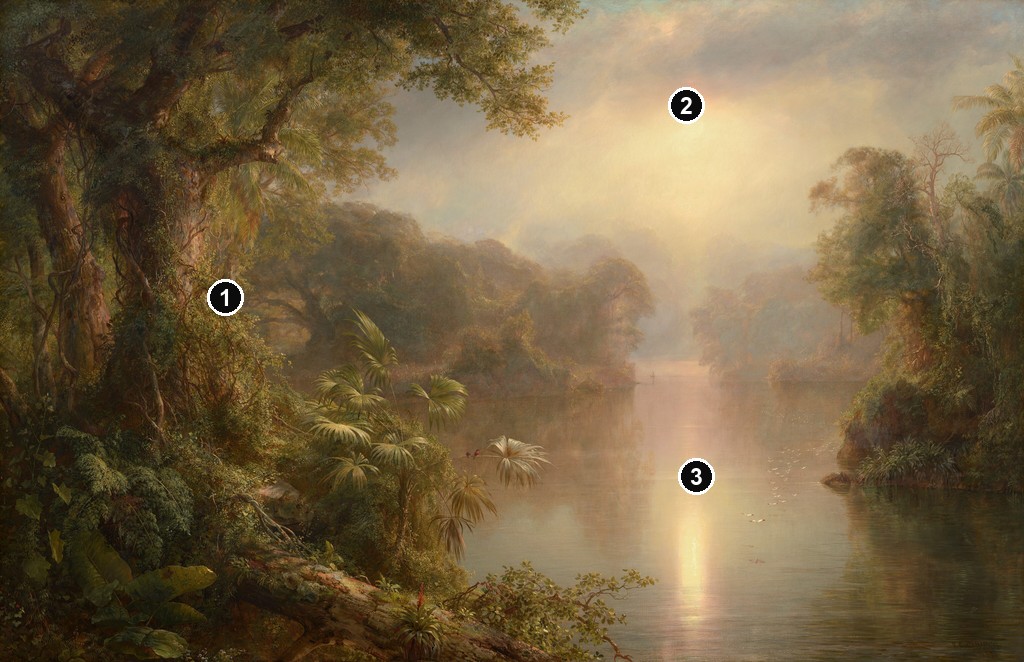
Details from EL RIO DE LUZ
These crops come directly from the verified source images. They preserve the original colours or printed tones; the numbered overview is a separate aid to looking.
Near canopy
Dense foliage and a large trunk shelter the near riverbank. Their varied dark forms contrast with the quieter opening beyond.
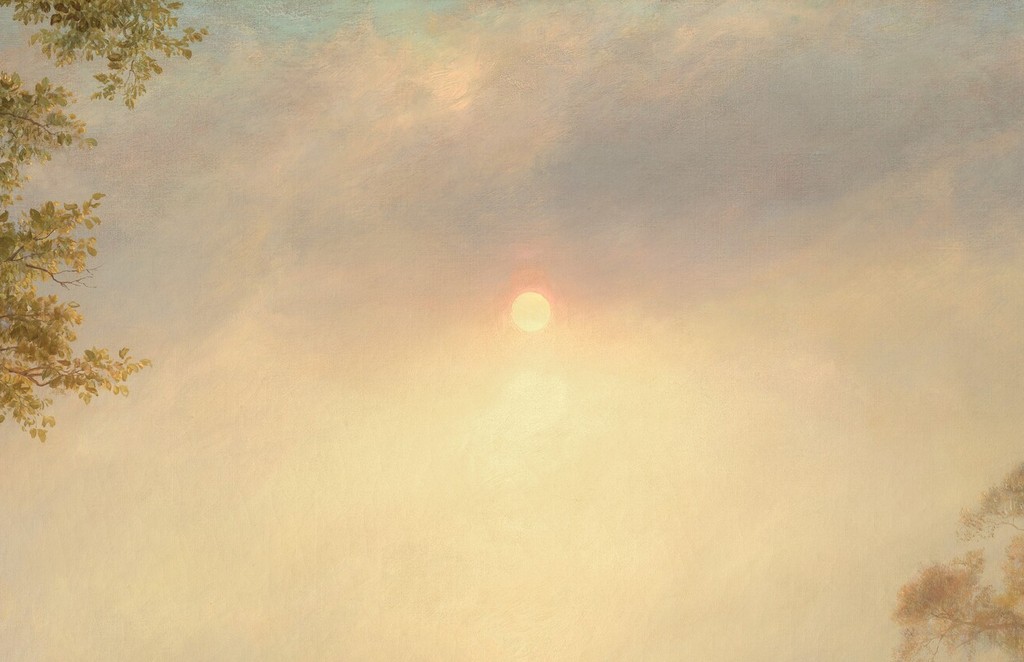
Sun through mist
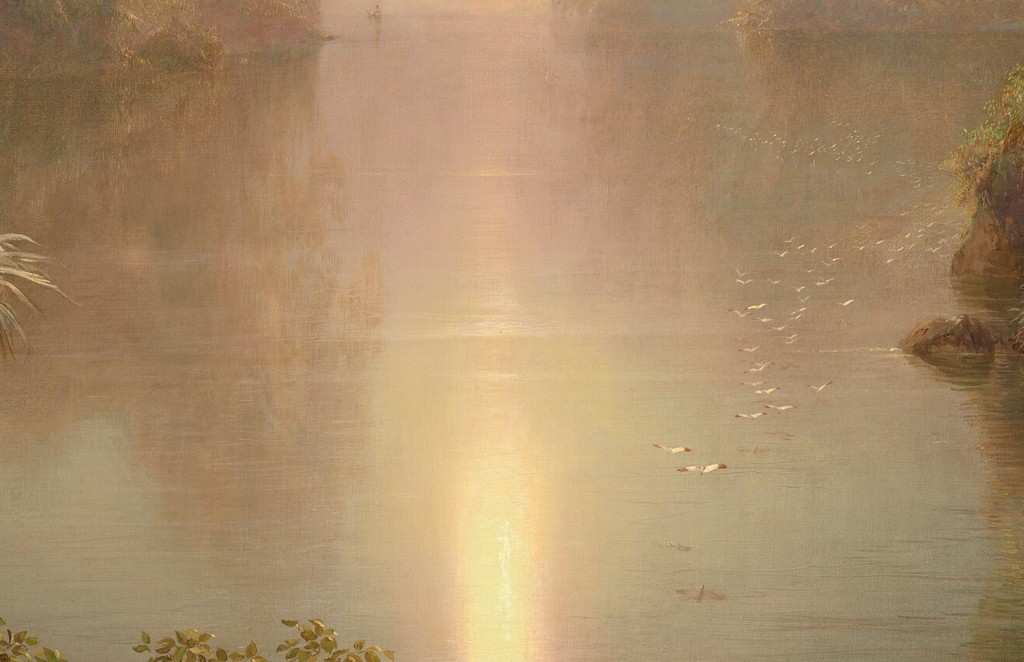
A pale sun appears through an atmospheric veil. Its soft boundary differs from the sharper vegetation nearby.
Vertical reflection
The sun’s reflection draws a bright vertical route across the river. Its narrow glow helps connect the distance to the foreground water.
Palms, climbing growth and small birds
The vegetation varies in both shape and texture. Palm fronds spread from slender stems beside the river. Some catch pale light across their upper surfaces; others turn downward into shadow. Behind them, finer growth hangs across the large tree and breaks up the heavier outlines of branches.
This range prevents the forest from becoming a uniform green screen. A broad leaf, a narrow frond and a branching stem each occupy the space differently. Church gives enough detail to distinguish their structures, then allows more distant plants to merge into larger masses.
Two small birds with bright red breasts perch on a curved stem near the palms. Their colour is unusually concentrated within the surrounding brown and green. They are a compact point of interest rather than the principal subject: the river and the glow beyond it continue to organise the larger composition.
Farther to the right, a loose line of pale birds passes low over the water. Their separated forms make a curve that can be followed toward the bank. Near and distant birds therefore offer different measures of scale within the same landscape.
The sun and its reflection
The sun appears as a small, pale disk in the upper middle-right. Around it, warmer light spreads through a much broader area of sky. The disk itself has a comparatively definite edge, while the surrounding glow merges gradually with softer cloud and haze.
Its reflection extends down the river toward the lower edge. The brightest passage is broken by small horizontal interruptions, giving it the appearance of light on a surface rather than a solid painted column. Darker water to either side makes that vertical brightness conspicuous.
The two directions of the water work together. The river leads away into depth, between successive banks, while the reflection runs toward the viewer across its surface. Church links the distant source of light with the nearest water without making every intervening form equally clear.
The hazy opening remains the most elusive part of the view. Tree shapes become paler and less distinct as they approach it, and the division between water and air grows harder to locate. That loss of definition is central to the painting’s sense of distance.
Earlier studies and a later studio painting
Church completed the canvas about twenty years after his last South American journey. Franklin Kelly’s entry in the National Gallery’s 1996 systematic catalogue explains that he drew on the drawings and oil sketches accumulated during his visits of 1853 and 1857, as well as his memory of the region.[2]
The interval separates the painting from the immediate circumstances of travel. Observations gathered outdoors could remain available long afterwards, allowing individual plants, riverbanks and atmospheric effects to be brought into a new arrangement. The finished scene need not correspond to a single sketch or one exact location.
Kelly describes the landscape as a composed tropical river rather than a securely identified view of the Amazon. That distinction suits the image: it offers convincing particulars, but those particulars do not provide a reliable address for the whole scene. Its coherence rests on their arrangement around the water and light.
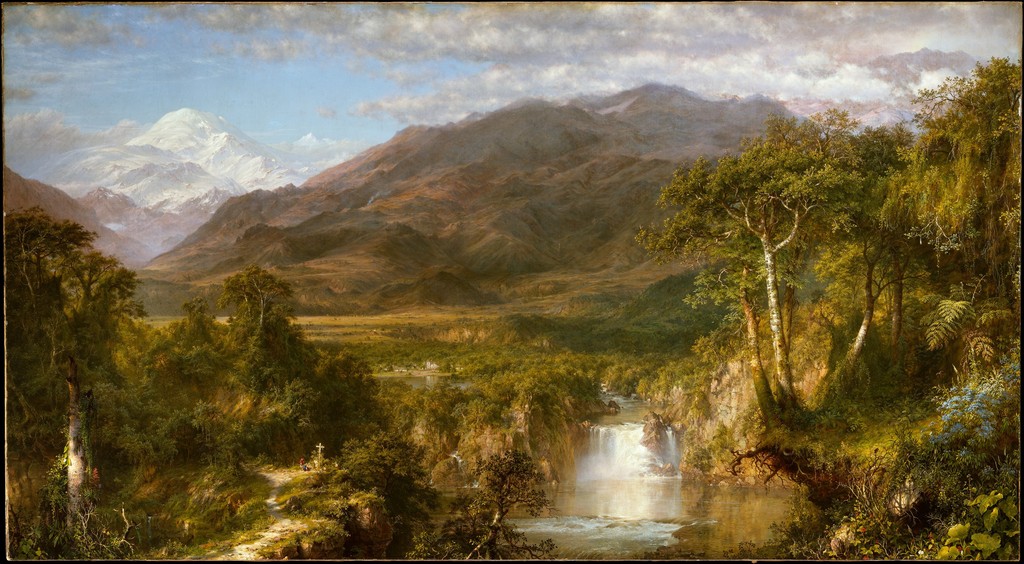
A closer view than The Heart of the Andes
In his 1989 Church catalogue essay, Kelly contrasts this geographically restricted river scene with the expansive panorama of The Heart of the Andes.[3] The comparison makes the later painting’s viewpoint especially clear.
In The Heart of the Andes, a large succession of landforms extends toward remote mountains. Here, vegetation presses much closer to the observer. The riverbanks offer a limited corridor through the forest, and the view narrows as it enters the mist.
Both paintings contain abundant detail, but they distribute it differently. In El Rio de Luz, attention repeatedly returns to the water’s opening, the small sun and its reflection. The near trunk, palms and birds remain connected to that central passage rather than competing with a vast range of distant terrain.
The difference is therefore about spatial organisation as well as subject. Church retains the large canvas and careful observation while bringing the implied position of the viewer closer to the riverbank.
A comparison with Martin Johnson Heade
Kelly also discusses Martin Johnson Heade’s South American River, painted in 1868, as a possible source of inspiration for Church’s later work. The suggestion originated with Theodore Stebbins.[3] It is a scholarly comparison, rather than proof that Church copied the earlier painting.
Heade’s vertical composition, reproduced in the catalogue, also looks into a tropical river bordered by dense vegetation. Its narrower format carries the eye between the banks, while Church spreads the foreground and open water across a broad horizontal canvas.
The comparison helps distinguish a shared subject from an identical design. A river, plants and a boat can be arranged to produce substantially different proportions and relationships. Church gives the sky and reflected sunlight considerable room within his version, making them inseparable from the route into depth.
Comparing the river with a modern photograph
SabineDeviche’s photograph of the Napo River near Coca, Ecuador, was taken from a boat on 19 December 2014.[4] Its low position offers a useful comparison with Church’s implied viewpoint beside the water.
The photograph shows forested banks beneath a broad blue sky and large white clouds. Ripples occupy much of the foreground, and an opening appears between the banks on the left. The view leads across open water toward the trees and the bend beyond them.
Church encloses his scene more closely. Nearby trunks and leaves partly surround the observer, while haze conceals the river’s continuation. His restricted colours also bring water, vegetation and sky into a closer relationship than the photograph’s pronounced contrast between blue and green.
These differences reveal choices in the painting’s organisation. The photograph documents a modern view from its own location and conditions. It is neither a record of Church’s source material nor an identification of the particular river he intended. Its value lies in making the low viewpoint, banks and changing visibility easier to compare.
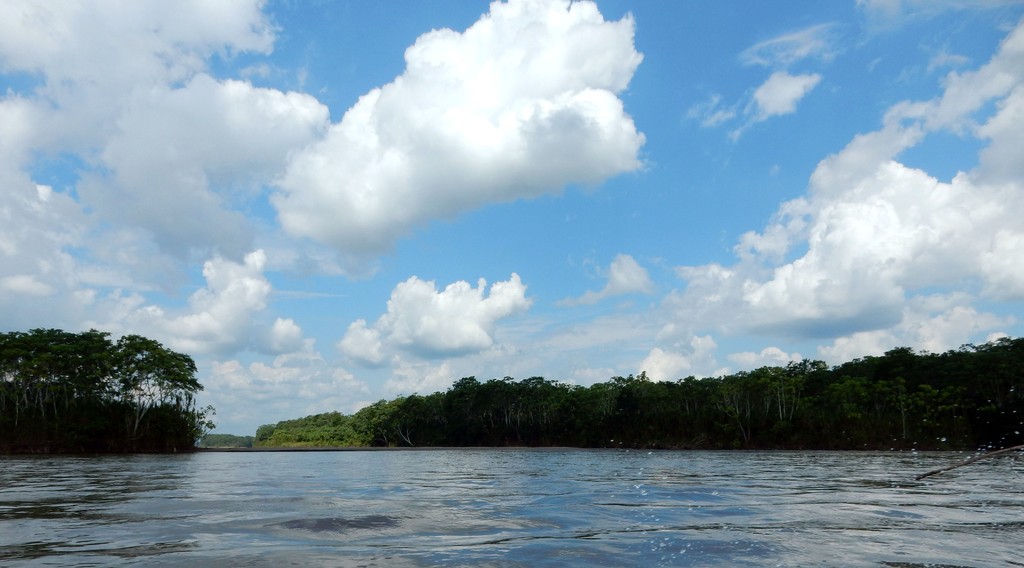
Napo River near Coca, Ecuador, viewed from a boat, 19 December 2014. Photograph by SabineDeviche, CC BY-SA 4.0 International. A modern comparison of riverbanks and viewpoint, not the precise scene painted by Church. SabineDeviche / Wikimedia Commons, CC BY-SA 4.0 International. Image source. CC BY-SA 4.0 International. Resized; full source proportions retained.
Watch: Frederic Edwin Church
Choose a film to explore the artist’s work, its interpretation and its wider setting.
Frederic Edwin Church's "The Icebergs" on the Move at the DMA
Follow the Dallas Museum of Art as it moves Church’s large painting The Icebergs.
Watch on YouTubeBirds, the canoeist and the journey into mist
A minute canoeist appears in the distant river. The figure is much less conspicuous than the red-breasted birds near the foreground, and becomes apparent only after the broader arrangement of water and light has been established. Its position supplies a human scale for a distance otherwise dominated by trees and atmosphere.
The pale birds bring another kind of movement into that space. Their line arcs across the water instead of following the straight vertical emphasis of the sun’s reflection. The canoeist and the birds offer different paths through the scene while remaining small within it.
Kelly interprets these forms in relation to a journey beyond the visible world and compares the painting with Old Age, the final scene in Thomas Cole’s The Voyage of Life.[3] In that reading, the water and light carry meanings beyond their physical appearance.
The comparison belongs to the history of interpreting the painting. Neither the small figure nor the birds establish one unavoidable message. They can also be examined as carefully placed forms that interrupt the river’s surface and give the uncertain distance a living presence.
Paint layers and the 1988 conservation treatment
The National Gallery’s published technical notes describe generally thin paint, with dark passages built through glazes, or thin translucent layers. Thicker highlights include some impasto, where paint stands above the surrounding surface. The notes also record the removal of discoloured varnish in 1988.[2]
The treatment removed earlier restoration paint from trees in the central middle distance. Beneath it were pentimenti, traces of an earlier stage of the composition, associated with Church’s brushed underpaint; these were subsequently inpainted to reduce their visual disruption. The account concerns previous inpainting and underlying revisions, rather than the removal of original trees from the landscape.
That distinction matters when describing the picture’s surface. A conservation record can reveal how a composition was laid out and how later restoration affected its appearance. It does not make every present transition of tone evidence of a documented alteration. The published treatment history should be read alongside the finished image, with its particular limits intact.
Titles and early exhibitions
The painting has circulated under several closely related titles. The National Gallery records its appearance at New York’s Century Association in 1877 as A Tropical Morning. At the Paris international exposition in 1878, it was listed as Le matin sous les tropiques; the Metropolitan Museum’s 1880 loan exhibition called it The River of Light.[1]
Kelly’s later catalogue notes that the Spanish title El Rio de Luz also appeared in an 1877 newspaper reference.[2] The English river title therefore should not be described simply as an invention of the 1880 exhibition.
Each name places a slightly different emphasis on the same scene. The morning titles identify a time and climatic setting. The River of Light draws attention to the continuity between the water, its reflection and the glowing air. Those emphases help explain why both morning and river names remain useful when discussing the painting.
Ownership and the National Gallery
The museum’s provenance begins with William Earl Dodge, Jr., then traces the painting through members of the Dodge family to Diana Dodge Ryan. In 1965 it was given to the Preservation Society of Newport County, Rhode Island. The National Gallery purchased it on 9 December of that year, with the collection credit recorded as Gift of the Avalon Foundation.[1]
The documented sequence establishes its path into the museum without supplying a purchase price or requiring assumptions about an intermediary’s role in the original commission. Its overall dimensions, 138.1 × 213.7 cm, also distinguish the painted canvas from the larger measurements that include the frame.
At that scale, the near plants can be considered individually while the little canoeist remains remote. The picture’s broad effect depends on holding those different distances together: substantial trunks and fallen wood at the edge, palms and birds above the bank, then water continuing into light that leaves its farther course unseen.
Artworks directory
A documented selection of Church’s works discussed across these articles, together with identified prints after his designs. This is not a catalogue raisonné. Repeated titles and aliases are reconciled; studies remain distinct from finished paintings. Some dates remain unconfirmed. Other makers are named where a print adapts Church’s work.
| Name | Date | Medium |
|---|---|---|
| Above the Clouds at Sunrise | 1849 | Oil on canvas |
| The Aegean Sea | About 1877 | Oil on canvas |
| The Andes of Ecuador | 1855 | Oil on canvas |
| Aurora Borealis | 1865 | Oil on canvas |
| Autumn in North America | Circa 1856 | Oil on board |
| Coast Scene | 1852 | Oil on canvas |
| Cotopaxi | 1862 | Oil on canvas |
| A Country Home | 1854 | Oil on canvas |
| El Khasné, Petra | 1874 | Oil on canvas |
| El Rio de Luz | 1877 | Oil on canvas |
| The Heart of the Andes | 1859 | Oil on canvas |
| The Icebergs | 1861; foreground mast added between mid-1862 and early 1863 | Oil on canvas |
| Jerusalem from the Mount of Olives | 1870 | Oil on canvas |
| Mount Ktaadn | 1853 | Oil on canvas |
| Our Banner in the Sky | 1861 | Oil paint over lithograph on paper, laid down on cardboard |
| The Parthenon | 1871 | Oil on canvas |
| Rainy Season in the Tropics | 1866 | Oil on canvas |
| Storm in the Mountains | 1847 | Oil on canvas |
| Syria by the Sea | 1873 | Oil on canvas |
| Tamaca Palms | 1854 | Oil on canvas |
| Tropical Scenery | 1873 | Oil on canvas |
| Twilight in the Tropics | 1874; signed and dated, according to Bonhams’ catalogue | Oil on canvas |
| Twilight in the Wilderness | 1860 | Oil on canvas |
| View of Cotopaxi | 1857 | Oil on canvas |
| Niagara | 1857 | Oil on canvas |
| Magdalena River, New Granada, Equador | 1853 | Graphite heightened with white on wove paper |
| Tamaca Palm, Colombia or Ecuador | May–October 1853 | Graphite on gray laid paper |
| Mixed Sketches with a Champan, Río Magdalena, Colombia | May 1853 | Graphite on gray laid paper |
| Study for Rainy Season in the Tropics | 1865–1866 | Graphite on ruled notepad paper |
| Al-Khazneh, Petra (study) | February–March 1868 | Oil and graphite on tan paperboard |
| The Great Fall, Niagara (Charles Risdon, after Church) | 1874 impression | Hand-coloured chromolithograph on paperboard |
| The Heart of the Andes (William Forrest, after Church) | 1862 | Engraving in black on wove paper |
| Our Heaven Born Banner (William Bauly, adapting Church’s motif) | circa 1861 | Colour lithograph |
| A Tropical Moonlight (wood engraving after Church) | 1879 publication | Wood engraving in American Painters |
| Off Iceberg, Newfoundland | June 1859 | Oil and graphite on paperboard |
| Parthenon at Night, Athens | April 1869 | Oil and graphite on tan paperboard |
| Jerusalem from the Mount of Olives (study) | 1 April 1868 | Oil and graphite study |
| Horseshoe Falls (study) | December 1856–January 1857 | Oil on paper mounted to canvas |
| Niagara Falls, from the American Side | 1867 | Oil on canvas |
| Study for The Heart of the Andes | 1858 | Oil study |
| Mount Chimborazo through Rising Mist and Clouds | 1857 | Oil study |
| Cotopaxi Erupting, Viewed from Quito, Ecuador | June 1857 | Oil and graphite on tan paperboard |
| Cotopaxi (painted for Cyrus Field) | 1855 | Painting |
| Chimborazo | 1864 | Painting |
| Twilight, A Sketch | 1858 | Oil on canvas |
| View of Baalbek | 1868 | Oil and pencil on board |
| Three Bedouins | Date unconfirmed | Oil study |
| Coast Scene, Mount Desert (later canvas) | 1863 | Painting |
| The Wreck | Date unconfirmed | Painting |
| Grand Manan Island, Bay of Fundy | Date unconfirmed | Painting |
| Summer in South America | circa 1853 | Painting |
| Evening in Vermont | Date unconfirmed | Painting |
| Home by the Lake | Date unconfirmed | Painting |
| Storm in the Blue Mountains, Jamaica | August 1865 | Painting |
| The Natural Bridge, Virginia | 1852 | Painting |
| The Vale of St. Thomas, Jamaica | 1867 | Painting |
| Tequendama Falls, near Bogota, New Granada | Date unconfirmed | Painting |
| Sunrise in Syria | Before the 1876 exhibition | Painting |
| Cuernavaca (oil study; descriptive title) | 1898 | Oil study |
| Olana window design (descriptive title) | Date unconfirmed | Watercolour and graphite |
| Olana dining-room stencil sketch (descriptive title) | Date unconfirmed | Oil and graphite |
| Olana house (with Calvert Vaux) | 1870–1872; later additions | Architecture |
| Olana designed landscape | From 1860; developed over decades | Designed landscape |
Frequently Asked Questions
Church completed it in 1877, drawing on earlier South American sketches and observations.
It means The River of Light. The painting is also known as Morning in the Tropics and was exhibited in 1877 as A Tropical Morning.
The painting has been associated with the name The Amazon, but a specific river identification is uncertain. The National Gallery’s scholarly catalogue treats it as a composed tropical river scene.
It belongs to the National Gallery of Art in Washington, accession 1965.14.1, Gift of the Avalon Foundation.
The overall canvas measures 138.1 × 213.7 cm. The framed dimensions are larger.
Discoloured varnish and earlier restoration paint were removed. Underlying pentimenti were subsequently inpainted to reduce visual disruption. The published account does not say that original trees were removed.
Discussion
Look again at the images and ideas explored in El Rio de Luz. These editorial prompts invite your own observations.
Compare the near birds with the distant canoeist, then follow the sun’s reflection toward the foreground. How do these small forms and the broad passage of light establish different distances? In the modern photograph, which features make the river feel more open than Church’s enclosed view?
Reader Insights
Which plant or bird do you notice only after looking for a while?
How do the sun and its reflection organise the depth of the river view?
What do the earlier studies add to your understanding of this later painting?
Join the Conversation
Share a detail, comparison or question about El Rio de Luz below.
References
- National Gallery of Art, El Rio de Luz (The River of Light), 1965.14.1. Current object details, overall dimensions, signature, provenance and exhibition titles.
- Franklin Kelly, American Paintings of the Nineteenth Century, Part I, National Gallery of Art, 1996. Morning in the Tropics, pp. 63–68, including technical notes on p. 63 and title evidence in note 23. Earlier studies, composed location and historical conservation account; original correspondence and newspaper references not directly consulted.
- Franklin Kelly, Frederic Edwin Church, National Gallery of Art, 1989. Essay, pp. 67–68 and notes 170–174 on p. 75; catalogue 49, p. 125. Comparisons with the earlier panorama, Heade and Cole; interpretations attributed to the essay.
- SabineDeviche, Rio Napo by boat, 19 December 2014, Wikimedia Commons. Modern photograph near Coca, Ecuador; CC BY-SA 4.0 International. A comparison with another place and time, not Church’s exact viewpoint.
- Splash image source.
Frederic Edwin Church, El Rio de Luz (The River of Light), 1877. Oil on canvas, 138.1 × 213.7 cm. National Gallery of Art, Washington, Gift of the Avalon Foundation, 1965.14.1. CC0. Image source. CC0 / NGA Open Access. Resized; full source proportions retained.