


 Filippo Brunelleschi.jpg)
 by Tom Gurney
Tom Gurney BSc (Hons) is an art history expert with over 20 years experience
Published on June 19, 2020 / Updated on July 9, 2026
Email: tomgurney1@gmail.com / Phone: +44 7429 011000
Hospital of the Innocents by Filippo Brunelleschi: Introduction
The Hospital of the Innocents, or Ospedale degli Innocenti, is one of the clearest places to begin with Filippo Brunelleschi's architecture. It stands on Piazza Santissima Annunziata in Florence and was built for a social purpose: the care of abandoned children. That matters, because the building is not only an early Renaissance facade to admire from a distance. It is architecture made for a public institution, facing the city with a long, calm loggia of arches and columns. [1]
The project is closely associated with the Arte della Seta, Florence's silk guild, and with Brunelleschi's early architectural career. The Museo degli Innocenti dates the commission to 1419 and presents the building as a defining part of the institution's history. [1] The same museum history also anchors the social story: the hospital developed from a charitable mission, shaped by the legacy of Francesco Datini, and opened for the reception of children in the mid-15th century. [2]
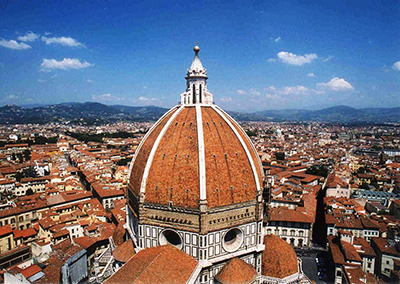
For readers used to thinking of Brunelleschi through the dome of Florence Cathedral, the Hospital of the Innocents gives a different kind of achievement. The dome is vast, technical and skyline-changing. The hospital is measured, civic and human in scale. Its importance lies in the way architecture, proportion and social care meet in public space.
At a Glance
- Architect: Filippo Brunelleschi
- Building: Hospital of the Innocents / Ospedale degli Innocenti
- Location: Piazza Santissima Annunziata, Florence
- Commission: associated with the Arte della Seta, with the project dated to 1419 by the Museo degli Innocenti
- Function: charitable institution and foundling hospital
- Key feature: long public loggia with repeated arches and columns
- Later visual identity: glazed terracotta infant roundels associated with Andrea della Robbia, added after Brunelleschi's original architectural phase
- Cluster role: flagship project page for Brunelleschi's civic architecture
Contents
- Why the Hospital of the Innocents Matters
- The Commission and Social Purpose
- Looking Carefully at the Facade
- Brunelleschi's Architectural Language
- Museum Perspective
- The Loggia and the City
- The Infant Roundels
- Comparison Works
- Things You Might Miss
- Interpretation
Why the Hospital of the Innocents Matters
The Hospital of the Innocents matters because it shows Brunelleschi applying architectural order to a civic institution. The building is not a palace built for private display or a church interior designed for liturgy. It is a public-facing charitable foundation. Its architecture had to give dignity, clarity and recognisable presence to an institution concerned with vulnerable children.
This is why the loggia is so important. A loggia is not simply decoration across the front of the building. It is a threshold between city and institution. The repeated arches create shelter, rhythm and a public face. The columns and bays make the facade readable from the square, while the horizontal line of the building gives the institution a calm visual order. [1]
The building is also important because it helps explain Brunelleschi's architectural language away from the drama of the cathedral dome. Here, the language is not about solving a huge engineering problem above a crossing. It is about measured repetition: arches, columns, proportional spacing, pale wall surfaces and stone detail. The effect is restrained, but not weak. It gives the institution authority without theatrical excess.
The Hospital of the Innocents also belongs to the history of Florence as a city of guilds, patronage and public identity. The Arte della Seta's role gives the project a civic and economic background, while the later museum preserves the memory of the children and families connected to the institution. [1] [2]
The Commission and Social Purpose
The building's social purpose should come before its style. In modern English, the word "hospital" can suggest a medical institution. In this context, the Ospedale degli Innocenti was a charitable institution associated with the care of abandoned children. The museum's history connects the foundation with a long charitable story and with the need to provide care for foundlings in Florence. [2]
That purpose changes how the architecture should be read. The loggia is public, welcoming and controlled. It does not hide the institution from the city. Instead, it creates a recognisable civic presence. The building announces that care is being organised, funded and given architectural form.
The commission is also a useful reminder that Brunelleschi did not work in isolation. The project depended on institutional patronage, guild support, builders, later administrators and later artists. The Museo degli Innocenti identifies the Arte della Seta as central to the commission and places Brunelleschi within that larger civic framework. [1]
This helps prevent a common simplification. Brunelleschi was not merely producing isolated masterpieces. He was working within the practical world of Florentine commissions. His architecture answered specific problems: how to span a cathedral crossing, how to give form to a sacristy, how to organise a church interior, and here, how to make a charitable institution visible and dignified within the city.
Looking Carefully at the Facade
The first thing to notice is the rhythm. The front of the Hospital of the Innocents is organised by a sequence of arches supported by slender columns. Each bay is easy to read, and the repetition gives the facade a calm visual pulse. The architecture does not depend on rich surface ornament for its main effect. Its power comes from order.
The second thing to notice is the relationship between the loggia and the square. The building does not simply present a flat wall. It offers a sheltered public edge. The arcade creates depth, shadow and movement between outside and inside. A visitor approaching the building experiences the facade as a sequence of openings, not just as an image.
The third thing to notice is the restraint. The forms are simple: round arches, columns, horizontal lines and regular spacing. This restraint is part of why the building has been so important in discussions of early Renaissance architecture. It makes proportion visible. The viewer can almost count the building as they look across it.
The fourth thing to notice is the later decorative layer. The famous infant roundels are visually memorable, but they should not be treated as Brunelleschi's original architectural invention. The Museo degli Innocenti connects those roundels with Andrea della Robbia and later additions to the building. [1] They became part of the building's identity, but the manuscript and HTML should keep the architectural design and later decorative history separate.
Brunelleschi's Architectural Language
The Hospital of the Innocents is a useful introduction to Brunelleschi's architectural language because it is so legible. The building teaches the eye to recognise repeated bays, round arches, classical columns, horizontal order and the disciplined use of space.
This is not the same kind of innovation as the Florence Cathedral Dome. The dome required engineering daring, machinery, structural judgement and the management of a vast construction problem. The hospital shows a different side of Brunelleschi: the ability to create a measured public architecture from a small number of repeated forms.
The repeated arches are particularly important. They create visual unity across the facade and make the building feel stable. The columns below them give the arcade a lightness that would be lost if the facade were treated as a heavy wall. The result is open but controlled.
The building also demonstrates the Renaissance interest in classical vocabulary, but that phrase can sound too abstract. On the facade, it means that columns, arches and proportional spacing are used to organise experience. The viewer does not need specialist language to feel the order. The building's clarity is visible from the square.
Museum Perspective
The modern Museo degli Innocenti makes this page especially strong because it preserves both the architectural and social history of the site. The building can be described as early Renaissance architecture, but the museum perspective keeps it attached to real lives: children received by the institution, civic charity, records, memory and the continuing interpretation of the site. [2]
That museum perspective is important for tone. A weak version of this page would treat the hospital only as a style milestone. A stronger version explains why style and purpose belong together. The architecture gives form to an institution of care. Its regularity, openness and dignity are not detached from the building's function.
The museum also helps with another problem: separating phases of the building. Visitors often remember the facade because of the infant roundels, but those roundels belong to the building's later visual history. [1] The page should welcome that memory without allowing it to confuse attribution.
The Loggia and the City
The loggia is the heart of the building's public effect. It creates a covered space along the front, turning the facade into a social and architectural edge. It is open to the square, but it also marks the institution as separate and ordered.
This in-between quality is central to the building. The hospital served children and families whose lives were shaped by vulnerability, secrecy, poverty or crisis. The architecture did not need to dramatise those stories. Instead, it gave the institution a stable civic form. The loggia made the hospital visible without making it harsh.
Because the building faces Piazza Santissima Annunziata, its architecture also participates in a larger urban setting. The square matters because the hospital's facade is not designed for a private courtyard. It is meant to be seen as part of the city. This makes the project an ideal page for explaining Brunelleschi's civic architecture.
The Infant Roundels
The infant roundels are among the building's best-known visual details, but they require careful handling. They are later decorative elements associated with Andrea della Robbia, not the core of Brunelleschi's original architectural design. [1]
That distinction does not make them unimportant. The roundels helped shape the building's later identity and made its social function visible in a direct, memorable way. They show infants wrapped in swaddling bands, turning the institution's purpose into a recognisable emblem.
For the reader, the key point is sequence. First comes Brunelleschi's architectural order: loggia, arches, columns and proportional clarity. Then comes the later decorative identity of the hospital, which adds a more explicit image of childhood and care. Both matter, but they matter differently.
Comparison Works
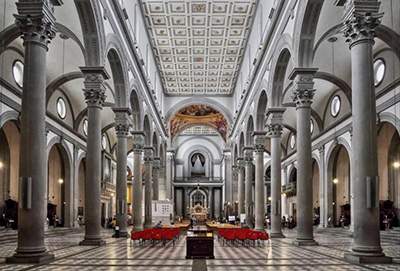
The closest comparison within the Brunelleschi cluster is San Lorenzo Basilica. Both buildings use repeated architectural elements to create order, but they do so in different settings. San Lorenzo organises a church interior. The Hospital of the Innocents organises a public charitable facade. [3]
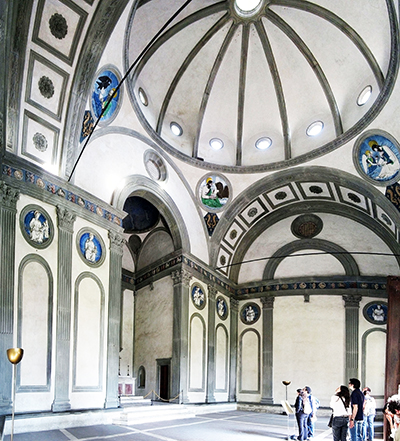
The Old Sacristy of San Lorenzo offers a more concentrated comparison. There, Brunelleschi's interest in geometry appears in a smaller sacred space. At the hospital, the same desire for clarity is stretched across a civic frontage.
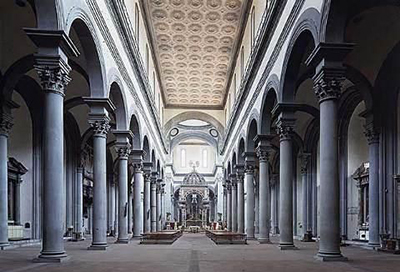
The Church of Santo Spirito is useful as a later comparison because it shows Brunelleschi's spatial rhythm at a larger interior scale. Its repeated bays and calm order can help readers understand that the hospital's facade is part of a wider architectural mind, not an isolated experiment. [4]
The Florence Cathedral Dome is the dramatic opposite. The dome is a massive engineering and civic landmark. The hospital is lower, calmer and more socially intimate. Together, they show why Brunelleschi cannot be reduced to one achievement. [5]
Things You Might Miss
The building's simplicity is not a lack of ambition. Its restraint is part of its intelligence.
The loggia is a public threshold, not merely a decorative arcade.
The hospital's social purpose is essential to its meaning.
The infant roundels are later additions and should not be credited to Brunelleschi's original design.
The building helps explain Brunelleschi as a civic architect, not only as the engineer of the cathedral dome.
Interpretation
The Hospital of the Innocents should be read as a meeting point between architecture and social responsibility. Brunelleschi's design gave the institution a dignified public language: ordered, open, measured and easy to understand from the square.
Its importance does not depend on dramatic decoration. The building's achievement is quieter. It shows how repeated forms can make a public institution feel coherent. It uses architectural clarity to serve civic identity.
This is why the page deserves flagship treatment in the Brunelleschi cluster. The hospital reveals an aspect of the Renaissance that is sometimes overshadowed by grand domes, heroic artists and courtly patronage. It shows architecture working in the life of the city, giving shape to care, administration and public trust.
FAQs
The Hospital of the Innocents, or Ospedale degli Innocenti, was a Florentine charitable institution associated with the care of abandoned children. Its modern museum preserves and interprets both the building and the institution's social history. [2]
The building is closely associated with Filippo Brunelleschi, and the Museo degli Innocenti presents the 1419 commission in connection with his role and the Arte della Seta. [1] As with many early Renaissance buildings, later additions and modifications should be separated from the original architectural phase.
It is important because it combines early Renaissance architectural order with a public charitable function. The loggia, repeated arches and proportional clarity made the institution visible and dignified within the city.
No. The infant roundels are later decorative additions associated with Andrea della Robbia. They are central to the building's later visual identity, but they should not be treated as part of Brunelleschi's original architectural design. [1]
The Hospital of the Innocents stands on Piazza Santissima Annunziata in Florence. Its location matters because the building's loggia works as a public architectural edge facing the square.
Discussion
The Hospital of the Innocents shows architecture serving a public institution. What changes when Renaissance design is read through care, charity and civic responsibility?
Reader Insights
The building's power lies in the way a calm loggia gives dignity and order to a social mission, not just in its formal beauty.
Can a building be both socially useful and artistically revolutionary? The hospital is one of the strongest Brunelleschi examples for that question.
Join the Conversation
Have a thought or observation about Hospital of the Innocents? Share it below. Thoughtful responses may be added to this section.
References
- Museo degli Innocenti, Architettura, https://www.museodeglinnocenti.it/museo/percorsi-espositivi/architettura/ (in Italian).
- Museo degli Innocenti, Storia, https://www.museodeglinnocenti.it/museo/storia/ (in Italian).
- San Lorenzo Firenze, La Basilica di San Lorenzo, https://sanlorenzofirenze.it/la-basilica-di-san-lorenzo/ (in Italian).
- Basilica di Santo Spirito, Architecture of the Basilica of Santo Spirito, https://www.basilicasantospirito.it/en/the-basilica/architecture-of-the-basilica-of-santo-spirito/.
- Opera di Santa Maria del Fiore, Brunelleschi e la genesi di un capolavoro, https://duomo.firenze.it/it/opera-magazine/post/4743/brunelleschi-e-la-genesi-di-un-capolavoro (in Italian).
 Filippo Brunelleschi.jpg)
 Filippo Brunelleschi.jpg)