


 by Tom Gurney
Tom Gurney BSc (Hons) is an art history expert with over 20 years experience
Published on June 19, 2020 / Updated on July 9, 2026
Email: tomgurney1@gmail.com / Phone: +44 7429 011000
Church of Santo Spirito by Filippo Brunelleschi: Introduction
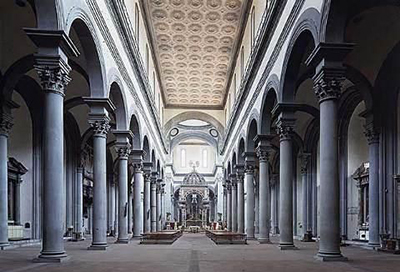
The Church of Santo Spirito in Florence is one of the most important places to understand Filippo Brunelleschi's later architectural thinking. It is a church of rhythm, proportion and interior clarity. Unlike the dome of Florence Cathedral, which commands the city from above, Santo Spirito works through the experience of moving through ordered space.
The official Santo Spirito architecture page presents the basilica through Brunelleschi's architectural language of proportion, rhythm and light. [1] Its history page also makes clear that the building's story continued after Brunelleschi's death in 1446. [2] That combination is essential: Santo Spirito is both a Brunelleschi project and a building with a longer construction history.
This makes the page especially useful for readers. It shows Brunelleschi's architecture as a system of space rather than a single monument. The church's importance lies in its interior order: repeated forms, clear movement, controlled light and a sense of calm progression.
At a Glance
- Architect: Filippo Brunelleschi, with later/posthumous construction history
- Building: Basilica / Church of Santo Spirito
- Location: Florence
- Type: church
- Key architectural interest: rhythm, proportion, light, repeated chapels and bays
- Related Brunelleschi comparison: San Lorenzo Basilica
- Editorial caution: separate Brunelleschi's design role from later execution and changes
Contents
- Why Santo Spirito Matters
- Looking Carefully
- Brunelleschi and Posthumous Construction
- Rhythm and Proportion
- Light and Space
- Comparison with San Lorenzo
- Comparison with the Hospital of the Innocents
- Comparison with the Cathedral Dome
- Things You Might Miss
- Interpretation
Why Santo Spirito Matters
Santo Spirito matters because it shows Brunelleschi's architectural language at a broad interior scale. The building is not famous because of a single external image. Its power is spatial. The viewer understands it by entering, looking, moving and sensing repetition.
The official architecture page emphasises rhythm, proportion and light, which are the best starting points for interpretation. [1] These are not decorative extras. They are the architecture itself. The church is organised so that the parts relate to each other clearly.
Santo Spirito also matters because it complicates the idea of architectural authorship. The history page places construction in a sequence that extends beyond Brunelleschi's lifetime. [2] The building needs both sides of that story: the design importance and the later history.
Looking Carefully
The first thing to notice is the rhythm. Santo Spirito is experienced through repeated architectural units. Arches, columns, bays and chapels create a sequence that the eye can follow.
The second thing to notice is the light. The official architecture page treats light as part of the building's spatial effect. [1] Light helps the interior feel legible rather than dense.
The third thing to notice is the calmness of the order. The church does not depend on dramatic interruption. Its architecture builds meaning through repetition and proportion.
The fourth thing to notice is the difference between exterior and interior. Santo Spirito's importance is not best captured by a facade alone. The heart of the building is spatial experience inside.
Brunelleschi and Posthumous Construction
Santo Spirito is a good reminder that architecture is not always completed neatly within an architect's lifetime. The official history notes Brunelleschi's death in 1446 and the continuation of the building's story. [2]
This matters because the page must avoid two opposite mistakes. One mistake is to deny Brunelleschi's importance because the building continued later. The other is to write as if every visible element were completed directly by him. The stronger interpretation sits between those extremes.
Brunelleschi's importance lies in the architectural concept and language associated with the project. Later execution and change belong to the building's history. Both are part of Santo Spirito's meaning.
Rhythm and Proportion
Rhythm is the key word for Santo Spirito. The interior is organised by repeated forms, and those repetitions create a sense of measured movement. A visitor does not simply see one grand object. They experience a sequence.
Proportion gives that sequence coherence. The bays and openings relate to one another, producing a sense that the building has an internal grammar. This is one of the great strengths of Brunelleschi's church architecture.
The comparison with music can be tempting, but the architectural point is simpler: repetition becomes order. The church creates calm because its parts are readable.
Light and Space
Light is not only an atmospheric effect at Santo Spirito. It helps reveal the order of the building. The official architecture page's emphasis on light is therefore important. [1]
In a building like Santo Spirito, light works with structure. It helps the viewer see arches, columns, bays and spatial depth. It gives the interior clarity.
This is why light is more than a vague symbol here. It is part of the architectural experience. It makes proportion visible.
Comparison with San Lorenzo
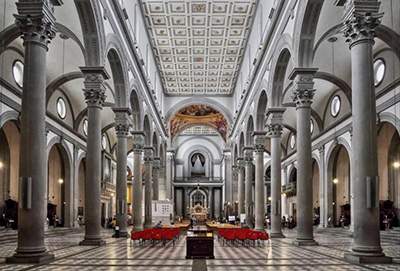
San Lorenzo is the natural comparison for Santo Spirito. Both churches are connected with Brunelleschi's architectural language, and both reveal his interest in repeated forms and ordered interiors. The San Lorenzo source connects that basilica's reconstruction with Brunelleschi's direction and later completion by Manetti. [3]
San Lorenzo can feel more compact and controlled, while Santo Spirito opens into a broader interior rhythm. The comparison helps readers understand Brunelleschi's church architecture as a family of related solutions rather than a single formula.
Both buildings also require careful attention to construction history. Renaissance architecture often emerges through design, patronage, building campaigns and later completion. That is part of the story, not an inconvenience.
Comparison with the Hospital of the Innocents
The Hospital of the Innocents offers a different kind of comparison. There, Brunelleschi's rhythm appears on a public civic facade. The Museo degli Innocenti connects the 1419 commission with the Arte della Seta and Brunelleschi's role. [4]
At Santo Spirito, rhythm becomes interior and processional. Instead of a loggia facing a square, the viewer encounters a church space shaped by repeated bays, light and movement.
The comparison shows Brunelleschi's flexibility. Similar architectural habits could serve a charitable institution, a basilica interior or a monumental cathedral project.
Comparison with the Cathedral Dome
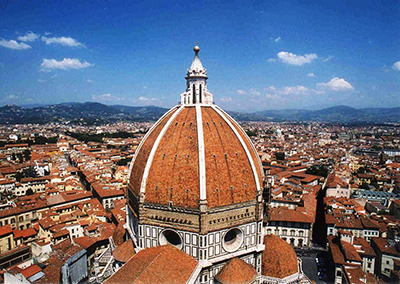
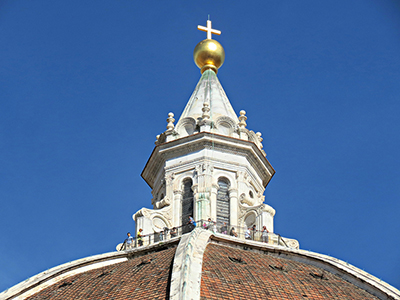
The dome of Florence Cathedral is the dramatic counterpoint to Santo Spirito. Opera di Santa Maria del Fiore presents the dome as a major technical and architectural solution, with features such as double-shell construction and herringbone brickwork. [5]
Santo Spirito does not compete with the dome in scale. Its importance is different. The dome changes the skyline; Santo Spirito shapes interior experience. The dome is a feat of construction and civic image; Santo Spirito is a lesson in rhythm, proportion and light.
Together, they show the range of Brunelleschi's architecture. He could think at the scale of the city and at the scale of the person moving through a church.
Things You Might Miss
Santo Spirito is strongest as an interior experience.
Its architecture depends on rhythm, proportion and light.
The building's history continued after Brunelleschi's death, so authorship needs careful wording.
San Lorenzo is the most useful comparison within the cluster.
The restrained exterior does not diminish the importance of the interior.
Interpretation
Santo Spirito is best interpreted as architecture of movement and clarity. It does not depend on one spectacular visual event. Its power unfolds through repeated forms and spatial order.
This makes it essential to the Brunelleschi cluster. The dome of Florence Cathedral shows his ability to solve a monumental construction problem. Santo Spirito shows how his architecture could shape a whole interior experience.
The church also gives a mature example of the Renaissance interest in proportion. It is not just an idea in a treatise. It is something the viewer can walk through.
FAQs
Santo Spirito is closely connected with Brunelleschi's architectural design, but the building history continued after his death in 1446. [2] The safest wording separates Brunelleschi's design role from later construction and changes.
Santo Spirito is important because it shows Brunelleschi's architecture through rhythm, proportion and light at a broad church-interior scale. [1]
Both churches show Brunelleschi's interest in ordered interiors and repeated architectural forms. San Lorenzo provides a useful comparison because it also connects Brunelleschi's direction with later completion history. [3]
Yes. The official history places the building's development in a sequence that continued after Brunelleschi's death in 1446. [2]
Discussion
Santo Spirito is often read through rhythm, proportion and light. What makes it feel different from San Lorenzo?
Reader Insights
Santo Spirito helps readers see that Brunelleschi's church architecture was not one formula repeated unchanged.
When you compare Santo Spirito with San Lorenzo, which space feels more successful as a complete architectural idea?
Join the Conversation
Have a thought or observation about Church of Santo Spirito? Share it below. Thoughtful responses may be added to this section.
References
- Basilica di Santo Spirito, Architecture of the Basilica of Santo Spirito, https://www.basilicasantospirito.it/en/the-basilica/architecture-of-the-basilica-of-santo-spirito/.
- Basilica di Santo Spirito, History, https://www.basilicasantospirito.it/en/the-basilica/history-of-the-basilica-of-santo-spirito/.
- San Lorenzo Firenze, La Basilica di San Lorenzo, https://sanlorenzofirenze.it/la-basilica-di-san-lorenzo/ (in Italian).
- Museo degli Innocenti, Architettura, https://www.museodeglinnocenti.it/museo/percorsi-espositivi/architettura/ (in Italian).
- Opera di Santa Maria del Fiore, Brunelleschi e la genesi di un capolavoro, https://duomo.firenze.it/it/opera-magazine/post/4743/brunelleschi-e-la-genesi-di-un-capolavoro (in Italian).
 Filippo Brunelleschi.jpg)
 Filippo Brunelleschi.jpg)
 Filippo Brunelleschi.jpg)