


 by Tom Gurney
Tom Gurney BSc (Hons) is an art history expert with over 20 years experience
Published on June 19, 2020 / Updated on July 9, 2026
Email: tomgurney1@gmail.com / Phone: +44 7429 011000
Filippo Brunelleschi Architecture: Introduction
Filippo Brunelleschi's architecture is best understood as a language of order. His buildings use repeated arches, columns, domes, measured bays and clear spatial sequences to make architecture feel legible. That clarity can appear at very different scales: the skyline of Florence Cathedral, the public loggia of the Hospital of the Innocents, the church interiors of San Lorenzo and Santo Spirito, or the more concentrated geometry of the Old Sacristy.
The danger with Brunelleschi is to reduce his architecture to a few famous labels: "Renaissance", "classical", "proportion" and "dome". Those words matter, but they can become too abstract. Brunelleschi's real importance lies in how those ideas were turned into buildings. He solved practical problems, gave institutions architectural form and made space feel ordered to the viewer.
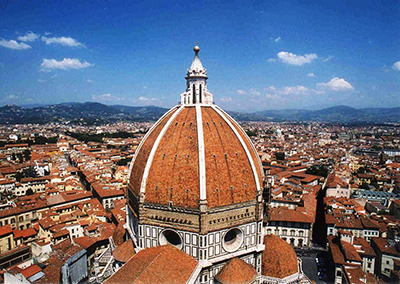
The dome of Florence Cathedral remains the most famous example. Opera di Santa Maria del Fiore presents it as a major architectural and technical solution, with features such as a double-shell structure and herringbone brickwork. [1] But Brunelleschi's architecture is not only about one vast dome. The Hospital of the Innocents, San Lorenzo and Santo Spirito show a quieter but equally important commitment to rhythm, proportion and civic space. [3] [4] [5]
At a Glance
- Architect: Filippo Brunelleschi
- Period: early Renaissance Florence
- Main architectural language: proportion, rhythm, round arches, columns, domes, measured space
- Best-known project: dome of Florence Cathedral
- Key civic project: Hospital of the Innocents
- Key church projects: San Lorenzo Basilica, Old Sacristy, Santo Spirito
- Cluster role: main works and architecture hub
- Editorial caution: separate design, execution, later additions and later attribution where needed
Contents
- What Defines Brunelleschi's Architecture?
- Florence Cathedral Dome
- The Hospital of the Innocents
- San Lorenzo Basilica
- Old Sacristy
- Santo Spirito
- The Lantern
- Brunelleschi's Architectural Language
- Major Projects
- Things You Might Miss
What Defines Brunelleschi's Architecture?
Brunelleschi's architecture is defined by clarity rather than spectacle. Even when the project is spectacular, as with the dome of Florence Cathedral, the deeper achievement lies in organisation. The building problem is made coherent. Structure, rhythm and visual form work together.
Across his work, repeated elements are especially important. Arches create sequence. Columns divide space into readable units. Domes concentrate geometry. Pale surfaces and darker stone lines help the eye understand how the parts relate. This is why Brunelleschi's buildings often feel calm even when they are ambitious.
His architecture also makes scale meaningful. The dome is vast and public. The Hospital of the Innocents is civic and social. San Lorenzo and Santo Spirito are interior and processional. The Old Sacristy is concentrated and geometric. Each project has a different task, but each uses order as a design principle.
That makes Brunelleschi a useful bridge between the practical and the intellectual sides of Renaissance architecture. His buildings are not merely theoretical demonstrations. They are places built for worship, care, movement, memory and civic identity.
Florence Cathedral Dome
The dome of Florence Cathedral is the essential starting point. It transformed the cathedral and the city skyline, but it also solved a problem that had to be answered through construction, not only through drawing.
Opera di Santa Maria del Fiore identifies the dome's double-shell structure and herringbone brickwork as important features of Brunelleschi's solution. [1] These technical details matter, but they should be understood as part of a wider architectural process. The dome required geometry, masonry, sequencing, organisation and confidence at an enormous scale.
The 1436 completion milestone gives the dome a secure chronological anchor. Opera di Santa Maria del Fiore marks 30 August 1436 in relation to the conclusion of the dome works. [2]
Architecturally, the dome shows Brunelleschi working as both designer and practical problem-solver. It is beautiful because it rises with force and clarity. It is historically important because that beauty had to be made buildable.
The Hospital of the Innocents
The Hospital of the Innocents is one of the clearest examples of Brunelleschi's civic architecture. The Museo degli Innocenti connects the 1419 commission with the Arte della Seta and Brunelleschi's role. [3]
The building's long loggia gives a charitable institution a public face. The repeated arches and columns create rhythm across the facade, while the sheltered arcade creates a threshold between the square and the institution.
This project is important because it shows that Brunelleschi's architecture was not only about technical daring. It could also create dignity through restraint. The hospital's purpose, associated with the care of abandoned children, gives the architecture a social and human dimension. [6]
The famous infant roundels should be handled carefully. The Museo degli Innocenti connects them with later additions and Andrea della Robbia, so they belong to the building's later visual identity rather than Brunelleschi's original architectural design. [3]
San Lorenzo Basilica
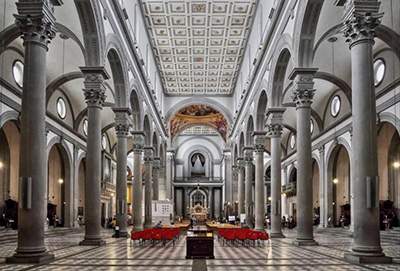
San Lorenzo shows Brunelleschi's architecture inside a church. The San Lorenzo source connects the basilica's reconstruction to Brunelleschi's direction and to later completion by Manetti. [4] That distinction matters because Renaissance buildings often have complicated histories of design, execution and later change.
The church interior helps readers understand rhythm. Columns, arches and bays create a measured sequence. The architecture does not overwhelm the eye with surface richness. It asks the viewer to notice proportion, repetition and spatial order.
San Lorenzo also connects Brunelleschi to the Medici and to the later history of Florentine architecture. But for this page, its main value is architectural: it shows how a church interior can be organised through clarity rather than dramatic display.
Old Sacristy
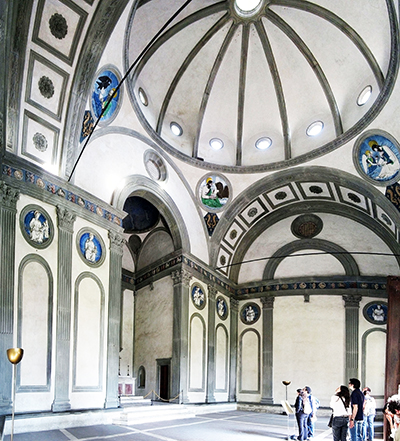
The Old Sacristy of San Lorenzo belongs closely with the basilica, but it deserves separate attention because of its concentrated geometry. The space brings together square, circle, dome and stone articulation in a compact sacred setting.
The Old Sacristy invites close looking because it shows Brunelleschi's architecture at a smaller scale. The dome here is not a city landmark. It is an ordering form inside an intimate architectural space.
The Old Sacristy also helps connect Brunelleschi to later developments at San Lorenzo. The site became one of the great architectural theatres of Florence, with later Medici and Michelangelo associations. Those later histories enrich the context, but they need to be separated from Brunelleschi's own architectural role.
Santo Spirito
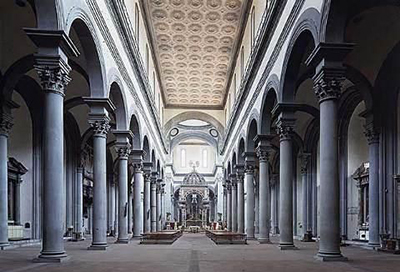
Santo Spirito gives another route into Brunelleschi's church architecture. Its official architecture page presents the basilica through rhythm, proportion and light. [5] Its history page also places the building in a sequence that continued after Brunelleschi's death in 1446. [7]
This makes Santo Spirito useful for understanding both Brunelleschi's vision and the complexity of architectural completion. A building can preserve an architect's design ideas while also reflecting later construction, modification and interpretation.
The interior's repeated forms are central. Santo Spirito teaches the same lesson as San Lorenzo at a different scale: architecture can create order through rhythm. The eye moves through the space by reading bays, arches and light.
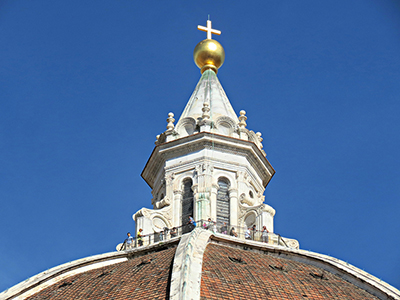
The Lantern
The lantern of Florence Cathedral is a smaller but important part of Brunelleschi's architectural story. Opera di Santa Maria del Fiore treats it as a dedicated subject, connected to the dome's continuation and completion. [8]
Visually, the lantern completes the dome's upward movement. It gives the profile a point of focus and helps the dome feel resolved. Historically, it reminds readers that the dome was not only one moment in 1436, but a larger architectural sequence.
The lantern therefore belongs close to the dome in any account of Brunelleschi's architecture, while still keeping its own identity. It is a completion element, a skyline detail and a way of seeing Brunelleschi's project continue above the main structure.
Brunelleschi's Architectural Language
Brunelleschi's architecture often uses a small vocabulary with great discipline. Round arches, columns, bays, domes and proportional relationships recur across different projects. The result is not repetition for its own sake, but a system for making space intelligible.
This is why his architecture can feel calm even when the stakes are high. The dome answers a huge structural challenge. The hospital addresses civic charity. The church interiors organise worship and movement. The architectural language changes with the function, but its commitment to order remains.
It is also why visual description matters. Brunelleschi's architecture becomes clearer when seen as sequence: one bay after another, one arch after another, one space leading into the next. His buildings reward looking slowly.
Major Projects
The main Brunelleschi architecture route begins with the projects where the evidence, visitor interest and architectural importance are strongest:
1. Florence Cathedral Dome 2. Hospital of the Innocents 3. San Lorenzo Basilica 4. Old Sacristy of San Lorenzo 5. Church of Santo Spirito 6. Florence Cathedral Lantern 7. Pazzi Chapel 8. St Mary of the Angels 9. Meeting Hall of the Palazzo di Parte Guelfa 10. Florence Cathedral Exedrae
The first six projects carry the clearest source support at this stage. The later specialist projects need careful evidence checks before they are treated as full standalone pages.
Things You Might Miss
Brunelleschi's architecture is not only about the cathedral dome.
The Hospital of the Innocents shows architecture serving a social institution.
San Lorenzo and Santo Spirito reveal rhythm and proportion at interior scale.
The Old Sacristy concentrates Brunelleschi's geometry in a smaller space.
The lantern is part of the dome's completion story.
Some projects require careful separation between design, later execution and later additions.
FAQs
Brunelleschi's architecture is defined by clarity, proportion, repeated forms and legible space. His buildings often use arches, columns, bays and domes to make structure and movement easy to read.
His most famous architectural achievement is the dome of Florence Cathedral, which Opera di Santa Maria del Fiore presents as a major technical and architectural solution. [1]
It shows Brunelleschi applying architectural order to a civic charitable institution. The Museo degli Innocenti connects the building with the Arte della Seta, the 1419 commission and the institution's wider history. [3]
Discussion
Brunelleschi's architecture can feel calm at first glance, but its discipline is active and deliberate. Which building best shows his language of order?
Reader Insights
The clearest pattern across the buildings is not decoration but rhythm: arches, columns, bays, domes and measured relationships that make space readable.
Do you find Brunelleschi's architectural clarity warm and humane, or strict and intellectual?
Join the Conversation
Have a thought or observation about Brunelleschi's Architecture? Share it below. Thoughtful responses may be added to this section.
References
- Opera di Santa Maria del Fiore, Brunelleschi e la genesi di un capolavoro, https://duomo.firenze.it/it/opera-magazine/post/4743/brunelleschi-e-la-genesi-di-un-capolavoro (in Italian).
- Opera di Santa Maria del Fiore, Il 30 agosto 1436 si concludevano i lavori della Cupola di Brunelleschi, https://duomo.firenze.it/it/opera-magazine/post/4649/il-30-agosto-1436-si-concludevano-i-lavori-della-cupola-di-brunelleschi (in Italian).
- Museo degli Innocenti, Architettura, https://www.museodeglinnocenti.it/museo/percorsi-espositivi/architettura/ (in Italian).
- San Lorenzo Firenze, La Basilica di San Lorenzo, https://sanlorenzofirenze.it/la-basilica-di-san-lorenzo/ (in Italian).
- Basilica di Santo Spirito, Architecture of the Basilica of Santo Spirito, https://www.basilicasantospirito.it/en/the-basilica/architecture-of-the-basilica-of-santo-spirito/.
- Museo degli Innocenti, Storia, https://www.museodeglinnocenti.it/museo/storia/ (in Italian).
- Basilica di Santo Spirito, History, https://www.basilicasantospirito.it/en/the-basilica/history-of-the-basilica-of-santo-spirito/.
- Opera di Santa Maria del Fiore, Una Lanterna per la Cupola del Duomo di Firenze, https://duomo.firenze.it/it/opera-magazine/post/4459/una-lanterna-per-la-cupola-del-duomo-di-firenze (in Italian).
 Filippo Brunelleschi.jpg)
 Filippo Brunelleschi.jpg)
 Filippo Brunelleschi.jpg)