



 by Tom Gurney
Tom Gurney BSc (Hons) is an art history expert with over 20 years experience
Published on June 19, 2020 / Updated on October 30, 2026
Email: tomgurney1@gmail.com / Phone: +44 7429 011000
Macbeth and the Witches: Introduction
Macbeth stands with his feet apart, his body enclosed in armour, while the world around him seems unable to hold its shape. Across a black cauldron, three witches reach towards him through a mesh of pale lines. Their gestures have direction and urgency; the space through which they move remains difficult to measure. In Eugène Delacroix’s Macbeth and the Witches, the king’s commanding stance meets an atmosphere that offers little security. The Metropolitan Museum of Art’s impression, titled Macbeth Consulting the Witches, is an 1825 lithograph, the third state of five. Its image measures 31.9 × 25.1 cm on a sheet measuring 50.2 × 35.2 cm.[1]
The confrontation occupies the lower part of the upright image. Above it, tangled light spreads across a broad dark field, giving the encounter an oppressive setting without defining a firm ceiling or distant wall. Macbeth may be the tallest figure, but he cannot command the whole space. Much of what surrounds his head belongs to the restless atmosphere shared by the witches. The print makes his physical solidity immediately apparent, then leaves us to consider how much protection that solidity affords.
At a Glance
- Date1825 [1]
- MediumLithograph; third state of five [1]
- DimensionsImage: 31.9 × 25.1 cm; sheet: 50.2 × 35.2 cm [1]
- Collection / recordThe Metropolitan Museum of Art; 22.63.19 [1]
This work across Eugène Delacroix’s career
Contents
- A king held in place
- Three witches, several directions of movement
- The cauldron scene and its words
- Light scraped out of darkness
- A different encounter in Hamlet
- Annotated details
A king held in place
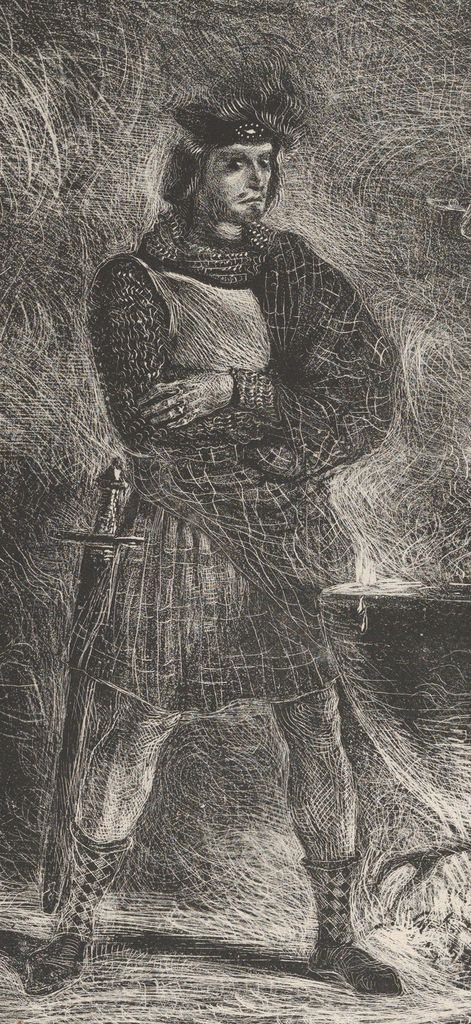
Macbeth’s pose has an almost ceremonial composure. One hand is drawn across his chest, the other rests at his hip; his legs remain separated and firmly planted. The crown, armour and sword establish his rank and martial presence. His torso faces substantially outwards, while his head turns towards the witches. That division matters. We can inspect the front of his body more readily than we can follow his attention into the space beside him. He is conspicuous, exposed to our scrutiny even as he confronts the figures on the right.
The armour gives the eye a structure to follow. Curved highlights describe the breastplate, smaller marks articulate the sleeves, and repeated lines organise the garment below his waist. The legs descend towards a relatively clear patch of ground. These details hold together as the equipment and clothing of a single body. Yet the surrounding pale strokes also seem to pass close around him, catching at his silhouette. Even the figure with the strongest stance participates in the image’s continual vibration.
His face is a small, bright interruption beneath the dark crown and hair. The turn of the head gives him a responsive presence, but the expression does not settle the encounter’s meaning. His stillness might suggest attention, resistance or arrested movement. The hands remain close to his own body rather than reaching across the cauldron. Delacroix places this contained posture against gestures that push insistently outwards, making the difference between the two sides legible before any expression has been interpreted.
Three witches, several directions of movement
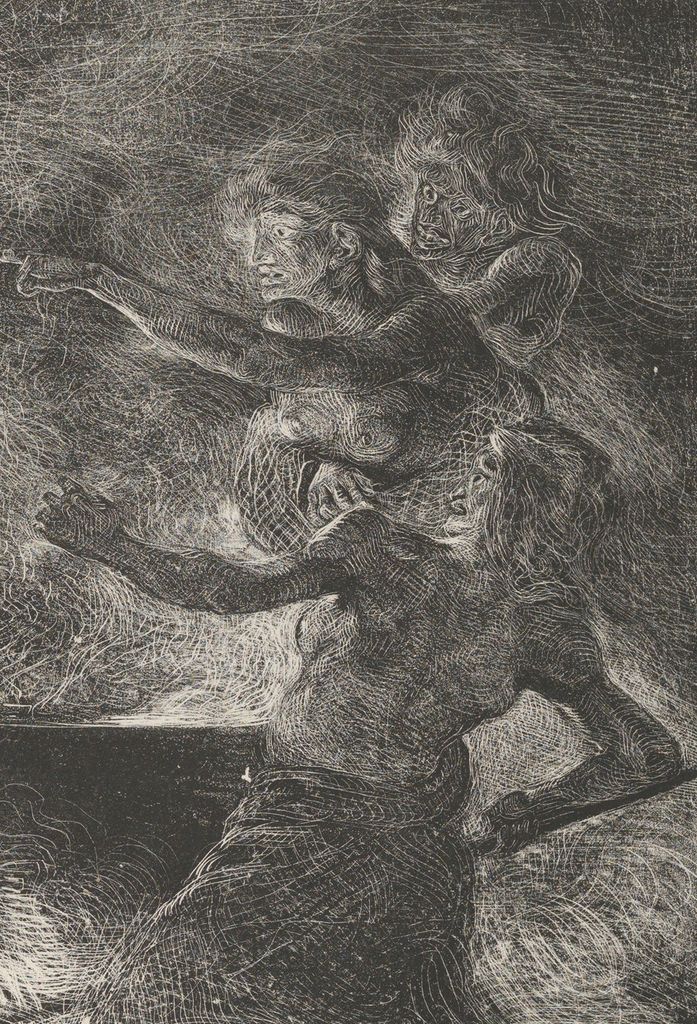
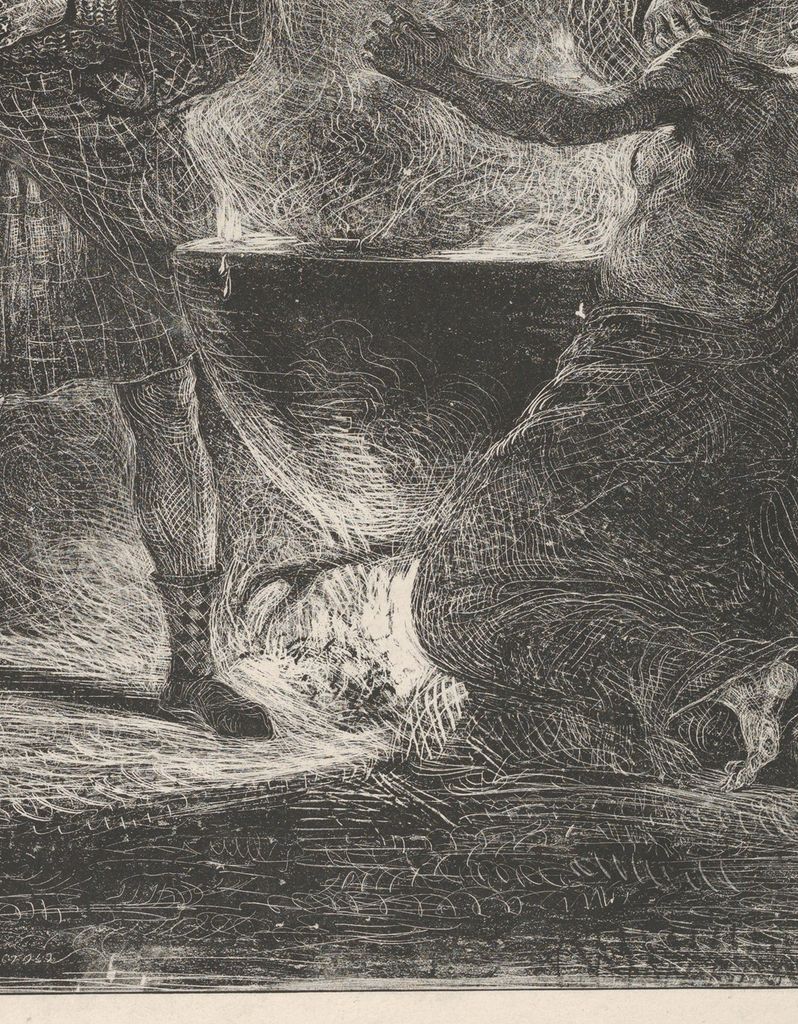
The witches form a compact group, but their bodies do not resolve into an orderly row. One occupies the foreground on the right, kneeling low, with her face turned towards Macbeth. Her bent body makes a large dark mass. Above it, the exposed neck, profile and extended forearm pick up the light. The arm runs almost horizontally towards the centre, so that a relatively small area of bare flesh carries a strong movement across the image.
Behind her, the other two heads rise towards the upper right. One witch extends an arm across the space above the cauldron, directing the eye leftwards towards Macbeth. The head behind her appears caught in wavering contours of hair and surrounding darkness. These overlapping forms create successive points of attention: the low forward face, the higher face near the reaching arm, and the head furthest back. Together they make the right side seem crowded and active, although much of each body remains dark.
Their agitation comes from more than emphatic gestures. Similar fine lines describe skin, hair, clothing and the vapour around them. A contour can be clear for a short distance and then become difficult to separate from the surrounding marks. The witches are recognisable figures, yet the way they emerge from the dark makes their relation to the atmosphere unstable. Macbeth has a largely continuous upright silhouette; their group expands into the space through pointing hands, projecting faces and streaming outlines.
Between the two sides, the cauldron is strikingly compact. Its broad dark bowl interrupts the bright turbulence at the centre. Light gathers along its rim and around the fire below, while rising curves carry the eye above it. The vessel both divides and connects the figures. It places a substantial obstacle between Macbeth and the witches, but the vapour rising from it fills the interval through which their gestures travel. The centre offers no clear, open passage from one side to the other.
Explore Delacroix on video
An artist overview and a closer look at Liberty Leading the People.
Eugene Delacroix Paintings
An overview of Delacroix’s paintings from TheHistoryOfArt.
Watch on YouTubeThe cauldron scene and its words
This is Macbeth’s second consultation with the witches, in Act 4, scene 1, rather than the earlier encounter on the heath. In the scene’s opening, the witches prepare and chant around the cauldron before Macbeth enters and demands answers, even at the cost of upheaval in the natural world. The cauldron refrain belongs to the witches.[8] That sequence gives force to the image’s encounter between an upright visitor and a group already absorbed in its own activity.
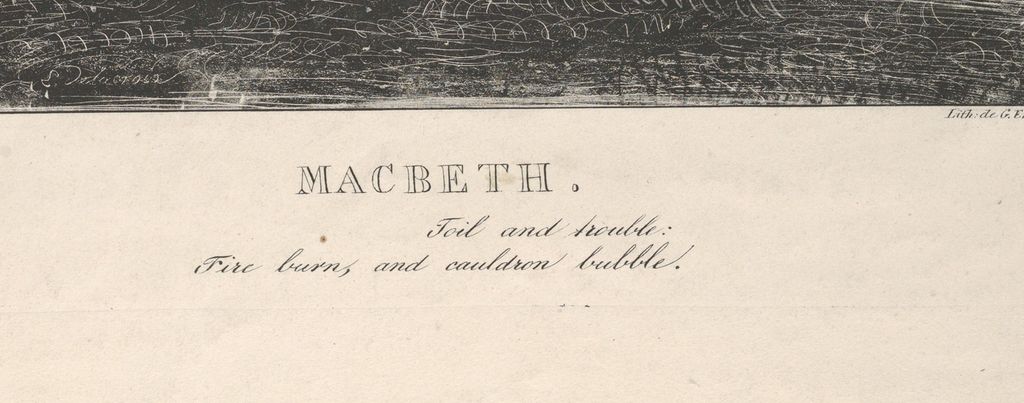
Below the image, the capitalised title “MACBETH” stands above two lines of script drawn from the chant. The title names the play; it does not identify the speaker of the words below. The separation between title and refrain allows the king to dominate the naming of the print while the witches supply its verbal accompaniment. Looking back from the lettering to the image, their reaching arms seem all the more insistent beside his contained stance.
The lettering also helps identify the print’s state. The Bibliothèque nationale de France describes a third state with English lettering, G. Engelmann’s printer line below the image at the right, and Delacroix’s signature made with a scraper within the image at the lower left. These features correspond to those visible on the Met sheet. The BnF record concerns a separate impression with different sheet dimensions.[9] Around the Met image, broad pale margins make a quiet interval between the dark scene and the edges of the paper. The rectangular boundary and orderly lettering contain the restless lines within the scene.
Light scraped out of darkness
Ashley E. Dunn, writing for the Metropolitan Museum, explains that Delacroix used a reductive method, working with a scraper to produce white lines in this lithograph.[10] The pale marks in the finished impression have an expressive range visible throughout the composition: a technique that can articulate armour can also dissolve the space around it.
At Macbeth’s chest, light follows a broad curve and helps establish volume. On the witches, shorter turns and sharp changes of direction make the exposed faces and limbs more angular. Around the cauldron, longer curves loosen into a spreading web. The marks change their descriptive function as the eye moves across the print. They can establish an edge, suggest a surface, or become a nearly continuous disturbance with no single object to define.
The upper field gives that disturbance unusual weight. It contains no comparably solid figure to arrest the eye, yet it is far from empty. Fine curves cross and recross the darkness, sometimes gathering into brighter passages and sometimes thinning almost to invisibility. The vapour obscures distance while occupying a large proportion of the picture. We cannot simply look past the encounter into an intelligible setting; the atmosphere itself keeps demanding attention.
This creates uncertainty without requiring us to decide that the witches are hallucinations. Their bodies, faces and gestures are visible, and the cauldron gives the encounter a material centre. What remains uncertain is the security of the space they inhabit and Macbeth’s position within it. His armour distinguishes him from the surrounding turbulence, but the bright lines describing it belong to the same visual world. The contrast between his stance and their movement holds; the possibility of complete separation does not.
A different encounter in Hamlet
Delacroix’s Hamlet and Horatio before the Gravediggers offers a revealing comparison. The Metropolitan Museum’s 1843 lithograph is a second state of four.[11] Here, too, a tall principal figure stands on the left and three other people occupy the space beside and before him. Yet the balance of light and dark produces a markedly different kind of encounter.
Hamlet advances one leg and inclines his head towards the skull raised by the gravedigger on the right. Horatio stands close behind him, while the second gravedigger sits low in the foreground with his back towards us. The skull is a small but clearly presented object between the figures. An outstretched arm supports it in relatively open space, allowing us to follow the physical exchange and the directions of attention around it.
The pale upper sky leaves room above the group. A distant building on the left and a cross on the right establish a setting that extends beyond the immediate conversation. Below, the ground remains readable around the figures’ feet, and a large pickaxe lies at the lower right. Dark contours and patches of shading give weight to clothes, limbs and tools. Even where the figures overlap, their positions can be followed through the surrounding light.
Returning to Macbeth, the difference becomes palpable. At its centre, a dark vessel produces obscurity, and reaching arms cross a dense field of vapour. The three witches press towards the isolated king, whereas the Hamlet group gathers around an object held up for inspection. These are different dramatic problems answered through different uses of lithography. The later print’s openness does not make it an improvement on the earlier darkness. It shows how strongly Delacroix could alter the conditions of an encounter by changing what light allows us to see.
In Macbeth and the Witches, we can recognise the king, count the witches and locate the cauldron, yet that clarity of identification never makes the scene feel settled. The fixed stance on the left and the multiplying lines on the right continue to pull against one another. Macbeth has arrived to demand knowledge. Delacroix gives him a setting in which even the act of looking brings further uncertainty.
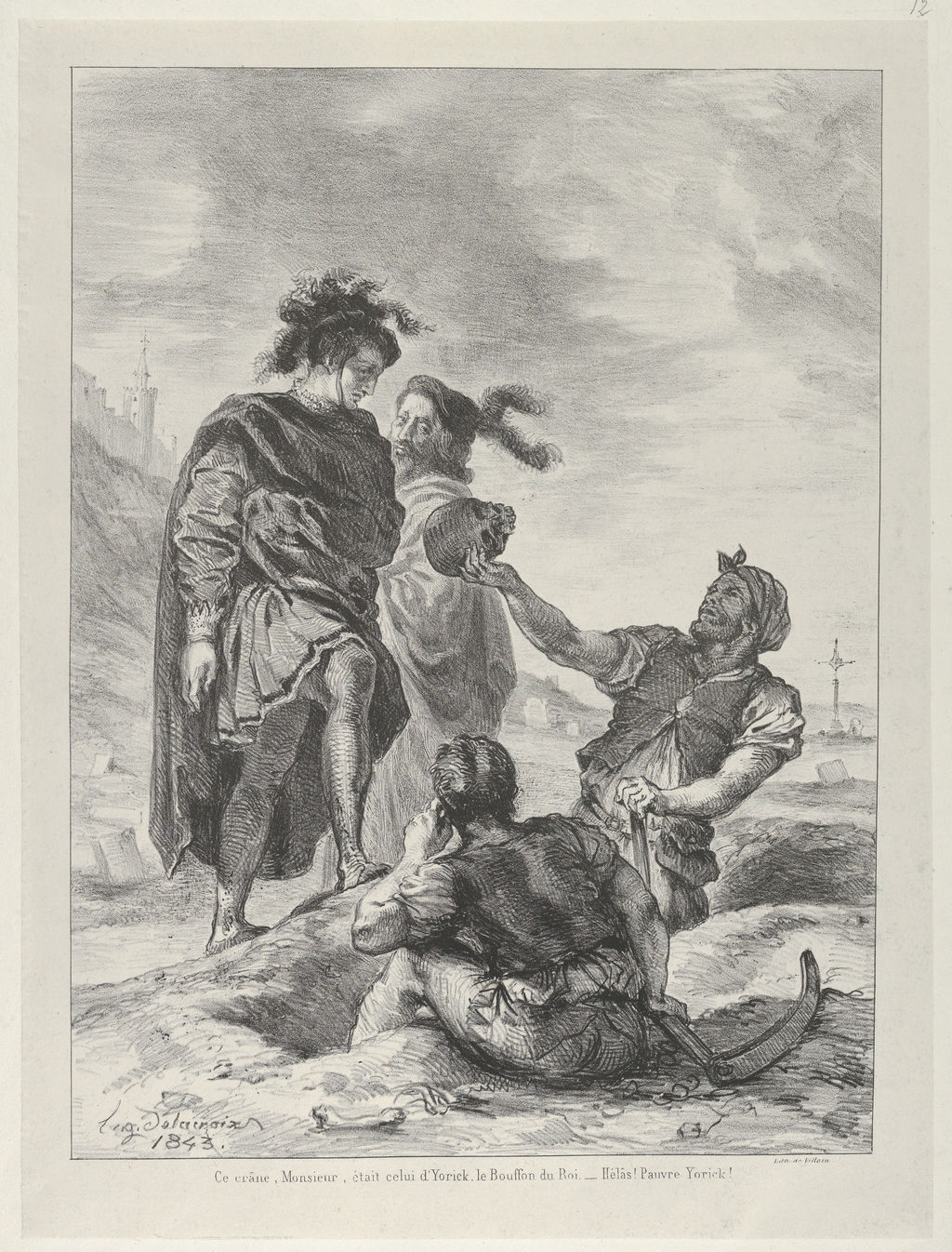
Hamlet and Horatio before the Gravediggers, 1843, lithograph, second state of four. The Metropolitan Museum of Art; 22.56.16. Open light and a clearly presented skull organise another dramatic encounter. The Metropolitan Museum of Art, Open Access. Image source. CC0 / Public domain. Whole supplied primary image retained, including documentary/support edges; no appearance editing.
Annotated Details from Macbeth and the Witches
The numbered points identify visible features discussed in this article. Return from each detail to the whole composition. Macbeth Consulting the Witches, 1825, lithograph, third state of five. The Metropolitan Museum of Art; 22.63.19. The Metropolitan Museum of Art, Open Access. Image source. CC0 / Public domain. Numbers added to a separate resized overview; detail images are crops of the source reproduction. No colour or perspective changes.
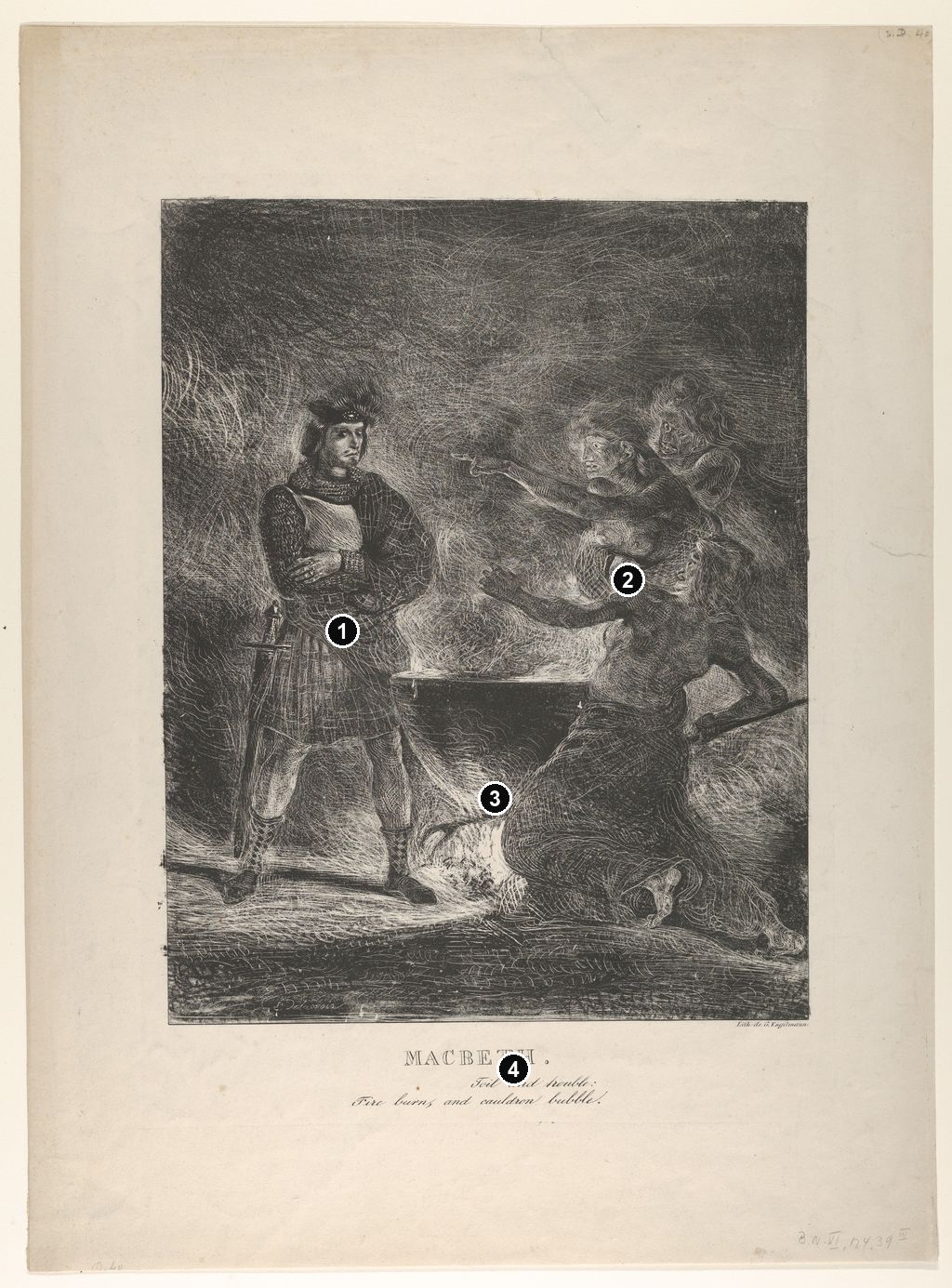
Details from MACBETH AND THE WITCHES
Compare each detail with its position in the complete reproduction.
Macbeth stands firmly at the left
Separated legs and a relatively upright body distinguish Macbeth from the bent figures opposite. Fine pale lines describe his armour within the dark field.
Three heads gather beside the cauldron
The witches’ heads rise at different heights. Reaching arms draw their clustered bodies towards Macbeth across the smoky interval.
Light lines unsettle the cauldron’s surroundings
The black vessel remains a heavy shape while flames and vapour break into pale strands. The surrounding lines connect bodies and atmosphere.
The lettered margin identifies the dramatic subject
The title and two lines of verse sit below the image. Their orderly spacing contrasts with the restless lines above.
Artworks directory
Selected documented works by or associated with Eugène Delacroix, with dates, media and collection records distinguished. This is a growing research directory, not a complete catalogue. An unspecified medium appears under All media.
| Name | Date | Medium |
|---|---|---|
| Male Academy Figure: Half‑Length, Side View | c. 1818–20 | Oil painting Catalogue. |
| Female Academy Figure: Seated, Front View (Mademoiselle Rose) | c. 1820–23 | Oil painting Catalogue. |
| Two Bearded Heads, after Veronese (detail from “The Marriage at Cana”) | 1820 | Oil painting Catalogue. |
| Self‑Portrait as Ravenswood | c.1821 | Oil painting Catalogue. |
| Nereid, after Rubens, detail from “The Landing of Maria de Medici at Marseilles” | c. 1822 | Oil painting Catalogue. |
| Studies of a Damned Man, for “The Barque of Dante” | 1822 | Drawing Catalogue. |
| Head of an Old Greek Woman | 1824 | Oil painting Catalogue. |
| Tasso in the Hospital of St. Anna, Ferrara | 1824 | Oil painting Catalogue. |
| Turk Mounting His Horse | 1824 | Aquatint Catalogue. |
| Portrait of Aspasie | About 1824 | Oil painting Catalogue. |
| Sketch after Goya’s “Caprichos” | c. 1822–24 | Drawing Catalogue. |
| Study of Babouches | c. 1823–24 | Oil painting Catalogue. |
| Thales Fielding (1793–1837) | c. 1824–25 | Oil painting Catalogue. |
| Studies of Bindings, an Oriental Jacket, and Figures after Goya | c. 1822–26 | Oil painting Catalogue. |
| Study of an Oriental Vest | c. 1822–26 | Drawing Catalogue. |
| Study of Greek Costumes | c. 1823–26 | Drawing Catalogue. |
| Christ in the Garden of Olives (The Agony in the Garden) | 1824–26 | Oil painting Catalogue. |
| Reclining Female Nude: Back View | c. 1824–26 | Oil painting Catalogue. |
| Macbeth Consulting the Witches | 1825 | Lithograph Catalogue. |
| Studies of Seven Greek Coins | 1825 | Lithograph Catalogue. |
| Studies of Twelve Greek and Roman Coins | 1825 | Lithograph Catalogue. |
| Mortally Wounded Brigand Quenches His Thirst | c.1825 | Oil painting Catalogue. |
| Charles VI and Odette de Champdivers | About 1825 | Oil painting Catalogue. |
| The Duke of Orléans Showing His Lover | About 1825–26 | Oil painting Catalogue. |
| Count Demetrius de Palatiano (1794–1849) in Suliot Costume | c. 1825–26 | Oil painting Catalogue. |
| Greece on the Ruins of Missolonghi | 1826 | Oil painting Catalogue. |
| Combat of the Giaour and Hassan | 1826 | Oil painting Catalogue. |
| Justinian Drafting His Laws, sketch | 1826 | Oil painting Catalogue. |
| Baron Schwiter (Louis Auguste Schwiter, 1805–1889) | 1826 | Lithograph Catalogue. |
| Louis Auguste Schwiter (1805–1889) | 1826–30 | Oil painting Catalogue. |
| Death of Sardanapalus, sketch | 1826–27 | Oil painting Catalogue. |
| A Lady and Her Valet | c. 1826–29 | Oil painting Catalogue. |
| Woman with a Parrot | 1827 | Oil painting Catalogue. |
| Seated Turk (possibly Paul Barroilhet, 1805–1871) | c. 1827–30 | Oil painting Catalogue. |
| A Greek and a Turk in an Interior | late 1820s | Watercolour Catalogue. |
| Faust (illustrated book) | 1828 | Illustrated book Catalogue. |
| Mephistopheles Flying over the City (Study for “Faust,” plate 1) | c. 1825–27 | Drawing Catalogue. |
| Faust, plate 1: Mephistopheles Aloft | 1826/27 | Lithograph Catalogue. |
| Faust, plate 2: Faust in His Study | 1826/27 | Lithograph Catalogue. |
| Faust, plate 3: Faust and Wagner | 1826/27 | Lithograph Catalogue. |
| Faust, plate 4: Faust, Wagner, and the Poodle | 1826/27 | Lithograph Catalogue. |
| Faust, plate 5: Mephistopheles Appearing to Faust | 1826/27 | Lithograph Catalogue. |
| Faust, plate 6: Mephistopheles Receiving the Student | 1826/27 | Lithograph Catalogue. |
| Faust and Mephistopheles in the Tavern (Study for “Faust,” plate 7) | 1825/26 | Drawing Catalogue. |
| Faust, plate 7: Mephistopheles in Auerbach’s Tavern | 1826 | Lithograph Catalogue. |
| Faust, Marguerite, and Mephistopheles in the Street (Study for “Faust,” plate 8) | c. 1825–27 | Drawing Catalogue. |
| Faust, plate 8: Faust Trying to Seduce Marguerite | 1826/27 | Lithograph Catalogue. |
| Faust, plate 9: Mephistopheles Introduces Himself at Martha’s House | 1827 | Lithograph Catalogue. |
| Faust, plate 10: Marguerite at the Spinning Wheel | 1826/27 | Lithograph Catalogue. |
| Faust, plate 11: Duel between Faust and Valentin | 1826/27 | Lithograph Catalogue. |
| Faust, plate 12: Mephistopheles and Faust Fleeing after the Duel | 1826/27 | Lithograph Catalogue. |
| Faust, plate 13: Marguerite in Church | 1826/27 | Lithograph Catalogue. |
| Faust, plate 14: Faust and Mephistopheles in the Harz Mountains | 1826/27 | Lithograph Catalogue. |
| Faust, plate 15: Marguerite’s Ghost Appearing to Faust | 1826/27 | Lithograph Catalogue. |
| Faust, plate 16: Faust and Mephistopheles Galloping on Walpurgis Night | 1826 | Lithograph Catalogue. |
| Faust, plate 17: Faust with Marguerite in Prison | 1826/27 | Lithograph Catalogue. |
| Wild Horse Felled by a Tiger | 1828 | Lithograph Catalogue. |
| Wild Horse Felled by a Tiger | 1828 | Watercolour Catalogue. |
| Wild Horse | 1828 | Lithograph Catalogue. |
| Studies of a Lion (Tours sketchbook) | 12 February 1824 or 1829 | Drawing Catalogue. |
| Sketches of Tigers and Men in Sixteenth‑Century Costume | c. 1828–29 | Watercolour Catalogue. |
| Nineteen Studies of Heads and Skulls of Lions | c. 1828–30 | Drawing Catalogue. |
| Tiger Lying at the Entrance of Its Lair | c. 1828–30 | Etching Catalogue. |
| The Murder of the Bishop of Liège | 1829 | Oil painting Catalogue. |
| Royal Tiger | 1829 | Lithograph Catalogue. |
| Lion of the Atlas Mountains | 1829–30 | Lithograph Catalogue. |
| Young Tiger Playing with Its Mother (Study of Two Tigers) | 1830 | Oil painting Catalogue. |
| The Battle of Poitiers | 1830 | Oil painting Catalogue. |
| The Battle of Nancy and the Death of Charles the Bold, Duke of Burgundy, January 5, 1477 | 1831 | Oil painting Catalogue. |
| Boissy d’Anglas at the Convention, sketch | 1831 | Oil painting Catalogue. |
| Interior of a Dominican Convent in Madrid (L’Amende Honorable) | 1831 | Oil painting Catalogue. |
| Jewish Woman of Tangier | 1832 | Drawing Catalogue. |
| Portrait of Schmareck, Tanner at Tangier | 1832 | Watercolour Catalogue. |
| Standing Moroccan | 1832 | Watercolour Catalogue. |
| A Man of Tangier | 1832 | Watercolour Catalogue. |
| Saada, the Wife of Abraham Ben‑Chimol, and Préciada, One of Their Daughters | 1832 | Watercolour Catalogue. |
| Street in Meknes | 1832 | Oil painting Catalogue. |
| Moroccan Military Exercises | 1832 | Oil painting Catalogue. |
| Arab Cavalry Practicing a Charge (Fantaisie Arabe) | 1833 | Oil painting Catalogue. |
| A Blacksmith | 1833 | Aquatint Catalogue. |
| Collision of Arab Horsemen | 1833/34 | Oil painting Catalogue. |
| Figure Study for “The Women of Algiers” | 1833/34 | Watercolour Catalogue. |
| Women of Algiers in Their Apartment | 1834 | Oil painting Catalogue. |
| The Natchez | 1823–24 and 1835 | Oil painting Catalogue. |
| Christ on the Cross | 1835 | Oil painting Catalogue. |
| Hamlet and Horatio in the Graveyard | 1835 | Oil painting Catalogue. |
| Combat of the Giaour and Hassan | 1835 | Oil painting Catalogue. |
| Léon Riesener (1808–1878) | 1835 | Oil painting Catalogue. |
| Madame Henri François Riesener (Félicité Longrois, 1786–1847) | 1835 | Oil painting Catalogue. |
| Saint Sebastian Tended by the Holy Women | 1836 | Oil painting Catalogue. |
| Medea About to Kill Her Children, sketch | c. 1836 | Oil painting Catalogue. |
| Moroccan Chieftain Receiving Tribute | 1837 | Oil painting Catalogue. |
| Self‑Portrait in a Green Vest | c. 1837 | Oil painting Catalogue. |
| Medea About to Kill Her Children (Medée furieuse) | 1838 | Oil painting Catalogue. |
| Cleopatra and the Peasant | 1838 | Oil painting Catalogue. |
| Hamlet and Horatio in the Graveyard | 1839 | Oil painting Catalogue. |
| Startled Arabian Horse in a Landscape | c. 1835–40 | Watercolour Catalogue. |
| The Shipwreck of Don Juan | 1840 | Oil painting Catalogue. |
| Christ on the Lake of Genesareth (Portland version) | c. 1853 | Oil painting Catalogue. |
| Pietà, first sketch | by 1843 | Oil painting Catalogue. |
| Pietà, second sketch | by 1843 | Oil painting Catalogue. |
| Christ on the Cross, sketch | 1845 | Oil painting Catalogue. |
| Christ on the Cross | 1846 | Oil painting Catalogue. |
| Death of Sardanapalus (Philadelphia replica) | 1844 / 1845–46 | Oil painting Catalogue. |
| The Abduction of Rebecca | 1846 | Oil painting Catalogue. |
| The Lamentation (Christ at the Tomb) | 1847–48 | Oil painting Catalogue. |
| Arab Players | 1848 | Oil painting Catalogue. |
| Arch of Morning Glories, study for “Basket of Flowers” | 1848/49 | Pastel Catalogue. |
| Basket of Flowers | 1848–49 | Oil painting Catalogue. |
| Basket of Flowers and Fruit | 1849 | Oil painting Catalogue. |
| Basket of Flowers | c. 1848–50 | Oil painting Catalogue. |
| Christ at the Column | probably 1849 | Oil painting Catalogue. |
| Landscape at Champrosay | possibly 1849 | Oil painting Catalogue. |
| Michelangelo in His Studio | About1849–50 | Oil painting Catalogue. |
| View in the Forest of Sénart | c. 1849–50 | Oil painting Catalogue. |
| Forest View with an Oak Tree | c. 1849–50 | Watercolour Catalogue. |
| The Triumph of Genius over Envy | c. 1849–51 | Drawing Catalogue. |
| Jacob Struggling with the Angel | 1850 | Drawing Catalogue. |
| Jacob Wrestling with the Angel | 1850 | Drawing Catalogue. |
| Jacob Wrestling with the Angel | 1850 | Oil painting Catalogue. |
| Sunset | c. 1850 | Pastel Catalogue. |
| Apollo Slays the Python, sketch | c. 1850 | Oil painting Catalogue. |
| Apollo Victorious over the Serpent Python, sketch | c. 1850 | Oil painting Catalogue. |
| Pietà | About1850 | Oil painting Catalogue. |
| The Agony in the Garden | 1851 | Oil painting Catalogue. |
| Study of the Sea | 1851(?) | Watercolour Catalogue. |
| Marphise | 1852 | Oil painting Catalogue. |
| The Sea at Dieppe | 1852 | Oil painting Catalogue. |
| Christ Asleep during the Tempest | c. 1853 | Oil painting Catalogue. |
| Saint Stephen Borne Away by His Disciples | 1853 | Oil painting Catalogue. |
| Christ on the Sea of Galilee | 1854 | Oil painting Catalogue. |
| The Sea at Dieppe | probably 1854 | Watercolour Catalogue. |
| A Lion and a Tiger, Fighting | c. 1854 | Drawing Catalogue. |
| Lion Hunt, sketch | 1854 | Oil painting Catalogue. |
| Lion Hunt (fragment) | 1855 | Oil painting Catalogue. |
| Lion Hunt | 1855–56 | Oil painting Catalogue. |
| Hilly Landscape | c. 1855 | Oil painting Catalogue. |
| The Sultan of Morocco and His Entourage | 1856 | Oil painting Catalogue. |
| The Bride of Abydos (Selim and Zuleika) | 1857 | Oil painting Catalogue. |
| Lamentation over the Body of Christ | 1857 | Oil painting Catalogue. |
| Abduction of Rebecca | 1858 | Oil painting Catalogue. |
| Ovid among the Scythians | 1859 | Oil painting Catalogue. |
| Amadis de Gaule Delivers a Damsel from Galpan’s Castle | 1859–60 | Oil painting Catalogue. |
| Arab Horses Fighting in a Stable | 1860 | Oil painting Catalogue. |
| Shipwreck on the Coast | 1862 | Oil painting Catalogue. |
| The Battle of Taillebourg won by Saint Louis (Château de Versailles) | 1837 | Oil on canvas Catalogue. |
| Christ on the Lake of Gennezaret (Christ Asleep during the Tempest) (The Metropolitan Museum of Art) | About 1853 | Oil on canvas Catalogue. |
| The Coast of Spain at Salabrena (Christie’s 1998 sale 6059, lot 123) | 19 January 1832 | Pen and ink Catalogue. |
| Crouching Tiger (The Metropolitan Museum of Art) | 1839 | Pen and ink Catalogue. |
| The Education of Achilles (J. Paul Getty Museum) | 1862 | Pastel Catalogue. |
| Fallen Warriors and a Runaway Horse (The Metropolitan Museum of Art) | 1862 | Pen and ink Catalogue. |
| George Sand's Garden at Nohant (The Metropolitan Museum of Art) | About 1842–43 | Oil on canvas Catalogue. |
| The Giaour on Horseback (The Metropolitan Museum of Art) | 1824–26 | Pen and ink Catalogue. |
| Lion Hunt (Art Institute of Chicago) | 1860–61; signed 1861 | Oil on canvas Catalogue. |
| Figure Studies related to Liberty Leading the People | 1830 | Pen and brown ink, brush and brown wash Catalogue. |
| Chios: Head, Shoulder and Foot Studies | 1823 | Graphite Catalogue. |
| Figure Studies for the Salon du Roi, Palais Bourbon | 1833–35 | Pen and iron gall ink Catalogue. |
| Four Studies of Horses | 1824–25 | Pen, ink, black wash and graphite (recto); graphite (verso) Catalogue. |
| Studies of a Horse and Rider for Heliodorus Driven from the Temple | 1849–50 | Pen and iron gall ink, graphite Catalogue. |
| Liberty Leading the People | 1830 | Oil on canvas Catalogue. |
| Massacre at Chios | 1824 | Oil on canvas Catalogue. |
| Death of Sardanapalus (Louvre original) | 1827 | Oil on canvas Catalogue. |
| Barque of Dante | 1822 | Oil painting Catalogue. |
| Orphan Girl at the Cemetery | 1824 | Oil painting Catalogue. |
| Jacob Wrestling with the Angel (Saint-Sulpice wall painting) | Completed 1861 | Wall painting Catalogue. |
| Heliodorus Driven from the Temple (Saint-Sulpice wall painting) | Completed 1861 | Wall painting Catalogue. |
| African Pirates Abducting a Young Woman | 1852 | Oil painting Catalogue. |
| An Arab Horseman at the Gallop | 1849 | Oil painting Catalogue. |
| Arabs Skirmishing in the Mountains | 1863 | Oil painting Catalogue. |
| Moroccan Horseman Crossing a Ford | About 1850 | Oil painting Catalogue. |
| A Moroccan (Arab) Saddling a Horse | 1855 | Oil painting Catalogue. |
| The Execution of the Doge Marino Faliero | 1825–26 | Oil painting Catalogue. |
| Christopher Columbus and his Son at La Rábida | 1838 | Oil painting Catalogue. |
| Horse Frightened by Lightning | 1825–29 | Watercolour Catalogue. |
| Horses Leaving the Sea | 1860 | Oil painting Catalogue. |
| Tiger with a Tortoise | 1862 | Oil painting Catalogue. |
| Tiger | About1830 | Watercolour Catalogue. |
| Tiger and Snake | 1862 | Oil painting Catalogue. |
| Tiger Hunt | 1854 | Oil painting Catalogue. |
| Lion Hunt in Morocco | 1854 | Oil painting Catalogue. |
| Lion Rending Apart a Corpse | About1848;historical catalogue placement | Watercolour Catalogue. |
| Frederic Chopin | 1838 | Oil painting Catalogue. |
| Portrait of George Sand | 1838 | Oil painting Catalogue. |
| Portrait of Frédéric Chopin and George Sand | 1838 | Oil painting Catalogue. |
| Mademoiselle Rose | About 1820 | Oil painting Catalogue. |
| Head of a Woman in a Red Turban | 1831; archive date | Oil painting Catalogue. |
| Two Views of a Standing Indian from Calcutta | About 1823–24 | Oil painting Catalogue. |
| Last Words of the Emperor Marcus Aurelius | 1844 | Oil painting Catalogue. |
| Entry of the Crusaders in Constantinople | 1840 | Oil painting Catalogue. |
| Medea | 1862 | Oil painting Catalogue. |
| The Death of Laras | 1858 | Oil painting Catalogue. |
| The Bride of Abydos | About 1852–53; dating disputed | Oil painting Catalogue. |
| The Bride of Lammermoor | About1826 | Watercolour Catalogue. |
| Cromwell at Windsor Castle | 1828 | Oil painting Catalogue. |
| Milton Dictated to his Daughters the Paradise Lost | 1827–28 | Oil painting Catalogue. |
| Tasso in the Madhouse | 1839 | Oil painting Catalogue. |
| Christ on the Cross | 1853 | Oil painting Catalogue. |
| The Disciples at Emmaus | 1853 | Oil painting Catalogue. |
| The Entombment of Christ | Nineteenth century; precise date unestablished | Oil painting Catalogue. |
| Fanatics of Tangier | 1837–38 | Oil painting Catalogue. |
| Jewish Bride | Undated; Moroccan subject associated with the1832journey | Watercolour Catalogue. |
| Jewish Wedding in Morocco | 1839; Salon1841 | Oil painting Catalogue. |
| Moroccan Fantasia | 1847 | Oil painting Catalogue. |
| The Sultan of Morocco | 1845 | Oil painting Catalogue. |
| Bouquet of Flowers 1843 | 1843 | Watercolour Catalogue. |
| Bouquet of Flowers, 1849 | 1849 | Watercolour Catalogue. |
| Cliffs Near Dieppe | 1852–55 | Watercolour Catalogue. |
| The Edge of a Wood at Nohant | c.1842/1843 | Watercolour Catalogue. |
| Still Life with Lobsters | 1826–27 | Oil on canvas Catalogue. |
| A Corner of the Studio (attribution disputed) | 1825–1850; attribution disputed | Oil on canvas Catalogue. |
| Study of the Sky at Sunset | c.1849 | Pastel Catalogue. |
| Self-Portrait, about 1840 | c.1840 | Oil on canvas Catalogue. |
| Women of Algiers in Their Apartment (1849) | 1849 | Oil on canvas Catalogue. |
| Susanna and the Elders | 1841 | Oil on canvas Catalogue. |
| The Education of Achilles (Drawing) | c.1844 | Graphite Catalogue. |
| Attila the Hun | Completed 1847 | Mural detail Catalogue. |
| The Italian Theatre | 1821 | Lithograph Catalogue. |
| A Turkish Man on a Grey Horse | Undated | Not specified Catalogue. |
| Study for The Massacre at Chios | About 1823–24 | Graphite, watercolour and gouache on paper Catalogue. |
| The Prisoner of Chillon | 1834; Salon of 1835 | Oil on canvas Catalogue. |
| Two Knights Fighting in a Landscape | Second quarter of the nineteenth century; precise date uncertain | Oil on canvas; possible later completion Catalogue. |
Discussion
Look again at the images and ideas explored in Macbeth and the Witches. These editorial prompts invite your observations.
Reader Insights
Compare Macbeth’s firm stance with the witches’ reaching arms. How do the different contours divide the scene?
Follow the pale lines through smoke, flames and figures. Where do they make forms clear, and where do they unsettle them?
Join the Conversation
Share a detail, comparison or question about Macbeth and the Witches below.
References
- The Metropolitan Museum of Art, New York. Macbeth Consulting the Witches, Eugène Delacroix, 1825; collection record, accession 22.63.19, Rogers Fund, 1922. Source language: English. Accessed 28 October 2026. View source.
- The Metropolitan Museum of Art, “The Giaour on Horseback”, Eugène Delacroix, 1824–26, accession 2015.713.2, collection record and recto image. Source language: English. Accessed 27 October 2026. View source.
- The Metropolitan Museum of Art, Macbeth Consulting the Witches, 1825, 22.63.19, lithograph, third state of five. English. Accessed 28 October 2026. View source.
- Ministère de la Culture, base Joconde, Bataille de Taillebourg. 21 juillet 1242, notice 000PE005883; collection du château de Versailles, MV 2676 / INV 3822 / LP 2780. French. Accessed 27 October 2026. View source.
- Asher Miller, compiler, “Checklist,” entries 1–145, in Sébastien Allard and Côme Fabre, Delacroix. New York: The Metropolitan Museum of Art, 2018, pp. 275–297. Basic title, date and medium metadata consulted; not a complete catalogue of the artist’s works. Source language: English. Accessed 28 October 2026. View source.
- The Metropolitan Museum of Art, “Eugène Delacroix: Christ Asleep during the Tempest,” collection record, accession 29.100.131, object details and introductory commentary. Source language: English. Accessed 28 October 2026. View source.
- George R. Goldner and Lee Hendrix, with Kelly Pask, European Drawings 2: Catalogue of the Collections. Malibu: J. Paul Getty Museum, 1992, entry 56, p. 140; colour plate 8. Source language: English. Accessed 27 October 2026. View source.
- William Shakespeare. Macbeth, Act 4, scene 1, opening through line 67, Folger Shakespeare Library digital edition. Source language: English. Accessed 28 October 2026. View source.
- Bibliothèque nationale de France. Macbeth : Toil and trouble : // Fire burn, and cauldron bubble, Eugène Delacroix, 1825; bibliographic record FRBNF45691908, third-state description and physical description. Source language: French. Accessed 28 October 2026. View source.
- Ashley E. Dunn. “Eugène Delacroix, Printmaker Par Excellence”, The Metropolitan Museum of Art, 7 November 2018; passage on the reductive technique of Macbeth. Source language: English. Accessed 28 October 2026. View source.
- The Metropolitan Museum of Art, New York. Hamlet and Horatio before the Gravediggers, Eugène Delacroix, 1843; collection record, accession 22.56.16. Source language: English. Accessed 28 October 2026. View source.
- Asher Ethan Miller, “Eugène Delacroix, Christ on the Sea of Galilee, 1853 or earlier,” French Paintings and Pastels, 1600–1945, Nelson-Atkins Museum of Art, 2021. Narrative and notes, including the revised Portland chronology; Glynnis Napier Stevenson documentation note 1 also consulted. Source language: English. Accessed 28 October 2026. View source.
- Christie’s, “The Coast of Spain at Salabrena”, Ferdinand-Victor-Eugène Delacroix, Impressionist & 19th Century Art, Pt. II, sale 6059, lot 123, 1998. Object details, sale-room notice and lot essay; unpaginated. Source language: English; artist’s inscription in French. Accessed 27 October 2026. View source.
- The Metropolitan Museum of Art, “Eugène Delacroix: Crouching Tiger”, collection record for accession 2013.1135.5, 1839; object details and curatorial commentary, unpaginated. Source language: English. Accessed 28 October 2026. View source.
- The Metropolitan Museum of Art, “Fallen Warriors and a Runaway Horse”, collection record, object details, curatorial commentary and collection image; unpaginated. Source language: English. Accessed 28 October 2026. View source.
- The Metropolitan Museum of Art, “George Sand’s Garden at Nohant,” Eugène Delacroix, collection record, accession 22.27.4; object details and curatorial overview. Source language: English. Accessed 27 October 2026. View source.
- Art Institute of Chicago, “Lion Hunt”, collection record, especially “About this artwork”, object information, inscriptions and provenance; unpaginated. Source language: English. Accessed 28 October 2026. View source.
- The Metropolitan Museum of Art, Figure Studies related to Liberty Leading the People, 1830, 2013.1135.12. Visible object metadata and short commentary. English. Accessed 28 October 2026. View source.
- The Metropolitan Museum of Art, Head, Shoulder, and Foot, Studies for Scenes from the Chios Massacres, 1823, 2013.1135.22. Visible object metadata and commentary. English. Accessed 28 October 2026. View source.
- The Metropolitan Museum of Art, Figure Studies for the Salon du Roi, Palais Bourbon, 1833–35, 2013.1135.24. Visible metadata and commentary. English. Accessed 28 October 2026. View source.
- The Metropolitan Museum of Art, Four Studies of Horses, 1824–25, 2024.591.65. Recto and verso metadata and commentary. English. Accessed 28 October 2026. View source.
- The Metropolitan Museum of Art, Studies of a Horse and Rider for Heliodorus Driven from the Temple, 1849–50, 2024.591.78. Visible metadata and commentary. English. Accessed 28 October 2026. View source.
- Musée du Louvre, Le 28 juillet 1830. La Liberté guidant le peuple, RF 129, 1830. Object details and historical record. French. Accessed 28 October 2026. View source.
- Musée du Louvre, Scènes des massacres de Scio, INV 3823, 1824. Object details and historical record. French. Accessed 28 October 2026. View source.
- Musée du Louvre, Mort de Sardanapale, RF 2346, 1827. Object details and historical record. French. Accessed 28 October 2026. View source.
- Philadelphia Museum of Art, The Death of Sardanapalus, object 82626, 1986-26-17, dated 1844. Heading and short commentary; dating differs from the 2018 catalogue. English. Accessed 28 October 2026. View source.
- Musée du Louvre, Dante et Virgile, dit aussi La barque de Dante, INV 3820, 1822; object metadata and history. French. Accessed 28 October 2026. View source.
- Musée du Louvre, Jeune orpheline au cimetière, RF 1652, 1824; object metadata and history. French. Accessed 28 October 2026. View source.
- Musée des Beaux-Arts de Bordeaux, La Grèce sur les ruines de Missolonghi, Bx E 439, 1826; collection record and audio transcript. French. Accessed 28 October 2026. View source.
- Ville de Paris, Retrouvez les chefs d’œuvres de Delacroix à la chapelle des Saints-Anges de Saint-Sulpice, updated 30 November 2016; chapel commission/completion and material history. French. Accessed 28 October 2026. View source.
- Musée du Louvre, Pirates africains enlevant une jeune femme, RF 1965 9, 1852; object record, interpretation and provenance. French. Accessed 28 October 2026. View source.
- Qatar Museums, Tales of a Connected World: About the Galleries; Arab Horseman at the Gallop, 1849, Lusail Museum Collection, and Delacroix’s Gaze. English. Accessed 28 October 2026. View source.
- National Gallery of Art, Arabs Skirmishing in the Mountains, 1863, 1966.12.1; object metadata, interpretation and provenance. English. Accessed 28 October 2026. View source.
- J. Paul Getty Museum, Moroccan Horseman Crossing a Ford, about 1850, 2001.42; Getty-authored commentary and metadata on Google Arts & Culture. English. Accessed 28 October 2026. View source.
- State Hermitage Museum, Moroccan Saddling a Horse, 1855, ГЭ-3852; complete indexed Russian owner text and object fields. Russian. Accessed 28 October 2026. View source.
- Paris Musées / Petit Palais, Le Combat du Giaour et du Pacha,1835,PDUT1162; object record and interpretation. French. Accessed 28 October 2026. View source.
- Art Institute of Chicago, The Combat of the Giaour and Hassan,1826; owner-authored Google Arts & Culture object record. English. Accessed 28 October 2026. View source.
- Ackland Art Museum, Cleopatra and the Peasant,1838,59.15.1; indexed owner object fields. English. Accessed 28 October 2026. View source.
- The Wallace Collection, The Execution of the Doge Marino Faliero,1825–26,P282; object record and description. English. Accessed 28 October 2026. View source.
- National Gallery of Art, Christopher Columbus and His Son at La Rábida,1838,1963.10.127; object record and provenance. English. Accessed 28 October 2026. View source.
- Musée d’Orsay, Chevaux arabes se battant dans une écurie,1860,RF1988; indexed owner object fields. French. Accessed 28 October 2026. View source.
- Museum of Fine Arts, Budapest / Zsuzsa Gonda, Horse Frightened by Lightning,1825–29,D_1935-2698; owner-authored Google Arts & Culture record and essay. English. Accessed 28 October 2026. View source.
- The Phillips Collection, Horses Coming Out of the Sea,1860,0486; collection record and commentary. English. Accessed 28 October 2026. View source.
- Musée du Louvre, Jeune Tigre jouant avec sa mère,1830,RF1943; full object record and history. French. Accessed 28 October 2026. View source.
- Christie’s, Tigre jouant avec une tortue,1862; Rockefeller2018 sale16718 lot3, record and essay. English. Accessed 28 October 2026. View source.
- National Gallery of Art, Tiger, about1830,1943.3.3375; indexed owner record, inscription and visual description. English. Accessed 28 October 2026. View source.
- National Gallery of Art, Tiger and Snake,1862,2014.136.30; indexed owner record, provenance and visual description. English. Accessed 28 October 2026. View source.
- Musée d’Orsay, Chasse au tigre,1854,RF1814; indexed owner record and commentary. French/English. Accessed 28 October 2026. View source.
- State Hermitage Museum, Lion Hunt in Morocco,1854,3853; official guide2014,entry195,pp248–249. English. Accessed 28 October 2026. View source.
- Alfred Robaut / Ernest Chesneau, L’Œuvre complet de Eugène Delacroix,1885,p279,entry1054,watercolour Lion déchirant un cadavre. French. Accessed 28 October 2026. View source.
- Musée du Louvre, Frédéric Chopin, 1838, RF 1717; current owner record of the surviving fragment. French. Accessed 28 October 2026. View source.
- Museum Ordrupgaard, George Sand, 1838, 280WH; current owner dimensions/materials/signature record. Danish. Accessed 28 October 2026. View source.
- Musée du Louvre, Preparatory study for Chopin and George Sand, circa 1838, RF 9357; owner record and commentary. French/English. Accessed 28 October 2026. View source.
- Musée du Louvre, Portrait de Léon Riesener, 1835, RF 1960 58; current owner metadata, label transcription and commentary. French. Accessed 28 October 2026. View source.
- The National Gallery, London, Louis-Auguste Schwiter, 1826–30, NG 3286; current owner record and in-depth commentary. English. Accessed 28 October 2026. View source.
- Musée du Louvre, Nu assis, dit Mademoiselle Rose, about 1820, RF 1942 14; complete owner object record. French. Accessed 28 October 2026. View source.
- Musée Fabre, Étude d’après le modèle Aspasie, about 1824, 868.1.36; current owner fields and short commentary. French. Accessed 28 October 2026. View source.
- Musées d’Orléans, Head of an Old Greek Woman, study for Chios,1824,96.2.1; full owner record and commentary. French. Accessed 28 October 2026. View source.
- Art Fund, Head of a Woman in Red Turban By Lamplight; archive date1831, rounded dimensions and1962acquisition support; archive cautions record notupdated. English. Accessed 28 October 2026. View source.
- National Gallery of Art, Two Studies of a Standing Indian from Calcutta,c1823/1824,2006.128.18; current owner record and visual description. English. Accessed 28 October 2026. View source.
- National Gallery of Art, Two Studies of an Indian from Calcutta,Seated and Standing,c1823/1824,2006.128.19; separate comparative canvas,current owner record. English. Accessed 28 October 2026. View source.
- Musée du Louvre, The Assassination of the Bishop of Liège,1829,RF1961 13; complete owner fields and selected provenance. French. Accessed 28 October 2026. View source.
- Musée des Beaux-Arts de Nancy, The Battle of Nancy, signed1831,177; current object fields, narrative and acquisition history. French. Accessed 28 October 2026. View source.
- Musée des Beaux-Arts de Lyon, Last Words of the Emperor Marcus Aurelius,1844,A2928; complete owner record and interpretation. French. Accessed 28 October 2026. View source.
- Mar Borobia, Museo Nacional Thyssen-Bornemisza, The Duke of Orléans Showing His Lover,about1825–26,127(1977.19); complete object record and essay. English. Accessed 28 October 2026. View source.
- Musée du Louvre, Entry of the Crusaders in Constantinople,1840,INV3821/LP4674; current owner description, commission and provenance. French. Accessed 28 October 2026. View source.
- Musée du Louvre, Medea,1862,RF1402; later variant of the1838Lilleoriginal,current object record. French. Accessed 28 October 2026. View source.
- Musée du Louvre, The Shipwreck of Don Juan,1840,RF359; current owner fields and1883gift record. French. Accessed 28 October 2026. View source.
- Musée du Louvre, The Bride of Abydos,RF1398; current dimensions/bequest and broad date differing from the2018catalogue. French. Accessed 28 October 2026. View source.
- Palais des Beaux-Arts de Lille, Medea About to Kill Her Children,1838,P542; the earlier large original,current owner record. French. Accessed 28 October 2026. View source.
- Kimbell Art Museum, Selim and Zuleika,1857,AP1986.04; separate final version, complete indexed owner narrative/provenance. English. Accessed 28 October 2026. View source.
- Art Gallery of Ontario, The Bride of Lammermoor,about1826,80/83; graphite,watercolour andgouache,collection/provenance record. English. Accessed 28 October 2026. View source.
- Christie’s, Cromwell at Windsor Castle,1828,Johnson129;2002auction record/lotessay and1831Salon listing. English. Accessed 28 October 2026. View source.
- Musée Fabre, Michelangelo in His Studio,1850,868.1.40;current object fields andinterpretive notice. French. Accessed 28 October 2026. View source.
- Kunsthaus Zürich, Milton Dictating Paradise Lost to His Daughters,1827–28,1988/0028;current ownerPDF. English. Accessed 28 October 2026. View source.
- Sammlung Oskar Reinhart Am Römerholz, Tasso in the Madhouse,1839,oil60×50cm;owner object record. English. Accessed 28 October 2026. View source.
- The National Gallery, London, Christ on the Cross,1853,NG6433;oil73.5×59.7cm,currentobjectrecord. English. Accessed 28 October 2026. View source.
- The Walters Art Museum, Christ on the Sea of Galilee,1854,37.186;oil59.8×73.3cm,currentobjectrecord. English. Accessed 28 October 2026. View source.
- Brooklyn Museum, The Disciples at Emmaus,1853,50.106;oil55.2×47cm,currentobjectrecord. English. Accessed 28 October 2026. View source.
- INHA / Joconde, La Mise au tombeau,copyafterTitian,LyonB286;oil40×55.5cm,nineteenthcentury,currentobjectfields. French. Accessed 28 October 2026. View source.
- Nasjonalmuseet, Oslo, Pietà,about1850,NG.M.01179;oil35.6×27cm,currentobjectrecord. English. Accessed 28 October 2026. View source.
- Minneapolis Institute of Art, Convulsionists of Tangier,1837–38,73.42.3;oil95.57×128.59cm,owner-published collection data. English. Accessed 28 October 2026. View source.
- Musée du Louvre, Mariée juive à Tanger,undated,RF4614Recto;watercolour/graphite28.5×23.2cm,currentobjectrecord. French. Accessed 28 October 2026. View source.
- Musée du Louvre, Noce juive dans le Maroc,1839,INV3825/LP4737;oil105×140.5cm,Salon1841,currentobjectrecord. French. Accessed 28 October 2026. View source.
- Swiss Federal Office of Culture, Marokkanische Soldaten bei einer Gefechtsübung,1847,SOR1936.3;oil66×82cm,Römerholz,currentobjectrecord. German. Accessed 28 October 2026. View source.
- Musée des Augustins, Toulouse, Moulay Abd-er-Rahman,sultan du Maroc,1845,2004 1 99;oil384×344cm,currentobjectrecord. French. Accessed 28 October 2026. View source.
- French Ministry of Culture / Musée Fabre, Bouquet de fleurs, 1843, inventory 876.3.101; black pencil and watercolour, 20.5 × 26.4 cm. Current Joconde collection record. French. Accessed 28 October 2026. View source.
- Musée du Louvre, Bouquet de fleurs, 1849, RF 31719, Recto; watercolour, gouache and pastel over black pencil on two joined sheets of grey paper, 65 × 65.4 cm. Current collection record. French. Accessed 28 October 2026. View source.
- Musée Marmottan Monet, Monet collectionneur – Chefs-d’œuvre de sa collection privée, 2017 press dossier, printed p.24 (PDF p.23). Cliffs near Dieppe, 1852–55, watercolour, 20 × 30.7 cm; reproduction and collection history. French. Accessed 28 October 2026. View source.
- National Gallery of Art, Washington, The Edge of a Wood at Nohant, c.1842/1843, accession 1985.16.2; watercolour, 15.5 × 20.5 cm. Current collection record. English. Accessed 28 October 2026. View source.
- Musée du Louvre, La mer vue des hauteurs de Dieppe, RF 1979-46; oil on cardboard glued to wood, 36 × 52 cm. Current collection record; 1852 dating follows the 2018 Delacroix catalogue, no.128. French. Accessed 28 October 2026. View source.
- Musée du Louvre, Nature morte au homard, RF1661,1826–27, oil on canvas80.5×106.5cm. French. Accessed 28 October 2026. View source.
- Musée du Louvre, Coin d’atelier. Le poêle, RF2058,1825–1850,oil51×43.4cm; doubtful signature and disputed attribution. French. Accessed 28 October 2026. View source.
- Musée du Louvre, Etude de ciel au soleil couchant, RF3706 Recto,c1849,pastel on grey paper19.2×23.8cm. French. Accessed 28 October 2026. View source.
- Ministero della Cultura / Gallerie degli Uffizi, Autoritratto di Delacroix,0900099717,Inv1890no3914,c1840,oil66×54cm; complete six-page SIGEC record. Italian. Accessed 28 October 2026. View source.
- Musée du Louvre / Musée national Eugène-Delacroix, Portrait de Delacroix en Hamlet, formerly Ravenswood,MD2021-2/RF1953-38,c1821,oil41×33cm. French. Accessed 28 October 2026. View source.
- Musée Fabre, Femmes d’Alger dans leur intérieur, 1849, 868.1.38, oil on canvas, 85 × 112 cm. French. Accessed 28 October 2026. View source.
- Musée des Beaux-Arts de Lyon, Femme caressant un perroquet, 1827, B 566, oil on canvas, 24.8 × 33 cm. French. Accessed 28 October 2026. View source.
- Palais des Beaux-Arts de Lille, Suzanne et les vieillards, 1841, P 986, oil on canvas, 27 × 35.5 cm. French. Accessed 28 October 2026. View source.
- Kunstmuseum Basel, Ein sterbender Brigant trinkt an einer Quelle, c.1825, 1726, oil on canvas, 32.7 × 40.8 cm. German. Accessed 28 October 2026. View source.
- The Metropolitan Museum of Art, The Education of Achilles, c.1844, 2014.732.3, graphite, 23.6 × 29.7 cm. English. Accessed 28 October 2026. View source.
- Assemblée nationale, Attila and His Hordes Overrun Italy and the Arts, War hemicycle detail, library of the Palais Bourbon, completed 1847, oil and wax on plaster. French. Accessed 28 October 2026. View source.
- The Metropolitan Museum of Art, Théâtre Italien, 13 August 1821, 2004.198, lithograph, sheet 25.6 × 18.6 cm. English. Accessed 28 October 2026. View source.
- Musée du Louvre, Hamlet et Horatio au cimetière, 1839, RF 1942, oil on canvas, 82 × 65 cm. French. Accessed 28 October 2026. View source.
- National Gallery, London, Ovid among the Scythians, 1859, NG6262, oil on canvas, 87.6 × 130.2 cm. English. Accessed 28 October 2026. View source.
- Museum of Fine Arts, Houston, The Abduction of Rebecca, Eugène Louis Lami, 1873, 88.341. Comparative attribution correction; not a Delacroix work. English. Accessed 28 October 2026. View source.
- The Metropolitan Museum of Art, Devotion to Drawing: The Karen B. Cohen Collection of Eugène Delacroix, 2018 exhibition overview. English. Accessed 28 October 2026. View source.
- New York Public Library, Print Collection: Print Glossary, definitions of impression, state, edition and processes. English. Accessed 28 October 2026. View source.
- Museum of Fine Arts, Boston, CAMEO, Lithograph, planographic printing glossary. English. Accessed 28 October 2026. View source.
- Musée Eugène-Delacroix, Delacroix and colour, 5 July 2022, collection article. English. Accessed 28 October 2026. View source.
- Musée du Louvre, Eugène Delacroix: artist biography. French. Accessed 28 October 2026. View source.
- Eugène Delacroix / Philippe Burty, editor, Lettres (1815–1863), Paris: A. Quantin, 1878, pp. 120–121; the published extract of 25 January 1832 and opening of 8 February. French. Accessed 28 October 2026. View source.
- The Metropolitan Museum of Art, A Wall Decorated in Spanish Tiles, 1832, 2013.1135.16; collection record. English. Accessed 28 October 2026. View source.
- National Gallery of Art, Washington, Mephistopheles in the Air, 1828, 1994.60.13; first state of five. English. Accessed 28 October 2026. View source.
- The Metropolitan Museum of Art, Hamlet Sees the Ghost of His Father on the Terrace, 1843, 22.56.7; first state of five. English. Accessed 28 October 2026. View source.
- Eugène Delacroix / Paul Flat and René Piot, editors, Journal, 22 June 1863; Paris: Plon, 1893, volume III, page 438. French. Accessed 28 October 2026. View source.
- Musée du Louvre, Apollo Slays Python, 1850–51; INV 3818. Collection record. French. Accessed 28 October 2026. View source.
- Sotheby’s, A Turkish Man on a Grey Horse, catalogued under Eugène Delacroix; sale N07716, 2001, lot 20. English. Accessed 28 October 2026. View source.
- Splash image, Macbeth Consulting the Witches, 1825, lithograph, third state of five. The Metropolitan Museum of Art; 22.63.19. The Metropolitan Museum of Art, Open Access. Image source. CC0 / Public domain. Whole supplied primary image retained, including documentary/support edges; no appearance editing.


