



 by Tom Gurney
Tom Gurney BSc (Hons) is an art history expert with over 20 years experience
Published on June 19, 2020 / Updated on October 30, 2026
Email: tomgurney1@gmail.com / Phone: +44 7429 011000
Last Words of the Emperor Marcus Aurelius: Introduction
The most urgent action in Eugène Delacroix’s Last Words of the Emperor Marcus Aurelius takes place between two bare arms. Propped against the cushions of his bed, the dying emperor reaches across and clasps his son’s upper arm. Commodus remains close enough to touch, yet his tilted head and oblique gaze seem to carry his attention elsewhere. The father can hold the young man physically; whether he can hold his attention, or secure his allegiance to the men gathered beside the bed, is much less certain. Around that small, unresolved contact, Delacroix builds a scene of imperial succession and personal separation.
Painted in 1844 and exhibited at the Paris Salon in 1845, this large oil on canvas measures 260.6 × 336.3 cm. It is held at the Musée des Beaux-Arts de Lyon, inventory A 2928, following an allocation by the French state in 1860, and is a deposit of the Centre national des arts plastiques. The museum identifies the subject as the emperor’s final hours and interprets the surrounding men as the philosophical circle against which Commodus’s character is tested.[1] Yet the painting gives its most brilliant colour to the heir whose conduct is in question. Its moral unease arises partly from that discrepancy: the figure easiest to distrust is also the figure hardest to stop looking at.
At a Glance
- Date1844; Salon of 1845 [1]
- MediumOil on canvas [1]
- Dimensions260.6 × 336.3 cm [1]
- Collection / recordMusée des Beaux-Arts de Lyon; A 2928 [1]
This work across Eugène Delacroix’s career
Contents
- A last appeal made through touch
- The men around the bed
- An ancient room, a familiar kind of history painting
- Preparing the bodies and gestures
- Red, green and the distribution of light
- What Baudelaire admired
- Annotated details
A last appeal made through touch
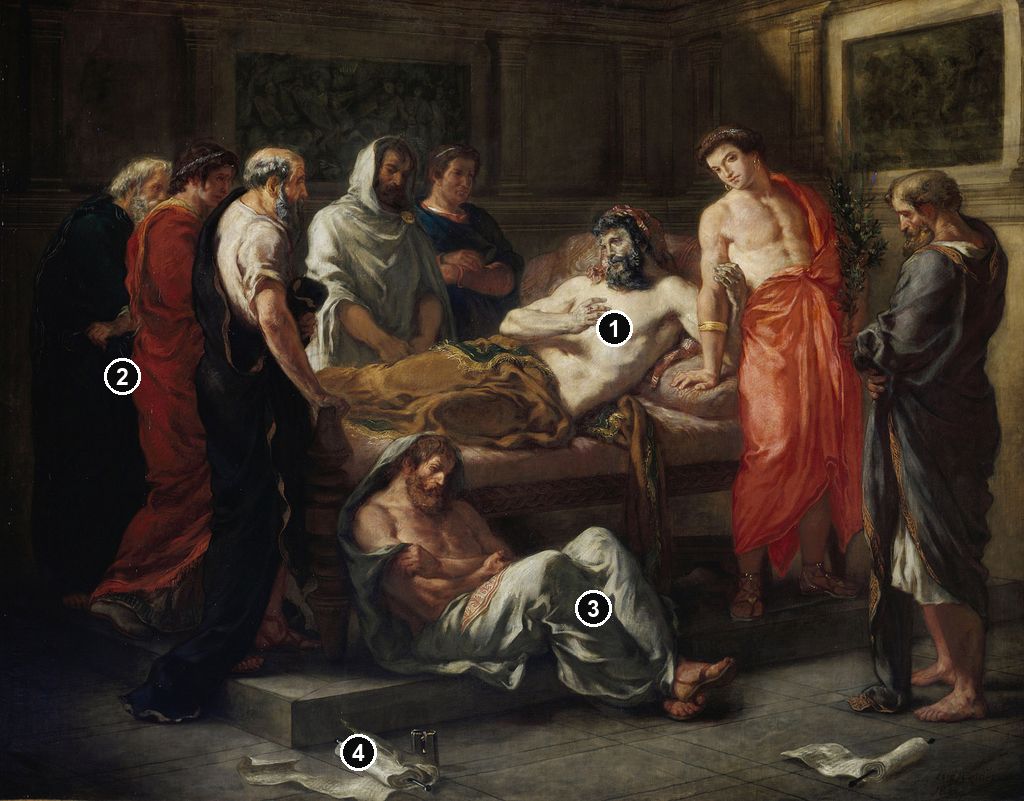
Marcus Aurelius occupies the centre without sitting upright in command. His body lies diagonally across the bed, supported at the shoulders, with his lower half covered by a heavy golden-brown cloth. One hand rests against his chest. The other crosses the interval to Commodus. The gestures divide his remaining activity between his own failing body and the person who will survive him. His beard, the dark framing of his head and the uneven light on his face give his features a worn gravity, while the exposed torso makes his dependence on the bed conspicuous.
Commodus stands on the raised platform at the right. A coral-red toga passes over one shoulder and gathers across his waist, leaving much of his chest uncovered. A gold band circles his arm below the father’s grasp. His hand rests on the cushion beside the emperor, so that his posture offers a second point of contact with the bed. He has not simply left the scene. His body remains part of its central group, even as the direction of his head weakens the exchange of looks that might have made the father’s appeal appear answered.
The title invites us to imagine speech, but Delacroix makes the encounter intelligible without supplying words. The emperor’s hand can be read as an appeal, an introduction or an attempt to detain. Commodus’s expression can suggest indifference, but the picture does not give access to a private thought. What it shows clearly is an unequal relation between effort and response. The reclining father reaches; the standing son receives the touch without visibly returning its urgency. That imbalance gives the scene its tension before any judgement about Commodus’s future is brought to it.
The traditional subject is an emperor commending his son to Stoic friends.[8] Within that story, political succession and the transmission of philosophical values become separate problems. Commodus can inherit a position; the assembled elders cannot ensure that he will accept their example. Delacroix’s nineteenth-century reconstruction makes that distinction visible through the vulnerable act of one person trying to connect another to a circle of witnesses. The imagined final speech takes its visible form in the emperor’s grasp.
The men around the bed
Five older companions form a compact group to the left. Their overlapping bodies close the space rather than opening a ceremonial avenue towards the emperor. A grey hood frames one lowered face; a red cloak gives another figure a narrow, warm vertical presence; the bearded man nearest the bed turns his exposed arm and shoulder towards it. Faces emerge at different heights and angles, so that their shared attendance does not become a row of identical expressions. Some appear absorbed in the emperor, while others seem to look across the group. The effect is of people held together by an event to which each responds separately.
At the far right, another older man stands apart, his grey drapery falling around him as he leans on a staff. His bowed head forms a subdued counterweight to Commodus’s illuminated face. The leafy sprig beside the young man introduces a small, upright accent between these two very different figures. Across the width of the picture, the older bodies enclose the bed and heir, but enclosure offers no guarantee of influence. They can witness the appeal; they cannot make the young man answer it.
The most striking interruption to their standing ranks is the man seated low in the foreground. Bare-chested and wrapped in green and pale cloth, he reclines against the bed’s platform, with his knees raised and one foot extending towards the tiled floor. His head sinks towards his shoulder. The folded posture can suggest grief or exhaustion, but its compositional force is more definite: it pulls the gathering downwards. Beneath the emperor’s supported body is another body that appears to have lost the energy to remain upright.
This foreground figure also changes our access to the central scene. His torso and drapery occupy the space immediately before the bed, preventing an unobstructed approach. The viewer must look over and around him towards the emperor’s chest and reaching hand. The step behind him marks a physical elevation, yet his presence makes that elevation precarious rather than triumphal. Power is displayed on a platform, with bodily weakness spread across its edge.
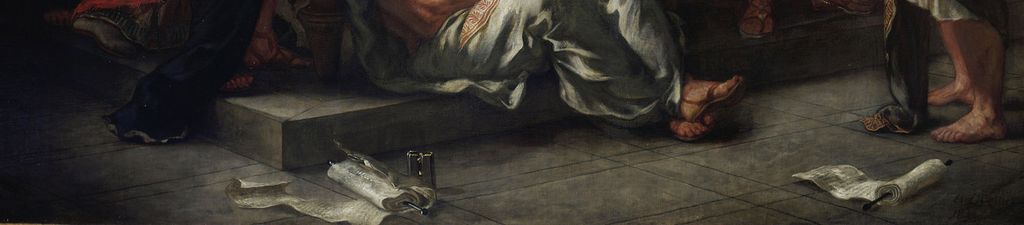
Loose sheets and partly unrolled scrolls lie on the floor. Their pale surfaces echo the cloth over the foreground man’s legs and lead the eye into the lower corners. Nothing in the image allows their writing to be read securely. As objects, however, they extend the scene beyond faces and gestures: written things remain in the room while the man at its centre is dying. Their proximity to the philosophical gathering makes the question of what can be preserved feel tangible, without requiring a particular text to be identified.
Explore Delacroix on video
An artist overview and a closer look at Liberty Leading the People.
Eugene Delacroix Paintings
An overview of Delacroix’s paintings from TheHistoryOfArt.
Watch on YouTubeAn ancient room, a familiar kind of history painting
The architecture provides a stern setting. Columns and pilasters divide the walls, with dark relief panels set between them. These surfaces are legible enough to give the gathering weight and enclosure, but subdued enough to leave the figures dominant. Strong horizontals in the wall, bed and platform steady the composition. Against them, the slant of the emperor’s torso and the foreground man’s folded legs register as human departures from architectural order.
The deathbed arrangement places Delacroix in a tradition of painting that makes a person’s final moments the occasion for a public lesson. In their 2018 Delacroix catalogue, Sébastien Allard and Côme Fabre discuss the work in relation to Nicolas Poussin’s Death of Germanicus and Jacques Louis David’s Death of Socrates. They also connect its dark austerity with Poussin’s Extreme Unction.[9] These comparisons help locate the seriousness of Delacroix’s undertaking: a room of witnesses, a central body approaching death and gestures charged with meaning. They need not imply that the painting simply copies any one predecessor.
Here the lesson remains unsettled. The emperor’s gesture is clear, but its effectiveness is not. The witnesses lend solemnity without producing agreement. Even the scale of the canvas, more than three metres wide, enlarges the uncertainty rather than resolving it. There is room to follow each attendant’s posture, the intervals between heads and the differences in the draperies. The scene’s authority comes from the sustained attention it demands, while its central exchange stays incomplete.
Preparing the bodies and gestures
A related sheet in the Louvre shows that these relationships were subjects of preparatory work. Catalogued as RF 9961, it is executed in pen and brown ink with brown wash on paper bearing a Pro Patria watermark, and measures 18.5 × 33.3 cm. The Louvre identifies studies for Marcus Aurelius and Commodus on the right, with studies for the seated foreground man in the centre and at the left. The sheet entered the museum through Étienne Moreau-Nélaton’s bequest in 1927.[10]
The distribution of subjects on that sheet is revealing even without assigning it a precise place in the sequence of preparation. Both the central pair and the low foreground figure required investigation. The first concentrates the action through touch; the second spreads its emotional weight into the space before the bed. The catalogue record supports attention to these bodily relationships, rather than a view of the work as merely a collection of antique costumes. It does not establish every step by which Delacroix arrived at the finished arrangement.
Red, green and the distribution of light
Commodus’s red toga is the painting’s strongest sustained colour. Its broad folds descend from the exposed shoulder towards the sandals, giving his standing body a continuous, conspicuous outline. The cloth is bright enough to draw the eye away from the deathbed, yet it also returns us to the emperor’s grasp. The arm held by the father belongs to the body enclosed by that red. Colour and gesture therefore compete for attention while remaining bound to the same figure.
Green answers the red across the lower centre, especially in the cloth around the reclining companion. It is a quieter, cooler presence, spread in a low mass rather than raised vertically. Smaller passages of red and dark green elsewhere prevent the two principal colours from belonging exclusively to two individuals. The eye moves among them, through brown bedding, grey clothing and areas of exposed flesh. The result is a connected room whose figures differ in visual force without becoming separate colour emblems.
Lyon’s interpretation emphasises the ambiguity of the luminous heir: the young man associated with pleasure also brings life and movement into the gathering.[1] Yet the emperor’s chest is also brightly exposed. Light catches the heads of the men at the left, runs over the grey hood and shoulder near the centre, and reaches the foreground man’s flesh and pale drapery. Darkness binds the scene together, but it does not swallow the older generation uniformly.
Charles Baudelaire made precisely this complication central to his response in the Salon de 1845. He mocked a critic’s ingenious explanation that Commodus represented the future in light while the Stoics represented the past in shadow. Almost every figure, he observed, received some light. His objection challenged the neatness of the proposed allegory. It also directs attention back to the actual picture: illumination moves among bodies whose relationships cannot be reduced to a division of the canvas into moral territories.[8]
What Baudelaire admired
Baudelaire’s enthusiasm went well beyond approval of a dramatic colour scheme. He admired the painting’s restrained, deep harmony and the balance of red and green. He also defended its drawing and modelling. For him, Delacroix’s achievement lay in making colour describe volume, movement and character, so that the organisation of light and shade worked together with the relationships between hues. Colour was part of the means by which bodies became convincing, rather than an attractive addition to an independently completed design.[8]
That argument is especially useful beside the emperor and Commodus. Their exposed torsos differ in posture and illumination, but both have to turn convincingly in space. Around them, cloth must describe a bent knee, a rounded shoulder or a hanging fold while retaining its place in the larger harmony. Baudelaire’s account gives these local decisions the importance they deserve. It also resists a familiar simplification of Delacroix as a painter whose colour compensates for deficient drawing.
The critic’s defence remains a contemporary interpretation, not a statement of Delacroix’s intentions. Its lasting value here is that it joins emotional force to close observation. The dark room can feel oppressive, the heir can seem inattentive and the companions can appear stricken, while the visible handling of light still refuses an effortless moral explanation. The painting holds those responses together without forcing them into agreement.
Return finally to the father’s hand. It has not released Commodus, and Commodus has not moved beyond its reach. The group is still assembled, the papers remain, and the appeal is still being made. Delacroix makes the threatened loss of a philosophical inheritance compelling by showing the fragile physical contact through which it is offered. The brilliance of the red toga keeps the uncertain recipient before our eyes. What endures is the interval between a dying man’s effort to pass something on and a living man’s unconfirmed response.
Annotated Details from Last Words of the Emperor Marcus Aurelius
The numbered points identify visible features discussed in this article. Return from each detail to the whole composition. Last Words of the Emperor Marcus Aurelius, 1844, oil on canvas. Musée des Beaux-Arts de Lyon; A 2928. Deposit of the Centre national des arts plastiques. Musée des Beaux-Arts de Lyon, faithful reproduction via Wikimedia Commons. Image source. Public domain. Numbers added to a separate resized overview; detail images are crops of the source reproduction. No colour or perspective changes.
Details from LAST WORDS OF THE EMPEROR MARCUS AURELIUS
Compare the broad forms in each detail with their place in the whole painting.
The father holds his son’s arm
The emperor reaches across to Commodus while his other hand rests on his chest. The young man stays close, but his turned head leaves the exchange uncertain.
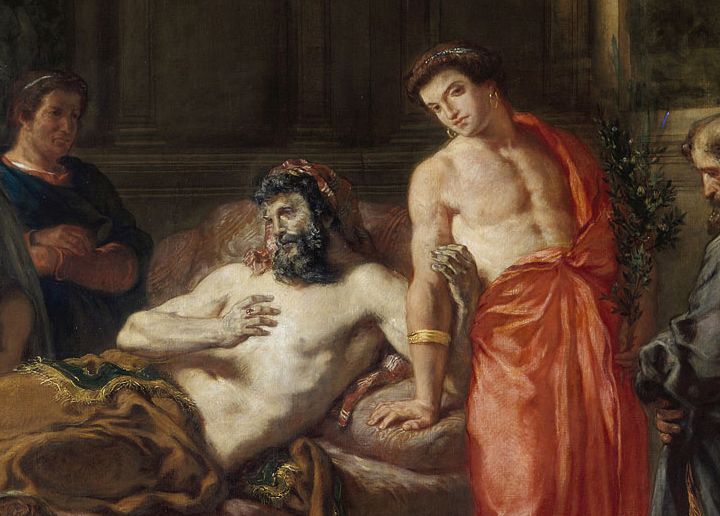
Older companions gather at the left
Five overlapping figures present different head heights and postures. Their shared attendance does not become a row of identical reactions.
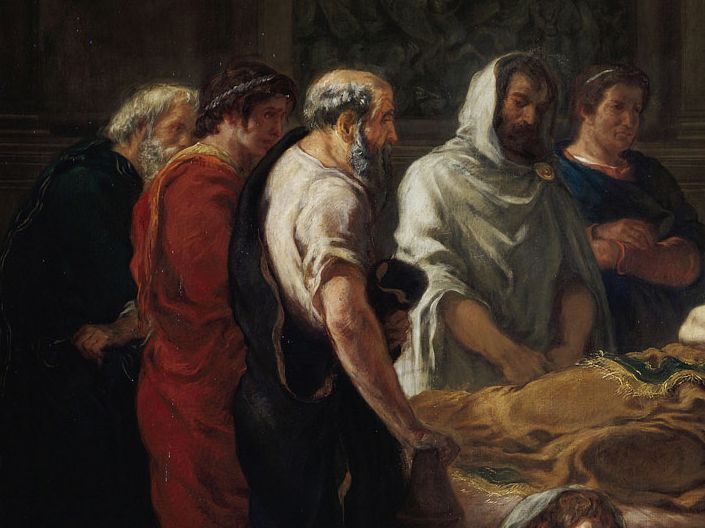
A low figure before the platform
The reclining companion pulls the gathering down towards the foreground. Pale and green cloth connect his folded posture to the floor below.
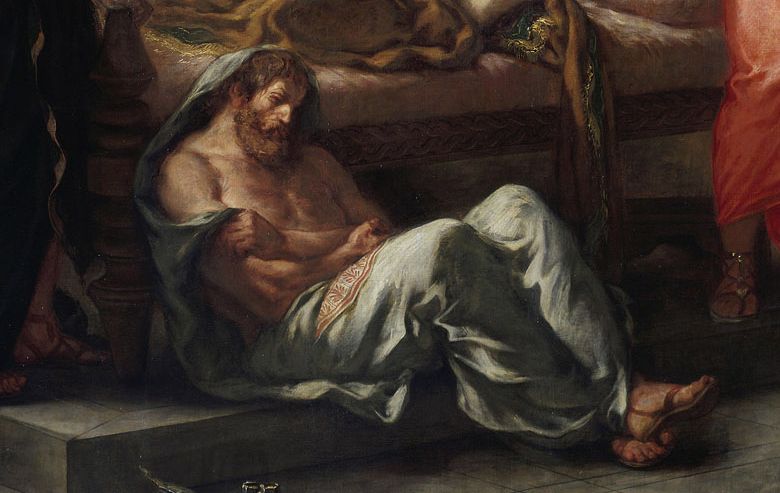
Papers remain on the tiled floor
Unrolled sheets lie below the figures. Their pale shapes carry attention across the lower edge without revealing a securely readable text.
Artworks directory
Selected documented works by or associated with Eugène Delacroix, with dates, media and collection records distinguished. This is a growing research directory, not a complete catalogue. An unspecified medium appears under All media.
| Name | Date | Medium |
|---|---|---|
| Male Academy Figure: Half‑Length, Side View | c. 1818–20 | Oil painting Catalogue. |
| Female Academy Figure: Seated, Front View (Mademoiselle Rose) | c. 1820–23 | Oil painting Catalogue. |
| Two Bearded Heads, after Veronese (detail from “The Marriage at Cana”) | 1820 | Oil painting Catalogue. |
| Self‑Portrait as Ravenswood | c.1821 | Oil painting Catalogue. |
| Nereid, after Rubens, detail from “The Landing of Maria de Medici at Marseilles” | c. 1822 | Oil painting Catalogue. |
| Studies of a Damned Man, for “The Barque of Dante” | 1822 | Drawing Catalogue. |
| Head of an Old Greek Woman | 1824 | Oil painting Catalogue. |
| Tasso in the Hospital of St. Anna, Ferrara | 1824 | Oil painting Catalogue. |
| Turk Mounting His Horse | 1824 | Aquatint Catalogue. |
| Portrait of Aspasie | About 1824 | Oil painting Catalogue. |
| Sketch after Goya’s “Caprichos” | c. 1822–24 | Drawing Catalogue. |
| Study of Babouches | c. 1823–24 | Oil painting Catalogue. |
| Thales Fielding (1793–1837) | c. 1824–25 | Oil painting Catalogue. |
| Studies of Bindings, an Oriental Jacket, and Figures after Goya | c. 1822–26 | Oil painting Catalogue. |
| Study of an Oriental Vest | c. 1822–26 | Drawing Catalogue. |
| Study of Greek Costumes | c. 1823–26 | Drawing Catalogue. |
| Christ in the Garden of Olives (The Agony in the Garden) | 1824–26 | Oil painting Catalogue. |
| Reclining Female Nude: Back View | c. 1824–26 | Oil painting Catalogue. |
| Macbeth Consulting the Witches | 1825 | Lithograph Catalogue. |
| Studies of Seven Greek Coins | 1825 | Lithograph Catalogue. |
| Studies of Twelve Greek and Roman Coins | 1825 | Lithograph Catalogue. |
| Mortally Wounded Brigand Quenches His Thirst | c.1825 | Oil painting Catalogue. |
| Charles VI and Odette de Champdivers | About 1825 | Oil painting Catalogue. |
| The Duke of Orléans Showing His Lover | About 1825–26 | Oil painting Catalogue. |
| Count Demetrius de Palatiano (1794–1849) in Suliot Costume | c. 1825–26 | Oil painting Catalogue. |
| Greece on the Ruins of Missolonghi | 1826 | Oil painting Catalogue. |
| Combat of the Giaour and Hassan | 1826 | Oil painting Catalogue. |
| Justinian Drafting His Laws, sketch | 1826 | Oil painting Catalogue. |
| Baron Schwiter (Louis Auguste Schwiter, 1805–1889) | 1826 | Lithograph Catalogue. |
| Louis Auguste Schwiter (1805–1889) | 1826–30 | Oil painting Catalogue. |
| Death of Sardanapalus, sketch | 1826–27 | Oil painting Catalogue. |
| A Lady and Her Valet | c. 1826–29 | Oil painting Catalogue. |
| Woman with a Parrot | 1827 | Oil painting Catalogue. |
| Seated Turk (possibly Paul Barroilhet, 1805–1871) | c. 1827–30 | Oil painting Catalogue. |
| A Greek and a Turk in an Interior | late 1820s | Watercolour Catalogue. |
| Faust (illustrated book) | 1828 | Illustrated book Catalogue. |
| Mephistopheles Flying over the City (Study for “Faust,” plate 1) | c. 1825–27 | Drawing Catalogue. |
| Faust, plate 1: Mephistopheles Aloft | 1826/27 | Lithograph Catalogue. |
| Faust, plate 2: Faust in His Study | 1826/27 | Lithograph Catalogue. |
| Faust, plate 3: Faust and Wagner | 1826/27 | Lithograph Catalogue. |
| Faust, plate 4: Faust, Wagner, and the Poodle | 1826/27 | Lithograph Catalogue. |
| Faust, plate 5: Mephistopheles Appearing to Faust | 1826/27 | Lithograph Catalogue. |
| Faust, plate 6: Mephistopheles Receiving the Student | 1826/27 | Lithograph Catalogue. |
| Faust and Mephistopheles in the Tavern (Study for “Faust,” plate 7) | 1825/26 | Drawing Catalogue. |
| Faust, plate 7: Mephistopheles in Auerbach’s Tavern | 1826 | Lithograph Catalogue. |
| Faust, Marguerite, and Mephistopheles in the Street (Study for “Faust,” plate 8) | c. 1825–27 | Drawing Catalogue. |
| Faust, plate 8: Faust Trying to Seduce Marguerite | 1826/27 | Lithograph Catalogue. |
| Faust, plate 9: Mephistopheles Introduces Himself at Martha’s House | 1827 | Lithograph Catalogue. |
| Faust, plate 10: Marguerite at the Spinning Wheel | 1826/27 | Lithograph Catalogue. |
| Faust, plate 11: Duel between Faust and Valentin | 1826/27 | Lithograph Catalogue. |
| Faust, plate 12: Mephistopheles and Faust Fleeing after the Duel | 1826/27 | Lithograph Catalogue. |
| Faust, plate 13: Marguerite in Church | 1826/27 | Lithograph Catalogue. |
| Faust, plate 14: Faust and Mephistopheles in the Harz Mountains | 1826/27 | Lithograph Catalogue. |
| Faust, plate 15: Marguerite’s Ghost Appearing to Faust | 1826/27 | Lithograph Catalogue. |
| Faust, plate 16: Faust and Mephistopheles Galloping on Walpurgis Night | 1826 | Lithograph Catalogue. |
| Faust, plate 17: Faust with Marguerite in Prison | 1826/27 | Lithograph Catalogue. |
| Wild Horse Felled by a Tiger | 1828 | Lithograph Catalogue. |
| Wild Horse Felled by a Tiger | 1828 | Watercolour Catalogue. |
| Wild Horse | 1828 | Lithograph Catalogue. |
| Studies of a Lion (Tours sketchbook) | 12 February 1824 or 1829 | Drawing Catalogue. |
| Sketches of Tigers and Men in Sixteenth‑Century Costume | c. 1828–29 | Watercolour Catalogue. |
| Nineteen Studies of Heads and Skulls of Lions | c. 1828–30 | Drawing Catalogue. |
| Tiger Lying at the Entrance of Its Lair | c. 1828–30 | Etching Catalogue. |
| The Murder of the Bishop of Liège | 1829 | Oil painting Catalogue. |
| Royal Tiger | 1829 | Lithograph Catalogue. |
| Lion of the Atlas Mountains | 1829–30 | Lithograph Catalogue. |
| Young Tiger Playing with Its Mother (Study of Two Tigers) | 1830 | Oil painting Catalogue. |
| The Battle of Poitiers | 1830 | Oil painting Catalogue. |
| The Battle of Nancy and the Death of Charles the Bold, Duke of Burgundy, January 5, 1477 | 1831 | Oil painting Catalogue. |
| Boissy d’Anglas at the Convention, sketch | 1831 | Oil painting Catalogue. |
| Interior of a Dominican Convent in Madrid (L’Amende Honorable) | 1831 | Oil painting Catalogue. |
| Jewish Woman of Tangier | 1832 | Drawing Catalogue. |
| Portrait of Schmareck, Tanner at Tangier | 1832 | Watercolour Catalogue. |
| Standing Moroccan | 1832 | Watercolour Catalogue. |
| A Man of Tangier | 1832 | Watercolour Catalogue. |
| Saada, the Wife of Abraham Ben‑Chimol, and Préciada, One of Their Daughters | 1832 | Watercolour Catalogue. |
| Street in Meknes | 1832 | Oil painting Catalogue. |
| Moroccan Military Exercises | 1832 | Oil painting Catalogue. |
| Arab Cavalry Practicing a Charge (Fantaisie Arabe) | 1833 | Oil painting Catalogue. |
| A Blacksmith | 1833 | Aquatint Catalogue. |
| Collision of Arab Horsemen | 1833/34 | Oil painting Catalogue. |
| Figure Study for “The Women of Algiers” | 1833/34 | Watercolour Catalogue. |
| Women of Algiers in Their Apartment | 1834 | Oil painting Catalogue. |
| The Natchez | 1823–24 and 1835 | Oil painting Catalogue. |
| Christ on the Cross | 1835 | Oil painting Catalogue. |
| Hamlet and Horatio in the Graveyard | 1835 | Oil painting Catalogue. |
| Combat of the Giaour and Hassan | 1835 | Oil painting Catalogue. |
| Léon Riesener (1808–1878) | 1835 | Oil painting Catalogue. |
| Madame Henri François Riesener (Félicité Longrois, 1786–1847) | 1835 | Oil painting Catalogue. |
| Saint Sebastian Tended by the Holy Women | 1836 | Oil painting Catalogue. |
| Medea About to Kill Her Children, sketch | c. 1836 | Oil painting Catalogue. |
| Moroccan Chieftain Receiving Tribute | 1837 | Oil painting Catalogue. |
| Self‑Portrait in a Green Vest | c. 1837 | Oil painting Catalogue. |
| Medea About to Kill Her Children (Medée furieuse) | 1838 | Oil painting Catalogue. |
| Cleopatra and the Peasant | 1838 | Oil painting Catalogue. |
| Hamlet and Horatio in the Graveyard | 1839 | Oil painting Catalogue. |
| Startled Arabian Horse in a Landscape | c. 1835–40 | Watercolour Catalogue. |
| The Shipwreck of Don Juan | 1840 | Oil painting Catalogue. |
| Christ on the Lake of Genesareth (Portland version) | c. 1853 | Oil painting Catalogue. |
| Pietà, first sketch | by 1843 | Oil painting Catalogue. |
| Pietà, second sketch | by 1843 | Oil painting Catalogue. |
| Christ on the Cross, sketch | 1845 | Oil painting Catalogue. |
| Christ on the Cross | 1846 | Oil painting Catalogue. |
| Death of Sardanapalus (Philadelphia replica) | 1844 / 1845–46 | Oil painting Catalogue. |
| The Abduction of Rebecca | 1846 | Oil painting Catalogue. |
| The Lamentation (Christ at the Tomb) | 1847–48 | Oil painting Catalogue. |
| Arab Players | 1848 | Oil painting Catalogue. |
| Arch of Morning Glories, study for “Basket of Flowers” | 1848/49 | Pastel Catalogue. |
| Basket of Flowers | 1848–49 | Oil painting Catalogue. |
| Basket of Flowers and Fruit | 1849 | Oil painting Catalogue. |
| Basket of Flowers | c. 1848–50 | Oil painting Catalogue. |
| Christ at the Column | probably 1849 | Oil painting Catalogue. |
| Landscape at Champrosay | possibly 1849 | Oil painting Catalogue. |
| Michelangelo in His Studio | About1849–50 | Oil painting Catalogue. |
| View in the Forest of Sénart | c. 1849–50 | Oil painting Catalogue. |
| Forest View with an Oak Tree | c. 1849–50 | Watercolour Catalogue. |
| The Triumph of Genius over Envy | c. 1849–51 | Drawing Catalogue. |
| Jacob Struggling with the Angel | 1850 | Drawing Catalogue. |
| Jacob Wrestling with the Angel | 1850 | Drawing Catalogue. |
| Jacob Wrestling with the Angel | 1850 | Oil painting Catalogue. |
| Sunset | c. 1850 | Pastel Catalogue. |
| Apollo Slays the Python, sketch | c. 1850 | Oil painting Catalogue. |
| Apollo Victorious over the Serpent Python, sketch | c. 1850 | Oil painting Catalogue. |
| Pietà | About1850 | Oil painting Catalogue. |
| The Agony in the Garden | 1851 | Oil painting Catalogue. |
| Study of the Sea | 1851(?) | Watercolour Catalogue. |
| Marphise | 1852 | Oil painting Catalogue. |
| The Sea at Dieppe | 1852 | Oil painting Catalogue. |
| Christ Asleep during the Tempest | c. 1853 | Oil painting Catalogue. |
| Saint Stephen Borne Away by His Disciples | 1853 | Oil painting Catalogue. |
| Christ on the Sea of Galilee | 1854 | Oil painting Catalogue. |
| The Sea at Dieppe | probably 1854 | Watercolour Catalogue. |
| A Lion and a Tiger, Fighting | c. 1854 | Drawing Catalogue. |
| Lion Hunt, sketch | 1854 | Oil painting Catalogue. |
| Lion Hunt (fragment) | 1855 | Oil painting Catalogue. |
| Lion Hunt | 1855–56 | Oil painting Catalogue. |
| Hilly Landscape | c. 1855 | Oil painting Catalogue. |
| The Sultan of Morocco and His Entourage | 1856 | Oil painting Catalogue. |
| The Bride of Abydos (Selim and Zuleika) | 1857 | Oil painting Catalogue. |
| Lamentation over the Body of Christ | 1857 | Oil painting Catalogue. |
| Abduction of Rebecca | 1858 | Oil painting Catalogue. |
| Ovid among the Scythians | 1859 | Oil painting Catalogue. |
| Amadis de Gaule Delivers a Damsel from Galpan’s Castle | 1859–60 | Oil painting Catalogue. |
| Arab Horses Fighting in a Stable | 1860 | Oil painting Catalogue. |
| Shipwreck on the Coast | 1862 | Oil painting Catalogue. |
| The Battle of Taillebourg won by Saint Louis (Château de Versailles) | 1837 | Oil on canvas Catalogue. |
| Christ on the Lake of Gennezaret (Christ Asleep during the Tempest) (The Metropolitan Museum of Art) | About 1853 | Oil on canvas Catalogue. |
| The Coast of Spain at Salabrena (Christie’s 1998 sale 6059, lot 123) | 19 January 1832 | Pen and ink Catalogue. |
| Crouching Tiger (The Metropolitan Museum of Art) | 1839 | Pen and ink Catalogue. |
| The Education of Achilles (J. Paul Getty Museum) | 1862 | Pastel Catalogue. |
| Fallen Warriors and a Runaway Horse (The Metropolitan Museum of Art) | 1862 | Pen and ink Catalogue. |
| George Sand's Garden at Nohant (The Metropolitan Museum of Art) | About 1842–43 | Oil on canvas Catalogue. |
| The Giaour on Horseback (The Metropolitan Museum of Art) | 1824–26 | Pen and ink Catalogue. |
| Lion Hunt (Art Institute of Chicago) | 1860–61; signed 1861 | Oil on canvas Catalogue. |
| Figure Studies related to Liberty Leading the People | 1830 | Pen and brown ink, brush and brown wash Catalogue. |
| Chios: Head, Shoulder and Foot Studies | 1823 | Graphite Catalogue. |
| Figure Studies for the Salon du Roi, Palais Bourbon | 1833–35 | Pen and iron gall ink Catalogue. |
| Four Studies of Horses | 1824–25 | Pen, ink, black wash and graphite (recto); graphite (verso) Catalogue. |
| Studies of a Horse and Rider for Heliodorus Driven from the Temple | 1849–50 | Pen and iron gall ink, graphite Catalogue. |
| Liberty Leading the People | 1830 | Oil on canvas Catalogue. |
| Massacre at Chios | 1824 | Oil on canvas Catalogue. |
| Death of Sardanapalus (Louvre original) | 1827 | Oil on canvas Catalogue. |
| Barque of Dante | 1822 | Oil painting Catalogue. |
| Orphan Girl at the Cemetery | 1824 | Oil painting Catalogue. |
| Jacob Wrestling with the Angel (Saint-Sulpice wall painting) | Completed 1861 | Wall painting Catalogue. |
| Heliodorus Driven from the Temple (Saint-Sulpice wall painting) | Completed 1861 | Wall painting Catalogue. |
| African Pirates Abducting a Young Woman | 1852 | Oil painting Catalogue. |
| An Arab Horseman at the Gallop | 1849 | Oil painting Catalogue. |
| Arabs Skirmishing in the Mountains | 1863 | Oil painting Catalogue. |
| Moroccan Horseman Crossing a Ford | About 1850 | Oil painting Catalogue. |
| A Moroccan (Arab) Saddling a Horse | 1855 | Oil painting Catalogue. |
| The Execution of the Doge Marino Faliero | 1825–26 | Oil painting Catalogue. |
| Christopher Columbus and his Son at La Rábida | 1838 | Oil painting Catalogue. |
| Horse Frightened by Lightning | 1825–29 | Watercolour Catalogue. |
| Horses Leaving the Sea | 1860 | Oil painting Catalogue. |
| Tiger with a Tortoise | 1862 | Oil painting Catalogue. |
| Tiger | About1830 | Watercolour Catalogue. |
| Tiger and Snake | 1862 | Oil painting Catalogue. |
| Tiger Hunt | 1854 | Oil painting Catalogue. |
| Lion Hunt in Morocco | 1854 | Oil painting Catalogue. |
| Lion Rending Apart a Corpse | About1848;historical catalogue placement | Watercolour Catalogue. |
| Frederic Chopin | 1838 | Oil painting Catalogue. |
| Portrait of George Sand | 1838 | Oil painting Catalogue. |
| Portrait of Frédéric Chopin and George Sand | 1838 | Oil painting Catalogue. |
| Mademoiselle Rose | About 1820 | Oil painting Catalogue. |
| Head of a Woman in a Red Turban | 1831; archive date | Oil painting Catalogue. |
| Two Views of a Standing Indian from Calcutta | About 1823–24 | Oil painting Catalogue. |
| Last Words of the Emperor Marcus Aurelius | 1844 | Oil painting Catalogue. |
| Entry of the Crusaders in Constantinople | 1840 | Oil painting Catalogue. |
| Medea | 1862 | Oil painting Catalogue. |
| The Death of Laras | 1858 | Oil painting Catalogue. |
| The Bride of Abydos | About 1852–53; dating disputed | Oil painting Catalogue. |
| The Bride of Lammermoor | About1826 | Watercolour Catalogue. |
| Cromwell at Windsor Castle | 1828 | Oil painting Catalogue. |
| Milton Dictated to his Daughters the Paradise Lost | 1827–28 | Oil painting Catalogue. |
| Tasso in the Madhouse | 1839 | Oil painting Catalogue. |
| Christ on the Cross | 1853 | Oil painting Catalogue. |
| The Disciples at Emmaus | 1853 | Oil painting Catalogue. |
| The Entombment of Christ | Nineteenth century; precise date unestablished | Oil painting Catalogue. |
| Fanatics of Tangier | 1837–38 | Oil painting Catalogue. |
| Jewish Bride | Undated; Moroccan subject associated with the1832journey | Watercolour Catalogue. |
| Jewish Wedding in Morocco | 1839; Salon1841 | Oil painting Catalogue. |
| Moroccan Fantasia | 1847 | Oil painting Catalogue. |
| The Sultan of Morocco | 1845 | Oil painting Catalogue. |
| Bouquet of Flowers 1843 | 1843 | Watercolour Catalogue. |
| Bouquet of Flowers, 1849 | 1849 | Watercolour Catalogue. |
| Cliffs Near Dieppe | 1852–55 | Watercolour Catalogue. |
| The Edge of a Wood at Nohant | c.1842/1843 | Watercolour Catalogue. |
| Still Life with Lobsters | 1826–27 | Oil on canvas Catalogue. |
| A Corner of the Studio (attribution disputed) | 1825–1850; attribution disputed | Oil on canvas Catalogue. |
| Study of the Sky at Sunset | c.1849 | Pastel Catalogue. |
| Self-Portrait, about 1840 | c.1840 | Oil on canvas Catalogue. |
| Women of Algiers in Their Apartment (1849) | 1849 | Oil on canvas Catalogue. |
| Susanna and the Elders | 1841 | Oil on canvas Catalogue. |
| The Education of Achilles (Drawing) | c.1844 | Graphite Catalogue. |
| Attila the Hun | Completed 1847 | Mural detail Catalogue. |
| The Italian Theatre | 1821 | Lithograph Catalogue. |
| A Turkish Man on a Grey Horse | Undated | Not specified Catalogue. |
| Study for The Massacre at Chios | About 1823–24 | Graphite, watercolour and gouache on paper Catalogue. |
| The Prisoner of Chillon | 1834; Salon of 1835 | Oil on canvas Catalogue. |
| Two Knights Fighting in a Landscape | Second quarter of the nineteenth century; precise date uncertain | Oil on canvas; possible later completion Catalogue. |
Discussion
Look again at the images and ideas explored in Last Words of the Emperor Marcus Aurelius. These editorial prompts invite your observations.
Reader Insights
Follow the emperor’s grasp to Commodus’s upper arm. Does the young man’s gaze complete the exchange?
Look for light across the older figures as well as the young heir. How does it complicate a simple opposition between them?
Join the Conversation
Share a detail, comparison or question about Last Words of the Emperor Marcus Aurelius below.
References
- Musée des Beaux-Arts de Lyon, “Dernières paroles de l’empereur Marc Aurèle”, collection record and interpretative text, inventory A 2928. Museum object page. French. Accessed 28 October 2026. View source.
- The Metropolitan Museum of Art, “The Giaour on Horseback”, Eugène Delacroix, 1824–26, accession 2015.713.2, collection record and recto image. Source language: English. Accessed 27 October 2026. View source.
- Ministère de la Culture, base Joconde, Bataille de Taillebourg. 21 juillet 1242, notice 000PE005883; collection du château de Versailles, MV 2676 / INV 3822 / LP 2780. French. Accessed 27 October 2026. View source.
- Musée des Beaux-Arts de Lyon, Last Words of the Emperor Marcus Aurelius,1844,A2928; complete owner record and interpretation. French. Accessed 28 October 2026. View source.
- Asher Miller, compiler, “Checklist,” entries 1–145, in Sébastien Allard and Côme Fabre, Delacroix. New York: The Metropolitan Museum of Art, 2018, pp. 275–297. Basic title, date and medium metadata consulted; not a complete catalogue of the artist’s works. Source language: English. Accessed 28 October 2026. View source.
- The Metropolitan Museum of Art, “Eugène Delacroix: Christ Asleep during the Tempest,” collection record, accession 29.100.131, object details and introductory commentary. Source language: English. Accessed 28 October 2026. View source.
- George R. Goldner and Lee Hendrix, with Kelly Pask, European Drawings 2: Catalogue of the Collections. Malibu: J. Paul Getty Museum, 1992, entry 56, p. 140; colour plate 8. Source language: English. Accessed 27 October 2026. View source.
- Charles Baudelaire, “Dernières paroles de Marc-Aurèle”, Salon de 1845, collected in Curiosités esthétiques. Public-domain transcription, complete named subsection. French. Accessed 28 October 2026. View source.
- Sébastien Allard and Côme Fabre, Delacroix, exhibition catalogue (New York: The Metropolitan Museum of Art, 2018), pp. 100 and 120; p. 166 corroborates the Salon year of 1845. Catalogue PDF. English. Accessed 28 October 2026. View source.
- Musée du Louvre, Département des Arts graphiques, “Feuille d’études de personnages vêtus à l’antique. Dessin préparatoire pour les Dernières Paroles de l’empereur Marc-Aurèle”, RF 9961, recto, collection record, including commentary citing Hélène Grollemund. Louvre object record. French. Accessed 28 October 2026. View source.
- Asher Ethan Miller, “Eugène Delacroix, Christ on the Sea of Galilee, 1853 or earlier,” French Paintings and Pastels, 1600–1945, Nelson-Atkins Museum of Art, 2021. Narrative and notes, including the revised Portland chronology; Glynnis Napier Stevenson documentation note 1 also consulted. Source language: English. Accessed 28 October 2026. View source.
- Christie’s, “The Coast of Spain at Salabrena”, Ferdinand-Victor-Eugène Delacroix, Impressionist & 19th Century Art, Pt. II, sale 6059, lot 123, 1998. Object details, sale-room notice and lot essay; unpaginated. Source language: English; artist’s inscription in French. Accessed 27 October 2026. View source.
- The Metropolitan Museum of Art, “Eugène Delacroix: Crouching Tiger”, collection record for accession 2013.1135.5, 1839; object details and curatorial commentary, unpaginated. Source language: English. Accessed 28 October 2026. View source.
- The Metropolitan Museum of Art, “Fallen Warriors and a Runaway Horse”, collection record, object details, curatorial commentary and collection image; unpaginated. Source language: English. Accessed 28 October 2026. View source.
- The Metropolitan Museum of Art, “George Sand’s Garden at Nohant,” Eugène Delacroix, collection record, accession 22.27.4; object details and curatorial overview. Source language: English. Accessed 27 October 2026. View source.
- Art Institute of Chicago, “Lion Hunt”, collection record, especially “About this artwork”, object information, inscriptions and provenance; unpaginated. Source language: English. Accessed 28 October 2026. View source.
- The Metropolitan Museum of Art, Figure Studies related to Liberty Leading the People, 1830, 2013.1135.12. Visible object metadata and short commentary. English. Accessed 28 October 2026. View source.
- The Metropolitan Museum of Art, Head, Shoulder, and Foot, Studies for Scenes from the Chios Massacres, 1823, 2013.1135.22. Visible object metadata and commentary. English. Accessed 28 October 2026. View source.
- The Metropolitan Museum of Art, Figure Studies for the Salon du Roi, Palais Bourbon, 1833–35, 2013.1135.24. Visible metadata and commentary. English. Accessed 28 October 2026. View source.
- The Metropolitan Museum of Art, Four Studies of Horses, 1824–25, 2024.591.65. Recto and verso metadata and commentary. English. Accessed 28 October 2026. View source.
- The Metropolitan Museum of Art, Studies of a Horse and Rider for Heliodorus Driven from the Temple, 1849–50, 2024.591.78. Visible metadata and commentary. English. Accessed 28 October 2026. View source.
- Musée du Louvre, Le 28 juillet 1830. La Liberté guidant le peuple, RF 129, 1830. Object details and historical record. French. Accessed 28 October 2026. View source.
- Musée du Louvre, Scènes des massacres de Scio, INV 3823, 1824. Object details and historical record. French. Accessed 28 October 2026. View source.
- Musée du Louvre, Mort de Sardanapale, RF 2346, 1827. Object details and historical record. French. Accessed 28 October 2026. View source.
- Philadelphia Museum of Art, The Death of Sardanapalus, object 82626, 1986-26-17, dated 1844. Heading and short commentary; dating differs from the 2018 catalogue. English. Accessed 28 October 2026. View source.
- Musée du Louvre, Dante et Virgile, dit aussi La barque de Dante, INV 3820, 1822; object metadata and history. French. Accessed 28 October 2026. View source.
- Musée du Louvre, Jeune orpheline au cimetière, RF 1652, 1824; object metadata and history. French. Accessed 28 October 2026. View source.
- Musée des Beaux-Arts de Bordeaux, La Grèce sur les ruines de Missolonghi, Bx E 439, 1826; collection record and audio transcript. French. Accessed 28 October 2026. View source.
- Ville de Paris, Retrouvez les chefs d’œuvres de Delacroix à la chapelle des Saints-Anges de Saint-Sulpice, updated 30 November 2016; chapel commission/completion and material history. French. Accessed 28 October 2026. View source.
- Musée du Louvre, Pirates africains enlevant une jeune femme, RF 1965 9, 1852; object record, interpretation and provenance. French. Accessed 28 October 2026. View source.
- Qatar Museums, Tales of a Connected World: About the Galleries; Arab Horseman at the Gallop, 1849, Lusail Museum Collection, and Delacroix’s Gaze. English. Accessed 28 October 2026. View source.
- National Gallery of Art, Arabs Skirmishing in the Mountains, 1863, 1966.12.1; object metadata, interpretation and provenance. English. Accessed 28 October 2026. View source.
- J. Paul Getty Museum, Moroccan Horseman Crossing a Ford, about 1850, 2001.42; Getty-authored commentary and metadata on Google Arts & Culture. English. Accessed 28 October 2026. View source.
- State Hermitage Museum, Moroccan Saddling a Horse, 1855, ГЭ-3852; complete indexed Russian owner text and object fields. Russian. Accessed 28 October 2026. View source.
- Paris Musées / Petit Palais, Le Combat du Giaour et du Pacha,1835,PDUT1162; object record and interpretation. French. Accessed 28 October 2026. View source.
- Art Institute of Chicago, The Combat of the Giaour and Hassan,1826; owner-authored Google Arts & Culture object record. English. Accessed 28 October 2026. View source.
- Ackland Art Museum, Cleopatra and the Peasant,1838,59.15.1; indexed owner object fields. English. Accessed 28 October 2026. View source.
- The Wallace Collection, The Execution of the Doge Marino Faliero,1825–26,P282; object record and description. English. Accessed 28 October 2026. View source.
- National Gallery of Art, Christopher Columbus and His Son at La Rábida,1838,1963.10.127; object record and provenance. English. Accessed 28 October 2026. View source.
- Musée d’Orsay, Chevaux arabes se battant dans une écurie,1860,RF1988; indexed owner object fields. French. Accessed 28 October 2026. View source.
- Museum of Fine Arts, Budapest / Zsuzsa Gonda, Horse Frightened by Lightning,1825–29,D_1935-2698; owner-authored Google Arts & Culture record and essay. English. Accessed 28 October 2026. View source.
- The Phillips Collection, Horses Coming Out of the Sea,1860,0486; collection record and commentary. English. Accessed 28 October 2026. View source.
- Musée du Louvre, Jeune Tigre jouant avec sa mère,1830,RF1943; full object record and history. French. Accessed 28 October 2026. View source.
- Christie’s, Tigre jouant avec une tortue,1862; Rockefeller2018 sale16718 lot3, record and essay. English. Accessed 28 October 2026. View source.
- National Gallery of Art, Tiger, about1830,1943.3.3375; indexed owner record, inscription and visual description. English. Accessed 28 October 2026. View source.
- National Gallery of Art, Tiger and Snake,1862,2014.136.30; indexed owner record, provenance and visual description. English. Accessed 28 October 2026. View source.
- Musée d’Orsay, Chasse au tigre,1854,RF1814; indexed owner record and commentary. French/English. Accessed 28 October 2026. View source.
- State Hermitage Museum, Lion Hunt in Morocco,1854,3853; official guide2014,entry195,pp248–249. English. Accessed 28 October 2026. View source.
- Alfred Robaut / Ernest Chesneau, L’Œuvre complet de Eugène Delacroix,1885,p279,entry1054,watercolour Lion déchirant un cadavre. French. Accessed 28 October 2026. View source.
- Musée du Louvre, Frédéric Chopin, 1838, RF 1717; current owner record of the surviving fragment. French. Accessed 28 October 2026. View source.
- Museum Ordrupgaard, George Sand, 1838, 280WH; current owner dimensions/materials/signature record. Danish. Accessed 28 October 2026. View source.
- Musée du Louvre, Preparatory study for Chopin and George Sand, circa 1838, RF 9357; owner record and commentary. French/English. Accessed 28 October 2026. View source.
- Musée du Louvre, Portrait de Léon Riesener, 1835, RF 1960 58; current owner metadata, label transcription and commentary. French. Accessed 28 October 2026. View source.
- The National Gallery, London, Louis-Auguste Schwiter, 1826–30, NG 3286; current owner record and in-depth commentary. English. Accessed 28 October 2026. View source.
- Musée du Louvre, Nu assis, dit Mademoiselle Rose, about 1820, RF 1942 14; complete owner object record. French. Accessed 28 October 2026. View source.
- Musée Fabre, Étude d’après le modèle Aspasie, about 1824, 868.1.36; current owner fields and short commentary. French. Accessed 28 October 2026. View source.
- Musées d’Orléans, Head of an Old Greek Woman, study for Chios,1824,96.2.1; full owner record and commentary. French. Accessed 28 October 2026. View source.
- Art Fund, Head of a Woman in Red Turban By Lamplight; archive date1831, rounded dimensions and1962acquisition support; archive cautions record notupdated. English. Accessed 28 October 2026. View source.
- National Gallery of Art, Two Studies of a Standing Indian from Calcutta,c1823/1824,2006.128.18; current owner record and visual description. English. Accessed 28 October 2026. View source.
- National Gallery of Art, Two Studies of an Indian from Calcutta,Seated and Standing,c1823/1824,2006.128.19; separate comparative canvas,current owner record. English. Accessed 28 October 2026. View source.
- Musée du Louvre, The Assassination of the Bishop of Liège,1829,RF1961 13; complete owner fields and selected provenance. French. Accessed 28 October 2026. View source.
- Musée des Beaux-Arts de Nancy, The Battle of Nancy, signed1831,177; current object fields, narrative and acquisition history. French. Accessed 28 October 2026. View source.
- Mar Borobia, Museo Nacional Thyssen-Bornemisza, The Duke of Orléans Showing His Lover,about1825–26,127(1977.19); complete object record and essay. English. Accessed 28 October 2026. View source.
- Musée du Louvre, Entry of the Crusaders in Constantinople,1840,INV3821/LP4674; current owner description, commission and provenance. French. Accessed 28 October 2026. View source.
- Musée du Louvre, Medea,1862,RF1402; later variant of the1838Lilleoriginal,current object record. French. Accessed 28 October 2026. View source.
- Musée du Louvre, The Shipwreck of Don Juan,1840,RF359; current owner fields and1883gift record. French. Accessed 28 October 2026. View source.
- Musée du Louvre, The Bride of Abydos,RF1398; current dimensions/bequest and broad date differing from the2018catalogue. French. Accessed 28 October 2026. View source.
- Palais des Beaux-Arts de Lille, Medea About to Kill Her Children,1838,P542; the earlier large original,current owner record. French. Accessed 28 October 2026. View source.
- Kimbell Art Museum, Selim and Zuleika,1857,AP1986.04; separate final version, complete indexed owner narrative/provenance. English. Accessed 28 October 2026. View source.
- Art Gallery of Ontario, The Bride of Lammermoor,about1826,80/83; graphite,watercolour andgouache,collection/provenance record. English. Accessed 28 October 2026. View source.
- Christie’s, Cromwell at Windsor Castle,1828,Johnson129;2002auction record/lotessay and1831Salon listing. English. Accessed 28 October 2026. View source.
- Musée Fabre, Michelangelo in His Studio,1850,868.1.40;current object fields andinterpretive notice. French. Accessed 28 October 2026. View source.
- Kunsthaus Zürich, Milton Dictating Paradise Lost to His Daughters,1827–28,1988/0028;current ownerPDF. English. Accessed 28 October 2026. View source.
- Sammlung Oskar Reinhart Am Römerholz, Tasso in the Madhouse,1839,oil60×50cm;owner object record. English. Accessed 28 October 2026. View source.
- The National Gallery, London, Christ on the Cross,1853,NG6433;oil73.5×59.7cm,currentobjectrecord. English. Accessed 28 October 2026. View source.
- The Walters Art Museum, Christ on the Sea of Galilee,1854,37.186;oil59.8×73.3cm,currentobjectrecord. English. Accessed 28 October 2026. View source.
- Brooklyn Museum, The Disciples at Emmaus,1853,50.106;oil55.2×47cm,currentobjectrecord. English. Accessed 28 October 2026. View source.
- INHA / Joconde, La Mise au tombeau,copyafterTitian,LyonB286;oil40×55.5cm,nineteenthcentury,currentobjectfields. French. Accessed 28 October 2026. View source.
- Nasjonalmuseet, Oslo, Pietà,about1850,NG.M.01179;oil35.6×27cm,currentobjectrecord. English. Accessed 28 October 2026. View source.
- Minneapolis Institute of Art, Convulsionists of Tangier,1837–38,73.42.3;oil95.57×128.59cm,owner-published collection data. English. Accessed 28 October 2026. View source.
- Musée du Louvre, Mariée juive à Tanger,undated,RF4614Recto;watercolour/graphite28.5×23.2cm,currentobjectrecord. French. Accessed 28 October 2026. View source.
- Musée du Louvre, Noce juive dans le Maroc,1839,INV3825/LP4737;oil105×140.5cm,Salon1841,currentobjectrecord. French. Accessed 28 October 2026. View source.
- Swiss Federal Office of Culture, Marokkanische Soldaten bei einer Gefechtsübung,1847,SOR1936.3;oil66×82cm,Römerholz,currentobjectrecord. German. Accessed 28 October 2026. View source.
- Musée des Augustins, Toulouse, Moulay Abd-er-Rahman,sultan du Maroc,1845,2004 1 99;oil384×344cm,currentobjectrecord. French. Accessed 28 October 2026. View source.
- French Ministry of Culture / Musée Fabre, Bouquet de fleurs, 1843, inventory 876.3.101; black pencil and watercolour, 20.5 × 26.4 cm. Current Joconde collection record. French. Accessed 28 October 2026. View source.
- Musée du Louvre, Bouquet de fleurs, 1849, RF 31719, Recto; watercolour, gouache and pastel over black pencil on two joined sheets of grey paper, 65 × 65.4 cm. Current collection record. French. Accessed 28 October 2026. View source.
- Musée Marmottan Monet, Monet collectionneur – Chefs-d’œuvre de sa collection privée, 2017 press dossier, printed p.24 (PDF p.23). Cliffs near Dieppe, 1852–55, watercolour, 20 × 30.7 cm; reproduction and collection history. French. Accessed 28 October 2026. View source.
- National Gallery of Art, Washington, The Edge of a Wood at Nohant, c.1842/1843, accession 1985.16.2; watercolour, 15.5 × 20.5 cm. Current collection record. English. Accessed 28 October 2026. View source.
- Musée du Louvre, La mer vue des hauteurs de Dieppe, RF 1979-46; oil on cardboard glued to wood, 36 × 52 cm. Current collection record; 1852 dating follows the 2018 Delacroix catalogue, no.128. French. Accessed 28 October 2026. View source.
- Musée du Louvre, Nature morte au homard, RF1661,1826–27, oil on canvas80.5×106.5cm. French. Accessed 28 October 2026. View source.
- Musée du Louvre, Coin d’atelier. Le poêle, RF2058,1825–1850,oil51×43.4cm; doubtful signature and disputed attribution. French. Accessed 28 October 2026. View source.
- Musée du Louvre, Etude de ciel au soleil couchant, RF3706 Recto,c1849,pastel on grey paper19.2×23.8cm. French. Accessed 28 October 2026. View source.
- Ministero della Cultura / Gallerie degli Uffizi, Autoritratto di Delacroix,0900099717,Inv1890no3914,c1840,oil66×54cm; complete six-page SIGEC record. Italian. Accessed 28 October 2026. View source.
- Musée du Louvre / Musée national Eugène-Delacroix, Portrait de Delacroix en Hamlet, formerly Ravenswood,MD2021-2/RF1953-38,c1821,oil41×33cm. French. Accessed 28 October 2026. View source.
- Musée Fabre, Femmes d’Alger dans leur intérieur, 1849, 868.1.38, oil on canvas, 85 × 112 cm. French. Accessed 28 October 2026. View source.
- Musée des Beaux-Arts de Lyon, Femme caressant un perroquet, 1827, B 566, oil on canvas, 24.8 × 33 cm. French. Accessed 28 October 2026. View source.
- Palais des Beaux-Arts de Lille, Suzanne et les vieillards, 1841, P 986, oil on canvas, 27 × 35.5 cm. French. Accessed 28 October 2026. View source.
- Kunstmuseum Basel, Ein sterbender Brigant trinkt an einer Quelle, c.1825, 1726, oil on canvas, 32.7 × 40.8 cm. German. Accessed 28 October 2026. View source.
- The Metropolitan Museum of Art, The Education of Achilles, c.1844, 2014.732.3, graphite, 23.6 × 29.7 cm. English. Accessed 28 October 2026. View source.
- Assemblée nationale, Attila and His Hordes Overrun Italy and the Arts, War hemicycle detail, library of the Palais Bourbon, completed 1847, oil and wax on plaster. French. Accessed 28 October 2026. View source.
- The Metropolitan Museum of Art, Théâtre Italien, 13 August 1821, 2004.198, lithograph, sheet 25.6 × 18.6 cm. English. Accessed 28 October 2026. View source.
- The Metropolitan Museum of Art, Macbeth Consulting the Witches, 1825, 22.63.19, lithograph, third state of five. English. Accessed 28 October 2026. View source.
- Musée du Louvre, Hamlet et Horatio au cimetière, 1839, RF 1942, oil on canvas, 82 × 65 cm. French. Accessed 28 October 2026. View source.
- National Gallery, London, Ovid among the Scythians, 1859, NG6262, oil on canvas, 87.6 × 130.2 cm. English. Accessed 28 October 2026. View source.
- Museum of Fine Arts, Houston, The Abduction of Rebecca, Eugène Louis Lami, 1873, 88.341. Comparative attribution correction; not a Delacroix work. English. Accessed 28 October 2026. View source.
- The Metropolitan Museum of Art, Devotion to Drawing: The Karen B. Cohen Collection of Eugène Delacroix, 2018 exhibition overview. English. Accessed 28 October 2026. View source.
- New York Public Library, Print Collection: Print Glossary, definitions of impression, state, edition and processes. English. Accessed 28 October 2026. View source.
- Museum of Fine Arts, Boston, CAMEO, Lithograph, planographic printing glossary. English. Accessed 28 October 2026. View source.
- Musée Eugène-Delacroix, Delacroix and colour, 5 July 2022, collection article. English. Accessed 28 October 2026. View source.
- Musée du Louvre, Eugène Delacroix: artist biography. French. Accessed 28 October 2026. View source.
- Eugène Delacroix / Philippe Burty, editor, Lettres (1815–1863), Paris: A. Quantin, 1878, pp. 120–121; the published extract of 25 January 1832 and opening of 8 February. French. Accessed 28 October 2026. View source.
- The Metropolitan Museum of Art, A Wall Decorated in Spanish Tiles, 1832, 2013.1135.16; collection record. English. Accessed 28 October 2026. View source.
- National Gallery of Art, Washington, Mephistopheles in the Air, 1828, 1994.60.13; first state of five. English. Accessed 28 October 2026. View source.
- The Metropolitan Museum of Art, Hamlet Sees the Ghost of His Father on the Terrace, 1843, 22.56.7; first state of five. English. Accessed 28 October 2026. View source.
- Eugène Delacroix / Paul Flat and René Piot, editors, Journal, 22 June 1863; Paris: Plon, 1893, volume III, page 438. French. Accessed 28 October 2026. View source.
- Musée du Louvre, Apollo Slays Python, 1850–51; INV 3818. Collection record. French. Accessed 28 October 2026. View source.
- Sotheby’s, A Turkish Man on a Grey Horse, catalogued under Eugène Delacroix; sale N07716, 2001, lot 20. English. Accessed 28 October 2026. View source.
- Splash image, Last Words of the Emperor Marcus Aurelius, 1844, oil on canvas. Musée des Beaux-Arts de Lyon; A 2928. Deposit of the Centre national des arts plastiques. Musée des Beaux-Arts de Lyon, faithful reproduction via Wikimedia Commons. Image source. Public domain. Whole supplied primary image retained, including documentary/support edges; no appearance editing.


