 by Tom Gurney
Tom Gurney BSc (Hons) is an art history expert with over 20 years experience
Published on June 19, 2020 / Updated on November 5, 2026
Email: tomgurney1@gmail.com / Phone: +44 7429 011000
Metabolism
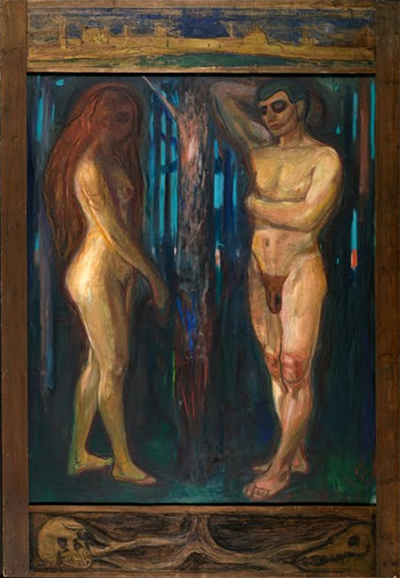
A naked woman and man stand on opposite sides of a tree. Behind them, a dense succession of trunks makes the forest feel both enclosing and rhythmic. The woman faces inward, her long red hair falling against her pale body. The man's bent arms create a more angular answer. They share the same ground but do not touch.
Edvard Munch's Metabolism, dated 1898–1899, belongs to MUNCH in Oslo. Its Norwegian title, Stoffveksling. Liv og død, explicitly joins life and death. The museum records the oil painting as MM.M.00419, Woll M 428, with image dimensions of 175 × 143 centimetres. Its carved frame extends the subject beyond the painted forest. [1]
At a Glance
The painting and its later changes
Contents
Two bodies beside a tree
The central trunk is the most decisive division in the picture. It separates the two people while giving them a shared point of orientation. Their bodies are not arranged as the matching halves of a perfectly balanced ornament. The woman's long, comparatively continuous outline differs from the man's more broken silhouette and raised arm.
That difference makes the space between them important. Neither figure crosses it to complete a familiar embrace. We notice instead the way each body bends or turns near the tree. Their relationship is expressed through intervals, not through a plainly described action with an obvious outcome.
The forest repeats the upright forms of the human bodies. Some trunks are dark and solid; others are interrupted by patches of blue and green. The couple can look conspicuous against those colours and then appear almost absorbed by the surrounding verticals. Human life is set within a living environment whose forms continue beyond the figures.
A frame that belongs to the subject
The frame is essential to the encounter. Its upper section introduces a city skyline, while the lower section brings carved forms associated with roots and death beneath the painted ground. The eye can move from the standing people down towards the bottom of the object, then back through the trees towards the city above. [2]
That movement changes what a frame ordinarily does. Instead of merely marking the boundary of a scene, this one adds another register to it. The painted bodies occupy the most immediately legible human space, but the larger object asks us to look above and below them as well.
The contrast between the city and the lower carving also changes the forest's role. It becomes an interval between different kinds of existence: built structures above, the standing couple in the middle, and forms of decay below. This is a way of organising a symbolic image, rather than a naturalistic description of how a particular woodland looks.
A reproduction cropped to the canvas would therefore alter the experience considerably. We could still see the separated pair, but we would lose the upward and downward extensions that connect their encounter with a wider cycle. The frame does not simply repeat what is already obvious in the painting.
Life and death in Munch's own account
In his 1918 booklet about the Frieze of Life, Munch described the man and woman in the forest as necessary to the larger series, “as a buckle is for a belt”. He connected the forest's nourishment from the dead with the city growing behind it. The image brought enduring life and death into the same conception. [3]
His statement helps explain why the work reaches beyond the couple's immediate relationship. The two figures are important, but their gestures do not exhaust its subject. The trees, lower carving and skyline participate in the meaning. We are asked to think about continuity through change, rather than only about a private encounter between two people.
The title supports that reading. Metabolism suggests processes of transformation and exchange. Applied to this painting, it directs attention to the relations between bodies and their environment. It does not require us to find a literal scientific diagram among the trees or assign a single technical function to every painted shape.
A painting changed over time
The present image was not Munch's first formulation. MUNCH's interpretation describes an earlier plant or bush sheltering an unborn child where the central tree now stands. It places the major repainting probably between 1915 and 1918. The composition we see thus combines its original late-1890s conception with a later intervention. [2]
This history is useful when looking at the conspicuous central division. The tree was not simply a neutral prop added to complete a woodland setting. Its place in the design had carried another, more explicit image of new life. Reworking that area altered how the relationship between the two adults could be understood.
The frame also had a separate history. According to the museum's account, it was removed before an exhibition in 1927 and replaced with a simpler wooden frame. The original was restored to the painting in the 1970s. Those changes affected how viewers could encounter the subject, even when the painted canvas itself remained the same object. [2]
Adam and Eve as a comparison
MUNCH reads the couple and tree as a reworking of the Adam and Eve motif. The resemblance offers a useful point of entry: two naked people and a central tree can evoke a familiar story without reproducing one particular traditional composition. [2]
The visible arrangement also makes that comparison incomplete. The frame and city extend attention towards growth, decay and collective life. The bodies do not provide an unmistakable moment of eating fruit or accepting temptation. It is more rewarding to follow what Munch does with the familiar elements than to make the entire picture conform to a narrative supplied from elsewhere.
The couple's separateness is particularly striking in this respect. Their shared nakedness does not produce an easy unity. The trunk holds the centre, and their different gestures remain suspended on either side. Symbolic association opens the picture; close looking keeps the association from becoming a substitute for it.
Colour, rhythm and enclosure
The warmer hair and flesh draw attention towards the people, while blue-green passages establish a cooler field around them. Dark trunks punctuate that field. Rather than allowing the forest to dissolve into distant scenery, the repetitions keep bringing its surface forward into our attention.
The relatively tall format intensifies those vertical rhythms. The bodies, central tree and surrounding trunks all rise within a confined space. At the same time, the differing angles of limbs interrupt that upward movement. A bent arm becomes conspicuous because so much around it proceeds vertically.
Try following the man's arm towards the centre, then let your eye move down through the trunk towards the frame. The human gesture becomes part of a larger path through the object. Return afterwards to the woman's face and red hair: the immediate encounter is still there, but it is held within a broader design. Metabolism joins the intimacy of two bodies with an unusually expansive image of continuity between life and death.
Selected Munch paintings
Selected paintings documented by MUNCH, SMK and the Getty. Repeated titles identify separate objects. Each collection record gives the source for its title, date and medium.
| Name | Date | Medium |
|---|---|---|
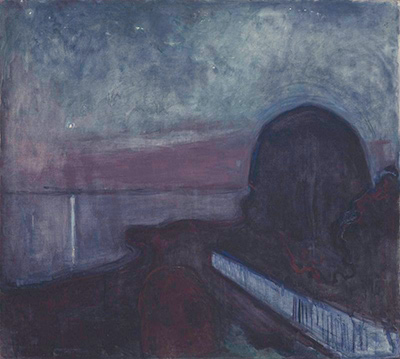
| Starry Night — Åsgårdstrand | 1893 | Oil on canvas |
| Metabolism | 1898–1899 | Oil on canvas |
| Red and White | 1899–1900 | Oil on canvas |
| Consul Christen Sandberg | 1901/1910 | Oil on canvas |
| The Researchers | 1911/1925–27? | Oil on canvas |
| On the Sofa | 1913 | Oil on canvas |
| Workers on their Way Home — Oslo | 1913–1914 | Oil on canvas |
| Workers on their Way Home — Copenhagen | 1914 | Oil on canvas |
| Starry Night — Ekely, upright version | 1922–1924 | Oil on canvas |
| Starry Night — another Ekely version | 1922–1924 | Oil on canvas |
| Woman | 1925 | Oil on canvas |
Frequently Asked Questions
Yes. Its upper and lower carvings extend the subject. The original frame was reinstated in the 1970s after decades with a simpler replacement. [2]
The museum places the major revision probably between 1915 and 1918. The original plant and unborn child were changed into the central tree. [2]
Discussion
Consider the central tree together with the carved frame.
Reader Insights
How does the tree connect the two figures while keeping them apart?
What changes when you look at the frame as part of the image?
Which painted rhythms link the bodies with the surrounding forest?
Join the Conversation
Share a detail, comparison or question about Metabolism below.
References
- MUNCH, Stoffveksling. Liv og død / Metabolism, 1898–1899, MM.M.00419, Woll M 428. Current collection record, Norwegian interface. View source.Splash image: Metabolism, 1898–1899. Oil on canvas; image 175 × 143 cm. MUNCH, Oslo, MM.M.00419.
- MUNCH, Metabolism, collection interpretation contributed to Google Arts & Culture. Revision, frame history and Adam and Eve comparison; current catalogue [1] supplies the image dimensions. View source.
- Edvard Munch, The Frieze of Life, 1918 exhibition booklet, MM UT 23, p. 2. English translation in the MUNCH digital archive. View source.