

 by Tom Gurney
Tom Gurney BSc (Hons) is an art history expert with over 20 years experience
Published on June 19, 2020June 19, 2020 / Updated on July 6, 2026
Email: tomgurney1@gmail.com / Phone: +44 7429 011000
Introduction
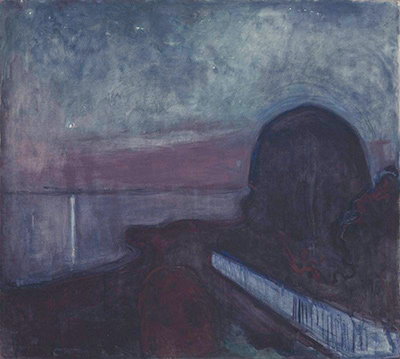
Starry Night belongs to Edvard Munch's landscape and mood route. Rather than using a figure to carry emotion, the painting relies on night, shoreline, trees, water and reflected light. It is connected to Åsgårdstrand, the Oslofjord town that became one of Munch's most important repeated settings. [3] [5]
The title naturally invites comparison with Vincent van Gogh's Starry Night, but Munch's painting works differently. Van Gogh's sky turns with visible cosmic motion; Munch's night is quieter, more grounded in shoreline and reflection. [4]
At a Glance
- Artist: Edvard Munch
- Title: Starry Night
- Setting: Åsgårdstrand / Oslofjord mood-landscape route
- Subject: Night landscape with trees, water and reflected light
- Cluster role: Landscape and mood connector
Why This Painting Matters
Starry Night matters because it shows how Munch could make landscape psychologically active without a dramatic human figure. The scene is outwardly calm, but the relation between trees, water, sky and reflected light gives it emotional depth. [4]
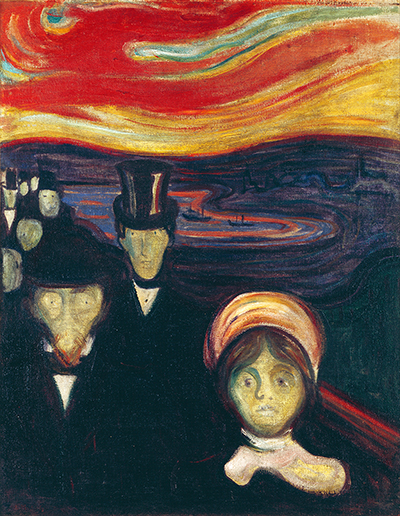
It also helps balance the cluster. Munch is not only the painter of urban anxiety and deathbed memory. He is also a painter of places revisited over time, where natural forms become carriers of mood. [1]
Looking Carefully
The trees are among the painting's strongest forms. They gather into dark shapes against the night and create a sense of enclosure. The water opens the space again, carrying light and reflection across the surface. [3]
The painting is not simply descriptive. Munch uses the shoreline as a structure for feeling. The boundary between land and water, dark mass and reflected light, makes the landscape feel both still and charged. [6]
Video Guide
This selected video from Getty Museum offers useful visual context before the detailed analysis continues.
Åsgårdstrand and Repetition
Åsgårdstrand mattered to Munch because it gave him a repeated set of motifs: shoreline, bridge, houses, trees, beach and water. Starry Night belongs to this family of images, alongside Girls on the Bridge and Summer Night by the Beach. [3]
That repetition is central to Munch's method. The same place can become bright, social, lonely, erotic or meditative depending on time of day, colour and composition. [2]
Comparison Works
These comparison routes were checked against the local Edvard Munch sitemap during production. [7]
- Girls on the Bridge also uses Åsgårdstrand, water and reflection, but with figures gathered on a bridge. [3]
- Summer Night by the Beach offers another route through shoreline and mood. [4]
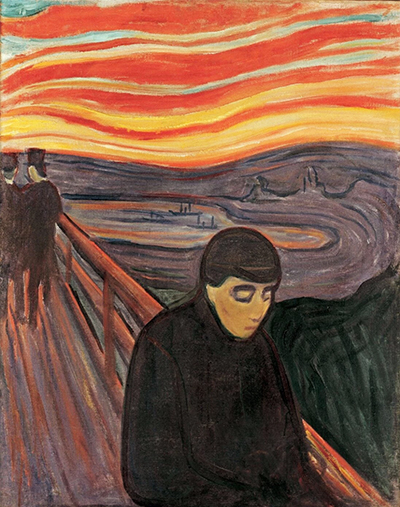
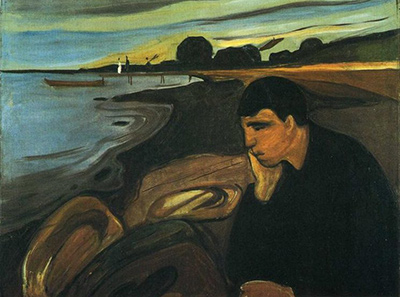
- Melancholy turns the shoreline into a setting for a withdrawn figure. [4]
- The Sun is the daylight opposite: radiant, public and monumental rather than nocturnal and inward. [7]
Interpretation
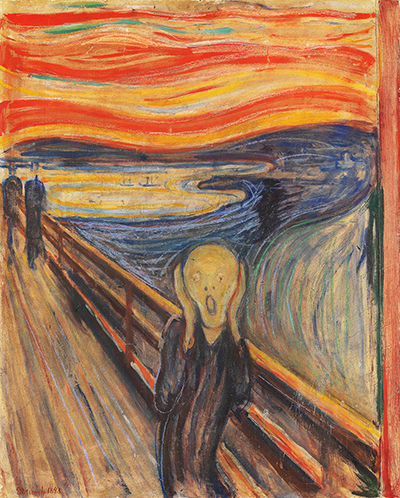
Starry Night is best read as a mood landscape. It does not need a screaming face or a deathbed to feel like Munch. The emotional pressure is carried by place itself: dark trees, reflected light, water and night. [6]
That makes the painting a useful closing individual page before the Paintings hub. It reminds readers that Munch's cluster is not a single mood, but a network of motifs moving between body, place, memory and atmosphere. [7]
FAQs
No. The shared title invites comparison, but Munch's version is quieter and more grounded in shoreline, water, trees and reflected light. [4]
Åsgårdstrand gave Munch repeated motifs of shoreline, water, houses, trees and summer-night mood across many works. [3]
References
- MUNCH, "Edvard Munch (1863-1944)," official artist page, accessed 5 July 2026.
- MUNCH, "Catalogue Raisonne / About the Collection," accessed 5 July 2026.
- Gerd Woll, Edvard Munch: Complete Paintings, London: Thames & Hudson, 2009.
- Patricia G. Berman, ed., Edvard Munch: The Modern Life of the Soul, Museum of Modern Art, 2006.
- Sue Prideaux, Edvard Munch: Behind the Scream, Yale University Press, 2005.
- eMunch, Edvard Munch's Writings: The English Edition, accessed 5 July 2026.
- TheHistoryOfArt.org, Edvard Munch sitemap and local internal-link validation, checked 5 July 2026.