



 by Tom Gurney
Tom Gurney BSc (Hons) is an art history expert with over 20 years experience
Published on June 19, 2020 / Updated on November 2, 2026
Email: tomgurney1@gmail.com / Phone: +44 7429 011000
Woman at Her Toilette by Berthe Morisot: Introduction
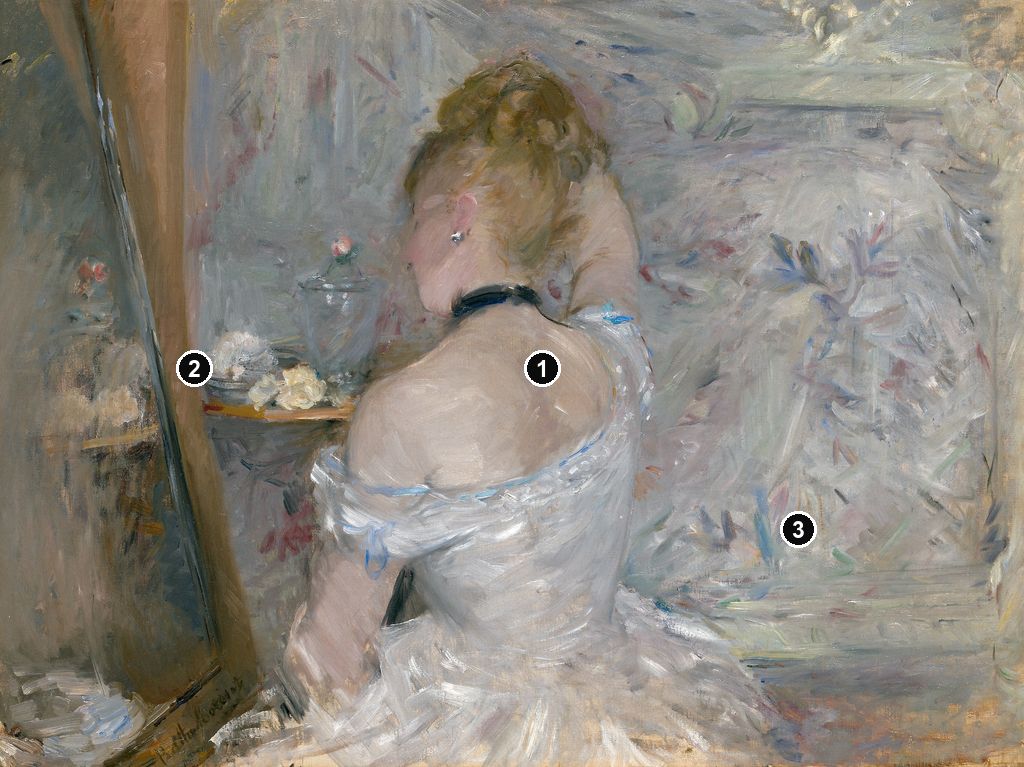
A black ribbon cuts across a pale neck. Beneath it, an exposed shoulder curves towards a white dress whose folds almost disappear into the surrounding room. In Woman at Her Toilette, Berthe Morisot brings us close to a woman turning towards a mirror, yet gives us only a narrow glimpse of her face. The most emphatic presence is her back: a broad, gently lit surface surrounded by restless paint.
The Art Institute of Chicago dates the canvas to 1875–80. Its subject belongs to the private routines through which a fashionable woman prepared or dismantled her public appearance. Morisot develops that routine through contrasts of colour, texture and viewpoint. Hair, jewellery, reflected objects and patterned fabrics offer different kinds of visual information; the painting asks us to move between recognising them and enjoying the marks that make them visible.[1]
At a Glance
- ArtistBerthe Morisot (1841–1895).
- TitleWoman at Her Toilette; French title, Femme à sa toilette.
- Date1875–80.
- MediumOil on canvas.
- Dimensions60.3 × 80.4 cm, height × width.
- CollectionArt Institute of Chicago, accession 1924.127; Stickney Fund.[1][2]
- Exhibition associationThe Art Institute links the canvas to the fifth Impressionist exhibition, Paris, 1880; the precise identification is disputed.[1]
This work across Berthe Morisot’s career
The Cradle
1872 [4]The Psyche Mirror
1876 [8]Summer’s Day
about 1879 [9]Self-Portrait
1885 [10]Contents
- A Back View That Organises the Room
- The Mirror Gives Only Part of the Answer
- White Fabric, Coloured Light and Broken Pattern
- Making a Private Routine into a Public Picture
- Related Mirrors, Different Paintings
- Exhibition History and the Journey to Chicago
- Annotated details
A Back View That Organises the Room
The woman's body turns away from us, but the composition draws us towards it. Her head occupies the upper centre of the picture, while her white clothing spreads towards the lower edge. Between these two areas, the shoulders form a firm, rounded shape. The surrounding textiles are busy and loosely defined; the back is comparatively continuous. Our eye finds a place to settle before moving outwards into the room.
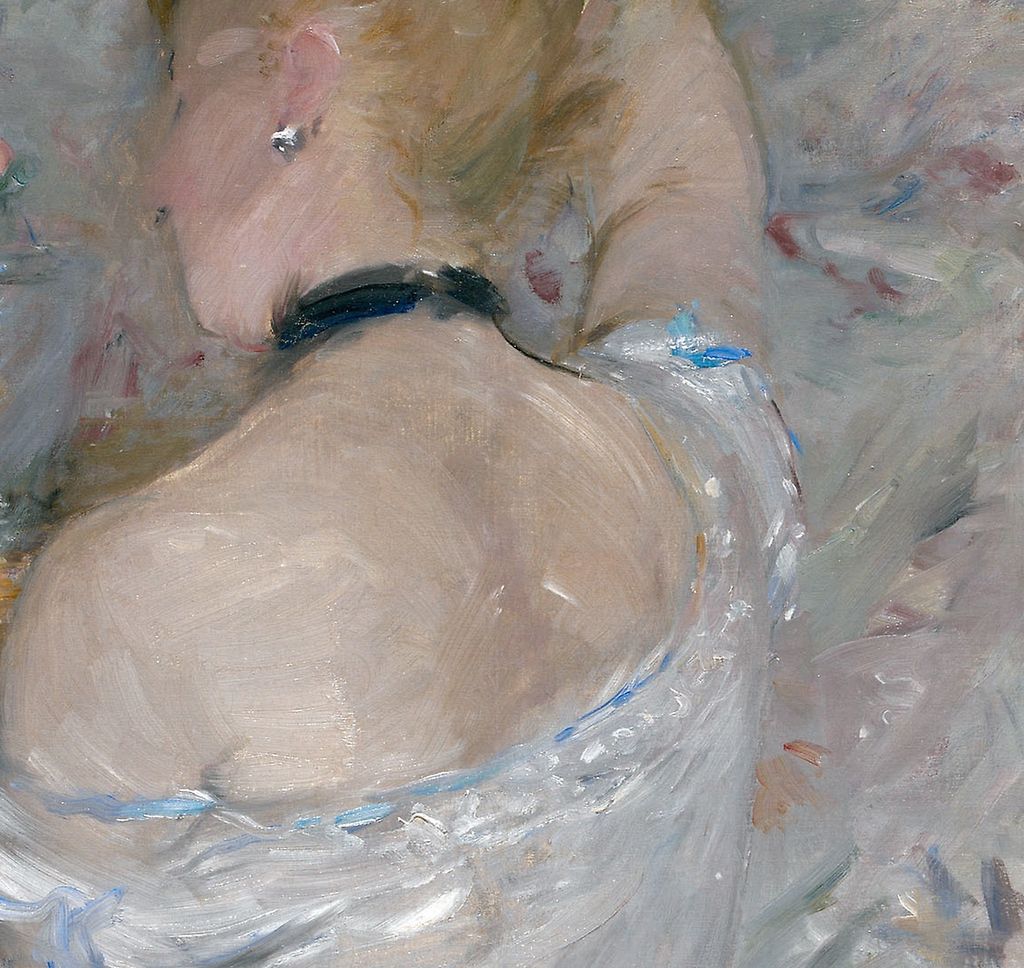
Small dark accents make this pale figure legible. The ribbon around her neck supplies the strongest boundary, while an earring catches a point of light close to the cheek. Brown and golden strokes gather her hair into a chignon, a hairstyle in which the hair is arranged in a knot at the back of the head. The gathered hair is more firmly defined than many of the surrounding objects. Morisot varies the amount of definition according to what each part contributes to the composition.
One arm bends up towards the back of the head. Its position gives the scene an action, although the hand and hair do not form a crisply explained sequence. The Chicago museum interprets the moment as the woman taking down her hair after a ball.[1] That account helps connect the remaining jewellery with the loosening of her appearance. The painting itself leaves the action suspended: the arm stays raised, the hair stays gathered, and the ribbon remains in place.
The dress slips low across the shoulders. A few blue strokes trace its upper edge, and brighter white paint catches folds below. Further down, broad curves and oblique marks describe fabric without enclosing every fold. The difference between skin and clothing comes through their handling as well as their colour. Skin is relatively quiet; the white material is full of changes in direction. Against the calmer back, these strokes have the movement of fabric being shifted or gathered.
The horizontal canvas also matters. A tall format could have followed the whole standing figure, but here the body is cropped and surrounded laterally by objects and pattern. We receive no complete account of her posture or of the furniture supporting the scene. The room feels close because its contents reach the edges before we can measure them. Even at this modest physical size, the cropped figure has considerable presence.
The Mirror Gives Only Part of the Answer
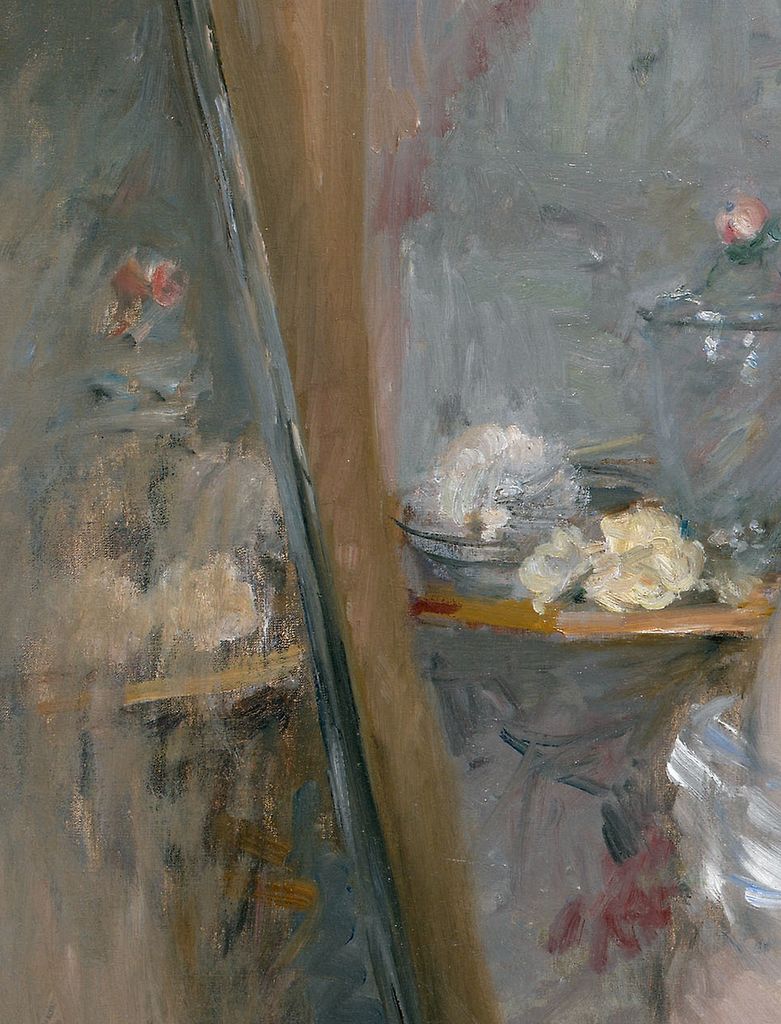
The tall mirror runs along the left side of the painting. Its broad brown frame is one of the few structures that can be followed through a large part of the composition. It leans diagonally into the image, creating a boundary beside the woman and giving the pale room a darker counterweight.
A mirror might be expected to reveal the face that the back view conceals. Here it offers no such easy completion. Its surface contains broken reflections and muted shapes. Objects near the dressing table are echoed more readily than the woman's features. Looking into the painted mirror becomes an attempt to interpret another patch of painting, rather than a shortcut to knowing the sitter.
This matters to the relationship between the woman and the viewer. She directs her attention towards the glass, while we look towards her. Those two lines of sight do not produce a meeting. The narrow profile gives enough information to suggest the turn of her head, but does not establish the sustained facial encounter of a conventional portrait. The act of looking is present throughout the scene without delivering an expressive face for us to read.
The mirror also changes the apparent depth of the room. At its base, the frame, reflected objects and dressing-table surfaces gather into a crowded intersection of brown, white and dark paint. Above, the glass is more diffuse. We can identify the device that should organise the space, yet cannot use it to reconstruct every object. This keeps attention on what is visible from this particular position.
Morisot placed her signature along the mirror's lower frame. The Chicago museum suggests that this placement could make the woman a stand-in for the artist.[1] It is an intriguing possibility, especially in a painting concerned with a woman looking at an image. It does not identify the sitter as Morisot or establish the canvas as a self-portrait. The signature is certain; the proposed relationship between author and figure remains an interpretation.
Even without that suggestion, the placement has a visible effect. The painted name sits within an object that belongs to the represented room. Close looking at the mirror therefore brings the artist's presence into view at the same time as it reveals the uncertainty of the reflection. Morisot's authorship becomes part of the picture's arrangement of surfaces.
Annotated Details from Mirror scenes and two figures indoors
The numbered points identify visible features discussed in this article. Return from each detail to the whole composition. Each caption identifies the work shown.
Woman at Her Toilette
Berthe Morisot, Woman at Her Toilette, 1875–80, Art Institute of Chicago, Stickney Fund. Image source. Public domain. Resized only; native appearance preserved.
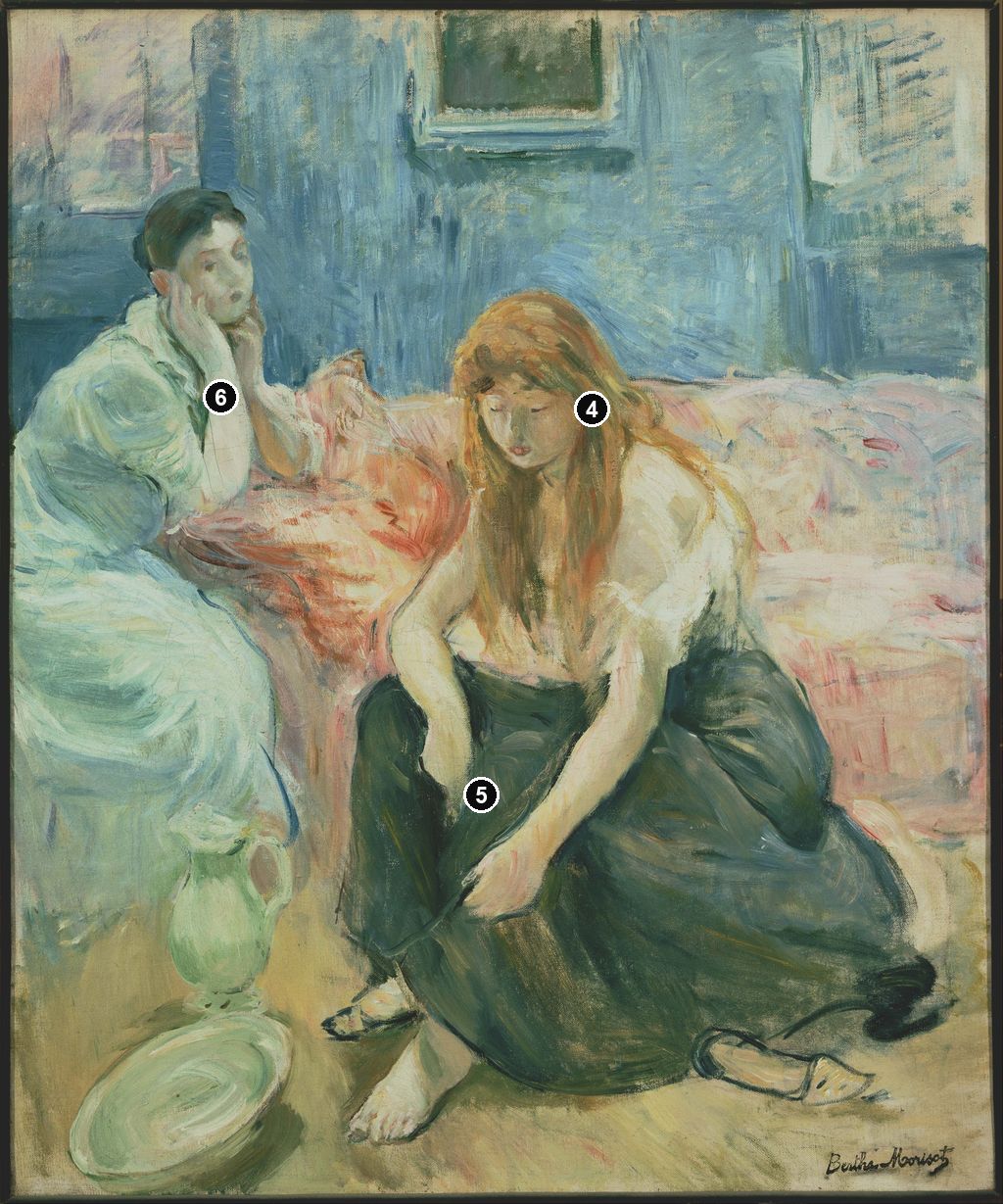
Two Girls
Berthe Morisot, Two Girls, about 1894, The Phillips Collection, accession 1390. The annotation overview preserves the thin dark reproduction margins present in the immutable source. Image source. Public domain. Resized only; native appearance preserved.
Details from MIRROR SCENES AND TWO FIGURES INDOORS
Compare the cropped details with the complete images above. Notice how their colours, shapes and positions contribute to the larger compositions.
Woman at Her Toilette
Back, neck and dark ribbon
The pale back curves beneath a dark ribbon at the neck. Cool and warm strokes keep the skin part of the larger colour field.
Mirror and interrupted reflection
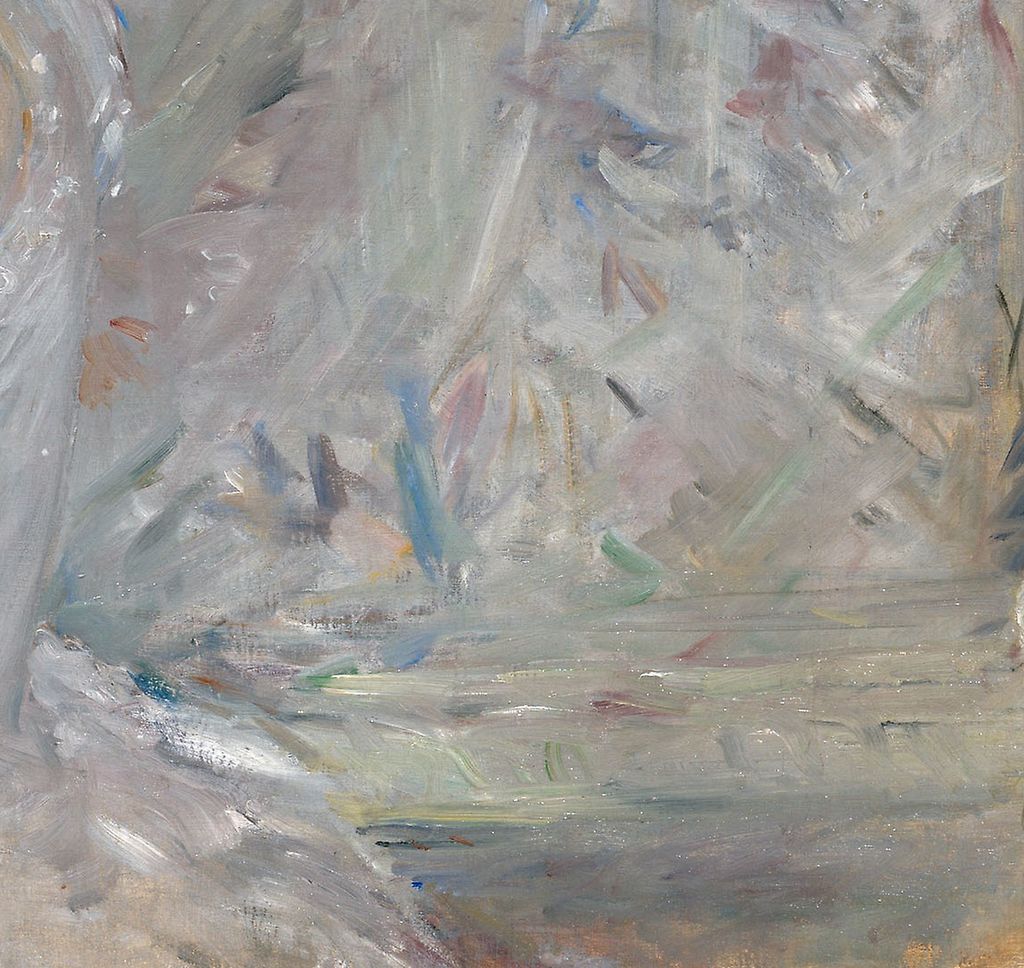
The mirror’s dark edge cuts through the pale surrounding marks. The reflected space remains less clearly described than the near body.
Cloth and surrounding colour
Pale fabric meets restless blue, pink and grey strokes. The figure and room share the same visible handling.
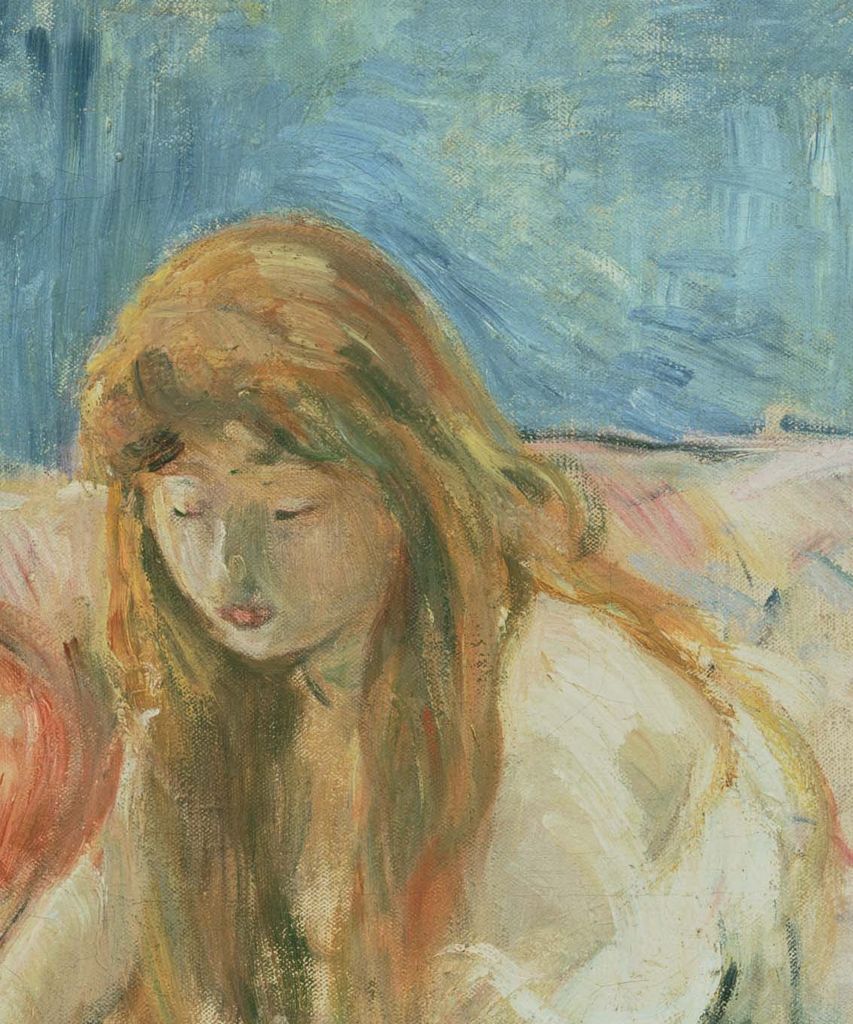
Two Girls
The foreground figure’s lowered head
The head bends down above long warm strands of hair. Pale skin and clothing stand out against cooler furniture and walls.
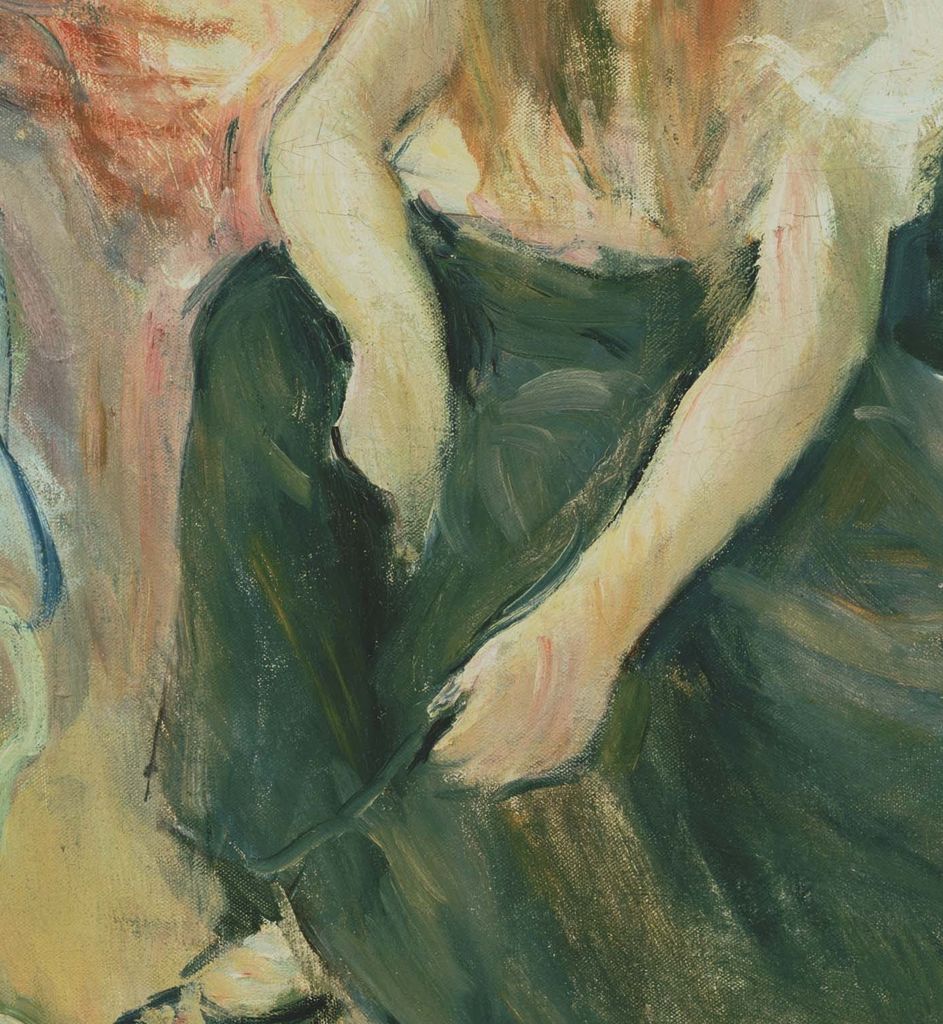
Hands and dark skirt
The hands meet the broad dark shape of the skirt. Their position helps turn the bent figure into a low diagonal.
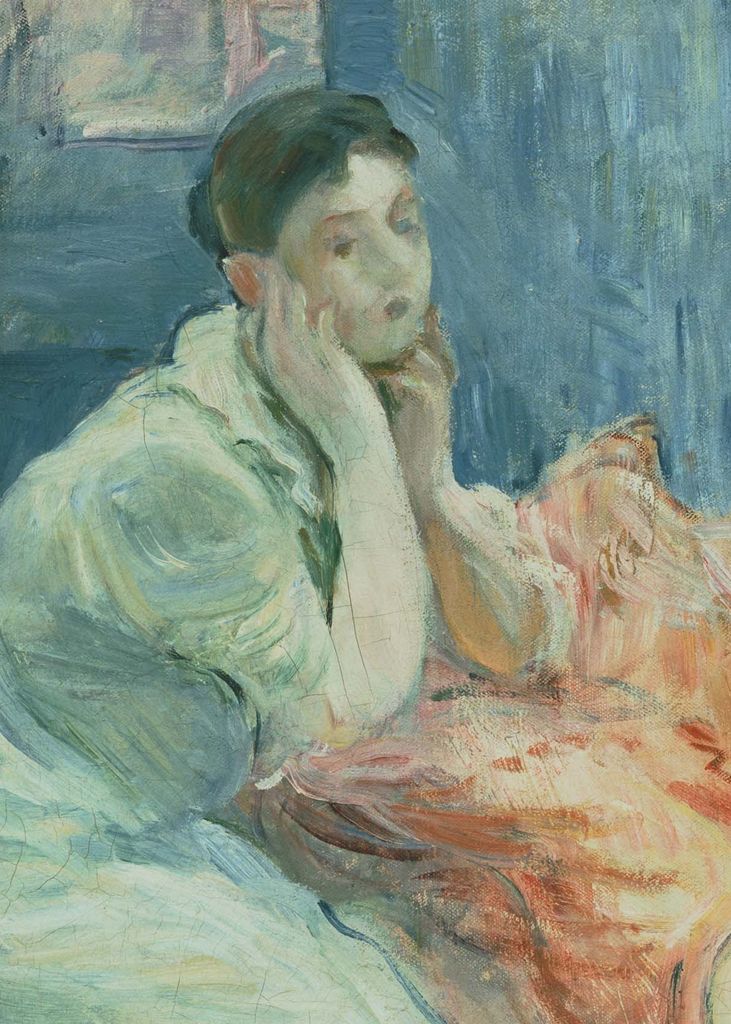
The second figure beside the sofa
A second woman sits farther back with a hand near her face. The two figures make different poses within the same room.
White Fabric, Coloured Light and Broken Pattern
Although white dominates the dress, pure whiteness is only one part of its effect. Blue, grey, pink and pale violet pass through the clothing and surrounding furnishings. The shoulder is warmer than much of the room, but its shadows still share the muted colours around it. The woman belongs to this atmosphere rather than appearing as a separately illuminated figure pasted against a background.
Look at the blue touches along the neckline. Seen close up, they are conspicuous marks of paint; from farther away, they help turn the cloth over the shoulder and distinguish its edge. A similar change happens in the patterned area to the right. Scattered red, blue, green and yellow strokes begin to suggest ornament on fabric, then separate again into individual gestures when examined.
The Art Institute identifies floral wallpaper and a patterned bedspread in the setting.[1] Their role in the painting is less descriptive than that of a carefully inventoried bedroom. Pattern extends across large areas without yielding a complete repeat that we could copy or reconstruct. There is sufficient information to suggest a decorated, furnished interior, while the interrupted motifs keep the surface active.
The small objects near the mirror work differently. A stoppered vessel, a shallow container and pale clustered forms emerge around a narrow tabletop. Tiny highlights suggest reflective or polished surfaces. These objects establish the practical world of the toilette without requiring every item to be named. Their compact shapes and concentrated colours also balance the larger, softer expanse of the figure.
Across the whole canvas, Morisot alternates between an edge we can follow and one that breaks apart. The ribbon is comparatively decisive; sections of the white dress merge with adjacent pale strokes. The mirror frame feels weighty; some of the furnishings beyond the woman have little fixed contour. These variations encourage different speeds of looking. We recognise the neck and shoulder quickly, then slow down to discover where fabric, reflection and background begin or end.
The Musée d'Orsay's 2019 exhibition discussion places this treatment within Morisot's wider exploration of finish. Its curators describe increasingly open handling in the late 1870s, including the merging of figure and setting and the visible retention of working marks.[2] This canvas offers a clear way to understand the effect. Its sense of immediacy depends on a mixture of selective precision and open passages. A lively surface alone cannot tell us how many sittings it required.
Watch: Berthe Morisot
Explore Morisot’s career with Katy Hessel, then look closely at Summer’s Day with the National Gallery.
Katy Hessel on Berthe Morisot
Katy Hessel tours the exhibition Berthe Morisot: Shaping Impressionism.
Watch on YouTubeMaking a Private Routine into a Public Picture
Toilette here means the activity of personal grooming and dressing, together with its associated clothes and objects. The word helps connect the raised arm, mirror and dressing table. These are elements of a routine, not merely accessories around an unidentified portrait.
Morisot returned to this subject repeatedly. The Musée d'Orsay's 2019 curators counted about twenty toilette scenes between 1876 and 1894 and identified professional models as participants in this group. They also identify the artist's own bedroom as a recurring setting in the early toilette scenes.[2] Their account presents intimacy as something constructed through the choice of setting, clothing and activity.
That context changes how we approach the apparent informality of Woman at Her Toilette. A room belonging to the artist could become a place of work; a model could enact an ordinary private gesture for a picture intended to be seen elsewhere. The informal viewpoint is compatible with that process of arranging a scene. The canvas offers a carefully organised experience of proximity.
The woman's clothes also connect the private room to life outside it. Jewellery and the black neck ribbon remain conspicuous against the loosened white fabric. Public appearance is being managed through small physical actions: adjusting hair, handling clothing, looking into a glass. Fashion enters the picture through what a person does as well as what she wears.
In its discussion of contemporary dress, the Orsay exhibition emphasised how Morisot used garments and accessories to develop an energetic, suggestive technique. The curators also noted the increasingly close framing of figures around the end of the 1870s.[2] Here those concerns meet in the neckline. Its few blue and white marks describe fashionable clothing, establish the position of the body and demonstrate the painter's touch all at once.
This helps explain the picture's importance as a scene of modern life. Its interest does not depend on a dramatic incident. An everyday action, a particular form of dress and an inhabited room provide enough material for a substantial painting. The subject's familiarity makes the painter's choices more noticeable: where to stand, how closely to frame the figure, and how much information to give.
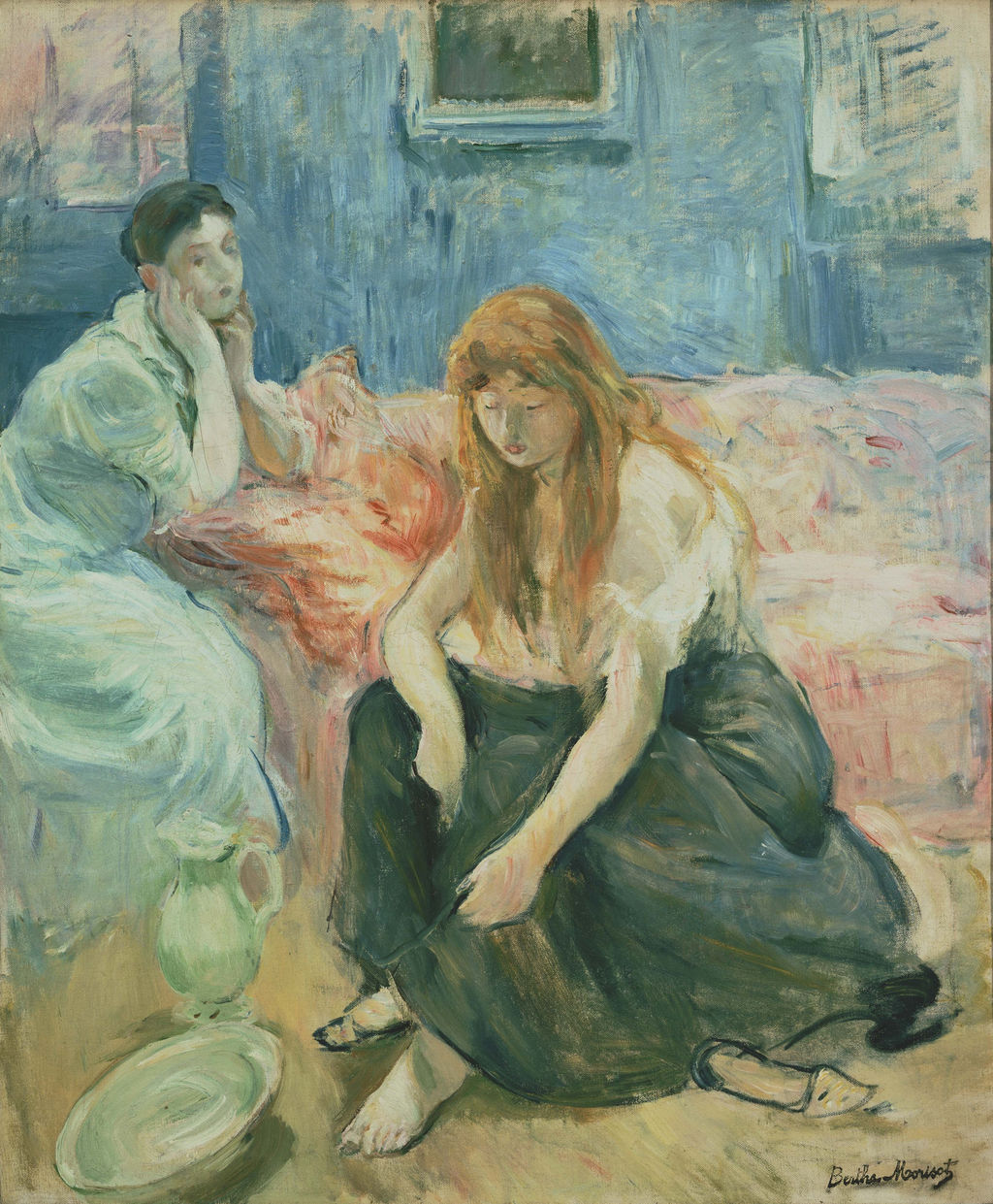
Berthe Morisot, Two Girls, about 1894, The Phillips Collection, Washington. A later toilette scene includes one woman attending to another’s hair. Image source. Public domain. Resized only; native appearance preserved.
Related Mirrors, Different Paintings
The Chicago canvas belongs beside other toilette scenes, but its back view and horizontal format give it a particular character. In The Psyche Mirror, dated 1876, a standing woman is shown at greater length beside a large mirror. The Thyssen-Bornemisza museum identifies the psyché as a type of tilting dressing mirror and records that painting's appearance at the Impressionist exhibition of 1877.[8] Its visible floor and full-length figure allow a more extended relationship between body, reflection and room.
In the Chicago picture, the closer crop makes the shoulder and hair disproportionately important. We lose the standing figure's full gesture and gain a broad field of skin, fabric and colour. Comparing the two shows how the same general subject can support different arrangements of looking.
Young Woman Powdering Her Face is another distinct work, dated 1877 and held by the Musée d'Orsay.[2] Its woman sits more nearly in profile, with a grooming action brought towards her face. The contrast makes the Chicago figure's turning away especially apparent. Mirrors, pale clothes and dressing-table objects recur across the three pictures, while changes in format and viewpoint give each a different emphasis.

Berthe Morisot, The Psyche Mirror, 1876, Museo Nacional Thyssen-Bornemisza. The upright format permits a different relationship between body and reflection.
Exhibition History and the Journey to Chicago
The present date range of 1875–80 leaves the exact year of execution open. The 1961 catalogue by Marie-Louise Bataille and Georges Wildenstein placed the picture under 1880 and listed it as no. 84, Jeune femme de dos à sa toilette—a young woman seen from behind at her toilette. That older descriptive title usefully singles out the viewpoint.[11] The Art Institute now dates the canvas more broadly, to 1875–80.[1]
The Art Institute associates this canvas with the fifth Impressionist exhibition in Paris in 1880.[1] The Musée d'Orsay's Base Salons, which transcribes the exhibition catalogue, also links the contemporary title Femme à sa toilette to the Chicago collection.[12] There is nevertheless a conflicting identification: Orsay's own collection record connects the same exhibition entry with its separate 1877 painting, Young Woman Powdering Her Face.[13] The Chicago association has substantial museum support, but the exact identification remains unsettled. An earlier appearance in the second exhibition of 1876 is listed by the Art Institute only as possible.[1]
The broader passage from private subject to public art is well documented in Morisot's toilette paintings. Orsay's 2019 curators stress that she exhibited and sold works of this kind.[2] A secluded room could supply the subject of an ambitious public picture. The Chicago canvas's later exhibition history makes that transition visible without depending on the disputed early identification.
The museum also records its inclusion in Morisot's 1896 memorial exhibition, catalogue no. 68.[1] Bataille and Wildenstein list a London exhibition in 1905, no. 162, extending that public history beyond France.[11] It reached the Art Institute of Chicago in 1924 through a purchase from Paul Rosenberg, with the credit line Stickney Fund.[1] The accession number, 1924.127, identifies this particular canvas across its changing titles and exhibition contexts.
Viewed today, its most revealing passages are still small ones: the black ribbon holding the neck in focus, a blue stroke turning the dress, the name written along the mirror. Each offers a different degree of certainty. Together they make a room that feels immediately present while leaving much of its space, action and reflected image open to the eye.
Artworks directory
Explore documented paintings, pastels, watercolours, prints and sculpture. Original French titles are retained for many works. The 1961 catalogue supplies the historical core; dates are updated where the linked museum records establish a revision. Lost works and surviving fragments remain part of that record. This is a directory of compositions, with individual print impressions and bronze casts grouped together.
| Name | Date | Medium |
|---|---|---|
| Ferme en Normandie | 1859 | Oil painting |
| Le Repas chez Simon | 1860 | Oil painting |
| Le Calvaire | 1860 | Oil painting |
| La Vue de Tivoli | 1863 | Oil painting |
| Souvenir des bords de l’Oise | 1863 | Oil painting |
| The Old Track to Auvers | 1863 | Oil painting |
| Chaudron | 1864 | Oil painting |
| Étude Au bord de l'eau | 1864 | Oil painting |
| La Brémondière | 1865 | Oil painting |
| Chaumière en Normandie | 1865 | Oil painting |
| La Seine en aval du Pont d'Iéna | 1866 | Oil painting |
| Rivière de Pont-Aven à Rosbras | 1866 | Oil painting |
| Portrait de Mme Lucien Boursier | 1867 | Oil painting |
| Reading | 1873 | Oil painting |
| Le Débarquement de Marie de Médicis à Marseille | 1868 | Oil painting |
| Un quai à Lorient | 1869 | Oil painting |
| The Harbour at Lorient | 1869 | Oil painting |
| The Artist's Sister at a Window | 1869 | Oil painting |
| Deux sœurs sur un canapé | 1869 | Oil painting |
| The Mother and Sister of the Artist | 1869–1870 | Oil painting |
| Portrait de Mme Heudé | 1870 | Oil painting |
| Jeune Femme (Young Woman) | 1871 | Oil painting |
| Vue de Paris des hauteurs du Trocadéro | 1872 | Oil painting |
| Woman and Child on a Balcony | 1872 | Oil painting |
| The Cradle | 1872 | Oil painting |
| Intérieur | 1872 | Oil painting |
| Cache-cache | 1873 | Oil painting |
| Sur la Plage | 1873 | Oil painting |
| La plage de Fécamp | 1873 | Oil painting |
| Falaise à Fécamp | 1873 | Oil painting |
| The Pink Dress (Albertie-Marguerite Carre, later Madame Ferdinand-Henri Himmes, 1854–1935) | about 1870 | Oil painting |
| Jeune fille en robe de bal | 1873 | Oil painting |
| Portrait de Mme Hubard | 1874 | Oil painting |
| Portraits de Mme Boursier et de sa fille | 1874 | Oil painting |
| Les lilas à Maurecourt | 1874 | Oil painting |
| The Butterfly Hunt | 1874 | Oil painting |
| Sur la terrasse | 1874 | Oil painting |
| In a Villa at the Seaside | 1874 | Oil painting |
| Boats under Construction | 1874 | Oil painting |
| Bassin du port de Fécamp | 1874 | Oil painting |
| Port de Fécamp | 1874 | Oil painting |
| L'entrée du port | 1874 | Oil painting |
| Le petit moulin à Gennevilliers | 1875 | Oil painting |
| Paysage à Gennevilliers | 1875 | Oil painting |
| Hanging the Laundry out to Dry | 1875 | Oil painting |
| Grain Field | 1875 | Oil painting |
| Le déjeuner sur l'herbe | 1875 | Oil painting |
| Enfants dans l'herbe en Angleterre | 1875 | Oil painting |
| La Tamise | 1875 | Oil painting |
| Dans l'île de Wight | 1875 | Oil painting |
| Eugène Manet on the Isle of Wight | 1875 | Oil painting |
| Marine en Angleterre | 1875 | Oil painting |
| The Isle of Wight | 1875 | Oil painting |
| Marine en Angleterre | 1875 | Oil painting |
| La jetée | 1875 | Oil painting |
| Le bateau à vapeur | 1875 | Oil painting |
| Jeune femme et fillette assises au pied d'un arbre | 1875 | Oil painting |
| Paysage aux environs de Valenciennes | 1875 | Oil painting |
| Avant le théâtre | 1875 | Oil painting |
| At the Ball (Au Bal) | 1875 | Oil painting |
| Jeune femme au miroir | 1876 | Oil painting |
| Jeune femme arrosant un arbuste | 1876 | Oil painting |
| La Toilette | 1876 | Oil painting |
| The Psyche Mirror | 1876 | Oil painting |
| Pomme coupée | 1876 | Oil painting |
| Dahlias | about 1876 | Oil painting |
| Femme à l’éventail | 1876 | Oil painting |
| Petit garçon | 1876 | Oil painting |
| Dame à l'écran | 1877 | Oil painting |
| Soupière et pomme | 1877 | Oil painting |
| Roses dans un verre | 1877 | Oil painting |
| Young Woman Powdering her Face | 1877 | Oil painting |
| Femme à sa toilette | 1877 | Oil painting |
| Le corsage noir | 1878 | Oil painting |
| Jeune femme près d’une fenêtre | 1878 | Oil painting |
| Fleurs à l'écran | 1878 | Oil painting |
| Jeune femme en gris étendue | 1879 | Oil painting |
| Jeune femme assise | 1879 | Oil painting |
| Summer's Day | about 1879 | Oil painting |
| Dames cueillant des fleurs | 1879 | Oil painting |
| Young Girl in a Ball Gown | 1879 | Oil painting |
| Derrière la jalousie | 1879 | Oil painting |
| Femme cousant | 1879 | Oil painting |
| Woman at her Toilette | 1875–1880 | Oil painting |
| Neige | 1880 | Oil painting |
| Hiver | 1880 | Oil painting |
| Jeune femme remettant son patin | 1880 | Oil painting |
| Petit garçon en gris | 1880 | Oil painting |
| Petit garçon | 1880 | Oil painting |
| Jeune femme en mauve | 1880 | Oil painting |
| Dans la salle à manger | 1880 | Oil painting |
| Pont sur la Seine | 1880 | Oil painting |
| Nourrice au fond d'un jardin | 1880 | Oil painting |
| Nourrice allaitant | 1880 | Oil painting |
| Nourrice et bébé | 1880 | Oil painting |
| Dans l'île | 1880 | Oil painting |
| Jeune fille mettant son bas | 1880 | Oil painting |
| Fleurs | 1880 | Oil painting |
| Portrait de Louise Riesener | 1881 | Oil painting |
| Portrait de Louise Riesener | 1881 | Oil painting |
| Enfant dans un intérieur | 1881 | Oil painting |
| La nourrice | 1881 | Oil painting |
| Eugène Manet et sa fille dans le jardin de Bougival | 1881 | Oil painting |
| Dame à l'ombrelle | 1881 | Oil painting |
| Paysanne étendant du linge | 1881 | Oil painting |
| Paysanne assise dans l'herbe | 1881 | Oil painting |
| Child in the Rose Garden | 1881 | Oil painting |
| Jeune femme cousant dans un jardin | 1881 | Oil painting |
| Petite fille aux cheveux blonds | 1881 | Oil painting |
| After Luncheon | 1881 | Oil painting |
| Port de Nice | 1882 | Oil painting |
| Le Port de Nice | 1882 | Oil painting |
| Le port de Nice | 1882 | Oil painting |
| Port de Nice | 1882 | Oil painting |
| Plage de Nice | 1882 | Oil painting |
| Plage de Nice | 1882 | Oil painting |
| Villa Arnulfi | 1882 | Oil painting |
| Villa dans les orangers | 1882 | Oil painting |
| Paysage | 1882 | Oil painting |
| Les pâtés de sable | 1882 | Oil painting |
| Jardin de Bougival | 1882 | Oil painting |
| à Bougival | 1882 | Oil painting |
| Jeune garçon dans les roses trémières | 1882 | Oil painting |
| Le balcon | 1882 | Oil painting |
| Le thé | 1882 | Oil painting |
| Berthe Morisot et sa fille | 1882 | Oil painting |
| Jeannie à la poupée | 1883 | Oil painting |
| La fillette blonde | 1883 | Oil painting |
| Fillette en mauve | 1883 | Oil painting |
| Petite fille en deuil dans un jardin | 1883 | Oil painting |
| Jardin | 1883 | Oil painting |
| Les foins à Bougival | 1883 | Oil painting |
| La meule de foin | 1883 | Oil painting |
| Paysage | 1883 | Oil painting |
| Le quai de Bougival | 1883 | Oil painting |
| En barque | 1883 | Oil painting |
| Eugène Manet and his Daughter in the Garden | 1883 | Oil painting |
| The Fable | 1883 | Oil painting |
| Jeune femme et enfant dans l'île | 1883 | Oil painting |
| Au bord du lac | 1883 | Oil painting |
| Fillette à la poupée | 1883 | Oil painting |
| Le jardin | 1883 | Oil painting |
| Jeune femme cousant au jardin | 1883 | Oil painting |
| Vénus va demander des armes à Vulcain | 1884 | Oil painting |
| Petite fille dans un jardin | 1884 | Oil painting |
| The Sewing Lesson (aka The Artist's Daughter, Julie, with Her Nanny) | about 1884 | Oil painting |
| On the Lake in the Bois de Boulogne | 1884 | Oil painting |
| The Garden at Bougival (le jardin a bougival) | 1884 | Oil painting |
| Jardin | 1884 | Oil painting |
| Fillette et sa bonne dans le jardin de Bougival | 1884 | Oil painting |
| La Seine à Bougival | 1884 | Oil painting |
| La barrière à Bougival | 1884 | Oil painting |
| Jeune femme et enfant dans le jardin de Bougival | 1884 | Oil painting |
| In the Garden at Maurecourt | 1884 | Oil painting |
| Young Woman with a Straw Hat | 1884 | Oil painting |
| Jeune femme assise dans l'herbe | 1884 | Oil painting |
| Roses Tremieres (Hollyhocks) | 1884 | Oil painting |
| A Woman and Child in a Garden | about 1884 | Oil painting |
| Portrait de Paule Gobillard | 1884 | Oil painting |
| Dans la vérandah | 1884 | Oil painting |
| Poupée dans la vérandah | 1884 | Oil painting |
| Automne au bois de Boulogne | 1884 | Oil painting |
| Petite fille à la poupée | 1884 | Oil painting |
| Miss Reynolds | 1884 | Oil painting |
| L'avenue du bois l'hiver | 1885 | Oil painting |
| Self Portrait | 1885 | Oil painting |
| Portrait de Berthe Morisot et de sa fille | 1885 | Oil painting |
| La Femme au gant, dite aussi Parisienne | 1885 | Oil painting |
| Nu de dos | 1885 | Oil painting |
| Petite danseuse | 1885 | Oil painting |
| Cage | 1885 | Oil painting |
| Daffodils | 1885 | Oil painting |
| Young Girl with Cage | 1885 | Oil painting |
| Isabelle au jardin | 1885 | Oil painting |
| Isabelle | 1885 | Oil painting |
| Pivoines | 1885 | Oil painting |
| Dans le jardin | 1885 | Oil painting |
| Rosiers | 1885 | Oil painting |
| L'oie | 1885 | Oil painting |
| Oies au bord du lac | 1885 | Oil painting |
| Fillettes au jardin, dit aussi La hotte | 1885 | Oil painting |
| Reines-marguerites | 1885 | Oil painting |
| Forêt de Compiègne | 1885 | Oil painting |
| Un canal à Rotterdam | 1885 | Oil painting |
| Corbeille renversée | 1885 | Oil painting |
| La cheminée | 1885 | Oil painting |
| Girl on a Divan | about 1885 | Oil painting |
| Enfant au tablier rouge | 1886 | Oil painting |
| Maisons sous la neige | 1886 | Oil painting |
| Le bain | 1886 | Oil painting |
| Le lever | 1886 | Oil painting |
| Sortant du lit | 1886 | Oil painting |
| Jeune femme se levant | 1886 | Oil painting |
| In the Dining Room | 1886 | Oil painting |
| La petite servante | 1886 | Oil painting |
| Intérieur | 1886 | Oil painting |
| Intérieur de cottage | 1886 | Oil painting |
| Le port de Gorey | 1886 | Oil painting |
| Bateau à quai | 1886 | Oil painting |
| La leçon au jardin | 1886 | Oil painting |
| La leçon au jardin | 1886 | Oil painting |
| Rivière au bois de Boulogne | 1886 | Oil painting |
| Enfants à la vasque | 1886 | Oil painting |
| Toilette de nuit | 1886 | Oil painting |
| Fillette à la poupée, premier fragment | 1886 | Oil painting |
| Fillette au chien, deuxième fragment | 1886 | Oil painting |
| Modèle au repos | 1887 | Oil painting |
| Paule Gobillard peignant | 1887 | Oil painting |
| Jeune Fille au chien | 1887 | Oil painting |
| Paule Gobillard en robe de bal | 1887 | Oil painting |
| Fillette dans le jardin | 1887 | Oil painting |
| Jardin | 1887 | Oil painting |
| Jeune fille accoudée | 1887 | Oil painting |
| Pommes | 1887 | Oil painting |
| Berthe Morisot et sa fille devant une fenêtre | 1887 | Oil painting |
| Berthe Morisot et sa fille devant une fenêtre | 1887 | Oil painting |
| Femme au chapeau | 1888 | Oil painting |
| Fillette portant un panier | 1888 | Oil painting |
| Reading (1888) | 1888 | Oil painting |
| Fillette à la perruche | 1888 | Oil painting |
| Le volant | 1888 | Oil painting |
| Portrait de Louise Riesener, plus tard Mme Léouzon-le-Duc | 1888 | Oil painting |
| Faneuse | 1888 | Oil painting |
| Jeune fille à l'arrosoir | 1888 | Oil painting |
| Les cygnes | 1888 | Oil painting |
| Roses devant une gravure | 1888 | Oil painting |
| Le vase bleu | 1888 | Oil painting |
| Tête de Jeannie, fragment d’une esquisse pour Le Piano | 1888 | Oil painting |
| Julie écoutant, fragment d’une esquisse pour Le Piano | 1888 | Oil painting |
| Julie écoutant, fragment d’une esquisse pour Le Piano | 1888 | Oil painting |
| Le piano | 1888 | Oil painting |
| La Petite Niçoise | 1889 | Oil painting |
| Les aloès | 1889 | Oil painting |
| Bateau illuminé | 1889 | Oil painting |
| La cueillette des oranges | 1889 | Oil painting |
| Branches d'oranger | 1889 | Oil painting |
| Sous l'oranger | 1889 | Oil painting |
| La mandoline | 1889 | Oil painting |
| Mains sur la mandoline, premier fragment | 1889 | Oil painting |
| Chien au ballon, deuxième fragment | 1889 | Oil painting |
| Jeune fille sur une chaise longue | 1889 | Oil painting |
| Jeune fille à la potiche | 1889 | Oil painting |
| Sur le lac | 1889 | Oil painting |
| Girl in a Boat, with Geese | about 1889 | Oil painting |
| Julie Manet tenant un livre | 1889 | Oil painting |
| La broderie | 1889 | Oil painting |
| Alice Gamby en buste | 1890 | Oil painting |
| Alice Gamby dans le salon | 1890 | Oil painting |
| Fillette à la mandoline | 1890 | Oil painting |
| Vue de la terrasse à Mézy | 1890 | Oil painting |
| La jatte de lait | 1890 | Oil painting |
| Le petit saint-Jean | 1890 | Oil painting |
| Panier de fleurs sur une table | 1890 | Oil painting |
| Dans le pommier | 1890 | Oil painting |
| Le flageolet | 1890 | Oil painting |
| Le flageolet | 1890 | Oil painting |
| Paysanne aux tulipes | 1890 | Oil painting |
| Sous le pommier | 1890 | Oil painting |
| Vue de la Seine à Mèzy | 1890 | Oil painting |
| Le Lever de lune sur la vallée de la Seine | 1890 | Oil painting |
| Fillette accrochant une cage dans un arbre | 1890 | Oil painting |
| The Artist's Daughter with a Parakeet | 1890 | Oil painting |
| Mèzy en automne | 1890 | Oil painting |
| Devant la psyché | 1890 | Oil painting |
| Julie Manet à la perruche | 1890 | Oil painting |
| Fillette au tablier | 1891 | Oil painting |
| Jeune fille écrivant | 1891 | Oil painting |
| Anémones roses | 1891 | Oil painting |
| Anémones | 1891 | Oil painting |
| Jeune fille dessinant | 1891 | Oil painting |
| Les foins à Mèzy | 1891 | Oil painting |
| Faneuse | 1891 | Oil painting |
| Les faneuses | 1891 | Oil painting |
| Le cerisier | 1891 | Oil painting |
| The Cherry Picker (Le Cerisier) | 1891; completed 1893 | Oil painting |
| Le cerisier | 1891 | Oil painting |
| Jeune fille cueillant des cerises | 1891 | Oil painting |
| La vallée de la Seine à Mèzy | 1891 | Oil painting |
| Bergère couchée | 1891 | Oil painting |
| Bergère couchée | 1891 | Oil painting |
| La chèvre Colette | 1891 | Oil painting |
| Bergère nue couchée | 1891 | Oil painting |
| Baigneuse | 1891 | Oil painting |
| Branche de prunes | 1891 | Oil painting |
| Fillette à la chèvre | 1891 | Oil painting |
| Pommier | 1891 | Oil painting |
| Petite fille à l'oiseau | 1891 | Oil painting |
| Jeune fille au corset bleu | 1891 | Oil painting |
| Jeune fille en blanc | 1891 | Oil painting |
| Tête de fillette | 1892 | Oil painting |
| Jeune fille en jaune | 1892 | Oil painting |
| Jeune fille peignant | 1892 | Oil painting |
| Fillette au panier | 1892 | Oil painting |
| Fillette au chapeau | 1892 | Oil painting |
| Pigeonnier du Mesnil | 1892 | Oil painting |
| Le bois du Mesnil | 1892 | Oil painting |
| Little Girl at Mesnil | 1892 | Oil painting |
| Young Girls at the Window | 1892 | Oil painting |
| Petite fille assise dans l'herbe | 1892 | Oil painting |
| Le coteau du Mesnil | 1892 | Oil painting |
| Le bain au Mesnil | 1892 | Oil painting |
| Baigneuses | 1892 | Oil painting |
| Baigneuses au Mesnil | 1892 | Oil painting |
| Sur le banc au Mesnil | 1892 | Oil painting |
| La couronne de roses blanches | 1892 | Oil painting |
| Fillette jouant avec un chien | 1892 | Oil painting |
| En barque sur le lac | 1892 | Oil painting |
| Jeanne Fourmanoir sur le lac | 1892 | Oil painting |
| La cueillette des pommes | 1892 | Oil painting |
| Fillette au chapeau de paille | 1892 | Oil painting |
| Jeune fille au chien | 1892 | Oil painting |
| Young Girl with Cat | Summer 1892 | Oil painting |
| Jeune fille endormie | 1892 | Oil painting |
| Oies au bord du lac | 1892 | Oil painting |
| En bateau | 1892 | Oil painting |
| Lucie Léon au piano | 1892 | Oil painting |
| Lucie Leon at the Piano | 1892 | Oil painting |
| Lucie Léon au piano | 1892 | Oil painting |
| Vue de Tours | 1892 | Oil painting |
| Apollon visitant Latone | 1892 | Oil painting |
| Paysage de Tours | 1892 | Oil painting |
| Étang et pigeonnier | 1892 | Oil painting |
| Conversation | 1893 | Oil painting |
| Jeune fille remettant son patin | 1893 | Oil painting |
| Patineuse | 1893 | Oil painting |
| Patinage | 1893 | Oil painting |
| Les patineuses | 1893 | Oil painting |
| Jeune fille en mantelet | 1893 | Oil painting |
| L'étude du violon | 1893 | Oil painting |
| Jeune fille se coiffant | 1893 | Oil painting |
| Devant la glace | 1893 | Oil painting |
| Jeune fille cueillant des oranges | 1893 | Oil painting |
| Paysanne avec des oies au bord de l'eau | 1893 | Oil painting |
| La cruche d'eau | 1893 | Oil painting |
| Jeune fille au lévrier | 1893 | Oil painting |
| La musique | 1893 | Oil painting |
| Avenue du bois de Boulogne au printemps | 1893 | Oil painting |
| Portrait de Jeanne Pontillon | 1893 | Oil painting |
| Sur la chaise longue | 1893 | Oil painting |
| Jeune fille étendue | 1893 | Oil painting |
| La perruche | 1893 | Oil painting |
| Jeune fille à l'ombrelle | 1893 | Oil painting |
| Jeune fille à l'éventail | 1893 | Oil painting |
| Parc de Fontainebleau | 1893 | Oil painting |
| La petite barque | 1893 | Oil painting |
| La Seine à Valvins | 1893 | Oil painting |
| La haute-Seine | 1893 | Oil painting |
| Forêt de Fontainebleau | 1893 | Oil painting |
| Bois de Boulogne | 1893 | Oil painting |
| Dôme des arènes de la rue Pergolèse | 1893 | Oil painting |
| Dôme des arènes de la rue Pergolèse, soleil couchant | 1893 | Oil painting |
| Étude de forêt | 1893 | Oil painting |
| Étude de forêt | 1893 | Oil painting |
| Julie au violon | 1893 | Oil painting |
| Portrait d’enfants | 1893 | Oil painting |
| Sur le banc | 1893 | Oil painting |
| La fleur aux cheveux | 1893 | Oil painting |
| Jeune fille décolletée | 1893 | Oil painting |
| Jeune fille en corset | 1893 | Oil painting |
| Jeune fille rousse en chapeau | 1894 | Oil painting |
| La coiffure | 1894 | Oil painting |
| Jeunes femmes à leur toilette | 1894 | Oil painting |
| Jeune fille accoudée | 1894 | Oil painting |
| Bain | 1894 | Oil painting |
| Baigneuse en chemise | 1894 | Oil painting |
| La robe rose | 1894 | Oil painting |
| Les enfants de Gabriel Thomas | 1894 | Oil painting |
| La poupée noire | 1894 | Oil painting |
| Jeune femme et enfant avenue du Bois | 1894 | Oil painting |
| Jeune femme et enfant avenue du Bois | 1894 | Oil painting |
| Jeune femme relevant ses cheveux | 1894 | Oil painting |
| L'hortensia | 1894 | Oil painting |
| Branches d'hortensia | 1894 | Oil painting |
| Jeannie Gobillard | 1894 | Oil painting |
| Julie Daydreaming | 1893–1894 | Oil painting |
| Julie Manet jouant du violon en robe blanche | 1894 | Oil painting |
| La sonate de Mozart | 1894 | Oil painting |
| La sonate de Mozart | 1894 | Oil painting |
| Sur la falaise au Portrieux | 1894 | Oil painting |
| Sur la plage au Portrieux | 1894 | Oil painting |
| Devant une cabine au Portrieux | 1894 | Oil painting |
| Personnages sur la plage | 1894 | Oil painting |
| Bateaux dans la brume | 1894 | Oil painting |
| Falaises au Portrieux | 1894 | Oil painting |
| Marine au Portrieux | 1894 | Oil painting |
| La voile orange | 1894 | Oil painting |
| Voiles | 1894 | Oil painting |
| Plage de la Comtesse | 1894 | Oil painting |
| Plage de la Comtesse dans la brume | 1894 | Oil painting |
| Roses | 1894 | Oil painting |
| Hortensias | 1894 | Oil painting |
| Jardin au Portrieux | 1894 | Oil painting |
| La Roche Plate au Portrieux | 1894 | Oil painting |
| Dans le jardin de la Roche Plate | 1894 | Oil painting |
| Dans le jardin | 1894 | Oil painting |
| Sur un banc au bois de Boulogne | 1894 | Oil painting |
| Au bord du lac au coucher du soleil | 1894 | Oil painting |
| Le lac | 1894 | Oil painting |
| Soleil couchant sur le lac du bois de Boulogne | 1894 | Oil painting |
| Cygnes sur le lac | 1894 | Oil painting |
| La levrette Laërte | 1894 | Oil painting |
| Sous-bois en automne | 1894 | Oil painting |
| Cygnes en automne | 1894 | Oil painting |
| Cygnes dans la brume | 1894 | Oil painting |
| Chrysanthèmes | 1894 | Oil painting |
| Jeune fille au repos | 1894 | Oil painting |
| Enfant de chœur | 1894 | Oil painting |
| Devant la toilette | 1894 | Oil painting |
| Devant la toilette | 1894 | Oil painting |
| Jeune fille au manteau vert | 1894 | Oil painting |
| Les deux sœurs | 1894 | Oil painting |
| Jeune fille et enfant | 1894 | Oil painting |
| Femme et fillette au bord du lac | 1894 | Oil painting |
| Petite fille à la toque | 1894 | Oil painting |
| Julie Manet au chapeau Liberty | 1895 | Oil painting |
| Portrait de la petite Marcelle en pied | 1895 | Oil painting |
| La petite Marcelle | 1895 | Oil painting |
| Vaches en Normandie | 1864 | Pastel |
| Bateaux à l'aurore | 1864 | Pastel |
| Portrait de Mme Pontillon | 1871 | Pastel |
| Fillette aux jacinthes | 1872 | Pastel |
| Coin de Paris vu de Passy | 1872 | Pastel |
| Tête de bébé | 1872 | Pastel |
| Nourrice et bébé | 1872 | Pastel |
| Le village de Maurecourt | 1873 | Pastel |
| Jeune fille en toilette de bal | 1873 | Pastel |
| Portrait de Madeleine Thomas | 1873 | Pastel |
| In a Park (Dans le parc) | about 1874 | Pastel |
| Dans les bois de Maurecourt | 1874 | Pastel |
| Sur la plage | 1874 | Pastel |
| Bassin du port de Fécamp | 1874 | Pastel |
| Bateaux sur la Tamise | 1875 | Pastel |
| Bateaux dans le port | 1875 | Pastel |
| Jeune femme au miroir | 1876 | Pastel |
| Rêveuse | 1877 | Pastel |
| Portrait de Blanche Pontillon | 1877 | Pastel |
| Jeanne Pontillon en bleu | 1877 | Pastel |
| Jeanne Pontillon en bleu | 1877 | Pastel |
| Blanche Pontillon en blanc | 1877 | Pastel |
| Étude de petites filles | 1877 | Pastel |
| Étude de fillette | 1877 | Pastel |
| Étude de fillette | 1877 | Pastel |
| Tête de petite fille brune | 1877 | Pastel |
| Bébé assis | 1878 | Pastel |
| Tête de bébé en bonnet | 1878 | Pastel |
| Deux têtes de bébé en bonnet | 1878 | Pastel |
| Jeune femme accoudée | 1879 | Pastel |
| Le skating | 1879 | Pastel |
| Patinage | 1879 | Pastel |
| Hiver | 1880 | Pastel |
| Au théâtre | 1880 | Pastel |
| Petit garçon debout | 1880 | Pastel |
| Femme en gris debout | 1880 | Pastel |
| Enfant de profil | 1880 | Pastel |
| Au bord de la Seine à Épinay | 1881 | Pastel |
| Paysanne et enfant au bord de la Seine | 1881 | Pastel |
| Nourrice et enfant dans la campagne | 1881 | Pastel |
| Étude de fillette | 1881 | Pastel |
| Linge étendu dans la campagne | 1881 | Pastel |
| Au bord de la Seine | 1881 | Pastel |
| Les capucines | 1882 | Pastel |
| Enfant jouant au jardin | 1882 | Pastel |
| Enfant sur un banc de jardin | 1882 | Pastel |
| Petite meule | 1882 | Pastel |
| Dans les vignes | 1882 | Pastel |
| Profil d'enfant | 1882 | Pastel |
| Fillette de dos | 1882 | Pastel |
| Étude de fillette | 1882 | Pastel |
| Tête d'enfant | 1882 | Pastel |
| Petite fille à la poupée | 1883 | Pastel |
| Tête de fillette au chapeau de paille | 1883 | Pastel |
| Jeannie en bleu | 1883 | Pastel |
| Jeannie en bleu | 1883 | Pastel |
| Jeannie en chapeau de velours | 1883 | Pastel |
| La hotte | 1883 | Pastel |
| Jeune italienne | 1884 | Pastel |
| L'anglaise | 1884 | Pastel |
| Anglaise et enfant | 1884 | Pastel |
| Étude d'enfant | 1884 | Pastel |
| Fillette aux bras nus | 1884 | Pastel |
| Jeanne Pontillon à la capeline | 1884 | Pastel |
| Portrait de l'artiste | 1885 | Pastel |
| Enfant au lit | 1885 | Pastel |
| L'anglaise au chapeau | 1885 | Pastel |
| Portrait de Mlle Labillois | 1885 | Pastel |
| Portrait de Mlle Labillois | 1885 | Pastel |
| Fillette à la capeline blanche | 1885 | Pastel |
| Petite fille assise | 1885 | Pastel |
| Oies | 1885 | Pastel |
| Oies | 1885 | Pastel |
| Oies | 1885 | Pastel |
| Oies | 1885 | Pastel |
| Canards au bois de Boulogne | 1885 | Pastel |
| Cygnes | 1885 | Pastel |
| Cygnes et canards | 1885 | Pastel |
| Cygnes | 1885 | Pastel |
| Cygnes | 1885 | Pastel |
| Cygnes | 1885 | Pastel |
| Personnages pêchant au bord du lac | 1885 | Pastel |
| Isabelle | 1885 | Pastel |
| Jeune fille aux épaule snues | 1885 | Pastel |
| Étude de bras | 1886 | Pastel |
| Profil de Paule Gobillard | 1886 | Pastel |
| Paule Gobillard dessinant | 1886 | Pastel |
| Jeune fille jouant à la balle | 1886 | Pastel |
| Au cirque | 1886 | Pastel |
| Tête de Julie Manet | 1886 | Pastel |
| Au cirque | 1886 | Pastel |
| Danseuse de corde | 1886 | Pastel |
| Fillette au jersey bleu | 1886 | Pastel |
| Jeune femme aux épaules nues | 1886 | Pastel |
| Marine à Jersey | 1886 | Pastel |
| La mer à Jersey | 1886 | Pastel |
| Verger à Jersey | 1886 | Pastel |
| Fillette lisant | 1886 | Pastel |
| Intérieur à Jersey | 1886 | Pastel |
| Julie en rose au bord du lac | 1886 | Pastel |
| Julie de dos | 1886 | Pastel |
| Jeannie et Julie se tenant par la main | 1886 | Pastel |
| Fillettes | 1886 | Pastel |
| Julie au chien | 1886 | Pastel |
| Tête de Julie | 1886 | Pastel |
| Tête de Jeannie | 1886 | Pastel |
| Jeune femme s'habillant | 1887 | Pastel |
| Modèles au repos | 1887 | Pastel |
| Avant le bain | 1887 | Pastel |
| Souvenir du concert | 1887 | Pastel |
| Tête de Julie Manet | 1887 | Pastel |
| Paule Gobillard en robe de bal | 1887 | Pastel |
| Vue de Tours | 1887 | Pastel |
| Mlle Marie de Vaissière | 1887 | Pastel |
| Têtes de fillettes | 1887 | Pastel |
| Tête de jeune fille rousse | 1888 | Pastel |
| Mlle Louise Riesener au chapeau | about 1877–80 | Pastel |
| La lecture | 1888 | Pastel |
| Jeune fille en robe rouge | 1888 | Pastel |
| Fillette au volant | 1888 | Pastel |
| Le volant | 1888 | Pastel |
| Le piano | 1888 | Pastel |
| Oliviers | 1888 | Pastel |
| Nice vu de Cimiez | 1888 | Pastel |
| Port de Nice | 1889 | Pastel |
| Aloès villa Ratti | 1889 | Pastel |
| Jardin de Cimiez | 1889 | Pastel |
| Les orangers | 1889 | Pastel |
| Sous les orangers | 1889 | Pastel |
| Paysanne niçoise | 1889 | Pastel |
| Niçoises sous les orangers | 1889 | Pastel |
| La cueillette des oranges | 1889 | Pastel |
| Niçoises en costume local | 1889 | Pastel |
| Niçoise en costume local | 1889 | Pastel |
| Le jardin de Cimiez au printemps | 1889 | Pastel |
| Le carnaval de Nice | 1889 | Pastel |
| Tête de Mlle L. R. | 1889 | Pastel |
| Fillette assise dans l'herbe | 1889 | Pastel |
| Jeune fille au corsage bleu | 1889 | Pastel |
| Le château de Vassé | 1889 | Pastel |
| Tête de fillette | 1889 | Pastel |
| Julie de profil | 1890 | Pastel |
| Alice Gamby en buste | 1890 | Pastel |
| Jeune fille assise dans la prairie | 1890 | Pastel |
| Vase dans un jardin | 1890 | Pastel |
| Sous le pommier | 1890 | Pastel |
| Le petit Saint-Jean | 1890 | Pastel |
| Tête de petit garçon | 1890 | Pastel |
| Fillette aux longs cheveux | 1890 | Pastel |
| Fillette aux longs cheveux | 1890 | Pastel |
| Jeune paysanne | 1890 | Pastel |
| Sous le pommier | 1890 | Pastel |
| Tête de fillette | 1890 | Pastel |
| Tête de petite fille | 1891 | Pastel |
| Portrait de Marthe Givaudan | 1891 | Pastel |
| Marthe Givaudan | 1891 | Pastel |
| Miss P. | 1891 | Pastel |
| Miss P. | 1891 | Pastel |
| L'allée du jardin de Mèzy | 1891 | Pastel |
| Jeune fille tendant un panier | 1891 | Pastel |
| Jeune fille cueillant des cerises | 1891 | Pastel |
| Échelle | 1891 | Pastel |
| La petite chèvre | 1891 | Pastel |
| Chèvre | 1891 | Pastel |
| Étude de chèvres | 1891 | Pastel |
| Les poires | 1891 | Pastel |
| Nu couché | 1891 | Pastel |
| Portrait d'enfant | 1891 | Pastel |
| Tête d’enfant blond | 1891 | Pastel |
| Enfant au béret | 1891 | Pastel |
| Fillette au panier | 1891 | Pastel |
| Tête de fillette | 1892 | Pastel |
| Le pigeonnier du Mesnil | 1892 | Pastel |
| Le bain au bassin du Mesnil | 1892 | Pastel |
| Le potager du Mesnil | 1892 | Pastel |
| Jeune fille tenant un chien dans ses bras | 1892 | Pastel |
| Marthe Givaudan | 1892 | Pastel |
| Sous-bois en automne | 1892 | Pastel |
| Jeune fille dans un appartement | 1893 | Pastel |
| Dôme des arènes de la rue Pergolèse | 1893 | Pastel |
| Jeune fille étendue | 1893 | Pastel |
| Au balcon | 1893 | Pastel |
| Sur le balcon | 1893 | Pastel |
| Jeunes filles sur le balcon | 1893 | Pastel |
| Jeanne Pontillon au chapeau | 1893 | Pastel |
| Jeanne Pontillon | 1893 | Pastel |
| Le violon | 1893 | Pastel |
| Portrait de Jeannine Thomas en capeline | 1893 | Pastel |
| Portrait d'enfant | 1893 | Pastel |
| Portrait de Jeannine Thomas | 1893 | Pastel |
| Petite fille au chat | 1894 | Pastel |
| Tête de jeune fille | 1894 | Pastel |
| La natte | 1894 | Pastel |
| Woman and Child | 1894 | Pastel |
| Tête d'enfant | 1894 | Pastel |
| Paysage d'automne | 1894 | Pastel |
| Tête d'enfant | 1895 | Pastel |
| Vaches en Normandie | 1864 | Watercolour |
| Vaches blanches en Normandie | 1864 | Watercolour |
| The Artist's Sister Edma Seated in a Park | 1864 | Watercolour |
| Rosalie Riesener | 1866 | Watercolour |
| Paysage | 1867 | Watercolour |
| Jeune femme assise dans l'herbe | 1872 | Watercolour |
| Jeune femme et enfant sur un banc | 1872 | Watercolour |
| Mme Pontillon et sa fille Jeanne sur un canapé | 1872 | Watercolour |
| Sur la falaise | 1873 | Watercolour |
| La lisière du bois | 1874 | Watercolour |
| Mme Pontillon et Jeanne à Maurecourt | 1874 | Watercolour |
| Printemps à Maurecourt | 1874 | Watercolour |
| Dans le bois | 1874 | Watercolour |
| Femme et enfant au bord de la mer | 1874 | Watercolour |
| Bébé sur la plage | 1874 | Watercolour |
| À Gennevilliers | 1875 | Watercolour |
| Avant d'un yacht | 1875 | Watercolour |
| Bateau à quai | 1875 | Watercolour |
| Entrée de la Midina dans l'île de Wight | 1875 | Watercolour |
| Marine | 1875 | Watercolour |
| Le déjeuner sur l'herbe | 1875 | Watercolour |
| Jeune femme et enfant dans l'herbe | 1875 | Watercolour |
| Mme Gobillard et sa fille Paule | 1875 | Watercolour |
| Jeune femme en robe noire | 1876 | Watercolour |
| Pont sur l'Oise | 1876 | Watercolour |
| L'Oise à Maurecourt | 1876 | Watercolour |
| Mme Pontillon et sa fille Blanche | 1877 | Watercolour |
| Au bord de l'eau | 1879 | Watercolour |
| Jour d'été | 1879 | Watercolour |
| Le déjeuner à la campagne | 1879 | Watercolour |
| Bébé dans sa voiture | 1879 | Watercolour |
| Bébé au berceau | 1879 | Watercolour |
| La gelée | 1880 | Watercolour |
| Jeune femme en barque, éventail | 1880 | Watercolour |
| Dame en barque | 1880 | Watercolour |
| Paysage en Normandie | 1880 | Watercolour |
| Vaches | 1880 | Watercolour |
| Vaches en Normandie | 1880 | Watercolour |
| Vaches dans la campagne | 1880 | Watercolour |
| Berthe Morisot et sa fille | 1880 | Watercolour |
| Jeune femme en chapeau assise dans l'herbe | 1881 | Watercolour |
| Dans les vignes | 1881 | Watercolour |
| Nourrice et enfant | 1881 | Watercolour |
| Enfant et nourrice | 1881 | Watercolour |
| Enfant dans un jardin | 1881 | Watercolour |
| Bateau blanc dans le port de Nice | 1881 | Watercolour |
| Bateau à Nice | 1881 | Watercolour |
| Port de Nice | 1882 | Watercolour |
| Barque sur la plage de Nice | 1882 | Watercolour |
| Plage de Nice | 1882 | Watercolour |
| Plage de Nice | 1882 | Watercolour |
| Enfant sur la plage de Nice | 1882 | Watercolour |
| Vue du vieux Nice | 1882 | Watercolour |
| Villa aux environs de Nice | 1882 | Watercolour |
| Villa aux environs de Nice | 1882 | Watercolour |
| Bateau-lavoir | 1882 | Watercolour |
| Le pont de Bougival | 1882 | Watercolour |
| Dans le jardin | 1882 | Watercolour |
| Paysans aux champs | 1882 | Watercolour |
| La moisson à Bougival | 1882 | Watercolour |
| Petite fille endormie | 1882 | Watercolour |
| Petite fille assise dans l'herbe | 1882 | Watercolour |
| Petite fille assise dans l'herbe | 1882 | Watercolour |
| Printemps à Bougival | 1883 | Watercolour |
| Dans les champs à Bougival | 1883 | Watercolour |
| Les foins à Bougival | 1883 | Watercolour |
| Prairie à Bougival | 1883 | Watercolour |
| La Malmaison | 1883 | Watercolour |
| Le Jardin à la Malmaison | 1883 | Watercolour |
| Petite fille et sa bonne | 1883 | Watercolour |
| La couture au jardin | 1883 | Watercolour |
| Bateaux sur la Seine | 1883 | Watercolour |
| Promeneuse | 1883 | Watercolour |
| Fillette et sa bonne sur un banc | 1883 | Watercolour |
| Meules | 1883 | Watercolour |
| Arbre mort à Bougival | 1883 | Watercolour |
| Petite fille | 1883 | Watercolour |
| Couverture du livre Alphabet de Bibi | 1883 | Watercolour |
| Enfants déjeunant | 1883 | Watercolour |
| Paysanne étendant du linge | 1883 | Watercolour |
| Cache-cache | 1883 | Watercolour |
| Dame en barque | 1883 | Watercolour |
| Trois études d'enfant | 1884 | Watercolour |
| Têtes de fillettes | 1884 | Watercolour |
| Le patinage, éventail | 1884 | Watercolour |
| La Leçon d’anglais | 1884 | Watercolour |
| Dans l'île du bois de Boulogne | 1884 | Watercolour |
| Bougival | 1884 | Watercolour |
| Bougival, éventail | 1884 | Watercolour |
| Oies au bord du lac, éventail | 1884 | Watercolour |
| L'ombrelle bleue, éventail | 1884 | Watercolour |
| Dans le jardin de Maurecourt | 1884 | Watercolour |
| Autruches et paons | 1884 | Watercolour |
| Autumn in the Bois de Boulogne | 1884 | Watercolour |
| Enfant jouant | 1884 | Watercolour |
| Jeune femme en chapeau | 1885 | Watercolour |
| Tête de jeune fille | 1885 | Watercolour |
| Jeune fille mettant son corset | 1885 | Watercolour |
| Jeune femme assise avenue du Bois | 1885 | Watercolour |
| Lac du bois de Boulogne | 1885 | Watercolour |
| Au bord du lac | 1885 | Watercolour |
| Cygnes | 1885 | Watercolour |
| Les oies | 1885 | Watercolour |
| Oies | 1885 | Watercolour |
| Canards | 1885 | Watercolour |
| Canards au jardin d’acclimatation | 1885 | Watercolour |
| Oies et canards au lac du bois de Boulogne, éventail | 1885 | Watercolour |
| Les Tuileries | 1885 | Watercolour |
| Les Tuileries | 1885 | Watercolour |
| Les Tuileries | 1885 | Watercolour |
| Les Tuileries | 1885 | Watercolour |
| Les Tuileries | 1885 | Watercolour |
| Orangers aux Tuileries | 1885 | Watercolour |
| Au jardin des Tuileries | 1885 | Watercolour |
| Fillette à la capeline aux Tuileries | 1885 | Watercolour |
| Couture près de la fenêtre | about 1885 | Watercolour |
| Ruines de Saint Cloud | 1885 | Watercolour |
| Arbustes sur le ciel | 1885 | Watercolour |
| Rotterdam | 1885 | Watercolour |
| Arbres roux | 1885 | Watercolour |
| Le pont Neuf | 1886 | Watercolour |
| Les Invalides vus du Trocadero | 1886 | Watercolour |
| Les Invalides vus du Trocadéro | 1886 | Watercolour |
| Dôme des Invalides, vu du Trocadéro, éventail | 1886 | Watercolour |
| Dôme des Invalides, vu du Trocadéro, éventail | 1886 | Watercolour |
| Les foins à Jersey | 1886 | Watercolour |
| Hortensias bleus à Jersey | 1886 | Watercolour |
| Jersey | 1886 | Watercolour |
| Intérieur de cottage | 1886 | Watercolour |
| Dans la vérandah | 1886 | Watercolour |
| Saint Hélier à Jersey | 1886 | Watercolour |
| Gorey | 1886 | Watercolour |
| Le port de Gorey | 1886 | Watercolour |
| Sur le lac | 1886 | Watercolour |
| Oiseau et fleurs, éventail | 1886 | Watercolour |
| Dahlias, éventail | 1886 | Watercolour |
| Médaillons, éventail | 1886 | Watercolour |
| Enfant jouant dans la neige, éventail | 1886 | Watercolour |
| Voiture au bois de Boulogne | 1887 | Watercolour |
| Promeneurs au bois | 1887 | Watercolour |
| Le bateau sur le lac du bois de Boulogne | 1887 | Watercolour |
| Barques | 1887 | Watercolour |
| Barque sur le lac | 1887 | Watercolour |
| Sous les pins au bord du lac | 1887 | Watercolour |
| La Loire | 1887 | Watercolour |
| Bords de la Loire | 1887 | Watercolour |
| Le lac en automne | 1887 | Watercolour |
| Baigneuse debout | 1888 | Watercolour |
| Baigneuses | 1888 | Watercolour |
| Grues à aigrettes | 1888 | Watercolour |
| Cygnes | 1888 | Watercolour |
| Au bois de Boulogne | 1888 | Watercolour |
| La plaine aux cerfs-volants | 1888 | Watercolour |
| Fillette en bleu aux bords du lac | 1888 | Watercolour |
| Arbre roux | 1888 | Watercolour |
| La montagne du château | 1888 | Watercolour |
| Nice vu de Cimiez | 1888 | Watercolour |
| Environs de Nice, vus du jardin de Cimiez | 1888 | Watercolour |
| Environs de Nice, vus du jardin de Cimiez | 1888 | Watercolour |
| La montagne de l'Observatoire, aux environs de Nice | 1889 | Watercolour |
| Sous l'oranger | 1889 | Watercolour |
| Fillette montant sur un oranger | 1889 | Watercolour |
| porte de la villa Ratti à Cimiez | 1889 | Watercolour |
| Le cerf-volant | 1889 | Watercolour |
| Figures dans l'herbe | 1889 | Watercolour |
| Enfants au Bois | 1889 | Watercolour |
| L'allée des poteaux au bois de Boulogne | 1889 | Watercolour |
| Le château de Vassé | 1889 | Watercolour |
| Alice Gamby de profil | 1889 | Watercolour |
| Julie à la casquette | 1889 | Watercolour |
| La broderie | 1889 | Watercolour |
| Portrait de Jeannie Gobillard | 1890 | Watercolour |
| La jatte de lait | 1890 | Watercolour |
| Matin sur les bords de la Seine | 1890 | Watercolour |
| Reflets sur la Seine | 1890 | Watercolour |
| Le croquet à Mézy | 1890 | Watercolour |
| Tulipes | 1890 | Watercolour |
| Le cerisier | 1891 | Watercolour |
| Le cerisier | 1891 | Watercolour |
| Arbres au Mesnil | 1892 | Watercolour |
| Fillettes à la fenêtre | 1892 | Watercolour |
| Petite fille au chat assise dans l'herbe | 1892 | Watercolour |
| Dans le bois du Mesnil | 1892 | Watercolour |
| la lecture sur la chaise longue | 1893 | Watercolour |
| L'avenue du Bois au printemps | 1893 | Watercolour |
| Portrait de Jeanne Pontillon | 1893 | Watercolour |
| La lecture du journal | 1893 | Watercolour |
| Jeune fille à la levrette | 1893 | Watercolour |
| Jeune fille assise dans l'herbe | 1893 | Watercolour |
| Jeune fille au bois | 1893 | Watercolour |
| Sous les arbres du bois | 1893 | Watercolour |
| Au bord de la rivière | 1893 | Watercolour |
| Bois de Boulogne | 1893 | Watercolour |
| Au bois de Boulogne | 1893 | Watercolour |
| Pêcheur au bord du lac | 1893 | Watercolour |
| Cygnes et canards | 1893 | Watercolour |
| Le lac au soleil couchant | 1893 | Watercolour |
| Silhouette | 1893 | Watercolour |
| Geraniums au bord du lac | 1893 | Watercolour |
| Pins au bord du lac | 1893 | Watercolour |
| Dans l'île | 1893 | Watercolour |
| Samois | 1893 | Watercolour |
| Valvins | 1893 | Watercolour |
| Valvins | 1893 | Watercolour |
| Forêt de Fontainebleau | 1893 | Watercolour |
| Forêt de Fontainebleau | 1893 | Watercolour |
| Pins dans la forêt de Fontainebleau | 1893 | Watercolour |
| Julie Manet au chapeau noir | 1893 | Watercolour |
| Branches d'arbres | 1893 | Watercolour |
| Arbre rouge au bois | 1893 | Watercolour |
| Enfants | 1893 | Watercolour |
| Enfants | 1893 | Watercolour |
| Jeune fille décolletée | 1893 | Watercolour |
| Près du feu | 1894 | Watercolour |
| Jeune femme et enfant | 1894 | Watercolour |
| Jeune fille aux cheveux noirs | 1894 | Watercolour |
| Marine au Portrieux | 1894 | Watercolour |
| Voile rousse au Portrieux | 1894 | Watercolour |
| Voiles au Portrieux | 1894 | Watercolour |
| Mer au Portrieux | 1894 | Watercolour |
| Paysage | 1894 | Watercolour |
| Moulin à Estable | 1894 | Watercolour |
| Jeune fille dans un jardin | 1894 | Watercolour |
| Au bois | 1894 | Watercolour |
| Sur un banc du bois de Boulogne | 1894 | Watercolour |
| Sous-bois | 1894 | Watercolour |
| Jeune fille au manteau vert | 1894 | Watercolour |
| Jeune fille au manteau vert | 1894 | Watercolour |
| Jeune fille au repos | 1894 | Watercolour |
| Jeune fille assise | 1894 | Watercolour |
| Jeune fille blonde | 1894 | Watercolour |
| Au bord de la Seine | 1894 | Watercolour |
| Arbre au bois | 1894 | Watercolour |
| Mlle L. R. en domino (recto) | 1889 | Pastel |
| Mlle L. R. en domino (verso) | 1889 | Pastel |
| Portrait de Jeannine Thomas | 1893 | Pastel |
| Le Port de Lorient | 1869 | Watercolour |
| Femme et enfant assis dans un pré | 1871 | Watercolour |
| Sur le sofa | 1871 | Watercolour |
| Femme assise | 1871 | Watercolour |
| Femme et enfant sur un balcon | 1872 | Watercolour |
| Au bord de la Seine à Valvins | 1893 | Watercolour |
| La Haute Seine | 1893 | Watercolour |
| Sur le lac (petite fille au cygne) | 1884 | Oil painting |
| Jeune fille à la voilette | 1884 | Pastel |
| Dans le parc de Saint-Cloud | 1885 | Watercolour |
| Le Lac du bois de Boulogne | 1889 | Drypoint |
| The Duck | 1888–90 | Drypoint |
| The Goose | 1889 | Drypoint |
| Swan and Duck | 1889 | Drypoint |
| Nude Seen from the Back | 1889 | Drypoint |
| Girl with a Cat (Julie Manet) | about 1889 | Drypoint |
| Young Woman Resting | 1889 | Drypoint |
| Berthe Morisot Drawing with Her Daughter, Julie | 1889 | Drypoint |
| Bust of Julie Manet | 1886 | Bronze sculpture |
| La Toilette | about 1890 | Pewter relief |
| Study for Before the Mirror | about 1889–90 | Graphite on tracing paper |
| Study for Young Girl in a Green Coat | about 1894 | Pencil on polished buff laid paper |
| Julie Reading | about 1889 | Graphite pencil on tan paper |
| Julie Manet Drawing | 1890 | Blue coloured pencil on wove paper |
Frequently Asked Questions
It belongs to the Art Institute of Chicago, accession 1924.127, with the credit line Stickney Fund. Its canvas measures 60.3 × 80.4 cm.[1]
The museum suggests that the signature on the mirror might allow the woman to stand in for the artist. That is an interpretation, not a secure identification of the sitter or a designation as a self-portrait.[1]
Her raised arm reaches towards her gathered hair. The Art Institute interprets the scene as taking down her chignon after a ball. The painting keeps the gesture partly obscured.[1]
The Art Institute and Orsay's Base Salons associate the Chicago canvas with the fifth exhibition in 1880.[1][12] Orsay's collection record assigns the same exhibition entry to a different toilette painting, so the precise identification remains disputed.[13] A proposed appearance in 1876 is also qualified as possible.[1]
Discussion
Look again at the images and ideas explored in Woman at Her Toilette by Berthe Morisot. These editorial prompts invite your observations.
Reader Insights
Follow the edges of the dress. Where does a firm boundary become a few separate strokes?
Compare what the mirror reveals with what the woman's back conceals. Where does your attention settle?
Cover the black ribbon with a finger at a comfortable distance from the image. How does that change the pale figure's clarity?
Join the Conversation
Share a detail, comparison or question about Woman at Her Toilette by Berthe Morisot below.
References
- Art Institute of Chicago, Woman at Her Toilette, Berthe Morisot, 1875–80, accession 1924.127: museum object record. Description, inscriptions, dimensions, credit line, exhibition history and provenance fields; accessed 26 October 2026. Public collection page. View source 1. View source 2.
- Musée d'Orsay, Berthe Morisot (1841–1895): Dossier de presse, exhibition 18 June–22 September 2019, printed pp. 17 (toilette scenes, models and private settings), 19 (modern dress and close framing), 21 (finish and visible working marks), and 35 (Chicago, Madrid and Paris object entries). Museum-authored dossier hosted by a public mirror. View source.
- NGA, The Harbor at Lorient. View source.
- Orsay, Le Berceau. View source. (in French).
- Cleveland, Reading. View source.
- Art Institute Chicago, Woman at Her Toilette. View source.
- Marmottan, Eugène Manet à l’île de Wight. View source. (in French).
- Paloma Alarcó, Museo Nacional Thyssen-Bornemisza, El espejo psiqué, Berthe Morisot, 1876, inventory 686 (1977.87). Collection entry, including mirror type and the separate painting's exhibition in 1877. View source. (in Spanish).
- National Gallery London, Summer’s Day. View source.
- Marmottan, Autoportrait. View source. (in French).
- Marie-Louise Bataille and Georges Wildenstein, Berthe Morisot: Catalogue des peintures, pastels et aquarelles (Paris, 1961), no. 84, Jeune femme de dos à sa toilette, printed p. 29 (digitised viewer p. 33), with illustration reference to plate 37; compare the distinct entries nos. 72–73 on printed p. 28 (viewer p. 32). Wildenstein Plattner Institute digitisation. View source. (in French).
- Musée d'Orsay, Base Salons, Femme à sa toilette, Berthe Morisot, Paris, 1880: exhibition-catalogue transcription and collection identification, database object 58945, catalogue-entry record 58597. The record associates the exhibited title with the Art Institute of Chicago; this identification differs from the separate Orsay collection entry below. View source. (in French).
- Musée d'Orsay, Jeune femme se poudrant, Berthe Morisot, 1877, inventory RF 1937 44, “Sources,” exhibition-catalogue section: fifth Impressionist exhibition, Paris, 1880. This record assigns the same exhibition entry to the separate Paris painting. View source. (in French).
- Marie-Louise Bataille and Georges Wildenstein, Berthe Morisot: Catalogue des peintures, pastels et aquarelles, 1961, catalogue headings and historical entries 1–847, including inserted and recto/verso records, printed pp. 23–72. View source. (in French). Historical catalogue titles and dates are distinguished from revisions in current owning records. Exact page-specific narrative readings are documented separately; this citation does not imply a modern exhaustive catalogue.
- Caroline Fieschi, Portraits de Berthe Morisot, INHA. View source. (in French).
- Metropolitan Museum of Art, The Private Collection of Edgar Degas: A Summary Catalogue, 1997, p. 103, print entries 899–905. View source. The relevant catalogue entries were consulted through an indexed extract; the complete commercial literature cited there was not read.
- Musée départemental Stéphane Mallarmé, Les Femmes de Mallarmé, exhibition dossier, 2011, p. 12, Bust of Julie Manet. View source. (in French).
- Christie’s, Berthe Morisot, La Toilette, lot 201, object 6340609, pewter relief, about 1890. View source.
- ORSAY RF12006. View source.
- MET 1975.1.674. View source.
- DIA 65.164. View source.
- ORSAY RF31885. View source.
- Cleveland, Mademoiselle Louise Riesener in a Hat. View source.
- Cleveland, Young Saint John. View source.
- Cleveland, Sewing near the Window. View source.
- Splash image, Berthe Morisot, Woman at Her Toilette, 1875–80, Art Institute of Chicago, Stickney Fund. Image source. Public domain. Resized only; native appearance preserved.


