



 by Tom Gurney
Tom Gurney BSc (Hons) is an art history expert with over 20 years experience
Published on June 19, 2020 / Updated on November 2, 2026
Email: tomgurney1@gmail.com / Phone: +44 7429 011000
Berthe Morisot Prints: Introduction
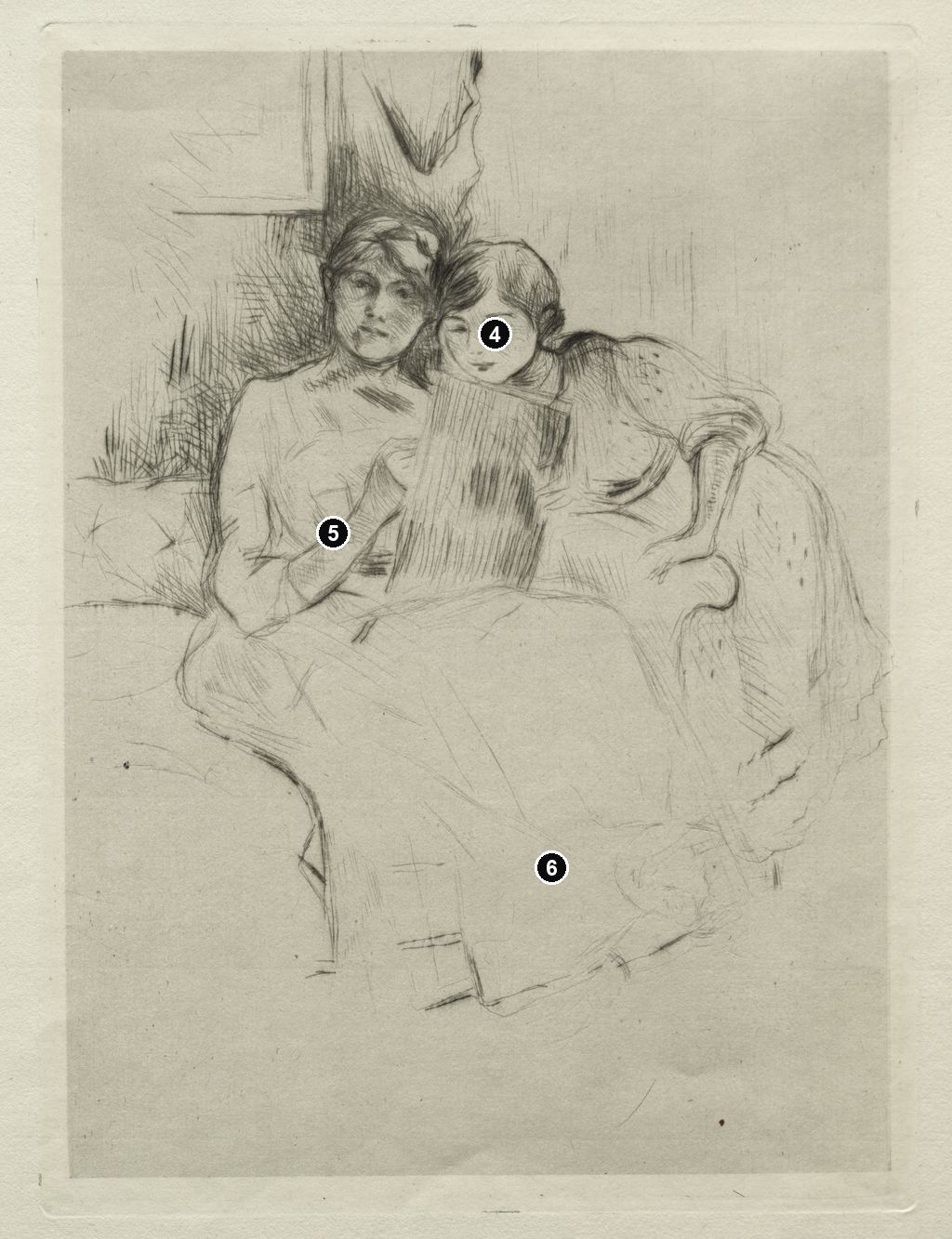
In The Drawing Lesson, Berthe Morisot looks out from beside a drawing board while her daughter Julie leans close to watch. The faces emerge from fine dark lines; much of the clothing remains open, allowing the paper to supply its light. This intimate image belongs to Morisot’s small body of original prints. The Metropolitan Museum of Art identifies it as a drypoint of 1889 and explains that Julie gave it its familiar title for a posthumous edition.[1] Its history introduces the central question when looking at a Morisot print: who made the image, and when was this particular sheet printed?
At a Glance
- Main techniqueDrypoint, sometimes combined with etching.
- Period of experimentationPrincipally 1887–1890.[2]
- Core drypoint groupEight designs; this is not an exhaustive count of everything described as a Morisot print.[1][2]
- Recurring subjectsJulie, women resting, water birds and waterside settings.
- Important distinctionA plate made during Morisot’s lifetime can survive in an impression printed after her death.
- Key exampleThe Drawing Lesson, 1889, held in different impressions by Cleveland, the Met and the National Gallery of Art.
Contents
- How Morisot Came to Printmaking
- What Drypoint and Etching Mean
- The Drawing Lesson: Mother, Artist and Observer
- Water Birds and an Experimental Plate
- A Reclining Woman and Julie with a Cat
- Plates, Impressions, States and Later Editions
- Original Prints and Reproductions
- Annotated details
How Morisot Came to Printmaking
Caroline Fieschi’s account for the Institut national d’histoire de l’art connects Morisot’s first experiments in 1887 with a request from the poet Stéphane Mallarmé. She initially explored colour lithographic reproduction of drawings made with three crayons for a projected poetry publication. The proposed collaborative format did not appear. She took up drypoint in 1888, turning to subjects also familiar from her paintings and works on paper.[2]
These beginnings help explain why an apparently simple category contains different kinds of object. Lithography transfers a drawn image from a prepared printing surface; drypoint begins with marks scratched into metal. A project to reproduce a coloured drawing and a drypoint developed on a plate involve different routes from the artist’s hand to the printed page. The surviving drypoints deserve attention as compositions conceived through line, with their own balances of dark marks and untouched paper.
Four original prints
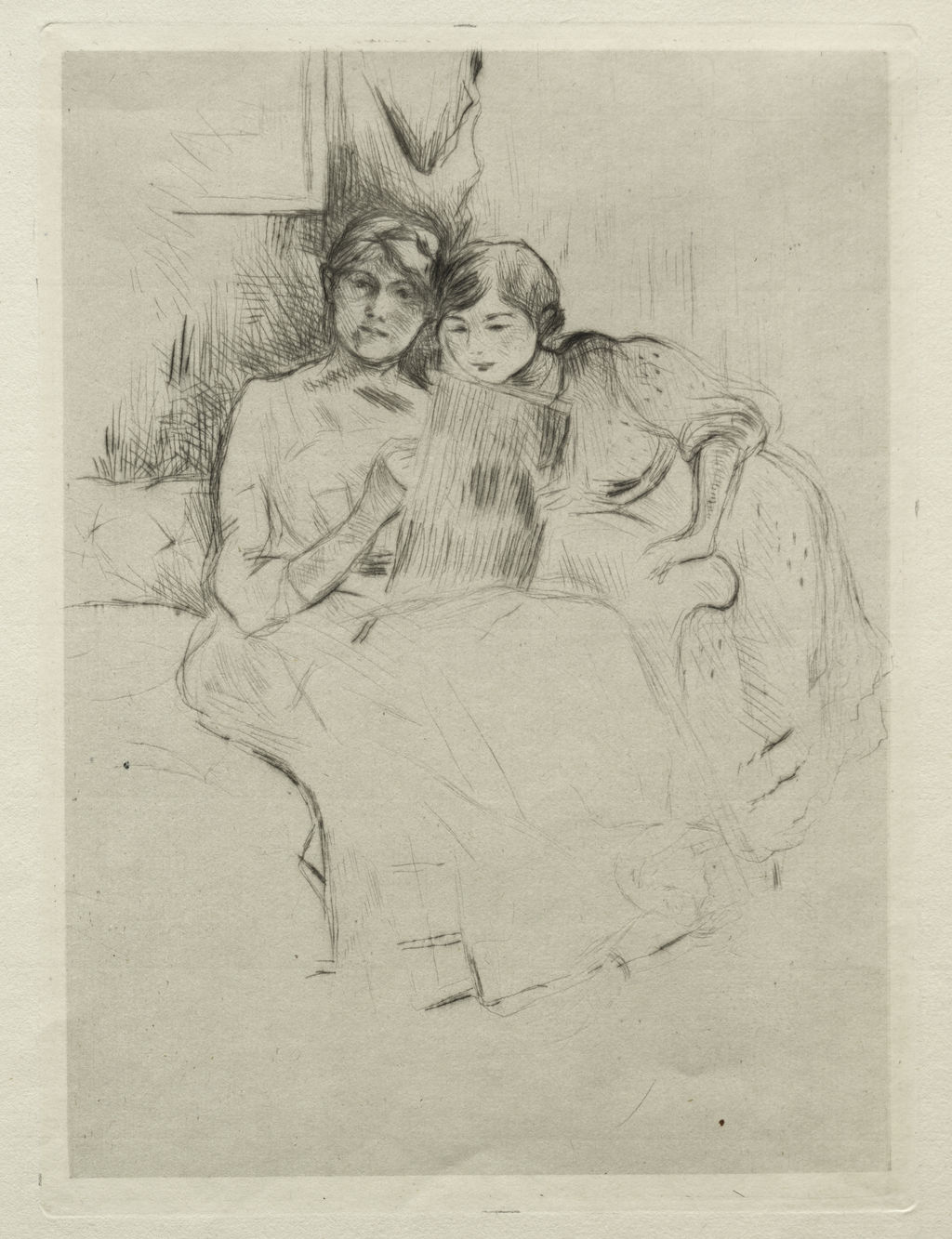
The Drawing Lesson
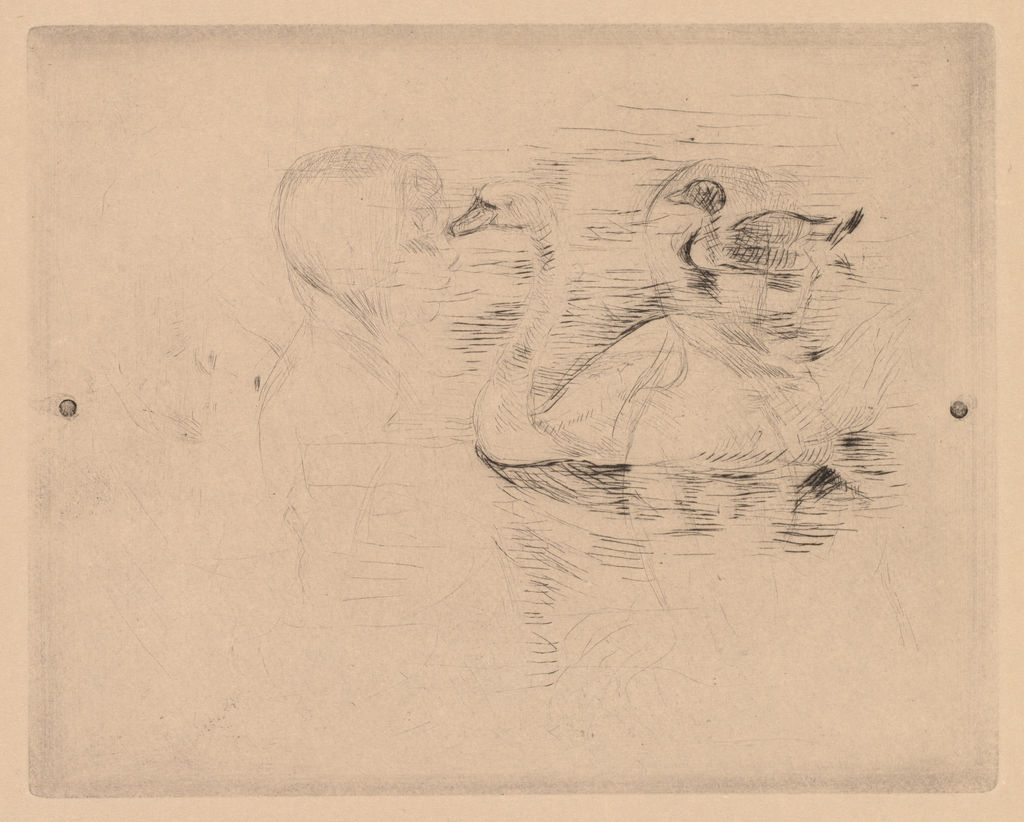
Swan and Duck
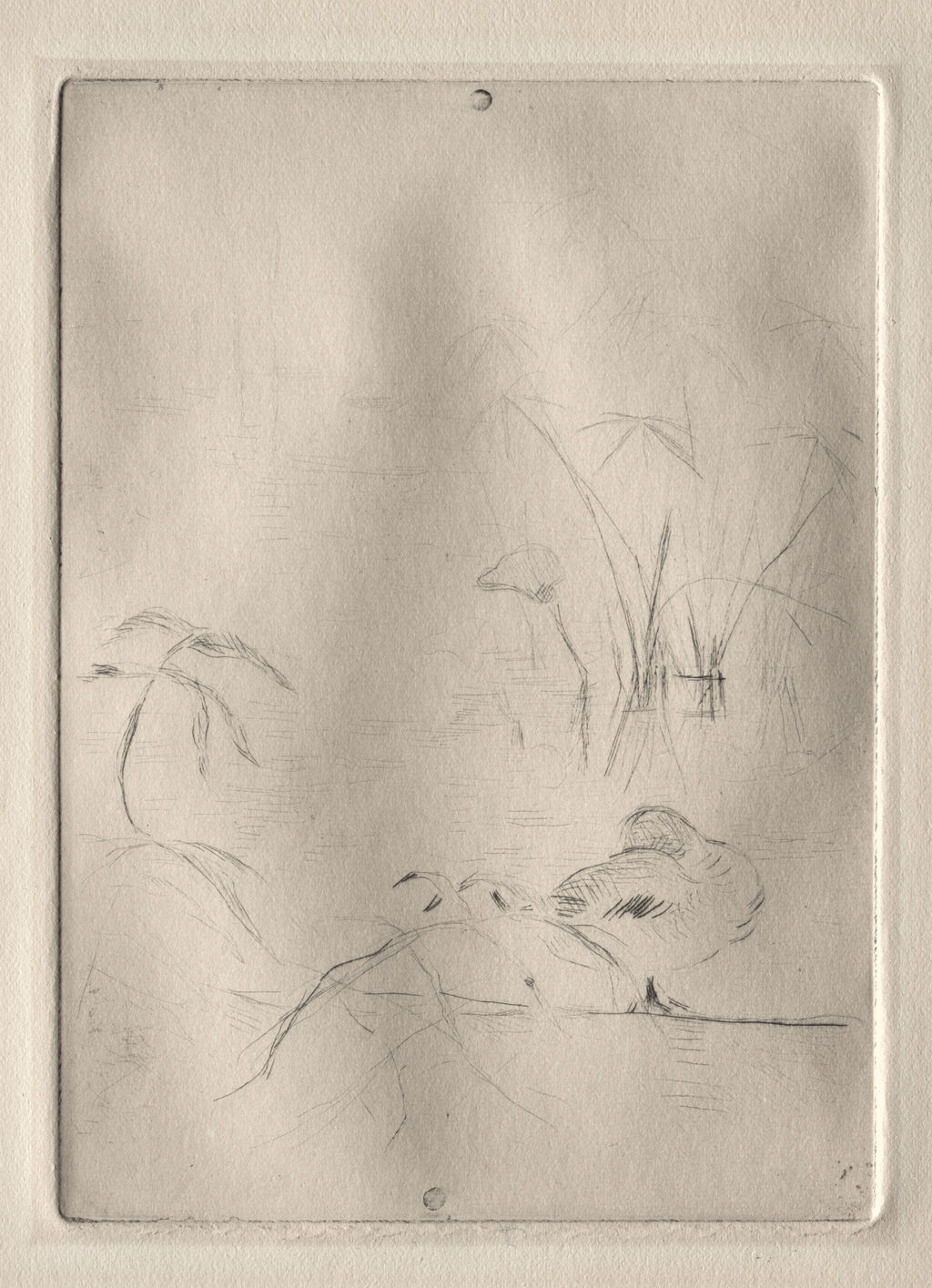
The Duck
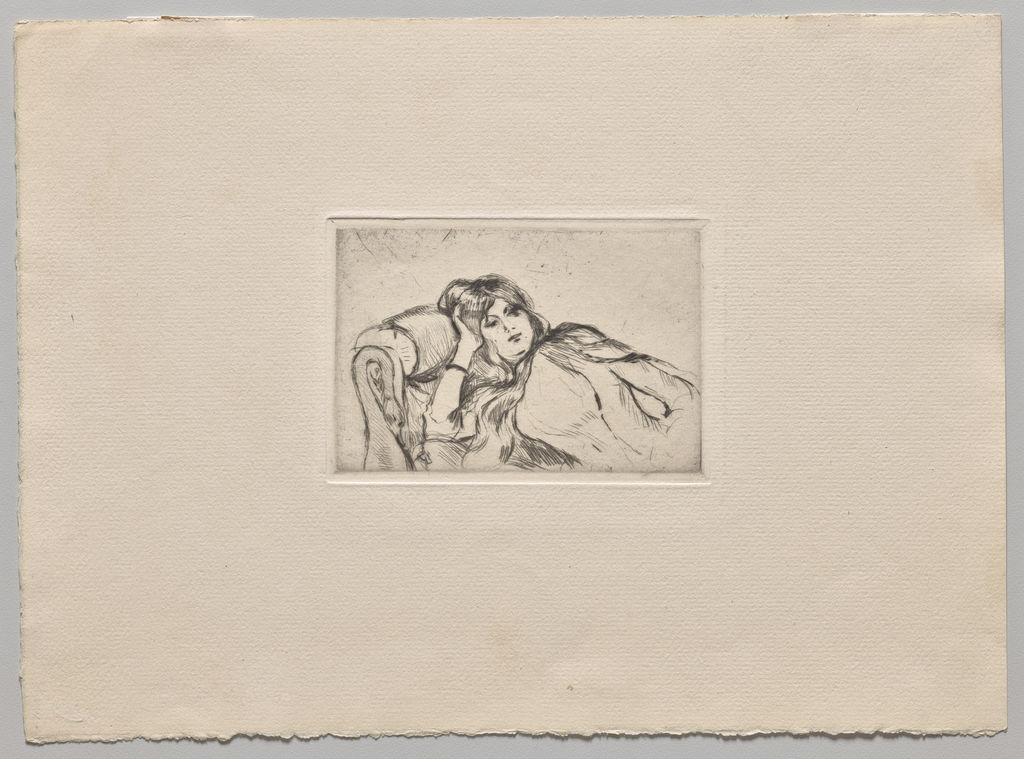
Young Woman at Rest
What Drypoint and Etching Mean
A drypoint needle scratches directly into a metal plate. As it moves, it raises a small ridge of displaced metal, called the burr. That ridge catches ink and can give a printed line a soft, dark edge. It also wears with use, so the character of impressions can change as a plate is printed. Wendy Thompson’s account for the Met explains both the technique’s rich blacks and its practical limitations for producing many impressions.[3]
Etching introduces another step: the artist draws through an acid-resistant coating, exposing the metal underneath. Acid then bites the exposed lines into the plate. The distinction concerns how the marks are formed, and the processes can be combined within one work.[4] Cleveland describes Morisot’s The Duck as etching and drypoint, while its Drawing Lesson is catalogued simply as drypoint.[5][6] A reader need not flatten these specific descriptions into a single label for her whole output.
For looking, start with the marks themselves. A single line may establish the curve of a neck or the edge of a sleeve. Closely spaced parallel strokes, known as hatching, create a darker area. When strokes cross, the darkness becomes denser. The surrounding paper has an equally active role: broad areas left without a descriptive mark can suggest water, light or the breadth of a dress. These images reward moving between the whole composition and its smallest decisions.
Berthe Morisot, The Duck, 1888–90, etching and drypoint, Cleveland Museum of Art, accession 1998.377. Image source. CC0 1.0; owner Open Access. Resized only; native appearance preserved.
Annotated Details from Four original print designs
The numbered points identify visible features discussed in this article. Return from each detail to the whole composition. Each caption identifies the work shown.
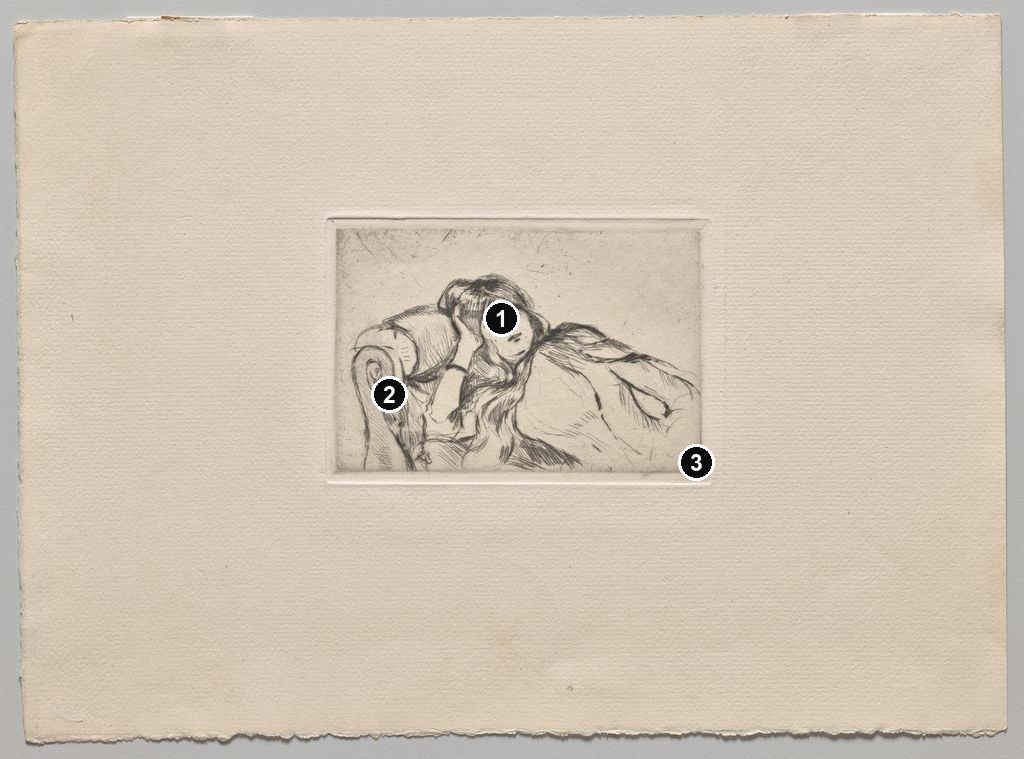
Young Woman at Rest
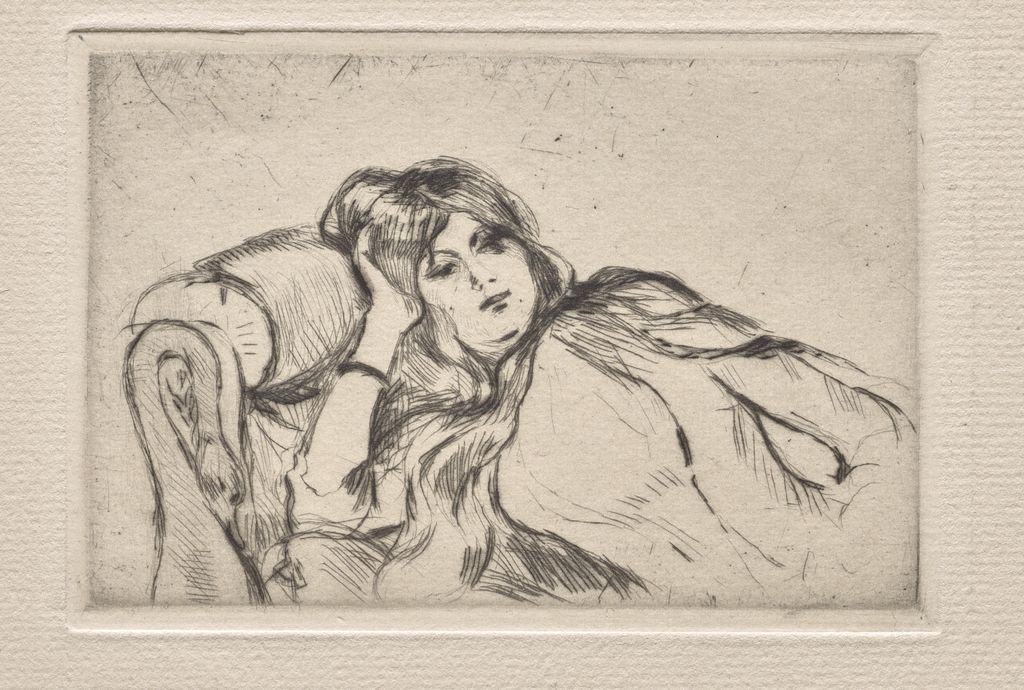
Berthe Morisot, Young Woman at Rest, 1889, drypoint, Cleveland Museum of Art, accession 2024.34. The small printed image sits within generous sheet margins. Image source. CC0 1.0; owner Open Access. Resized only; native appearance preserved.
The Drawing Lesson
Berthe Morisot, The Drawing Lesson, 1889, drypoint, Cleveland Museum of Art, accession 1925.1036. Image source. CC0 1.0; owner Open Access. Resized only; native appearance preserved.
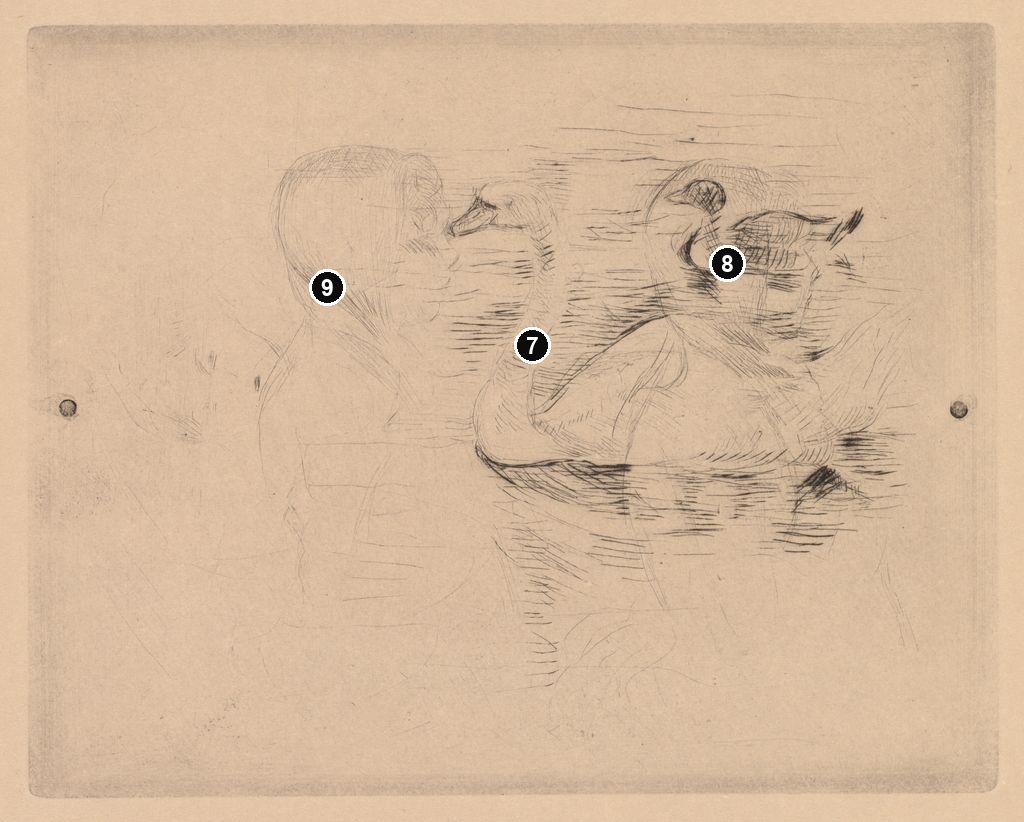
Swan and Duck
Berthe Morisot, Swan and Duck, with portraits of Julie, 1889, drypoint, Cleveland Museum of Art. Faint profiles share the experimental plate with the birds. Image source. CC0 1.0; owner Open Access. Resized only; native appearance preserved.
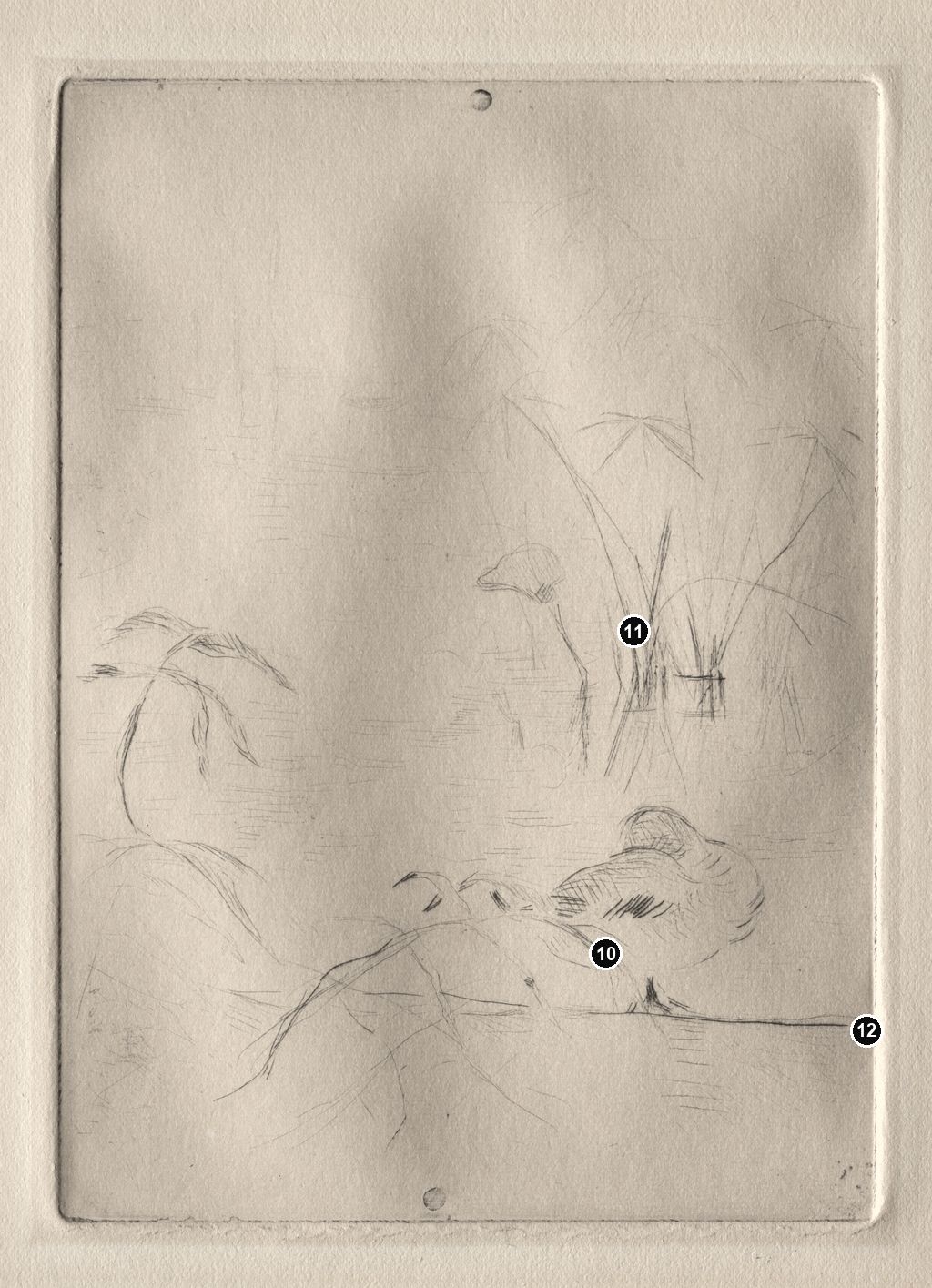
The Duck
Berthe Morisot, The Duck, 1888–90, etching and drypoint, Cleveland Museum of Art, accession 1998.377. Image source. CC0 1.0; owner Open Access. Resized only; native appearance preserved.
Details from FOUR ORIGINAL PRINT DESIGNS
Compare the cropped details with the complete images above. Notice how their colours, shapes and positions contribute to the larger compositions.
Young Woman at Rest
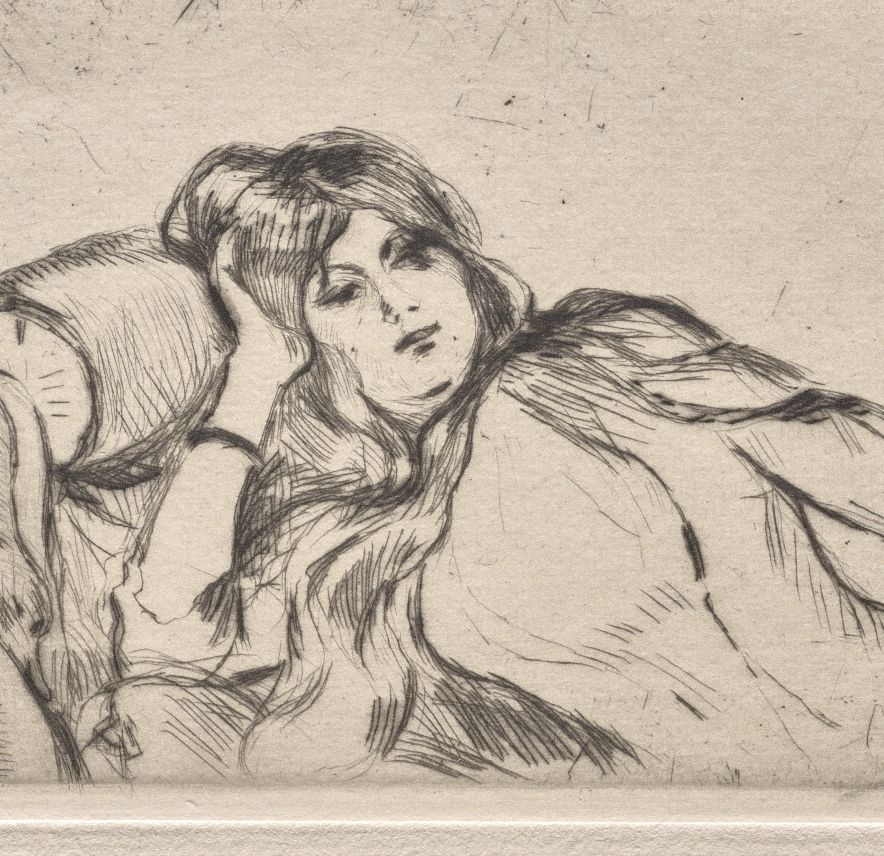
Face within the reclining pose
The face turns toward the viewer within the low reclining figure. Dark contours gather around the head and loosen across the body.
Curved chair arm
The chair’s curved arm supports the reclining pose. Its looping lines provide a firm shape beside the figure.
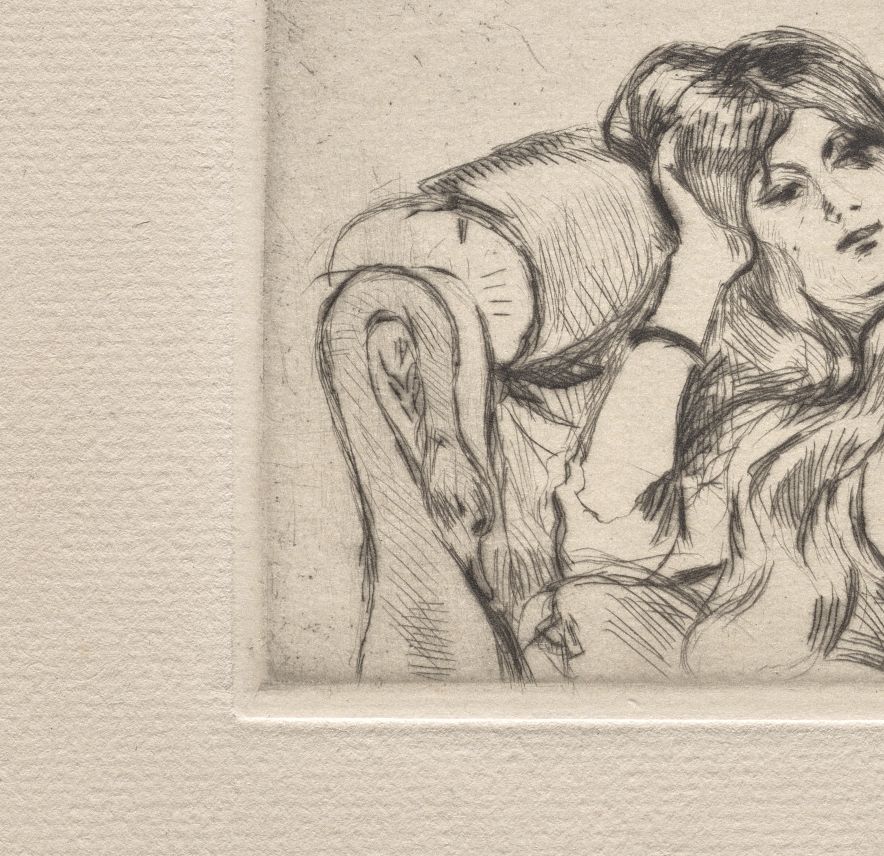
Figure and printed boundary
The small printed rectangle sits inside much larger sheet margins. Keeping that boundary visible distinguishes the image from the paper carrying its impression.
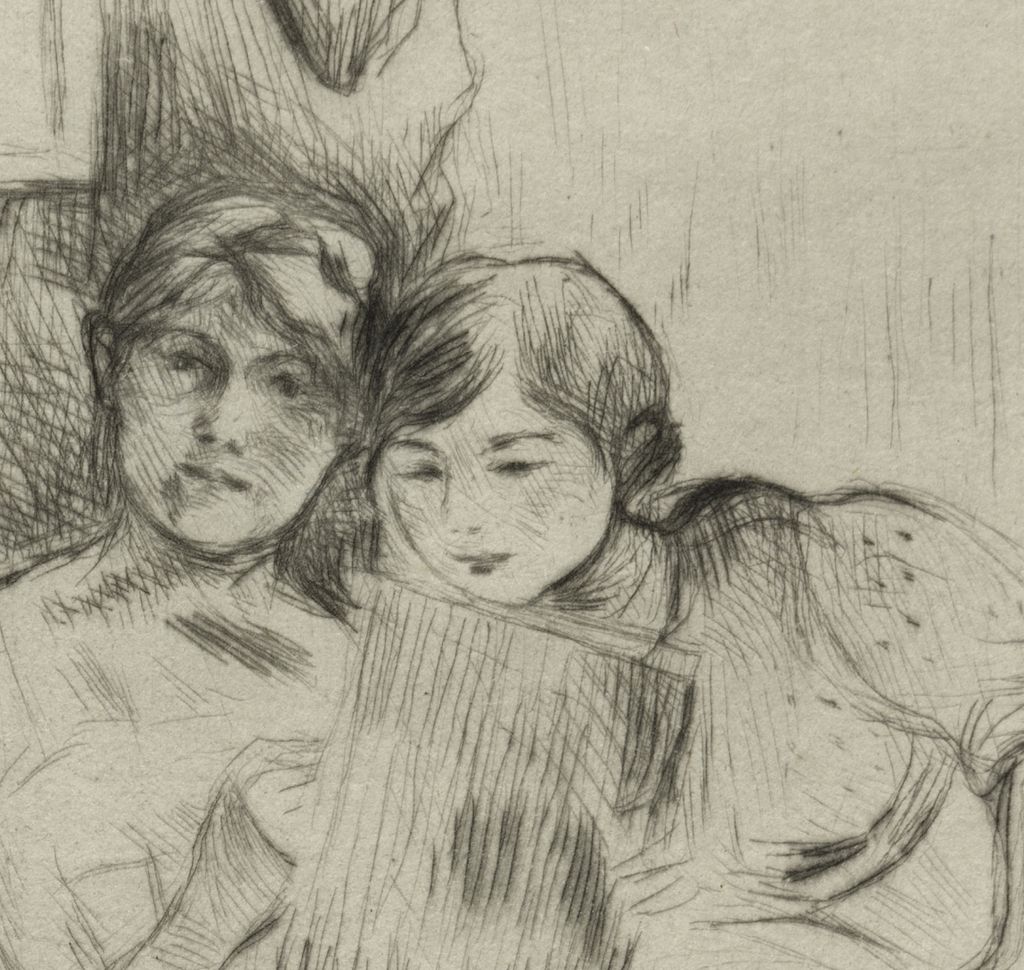
The Drawing Lesson
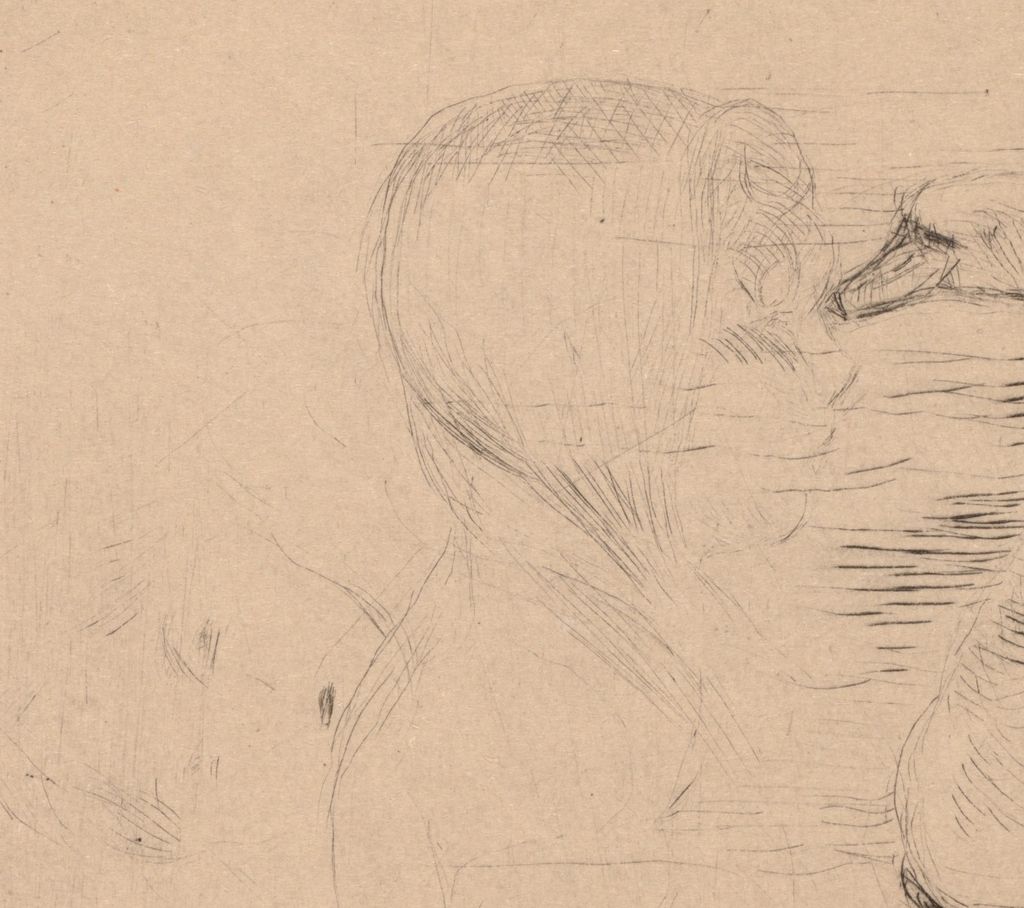
Two heads brought together
The two heads touch within a compact group of dark marks. Their closeness is established through position and shared contours.
The drawing hand
The hand and raised working surface bring the act of drawing into the composition. Fine lines distinguish these small forms from the broader dress.
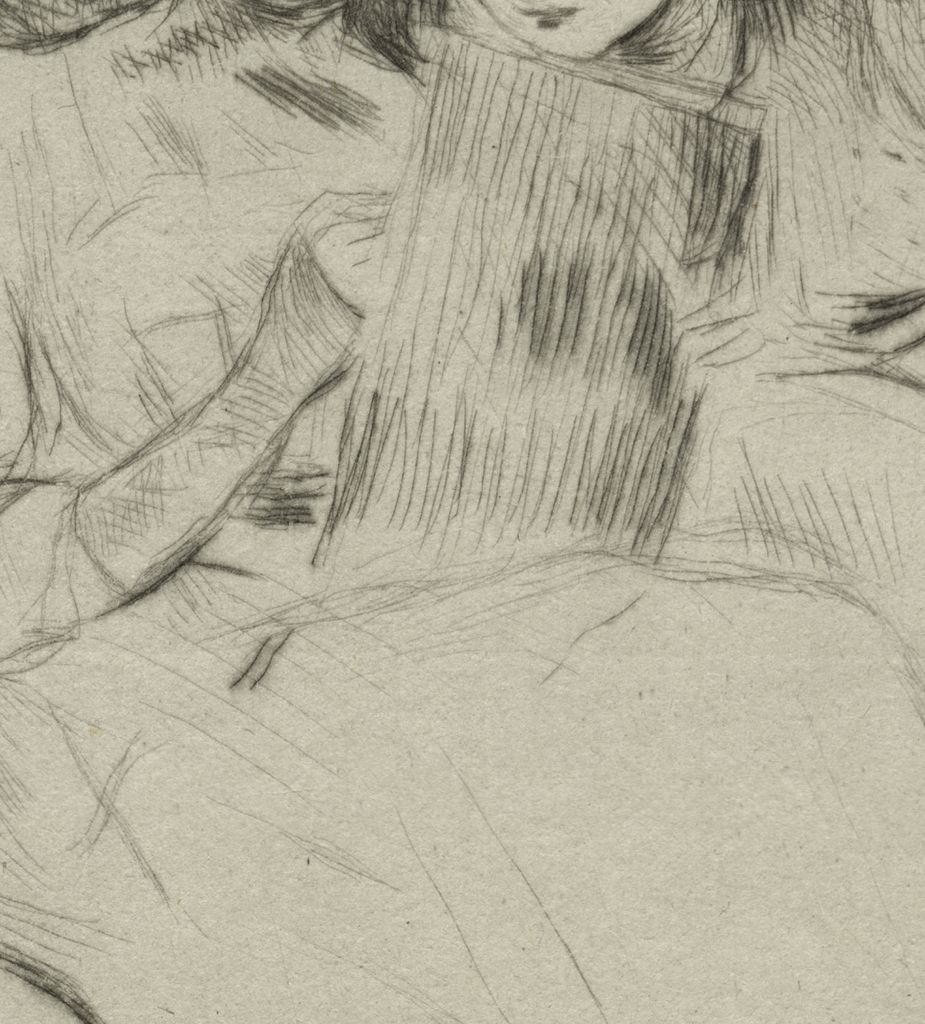
The lightly described lower body
Lines become more widely separated across the lower figure. The printed image remains open, allowing the paper to carry much of its light.
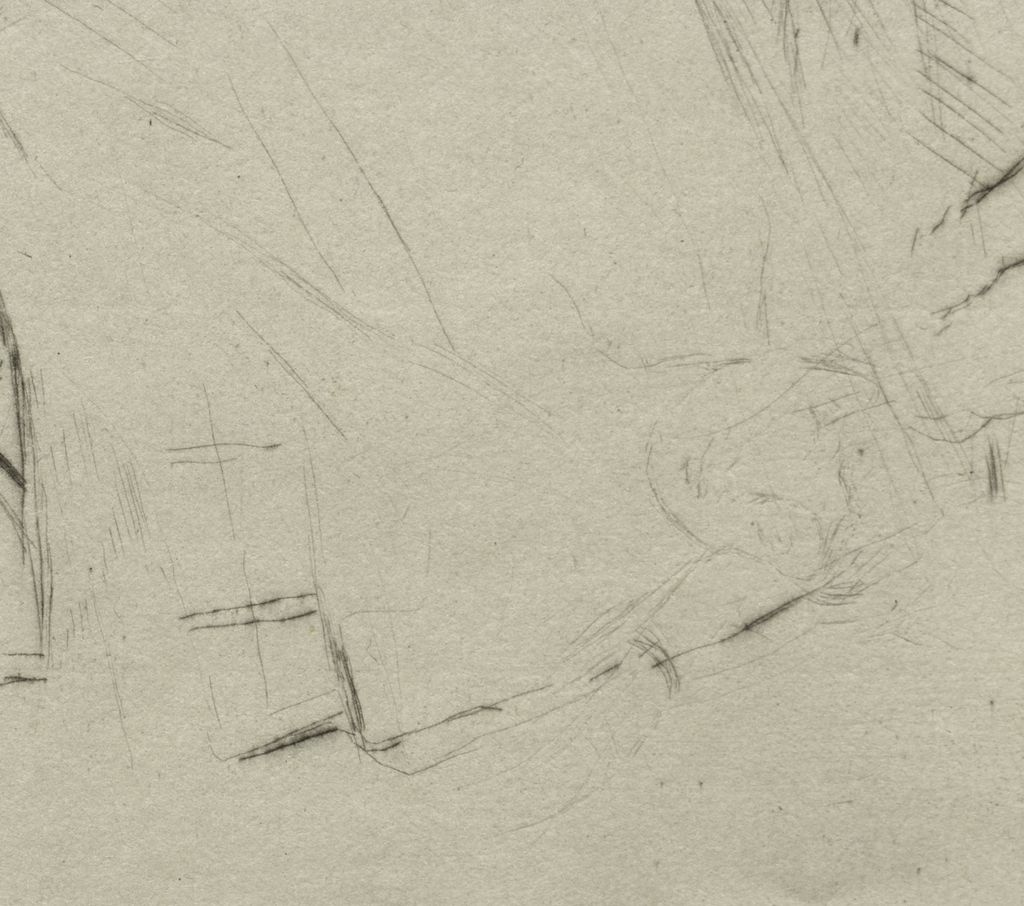
Swan and Duck
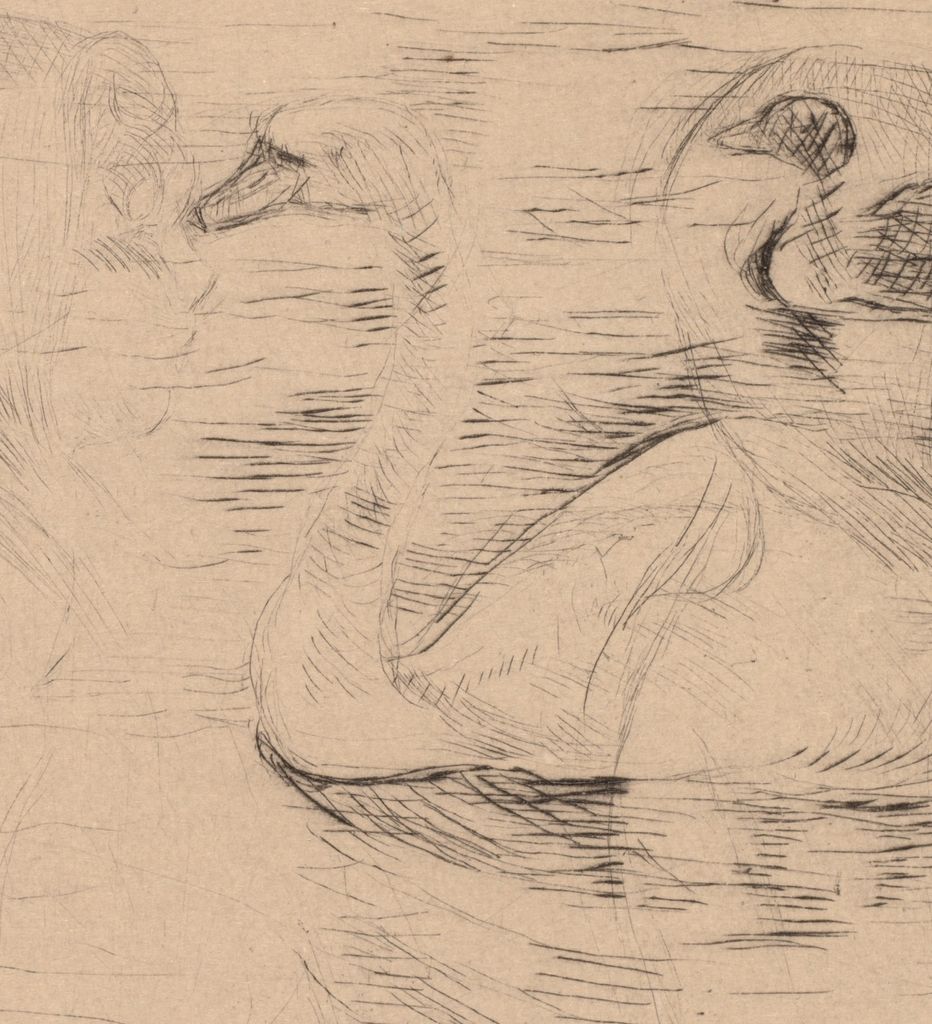
The swan’s curved neck
The swan’s long neck rises above its body. Closely spaced lines describe its outline and reflection.
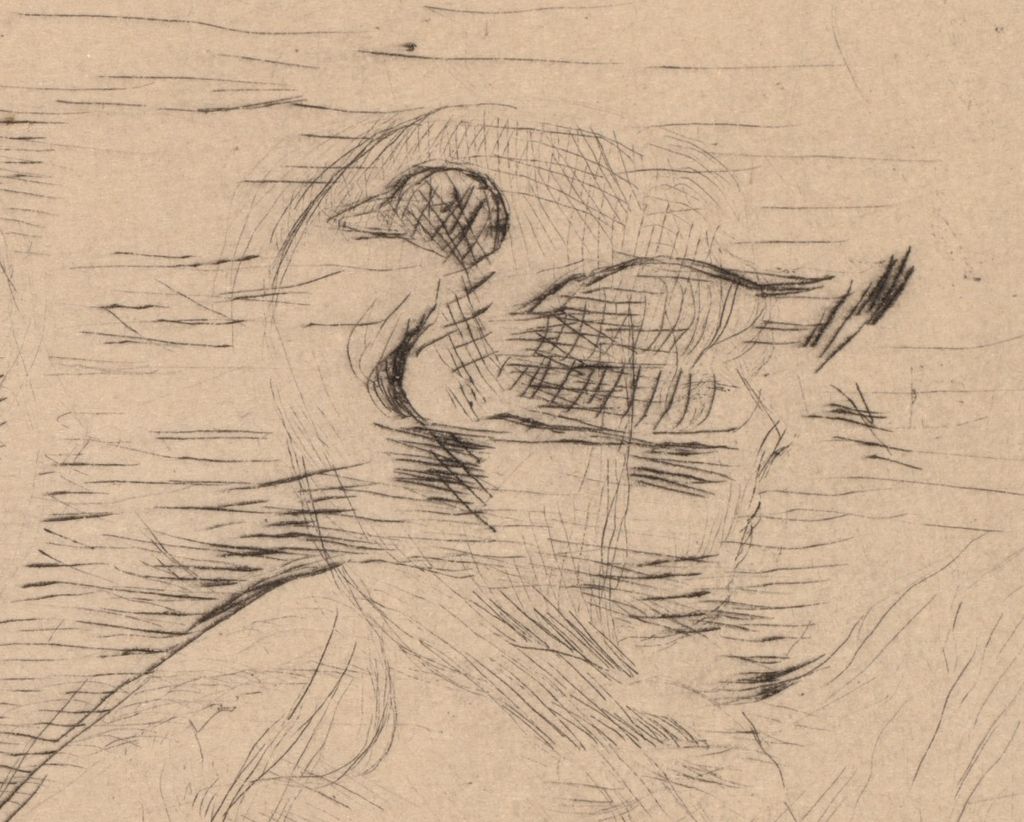
The duck above the swan
A smaller duck occupies the upper part of the plate. Horizontal marks connect the separate birds through the suggestion of water.
Faint profiles on the plate
Lightly drawn profiles share the plate with the birds. Their presence makes the sheet a place of experiment rather than a neatly isolated bird study.
The Duck
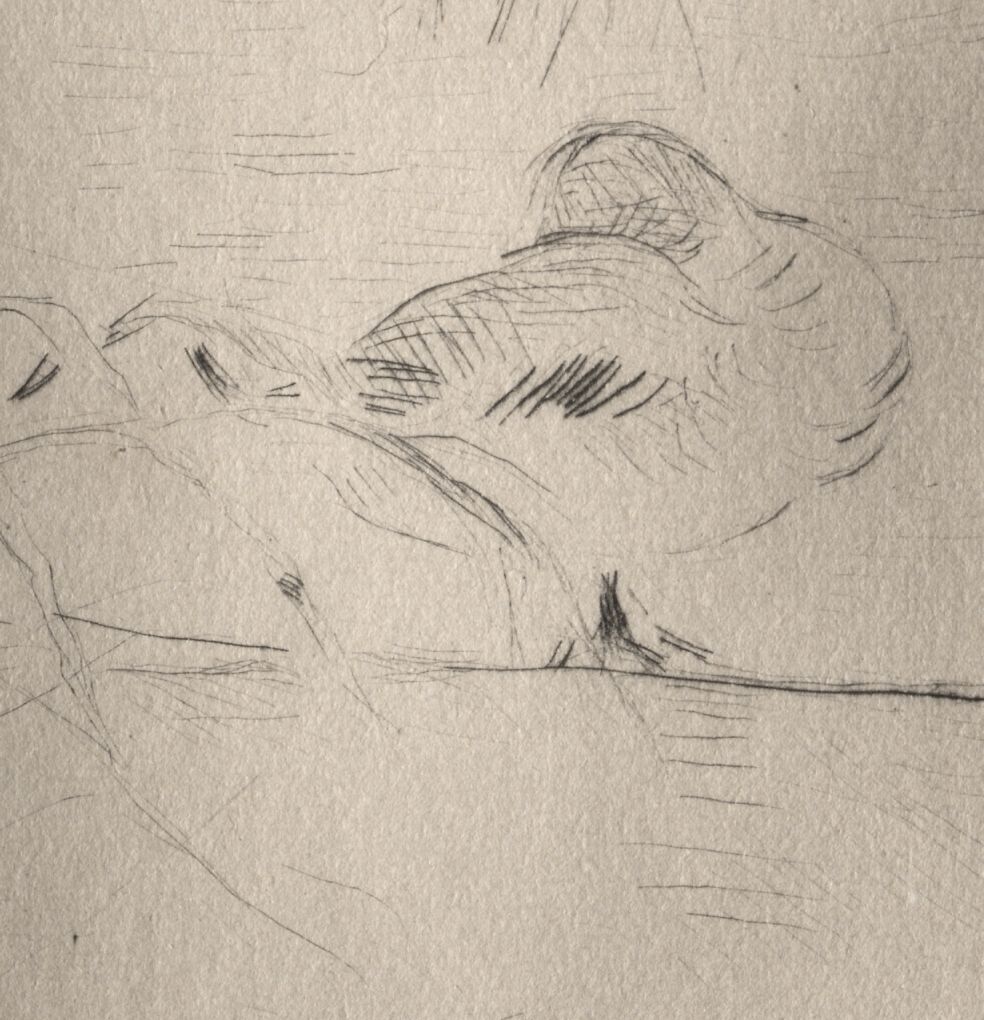
The small duck
A few dark curves define the small duck and the narrow line beneath it. Much of the surrounding printed field stays light.
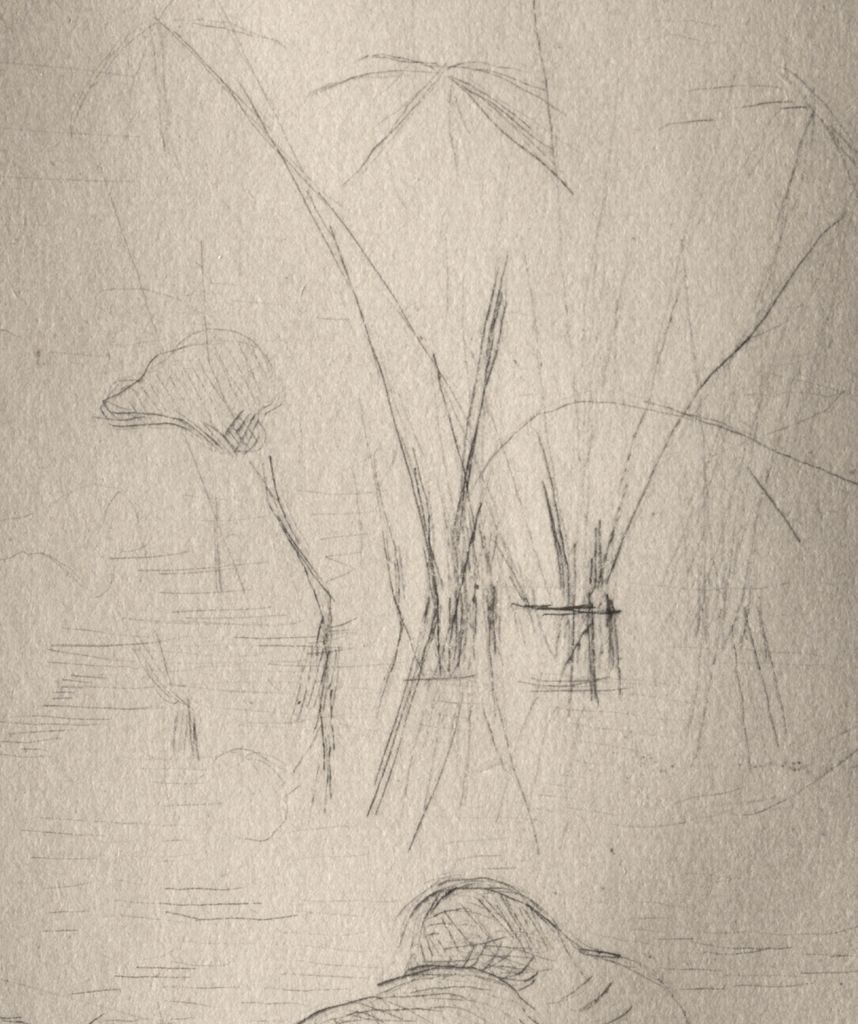
Reeds above the bird
Thin stems rise through the open field. Their vertical direction differs from the low horizontal body of the duck.
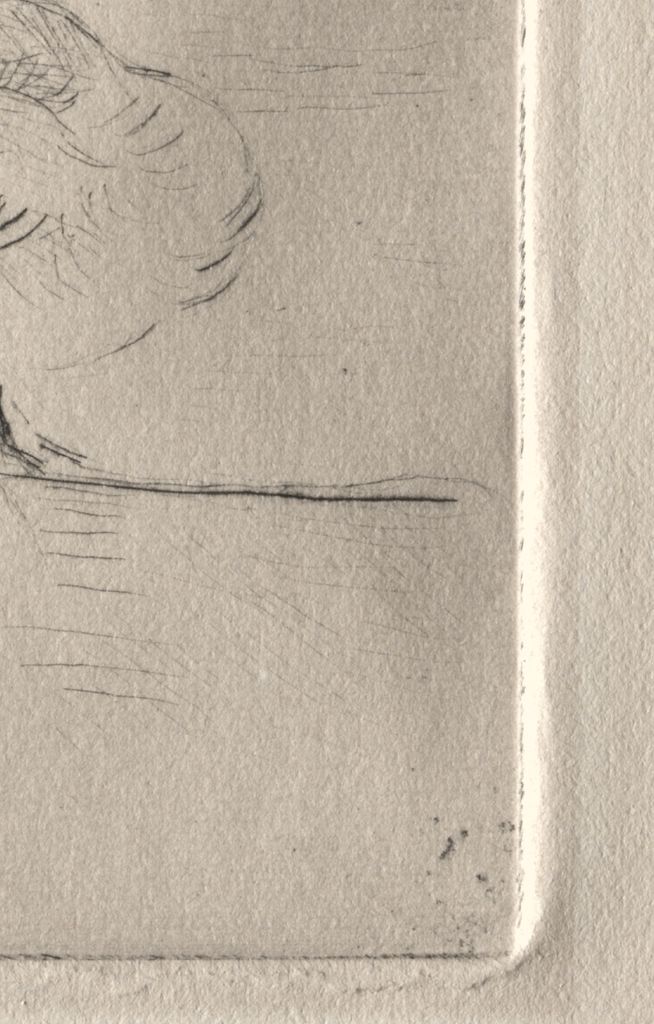
The printed plate edge
The plate’s boundary remains visible within the sheet. It helps distinguish the small drawn image, the printed field and the surrounding paper.
The Drawing Lesson: Mother, Artist and Observer
Cleveland’s impression of The Drawing Lesson, dated 1889, shows the adult figure seated upright, with the board cutting a strong diagonal across the centre. Julie’s head comes close to her mother’s, but her attention falls towards the work. Morisot’s gaze meets ours. The two directions of looking make the scene feel active: one person studies the image being made while the other appears to study someone beyond the paper.[5]
Dark hatching gathers behind Morisot’s head and along parts of the board, giving the faces a firm setting. Below, the skirts spread into a loose web of contours. Following those contours is a useful way to see how little continuous description is needed. The lower half has weight and movement even where the forms remain open. The change in density also prevents the board from becoming an isolated rectangle: its lines sit within a broader rhythm of sleeves, knees and fabric.
The Met identifies the composition as a self-portrait in which Morisot draws her reflection while Julie watches. Its account of the title adds another layer. The Drawing Lesson is Julie’s posthumous name for the image, rather than a securely documented title assigned by Morisot herself.[1] That does not erase the subject of shared attention. It does mean that a familiar title carries the daughter’s later interpretation alongside the mother’s original act of making.
Cleveland also associates Morisot’s experiments with encouragement from Mary Cassatt and Mallarmé.[5] The print gives a particularly concrete expression to that larger artistic world. Within a scene of family proximity, Morisot shows the tools, posture and concentration of work. Julie participates through observation. The composition holds those different activities together without needing a separate emblem to announce the artist’s profession.
Berthe Morisot, The Drawing Lesson, 1889, drypoint, Cleveland Museum of Art, accession 1925.1036. Image source. CC0 1.0; owner Open Access. Resized only; native appearance preserved.
Water Birds and an Experimental Plate
Cleveland’s Swan and Duck, with portraits of Julie, dated 1889, is especially revealing. The swan occupies the centre, a smaller duck sits towards the upper right, and faint profiles of Julie overlap the birds and the water. The museum’s alternative French title includes essai, or trial. Its plate measures only 11.7 by 14.9 centimetres, much smaller than an enlarged screen image might suggest.[7]
In this impression, the swan’s neck rises beside a girl’s profile, bringing two very different kinds of contour into contact. Short horizontal strokes surround the bird and suggest the broken surface of water. The lightly traced head at the left remains legible without having the same dark emphasis. Looking across the plate, the eye must alternate between overlapping subjects rather than settle into one continuous scene.
That coexistence is valuable evidence of experiment. It allows us to see a plate carrying more than a neatly isolated animal study. It does not, by itself, establish the exact order in which every profile and bird was drawn. The safe starting point is what this particular impression preserves: different motifs sharing the same small surface. A print’s apparent looseness can be an invitation to examine its construction closely.
The Duck, in Cleveland’s collection, produces a different relationship between animal and setting. The museum dates it 1888–1890 and records both etching and drypoint.[6] The duck sits low in a tall composition. Reeds rise at the right, slanting stems cross the foreground, and a great deal of the upper area remains pale. The bird’s few dark accents become conspicuous because so much around them is lightly marked. The scale of the emptiness matters as much as the detail of the feathers.
Waterside motifs also provide a useful comparison with the oil painting Girl in a Boat with Geese. Look for the different means used to separate bird, bank and water: colour and brushwork in an oil, selected contours and intervals of paper in a print. A shared motif need not make one object a reproduction of another.
Berthe Morisot, Swan and Duck, with portraits of Julie, 1889, drypoint, Cleveland Museum of Art. Faint profiles share the experimental plate with the birds. Image source. CC0 1.0; owner Open Access. Resized only; native appearance preserved.
Watch: Berthe Morisot
Explore Morisot’s career with Katy Hessel, then look closely at Summer’s Day with the National Gallery.
Katy Hessel on Berthe Morisot
Katy Hessel tours the exhibition Berthe Morisot: Shaping Impressionism.
Watch on YouTubeA Reclining Woman and Julie with a Cat
Young Woman at Rest, Cleveland’s drypoint of 1889, compresses its subject into a small horizontal rectangle. A woman props her head on one hand, her hair falling towards the bottom edge. The carved end of the furniture answers the curves of her hair and sleeve. Cleveland identifies the model as Jeanne-Marie Fourmanoir and places the scene in Morisot’s studio.[8]
Here the eye can move from a compact face to the larger, less densely worked shape of the body. The dark hair and the shaded armrest anchor the left side. Towards the right, strokes trace the draped figure without filling every space between them. The contrast gives the reclining pose breadth while preserving the immediacy of the drawn line. On the full sheet, the printed image sits within a generous margin, making its modest physical scale especially clear.
Another print brings the family’s artistic exchanges into focus. The Blanton Museum of Art records Girl with a Cat (Julie Manet) after Pierre-Auguste Renoir as an etching and drypoint of 1889, Bailly-Herzberg number 6. Morisot adapted Renoir’s 1887 painting of Julie, removing its setting and concentrating on the child and cat.[9] The word “after” identifies the source of the composition. Morisot remains the printmaker; Renoir supplied the painted model that she reinterpreted.
That example is a reminder to read an attribution as a whole sentence. “By Morisot, after Renoir” has a different meaning from “after Morisot.” The first can identify a print that she made through her own work on the plate. The second may identify someone else’s translation of one of her images. A related subject, a familiar name or a reproduced signature cannot settle authorship alone.
Berthe Morisot, Young Woman at Rest, 1889, drypoint, Cleveland Museum of Art, accession 2024.34. The small printed image sits within generous sheet margins. Image source. CC0 1.0; owner Open Access. Resized only; native appearance preserved.
Plates, Impressions, States and Later Editions
An impression is an individual sheet printed from a prepared surface. A state records a version of that surface after a change has been made to it. A trial proof lets the maker assess the image during its development; it is not simply another name for every scarce print. The New York Public Library’s print glossary explains why several proofs and states can belong to the history of a single design.[10]
Morisot’s prints have a particularly important life after the artist’s death. Fieschi identifies the INHA’s eight drypoints as impressions from a printing initiated by Ernest Rouart around 1904–1905. Jacques Doucet bought the group from Alfred Strölin, with an invoice dated 17 February 1908. Lifetime impressions remain poorly documented.[2]
A separate, precisely dated example appears in Washington. The National Gallery of Art describes its Drawing Lesson as “1889, printed 1921,” in the series Cahier de huit pointes seches. Its record also transcribes the number 18/25 in a later hand and a B.M. collection mark.[11] The two dates distinguish the origin of the design from the manufacture of that sheet. They should remain together when discussing the museum’s impression.
A later impression can therefore preserve Morisot’s original print design while belonging to a publication history she did not oversee. Conversely, the early date of a plate does not make every impression a lifetime proof. An edition number identifies a sheet’s place within a stated group; it cannot establish the date without accompanying records. The Washington example shows how much information a careful description can carry beyond a title and artist’s name.
The scale of the oeuvre also needs precise wording. The Met identifies eight drypoints, while Fieschi discusses nine known prints in a broader account that includes the early lithographic experiments.[1][2] Eight drypoint designs and nine prints are not interchangeable claims. The broader total should be retained without assigning an unverified identity to the additional work.
Original Prints and Reproductions
The Victoria and Albert Museum defines a print through the transfer of an image from one surface to another in a repeatable process; the resulting impression is itself the work of art.[12] In everyday shopping language, however, “Morisot print” may also mean a newly produced image of one of her paintings. Those are different objects with different histories, even when both offer an enjoyable way to live with her art.
A useful description should identify the maker, source image, medium, image or plate dimensions, sheet dimensions, and printing date where known. For a historical drypoint, an edition or state and an owning collection’s catalogue number can help distinguish impressions. For a modern reproduction, the printing process and the artwork being reproduced should be stated plainly. “Limited edition” tells us that a quantity has been set; it does not by itself establish the artist’s involvement.
Portraits of Morisot require the same attention: INHA preserves examples made by Manet.[2] Her name can describe the sitter as well as the maker. The attribution identifies her role in that particular object.
For the connection between an individual hand-drawn sheet and an image made through a printing plate, explore Morisot’s drawings. In the prints themselves, keep returning to the relationship between line and paper. A sharply observed head, the curve of a bird or a lightly suggested dress can carry an image with very few marks. The small scale encourages the close attention those decisions deserve.
Further reading
These museum and library resources offer different ways to continue looking at the works.
Berthe Morisot: Catalogue des peintures, pastels et aquarelles. Marie-Louise Bataille and Georges Wildenstein, Paris, 1961; digitised by the Wildenstein Plattner Institute.
Use the historical catalogue to compare titles, compositions and recorded exhibitions. Current museums sometimes revise its dates or identifications. Open the digitised catalogue.
Portraits de Berthe Morisot. Caroline Fieschi, Institut national d’histoire de l’art. French.
This institutional study explains the small print oeuvre, drypoint practice and later editions. Read the INHA study.
Artworks directory
Explore documented paintings, pastels, watercolours, prints and sculpture. Original French titles are retained for many works. The 1961 catalogue supplies the historical core; dates are updated where the linked museum records establish a revision. Lost works and surviving fragments remain part of that record. This is a directory of compositions, with individual print impressions and bronze casts grouped together.
| Name | Date | Medium |
|---|---|---|
| Ferme en Normandie | 1859 | Oil painting |
| Le Repas chez Simon | 1860 | Oil painting |
| Le Calvaire | 1860 | Oil painting |
| La Vue de Tivoli | 1863 | Oil painting |
| Souvenir des bords de l’Oise | 1863 | Oil painting |
| The Old Track to Auvers | 1863 | Oil painting |
| Chaudron | 1864 | Oil painting |
| Étude Au bord de l'eau | 1864 | Oil painting |
| La Brémondière | 1865 | Oil painting |
| Chaumière en Normandie | 1865 | Oil painting |
| La Seine en aval du Pont d'Iéna | 1866 | Oil painting |
| Rivière de Pont-Aven à Rosbras | 1866 | Oil painting |
| Portrait de Mme Lucien Boursier | 1867 | Oil painting |
| Reading | 1873 | Oil painting |
| Le Débarquement de Marie de Médicis à Marseille | 1868 | Oil painting |
| Un quai à Lorient | 1869 | Oil painting |
| The Harbour at Lorient | 1869 | Oil painting |
| The Artist's Sister at a Window | 1869 | Oil painting |
| Deux sœurs sur un canapé | 1869 | Oil painting |
| The Mother and Sister of the Artist | 1869–1870 | Oil painting |
| Portrait de Mme Heudé | 1870 | Oil painting |
| Jeune Femme (Young Woman) | 1871 | Oil painting |
| Vue de Paris des hauteurs du Trocadéro | 1872 | Oil painting |
| Woman and Child on a Balcony | 1872 | Oil painting |
| The Cradle | 1872 | Oil painting |
| Intérieur | 1872 | Oil painting |
| Cache-cache | 1873 | Oil painting |
| Sur la Plage | 1873 | Oil painting |
| La plage de Fécamp | 1873 | Oil painting |
| Falaise à Fécamp | 1873 | Oil painting |
| The Pink Dress (Albertie-Marguerite Carre, later Madame Ferdinand-Henri Himmes, 1854–1935) | about 1870 | Oil painting |
| Jeune fille en robe de bal | 1873 | Oil painting |
| Portrait de Mme Hubard | 1874 | Oil painting |
| Portraits de Mme Boursier et de sa fille | 1874 | Oil painting |
| Les lilas à Maurecourt | 1874 | Oil painting |
| The Butterfly Hunt | 1874 | Oil painting |
| Sur la terrasse | 1874 | Oil painting |
| In a Villa at the Seaside | 1874 | Oil painting |
| Boats under Construction | 1874 | Oil painting |
| Bassin du port de Fécamp | 1874 | Oil painting |
| Port de Fécamp | 1874 | Oil painting |
| L'entrée du port | 1874 | Oil painting |
| Le petit moulin à Gennevilliers | 1875 | Oil painting |
| Paysage à Gennevilliers | 1875 | Oil painting |
| Hanging the Laundry out to Dry | 1875 | Oil painting |
| Grain Field | 1875 | Oil painting |
| Le déjeuner sur l'herbe | 1875 | Oil painting |
| Enfants dans l'herbe en Angleterre | 1875 | Oil painting |
| La Tamise | 1875 | Oil painting |
| Dans l'île de Wight | 1875 | Oil painting |
| Eugène Manet on the Isle of Wight | 1875 | Oil painting |
| Marine en Angleterre | 1875 | Oil painting |
| The Isle of Wight | 1875 | Oil painting |
| Marine en Angleterre | 1875 | Oil painting |
| La jetée | 1875 | Oil painting |
| Le bateau à vapeur | 1875 | Oil painting |
| Jeune femme et fillette assises au pied d'un arbre | 1875 | Oil painting |
| Paysage aux environs de Valenciennes | 1875 | Oil painting |
| Avant le théâtre | 1875 | Oil painting |
| At the Ball (Au Bal) | 1875 | Oil painting |
| Jeune femme au miroir | 1876 | Oil painting |
| Jeune femme arrosant un arbuste | 1876 | Oil painting |
| La Toilette | 1876 | Oil painting |
| The Psyche Mirror | 1876 | Oil painting |
| Pomme coupée | 1876 | Oil painting |
| Dahlias | about 1876 | Oil painting |
| Femme à l’éventail | 1876 | Oil painting |
| Petit garçon | 1876 | Oil painting |
| Dame à l'écran | 1877 | Oil painting |
| Soupière et pomme | 1877 | Oil painting |
| Roses dans un verre | 1877 | Oil painting |
| Young Woman Powdering her Face | 1877 | Oil painting |
| Femme à sa toilette | 1877 | Oil painting |
| Le corsage noir | 1878 | Oil painting |
| Jeune femme près d’une fenêtre | 1878 | Oil painting |
| Fleurs à l'écran | 1878 | Oil painting |
| Jeune femme en gris étendue | 1879 | Oil painting |
| Jeune femme assise | 1879 | Oil painting |
| Summer's Day | about 1879 | Oil painting |
| Dames cueillant des fleurs | 1879 | Oil painting |
| Young Girl in a Ball Gown | 1879 | Oil painting |
| Derrière la jalousie | 1879 | Oil painting |
| Femme cousant | 1879 | Oil painting |
| Woman at her Toilette | 1875–1880 | Oil painting |
| Neige | 1880 | Oil painting |
| Hiver | 1880 | Oil painting |
| Jeune femme remettant son patin | 1880 | Oil painting |
| Petit garçon en gris | 1880 | Oil painting |
| Petit garçon | 1880 | Oil painting |
| Jeune femme en mauve | 1880 | Oil painting |
| Dans la salle à manger | 1880 | Oil painting |
| Pont sur la Seine | 1880 | Oil painting |
| Nourrice au fond d'un jardin | 1880 | Oil painting |
| Nourrice allaitant | 1880 | Oil painting |
| Nourrice et bébé | 1880 | Oil painting |
| Dans l'île | 1880 | Oil painting |
| Jeune fille mettant son bas | 1880 | Oil painting |
| Fleurs | 1880 | Oil painting |
| Portrait de Louise Riesener | 1881 | Oil painting |
| Portrait de Louise Riesener | 1881 | Oil painting |
| Enfant dans un intérieur | 1881 | Oil painting |
| La nourrice | 1881 | Oil painting |
| Eugène Manet et sa fille dans le jardin de Bougival | 1881 | Oil painting |
| Dame à l'ombrelle | 1881 | Oil painting |
| Paysanne étendant du linge | 1881 | Oil painting |
| Paysanne assise dans l'herbe | 1881 | Oil painting |
| Child in the Rose Garden | 1881 | Oil painting |
| Jeune femme cousant dans un jardin | 1881 | Oil painting |
| Petite fille aux cheveux blonds | 1881 | Oil painting |
| After Luncheon | 1881 | Oil painting |
| Port de Nice | 1882 | Oil painting |
| Le Port de Nice | 1882 | Oil painting |
| Le port de Nice | 1882 | Oil painting |
| Port de Nice | 1882 | Oil painting |
| Plage de Nice | 1882 | Oil painting |
| Plage de Nice | 1882 | Oil painting |
| Villa Arnulfi | 1882 | Oil painting |
| Villa dans les orangers | 1882 | Oil painting |
| Paysage | 1882 | Oil painting |
| Les pâtés de sable | 1882 | Oil painting |
| Jardin de Bougival | 1882 | Oil painting |
| à Bougival | 1882 | Oil painting |
| Jeune garçon dans les roses trémières | 1882 | Oil painting |
| Le balcon | 1882 | Oil painting |
| Le thé | 1882 | Oil painting |
| Berthe Morisot et sa fille | 1882 | Oil painting |
| Jeannie à la poupée | 1883 | Oil painting |
| La fillette blonde | 1883 | Oil painting |
| Fillette en mauve | 1883 | Oil painting |
| Petite fille en deuil dans un jardin | 1883 | Oil painting |
| Jardin | 1883 | Oil painting |
| Les foins à Bougival | 1883 | Oil painting |
| La meule de foin | 1883 | Oil painting |
| Paysage | 1883 | Oil painting |
| Le quai de Bougival | 1883 | Oil painting |
| En barque | 1883 | Oil painting |
| Eugène Manet and his Daughter in the Garden | 1883 | Oil painting |
| The Fable | 1883 | Oil painting |
| Jeune femme et enfant dans l'île | 1883 | Oil painting |
| Au bord du lac | 1883 | Oil painting |
| Fillette à la poupée | 1883 | Oil painting |
| Le jardin | 1883 | Oil painting |
| Jeune femme cousant au jardin | 1883 | Oil painting |
| Vénus va demander des armes à Vulcain | 1884 | Oil painting |
| Petite fille dans un jardin | 1884 | Oil painting |
| The Sewing Lesson (aka The Artist's Daughter, Julie, with Her Nanny) | about 1884 | Oil painting |
| On the Lake in the Bois de Boulogne | 1884 | Oil painting |
| The Garden at Bougival (le jardin a bougival) | 1884 | Oil painting |
| Jardin | 1884 | Oil painting |
| Fillette et sa bonne dans le jardin de Bougival | 1884 | Oil painting |
| La Seine à Bougival | 1884 | Oil painting |
| La barrière à Bougival | 1884 | Oil painting |
| Jeune femme et enfant dans le jardin de Bougival | 1884 | Oil painting |
| In the Garden at Maurecourt | 1884 | Oil painting |
| Young Woman with a Straw Hat | 1884 | Oil painting |
| Jeune femme assise dans l'herbe | 1884 | Oil painting |
| Roses Tremieres (Hollyhocks) | 1884 | Oil painting |
| A Woman and Child in a Garden | about 1884 | Oil painting |
| Portrait de Paule Gobillard | 1884 | Oil painting |
| Dans la vérandah | 1884 | Oil painting |
| Poupée dans la vérandah | 1884 | Oil painting |
| Automne au bois de Boulogne | 1884 | Oil painting |
| Petite fille à la poupée | 1884 | Oil painting |
| Miss Reynolds | 1884 | Oil painting |
| L'avenue du bois l'hiver | 1885 | Oil painting |
| Self Portrait | 1885 | Oil painting |
| Portrait de Berthe Morisot et de sa fille | 1885 | Oil painting |
| La Femme au gant, dite aussi Parisienne | 1885 | Oil painting |
| Nu de dos | 1885 | Oil painting |
| Petite danseuse | 1885 | Oil painting |
| Cage | 1885 | Oil painting |
| Daffodils | 1885 | Oil painting |
| Young Girl with Cage | 1885 | Oil painting |
| Isabelle au jardin | 1885 | Oil painting |
| Isabelle | 1885 | Oil painting |
| Pivoines | 1885 | Oil painting |
| Dans le jardin | 1885 | Oil painting |
| Rosiers | 1885 | Oil painting |
| L'oie | 1885 | Oil painting |
| Oies au bord du lac | 1885 | Oil painting |
| Fillettes au jardin, dit aussi La hotte | 1885 | Oil painting |
| Reines-marguerites | 1885 | Oil painting |
| Forêt de Compiègne | 1885 | Oil painting |
| Un canal à Rotterdam | 1885 | Oil painting |
| Corbeille renversée | 1885 | Oil painting |
| La cheminée | 1885 | Oil painting |
| Girl on a Divan | about 1885 | Oil painting |
| Enfant au tablier rouge | 1886 | Oil painting |
| Maisons sous la neige | 1886 | Oil painting |
| Le bain | 1886 | Oil painting |
| Le lever | 1886 | Oil painting |
| Sortant du lit | 1886 | Oil painting |
| Jeune femme se levant | 1886 | Oil painting |
| In the Dining Room | 1886 | Oil painting |
| La petite servante | 1886 | Oil painting |
| Intérieur | 1886 | Oil painting |
| Intérieur de cottage | 1886 | Oil painting |
| Le port de Gorey | 1886 | Oil painting |
| Bateau à quai | 1886 | Oil painting |
| La leçon au jardin | 1886 | Oil painting |
| La leçon au jardin | 1886 | Oil painting |
| Rivière au bois de Boulogne | 1886 | Oil painting |
| Enfants à la vasque | 1886 | Oil painting |
| Toilette de nuit | 1886 | Oil painting |
| Fillette à la poupée, premier fragment | 1886 | Oil painting |
| Fillette au chien, deuxième fragment | 1886 | Oil painting |
| Modèle au repos | 1887 | Oil painting |
| Paule Gobillard peignant | 1887 | Oil painting |
| Jeune Fille au chien | 1887 | Oil painting |
| Paule Gobillard en robe de bal | 1887 | Oil painting |
| Fillette dans le jardin | 1887 | Oil painting |
| Jardin | 1887 | Oil painting |
| Jeune fille accoudée | 1887 | Oil painting |
| Pommes | 1887 | Oil painting |
| Berthe Morisot et sa fille devant une fenêtre | 1887 | Oil painting |
| Berthe Morisot et sa fille devant une fenêtre | 1887 | Oil painting |
| Femme au chapeau | 1888 | Oil painting |
| Fillette portant un panier | 1888 | Oil painting |
| Reading (1888) | 1888 | Oil painting |
| Fillette à la perruche | 1888 | Oil painting |
| Le volant | 1888 | Oil painting |
| Portrait de Louise Riesener, plus tard Mme Léouzon-le-Duc | 1888 | Oil painting |
| Faneuse | 1888 | Oil painting |
| Jeune fille à l'arrosoir | 1888 | Oil painting |
| Les cygnes | 1888 | Oil painting |
| Roses devant une gravure | 1888 | Oil painting |
| Le vase bleu | 1888 | Oil painting |
| Tête de Jeannie, fragment d’une esquisse pour Le Piano | 1888 | Oil painting |
| Julie écoutant, fragment d’une esquisse pour Le Piano | 1888 | Oil painting |
| Julie écoutant, fragment d’une esquisse pour Le Piano | 1888 | Oil painting |
| Le piano | 1888 | Oil painting |
| La Petite Niçoise | 1889 | Oil painting |
| Les aloès | 1889 | Oil painting |
| Bateau illuminé | 1889 | Oil painting |
| La cueillette des oranges | 1889 | Oil painting |
| Branches d'oranger | 1889 | Oil painting |
| Sous l'oranger | 1889 | Oil painting |
| La mandoline | 1889 | Oil painting |
| Mains sur la mandoline, premier fragment | 1889 | Oil painting |
| Chien au ballon, deuxième fragment | 1889 | Oil painting |
| Jeune fille sur une chaise longue | 1889 | Oil painting |
| Jeune fille à la potiche | 1889 | Oil painting |
| Sur le lac | 1889 | Oil painting |
| Girl in a Boat, with Geese | about 1889 | Oil painting |
| Julie Manet tenant un livre | 1889 | Oil painting |
| La broderie | 1889 | Oil painting |
| Alice Gamby en buste | 1890 | Oil painting |
| Alice Gamby dans le salon | 1890 | Oil painting |
| Fillette à la mandoline | 1890 | Oil painting |
| Vue de la terrasse à Mézy | 1890 | Oil painting |
| La jatte de lait | 1890 | Oil painting |
| Le petit saint-Jean | 1890 | Oil painting |
| Panier de fleurs sur une table | 1890 | Oil painting |
| Dans le pommier | 1890 | Oil painting |
| Le flageolet | 1890 | Oil painting |
| Le flageolet | 1890 | Oil painting |
| Paysanne aux tulipes | 1890 | Oil painting |
| Sous le pommier | 1890 | Oil painting |
| Vue de la Seine à Mèzy | 1890 | Oil painting |
| Le Lever de lune sur la vallée de la Seine | 1890 | Oil painting |
| Fillette accrochant une cage dans un arbre | 1890 | Oil painting |
| The Artist's Daughter with a Parakeet | 1890 | Oil painting |
| Mèzy en automne | 1890 | Oil painting |
| Devant la psyché | 1890 | Oil painting |
| Julie Manet à la perruche | 1890 | Oil painting |
| Fillette au tablier | 1891 | Oil painting |
| Jeune fille écrivant | 1891 | Oil painting |
| Anémones roses | 1891 | Oil painting |
| Anémones | 1891 | Oil painting |
| Jeune fille dessinant | 1891 | Oil painting |
| Les foins à Mèzy | 1891 | Oil painting |
| Faneuse | 1891 | Oil painting |
| Les faneuses | 1891 | Oil painting |
| Le cerisier | 1891 | Oil painting |
| The Cherry Picker (Le Cerisier) | 1891; completed 1893 | Oil painting |
| Le cerisier | 1891 | Oil painting |
| Jeune fille cueillant des cerises | 1891 | Oil painting |
| La vallée de la Seine à Mèzy | 1891 | Oil painting |
| Bergère couchée | 1891 | Oil painting |
| Bergère couchée | 1891 | Oil painting |
| La chèvre Colette | 1891 | Oil painting |
| Bergère nue couchée | 1891 | Oil painting |
| Baigneuse | 1891 | Oil painting |
| Branche de prunes | 1891 | Oil painting |
| Fillette à la chèvre | 1891 | Oil painting |
| Pommier | 1891 | Oil painting |
| Petite fille à l'oiseau | 1891 | Oil painting |
| Jeune fille au corset bleu | 1891 | Oil painting |
| Jeune fille en blanc | 1891 | Oil painting |
| Tête de fillette | 1892 | Oil painting |
| Jeune fille en jaune | 1892 | Oil painting |
| Jeune fille peignant | 1892 | Oil painting |
| Fillette au panier | 1892 | Oil painting |
| Fillette au chapeau | 1892 | Oil painting |
| Pigeonnier du Mesnil | 1892 | Oil painting |
| Le bois du Mesnil | 1892 | Oil painting |
| Little Girl at Mesnil | 1892 | Oil painting |
| Young Girls at the Window | 1892 | Oil painting |
| Petite fille assise dans l'herbe | 1892 | Oil painting |
| Le coteau du Mesnil | 1892 | Oil painting |
| Le bain au Mesnil | 1892 | Oil painting |
| Baigneuses | 1892 | Oil painting |
| Baigneuses au Mesnil | 1892 | Oil painting |
| Sur le banc au Mesnil | 1892 | Oil painting |
| La couronne de roses blanches | 1892 | Oil painting |
| Fillette jouant avec un chien | 1892 | Oil painting |
| En barque sur le lac | 1892 | Oil painting |
| Jeanne Fourmanoir sur le lac | 1892 | Oil painting |
| La cueillette des pommes | 1892 | Oil painting |
| Fillette au chapeau de paille | 1892 | Oil painting |
| Jeune fille au chien | 1892 | Oil painting |
| Young Girl with Cat | Summer 1892 | Oil painting |
| Jeune fille endormie | 1892 | Oil painting |
| Oies au bord du lac | 1892 | Oil painting |
| En bateau | 1892 | Oil painting |
| Lucie Léon au piano | 1892 | Oil painting |
| Lucie Leon at the Piano | 1892 | Oil painting |
| Lucie Léon au piano | 1892 | Oil painting |
| Vue de Tours | 1892 | Oil painting |
| Apollon visitant Latone | 1892 | Oil painting |
| Paysage de Tours | 1892 | Oil painting |
| Étang et pigeonnier | 1892 | Oil painting |
| Conversation | 1893 | Oil painting |
| Jeune fille remettant son patin | 1893 | Oil painting |
| Patineuse | 1893 | Oil painting |
| Patinage | 1893 | Oil painting |
| Les patineuses | 1893 | Oil painting |
| Jeune fille en mantelet | 1893 | Oil painting |
| L'étude du violon | 1893 | Oil painting |
| Jeune fille se coiffant | 1893 | Oil painting |
| Devant la glace | 1893 | Oil painting |
| Jeune fille cueillant des oranges | 1893 | Oil painting |
| Paysanne avec des oies au bord de l'eau | 1893 | Oil painting |
| La cruche d'eau | 1893 | Oil painting |
| Jeune fille au lévrier | 1893 | Oil painting |
| La musique | 1893 | Oil painting |
| Avenue du bois de Boulogne au printemps | 1893 | Oil painting |
| Portrait de Jeanne Pontillon | 1893 | Oil painting |
| Sur la chaise longue | 1893 | Oil painting |
| Jeune fille étendue | 1893 | Oil painting |
| La perruche | 1893 | Oil painting |
| Jeune fille à l'ombrelle | 1893 | Oil painting |
| Jeune fille à l'éventail | 1893 | Oil painting |
| Parc de Fontainebleau | 1893 | Oil painting |
| La petite barque | 1893 | Oil painting |
| La Seine à Valvins | 1893 | Oil painting |
| La haute-Seine | 1893 | Oil painting |
| Forêt de Fontainebleau | 1893 | Oil painting |
| Bois de Boulogne | 1893 | Oil painting |
| Dôme des arènes de la rue Pergolèse | 1893 | Oil painting |
| Dôme des arènes de la rue Pergolèse, soleil couchant | 1893 | Oil painting |
| Étude de forêt | 1893 | Oil painting |
| Étude de forêt | 1893 | Oil painting |
| Julie au violon | 1893 | Oil painting |
| Portrait d’enfants | 1893 | Oil painting |
| Sur le banc | 1893 | Oil painting |
| La fleur aux cheveux | 1893 | Oil painting |
| Jeune fille décolletée | 1893 | Oil painting |
| Jeune fille en corset | 1893 | Oil painting |
| Jeune fille rousse en chapeau | 1894 | Oil painting |
| La coiffure | 1894 | Oil painting |
| Jeunes femmes à leur toilette | 1894 | Oil painting |
| Jeune fille accoudée | 1894 | Oil painting |
| Bain | 1894 | Oil painting |
| Baigneuse en chemise | 1894 | Oil painting |
| La robe rose | 1894 | Oil painting |
| Les enfants de Gabriel Thomas | 1894 | Oil painting |
| La poupée noire | 1894 | Oil painting |
| Jeune femme et enfant avenue du Bois | 1894 | Oil painting |
| Jeune femme et enfant avenue du Bois | 1894 | Oil painting |
| Jeune femme relevant ses cheveux | 1894 | Oil painting |
| L'hortensia | 1894 | Oil painting |
| Branches d'hortensia | 1894 | Oil painting |
| Jeannie Gobillard | 1894 | Oil painting |
| Julie Daydreaming | 1893–1894 | Oil painting |
| Julie Manet jouant du violon en robe blanche | 1894 | Oil painting |
| La sonate de Mozart | 1894 | Oil painting |
| La sonate de Mozart | 1894 | Oil painting |
| Sur la falaise au Portrieux | 1894 | Oil painting |
| Sur la plage au Portrieux | 1894 | Oil painting |
| Devant une cabine au Portrieux | 1894 | Oil painting |
| Personnages sur la plage | 1894 | Oil painting |
| Bateaux dans la brume | 1894 | Oil painting |
| Falaises au Portrieux | 1894 | Oil painting |
| Marine au Portrieux | 1894 | Oil painting |
| La voile orange | 1894 | Oil painting |
| Voiles | 1894 | Oil painting |
| Plage de la Comtesse | 1894 | Oil painting |
| Plage de la Comtesse dans la brume | 1894 | Oil painting |
| Roses | 1894 | Oil painting |
| Hortensias | 1894 | Oil painting |
| Jardin au Portrieux | 1894 | Oil painting |
| La Roche Plate au Portrieux | 1894 | Oil painting |
| Dans le jardin de la Roche Plate | 1894 | Oil painting |
| Dans le jardin | 1894 | Oil painting |
| Sur un banc au bois de Boulogne | 1894 | Oil painting |
| Au bord du lac au coucher du soleil | 1894 | Oil painting |
| Le lac | 1894 | Oil painting |
| Soleil couchant sur le lac du bois de Boulogne | 1894 | Oil painting |
| Cygnes sur le lac | 1894 | Oil painting |
| La levrette Laërte | 1894 | Oil painting |
| Sous-bois en automne | 1894 | Oil painting |
| Cygnes en automne | 1894 | Oil painting |
| Cygnes dans la brume | 1894 | Oil painting |
| Chrysanthèmes | 1894 | Oil painting |
| Jeune fille au repos | 1894 | Oil painting |
| Enfant de chœur | 1894 | Oil painting |
| Devant la toilette | 1894 | Oil painting |
| Devant la toilette | 1894 | Oil painting |
| Jeune fille au manteau vert | 1894 | Oil painting |
| Les deux sœurs | 1894 | Oil painting |
| Jeune fille et enfant | 1894 | Oil painting |
| Femme et fillette au bord du lac | 1894 | Oil painting |
| Petite fille à la toque | 1894 | Oil painting |
| Julie Manet au chapeau Liberty | 1895 | Oil painting |
| Portrait de la petite Marcelle en pied | 1895 | Oil painting |
| La petite Marcelle | 1895 | Oil painting |
| Vaches en Normandie | 1864 | Pastel |
| Bateaux à l'aurore | 1864 | Pastel |
| Portrait de Mme Pontillon | 1871 | Pastel |
| Fillette aux jacinthes | 1872 | Pastel |
| Coin de Paris vu de Passy | 1872 | Pastel |
| Tête de bébé | 1872 | Pastel |
| Nourrice et bébé | 1872 | Pastel |
| Le village de Maurecourt | 1873 | Pastel |
| Jeune fille en toilette de bal | 1873 | Pastel |
| Portrait de Madeleine Thomas | 1873 | Pastel |
| In a Park (Dans le parc) | about 1874 | Pastel |
| Dans les bois de Maurecourt | 1874 | Pastel |
| Sur la plage | 1874 | Pastel |
| Bassin du port de Fécamp | 1874 | Pastel |
| Bateaux sur la Tamise | 1875 | Pastel |
| Bateaux dans le port | 1875 | Pastel |
| Jeune femme au miroir | 1876 | Pastel |
| Rêveuse | 1877 | Pastel |
| Portrait de Blanche Pontillon | 1877 | Pastel |
| Jeanne Pontillon en bleu | 1877 | Pastel |
| Jeanne Pontillon en bleu | 1877 | Pastel |
| Blanche Pontillon en blanc | 1877 | Pastel |
| Étude de petites filles | 1877 | Pastel |
| Étude de fillette | 1877 | Pastel |
| Étude de fillette | 1877 | Pastel |
| Tête de petite fille brune | 1877 | Pastel |
| Bébé assis | 1878 | Pastel |
| Tête de bébé en bonnet | 1878 | Pastel |
| Deux têtes de bébé en bonnet | 1878 | Pastel |
| Jeune femme accoudée | 1879 | Pastel |
| Le skating | 1879 | Pastel |
| Patinage | 1879 | Pastel |
| Hiver | 1880 | Pastel |
| Au théâtre | 1880 | Pastel |
| Petit garçon debout | 1880 | Pastel |
| Femme en gris debout | 1880 | Pastel |
| Enfant de profil | 1880 | Pastel |
| Au bord de la Seine à Épinay | 1881 | Pastel |
| Paysanne et enfant au bord de la Seine | 1881 | Pastel |
| Nourrice et enfant dans la campagne | 1881 | Pastel |
| Étude de fillette | 1881 | Pastel |
| Linge étendu dans la campagne | 1881 | Pastel |
| Au bord de la Seine | 1881 | Pastel |
| Les capucines | 1882 | Pastel |
| Enfant jouant au jardin | 1882 | Pastel |
| Enfant sur un banc de jardin | 1882 | Pastel |
| Petite meule | 1882 | Pastel |
| Dans les vignes | 1882 | Pastel |
| Profil d'enfant | 1882 | Pastel |
| Fillette de dos | 1882 | Pastel |
| Étude de fillette | 1882 | Pastel |
| Tête d'enfant | 1882 | Pastel |
| Petite fille à la poupée | 1883 | Pastel |
| Tête de fillette au chapeau de paille | 1883 | Pastel |
| Jeannie en bleu | 1883 | Pastel |
| Jeannie en bleu | 1883 | Pastel |
| Jeannie en chapeau de velours | 1883 | Pastel |
| La hotte | 1883 | Pastel |
| Jeune italienne | 1884 | Pastel |
| L'anglaise | 1884 | Pastel |
| Anglaise et enfant | 1884 | Pastel |
| Étude d'enfant | 1884 | Pastel |
| Fillette aux bras nus | 1884 | Pastel |
| Jeanne Pontillon à la capeline | 1884 | Pastel |
| Portrait de l'artiste | 1885 | Pastel |
| Enfant au lit | 1885 | Pastel |
| L'anglaise au chapeau | 1885 | Pastel |
| Portrait de Mlle Labillois | 1885 | Pastel |
| Portrait de Mlle Labillois | 1885 | Pastel |
| Fillette à la capeline blanche | 1885 | Pastel |
| Petite fille assise | 1885 | Pastel |
| Oies | 1885 | Pastel |
| Oies | 1885 | Pastel |
| Oies | 1885 | Pastel |
| Oies | 1885 | Pastel |
| Canards au bois de Boulogne | 1885 | Pastel |
| Cygnes | 1885 | Pastel |
| Cygnes et canards | 1885 | Pastel |
| Cygnes | 1885 | Pastel |
| Cygnes | 1885 | Pastel |
| Cygnes | 1885 | Pastel |
| Personnages pêchant au bord du lac | 1885 | Pastel |
| Isabelle | 1885 | Pastel |
| Jeune fille aux épaule snues | 1885 | Pastel |
| Étude de bras | 1886 | Pastel |
| Profil de Paule Gobillard | 1886 | Pastel |
| Paule Gobillard dessinant | 1886 | Pastel |
| Jeune fille jouant à la balle | 1886 | Pastel |
| Au cirque | 1886 | Pastel |
| Tête de Julie Manet | 1886 | Pastel |
| Au cirque | 1886 | Pastel |
| Danseuse de corde | 1886 | Pastel |
| Fillette au jersey bleu | 1886 | Pastel |
| Jeune femme aux épaules nues | 1886 | Pastel |
| Marine à Jersey | 1886 | Pastel |
| La mer à Jersey | 1886 | Pastel |
| Verger à Jersey | 1886 | Pastel |
| Fillette lisant | 1886 | Pastel |
| Intérieur à Jersey | 1886 | Pastel |
| Julie en rose au bord du lac | 1886 | Pastel |
| Julie de dos | 1886 | Pastel |
| Jeannie et Julie se tenant par la main | 1886 | Pastel |
| Fillettes | 1886 | Pastel |
| Julie au chien | 1886 | Pastel |
| Tête de Julie | 1886 | Pastel |
| Tête de Jeannie | 1886 | Pastel |
| Jeune femme s'habillant | 1887 | Pastel |
| Modèles au repos | 1887 | Pastel |
| Avant le bain | 1887 | Pastel |
| Souvenir du concert | 1887 | Pastel |
| Tête de Julie Manet | 1887 | Pastel |
| Paule Gobillard en robe de bal | 1887 | Pastel |
| Vue de Tours | 1887 | Pastel |
| Mlle Marie de Vaissière | 1887 | Pastel |
| Têtes de fillettes | 1887 | Pastel |
| Tête de jeune fille rousse | 1888 | Pastel |
| Mlle Louise Riesener au chapeau | about 1877–80 | Pastel |
| La lecture | 1888 | Pastel |
| Jeune fille en robe rouge | 1888 | Pastel |
| Fillette au volant | 1888 | Pastel |
| Le volant | 1888 | Pastel |
| Le piano | 1888 | Pastel |
| Oliviers | 1888 | Pastel |
| Nice vu de Cimiez | 1888 | Pastel |
| Port de Nice | 1889 | Pastel |
| Aloès villa Ratti | 1889 | Pastel |
| Jardin de Cimiez | 1889 | Pastel |
| Les orangers | 1889 | Pastel |
| Sous les orangers | 1889 | Pastel |
| Paysanne niçoise | 1889 | Pastel |
| Niçoises sous les orangers | 1889 | Pastel |
| La cueillette des oranges | 1889 | Pastel |
| Niçoises en costume local | 1889 | Pastel |
| Niçoise en costume local | 1889 | Pastel |
| Le jardin de Cimiez au printemps | 1889 | Pastel |
| Le carnaval de Nice | 1889 | Pastel |
| Tête de Mlle L. R. | 1889 | Pastel |
| Fillette assise dans l'herbe | 1889 | Pastel |
| Jeune fille au corsage bleu | 1889 | Pastel |
| Le château de Vassé | 1889 | Pastel |
| Tête de fillette | 1889 | Pastel |
| Julie de profil | 1890 | Pastel |
| Alice Gamby en buste | 1890 | Pastel |
| Jeune fille assise dans la prairie | 1890 | Pastel |
| Vase dans un jardin | 1890 | Pastel |
| Sous le pommier | 1890 | Pastel |
| Le petit Saint-Jean | 1890 | Pastel |
| Tête de petit garçon | 1890 | Pastel |
| Fillette aux longs cheveux | 1890 | Pastel |
| Fillette aux longs cheveux | 1890 | Pastel |
| Jeune paysanne | 1890 | Pastel |
| Sous le pommier | 1890 | Pastel |
| Tête de fillette | 1890 | Pastel |
| Tête de petite fille | 1891 | Pastel |
| Portrait de Marthe Givaudan | 1891 | Pastel |
| Marthe Givaudan | 1891 | Pastel |
| Miss P. | 1891 | Pastel |
| Miss P. | 1891 | Pastel |
| L'allée du jardin de Mèzy | 1891 | Pastel |
| Jeune fille tendant un panier | 1891 | Pastel |
| Jeune fille cueillant des cerises | 1891 | Pastel |
| Échelle | 1891 | Pastel |
| La petite chèvre | 1891 | Pastel |
| Chèvre | 1891 | Pastel |
| Étude de chèvres | 1891 | Pastel |
| Les poires | 1891 | Pastel |
| Nu couché | 1891 | Pastel |
| Portrait d'enfant | 1891 | Pastel |
| Tête d’enfant blond | 1891 | Pastel |
| Enfant au béret | 1891 | Pastel |
| Fillette au panier | 1891 | Pastel |
| Tête de fillette | 1892 | Pastel |
| Le pigeonnier du Mesnil | 1892 | Pastel |
| Le bain au bassin du Mesnil | 1892 | Pastel |
| Le potager du Mesnil | 1892 | Pastel |
| Jeune fille tenant un chien dans ses bras | 1892 | Pastel |
| Marthe Givaudan | 1892 | Pastel |
| Sous-bois en automne | 1892 | Pastel |
| Jeune fille dans un appartement | 1893 | Pastel |
| Dôme des arènes de la rue Pergolèse | 1893 | Pastel |
| Jeune fille étendue | 1893 | Pastel |
| Au balcon | 1893 | Pastel |
| Sur le balcon | 1893 | Pastel |
| Jeunes filles sur le balcon | 1893 | Pastel |
| Jeanne Pontillon au chapeau | 1893 | Pastel |
| Jeanne Pontillon | 1893 | Pastel |
| Le violon | 1893 | Pastel |
| Portrait de Jeannine Thomas en capeline | 1893 | Pastel |
| Portrait d'enfant | 1893 | Pastel |
| Portrait de Jeannine Thomas | 1893 | Pastel |
| Petite fille au chat | 1894 | Pastel |
| Tête de jeune fille | 1894 | Pastel |
| La natte | 1894 | Pastel |
| Woman and Child | 1894 | Pastel |
| Tête d'enfant | 1894 | Pastel |
| Paysage d'automne | 1894 | Pastel |
| Tête d'enfant | 1895 | Pastel |
| Vaches en Normandie | 1864 | Watercolour |
| Vaches blanches en Normandie | 1864 | Watercolour |
| The Artist's Sister Edma Seated in a Park | 1864 | Watercolour |
| Rosalie Riesener | 1866 | Watercolour |
| Paysage | 1867 | Watercolour |
| Jeune femme assise dans l'herbe | 1872 | Watercolour |
| Jeune femme et enfant sur un banc | 1872 | Watercolour |
| Mme Pontillon et sa fille Jeanne sur un canapé | 1872 | Watercolour |
| Sur la falaise | 1873 | Watercolour |
| La lisière du bois | 1874 | Watercolour |
| Mme Pontillon et Jeanne à Maurecourt | 1874 | Watercolour |
| Printemps à Maurecourt | 1874 | Watercolour |
| Dans le bois | 1874 | Watercolour |
| Femme et enfant au bord de la mer | 1874 | Watercolour |
| Bébé sur la plage | 1874 | Watercolour |
| À Gennevilliers | 1875 | Watercolour |
| Avant d'un yacht | 1875 | Watercolour |
| Bateau à quai | 1875 | Watercolour |
| Entrée de la Midina dans l'île de Wight | 1875 | Watercolour |
| Marine | 1875 | Watercolour |
| Le déjeuner sur l'herbe | 1875 | Watercolour |
| Jeune femme et enfant dans l'herbe | 1875 | Watercolour |
| Mme Gobillard et sa fille Paule | 1875 | Watercolour |
| Jeune femme en robe noire | 1876 | Watercolour |
| Pont sur l'Oise | 1876 | Watercolour |
| L'Oise à Maurecourt | 1876 | Watercolour |
| Mme Pontillon et sa fille Blanche | 1877 | Watercolour |
| Au bord de l'eau | 1879 | Watercolour |
| Jour d'été | 1879 | Watercolour |
| Le déjeuner à la campagne | 1879 | Watercolour |
| Bébé dans sa voiture | 1879 | Watercolour |
| Bébé au berceau | 1879 | Watercolour |
| La gelée | 1880 | Watercolour |
| Jeune femme en barque, éventail | 1880 | Watercolour |
| Dame en barque | 1880 | Watercolour |
| Paysage en Normandie | 1880 | Watercolour |
| Vaches | 1880 | Watercolour |
| Vaches en Normandie | 1880 | Watercolour |
| Vaches dans la campagne | 1880 | Watercolour |
| Berthe Morisot et sa fille | 1880 | Watercolour |
| Jeune femme en chapeau assise dans l'herbe | 1881 | Watercolour |
| Dans les vignes | 1881 | Watercolour |
| Nourrice et enfant | 1881 | Watercolour |
| Enfant et nourrice | 1881 | Watercolour |
| Enfant dans un jardin | 1881 | Watercolour |
| Bateau blanc dans le port de Nice | 1881 | Watercolour |
| Bateau à Nice | 1881 | Watercolour |
| Port de Nice | 1882 | Watercolour |
| Barque sur la plage de Nice | 1882 | Watercolour |
| Plage de Nice | 1882 | Watercolour |
| Plage de Nice | 1882 | Watercolour |
| Enfant sur la plage de Nice | 1882 | Watercolour |
| Vue du vieux Nice | 1882 | Watercolour |
| Villa aux environs de Nice | 1882 | Watercolour |
| Villa aux environs de Nice | 1882 | Watercolour |
| Bateau-lavoir | 1882 | Watercolour |
| Le pont de Bougival | 1882 | Watercolour |
| Dans le jardin | 1882 | Watercolour |
| Paysans aux champs | 1882 | Watercolour |
| La moisson à Bougival | 1882 | Watercolour |
| Petite fille endormie | 1882 | Watercolour |
| Petite fille assise dans l'herbe | 1882 | Watercolour |
| Petite fille assise dans l'herbe | 1882 | Watercolour |
| Printemps à Bougival | 1883 | Watercolour |
| Dans les champs à Bougival | 1883 | Watercolour |
| Les foins à Bougival | 1883 | Watercolour |
| Prairie à Bougival | 1883 | Watercolour |
| La Malmaison | 1883 | Watercolour |
| Le Jardin à la Malmaison | 1883 | Watercolour |
| Petite fille et sa bonne | 1883 | Watercolour |
| La couture au jardin | 1883 | Watercolour |
| Bateaux sur la Seine | 1883 | Watercolour |
| Promeneuse | 1883 | Watercolour |
| Fillette et sa bonne sur un banc | 1883 | Watercolour |
| Meules | 1883 | Watercolour |
| Arbre mort à Bougival | 1883 | Watercolour |
| Petite fille | 1883 | Watercolour |
| Couverture du livre Alphabet de Bibi | 1883 | Watercolour |
| Enfants déjeunant | 1883 | Watercolour |
| Paysanne étendant du linge | 1883 | Watercolour |
| Cache-cache | 1883 | Watercolour |
| Dame en barque | 1883 | Watercolour |
| Trois études d'enfant | 1884 | Watercolour |
| Têtes de fillettes | 1884 | Watercolour |
| Le patinage, éventail | 1884 | Watercolour |
| La Leçon d’anglais | 1884 | Watercolour |
| Dans l'île du bois de Boulogne | 1884 | Watercolour |
| Bougival | 1884 | Watercolour |
| Bougival, éventail | 1884 | Watercolour |
| Oies au bord du lac, éventail | 1884 | Watercolour |
| L'ombrelle bleue, éventail | 1884 | Watercolour |
| Dans le jardin de Maurecourt | 1884 | Watercolour |
| Autruches et paons | 1884 | Watercolour |
| Autumn in the Bois de Boulogne | 1884 | Watercolour |
| Enfant jouant | 1884 | Watercolour |
| Jeune femme en chapeau | 1885 | Watercolour |
| Tête de jeune fille | 1885 | Watercolour |
| Jeune fille mettant son corset | 1885 | Watercolour |
| Jeune femme assise avenue du Bois | 1885 | Watercolour |
| Lac du bois de Boulogne | 1885 | Watercolour |
| Au bord du lac | 1885 | Watercolour |
| Cygnes | 1885 | Watercolour |
| Les oies | 1885 | Watercolour |
| Oies | 1885 | Watercolour |
| Canards | 1885 | Watercolour |
| Canards au jardin d’acclimatation | 1885 | Watercolour |
| Oies et canards au lac du bois de Boulogne, éventail | 1885 | Watercolour |
| Les Tuileries | 1885 | Watercolour |
| Les Tuileries | 1885 | Watercolour |
| Les Tuileries | 1885 | Watercolour |
| Les Tuileries | 1885 | Watercolour |
| Les Tuileries | 1885 | Watercolour |
| Orangers aux Tuileries | 1885 | Watercolour |
| Au jardin des Tuileries | 1885 | Watercolour |
| Fillette à la capeline aux Tuileries | 1885 | Watercolour |
| Couture près de la fenêtre | about 1885 | Watercolour |
| Ruines de Saint Cloud | 1885 | Watercolour |
| Arbustes sur le ciel | 1885 | Watercolour |
| Rotterdam | 1885 | Watercolour |
| Arbres roux | 1885 | Watercolour |
| Le pont Neuf | 1886 | Watercolour |
| Les Invalides vus du Trocadero | 1886 | Watercolour |
| Les Invalides vus du Trocadéro | 1886 | Watercolour |
| Dôme des Invalides, vu du Trocadéro, éventail | 1886 | Watercolour |
| Dôme des Invalides, vu du Trocadéro, éventail | 1886 | Watercolour |
| Les foins à Jersey | 1886 | Watercolour |
| Hortensias bleus à Jersey | 1886 | Watercolour |
| Jersey | 1886 | Watercolour |
| Intérieur de cottage | 1886 | Watercolour |
| Dans la vérandah | 1886 | Watercolour |
| Saint Hélier à Jersey | 1886 | Watercolour |
| Gorey | 1886 | Watercolour |
| Le port de Gorey | 1886 | Watercolour |
| Sur le lac | 1886 | Watercolour |
| Oiseau et fleurs, éventail | 1886 | Watercolour |
| Dahlias, éventail | 1886 | Watercolour |
| Médaillons, éventail | 1886 | Watercolour |
| Enfant jouant dans la neige, éventail | 1886 | Watercolour |
| Voiture au bois de Boulogne | 1887 | Watercolour |
| Promeneurs au bois | 1887 | Watercolour |
| Le bateau sur le lac du bois de Boulogne | 1887 | Watercolour |
| Barques | 1887 | Watercolour |
| Barque sur le lac | 1887 | Watercolour |
| Sous les pins au bord du lac | 1887 | Watercolour |
| La Loire | 1887 | Watercolour |
| Bords de la Loire | 1887 | Watercolour |
| Le lac en automne | 1887 | Watercolour |
| Baigneuse debout | 1888 | Watercolour |
| Baigneuses | 1888 | Watercolour |
| Grues à aigrettes | 1888 | Watercolour |
| Cygnes | 1888 | Watercolour |
| Au bois de Boulogne | 1888 | Watercolour |
| La plaine aux cerfs-volants | 1888 | Watercolour |
| Fillette en bleu aux bords du lac | 1888 | Watercolour |
| Arbre roux | 1888 | Watercolour |
| La montagne du château | 1888 | Watercolour |
| Nice vu de Cimiez | 1888 | Watercolour |
| Environs de Nice, vus du jardin de Cimiez | 1888 | Watercolour |
| Environs de Nice, vus du jardin de Cimiez | 1888 | Watercolour |
| La montagne de l'Observatoire, aux environs de Nice | 1889 | Watercolour |
| Sous l'oranger | 1889 | Watercolour |
| Fillette montant sur un oranger | 1889 | Watercolour |
| porte de la villa Ratti à Cimiez | 1889 | Watercolour |
| Le cerf-volant | 1889 | Watercolour |
| Figures dans l'herbe | 1889 | Watercolour |
| Enfants au Bois | 1889 | Watercolour |
| L'allée des poteaux au bois de Boulogne | 1889 | Watercolour |
| Le château de Vassé | 1889 | Watercolour |
| Alice Gamby de profil | 1889 | Watercolour |
| Julie à la casquette | 1889 | Watercolour |
| La broderie | 1889 | Watercolour |
| Portrait de Jeannie Gobillard | 1890 | Watercolour |
| La jatte de lait | 1890 | Watercolour |
| Matin sur les bords de la Seine | 1890 | Watercolour |
| Reflets sur la Seine | 1890 | Watercolour |
| Le croquet à Mézy | 1890 | Watercolour |
| Tulipes | 1890 | Watercolour |
| Le cerisier | 1891 | Watercolour |
| Le cerisier | 1891 | Watercolour |
| Arbres au Mesnil | 1892 | Watercolour |
| Fillettes à la fenêtre | 1892 | Watercolour |
| Petite fille au chat assise dans l'herbe | 1892 | Watercolour |
| Dans le bois du Mesnil | 1892 | Watercolour |
| la lecture sur la chaise longue | 1893 | Watercolour |
| L'avenue du Bois au printemps | 1893 | Watercolour |
| Portrait de Jeanne Pontillon | 1893 | Watercolour |
| La lecture du journal | 1893 | Watercolour |
| Jeune fille à la levrette | 1893 | Watercolour |
| Jeune fille assise dans l'herbe | 1893 | Watercolour |
| Jeune fille au bois | 1893 | Watercolour |
| Sous les arbres du bois | 1893 | Watercolour |
| Au bord de la rivière | 1893 | Watercolour |
| Bois de Boulogne | 1893 | Watercolour |
| Au bois de Boulogne | 1893 | Watercolour |
| Pêcheur au bord du lac | 1893 | Watercolour |
| Cygnes et canards | 1893 | Watercolour |
| Le lac au soleil couchant | 1893 | Watercolour |
| Silhouette | 1893 | Watercolour |
| Geraniums au bord du lac | 1893 | Watercolour |
| Pins au bord du lac | 1893 | Watercolour |
| Dans l'île | 1893 | Watercolour |
| Samois | 1893 | Watercolour |
| Valvins | 1893 | Watercolour |
| Valvins | 1893 | Watercolour |
| Forêt de Fontainebleau | 1893 | Watercolour |
| Forêt de Fontainebleau | 1893 | Watercolour |
| Pins dans la forêt de Fontainebleau | 1893 | Watercolour |
| Julie Manet au chapeau noir | 1893 | Watercolour |
| Branches d'arbres | 1893 | Watercolour |
| Arbre rouge au bois | 1893 | Watercolour |
| Enfants | 1893 | Watercolour |
| Enfants | 1893 | Watercolour |
| Jeune fille décolletée | 1893 | Watercolour |
| Près du feu | 1894 | Watercolour |
| Jeune femme et enfant | 1894 | Watercolour |
| Jeune fille aux cheveux noirs | 1894 | Watercolour |
| Marine au Portrieux | 1894 | Watercolour |
| Voile rousse au Portrieux | 1894 | Watercolour |
| Voiles au Portrieux | 1894 | Watercolour |
| Mer au Portrieux | 1894 | Watercolour |
| Paysage | 1894 | Watercolour |
| Moulin à Estable | 1894 | Watercolour |
| Jeune fille dans un jardin | 1894 | Watercolour |
| Au bois | 1894 | Watercolour |
| Sur un banc du bois de Boulogne | 1894 | Watercolour |
| Sous-bois | 1894 | Watercolour |
| Jeune fille au manteau vert | 1894 | Watercolour |
| Jeune fille au manteau vert | 1894 | Watercolour |
| Jeune fille au repos | 1894 | Watercolour |
| Jeune fille assise | 1894 | Watercolour |
| Jeune fille blonde | 1894 | Watercolour |
| Au bord de la Seine | 1894 | Watercolour |
| Arbre au bois | 1894 | Watercolour |
| Mlle L. R. en domino (recto) | 1889 | Pastel |
| Mlle L. R. en domino (verso) | 1889 | Pastel |
| Portrait de Jeannine Thomas | 1893 | Pastel |
| Le Port de Lorient | 1869 | Watercolour |
| Femme et enfant assis dans un pré | 1871 | Watercolour |
| Sur le sofa | 1871 | Watercolour |
| Femme assise | 1871 | Watercolour |
| Femme et enfant sur un balcon | 1872 | Watercolour |
| Au bord de la Seine à Valvins | 1893 | Watercolour |
| La Haute Seine | 1893 | Watercolour |
| Sur le lac (petite fille au cygne) | 1884 | Oil painting |
| Jeune fille à la voilette | 1884 | Pastel |
| Dans le parc de Saint-Cloud | 1885 | Watercolour |
| Le Lac du bois de Boulogne | 1889 | Drypoint |
| The Duck | 1888–90 | Drypoint |
| The Goose | 1889 | Drypoint |
| Swan and Duck | 1889 | Drypoint |
| Nude Seen from the Back | 1889 | Drypoint |
| Girl with a Cat (Julie Manet) | about 1889 | Drypoint |
| Young Woman Resting | 1889 | Drypoint |
| Berthe Morisot Drawing with Her Daughter, Julie | 1889 | Drypoint |
| Bust of Julie Manet | 1886 | Bronze sculpture |
| La Toilette | about 1890 | Pewter relief |
| Study for Before the Mirror | about 1889–90 | Graphite on tracing paper |
| Study for Young Girl in a Green Coat | about 1894 | Pencil on polished buff laid paper |
| Julie Reading | about 1889 | Graphite pencil on tan paper |
| Julie Manet Drawing | 1890 | Blue coloured pencil on wove paper |
Frequently Asked Questions
No. Distinguish the date of the plate from that of the impression. Washington’s Drawing Lesson, for example, was designed in 1889 and printed in 1921.[11]
No. She was also the subject of prints by other artists, including Manet. Check the maker’s name separately from the sitter’s.[2]
It identifies Renoir’s painting as the source composition. Morisot made the print and adapted the image, concentrating on Julie and the cat.[9]
Discussion
Look again at the images and ideas explored in Berthe Morisot Prints. These editorial prompts invite your observations.
Reader Insights
In The Drawing Lesson, how does the direction of each figure’s gaze change your sense of who is watching whom?
In the bird prints, which unmarked areas do the most work in suggesting water or distance?
How does knowing an impression’s printing date change your understanding of its connection to the artist?
Join the Conversation
Share a detail, comparison or question about Berthe Morisot Prints below.
References
- The Metropolitan Museum of Art, The Drawing Lesson (Berthe Morisot and her Daughter), 1889, drypoint on wove paper, object 22.60.93; curatorial account of the self-portrait, eight drypoints and Julie’s posthumous title. View source.
- Caroline Fieschi, “Portraits de Berthe Morisot”, Institut national d’histoire de l’art, updated 13 September 2024, sections “Sous le regard de Jacques Doucet,” “L’œuvre gravé de Berthe Morisot” and “Portraits croisés”; INHA shelfmarks EM MORISOT 4 and EM MORISOT 6; invoice of 17 February 1908. View source. (in French).
- Wendy Thompson, “The Printed Image in the West: Drypoint”, The Metropolitan Museum of Art, October 2003. View source.
- The Metropolitan Museum of Art, “Etching”, Materials and Techniques, account of the ground, acid and metal plate. View source.
- Cleveland Museum of Art, The Drawing Lesson (Berthe Morisot Drawing with Her Daughter), 1889, drypoint, accession 1925.1036; object record, description and collection image. View source.
- Cleveland Museum of Art, The Duck, 1888–1890, etching and drypoint, accession 1998.377, API object 160602; object metadata and collection image. View source.
- Cleveland Museum of Art, Swan and Duck, with portraits of Julie (Cygne et canard, avec portraits de Julie, or Cygne et canard, essai), 1889, drypoint, accession 2016.254; object record and collection image. View source.
- Cleveland Museum of Art, Young Woman at Rest, 1889, drypoint, accession 2024.34, API object 676651; owning collection’s description, measurements and image. View source.
- Blanton Museum of Art, The University of Texas at Austin, Girl with a Cat (Julie Manet) after Pierre-Auguste Renoir, 1889, etching and drypoint, object 1999.147, Bailly-Herzberg 6, Patry 155; object fields and label text. View source.
- New York Public Library, “Print Glossary”, Print Collection at NYPL, entries “State” and “Trial Proof.” View source.
- National Gallery of Art, Washington, The Drawing Lesson (Berthe Morisot and her Daughter Julie Manet), 1889, printed 1921, drypoint on laid paper, Rosenwald Collection, accession 1953.6.98, Bailly-Herzberg 1979, no. 8; series, inscriptions and marks. View source.
- Victoria and Albert Museum, “What is print?”, updated 17 April 2024, definition of a print and repeatable transfer processes. View source.
- Marie-Louise Bataille and Georges Wildenstein, Berthe Morisot: Catalogue des peintures, pastels et aquarelles, 1961, catalogue headings and historical entries 1–847, including inserted and recto/verso records, printed pp. 23–72. View source. (in French). Historical catalogue titles and dates are distinguished from revisions in current owning records. Exact page-specific narrative readings are documented separately; this citation does not imply a modern exhaustive catalogue.
- Metropolitan Museum of Art, The Private Collection of Edgar Degas: A Summary Catalogue, 1997, p. 103, print entries 899–905. View source. The relevant catalogue entries were consulted through an indexed extract; the complete commercial literature cited there was not read.
- Musée départemental Stéphane Mallarmé, Les Femmes de Mallarmé, exhibition dossier, 2011, p. 12, Bust of Julie Manet. View source. (in French).
- Christie’s, Berthe Morisot, La Toilette, lot 201, object 6340609, pewter relief, about 1890. View source.
- ORSAY RF12006. View source.
- MET 1975.1.674. View source.
- DIA 65.164. View source.
- ORSAY RF31885. View source.
- Cleveland, Mademoiselle Louise Riesener in a Hat. View source.
- Cleveland, Young Saint John. View source.
- Cleveland, Sewing near the Window. View source.
- Splash image, Berthe Morisot, In the Dining Room, 1886, oil on canvas, National Gallery of Art, Washington. This contextual painting is distinct from the original drypoints illustrated below. Image source. CC0 / Public domain. Resized only; native appearance preserved.


