


 Berthe Morisot.jpg)
 by Tom Gurney
Tom Gurney BSc (Hons) is an art history expert with over 20 years experience
Published on June 19, 2020 / Updated on November 2, 2026
Email: tomgurney1@gmail.com / Phone: +44 7429 011000
The Pink Dress by Berthe Morisot: Introduction
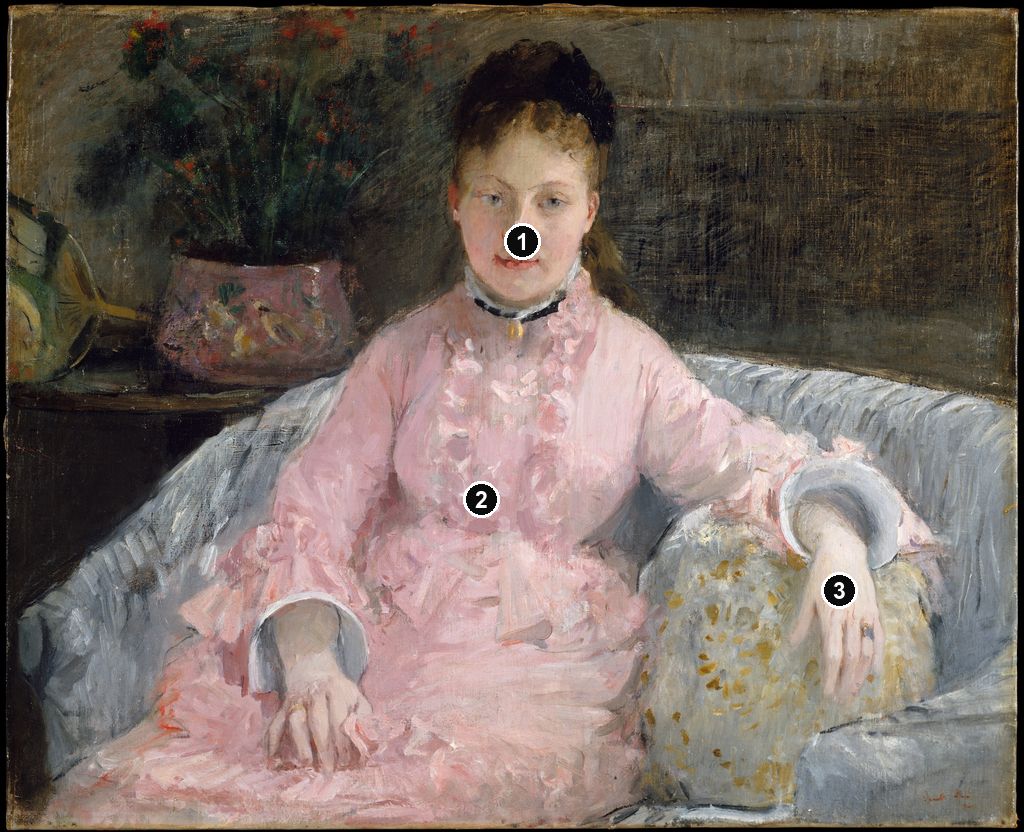
Pink fabric spreads across the lower half of Berthe Morisot’s The Pink Dress, but the woman wearing it holds the centre of the picture. Her face turns towards us; one hand lies on her lap while the other drops over a patterned cushion. The surrounding room is dark enough to make the pale dress glow. Within this compact interior, the painter brings together a direct encounter with a sitter and an exploration of how colour describes a body.
The Metropolitan Museum of Art dates the canvas to about 1870 and identifies its subject as Albertie-Marguerite Carré, later Madame Ferdinand-Henri Himmes (1854–1935).[1] The portrait belongs to the years before Morisot joined the first Impressionist exhibition. It already offers a useful way into her art: look first at the relationship between the face, the fabric and the surrounding furnishings, then at the varied marks that hold them together.
At a Glance
- ArtistBerthe Morisot
- TitleThe Pink Dress
- SitterAlbertie-Marguerite Carré, later Madame Ferdinand-Henri Himmes
- DateAbout 1870
- MediumOil on canvas
- Size54.6 × 67.3 cm
- CollectionMetropolitan Museum of Art, New York
- Object number2003.20.8[1]
This work across Berthe Morisot’s career
The Cradle
1872 [3]Woman at Her Toilette
1875–80 [5]The Psyche Mirror
1876 [7]Summer’s Day
about 1879 [8]Self-Portrait
1885 [9]Contents
- A portrait with two kinds of identity
- The pose: upright, informal and carefully balanced
- How Morisot makes pink luminous
- The witness who remembered the sittings
- An early work by an established practising artist
- Fashion and the modern interior
- Looking alongside The Artist’s Sister at a Window
- From Carré’s likeness to a museum collection
- Annotated details
A portrait with two kinds of identity
The short title directs attention to something immediately visible: an expanse of pink whose folds, frills and highlights fill much of the composition. The sitter’s name gives the picture a different emphasis. It is also a likeness of a particular young person, with an individual face and a presence that survives the richly furnished setting.
The identification has a history beyond the modern museum title. Marie-Louise Bataille and Georges Wildenstein’s 1961 catalogue lists the painting as La Robe rose, number 31, and names the model as Mademoiselle Carré, later Madame Himmes.[10] Her married name and maiden name therefore refer to the same sitter. They should not lead us to imagine two portraits or a different subject simply because a catalogue uses a shorter title.
There is an interesting tension between these ways of naming the work. A colour title encourages the eye to wander across the painted surface. A portrait title brings it back to the person looking out. Morisot’s composition sustains both kinds of attention. We can enjoy the broken rhythms of the dress without losing track of the woman inside it, and study her face without treating the rest of the canvas as decoration.
The pose: upright, informal and carefully balanced
The sitter faces us almost directly, with her head near the upper centre of the canvas. Her dark hair makes a compact shape above a much lighter face. A narrow dark band at the neck creates a second accent, separating skin from the high, frilled dress. These small dark forms give definition to a figure otherwise surrounded by pale pink and white.
Her arms establish an uneven balance. On the left side of the picture, the forearm descends towards the hand resting on the skirt. On the right, the other arm extends along the sofa before the wrist bends and the fingers fall over the cushion. One hand is supported by her own clothing; the other reaches into the space of the furniture. The difference prevents the pose from becoming rigidly symmetrical.
At the same time, the torso remains upright. The sofa offers a place to relax, but the figure has not sunk into it. Her frontal position preserves the formality of a sitting even as the extended arm introduces a more casual note. The result can feel both approachable and slightly reserved. That response comes from the visible arrangement of the body; it need not be turned into a claim about Carré’s temperament.
The horizontal canvas matters here. There is room beside the figure for the cushion, the sofa and a dark table carrying a flowerpot. These objects help establish the sitter’s surroundings without competing equally with her face. The sofa’s pale back runs behind her and across the right-hand side, linking the body to the edge of the picture. The skirt opens towards the opposite lower corner, spreading the pink across the foreground.
Follow those lines and the portrait becomes more active than its seated subject first suggests. The bent wrist, the slope of the skirt and the receding sofa continually redirect the eye. The pose has a stable centre, but the rest of the composition moves around it.
Annotated Details from The Pink Dress
The numbered points identify visible features discussed in this article. Return from each detail to the whole composition. Berthe Morisot, The Pink Dress, about 1870, Metropolitan Museum of Art. The sitter is Albertie-Marguerite Carré. Image source. CC0 / Public domain. Resized only; native appearance preserved.
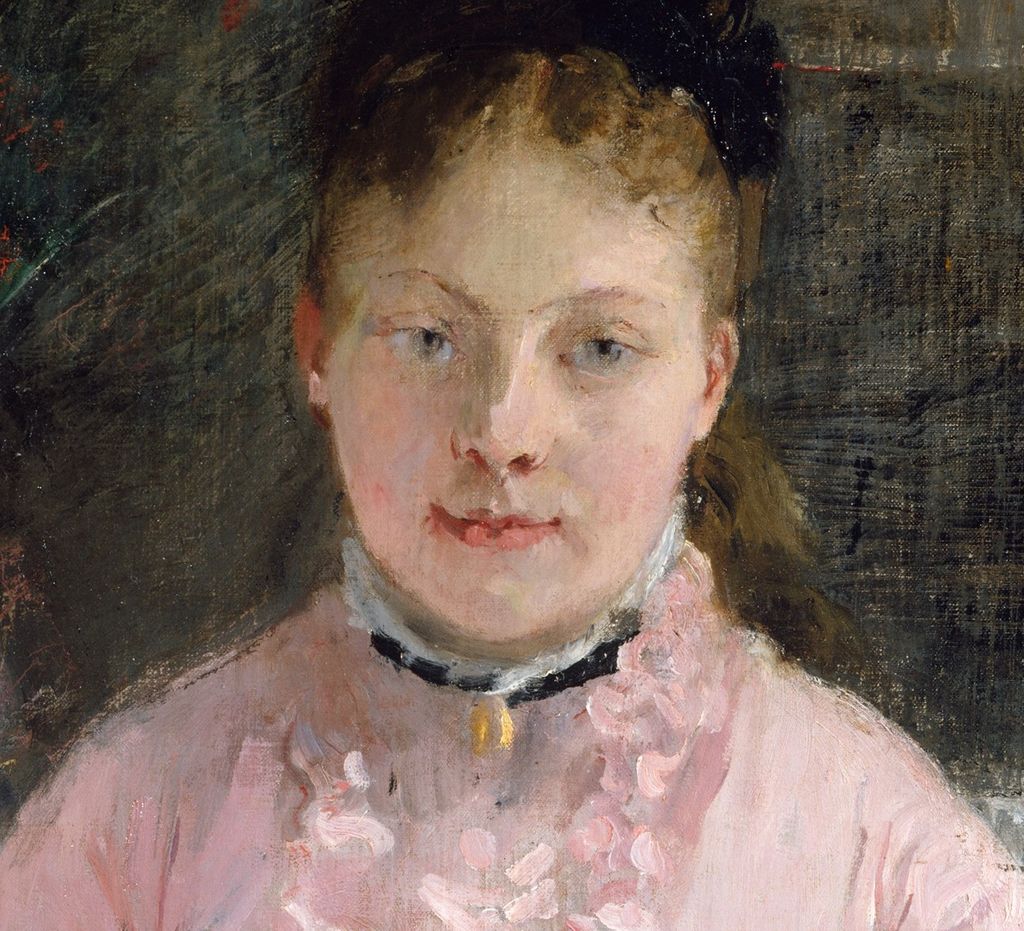
Details from THE PINK DRESS
Compare the cropped details with the complete images above. Notice how their colours, shapes and positions contribute to the larger compositions.
Face and dark hair
The face sits within a broad dark shape of hair. Pale skin and small warm accents give the head clarity against the quieter wall.
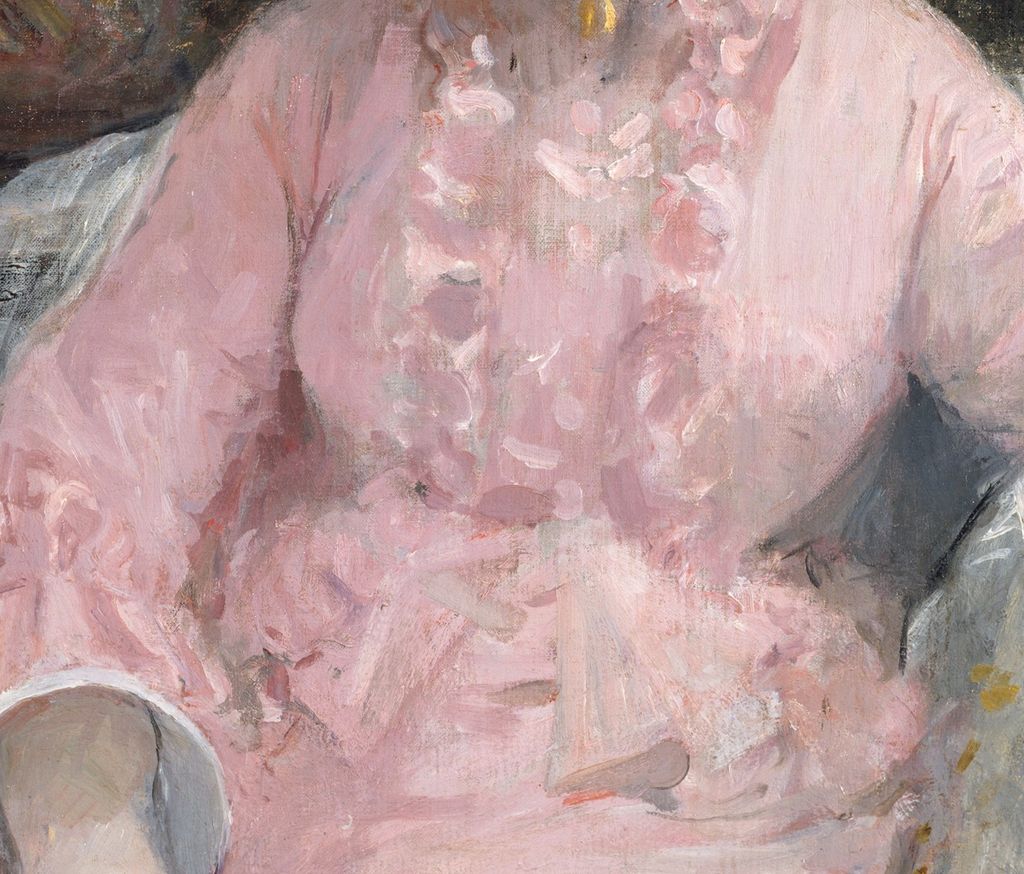
Ruffles across the pink dress
Light curved touches describe the ruffled front of the dress. Pink fabric remains broad and luminous around these smaller marks.
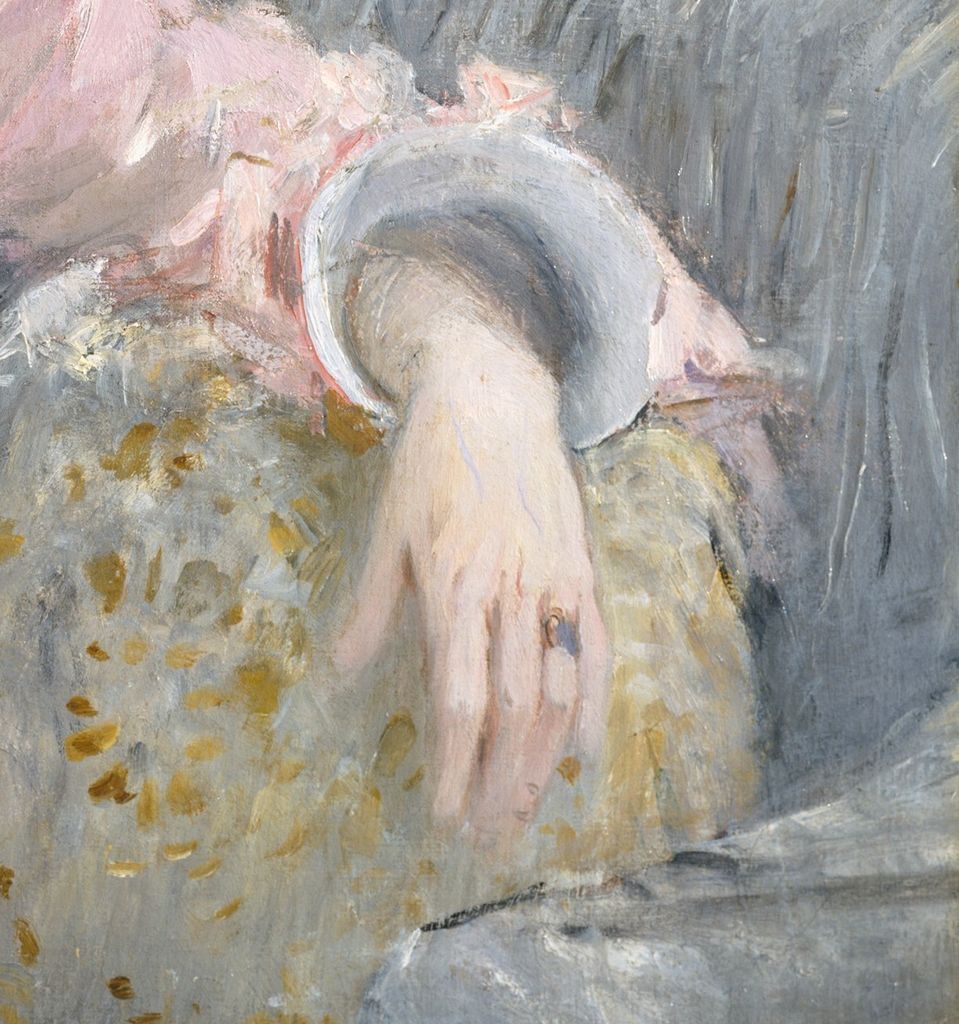
Relaxed hand and patterned cushion
The hanging hand meets a cushion scattered with yellow-brown marks. These small patterns play against the larger folds of the couch.
How Morisot makes pink luminous
The dress contains several kinds of pink. Lighter, almost white marks sit beside cooler grey-pink passages and stronger rose accents. At the bodice, broken touches suggest small frills and changes in the surface. Across the skirt, longer strokes make broader folds. Morisot varies the scale of her marks to suggest different portions of the same garment.
This is particularly clear around the sleeves. Pale edging describes the openings, while cooler paint marks the space around the wrists. A thin line alone would make a diagram of the garment. Here the contrast between adjacent colours allows the sleeve to open around an arm. We read volume through changes in tone, even where the brushwork remains conspicuous.
The cushion on the right supplies another rhythm. Its scattered yellow marks differ from the pink dress and from the longer grey-white strokes of the sofa. The furnishings are recognisable, but the differences between them are also differences in the movement of paint: short patterned dabs, loose fabric strokes and the more compact modelling of the face.
The dark background makes these passages more luminous. Behind the sitter, a broad brown-grey area provides relatively little distraction. On the left, the flowerpot carries muted pink and yellow touches that quietly echo colours lower down. The foliage above it forms a dark, irregular mass punctuated by small warmer accents. The room thus participates in the portrait’s colour relationships while remaining less emphatic than the figure.
Calling the painting light in effect does not mean that it contains no darkness. Its darks are essential. They frame the head, give depth behind the sofa and make the dress seem to advance. The face and hands retain changes of tone, too. Morisot’s economy lies in how much she can achieve with these differences, allowing some forms to remain broadly stated while giving others a more concentrated presence.
A useful way to look is to move between the whole and a single passage. Seen together, the marks form a convincing seated figure. Seen individually, many remain abbreviated descriptions of ruffles, upholstery or folded cloth. The portrait asks the eye to complete connections that the brush has only partly specified.
Watch: Berthe Morisot
Explore Morisot’s career with Katy Hessel, then look closely at Summer’s Day with the National Gallery.
Katy Hessel on Berthe Morisot
Katy Hessel tours the exhibition Berthe Morisot: Shaping Impressionism.
Watch on YouTubeThe witness who remembered the sittings
An unusual account accompanies this painting. The Met quotes Jacques-Émile Blanche’s recollection of watching Morisot paint Carré at the Villa Fodor, her family home. He remembered the picture’s lightness, but also repeated sittings and Morisot’s habit of repainting after a session.[1] This is Blanche’s account as transmitted by the museum, rather than a statement by Morisot herself.
His recollection changes the way the surface can be understood. The quick-looking touch does not establish a quick overall process. An individual stroke may have been made rapidly within a painting that developed through sustained reconsideration. Freshness can be the result of replacing an unsatisfactory passage, adjusting a relationship or finding a more economical way to describe a form.
Blanche’s testimony does not provide a map of everything Morisot changed. Without technical evidence identifying earlier paint layers, we cannot assign a specific revision to the hand, the cushion or the background merely by looking at a reproduction. What it gives us is evidence of a working method in which the image remained open to change between sessions.
That distinction is especially helpful with Morisot. The Musée d’Orsay’s 2019 exhibition dossier explains that questions of finish run through her career, becoming particularly radical from the later 1870s. Its curators describe a painter who could preserve visible traces of making and use them in the completed work.[11] The Pink Dress belongs to an earlier moment, but Blanche’s account already shows why an appearance of immediacy should be considered alongside deliberate decisions and revision.
An early work by an established practising artist
Around 1870, Morisot was several years away from the exhibition that would give Impressionism its name. She had already trained and exhibited professionally. Her training had included lessons, copying at the Louvre and work in the orbit of the landscape painter Camille Corot. She first exhibited at the Paris Salon in 1864, and met Édouard Manet in 1868.[11][12]
Those dates help place the portrait. It emerged after years of study and public exhibition, during a period when Morisot was developing the figure painting that would become central to her work. Her relationship with Manet formed part of that development, alongside earlier training and her own experiments. The National Gallery describes their artistic exchange as reciprocal, with admiration and influence moving between the two painters.[12]
In this canvas, the combination of a dark interior and a pale, directly presented figure makes the problem of portraiture tangible. How much detail does a likeness require? How can a richly dressed sitter remain a person rather than become an arrangement of fabric? How can a body feel solid while the brushwork remains visible? Morisot addresses these questions through the arrangement and handling of the painting itself.
The Met describes The Pink Dress as one of her relatively few surviving early works.[1] That survival gives it particular value, although it cannot tell us what every lost painting looked like. It allows us to study one substantial early solution: a likeness integrated into an interior through linked colours, unequal accents and a carefully varied painted surface.

Berthe Morisot, The Mother and Sister of the Artist, 1869–1870, National Gallery of Art, Washington. Contrasting fabrics also structure this early interior. Image source. Public domain. Resized only; native appearance preserved.
Fashion and the modern interior
The dress is central to the sitter’s appearance and to the painter’s opportunities. Its high neck, abundant fabric and frilled edges establish an elaborate clothed presence. Morisot uses those features to create contrasts between softness and definition, repeated small marks and larger areas of colour.
The Orsay exhibition places fashion and the contemporary interior within Morisot’s broader treatment of modern life. Its essays explain that clothing offered Impressionist painters both a contemporary subject and a means of exploring paint; they also place domestic figure scenes alongside work by Degas, Caillebotte, Cassatt, Renoir and Monet.[11] This context helps explain why an apparently quiet drawing-room portrait belongs within the history of modern painting.
The room shapes the encounter. We approach someone who is already situated among particular furnishings, with a cushion beneath one arm and a flowerpot nearby. The arrangement suggests a lived social setting while allowing Morisot to organise a limited group of pictorial elements. Fabric, skin, patterned upholstery and dark foliage demand different kinds of attention from both painter and viewer.
There is no visible activity to explain the sitter. She is not reading, sewing or playing an instrument. Her presence, clothing and posture carry the picture. This makes the act of sitting unusually apparent: a person has taken a position and is being looked at. The direct gaze returns some of that attention, making our encounter with the portrait less one-sided.
Looking alongside The Artist’s Sister at a Window
A revealing comparison is The Artist’s Sister at a Window, a portrait of Edma from 1869 included in the Orsay dossier.[11] In that painting, a pale dress again occupies a large part of an interior. The figure sits sideways, with her attention lowered towards a fan. Window, chair and floor create a more explicit sequence of spaces around her.
The Pink Dress brings the encounter forward. The sitter turns towards us, and the broad skirt presses towards the lower edge. The background is less expansive; the upholstery wraps around the figure. Comparing the two makes it easier to notice how much Morisot can change through pose and framing while working with a similarly restricted subject: a seated woman in a pale dress.
The pale clothing performs different tasks in each composition. At the window it extends diagonally through the room, carrying light into the foreground. Here the pink connects lap, bodice and arms into a more frontal shape. Colour is doing structural work, determining how we move through the canvas as well as how we recognise its materials.

Berthe Morisot, The Artist’s Sister at a Window, 1869. A turned pose and a handheld fan change the encounter with a woman in a pale dress. Image source. Public domain. Resized only; native appearance preserved.
From Carré’s likeness to a museum collection
The painting’s later history can be traced at several documented points. The 1961 catalogue records the collection of Madame Himmes and then M. Santa Marina in Buenos Aires. It also lists the canvas at the Impressionist exhibition of 1881 as number 58, followed by exhibitions in 1902 and 1919.[10] These entries preserve stages in the work’s ownership and public life; the Buenos Aires location belongs to that historical catalogue record.
The Met’s credit line identifies its present collection context as the Walter H. and Leonore Annenberg Collection, through Walter H. Annenberg’s 2002 bequest.[1] The sitter’s married name in the older catalogue and the collector’s name in the museum credit line mark different stages in the life of the same painting.
Artworks directory
Explore documented paintings, pastels, watercolours, prints and sculpture. Original French titles are retained for many works. The 1961 catalogue supplies the historical core; dates are updated where the linked museum records establish a revision. Lost works and surviving fragments remain part of that record. This is a directory of compositions, with individual print impressions and bronze casts grouped together.
| Name | Date | Medium |
|---|---|---|
| Ferme en Normandie | 1859 | Oil painting |
| Le Repas chez Simon | 1860 | Oil painting |
| Le Calvaire | 1860 | Oil painting |
| La Vue de Tivoli | 1863 | Oil painting |
| Souvenir des bords de l’Oise | 1863 | Oil painting |
| The Old Track to Auvers | 1863 | Oil painting |
| Chaudron | 1864 | Oil painting |
| Étude Au bord de l'eau | 1864 | Oil painting |
| La Brémondière | 1865 | Oil painting |
| Chaumière en Normandie | 1865 | Oil painting |
| La Seine en aval du Pont d'Iéna | 1866 | Oil painting |
| Rivière de Pont-Aven à Rosbras | 1866 | Oil painting |
| Portrait de Mme Lucien Boursier | 1867 | Oil painting |
| Reading | 1873 | Oil painting |
| Le Débarquement de Marie de Médicis à Marseille | 1868 | Oil painting |
| Un quai à Lorient | 1869 | Oil painting |
| The Harbour at Lorient | 1869 | Oil painting |
| The Artist's Sister at a Window | 1869 | Oil painting |
| Deux sœurs sur un canapé | 1869 | Oil painting |
| The Mother and Sister of the Artist | 1869–1870 | Oil painting |
| Portrait de Mme Heudé | 1870 | Oil painting |
| Jeune Femme (Young Woman) | 1871 | Oil painting |
| Vue de Paris des hauteurs du Trocadéro | 1872 | Oil painting |
| Woman and Child on a Balcony | 1872 | Oil painting |
| The Cradle | 1872 | Oil painting |
| Intérieur | 1872 | Oil painting |
| Cache-cache | 1873 | Oil painting |
| Sur la Plage | 1873 | Oil painting |
| La plage de Fécamp | 1873 | Oil painting |
| Falaise à Fécamp | 1873 | Oil painting |
| The Pink Dress (Albertie-Marguerite Carre, later Madame Ferdinand-Henri Himmes, 1854–1935) | about 1870 | Oil painting |
| Jeune fille en robe de bal | 1873 | Oil painting |
| Portrait de Mme Hubard | 1874 | Oil painting |
| Portraits de Mme Boursier et de sa fille | 1874 | Oil painting |
| Les lilas à Maurecourt | 1874 | Oil painting |
| The Butterfly Hunt | 1874 | Oil painting |
| Sur la terrasse | 1874 | Oil painting |
| In a Villa at the Seaside | 1874 | Oil painting |
| Boats under Construction | 1874 | Oil painting |
| Bassin du port de Fécamp | 1874 | Oil painting |
| Port de Fécamp | 1874 | Oil painting |
| L'entrée du port | 1874 | Oil painting |
| Le petit moulin à Gennevilliers | 1875 | Oil painting |
| Paysage à Gennevilliers | 1875 | Oil painting |
| Hanging the Laundry out to Dry | 1875 | Oil painting |
| Grain Field | 1875 | Oil painting |
| Le déjeuner sur l'herbe | 1875 | Oil painting |
| Enfants dans l'herbe en Angleterre | 1875 | Oil painting |
| La Tamise | 1875 | Oil painting |
| Dans l'île de Wight | 1875 | Oil painting |
| Eugène Manet on the Isle of Wight | 1875 | Oil painting |
| Marine en Angleterre | 1875 | Oil painting |
| The Isle of Wight | 1875 | Oil painting |
| Marine en Angleterre | 1875 | Oil painting |
| La jetée | 1875 | Oil painting |
| Le bateau à vapeur | 1875 | Oil painting |
| Jeune femme et fillette assises au pied d'un arbre | 1875 | Oil painting |
| Paysage aux environs de Valenciennes | 1875 | Oil painting |
| Avant le théâtre | 1875 | Oil painting |
| At the Ball (Au Bal) | 1875 | Oil painting |
| Jeune femme au miroir | 1876 | Oil painting |
| Jeune femme arrosant un arbuste | 1876 | Oil painting |
| La Toilette | 1876 | Oil painting |
| The Psyche Mirror | 1876 | Oil painting |
| Pomme coupée | 1876 | Oil painting |
| Dahlias | about 1876 | Oil painting |
| Femme à l’éventail | 1876 | Oil painting |
| Petit garçon | 1876 | Oil painting |
| Dame à l'écran | 1877 | Oil painting |
| Soupière et pomme | 1877 | Oil painting |
| Roses dans un verre | 1877 | Oil painting |
| Young Woman Powdering her Face | 1877 | Oil painting |
| Femme à sa toilette | 1877 | Oil painting |
| Le corsage noir | 1878 | Oil painting |
| Jeune femme près d’une fenêtre | 1878 | Oil painting |
| Fleurs à l'écran | 1878 | Oil painting |
| Jeune femme en gris étendue | 1879 | Oil painting |
| Jeune femme assise | 1879 | Oil painting |
| Summer's Day | about 1879 | Oil painting |
| Dames cueillant des fleurs | 1879 | Oil painting |
| Young Girl in a Ball Gown | 1879 | Oil painting |
| Derrière la jalousie | 1879 | Oil painting |
| Femme cousant | 1879 | Oil painting |
| Woman at her Toilette | 1875–1880 | Oil painting |
| Neige | 1880 | Oil painting |
| Hiver | 1880 | Oil painting |
| Jeune femme remettant son patin | 1880 | Oil painting |
| Petit garçon en gris | 1880 | Oil painting |
| Petit garçon | 1880 | Oil painting |
| Jeune femme en mauve | 1880 | Oil painting |
| Dans la salle à manger | 1880 | Oil painting |
| Pont sur la Seine | 1880 | Oil painting |
| Nourrice au fond d'un jardin | 1880 | Oil painting |
| Nourrice allaitant | 1880 | Oil painting |
| Nourrice et bébé | 1880 | Oil painting |
| Dans l'île | 1880 | Oil painting |
| Jeune fille mettant son bas | 1880 | Oil painting |
| Fleurs | 1880 | Oil painting |
| Portrait de Louise Riesener | 1881 | Oil painting |
| Portrait de Louise Riesener | 1881 | Oil painting |
| Enfant dans un intérieur | 1881 | Oil painting |
| La nourrice | 1881 | Oil painting |
| Eugène Manet et sa fille dans le jardin de Bougival | 1881 | Oil painting |
| Dame à l'ombrelle | 1881 | Oil painting |
| Paysanne étendant du linge | 1881 | Oil painting |
| Paysanne assise dans l'herbe | 1881 | Oil painting |
| Child in the Rose Garden | 1881 | Oil painting |
| Jeune femme cousant dans un jardin | 1881 | Oil painting |
| Petite fille aux cheveux blonds | 1881 | Oil painting |
| After Luncheon | 1881 | Oil painting |
| Port de Nice | 1882 | Oil painting |
| Le Port de Nice | 1882 | Oil painting |
| Le port de Nice | 1882 | Oil painting |
| Port de Nice | 1882 | Oil painting |
| Plage de Nice | 1882 | Oil painting |
| Plage de Nice | 1882 | Oil painting |
| Villa Arnulfi | 1882 | Oil painting |
| Villa dans les orangers | 1882 | Oil painting |
| Paysage | 1882 | Oil painting |
| Les pâtés de sable | 1882 | Oil painting |
| Jardin de Bougival | 1882 | Oil painting |
| à Bougival | 1882 | Oil painting |
| Jeune garçon dans les roses trémières | 1882 | Oil painting |
| Le balcon | 1882 | Oil painting |
| Le thé | 1882 | Oil painting |
| Berthe Morisot et sa fille | 1882 | Oil painting |
| Jeannie à la poupée | 1883 | Oil painting |
| La fillette blonde | 1883 | Oil painting |
| Fillette en mauve | 1883 | Oil painting |
| Petite fille en deuil dans un jardin | 1883 | Oil painting |
| Jardin | 1883 | Oil painting |
| Les foins à Bougival | 1883 | Oil painting |
| La meule de foin | 1883 | Oil painting |
| Paysage | 1883 | Oil painting |
| Le quai de Bougival | 1883 | Oil painting |
| En barque | 1883 | Oil painting |
| Eugène Manet and his Daughter in the Garden | 1883 | Oil painting |
| The Fable | 1883 | Oil painting |
| Jeune femme et enfant dans l'île | 1883 | Oil painting |
| Au bord du lac | 1883 | Oil painting |
| Fillette à la poupée | 1883 | Oil painting |
| Le jardin | 1883 | Oil painting |
| Jeune femme cousant au jardin | 1883 | Oil painting |
| Vénus va demander des armes à Vulcain | 1884 | Oil painting |
| Petite fille dans un jardin | 1884 | Oil painting |
| The Sewing Lesson (aka The Artist's Daughter, Julie, with Her Nanny) | about 1884 | Oil painting |
| On the Lake in the Bois de Boulogne | 1884 | Oil painting |
| The Garden at Bougival (le jardin a bougival) | 1884 | Oil painting |
| Jardin | 1884 | Oil painting |
| Fillette et sa bonne dans le jardin de Bougival | 1884 | Oil painting |
| La Seine à Bougival | 1884 | Oil painting |
| La barrière à Bougival | 1884 | Oil painting |
| Jeune femme et enfant dans le jardin de Bougival | 1884 | Oil painting |
| In the Garden at Maurecourt | 1884 | Oil painting |
| Young Woman with a Straw Hat | 1884 | Oil painting |
| Jeune femme assise dans l'herbe | 1884 | Oil painting |
| Roses Tremieres (Hollyhocks) | 1884 | Oil painting |
| A Woman and Child in a Garden | about 1884 | Oil painting |
| Portrait de Paule Gobillard | 1884 | Oil painting |
| Dans la vérandah | 1884 | Oil painting |
| Poupée dans la vérandah | 1884 | Oil painting |
| Automne au bois de Boulogne | 1884 | Oil painting |
| Petite fille à la poupée | 1884 | Oil painting |
| Miss Reynolds | 1884 | Oil painting |
| L'avenue du bois l'hiver | 1885 | Oil painting |
| Self Portrait | 1885 | Oil painting |
| Portrait de Berthe Morisot et de sa fille | 1885 | Oil painting |
| La Femme au gant, dite aussi Parisienne | 1885 | Oil painting |
| Nu de dos | 1885 | Oil painting |
| Petite danseuse | 1885 | Oil painting |
| Cage | 1885 | Oil painting |
| Daffodils | 1885 | Oil painting |
| Young Girl with Cage | 1885 | Oil painting |
| Isabelle au jardin | 1885 | Oil painting |
| Isabelle | 1885 | Oil painting |
| Pivoines | 1885 | Oil painting |
| Dans le jardin | 1885 | Oil painting |
| Rosiers | 1885 | Oil painting |
| L'oie | 1885 | Oil painting |
| Oies au bord du lac | 1885 | Oil painting |
| Fillettes au jardin, dit aussi La hotte | 1885 | Oil painting |
| Reines-marguerites | 1885 | Oil painting |
| Forêt de Compiègne | 1885 | Oil painting |
| Un canal à Rotterdam | 1885 | Oil painting |
| Corbeille renversée | 1885 | Oil painting |
| La cheminée | 1885 | Oil painting |
| Girl on a Divan | about 1885 | Oil painting |
| Enfant au tablier rouge | 1886 | Oil painting |
| Maisons sous la neige | 1886 | Oil painting |
| Le bain | 1886 | Oil painting |
| Le lever | 1886 | Oil painting |
| Sortant du lit | 1886 | Oil painting |
| Jeune femme se levant | 1886 | Oil painting |
| In the Dining Room | 1886 | Oil painting |
| La petite servante | 1886 | Oil painting |
| Intérieur | 1886 | Oil painting |
| Intérieur de cottage | 1886 | Oil painting |
| Le port de Gorey | 1886 | Oil painting |
| Bateau à quai | 1886 | Oil painting |
| La leçon au jardin | 1886 | Oil painting |
| La leçon au jardin | 1886 | Oil painting |
| Rivière au bois de Boulogne | 1886 | Oil painting |
| Enfants à la vasque | 1886 | Oil painting |
| Toilette de nuit | 1886 | Oil painting |
| Fillette à la poupée, premier fragment | 1886 | Oil painting |
| Fillette au chien, deuxième fragment | 1886 | Oil painting |
| Modèle au repos | 1887 | Oil painting |
| Paule Gobillard peignant | 1887 | Oil painting |
| Jeune Fille au chien | 1887 | Oil painting |
| Paule Gobillard en robe de bal | 1887 | Oil painting |
| Fillette dans le jardin | 1887 | Oil painting |
| Jardin | 1887 | Oil painting |
| Jeune fille accoudée | 1887 | Oil painting |
| Pommes | 1887 | Oil painting |
| Berthe Morisot et sa fille devant une fenêtre | 1887 | Oil painting |
| Berthe Morisot et sa fille devant une fenêtre | 1887 | Oil painting |
| Femme au chapeau | 1888 | Oil painting |
| Fillette portant un panier | 1888 | Oil painting |
| Reading (1888) | 1888 | Oil painting |
| Fillette à la perruche | 1888 | Oil painting |
| Le volant | 1888 | Oil painting |
| Portrait de Louise Riesener, plus tard Mme Léouzon-le-Duc | 1888 | Oil painting |
| Faneuse | 1888 | Oil painting |
| Jeune fille à l'arrosoir | 1888 | Oil painting |
| Les cygnes | 1888 | Oil painting |
| Roses devant une gravure | 1888 | Oil painting |
| Le vase bleu | 1888 | Oil painting |
| Tête de Jeannie, fragment d’une esquisse pour Le Piano | 1888 | Oil painting |
| Julie écoutant, fragment d’une esquisse pour Le Piano | 1888 | Oil painting |
| Julie écoutant, fragment d’une esquisse pour Le Piano | 1888 | Oil painting |
| Le piano | 1888 | Oil painting |
| La Petite Niçoise | 1889 | Oil painting |
| Les aloès | 1889 | Oil painting |
| Bateau illuminé | 1889 | Oil painting |
| La cueillette des oranges | 1889 | Oil painting |
| Branches d'oranger | 1889 | Oil painting |
| Sous l'oranger | 1889 | Oil painting |
| La mandoline | 1889 | Oil painting |
| Mains sur la mandoline, premier fragment | 1889 | Oil painting |
| Chien au ballon, deuxième fragment | 1889 | Oil painting |
| Jeune fille sur une chaise longue | 1889 | Oil painting |
| Jeune fille à la potiche | 1889 | Oil painting |
| Sur le lac | 1889 | Oil painting |
| Girl in a Boat, with Geese | about 1889 | Oil painting |
| Julie Manet tenant un livre | 1889 | Oil painting |
| La broderie | 1889 | Oil painting |
| Alice Gamby en buste | 1890 | Oil painting |
| Alice Gamby dans le salon | 1890 | Oil painting |
| Fillette à la mandoline | 1890 | Oil painting |
| Vue de la terrasse à Mézy | 1890 | Oil painting |
| La jatte de lait | 1890 | Oil painting |
| Le petit saint-Jean | 1890 | Oil painting |
| Panier de fleurs sur une table | 1890 | Oil painting |
| Dans le pommier | 1890 | Oil painting |
| Le flageolet | 1890 | Oil painting |
| Le flageolet | 1890 | Oil painting |
| Paysanne aux tulipes | 1890 | Oil painting |
| Sous le pommier | 1890 | Oil painting |
| Vue de la Seine à Mèzy | 1890 | Oil painting |
| Le Lever de lune sur la vallée de la Seine | 1890 | Oil painting |
| Fillette accrochant une cage dans un arbre | 1890 | Oil painting |
| The Artist's Daughter with a Parakeet | 1890 | Oil painting |
| Mèzy en automne | 1890 | Oil painting |
| Devant la psyché | 1890 | Oil painting |
| Julie Manet à la perruche | 1890 | Oil painting |
| Fillette au tablier | 1891 | Oil painting |
| Jeune fille écrivant | 1891 | Oil painting |
| Anémones roses | 1891 | Oil painting |
| Anémones | 1891 | Oil painting |
| Jeune fille dessinant | 1891 | Oil painting |
| Les foins à Mèzy | 1891 | Oil painting |
| Faneuse | 1891 | Oil painting |
| Les faneuses | 1891 | Oil painting |
| Le cerisier | 1891 | Oil painting |
| The Cherry Picker (Le Cerisier) | 1891; completed 1893 | Oil painting |
| Le cerisier | 1891 | Oil painting |
| Jeune fille cueillant des cerises | 1891 | Oil painting |
| La vallée de la Seine à Mèzy | 1891 | Oil painting |
| Bergère couchée | 1891 | Oil painting |
| Bergère couchée | 1891 | Oil painting |
| La chèvre Colette | 1891 | Oil painting |
| Bergère nue couchée | 1891 | Oil painting |
| Baigneuse | 1891 | Oil painting |
| Branche de prunes | 1891 | Oil painting |
| Fillette à la chèvre | 1891 | Oil painting |
| Pommier | 1891 | Oil painting |
| Petite fille à l'oiseau | 1891 | Oil painting |
| Jeune fille au corset bleu | 1891 | Oil painting |
| Jeune fille en blanc | 1891 | Oil painting |
| Tête de fillette | 1892 | Oil painting |
| Jeune fille en jaune | 1892 | Oil painting |
| Jeune fille peignant | 1892 | Oil painting |
| Fillette au panier | 1892 | Oil painting |
| Fillette au chapeau | 1892 | Oil painting |
| Pigeonnier du Mesnil | 1892 | Oil painting |
| Le bois du Mesnil | 1892 | Oil painting |
| Little Girl at Mesnil | 1892 | Oil painting |
| Young Girls at the Window | 1892 | Oil painting |
| Petite fille assise dans l'herbe | 1892 | Oil painting |
| Le coteau du Mesnil | 1892 | Oil painting |
| Le bain au Mesnil | 1892 | Oil painting |
| Baigneuses | 1892 | Oil painting |
| Baigneuses au Mesnil | 1892 | Oil painting |
| Sur le banc au Mesnil | 1892 | Oil painting |
| La couronne de roses blanches | 1892 | Oil painting |
| Fillette jouant avec un chien | 1892 | Oil painting |
| En barque sur le lac | 1892 | Oil painting |
| Jeanne Fourmanoir sur le lac | 1892 | Oil painting |
| La cueillette des pommes | 1892 | Oil painting |
| Fillette au chapeau de paille | 1892 | Oil painting |
| Jeune fille au chien | 1892 | Oil painting |
| Young Girl with Cat | Summer 1892 | Oil painting |
| Jeune fille endormie | 1892 | Oil painting |
| Oies au bord du lac | 1892 | Oil painting |
| En bateau | 1892 | Oil painting |
| Lucie Léon au piano | 1892 | Oil painting |
| Lucie Leon at the Piano | 1892 | Oil painting |
| Lucie Léon au piano | 1892 | Oil painting |
| Vue de Tours | 1892 | Oil painting |
| Apollon visitant Latone | 1892 | Oil painting |
| Paysage de Tours | 1892 | Oil painting |
| Étang et pigeonnier | 1892 | Oil painting |
| Conversation | 1893 | Oil painting |
| Jeune fille remettant son patin | 1893 | Oil painting |
| Patineuse | 1893 | Oil painting |
| Patinage | 1893 | Oil painting |
| Les patineuses | 1893 | Oil painting |
| Jeune fille en mantelet | 1893 | Oil painting |
| L'étude du violon | 1893 | Oil painting |
| Jeune fille se coiffant | 1893 | Oil painting |
| Devant la glace | 1893 | Oil painting |
| Jeune fille cueillant des oranges | 1893 | Oil painting |
| Paysanne avec des oies au bord de l'eau | 1893 | Oil painting |
| La cruche d'eau | 1893 | Oil painting |
| Jeune fille au lévrier | 1893 | Oil painting |
| La musique | 1893 | Oil painting |
| Avenue du bois de Boulogne au printemps | 1893 | Oil painting |
| Portrait de Jeanne Pontillon | 1893 | Oil painting |
| Sur la chaise longue | 1893 | Oil painting |
| Jeune fille étendue | 1893 | Oil painting |
| La perruche | 1893 | Oil painting |
| Jeune fille à l'ombrelle | 1893 | Oil painting |
| Jeune fille à l'éventail | 1893 | Oil painting |
| Parc de Fontainebleau | 1893 | Oil painting |
| La petite barque | 1893 | Oil painting |
| La Seine à Valvins | 1893 | Oil painting |
| La haute-Seine | 1893 | Oil painting |
| Forêt de Fontainebleau | 1893 | Oil painting |
| Bois de Boulogne | 1893 | Oil painting |
| Dôme des arènes de la rue Pergolèse | 1893 | Oil painting |
| Dôme des arènes de la rue Pergolèse, soleil couchant | 1893 | Oil painting |
| Étude de forêt | 1893 | Oil painting |
| Étude de forêt | 1893 | Oil painting |
| Julie au violon | 1893 | Oil painting |
| Portrait d’enfants | 1893 | Oil painting |
| Sur le banc | 1893 | Oil painting |
| La fleur aux cheveux | 1893 | Oil painting |
| Jeune fille décolletée | 1893 | Oil painting |
| Jeune fille en corset | 1893 | Oil painting |
| Jeune fille rousse en chapeau | 1894 | Oil painting |
| La coiffure | 1894 | Oil painting |
| Jeunes femmes à leur toilette | 1894 | Oil painting |
| Jeune fille accoudée | 1894 | Oil painting |
| Bain | 1894 | Oil painting |
| Baigneuse en chemise | 1894 | Oil painting |
| La robe rose | 1894 | Oil painting |
| Les enfants de Gabriel Thomas | 1894 | Oil painting |
| La poupée noire | 1894 | Oil painting |
| Jeune femme et enfant avenue du Bois | 1894 | Oil painting |
| Jeune femme et enfant avenue du Bois | 1894 | Oil painting |
| Jeune femme relevant ses cheveux | 1894 | Oil painting |
| L'hortensia | 1894 | Oil painting |
| Branches d'hortensia | 1894 | Oil painting |
| Jeannie Gobillard | 1894 | Oil painting |
| Julie Daydreaming | 1893–1894 | Oil painting |
| Julie Manet jouant du violon en robe blanche | 1894 | Oil painting |
| La sonate de Mozart | 1894 | Oil painting |
| La sonate de Mozart | 1894 | Oil painting |
| Sur la falaise au Portrieux | 1894 | Oil painting |
| Sur la plage au Portrieux | 1894 | Oil painting |
| Devant une cabine au Portrieux | 1894 | Oil painting |
| Personnages sur la plage | 1894 | Oil painting |
| Bateaux dans la brume | 1894 | Oil painting |
| Falaises au Portrieux | 1894 | Oil painting |
| Marine au Portrieux | 1894 | Oil painting |
| La voile orange | 1894 | Oil painting |
| Voiles | 1894 | Oil painting |
| Plage de la Comtesse | 1894 | Oil painting |
| Plage de la Comtesse dans la brume | 1894 | Oil painting |
| Roses | 1894 | Oil painting |
| Hortensias | 1894 | Oil painting |
| Jardin au Portrieux | 1894 | Oil painting |
| La Roche Plate au Portrieux | 1894 | Oil painting |
| Dans le jardin de la Roche Plate | 1894 | Oil painting |
| Dans le jardin | 1894 | Oil painting |
| Sur un banc au bois de Boulogne | 1894 | Oil painting |
| Au bord du lac au coucher du soleil | 1894 | Oil painting |
| Le lac | 1894 | Oil painting |
| Soleil couchant sur le lac du bois de Boulogne | 1894 | Oil painting |
| Cygnes sur le lac | 1894 | Oil painting |
| La levrette Laërte | 1894 | Oil painting |
| Sous-bois en automne | 1894 | Oil painting |
| Cygnes en automne | 1894 | Oil painting |
| Cygnes dans la brume | 1894 | Oil painting |
| Chrysanthèmes | 1894 | Oil painting |
| Jeune fille au repos | 1894 | Oil painting |
| Enfant de chœur | 1894 | Oil painting |
| Devant la toilette | 1894 | Oil painting |
| Devant la toilette | 1894 | Oil painting |
| Jeune fille au manteau vert | 1894 | Oil painting |
| Les deux sœurs | 1894 | Oil painting |
| Jeune fille et enfant | 1894 | Oil painting |
| Femme et fillette au bord du lac | 1894 | Oil painting |
| Petite fille à la toque | 1894 | Oil painting |
| Julie Manet au chapeau Liberty | 1895 | Oil painting |
| Portrait de la petite Marcelle en pied | 1895 | Oil painting |
| La petite Marcelle | 1895 | Oil painting |
| Vaches en Normandie | 1864 | Pastel |
| Bateaux à l'aurore | 1864 | Pastel |
| Portrait de Mme Pontillon | 1871 | Pastel |
| Fillette aux jacinthes | 1872 | Pastel |
| Coin de Paris vu de Passy | 1872 | Pastel |
| Tête de bébé | 1872 | Pastel |
| Nourrice et bébé | 1872 | Pastel |
| Le village de Maurecourt | 1873 | Pastel |
| Jeune fille en toilette de bal | 1873 | Pastel |
| Portrait de Madeleine Thomas | 1873 | Pastel |
| In a Park (Dans le parc) | about 1874 | Pastel |
| Dans les bois de Maurecourt | 1874 | Pastel |
| Sur la plage | 1874 | Pastel |
| Bassin du port de Fécamp | 1874 | Pastel |
| Bateaux sur la Tamise | 1875 | Pastel |
| Bateaux dans le port | 1875 | Pastel |
| Jeune femme au miroir | 1876 | Pastel |
| Rêveuse | 1877 | Pastel |
| Portrait de Blanche Pontillon | 1877 | Pastel |
| Jeanne Pontillon en bleu | 1877 | Pastel |
| Jeanne Pontillon en bleu | 1877 | Pastel |
| Blanche Pontillon en blanc | 1877 | Pastel |
| Étude de petites filles | 1877 | Pastel |
| Étude de fillette | 1877 | Pastel |
| Étude de fillette | 1877 | Pastel |
| Tête de petite fille brune | 1877 | Pastel |
| Bébé assis | 1878 | Pastel |
| Tête de bébé en bonnet | 1878 | Pastel |
| Deux têtes de bébé en bonnet | 1878 | Pastel |
| Jeune femme accoudée | 1879 | Pastel |
| Le skating | 1879 | Pastel |
| Patinage | 1879 | Pastel |
| Hiver | 1880 | Pastel |
| Au théâtre | 1880 | Pastel |
| Petit garçon debout | 1880 | Pastel |
| Femme en gris debout | 1880 | Pastel |
| Enfant de profil | 1880 | Pastel |
| Au bord de la Seine à Épinay | 1881 | Pastel |
| Paysanne et enfant au bord de la Seine | 1881 | Pastel |
| Nourrice et enfant dans la campagne | 1881 | Pastel |
| Étude de fillette | 1881 | Pastel |
| Linge étendu dans la campagne | 1881 | Pastel |
| Au bord de la Seine | 1881 | Pastel |
| Les capucines | 1882 | Pastel |
| Enfant jouant au jardin | 1882 | Pastel |
| Enfant sur un banc de jardin | 1882 | Pastel |
| Petite meule | 1882 | Pastel |
| Dans les vignes | 1882 | Pastel |
| Profil d'enfant | 1882 | Pastel |
| Fillette de dos | 1882 | Pastel |
| Étude de fillette | 1882 | Pastel |
| Tête d'enfant | 1882 | Pastel |
| Petite fille à la poupée | 1883 | Pastel |
| Tête de fillette au chapeau de paille | 1883 | Pastel |
| Jeannie en bleu | 1883 | Pastel |
| Jeannie en bleu | 1883 | Pastel |
| Jeannie en chapeau de velours | 1883 | Pastel |
| La hotte | 1883 | Pastel |
| Jeune italienne | 1884 | Pastel |
| L'anglaise | 1884 | Pastel |
| Anglaise et enfant | 1884 | Pastel |
| Étude d'enfant | 1884 | Pastel |
| Fillette aux bras nus | 1884 | Pastel |
| Jeanne Pontillon à la capeline | 1884 | Pastel |
| Portrait de l'artiste | 1885 | Pastel |
| Enfant au lit | 1885 | Pastel |
| L'anglaise au chapeau | 1885 | Pastel |
| Portrait de Mlle Labillois | 1885 | Pastel |
| Portrait de Mlle Labillois | 1885 | Pastel |
| Fillette à la capeline blanche | 1885 | Pastel |
| Petite fille assise | 1885 | Pastel |
| Oies | 1885 | Pastel |
| Oies | 1885 | Pastel |
| Oies | 1885 | Pastel |
| Oies | 1885 | Pastel |
| Canards au bois de Boulogne | 1885 | Pastel |
| Cygnes | 1885 | Pastel |
| Cygnes et canards | 1885 | Pastel |
| Cygnes | 1885 | Pastel |
| Cygnes | 1885 | Pastel |
| Cygnes | 1885 | Pastel |
| Personnages pêchant au bord du lac | 1885 | Pastel |
| Isabelle | 1885 | Pastel |
| Jeune fille aux épaule snues | 1885 | Pastel |
| Étude de bras | 1886 | Pastel |
| Profil de Paule Gobillard | 1886 | Pastel |
| Paule Gobillard dessinant | 1886 | Pastel |
| Jeune fille jouant à la balle | 1886 | Pastel |
| Au cirque | 1886 | Pastel |
| Tête de Julie Manet | 1886 | Pastel |
| Au cirque | 1886 | Pastel |
| Danseuse de corde | 1886 | Pastel |
| Fillette au jersey bleu | 1886 | Pastel |
| Jeune femme aux épaules nues | 1886 | Pastel |
| Marine à Jersey | 1886 | Pastel |
| La mer à Jersey | 1886 | Pastel |
| Verger à Jersey | 1886 | Pastel |
| Fillette lisant | 1886 | Pastel |
| Intérieur à Jersey | 1886 | Pastel |
| Julie en rose au bord du lac | 1886 | Pastel |
| Julie de dos | 1886 | Pastel |
| Jeannie et Julie se tenant par la main | 1886 | Pastel |
| Fillettes | 1886 | Pastel |
| Julie au chien | 1886 | Pastel |
| Tête de Julie | 1886 | Pastel |
| Tête de Jeannie | 1886 | Pastel |
| Jeune femme s'habillant | 1887 | Pastel |
| Modèles au repos | 1887 | Pastel |
| Avant le bain | 1887 | Pastel |
| Souvenir du concert | 1887 | Pastel |
| Tête de Julie Manet | 1887 | Pastel |
| Paule Gobillard en robe de bal | 1887 | Pastel |
| Vue de Tours | 1887 | Pastel |
| Mlle Marie de Vaissière | 1887 | Pastel |
| Têtes de fillettes | 1887 | Pastel |
| Tête de jeune fille rousse | 1888 | Pastel |
| Mlle Louise Riesener au chapeau | about 1877–80 | Pastel |
| La lecture | 1888 | Pastel |
| Jeune fille en robe rouge | 1888 | Pastel |
| Fillette au volant | 1888 | Pastel |
| Le volant | 1888 | Pastel |
| Le piano | 1888 | Pastel |
| Oliviers | 1888 | Pastel |
| Nice vu de Cimiez | 1888 | Pastel |
| Port de Nice | 1889 | Pastel |
| Aloès villa Ratti | 1889 | Pastel |
| Jardin de Cimiez | 1889 | Pastel |
| Les orangers | 1889 | Pastel |
| Sous les orangers | 1889 | Pastel |
| Paysanne niçoise | 1889 | Pastel |
| Niçoises sous les orangers | 1889 | Pastel |
| La cueillette des oranges | 1889 | Pastel |
| Niçoises en costume local | 1889 | Pastel |
| Niçoise en costume local | 1889 | Pastel |
| Le jardin de Cimiez au printemps | 1889 | Pastel |
| Le carnaval de Nice | 1889 | Pastel |
| Tête de Mlle L. R. | 1889 | Pastel |
| Fillette assise dans l'herbe | 1889 | Pastel |
| Jeune fille au corsage bleu | 1889 | Pastel |
| Le château de Vassé | 1889 | Pastel |
| Tête de fillette | 1889 | Pastel |
| Julie de profil | 1890 | Pastel |
| Alice Gamby en buste | 1890 | Pastel |
| Jeune fille assise dans la prairie | 1890 | Pastel |
| Vase dans un jardin | 1890 | Pastel |
| Sous le pommier | 1890 | Pastel |
| Le petit Saint-Jean | 1890 | Pastel |
| Tête de petit garçon | 1890 | Pastel |
| Fillette aux longs cheveux | 1890 | Pastel |
| Fillette aux longs cheveux | 1890 | Pastel |
| Jeune paysanne | 1890 | Pastel |
| Sous le pommier | 1890 | Pastel |
| Tête de fillette | 1890 | Pastel |
| Tête de petite fille | 1891 | Pastel |
| Portrait de Marthe Givaudan | 1891 | Pastel |
| Marthe Givaudan | 1891 | Pastel |
| Miss P. | 1891 | Pastel |
| Miss P. | 1891 | Pastel |
| L'allée du jardin de Mèzy | 1891 | Pastel |
| Jeune fille tendant un panier | 1891 | Pastel |
| Jeune fille cueillant des cerises | 1891 | Pastel |
| Échelle | 1891 | Pastel |
| La petite chèvre | 1891 | Pastel |
| Chèvre | 1891 | Pastel |
| Étude de chèvres | 1891 | Pastel |
| Les poires | 1891 | Pastel |
| Nu couché | 1891 | Pastel |
| Portrait d'enfant | 1891 | Pastel |
| Tête d’enfant blond | 1891 | Pastel |
| Enfant au béret | 1891 | Pastel |
| Fillette au panier | 1891 | Pastel |
| Tête de fillette | 1892 | Pastel |
| Le pigeonnier du Mesnil | 1892 | Pastel |
| Le bain au bassin du Mesnil | 1892 | Pastel |
| Le potager du Mesnil | 1892 | Pastel |
| Jeune fille tenant un chien dans ses bras | 1892 | Pastel |
| Marthe Givaudan | 1892 | Pastel |
| Sous-bois en automne | 1892 | Pastel |
| Jeune fille dans un appartement | 1893 | Pastel |
| Dôme des arènes de la rue Pergolèse | 1893 | Pastel |
| Jeune fille étendue | 1893 | Pastel |
| Au balcon | 1893 | Pastel |
| Sur le balcon | 1893 | Pastel |
| Jeunes filles sur le balcon | 1893 | Pastel |
| Jeanne Pontillon au chapeau | 1893 | Pastel |
| Jeanne Pontillon | 1893 | Pastel |
| Le violon | 1893 | Pastel |
| Portrait de Jeannine Thomas en capeline | 1893 | Pastel |
| Portrait d'enfant | 1893 | Pastel |
| Portrait de Jeannine Thomas | 1893 | Pastel |
| Petite fille au chat | 1894 | Pastel |
| Tête de jeune fille | 1894 | Pastel |
| La natte | 1894 | Pastel |
| Woman and Child | 1894 | Pastel |
| Tête d'enfant | 1894 | Pastel |
| Paysage d'automne | 1894 | Pastel |
| Tête d'enfant | 1895 | Pastel |
| Vaches en Normandie | 1864 | Watercolour |
| Vaches blanches en Normandie | 1864 | Watercolour |
| The Artist's Sister Edma Seated in a Park | 1864 | Watercolour |
| Rosalie Riesener | 1866 | Watercolour |
| Paysage | 1867 | Watercolour |
| Jeune femme assise dans l'herbe | 1872 | Watercolour |
| Jeune femme et enfant sur un banc | 1872 | Watercolour |
| Mme Pontillon et sa fille Jeanne sur un canapé | 1872 | Watercolour |
| Sur la falaise | 1873 | Watercolour |
| La lisière du bois | 1874 | Watercolour |
| Mme Pontillon et Jeanne à Maurecourt | 1874 | Watercolour |
| Printemps à Maurecourt | 1874 | Watercolour |
| Dans le bois | 1874 | Watercolour |
| Femme et enfant au bord de la mer | 1874 | Watercolour |
| Bébé sur la plage | 1874 | Watercolour |
| À Gennevilliers | 1875 | Watercolour |
| Avant d'un yacht | 1875 | Watercolour |
| Bateau à quai | 1875 | Watercolour |
| Entrée de la Midina dans l'île de Wight | 1875 | Watercolour |
| Marine | 1875 | Watercolour |
| Le déjeuner sur l'herbe | 1875 | Watercolour |
| Jeune femme et enfant dans l'herbe | 1875 | Watercolour |
| Mme Gobillard et sa fille Paule | 1875 | Watercolour |
| Jeune femme en robe noire | 1876 | Watercolour |
| Pont sur l'Oise | 1876 | Watercolour |
| L'Oise à Maurecourt | 1876 | Watercolour |
| Mme Pontillon et sa fille Blanche | 1877 | Watercolour |
| Au bord de l'eau | 1879 | Watercolour |
| Jour d'été | 1879 | Watercolour |
| Le déjeuner à la campagne | 1879 | Watercolour |
| Bébé dans sa voiture | 1879 | Watercolour |
| Bébé au berceau | 1879 | Watercolour |
| La gelée | 1880 | Watercolour |
| Jeune femme en barque, éventail | 1880 | Watercolour |
| Dame en barque | 1880 | Watercolour |
| Paysage en Normandie | 1880 | Watercolour |
| Vaches | 1880 | Watercolour |
| Vaches en Normandie | 1880 | Watercolour |
| Vaches dans la campagne | 1880 | Watercolour |
| Berthe Morisot et sa fille | 1880 | Watercolour |
| Jeune femme en chapeau assise dans l'herbe | 1881 | Watercolour |
| Dans les vignes | 1881 | Watercolour |
| Nourrice et enfant | 1881 | Watercolour |
| Enfant et nourrice | 1881 | Watercolour |
| Enfant dans un jardin | 1881 | Watercolour |
| Bateau blanc dans le port de Nice | 1881 | Watercolour |
| Bateau à Nice | 1881 | Watercolour |
| Port de Nice | 1882 | Watercolour |
| Barque sur la plage de Nice | 1882 | Watercolour |
| Plage de Nice | 1882 | Watercolour |
| Plage de Nice | 1882 | Watercolour |
| Enfant sur la plage de Nice | 1882 | Watercolour |
| Vue du vieux Nice | 1882 | Watercolour |
| Villa aux environs de Nice | 1882 | Watercolour |
| Villa aux environs de Nice | 1882 | Watercolour |
| Bateau-lavoir | 1882 | Watercolour |
| Le pont de Bougival | 1882 | Watercolour |
| Dans le jardin | 1882 | Watercolour |
| Paysans aux champs | 1882 | Watercolour |
| La moisson à Bougival | 1882 | Watercolour |
| Petite fille endormie | 1882 | Watercolour |
| Petite fille assise dans l'herbe | 1882 | Watercolour |
| Petite fille assise dans l'herbe | 1882 | Watercolour |
| Printemps à Bougival | 1883 | Watercolour |
| Dans les champs à Bougival | 1883 | Watercolour |
| Les foins à Bougival | 1883 | Watercolour |
| Prairie à Bougival | 1883 | Watercolour |
| La Malmaison | 1883 | Watercolour |
| Le Jardin à la Malmaison | 1883 | Watercolour |
| Petite fille et sa bonne | 1883 | Watercolour |
| La couture au jardin | 1883 | Watercolour |
| Bateaux sur la Seine | 1883 | Watercolour |
| Promeneuse | 1883 | Watercolour |
| Fillette et sa bonne sur un banc | 1883 | Watercolour |
| Meules | 1883 | Watercolour |
| Arbre mort à Bougival | 1883 | Watercolour |
| Petite fille | 1883 | Watercolour |
| Couverture du livre Alphabet de Bibi | 1883 | Watercolour |
| Enfants déjeunant | 1883 | Watercolour |
| Paysanne étendant du linge | 1883 | Watercolour |
| Cache-cache | 1883 | Watercolour |
| Dame en barque | 1883 | Watercolour |
| Trois études d'enfant | 1884 | Watercolour |
| Têtes de fillettes | 1884 | Watercolour |
| Le patinage, éventail | 1884 | Watercolour |
| La Leçon d’anglais | 1884 | Watercolour |
| Dans l'île du bois de Boulogne | 1884 | Watercolour |
| Bougival | 1884 | Watercolour |
| Bougival, éventail | 1884 | Watercolour |
| Oies au bord du lac, éventail | 1884 | Watercolour |
| L'ombrelle bleue, éventail | 1884 | Watercolour |
| Dans le jardin de Maurecourt | 1884 | Watercolour |
| Autruches et paons | 1884 | Watercolour |
| Autumn in the Bois de Boulogne | 1884 | Watercolour |
| Enfant jouant | 1884 | Watercolour |
| Jeune femme en chapeau | 1885 | Watercolour |
| Tête de jeune fille | 1885 | Watercolour |
| Jeune fille mettant son corset | 1885 | Watercolour |
| Jeune femme assise avenue du Bois | 1885 | Watercolour |
| Lac du bois de Boulogne | 1885 | Watercolour |
| Au bord du lac | 1885 | Watercolour |
| Cygnes | 1885 | Watercolour |
| Les oies | 1885 | Watercolour |
| Oies | 1885 | Watercolour |
| Canards | 1885 | Watercolour |
| Canards au jardin d’acclimatation | 1885 | Watercolour |
| Oies et canards au lac du bois de Boulogne, éventail | 1885 | Watercolour |
| Les Tuileries | 1885 | Watercolour |
| Les Tuileries | 1885 | Watercolour |
| Les Tuileries | 1885 | Watercolour |
| Les Tuileries | 1885 | Watercolour |
| Les Tuileries | 1885 | Watercolour |
| Orangers aux Tuileries | 1885 | Watercolour |
| Au jardin des Tuileries | 1885 | Watercolour |
| Fillette à la capeline aux Tuileries | 1885 | Watercolour |
| Couture près de la fenêtre | about 1885 | Watercolour |
| Ruines de Saint Cloud | 1885 | Watercolour |
| Arbustes sur le ciel | 1885 | Watercolour |
| Rotterdam | 1885 | Watercolour |
| Arbres roux | 1885 | Watercolour |
| Le pont Neuf | 1886 | Watercolour |
| Les Invalides vus du Trocadero | 1886 | Watercolour |
| Les Invalides vus du Trocadéro | 1886 | Watercolour |
| Dôme des Invalides, vu du Trocadéro, éventail | 1886 | Watercolour |
| Dôme des Invalides, vu du Trocadéro, éventail | 1886 | Watercolour |
| Les foins à Jersey | 1886 | Watercolour |
| Hortensias bleus à Jersey | 1886 | Watercolour |
| Jersey | 1886 | Watercolour |
| Intérieur de cottage | 1886 | Watercolour |
| Dans la vérandah | 1886 | Watercolour |
| Saint Hélier à Jersey | 1886 | Watercolour |
| Gorey | 1886 | Watercolour |
| Le port de Gorey | 1886 | Watercolour |
| Sur le lac | 1886 | Watercolour |
| Oiseau et fleurs, éventail | 1886 | Watercolour |
| Dahlias, éventail | 1886 | Watercolour |
| Médaillons, éventail | 1886 | Watercolour |
| Enfant jouant dans la neige, éventail | 1886 | Watercolour |
| Voiture au bois de Boulogne | 1887 | Watercolour |
| Promeneurs au bois | 1887 | Watercolour |
| Le bateau sur le lac du bois de Boulogne | 1887 | Watercolour |
| Barques | 1887 | Watercolour |
| Barque sur le lac | 1887 | Watercolour |
| Sous les pins au bord du lac | 1887 | Watercolour |
| La Loire | 1887 | Watercolour |
| Bords de la Loire | 1887 | Watercolour |
| Le lac en automne | 1887 | Watercolour |
| Baigneuse debout | 1888 | Watercolour |
| Baigneuses | 1888 | Watercolour |
| Grues à aigrettes | 1888 | Watercolour |
| Cygnes | 1888 | Watercolour |
| Au bois de Boulogne | 1888 | Watercolour |
| La plaine aux cerfs-volants | 1888 | Watercolour |
| Fillette en bleu aux bords du lac | 1888 | Watercolour |
| Arbre roux | 1888 | Watercolour |
| La montagne du château | 1888 | Watercolour |
| Nice vu de Cimiez | 1888 | Watercolour |
| Environs de Nice, vus du jardin de Cimiez | 1888 | Watercolour |
| Environs de Nice, vus du jardin de Cimiez | 1888 | Watercolour |
| La montagne de l'Observatoire, aux environs de Nice | 1889 | Watercolour |
| Sous l'oranger | 1889 | Watercolour |
| Fillette montant sur un oranger | 1889 | Watercolour |
| porte de la villa Ratti à Cimiez | 1889 | Watercolour |
| Le cerf-volant | 1889 | Watercolour |
| Figures dans l'herbe | 1889 | Watercolour |
| Enfants au Bois | 1889 | Watercolour |
| L'allée des poteaux au bois de Boulogne | 1889 | Watercolour |
| Le château de Vassé | 1889 | Watercolour |
| Alice Gamby de profil | 1889 | Watercolour |
| Julie à la casquette | 1889 | Watercolour |
| La broderie | 1889 | Watercolour |
| Portrait de Jeannie Gobillard | 1890 | Watercolour |
| La jatte de lait | 1890 | Watercolour |
| Matin sur les bords de la Seine | 1890 | Watercolour |
| Reflets sur la Seine | 1890 | Watercolour |
| Le croquet à Mézy | 1890 | Watercolour |
| Tulipes | 1890 | Watercolour |
| Le cerisier | 1891 | Watercolour |
| Le cerisier | 1891 | Watercolour |
| Arbres au Mesnil | 1892 | Watercolour |
| Fillettes à la fenêtre | 1892 | Watercolour |
| Petite fille au chat assise dans l'herbe | 1892 | Watercolour |
| Dans le bois du Mesnil | 1892 | Watercolour |
| la lecture sur la chaise longue | 1893 | Watercolour |
| L'avenue du Bois au printemps | 1893 | Watercolour |
| Portrait de Jeanne Pontillon | 1893 | Watercolour |
| La lecture du journal | 1893 | Watercolour |
| Jeune fille à la levrette | 1893 | Watercolour |
| Jeune fille assise dans l'herbe | 1893 | Watercolour |
| Jeune fille au bois | 1893 | Watercolour |
| Sous les arbres du bois | 1893 | Watercolour |
| Au bord de la rivière | 1893 | Watercolour |
| Bois de Boulogne | 1893 | Watercolour |
| Au bois de Boulogne | 1893 | Watercolour |
| Pêcheur au bord du lac | 1893 | Watercolour |
| Cygnes et canards | 1893 | Watercolour |
| Le lac au soleil couchant | 1893 | Watercolour |
| Silhouette | 1893 | Watercolour |
| Geraniums au bord du lac | 1893 | Watercolour |
| Pins au bord du lac | 1893 | Watercolour |
| Dans l'île | 1893 | Watercolour |
| Samois | 1893 | Watercolour |
| Valvins | 1893 | Watercolour |
| Valvins | 1893 | Watercolour |
| Forêt de Fontainebleau | 1893 | Watercolour |
| Forêt de Fontainebleau | 1893 | Watercolour |
| Pins dans la forêt de Fontainebleau | 1893 | Watercolour |
| Julie Manet au chapeau noir | 1893 | Watercolour |
| Branches d'arbres | 1893 | Watercolour |
| Arbre rouge au bois | 1893 | Watercolour |
| Enfants | 1893 | Watercolour |
| Enfants | 1893 | Watercolour |
| Jeune fille décolletée | 1893 | Watercolour |
| Près du feu | 1894 | Watercolour |
| Jeune femme et enfant | 1894 | Watercolour |
| Jeune fille aux cheveux noirs | 1894 | Watercolour |
| Marine au Portrieux | 1894 | Watercolour |
| Voile rousse au Portrieux | 1894 | Watercolour |
| Voiles au Portrieux | 1894 | Watercolour |
| Mer au Portrieux | 1894 | Watercolour |
| Paysage | 1894 | Watercolour |
| Moulin à Estable | 1894 | Watercolour |
| Jeune fille dans un jardin | 1894 | Watercolour |
| Au bois | 1894 | Watercolour |
| Sur un banc du bois de Boulogne | 1894 | Watercolour |
| Sous-bois | 1894 | Watercolour |
| Jeune fille au manteau vert | 1894 | Watercolour |
| Jeune fille au manteau vert | 1894 | Watercolour |
| Jeune fille au repos | 1894 | Watercolour |
| Jeune fille assise | 1894 | Watercolour |
| Jeune fille blonde | 1894 | Watercolour |
| Au bord de la Seine | 1894 | Watercolour |
| Arbre au bois | 1894 | Watercolour |
| Mlle L. R. en domino (recto) | 1889 | Pastel |
| Mlle L. R. en domino (verso) | 1889 | Pastel |
| Portrait de Jeannine Thomas | 1893 | Pastel |
| Le Port de Lorient | 1869 | Watercolour |
| Femme et enfant assis dans un pré | 1871 | Watercolour |
| Sur le sofa | 1871 | Watercolour |
| Femme assise | 1871 | Watercolour |
| Femme et enfant sur un balcon | 1872 | Watercolour |
| Au bord de la Seine à Valvins | 1893 | Watercolour |
| La Haute Seine | 1893 | Watercolour |
| Sur le lac (petite fille au cygne) | 1884 | Oil painting |
| Jeune fille à la voilette | 1884 | Pastel |
| Dans le parc de Saint-Cloud | 1885 | Watercolour |
| Le Lac du bois de Boulogne | 1889 | Drypoint |
| The Duck | 1888–90 | Drypoint |
| The Goose | 1889 | Drypoint |
| Swan and Duck | 1889 | Drypoint |
| Nude Seen from the Back | 1889 | Drypoint |
| Girl with a Cat (Julie Manet) | about 1889 | Drypoint |
| Young Woman Resting | 1889 | Drypoint |
| Berthe Morisot Drawing with Her Daughter, Julie | 1889 | Drypoint |
| Bust of Julie Manet | 1886 | Bronze sculpture |
| La Toilette | about 1890 | Pewter relief |
| Study for Before the Mirror | about 1889–90 | Graphite on tracing paper |
| Study for Young Girl in a Green Coat | about 1894 | Pencil on polished buff laid paper |
| Julie Reading | about 1889 | Graphite pencil on tan paper |
| Julie Manet Drawing | 1890 | Blue coloured pencil on wove paper |
Frequently Asked Questions
The Met identifies her as Albertie-Marguerite Carré, later Madame Ferdinand-Henri Himmes.[1]
The current museum date is about 1870. The approximate wording should be retained.[1]
Blanche’s account, quoted by the Met, describes repeated sittings and repainting between sessions.[1]
It means The Pink Dress. Bataille and Wildenstein use that French title for catalogue number 31.[10]
Discussion
Look again at the images and ideas explored in The Pink Dress by Berthe Morisot. These editorial prompts invite your observations.
Reader Insights
Follow the two arms from shoulder to fingertips. How does their different support change the apparent ease of the pose?
Compare the dress, cushion and sofa. Which changes in brushwork help you distinguish one fabric from another?
Look away from the pink towards the darkest passages. How much of the painting’s luminosity depends on them?
Join the Conversation
Share a detail, comparison or question about The Pink Dress by Berthe Morisot below.
References
- Metropolitan Museum of Art, The Pink Dress (Albertie-Marguerite Carré, later Madame Ferdinand-Henri Himmes, 1854–1935), collection record, object 2003.20.8; artwork details, curatorial text incorporating Jacques-Émile Blanche’s recollection, and collection credit line. Blanche’s account is used through the museum’s presentation. View source.
- NGA, The Harbor at Lorient. View source.
- Orsay, Le Berceau. View source. (in French).
- Cleveland, Reading. View source.
- Art Institute Chicago, Woman at Her Toilette. View source.
- Marmottan, Eugène Manet à l’île de Wight. View source. (in French).
- Thyssen, El espejo psiqué. View source. (in Spanish).
- National Gallery London, Summer’s Day. View source.
- Marmottan, Autoportrait. View source. (in French).
- Marie-Louise Bataille and Georges Wildenstein, Berthe Morisot: Catalogue des peintures, pastels et aquarelles (Paris, 1961), printed p. 25, no. 31, La Robe rose, fig. 104; Wildenstein Plattner Institute digitisation, viewer p. 29. Historical ownership and exhibition entries. View source. (in French).
- Musée d’Orsay, Berthe Morisot (1841–1895): Dossier de presse, 18 juin–22 septembre 2019, printed pp. 13 (modern figure painting and interiors), 19 (fashion), 21 (finish and working traces), 29 (early chronology), and 33 (Jeune femme à sa fenêtre, 1869). Museum-authored public dossier, hosted on a public mirror. View source.
- National Gallery, London, Berthe Morisot (1841–1895), artist biography, sections on training, Salon participation and artistic exchange with Édouard Manet. View source.
- Marie-Louise Bataille and Georges Wildenstein, Berthe Morisot: Catalogue des peintures, pastels et aquarelles, 1961, catalogue headings and historical entries 1–847, including inserted and recto/verso records, printed pp. 23–72. View source. (in French). Historical catalogue titles and dates are distinguished from revisions in current owning records. Exact page-specific narrative readings are documented separately; this citation does not imply a modern exhaustive catalogue.
- Caroline Fieschi, Portraits de Berthe Morisot, INHA. View source. (in French).
- Metropolitan Museum of Art, The Private Collection of Edgar Degas: A Summary Catalogue, 1997, p. 103, print entries 899–905. View source. The relevant catalogue entries were consulted through an indexed extract; the complete commercial literature cited there was not read.
- Musée départemental Stéphane Mallarmé, Les Femmes de Mallarmé, exhibition dossier, 2011, p. 12, Bust of Julie Manet. View source. (in French).
- Christie’s, Berthe Morisot, La Toilette, lot 201, object 6340609, pewter relief, about 1890. View source.
- ORSAY RF12006. View source.
- MET 1975.1.674. View source.
- DIA 65.164. View source.
- ORSAY RF31885. View source.
- Cleveland, Mademoiselle Louise Riesener in a Hat. View source.
- Cleveland, Young Saint John. View source.
- Cleveland, Sewing near the Window. View source.
- Splash image, Berthe Morisot, The Pink Dress, about 1870, Metropolitan Museum of Art. The sitter is Albertie-Marguerite Carré. Image source. CC0 / Public domain. Resized only; native appearance preserved.


