 by Tom Gurney
Tom Gurney BSc (Hons) is an art history expert with over 20 years experience
Published on June 19, 2020 / Updated on October 16, 2026
Email: tomgurney1@gmail.com / Phone: +44 7429 011000
The Crab and the Source Title Le Crabe
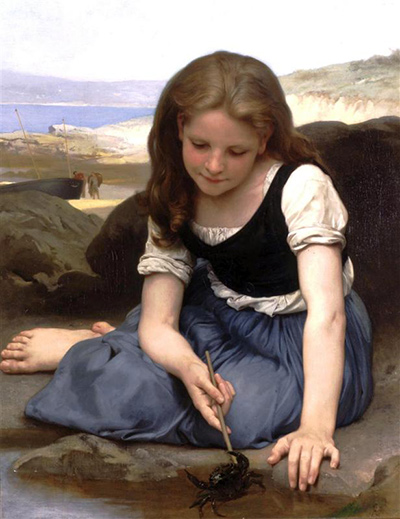
William-Adolphe Bouguereau's The Crab presents a young girl seated on a rocky shore, leaning toward a small crab at the water's edge. The scene is quiet, but it is not empty. The child's head tilts downward, her hand reaches toward the creature, and the long blue folds of her skirt gather around her body like a calm visual anchor. Behind her, the coast opens into pale water, distant cliffs and small figures at work. Bouguereau turns a child's close attention into the center of a finished Academic painting.
The strongest captured source for this page is Sotheby's 2010 record for Le Crabe, the French title by which the painting is documented there. Sotheby's records the work as an 1869 oil on canvas, signed and dated lower left, and measuring 32 by 25 3/4 inches, or 81.3 by 65.4 cm. The Crab remains the useful English page title, but Le Crabe should guide the object facts.
At a Glance
- ArtistWilliam-Adolphe Bouguereau
- Route TitleThe Crab
- Source TitleLe Crabe [1]
- Date1869 [1]
- MediumOil on canvas [1]
- Dimensions32 x 25 3/4 in. / 81.3 x 65.4 cm [1]
- Source RouteSotheby's 2010 lot record [1]
- Study ContextOrsay and Louvre crab drawings, process only [2][3]
Contents
- Introduction
- A Coastal Child Subject
- Observation, Finish and the Crab Studies
- Provenance and Market Route
- Reading The Crab Today
A Coastal Child Subject
Bouguereau is often associated with mythological nudes, religious paintings and idealized mother-and-child subjects, but he also returned often to children observed in rural or coastal settings. In The Crab, the child's world narrows to the animal before her. She uses a stick to approach it, not with drama or fear, but with concentration. The crab is small, dark and low in the composition, yet it controls the action of the painting because every gesture around it points downward.
The background gives the scene a larger setting without taking over. Sotheby's describes the figure as a young fisher girl and notes the coastal environment, possibly connected with Brittany and the Fouesnant area where Bouguereau spent summers in the later 1860s. The distant figures and boat suggest work, travel and adult routines, while the girl remains absorbed in discovery. That contrast gives the painting its emotional shape: the child's private curiosity sits inside a working seacoast world.
The picture should not be treated as social documentation in a literal modern sense. Bouguereau's peasant and fisher children are carefully idealized. Bare feet, rustic clothing and outdoor setting make the subject approachable, but the surfaces are too polished and the pose too deliberately arranged to read as an unfiltered record of daily life. The painting offers a designed image of childhood attention, filtered through the expectations of nineteenth-century collectors.
Observation, Finish and the Crab Studies
One reason The Crab feels unusually specific is the attention paid to the small animal itself. The crab is not just a title device. Its position, legs and dark shape give the child's gaze a believable object. Bouguereau did not need to make the creature large; he made it precise enough to hold the scene together.
Related study material helps explain that precision. The Musee d'Orsay records a graphite drawing titled Etudes de crabe, dated circa 1869, and held in the Orsay collection with the drawings department of the Louvre as its place of conservation. The Louvre collection also records Etudes : crabes et diverses, from a Bouguereau sketchbook associated with his 1869 stay in Brittany, and its note relates the crab studies to the 1869 painting. These drawings are not the painting itself, and their inventory numbers and dimensions should not be transferred to the oil on canvas. They do, however, support the idea that Bouguereau looked closely at crab forms while developing this coastal subject.
That study evidence matters because Bouguereau's finish can sometimes seem almost too smooth. In this painting, the academic surface depends on observation. The girl's hair, sleeves, skirt, hand and the reflective water are all ordered into a clean composition, but the crab keeps the scene grounded in a specific encounter. The result is both idealized and concrete.
Provenance and Market Route
Sotheby's provides the safest object trail for the painting. The record states that Goupil et Cie. in Paris acquired Le Crabe directly from Bouguereau on October 16, 1869, and that M. Rooquard van der Ham of The Hague acquired it from Goupil in February 1870. The later route includes a private collection in the Netherlands and a Sotheby's New York sale in 1985 before the 2010 auction record.
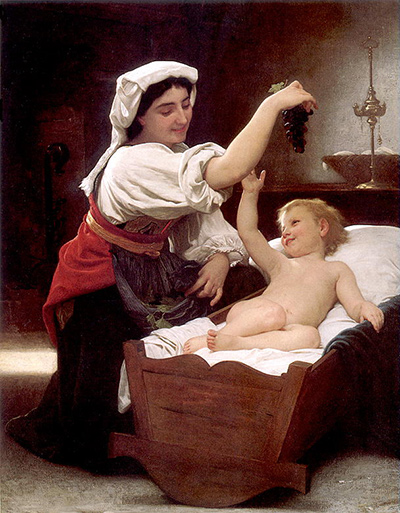
That route is important, but it should be handled with restraint. It shows early dealer circulation and later auction history; it does not by itself establish a current owner, current display location or complete provenance. The painting belongs to the same world of commercially successful Bouguereau figure pictures as The Bunch of Grapes, Berceuse and other market-circulated genre subjects. Its value for this page is that it has a clear enough source spine to discuss the object carefully without pretending it is museum-led.
The literature attached to the Sotheby's record also places the work in Bouguereau's documented oeuvre, including nineteenth-century references and later catalogues. That support strengthens the route, especially because the painting's public web presence often depends on image databases and reproduction pages. Those secondary sources can help readers recognize the work, but Sotheby's remains the authority for the public object facts.
Reading The Crab Today
The Crab rewards close looking because its subject is so modest. A child, a stick, a crab and a strip of shore become enough for a complete image. Bouguereau's interest lies in a moment before language: the girl studies the animal, the animal holds its ground, and the viewer is invited into the pause between curiosity and contact.
The painting also shows how Bouguereau could adapt his Academic method to a coastal genre subject. Nothing here has the scale of his Salon mythologies or religious works, yet the drawing is disciplined, the surface is controlled and the emotional tone is clear. The child's absorption is sentimental, but not chaotic. It has been composed.
The safest way to present the work is to begin with the source-locked facts: Le Crabe, 1869, oil on canvas, signed and dated, with dimensions and provenance recorded by Sotheby's. From there, the Orsay and Louvre crab studies can enrich the process story, provided they remain separate drawing records. The Crab is a small subject by Bouguereau's standards, but it is a useful example of how observation, market appeal and idealized childhood could meet in one carefully finished painting.
Related Childhood, Coastal and Process Pages
Frequently Asked Questions
Discussion
The Crab is a compact route into Bouguereau's coastal childhood imagery, study practice and market-led object history.
Use the prompts below to compare observation, idealization and the source boundary between painting and study drawings.
Reader Insights
How does the small crab control the direction of the girl's pose and attention?
Where does Bouguereau make a modest coastal encounter feel carefully composed?
How do the crab studies help without replacing the painting's own source route?
Join the Conversation
Share your reading of Bouguereau's coastal child subjects, drawing practice and polished genre paintings below.
References
- Sotheby's, William Bouguereau, Le Crabe, 2010 lot record, accessed 29 July 2026.
- Musee d'Orsay, Etudes de crabe, accessed 29 July 2026.
- Louvre Collections, Etudes : crabes et diverses, accessed 29 July 2026.
- Wikimedia Commons, Le Crabe image metadata, accessed 29 July 2026.
- WikiArt, The Crab, 1869, accessed 29 July 2026.