 by Tom Gurney
Tom Gurney BSc (Hons) is an art history expert with over 20 years experience
Published on June 19, 2020 / Updated on October 16, 2026
Email: tomgurney1@gmail.com / Phone: +44 7429 011000
The Bunch of Grapes and the Source Title La grappe de raisin
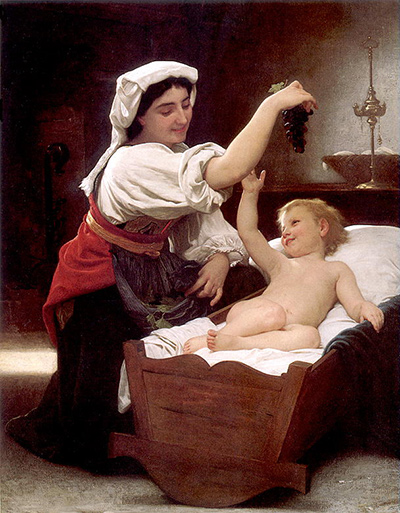
William-Adolphe Bouguereau's The Bunch of Grapes shows a young mother holding grapes above an infant in a cradle. The scene is intimate and playful: the mother's arm curves upward, the child reaches toward the dark cluster of fruit, and the surrounding interior keeps the exchange close to the viewer. Bouguereau turns a small domestic moment into a polished figure composition, balancing the softness of the infant's body with the structured pose and costume of the mother.
The strongest captured source for this page is Sotheby's 2020 record for La grappe de raisin (première réduction). That title means the painting should be handled with care. The Bunch of Grapes is the familiar English route title, but the source title identifies this object as a first reduction, not simply as an undifferentiated version of a larger composition. Sotheby's records the work as an 1868 oil on canvas, measuring 23 by 17 7/8 inches, or 58.4 by 41.5 cm.
At a Glance
- ArtistWilliam-Adolphe Bouguereau
- Route TitleThe Bunch of Grapes
- Source TitleLa grappe de raisin (première réduction) [1]
- Date1868 [1]
- MediumOil on canvas [1]
- Dimensions23 x 17 7/8 in. / 58.4 x 41.5 cm [1]
- VersionFirst reduction [1]
- Source RouteSotheby's 2020 lot record [1]
Contents
- Introduction
- A Domestic Scene Built Like an Academic Painting
- Goupil, Wallis and Market Circulation
- Grapes, Childhood and Idealized Care
- Reading The Bunch of Grapes Today
A Domestic Scene Built Like an Academic Painting
The subject is simple enough to read at a glance: a mother encourages a child with fruit. Yet Bouguereau's construction is anything but casual. The mother bends around the cradle, the white folds of fabric lead the eye toward the infant, and the bunch of grapes becomes the point where gesture, desire and attention meet. The child reaches upward with the directness of infancy, while the mother controls the moment with a poised, almost theatrical stillness.
That combination of warmth and control is central to Bouguereau's appeal. His family and childhood pictures often appear spontaneous, but they depend on precise drawing and carefully ordered surfaces. In The Bunch of Grapes, the emotional subject is tenderness, but the visual subject is structure: the angle of the raised arm, the cradle's hard edge, the contrast of red garment and pale bedding, and the way the small cluster of grapes activates the whole composition.
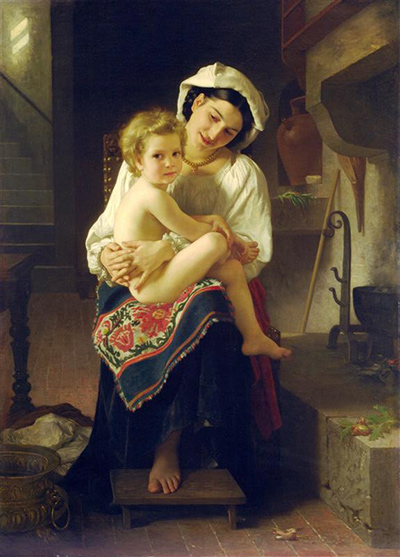
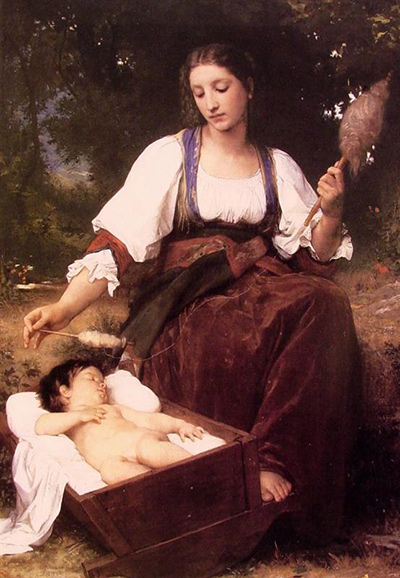
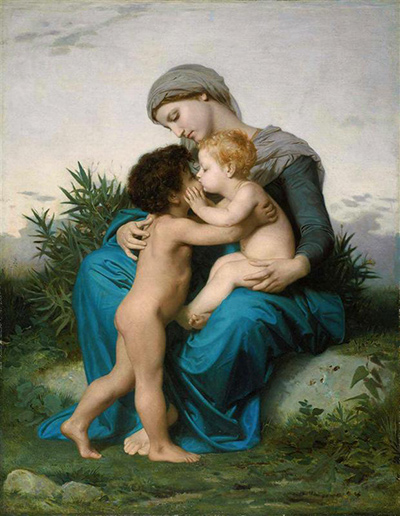
The work belongs beside Bouguereau's other mother-and-child and family subjects, including Young Mother Gazing at Her Child, Berceuse, Fraternal Love and Innocence. These paintings do not document ordinary home life in a modern social-history sense. They transform family feeling into idealized Academic images, where sentiment is made readable through pose, finish and compositional clarity.
Goupil, Wallis and Market Circulation
Sotheby's gives the painting a useful early provenance route. It records Goupil & Cie. in Paris acquiring the work from Bouguereau in October 1868, and M. Wallis in London acquiring it from Goupil in May 1870. That early dealer path is important because Bouguereau's reputation was built not only in Salon culture, but also through an international market for refined figure pictures. Domestic scenes such as this one could travel well because their subject was immediately legible, while their finish advertised the artist's technical authority.
The record also connects the painting with Bouguereau's accounts under the title Italienne aux raisins (première réduction), and with later literature including Bartoli and Ross's catalogue raisonné number 1868/08A. Those details help keep the page anchored in a specific object trail. They also explain why title discipline matters: The Bunch of Grapes, La grappe de raisin and Italienne aux raisins are related routes around the same subject family, but the later page should keep Sotheby's first-reduction wording visible when discussing object facts.
This does not make the painting a museum-led page. It is better described as a market-led object record with a strong auction source. The useful information is substantial, but it should stay within the sale trail Sotheby's records.
The first-reduction wording also changes how the painting should be introduced. A reduction was not a casual copy in the way modern viewers sometimes use that word. In nineteenth-century studio and dealer practice, a smaller version could make a successful composition available in another format and at another scale. For this page, that means the object deserves its own careful treatment, but it should still be described through the version-specific record that survives for it.
Grapes, Childhood and Idealized Care
The grapes give the scene more than a title. They create a small drama of offering and desire. The infant's body is open and reaching, while the mother holds the fruit just high enough to make the exchange visible. Bouguereau uses the object as a bridge between figures: the grapes connect hand, eye and smile, allowing a quiet cradle scene to become animated without needing a larger narrative.
The fruit also gives the painting an Italianate and pastoral flavor. Bouguereau frequently used costume, gesture and idealized setting to move domestic subjects away from literal portraiture. The woman here is not presented as a named sitter. She is a type of young mother, shaped by studio design and by the artist's memory of Italian genre imagery. The scene feels approachable, but it is arranged with the formality of a finished exhibition picture.
Modern viewers may find the sweetness direct, but the painting rewards a slower look. Its sentiment depends on restraint. The child reaches, the mother smiles, and yet everything is held within a stable arrangement. The cradle, fabric, fruit and figure all work together to make affection appear calm, balanced and permanent.
Reading The Bunch of Grapes Today
The Bunch of Grapes is best read as a compact example of Bouguereau's ability to turn domestic affection into an Academic image. It is not a major mythological or religious painting, but it uses the same disciplined drawing, smooth finish and staged clarity that shaped his larger works. The subject is small; the method is not.
The safest public frame begins with the source-locked facts: Bouguereau, La grappe de raisin (première réduction), 1868, oil on canvas, a first reduction, and an early route through Goupil and Wallis. From there, the familiar English title The Bunch of Grapes can remain useful for readers, provided the page does not flatten the title and version history. The painting's charm lies in the reach toward fruit, but its historical value lies in the way that charm was designed, documented and circulated.
Related Mother, Child and Circulation Pages

Frequently Asked Questions
Discussion
The Bunch of Grapes is a compact route into Bouguereau's mother-and-child imagery, Goupil-era circulation and title/version discipline.
Use the prompts below to compare domestic affection, market history and Bouguereau's Academic construction of tenderness.
Reader Insights
How do the grapes connect the mother's gesture with the infant's reaching body?
Where does Bouguereau turn a small cradle scene into a controlled figure composition?
How does the first-reduction title change the way this familiar English title should be read?
Join the Conversation
Share your reading of Bouguereau's family imagery, title history and market route below.
References
- Sotheby's, William Bouguereau, La grappe de raisin (première réduction), 2020 lot record, accessed 29 July 2026.
- Wikimedia Commons, The Bunch Of Grapes (1868), accessed 29 July 2026.
- Wikimedia Commons, La grappe de raisin (première réduction), accessed 29 July 2026.
- WikiArt, The Bunch Of Grapes, 1868, accessed 29 July 2026.