 by Tom Gurney
Tom Gurney BSc (Hons) is an art history expert with over 20 years experience
Published on June 19, 2020 / Updated on October 16, 2026
Email: tomgurney1@gmail.com / Phone: +44 7429 011000
The Oreads by William-Adolphe Bouguereau: Introduction
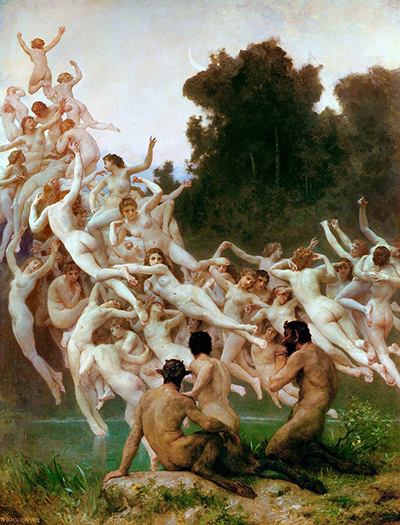
William-Adolphe Bouguereau painted The Oreads, titled Les Oreades in the Musee d'Orsay record, in 1902 [1]. It is one of his late mythological paintings and one of the clearest examples of how he continued to use the academic nude at the end of a long career. Instead of a single goddess, the painting offers a rising group: mountain nymphs taking flight from a twilight landscape while fauns watch from below.
The Musee d'Orsay records the work as an oil on canvas measuring 237.5 by 181.5 cm, signed and dated 1902, and now held by the museum under accession number RF 2010 4 [1]. Orsay also records its exhibition at the Salon de la Societe des artistes francais in Paris in 1902, under number 207 [1]. That Salon setting matters. The Oreads is not simply a private fantasy of nymphs and landscape; it is a large public picture made for the exhibition world in which Bouguereau had built his reputation.
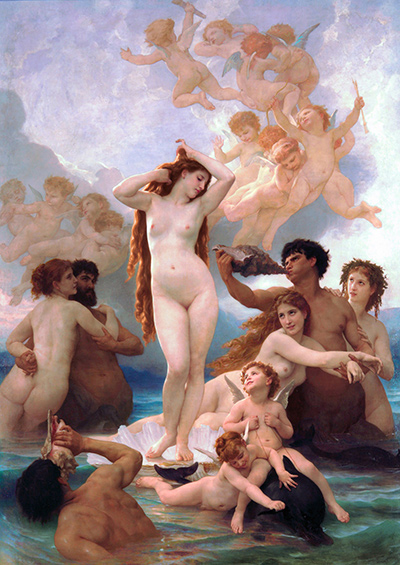
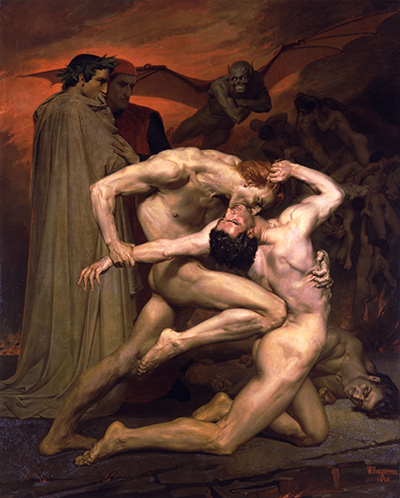
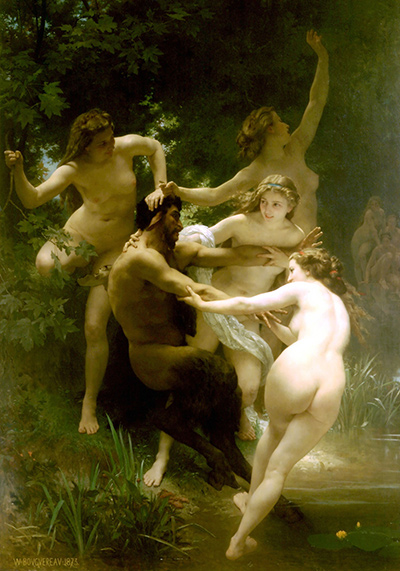
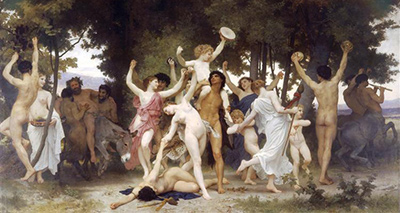
The painting belongs near The Birth of Venus, Nymphs and Satyr and Youth of Bacchus in the Bouguereau catalogue. All four works use mythology to make the human body central. The Oreads, however, is especially about movement. Its figures do not stand in ceremony like Venus or struggle like the bodies in Dante and Virgil in Hell. They ascend, drift, turn and gather into rhythm.
For Bouguereau's wider career, start with the William-Adolphe Bouguereau biography. For the larger painted corpus, continue to William-Adolphe Bouguereau paintings. The Oreads is best read as one of the late anchors of that painted world: polished, idealised, theatrical and still deeply committed to the disciplined figure.
At a Glance
- ArtistWilliam-Adolphe Bouguereau
- TitleThe Oreads / Les Oreades [1]
- Date1902 [1]
- MediumOil on canvas [1]
- Dimensions237.5 x 181.5 cm [1]
- CollectionMusee d'Orsay, Paris; accession RF 2010 4 [1]
- SalonExhibited at the Salon de la Societe des artistes francais, Paris, 1902, no. 207 [1]
- SubjectMountain nymphs rising from a dawn landscape while fauns watch from below [1]
Contents
- Introduction
- Object Facts
- The Mythological Subject
- Bouguereau in 1902
- Composition and Movement
- Academic Bodies in Flight
- Dawn, Poetry and Symbolist Tone
- Salon Display and Public Ambition
- Relationship to Bouguereau's Other Mythological Works
- Reception and Modern Reassessment
Object Facts
The core object facts are unusually strong. Orsay lists the artist as William Bouguereau, born in La Rochelle in 1825 and dead there in 1905 [1]. The original title is Les Oreades, the date is 1902, the medium is oil on canvas, and the dimensions are 237.5 by 181.5 cm, with framed dimensions of 282 by 229 cm [1]. The museum record also notes a lower-right signature and date [1].
The work's museum history is later than many readers might expect. Orsay states that the painting remained in the collection of Bouguereau's heirs until 2010, when it was accepted by the French state as a dation, a payment in kind connected to inheritance tax, for the national museums [1]. It entered the Musee d'Orsay collection in 2010 [1]. This makes The Oreads a nineteenth-century Salon picture whose public museum presence, in its present form, is a twenty-first-century development.
That recent accession is important for the page because it helps explain the painting's renewed visibility. The Oreads is not a minor work newly inflated by reproduction culture. It is a large late canvas with Salon history, family provenance and a national museum record. Its object facts support a substantial standalone page.
The exhibition record also matters. Orsay lists The Oreads at the 1902 Salon, later in a Bouguereau exhibition at Galerie Denise Breteau in 1965-1966, in the 1980 Ingres and his posterity exhibition at Montauban, and in the 2015 Mapfre exhibition on academic paintings from the Paris Salon in Orsay's collections [1]. Those later appearances show how the painting can be used to discuss more than one story: Bouguereau himself, the afterlife of Ingres, academic painting at the end of the century, and the retrospective reassessment of Salon art.
The Mythological Subject
The Oreads are mountain nymphs. Orsay describes them as nymphs of mountains and grottoes, and names Echo as the best-known example [1]. In the museum's summary, they emerge in lively groups to hunt, follow Diana, and return to a divine realm after the night [1]. Bouguereau turns that mythological idea into a scene of ascent.
This is important because the title is not just decorative. The subject gives the painting its movement. These figures are not generic bathers or unnamed female nudes placed in a landscape. They are Oreads, mythological beings associated with mountains, caves, hunting and the goddess Diana. The landscape is therefore not a neutral background. It belongs to the story the bodies are performing.
The 1902 Salon catalogue commentary, preserved in Orsay's record, described dawn arriving after the shadows of night and the nymphs lifting into the sky while fauns watched from below [1]. Bouguereau's painting visualises exactly that threshold. Night is ending; day is appearing; the nymphs are leaving the earthly landscape. The scene is not a hunt itself, but the moment after nocturnal movement, when the group returns upward.
The fauns are equally important. They stand below, earthbound and watching. Orsay's interpretation calls attention to their astonishment and to the erotic charge of their gaze [1]. Bouguereau uses them to make the scene more than a graceful procession. The painting contains looking as well as rising: male figures watch the airborne female group, and the viewer is made aware of that act of watching.
This creates one of the painting's central tensions. The Oreads are idealised, luminous and airborne, but they are also visibly bodies under observation. Myth gives the nude a classical framework; the fauns remind us that desire is present inside that framework. Bouguereau does not make the scene vulgar, but he also does not remove its erotic energy.
Bouguereau in 1902
The Oreads was painted near the end of Bouguereau's life. He was born in 1825 and died in 1905 [1][2]. By 1902 he was no young artist trying to establish himself at the Salon for the first time. He had already passed through the Ecole des Beaux-Arts, won the Prix de Rome, spent years in Italy and become one of the most famous Academic painters in France [2].
That late date changes how the painting should be read. The Oreads is not an early experiment. It is a statement of persistence. At a moment when the artistic world had already changed dramatically, Bouguereau continued to believe in mythology, anatomy, polished surface and the large composed figure group. He did not abandon the language that had made his career.
The Getty's introduction to Bouguereau is useful here because it describes both his popularity and the later criticism of his polished, romanticised painting [4]. The Oreads sits directly inside that tension. It is technically assured and visually seductive, yet it belongs to a tradition that many modernist accounts treated as outdated. Its late date makes that tension sharper. Painted in 1902, it is almost contemporary with an art world moving toward Post-Impressionism, Symbolism, Fauvism and other alternatives to academic finish.
But the painting should not be dismissed as a relic. Its strength comes from the seriousness with which Bouguereau continues to use his chosen language. He is not merely repeating a formula. He is trying to make a difficult figure group feel airborne, musical and coherent. The bodies must be individually legible and collectively rhythmic. The landscape must be poetic without swallowing the figures. The whole scene must remain clear at Salon scale.
This is why The Oreads is so valuable within the Bouguereau cluster. It shows what his art could still do late in life. Dante and Virgil in Hell shows the young painter using the body for violence and ambition. The Birth of Venus shows the mature painter using the body for ceremony and beauty. The Oreads shows the late painter using many bodies for lift, atmosphere and poetic motion.
Composition and Movement
The composition is built around upward motion. The Oreads rise diagonally through the air, leaving the darker earthly zone for a lighter realm above. Their bodies overlap, separate and rejoin, forming a procession rather than a static group. Bouguereau's challenge is to make many nude figures read as one movement without turning them into a confused mass.
He does this through rhythm. Some figures face outward, some turn away, some lift their arms, some seem to float almost horizontally, and others move in more upright arcs. The repeated pale bodies become a visual current. The viewer's eye does not stop on one central figure in the way it does in The Birth of Venus. It travels upward through the group.
That difference is crucial. Venus is a painting of centrality. The Oreads is a painting of circulation. There is no single body that carries the whole meaning. Instead, meaning comes from the collective. Bouguereau turns the academic nude into a procession, almost a sequence of musical phrases. The figures are separate enough to show his drawing skill, but connected enough to create a single visual ascent.
The fauns below provide the counterweight. They are darker, lower and more fixed. Their bodies and gazes anchor the bottom of the composition while the nymphs move away from them. Without the fauns, the picture might become pure upward drift. With them, it has a tension between earth and air, desire and distance, watching and escape.
The landscape strengthens that tension. Orsay's account of the Salon commentary places the scene at dawn, when night shadows dissipate and the mountain tops take on new color [1]. The painting's background should therefore be read as part of the action. Dawn is not merely atmospheric decoration. It marks the change from nocturnal freedom to the nymphs' return.
Academic Bodies in Flight
Bouguereau's academic training is visible everywhere in The Oreads. Each body is carefully drawn, idealised and placed. The figures twist, hover and rise, but their anatomy remains controlled. The painting does not ask viewers to see loose brushwork or accidental movement. It asks them to admire the illusion of weightless bodies made through disciplined drawing.
The Musee des Beaux-Arts de Bordeaux describes Bouguereau as a methodical artist who worked through drawings, detail studies, drapery studies and compositional research [5]. Getty likewise emphasises his preparation before the final canvas [4]. The Oreads depends on that method. A large group of floating figures cannot be convincing if the composition is improvised too casually. The movement must be planned.
This planning does not make the painting cold. On the contrary, it allows Bouguereau to create a controlled kind of intoxication. The nymphs seem to rise naturally, but the viewer can feel the underlying order. Arms, legs, torsos and heads are arranged to avoid visual collapse. The group is complex, but it remains legible.
That is the Academic paradox of the painting. It represents flight, but through structure. It represents mythological abandon, but through calculation. It represents sensual bodies, but through a system of idealisation. The result is not spontaneous in the modernist sense. It is a highly finished vision of spontaneity.
The Oreads also shows why Bouguereau's nude painting cannot be reduced to one formula. The central Venus of 1879 is a vertical, frontal ideal. The damned men in Dante and Virgil in Hell are muscular bodies under violent pressure. The Oreads are bodies arranged as rhythm and ascent. Across those works, the body remains Bouguereau's main instrument, but it plays different roles.
Dawn, Poetry and Symbolist Tone
One reason The Oreads feels different from Bouguereau's more ceremonial mythological paintings is its atmosphere. Orsay's interpretation emphasises the twilight landscape and connects the poetic background to Corot, while also noting a Symbolist tone [1]. That comparison matters because the painting is not only a display of anatomy. It is also a mood image.
The nymphs rise between night and day. The lower landscape still feels shadowed and earthly; the upper movement suggests a passage away from that world. This threshold quality gives the painting its poetry. It is not a scene of battle, triumph or worship. It is a scene of departure.
The dawn setting also changes the erotic tone. If the scene took place in bright midday, the bodies might feel more bluntly exposed. In the half-light, they become part of a dreamlike transition. The fauns' gaze remains charged, but the nymphs' ascent pulls the painting away from simple voyeurism. Desire is present, yet it is not allowed to stop the movement.
This is where the painting becomes especially late nineteenth-century. Mythology, ideal bodies, poetic twilight and an almost visionary ascent all meet. The Oreads can be read as Academic, but it also brushes against Symbolist atmosphere. It does not become obscure or mystical in a radical way; Bouguereau remains committed to clarity. Still, the painting's mood is more dreamlike than documentary.
The painting is often described as poetic, but that response should be grounded in the object record rather than loose praise. Its poetry comes from specific choices: dawn, ascent, mountain nymphs, watching fauns, a landscape of transition and a figure group organised like a rising current.
Salon Display and Public Ambition
The 1902 Salon entry gives The Oreads its public frame [1]. By then, Bouguereau had spent more than half a century in relation to the Salon system. Orsay's artist directory records his Salon debut in 1849 and notes that he became highly reputed [2]. The Oreads therefore belongs to a very long exhibition career.
That career context matters because the painting's scale and complexity are not accidental. A Salon picture needed to hold attention. It had to read from a distance, reward close looking and communicate its artistic ambition quickly. The Oreads does this through a large airborne group, a mythological subject, a polished surface and a theatrical contrast between nymphs and fauns.
The painting also shows Bouguereau continuing to defend the Academic ideal through performance rather than argument. He does not write a manifesto on behalf of academic art. He stages a demonstration: many bodies in motion, drawn with precision, organised into a coherent whole. The page should make this visible to readers who may know him only through isolated reproductions.
The Salon context also helps explain the painting's interpretive richness. The title and catalogue commentary gave contemporary viewers a narrative key: these are Oreads returning upward at dawn while fauns watch below [1]. Without that context, a viewer might see only a swarm of figures. With it, the painting becomes a mythological transition from night to morning, from earth to divine space.
The work's later inclusion in exhibitions about Ingres's posterity and academic Salon painting reinforces that public identity [1]. The Oreads can be seen as a late continuation of a line of French figure painting that valued drawing, ideal bodies and compositional order. It is not Ingres, and it is not simply a repetition of earlier classicism, but it belongs to a tradition shaped by those values.
Relationship to Bouguereau's Other Mythological Works
The Oreads is most powerful when read beside Bouguereau's other mythological paintings. The Birth of Venus gives mythology a central goddess and a ceremonial stage [7]. Dante and Virgil in Hell turns a literary subject into violent anatomy [8]. The Oreads uses mythology to create a collective ascent.
Nymphs and Satyr is especially close in subject family because it also stages nymphs, desire, pursuit and group choreography. The difference is directional. Nymphs and Satyr is usually read as a scene of play, pulling and resistance at the edge of water. The Oreads opens upward. It does not trap the nymphs in a horizontal exchange; it sends them into the air.
Youth of Bacchus provides another comparison for mythological procession. There, Bacchic energy is social, festive and earthly. In The Oreads, the procession is more airy and visionary. The figures do not simply celebrate; they depart. That difference makes The Oreads one of Bouguereau's most elegant late treatments of group movement.
The painting also belongs beside the drawings hub. A work this complex depends on preparation. Readers who move from The Oreads to drawing-related pages can better understand how Bouguereau's polished figures were constructed. The final surface may look effortless, but the structure behind it is disciplined.
These internal comparisons should help prevent the page from becoming isolated. The Oreads is not simply "another Bouguereau nude." It is a key part of the mythological network: Venus for ceremony, Dante for violence, Nymphs and Satyr for erotic play, Youth of Bacchus for procession, and The Oreads for ascent.
Reception and Modern Reassessment
The Oreads remains compelling because it concentrates both the appeal and the difficulty of Bouguereau's late art. Viewers who admire him can point to the drawing, polish, scale and poetic atmosphere. Viewers who resist him may see the same qualities as too idealised or too committed to an older academic world. The painting does not resolve that disagreement. It makes it visible.
That disagreement is part of Bouguereau's modern interest. Getty's overview notes that Bouguereau was highly popular in his own time and later became a controversial figure because his finished, romanticised art stood apart from younger artists' rougher, more visibly modern approaches [4]. The Oreads is a perfect example of that divide. It is painted in 1902, but its values are rooted in a longer Academic tradition.
Yet late Academic does not mean artistically inert. The Oreads asks a real pictorial question: how can a painter make many ideal bodies rise together without losing clarity, sensuality or poetic atmosphere? Bouguereau's answer is not modernist fragmentation. It is order. He trusts drawing, rhythm and finish.
Seen today, that trust can feel distant from the art histories that place modernism at the center of the period. But distance is not the same as irrelevance. The Oreads helps readers understand what Academic painting still offered at the beginning of the twentieth century: a belief that mythology, ideal bodies and controlled composition could still produce visual wonder.
The painting is therefore best approached without caricature. It is not merely sentimental, and it is not secretly avant-garde. It is a late Academic mythological painting by an artist who had mastered his language and kept using it. Its fascination lies in that clarity of commitment.
Where to Go Next
To understand The Oreads within Bouguereau's career, begin with the William-Adolphe Bouguereau biography and the paintings hub. For an earlier and more dramatic use of anatomy, compare Dante and Virgil in Hell. For a mature mythological nude organised around a single central figure, see The Birth of Venus.
For related mythological group scenes, continue to Nymphs and Satyr and Youth of Bacchus. Those pages show how Bouguereau used mythology not as one fixed subject, but as a flexible stage for bodies, desire, movement and public display.
The drawings page is also a useful next step. The Oreads depends on the kind of preparation that made Bouguereau's finished surfaces possible. The more carefully a viewer looks at the group, the clearer it becomes that the painting's apparent ease is built from control.
The Oreads is one of Bouguereau's late statements of faith in the Academic figure. Its nymphs rise through dawn, watched by fauns and organised into a luminous procession. The painting does not ask us to forget that modern art was changing around Bouguereau. It asks us to see what he still believed painting could do: turn myth, anatomy, desire and atmosphere into a single upward movement.
Related Bouguereau Mythological Paintings
Frequently Asked Questions
Discussion
The Oreads is a useful test case for Bouguereau because it turns Academic figure drawing into a large late-career image of ascent, atmosphere and mythological rhythm.
Use the prompts below to connect the painting's Orsay object record, Salon setting and rising group composition.
Reader Insights
Which figure or gesture most strongly carries the procession upward?
How does the 1902 Salon context change the way you read the painting's scale and finish?
How do the fauns below change the meaning of the nymphs' upward flight?
Join the Conversation
Share your reading of Bouguereau's The Oreads below.
References
- Musee d'Orsay, Les Oreades, accessed 28 July 2026.
- Musee d'Orsay artist directory, accessed 28 July 2026.
- TheHistoryOfArt.org, William-Adolphe Bouguereau, accessed 28 July 2026.
- Getty, Adolphe-William Bouguereau: An Introduction, accessed 28 July 2026.
- Musee des Beaux-Arts de Bordeaux, William Bouguereau, accessed 28 July 2026.
- TheHistoryOfArt.org, William-Adolphe Bouguereau Paintings, accessed 28 July 2026.
- TheHistoryOfArt.org, The Birth of Venus by William-Adolphe Bouguereau, accessed 28 July 2026.
- TheHistoryOfArt.org, Dante and Virgil in Hell by William-Adolphe Bouguereau, accessed 28 July 2026.