

 by Tom Gurney
Tom Gurney BSc (Hons) is an art history expert with over 20 years experience
Published on June 19, 2020 / Updated on July 26, 2026
Email: tomgurney1@gmail.com / Phone: +44 7429 011000
Young Woman Seated at the Virginal and the Vermeer Title Problem: Introduction
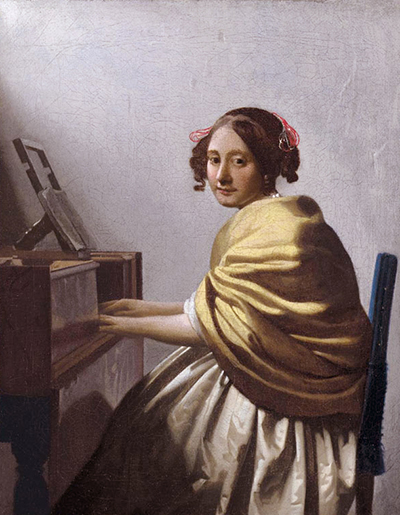
Young Woman Seated at the Virginal is one of the most delicate Vermeer title problems. The issue is not only attribution. It is also title confusion. The painting discussed here is the small Leiden Collection work, not the larger National Gallery, London seated virginal painting. The two works need to remain clearly distinct for readers.
The Leiden Collection catalogue gives the work as Young Woman Seated at a Virginal, by Johannes Vermeer, about 1670-75, oil on canvas, 25.5 by 20.1 cm, inventory number JVe-100. [1] The catalogue entry has been revised by Arthur K. Wheelock Jr. in 2020 and 2023 and rewritten in 2024. [1]
At a Glance
- Current catalogue attributionJohannes Vermeer
- TitleYoung Woman Seated at a Virginal
- CollectionThe Leiden Collection
- Inventory numberJVe-100
- DateAbout 1670-75
- MediumOil on canvas
- Dimensions25.5 x 20.1 cm
- Key themesAttribution history, title confusion, conservation, late music painting
Contents
- Introduction
- At a Glance
- Why This Page Needs a Warning
- What the Painting Shows
- The Current Leiden Attribution
- Conservation and the 2024 Appearance
- Relationship to Vermeer’s Music Paintings
- Relationship to The Lacemaker
- Title Collision with the London Painting
- How to Read the Page Responsibly
- Place in the Vermeer Story
- Frequently Asked Questions
Why This Page Needs a Warning
The warning is necessary because readers can easily confuse this painting with the National Gallery, London work A Young Woman seated at a Virginal. The difference between “a” and “the” in local URLs is not enough to protect the reader from misunderstanding.
The London painting is a separate object, inventory NG2568, larger in scale and held by the National Gallery. The Leiden painting is much smaller and belongs to a different collection history. It has also carried a more complex public attribution history.
For that reason, the work is best treated as a title-confusion and attribution-history subject: useful, but visibly cautious.
What the Painting Shows
The painting shows a young woman seated at a virginal, turned toward the viewer. The format is compact, and the figure occupies a small, intimate space. The subject connects naturally with Vermeer’s late interest in music, interiors and women at keyboard instruments.
Because the painting is small, the encounter is different from the London seated virginal work. It feels closer to a concentrated study than to a fully developed room. The viewer is drawn toward the figure, the instrument and the controlled relation between pose and gaze.
That compactness is part of the painting’s appeal, but it also contributes to the attribution question. Small scale can intensify Vermeer’s effects, as in The Lacemaker and Girl with the Red Hat, but it can also make comparison with secure works more demanding.
The Current Leiden Attribution
The current Leiden Collection catalogue presents the painting as by Johannes Vermeer. [1] That current catalogue status should be stated plainly. The account should not imply that the work is currently catalogued by Leiden as anonymous, studio or merely attributed.
At the same time, the painting needs caution. Its public history has been bound up with attribution debate, sale history, technical examination and comparison with secure Vermeer paintings. A responsible account can acknowledge the current attribution while still explaining why the work has needed special scrutiny.
That balance is the purpose of the warning box. It prevents two errors: treating the painting as a simple duplicate of the London work, or treating the current Leiden catalogue as if it erased the painting’s complicated reception history.
Conservation and the 2024 Appearance
The Leiden catalogue records a 2024 conservation treatment by David Bull. The treatment removed aged varnish and retouching, including overpaint on the lips and eyebrows. The catalogue notes that this changed the visible expression and improved readings of luminosity and tone. [1]
This matters because appearance and attribution are linked. A painting that has been altered by varnish, retouching or overpaint may not present its original surface clearly. Conservation can therefore change how viewers and scholars understand expression, light and handling.
The 2024 treatment should be discussed as part of the painting’s modern evidence history. It should not be sensationalised as a sudden discovery of a “new Vermeer.” The better point is more precise: conservation changed what can be seen, and that affects how the work is read.
Relationship to Vermeer’s Music Paintings
The Leiden painting belongs thematically with Vermeer’s music works. It should be discussed near A Young Woman Standing at a Virginal, the National Gallery A Young Woman seated at a Virginal, The Music Lesson and The Concert.
The relationship is not only subject matter. Vermeer’s music paintings often explore presence and absence. Instruments suggest sound, but the images remain silent. Figures look outward or inward. The viewer becomes aware of social relationships that are implied rather than fully shown.
The Leiden work participates in that world, but it should not be used to blur the boundaries between different objects. Its value is partly that it forces a careful distinction between similar titles and similar subjects.
Relationship to The Lacemaker
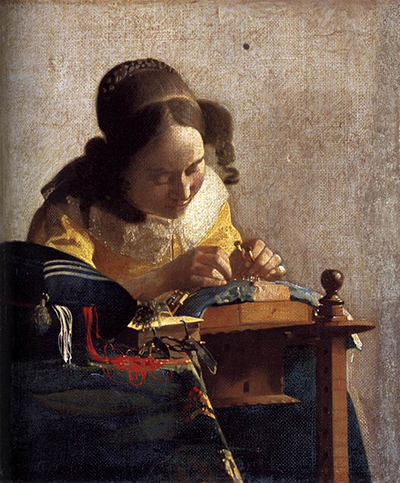
The Leiden catalogue also invites comparison with The Lacemaker. Both are very small paintings. Both ask the viewer to look closely at scale, surface and concentrated attention. That comparison can help readers understand why small Vermeer works can carry large interpretive weight.
The comparison should remain disciplined. The Lacemaker is a secure Louvre work. The Leiden painting has a different history. The shared small scale is useful, but it does not make the works equivalent.
Still, the comparison helps place the Leiden work within a broader question: how much presence can Vermeer, or a work attributed to him, concentrate into a very small format?
Title Collision with the London Painting
Two seated-virginal titles are easily confused because there are two different works in play. The London painting is the National Gallery work, inventory NG2568. The Leiden Collection painting is inventory JVe-100.
A simple merge would be misleading because it would erase the object distinction. Treating one title as merely a substitute for the other would also be risky because readers may be looking for one painting rather than the other.
The safest public treatment is to be explicit. Collection, inventory number and title issue need to appear early so that the two paintings are understood as related but not duplicate objects.
How to Read the Page Responsibly
Readers should approach the Leiden painting through three questions. First, what does the current catalogue say? Second, how has the painting’s attribution and appearance been studied over time? Third, how does it relate to, but remain separate from, Vermeer’s other music paintings?
Those questions produce a more useful page than a simple yes-or-no attribution argument. They show how Vermeer scholarship works: through object records, conservation, comparison, provenance, technical examination and changing catalogue judgment.
This subject therefore has a different role from a flagship artwork. It is not about making the painting more famous than it is. It is about preventing confusion and recording why the work matters.
Place in the Vermeer Story
This work belongs in an attribution-history and title-collision context. It connects naturally to the London seated virginal page, A Young Woman Standing at a Virginal, The Music Lesson, The Lacemaker, the paintings catalogue and the wider Vermeer legacy story.
It should not be promoted as one of the core public-facing flagships. Its function is precision. Vermeer’s surviving oeuvre is small, so each title, object and attribution decision matters.
The painting also demonstrates a useful rule for difficult attribution histories: when titles are dangerously similar, the public explanation should solve the confusion directly rather than hiding it behind vague wording.
Frequently Asked Questions
No. This article discusses the Leiden Collection painting, inventory JVe-100. The National Gallery London seated virginal painting is a separate work, inventory NG2568.
Yes. The current Leiden Collection catalogue presents the painting as by Johannes Vermeer. [1]
Because the painting has a complex attribution and reception history, and because its title is easily confused with the National Gallery London seated virginal painting.
The Leiden catalogue records that David Bull removed aged varnish, retouching and disturbing overpaint on the lips and eyebrows, changing the visible expression and improving tonal and luminosity readings. [1]
No automatic merger should be assumed. The two works are separate objects, and any public account needs to preserve that distinction clearly for readers.
Discussion
What feels most revealing about Young Woman Seated at the Virginal and the Vermeer Title Problem: Vermeer's handling of light, the silence of the scene, the object details, the attribution history, or the way the painting fits within Dutch Golden Age art?
Reader Insights
Vermeer rewards slow attention. Begin with the main action, then move outward to light, edges, objects and the quiet spaces that hold the composition together.
Many of these paintings are small, but their meanings open through Delft, collecting history, technical study and comparison with related Dutch interiors.
Pair this article with the biography and one neighbouring Vermeer work to see how subject, light and attention shift across the artist's compact oeuvre.
Join the Conversation
Have a thought or observation about Young Woman Seated at the Virginal and the Vermeer Title Problem? Share it below. Thoughtful responses may be added to this section as the Vermeer pages develop.
References
- The Leiden Collection, Young Woman Seated at a Virginal, inventory JVe-100, catalogue entry revised by Arthur K. Wheelock Jr. in 2020 and 2023 and rewritten in 2024.
- Vermeer research notes on the seated-virginal title collision, London/Leiden separation and 2024 conservation treatment.
- National Gallery, London, A Young Woman seated at a Virginal, NG2568, for title/object contrast.