


 by Tom Gurney
Tom Gurney BSc (Hons) is an art history expert with over 20 years experience
Page Created on / Page Updated on
Email: tomgurney1@gmail.com / Phone: +44 7429 011000
The Champion Single Sculls: Introduction
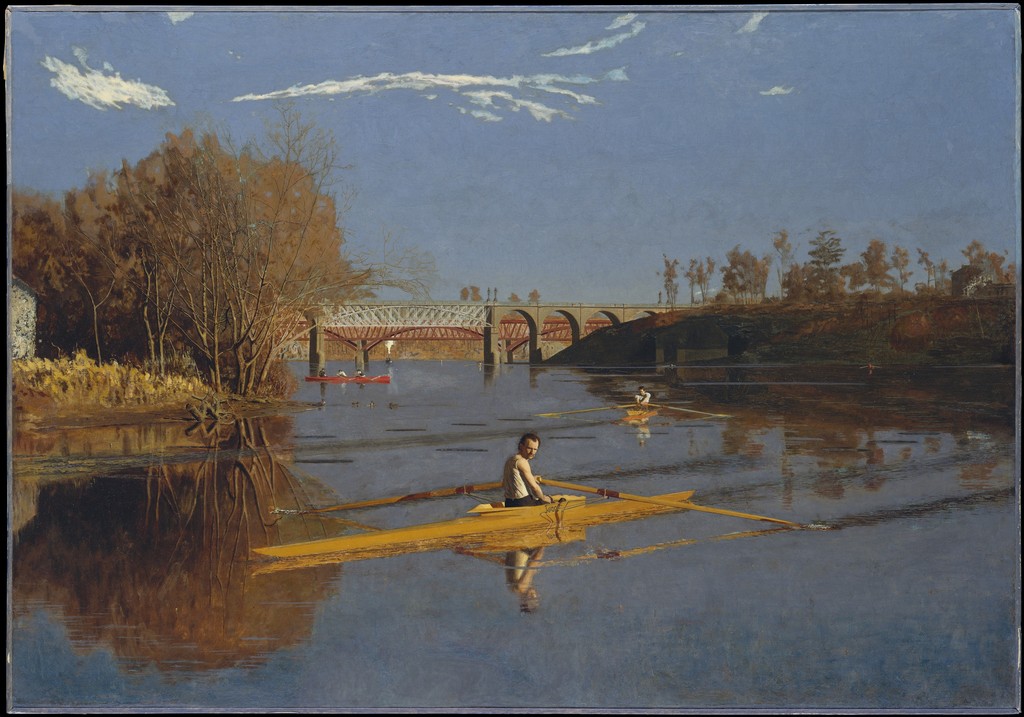
Thomas Eakins’s The Champion Single Sculls (Max Schmitt in a Single Scull) gives an athlete, a boat, and a familiar stretch of river equal importance. Max Schmitt sits close to the viewer in a long yellow shell, his body turned away from the course of the boat so that his face becomes visible. Behind him, bridges, autumnal banks, other craft, and a second sculler establish the Schuylkill as a used urban waterway. The Metropolitan Museum of Art dates the oil painting to 1871 and identifies it as the first major work in Eakins’s rowing series.[1]
Its scale is substantial without being monumental: 81.9 by 117.5 centimetres. The horizontal canvas is wide enough to admit a deep river setting, yet Schmitt’s shell nearly spans it. The Met’s current object data records the work as number 34.92 and makes the image available through its Open Access programme.[2] Those particulars matter because the painting is at once an exact object, a named portrait, and an unusually ambitious treatment of a contemporary sport.
Eakins returned from Europe in 1870 and soon made rowing one of the subjects through which he defined an American career. A National Gallery of Art exhibition later brought together nine paintings and fourteen works on paper devoted to rowing, including preparatory material.[3] Max Schmitt stands near the beginning of that concentrated sequence. Its calm is not a lack of action. It is the product of choices about timing, perspective, reflection, and the relation between friendship and athletic achievement.
At a Glance
- Full titleThe Champion Single Sculls (Max Schmitt in a Single Scull) [1]
- Artist and dateThomas Eakins, 1871 [1][2]
- MediumOil on canvas [1][2]
- Dimensions32 1/4 × 46 1/4 inches (81.9 × 117.5 centimetres) [1][2]
- SubjectMax Schmitt, Eakins’s school friend, an attorney and accomplished amateur rower [1]
- CollectionThe Metropolitan Museum of Art, object 34.92, purchased in 1934 [1][2]
Thomas Eakins in context
The Gross Clinic
1875Swimming
1885The Agnew Clinic
1889The Concert Singer
1890–92The Thinker
1900Contents
- Introduction
- Naming a Champion
- A New Local Subject
- First Public Attention
- Building the River
- Reading the Scull
- Perspective and Reflection
- Eakins in the Distance
- One Rower, Then Two
- Why the Stillness Matters
Naming a Champion
The Met’s full title carries two kinds of identification. “The Champion Single Sculls” presents a public sporting distinction, while the parenthetical phrase names the individual in the foreground. Schmitt, born in 1843, had known Eakins at school, later worked as an attorney, and competed successfully as an amateur oarsman. The museum says the painting is believed to commemorate his victory in an important Schuylkill race in October 1870.[1]
“Believed” is essential. The record supports an association with that victory; it does not establish that the scene reproduces a documented instant from the contest. No opponent presses into the foreground, no finishing line is marked, and the river traffic does not organise itself into a single obvious race narrative. Schmitt has turned towards the viewer rather than directing every visible faculty down the course. The canvas can honour a result without pretending to preserve one second of the event.
The National Gallery’s account of Eakins’s rowing pictures describes Schmitt as an amateur engaged in a demanding competitive activity and places rowing within contemporary Philadelphia popular culture.[4] This helps explain why both halves of the title belong. Schmitt’s achievement gave him public standing within the sport, while his friendship with Eakins made him available as a particular, observed person. The portraits guide follows the artist’s broader habit of revealing identity through trained action rather than through ceremonial attributes.
A New Local Subject
Eakins had returned to Philadelphia after rigorous study in France and a period in Spain. The Met’s retrospective places his early outdoor pictures of male friends directly after that homecoming and notes his preference for familiar American experience over imported narrative subjects.[5] Rowing offered a demanding way to act on that preference. The sport was current, local, and organised, yet it also required the figure drawing and spatial construction he had practised in Europe.
The Met’s account of Eakins as a painter says that he had been athletic from boyhood and chose activities he knew as opportunities to demonstrate professional skill.[6] That connection should not be reduced to autobiography. Knowing how a shell responds to a shift of weight could help him recognise a persuasive pose, but the painting still had to transform practical knowledge into an intelligible design. Its American character lies not simply in the river’s location; it lies in treating a friend’s disciplined participation in modern sport as worthy of sustained painting.
The biography places this choice within his homecoming. Eakins redirected academic procedure towards a river, its recreational infrastructure, and an amateur champion.
First Public Attention
Research published by the Met in 1968 connected The Champion Single Sculls with an exhibition at Philadelphia’s Union League that opened on 26 April 1871. Along with an unidentified portrait, it was among Eakins’s first two publicly exhibited works. Contemporary responses were divided. One critic found promise in the bold treatment of an ordinary subject, while another admired the foreground rower but questioned the relationship between the bright water and the duller sky.[7]
Those reactions are valuable because they show the painting before its later canonical status was secure. What now appears recognisably “Eakins” could initially look peculiar: a large, carefully planned river picture whose principal figure is an amateur sportsman. The early reviewers noticed both its challenge and its unevenness. Reception did not proceed in a straight line from innovation to acclaim.
The present object record describes the work as the painting that launched Eakins’s professional career.[1] The Met purchased it in 1934 through the Alfred N. Punnett Endowment Fund and a George D. Pratt gift; this records the museum’s acquisition, not a complete chain of earlier ownership.[2]
Building the River
The Schuylkill is not a generic strip of blue behind Schmitt. Trees and reeds crowd the near bank at the left, while the opposite side rises in darker horizontal layers. Two crossings overlap near the centre: broad masonry arches define one rhythm, and a red lattice structure supplies a finer one behind it. Small craft, smoke, rail movement, buildings, and figures prevent the landscape from becoming untouched countryside.
A Met collection guide locates the setting on the Schuylkill as it passes through Philadelphia’s Fairmount Park. It also draws attention to the artist in the second shell, a train approaching a bridge, a smoke-producing boat, and the more freely handled stone building and foliage at the left.[8] These details join recreation to transport and settled land. Schmitt rows through a corridor where parks, industry, infrastructure, and leisure meet.
Topography also controls the viewer’s route. The long near bank and its dark reflection form a bracket at the left. The bridges compress the river in the distance, while a broad open surface separates them from Schmitt. His shell lies across that space rather than simply receding into it. The paintings guide places this negotiation between observed place and calculated arrangement alongside Eakins’s medical, musical, and sporting compositions.
Reading the Scull
In sculling, one athlete handles two oars, one in each hand; USRowing distinguishes this from sweep rowing, in which each athlete uses one oar.[9] That difference is visible before any technical vocabulary is applied. Schmitt’s two blades extend towards opposite sides of the canvas, making his body the hinge of a wide, shallow structure. Boat, arms, and oars have to remain coordinated if the narrow shell is to stay level.
A rowing stroke usually passes through catch, drive, finish or extraction, and recovery. British Rowing’s technical guidance stresses blade control, posture, propulsion during the drive, and smooth movement while the oars travel out of the water.[10] Eakins does not illustrate that sequence as a manual would. Instead, he chooses an interval in which Schmitt can turn his head and upper body towards us while retaining command of both oars. The result lets viewers consider skill without claiming that a continuous action has become transparent.
The shell contributes to this controlled suspension. Its narrow hull is almost perfectly lateral, and its sharpened ends extend well beyond Schmitt. A strong yellow runs along the craft, but changing light breaks the colour into several tones. The oars carry that line farther, one blade nearing the right edge and the other meeting the darker water at left. The equipment is not decorative evidence of “sport”; it determines the geometry of the entire foreground.
Schmitt’s turn complicates the physical task. His lower body remains aligned with the boat while shoulders and face rotate towards the spectator. The posture converts a river activity into a likeness without removing it from the river. We meet him through a moment of divided attention: still responsible for balance and blades, but sufficiently composed to acknowledge another presence.
Perspective and Reflection
The water occupies most of the lower half of the canvas, and Eakins treats it as both depth and surface. Schmitt’s hull crosses horizontally, yet its slight changes of width and the angle of the rigging keep it from reading as a flat stripe. Smaller boats contract rapidly behind him. Bridge openings, embankments, and converging intervals carry the eye back without allowing the foreground figure to lose authority.
Reflection makes this construction more demanding. Schmitt’s pale shirt and dark head recur below him; yellow fragments from boat and oars bend across disturbed water; the left bank descends in long brown strokes. These mirrored forms do not produce perfect duplicates. Ripples stretch, interrupt, and darken them. The painting therefore distinguishes between an object’s designed shape and its unstable appearance on the river.
The National Gallery notes that Eakins made the rowing pictures in the studio and worked their elements out through perspective drawings, oil studies, watercolours, and finished oils.[4] That record rules out a simple idea of optical transcription. The scene’s conviction rests on construction: observed boats and bodies are coordinated within a space tested through preparatory work. Accuracy here is an achievement of arrangement, not proof that the canvas records an untouched view.
Eakins in the Distance
The second sculler is not anonymous. The Met identifies him as Eakins, and the older museum study notes that the boat bears the inscription “EAKINS 1871.”[1][7] He appears much smaller than Schmitt, dressed in a light top and moving through the middle distance. The signature is therefore attached to the artist’s craft as well as to the painting’s surface.
That self-placement changes the relation between observer and subject. Eakins is present as someone who shares the activity, understands its equipment, and occupies the same water. Yet he does not compete with Schmitt for scale. The friend remains the foreground champion; the artist becomes participant, witness, and maker at once. Their separation across the river keeps those roles distinct.
The device also makes the portrait reciprocal. Schmitt turns towards the side from which he is being viewed, while Eakins is pictured farther along the same spatial system. We cannot turn this arrangement into a documented exchange of glances, but we can recognise how it embeds a social relation. The painting is about one named rower, seen by another rower who has chosen to include himself.
One Rower, Then Two
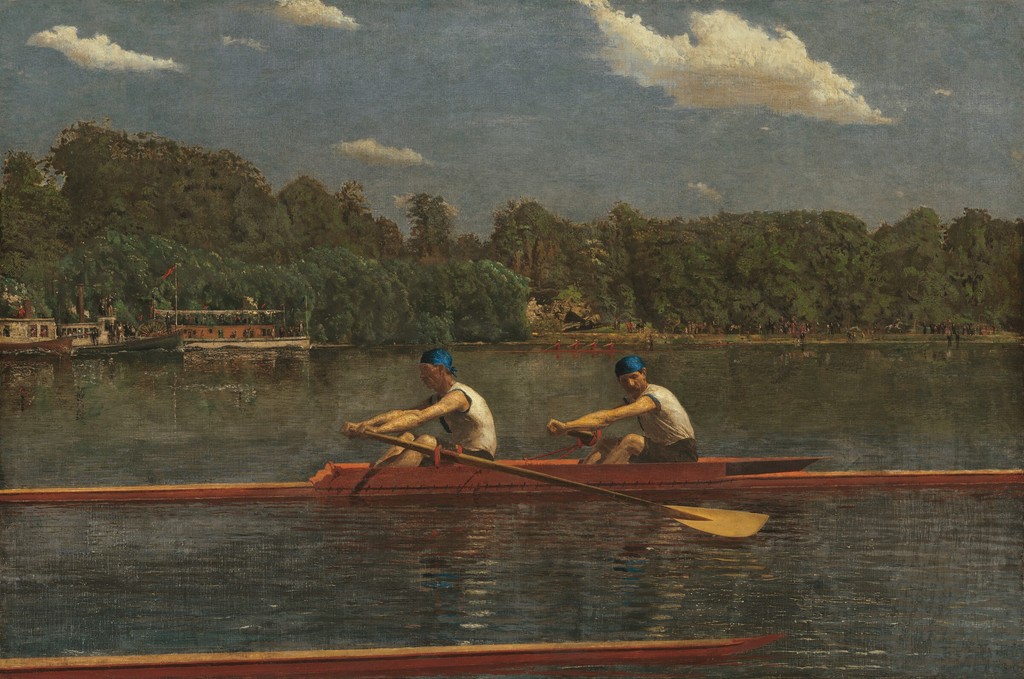
The Biglin Brothers Racing of 1872 demonstrates how much Eakins could alter the rowing subject within a year. The National Gallery identifies John and Bernard Biglin as professional oarsmen and relates its picture to a well-attended five-mile race held on the Schuylkill in May 1872.[11] In that later work, two athletes must coordinate with each other while boats and spectators establish an unmistakably public competition.
Max Schmitt distributes attention differently. One amateur athlete commands the near field, but the surrounding river remains spacious enough to register bridges, banks, reflections, and other users. His turned face creates an encounter that a tightly paired crew cannot offer. The comparison is not between inactivity and speed; both pictures depend on skilled movement. It is between two social forms of sport: individual command within a familiar landscape and professional teamwork before a crowd.
This distinction also affects Eakins’s pictorial problems. In the Schmitt painting, the oars spread out from one central body, and the broad water must sustain a long transition into distance. In the Biglin canvas, repeated bodies and matched equipment bring coordination closer to the picture plane. Looking from one to the other reveals an artist testing different relations among portraiture, movement, and public event rather than repeating a successful formula.
Why the Stillness Matters
The picture’s composure can tempt viewers to call it timeless or symbolic. Its documented circumstances point in another direction. This is a named Philadelphia amateur on a recognisable river, painted just after Eakins’s return and connected, cautiously, with a recent victory. Bridges, transport, sporting equipment, and other river users make the setting contemporary. Nothing requires the rower to stand for an abstract idea.
Stillness is better understood as a viewing condition Eakins created. A real stroke cycles onwards; a painted one remains available. Schmitt’s turn interrupts exertion just enough to let the athlete become a person, while the spread oars retain the demands of his activity. The river likewise holds movement in traces—smoke, small craft, ripples, and reflections—without becoming a spectacle.
Researched works directory
This searchable evidence census was assembled from public museum records and a reproducible Wikidata snapshot. It is not a catalogue raisonné, not a claim to complete oeuvre coverage, and not a substitute for the published catalogue literature, which was not used to claim absolute completeness.
| Name | Date | Medium |
|---|---|---|
| A Singer (Mrs. W.H. Bowden) | 1906 | Painting |
| A Singer: Portrait of Mrs. W.H. Bowden | 1906 | Painting |
| A Street Scene | Date unknown | Painting |
| A street scene in Sevilla | 1870 | Painting |
| A Street Scene in Seville | 1870 | Painting |
| African-American Man | 1884 | Photography |
| An Actress (Portrait of Suzanne Santje) | 1903 | Painting |
| Anna Lewis | 1890 | Painting |
| Annie C. Lochrey Husson (Mrs. Louis Husson) | 1905 | Painting |
| Antiquated Music (Portrait of Sarah Sagehorn Frishmuth) | 1900 | Painting |
| Arcadia | 1883 | Painting |
| Arcadia | Date unknown | Sculpture |
| Arcadia: Figure Study, Female Nude | 1883 | Painting |
| Arcadia Sketch | 1883 | Painting |
| Arcadian | Date unknown | Painting |
| Archbishop Diomede Falconio | 1905 | Painting |
| Archbishop James Frederick Wood | 1877 | Painting |
| Archbishop James Frederick Wood (1813-1883) | 1876 | Painting |
| Archbishop William Henry Elder | 1903 | Painting |
| Arthur B. Frost | 1886 | Painting |
| Artist and His Father Hunting Reed Birds: Marsh Landscape Sketch | 1873 | Painting |
| B.J. Blommers | 1904 | Painting |
| Baby at Play | 1876 | Painting |
| Baseball Players Practicing | 1875 | Artwork |
| Benjamin Eakins G38 | Date unknown | Painting |
| Bertrand Gardel (Sketch for The Chess Players) | 1875 | Painting |
| Between Rounds | 1898 | Painting |
| Billy Smith | 1898 | Painting |
| Billy Smith (Sketch for Between Rounds) | 1898 | Painting |
| Boy Reclining | 1883 | Painting |
| Carmelita Requena | 1869 | Painting |
| Charles Edmund Dana | 1902 | Painting |
| Charles Percival Buck | 1904 | Painting |
| Clara | 1890 | Painting |
| Courtship | 1878 | Painting |
| Cowboy Singing | 1892 | Painting |
| Cowboys in the Badlands | 1888 | Painting |
| Cowboys in the Badlands sketch 2 | 1888 | Painting |
| Delaware River Scene | 1881 | Painting |
| Delaware River Study | 1881 | Painting |
| Dr. Agnew (Dr. D. Hayes Agnew) (1818-1892) | 1889 | Painting |
| Dr. Agnew (Dr. D. Hayes Agnew) (1818–1892) | 1889 | Painting |
| Dr. Horatio C. Wood | 1886 | Painting |
| Dr. Thomas H. Fenton | 1916 | Painting |
| Drifting | 1875 | Painting |
| Eakins G184 | 1916 | Painting |
| Ecorché: Relief of a Horse (Josephine) | 1882 | Sculpture |
| Edward W. Redfield | 1905 | Painting |
| Fairman Rogers Four-in-Hand: Landscape Study of Fairmount Park | 1879 | Painting |
| Fairman Rogers Four-in-Hand: Study of a Horse's Leg | 1879 | Painting |
| Fairmount Park (Sketch for The Fairman Rogers Four-in-Hand) | Date unknown | Painting |
| Female Model | 1867 | Painting |
| Female Nude | 1884 | Painting |
| Female Nude from the Back | 1889 | Photography |
| Female Nude (Study) | 1881 | Painting |
| Fifty Years Ago (Young Girl Meditating): Study | 1877 | Painting |
| Figure Study: Masked Nude Woman | Date unknown | Painting |
| Figure Study: Nude Woman, Seated, with Arms Lowered (r) | Date unknown | Painting |
| Figure Study: Nude Woman, Seated, with Arms Raised | Date unknown | Painting |
| [Four Sketches: Seated Man, Sleeping Dog, Two Vases(?)] | Date unknown | Painting |
| Frances Eakins | 1870 | Painting |
| Francis J. Ziegler | 1890 | Painting |
| Frank Hamilton Cushing | 1895 | Painting |
| Frank Jay St. John | 1900 | Painting |
| General E. Burd Grubb (1841-1914) | 1898 | Painting |
| Girl with a Fan; Portrait of Miss Gutierrez | Date unknown | Painting |
| Harriet Husson Carville (Mrs. James G. Carville) | 1904 | Painting |
| Harrison S. Morris | 1896 | Painting |
| Hauling the Seine | 1882 | Painting |
| Head of a Man (Rutherford B. Hayes?) | 1877 | Painting |
| Hiawatha | 1874 | Painting |
| Hiawatha | Date unknown | Artwork |
| Home Ranch | 1892 | Painting |
| Home Scene | 1871 | Painting |
| Homespun | 1881 | Painting |
| In the Studio | 1884 | Painting |
| Interior of a Woodcarver's Shop (Sketch for William Rush Carving His Allegorical Figure of the Schuylkill River) | Date unknown | Painting |
| James MacAlister (Sketch) | 1895 | Painting |
| John Biglin in a Single Scull | 1873 | Painting |
| John Biglin in a Single Scull | 1874 | Painting |
| Joseph R. Woodwell | 1904 | Painting |
| Kathrin | 1872 | Painting |
| Knitting | 1881 | Sculpture |
| Knitting | 1882 | Sculpture |
| Knitting | Date unknown | Sculpture |
| Lafayette Park, Washington, D.C. | 1877 | Painting |
| Landscape | 1881 | Painting |
| Landscape | 1882 | Painting |
| Landscape Sketch | 1880 | Painting |
| Landscape (Sketch for Cowboys in the Bad Lands) | 1887 | Painting |
| Landscape Study: Cultivated Field and Tree | 1874 | Painting |
| Landscape Study: Shoreline with Trees | 1874 | Painting |
| Landscape with a Dog | 1874 | Painting |
| Letitia Wilson Jordan | 1888 | Painting |
| Louis Husson | 1899 | Painting |
| Major Manuel Waldteufel | 1907 | Painting |
| Masked nude standing | 1880 | Painting |
| Maud Cook (Mrs. Robert C. Reid) | 1895 | Painting |
| Mending the Net | 1881 | Painting |
| Mending the Net: Study of a Fisherman | Date unknown | Painting |
| Miss Alice Kurtz | 1903 | Painting |
| Miss Amelia Van Buren | 1891 | Painting |
| Miss Eleanor S. F. Pue | 1907 | Painting |
| Miss Gertrude Murray | 1895 | Painting |
| Monsignor James P. Turner | 1906 | Painting |
| Mother (Annie Williams Gandy) | 1903 | Painting |
| Mrs. Gilbert L. Parker | 1910 | Painting |
| Mrs. Mary Arthur | 1900 | Painting |
| Music | 1904 | Painting |
| Nude man with beard | Date unknown | Painting |
| Nude Woman Standing | 1908 | Painting |
| Old Lady Sewing | 1879 | Painting |
| Portrait of a Little Girl | 1897 | Painting |
| Portrait of a Woman Reading | Date unknown | Painting |
| Portrait of Adam S. Bare | 1903 | Painting |
| Portrait of Alfred Reynolds | Date unknown | Painting |
| Portrait of Arthur Burdett Frost | 1886 | Painting |
| Portrait of Ashbury Wright Lee | 1905 | Painting |
| Portrait of Benjamin Eakins | 1894 | Painting |
| Portrait of Benjamin Eakins (Sketch for The Writing Master) | 1882 | Painting |
| Portrait of Blanche Hurlburt | 1885 | Painting |
| Portrait of Douglass Morgan Hall | 1889 | Painting |
| Portrait of Dr. Edward J. Nolan | 1900 | Painting |
| Portrait of Dr. Samuel D. Gross (The Gross Clinic) | 1875 | Painting |
| Portrait of Edward Taylor Snow | 1904 | Painting |
| Portrait of Elizabeth L. Burton | 1905 | Painting |
| Portrait of Florence Einstein | 1905 | Painting |
| Portrait of Henry O. Tanner | 1902 | Painting |
| Portrait of J. Harry Lewis | 1876 | Painting |
| Portrait of John B. Gest | 1905 | Painting |
| Portrait of Joshua Ballinger Lippincott | 1892 | Painting |
| Portrait of Leslie W. Miller | 1901 | Painting |
| Portrait of Lucy Lewis | 1896 | Painting |
| Portrait of Margaret Eakins in a Skating Costume | 1871 | Painting |
| Portrait of Mary Adeline Williams | 1899 | Painting |
| Portrait of Mary Adeline Williams | 1900 | Painting |
| Portrait of Mrs. Fairman Rogers (Study for The Fairman Rogers Four-in-Hand) | 1879 | Painting |
| Portrait of Mrs. Frank Hamilton Cushing | 1895 | Painting |
| Portrait of Mrs. James Mapes Dodge (Josephine Kern) | 1896 | Painting |
| Portrait of Professor Benjamin H. Rand | 1874 | Painting |
| Portrait of Professor W. D. Marks | 1886 | Painting |
| Portrait of Rear Admiral George Wallace Melville | 1904 | Painting |
| Portrait of Walter S. Macdowell | 1904 | Painting |
| Porträt des Alfred Bryan Wall | 1904 | Painting |
| Porträt des David Wilson Jordan | Date unknown | Painting |
| Porträt des John McLure Hamilton (1853- 1936) | 1895 | Painting |
| Professionals at Rehearsal | 1883 | Painting |
| Professor William D Marks | 1886 | Painting |
| Professor William Woolsey Johnson | 1896 | Painting |
| Pushing for Rail | 1874 | Painting |
| Rail Shooting on the Delaware | 1876 | Painting |
| Rear Admiral Charles Dwight Sigsbee G388-2 | 1903 | Painting |
| Rear Admiral George W. Melville | 1905 | Painting |
| Reclining Male Nude | 1887 | Photography |
| Reclining Nude | Date unknown | Painting |
| Retrospection | 1880 | Painting |
| Riter Fitzgerald | 1895 | Painting |
| Robert M. Lindsay | 1900 | Painting |
| Ruth (Ruth W. Harding) | 1903 | Painting |
| Saddle (Sketch for Cowboys in the Bad Lands) | 1887 | Painting |
| Sailboats Racing on the Delaware | 1874 | Painting |
| Sailboats Racing: Study of the Delaware River | 1874 | Painting |
| Sailing | 1875 | Painting |
| Salutat | 1898 | Painting |
| Seated Figures | 1886 | Painting |
| Self-portrait | 1902 | Painting |
| Seventy Years Ago | 1877 | Painting |
| Shad Fishing at Gloucester on the Delaware: Delaware River and Gloucester Pier | 1881 | Painting |
| Shad Fishing at Gloucester on the Delaware River | 1881 | Painting |
| Shad Fishing at Gloucester on the Delaware River: Study of a Woman's Head | 1881 | Painting |
| Ships and Sailboats on the Delaware | 1874 | Painting |
| Ships and Sailboats on the Delaware: Study | 1874 | Painting |
| Shoreline of the Delaware River, with Fishing Nets | Date unknown | Painting |
| Signora Gomez d'Arza | 1901 | Painting |
| Singing a Pathetic Song | 1881 | Painting |
| Sketch for Cowboys in the Bad Lands | 1887 | Painting |
| Sketch for Music (The Violinist) | 1904 | Painting |
| Sketch for Portrait of Dr. Jacob Mendez da Costa | 1893 | Painting |
| Sketch for Portrait of Leslie W. Miller | 1901 | Painting |
| Sketch for Portrait of Letitia Wilson Jordan | 1888 | Painting |
| Sketch for Portrait of Monsignor James P. Turner | 1906 | Painting |
| Sketch for Portrait of Mother Patricia Waldron | 1903 | Painting |
| Sketch for Portrait of Professor George F. Barker | 1886 | Painting |
| Sketch for Seventy Years Ago | Date unknown | Painting |
| Sketch for The Concert Singer | 1892 | Painting |
| Sketch for The Fairman Rogers Four-in-Hand | 1879 | Painting |
| Sketch for The Gross Clinic | 1875 | Painting |
| Sketch for the Surrender of General Lee to General Grant at Appomatox | Date unknown | Painting |
| Sketch for William Rush and His Model | 1908 | Painting |
| Sketch of a Landscape | 1882 | Painting |
| Sketch of a Man and Study of Drapery | 1882 | Painting |
| Sketch of Harry | 1892 | Painting |
| Sketch of Max Schmitt in a Single Scull | 1874 | Painting |
| Sketches for “Home-Spun”, (recto and verso) | 1881 | Painting |
| Sketches (Four on one panel) | Date unknown | Painting |
| Spinning | 1881 | Painting |
| Spinning | 1882 | Sculpture |
| Spinning: Sketch | 1881 | Painting |
| Starting Out After Rail | 1863 | Painting |
| Starting Out After Rail | 1874 | Painting |
| Study for Arcadia: Youth Playing Pipes | 1883 | Painting |
| Study for "Cowboys in the Badlands | 1887 | Painting |
| Study for "Negro Boy Dancing": The Banjo Player | Date unknown | Painting |
| Study for "Negro Boy Dancing": The Boy | Date unknown | Painting |
| Study for Portrait of John McClure Hamilton | 1895 | Painting |
| Study for Salutat | 1898 | Painting |
| Study for 'The Meadows, Gloucester' | 1882 | Painting |
| Study for "William Rush Carving His Allegorical Figure of the Schuylkill River | 1876 | Painting |
| Study of a Groom | 1879 | Painting |
| Study of a Nude Man | 1869 | Painting |
| Study of a Nude Man (The Strong Man) | 1869 | Painting |
| Study of a Seated Nude Woman Wearing a Mask | 1863 | Drawing |
| Study of a Young Woman | 1868 | Painting |
| Study of Dr Samuel David Gross | 1875 | Painting |
| Study of Horse for The Fairman Rogers Four-in-Hand | 1879 | Painting |
| Swimming | 1885 | Painting |
| Taking the Count | 1898 | Painting |
| Taking the Count, study | 1898 | Painting |
| Taking Up Net | 1881 | Painting |
| Talcott Williams | 1889 | Painting |
| That's a New Game Down in Frisco": Study for the Central Standing Figure | 1878 | Painting |
| The Agnew Clinic | 1889 | Painting |
| The Art Student (James Wright) | 1890 | Painting |
| The Artist's Wife and His Setter Dog | 1884 | Painting |
| The Biglin Brothers Racing | 1872 | Painting |
| The Biglin Brothers Turning the Stake | 1873 | Painting |
| The Black Fan (Portrait of Mrs. Talcott Williams) | 1891 | Painting |
| The Bohemian (Portrait of Franklin Louis Schenck) | 1890 | Painting |
| The Brinton House | 1878 | Painting |
| The Cello Player | 1896 | Painting |
| The Champion Single Sculls (Max Schmitt in a Single Scull) | 1871 | Painting |
| The Chaperone | 1908 | Painting |
| The Chess Players | 1876 | Painting |
| The Concert Singer | 1890–1892 | Painting |
| The Courtship | 1878 | Painting |
| The Crucifixion | 1880 | Painting |
| The Dancing Lesson | 1878 | Painting |
| The Dean's Roll Call | 1899 | Painting |
| The Fairman Rogers Four-in-Hand | 1879 | Painting |
| The Fairman Rogers Four-In-Hand (A May Morning in... | 1899 | Painting |
| The Meadows, Gloucester | 1882 | Painting |
| The Model | 1908 | Painting |
| The Oarsmen (The Schreiber Brothers) | 1874 | Painting |
| The Oboe Player (Portrait of Dr. Benjamin Sharp) | 1903 | Painting |
| The Old-Fashioned Dress (Portrait of Helen Montanverde Parker) | 1908 | Painting |
| The Pair-Oared Shell | 1872 | Painting |
| The Pathetic Song | 1881 | Painting |
| The Pianist | 1896 | Painting |
| The Poleman in the Ma'sh | 1881 | Drawing |
| The Red Shawl | 1890 | Painting |
| The Spinner | 1876 | Painting |
| The Thinker: Portrait of Louis N. Kenton | 1900 | Painting |
| The Timer | 1879 | Painting |
| The Translator, Portrait of Monsignor Hugh T. Henry | 1902 | Painting |
| The Veteran (Portrait of George Reynolds) | Date unknown | Painting |
| The Writing Master | 1882 | Painting |
| The Young Man (Portrait of Kern Dodge) | 1898 | Painting |
| Thomas Eakins and John Laurie Wallace on a Beach | 1883 | Photography |
| Three Boys Wading in a Creek | 1883 | Photography |
| Trenton Battle Monument | 1893 | Sculpture |
| Two Pupils in Greek Dress | 1883 | Photography |
| Views of Harry | 1885 | Painting |
| Walt Whitman | 1887 | Painting |
| Whistling for Plover | 1874 | Painting |
| William H. Macdowell | 1884 | Photography |
| William H. Macdowell and Margaret Eakins in Saltville (or Clinch Mountain), Virginia | 1875 | Photography |
| William Hance Macdowell (1816-1906) | 1897 | Painting |
| William Rush and his Model | 1908 | Painting |
| William Rush and His Model | Date unknown | Painting |
| William Rush Carving His Allegorical Figure of the Schuylkill River | 1876 | Painting |
| William Rush Carving His Allegorical Figure of the Schuylkill River | 1908 | Painting |
| William Rush Carving His Allegorical Figure of the Schuylkill River, Study | 1876 | Painting |
| William Rush's Model | 1908 | Painting |
| Wrestlers | 1899 | Painting |
| Young Girl Meditating | 1877 | Painting |
Frequently Asked Questions
The Met uses The Champion Single Sculls (Max Schmitt in a Single Scull). The first phrase foregrounds sporting achievement; the parenthetical phrase identifies the rower and the type of boat. “Max Schmitt” is common as a short title, but the museum’s wording preserves both the public and personal dimensions of the work.[1]
Schmitt was Eakins’s school friend, an attorney, and a skilled amateur rower. The Met gives his dates as 1843–1900. An institutional study also records his later listing as single-scull champion of Philadelphia’s Schuylkill Navy, confirming that “champion” was more than a flattering invention by the painter.[1][7]
The Met says the work is believed to commemorate Schmitt’s victory in an important Schuylkill race in October 1870. That supports a commemorative reading, not certainty that Eakins depicted the contest itself or one verifiable second from it. The uncluttered foreground and Schmitt’s turn towards the viewer favour portrait encounter over race reportage.[1]
Yes. The Met identifies Eakins as the sculler in the middle distance. His smaller boat bears his name and the date 1871, making the self-depiction also function as an inscription. He shares Schmitt’s activity while yielding the foreground to his friend.[1][7]
It was the first major painting in Eakins’s rowing series and one of his first publicly exhibited works. It joins a named modern athlete to a carefully structured Philadelphia landscape, bringing European figure training and perspective to a local subject. The combination helped establish the terms of Eakins’s professional career.[1][4][7]
Discussion
Use this evidence-led guide as a starting point for close looking rather than a final verdict.
Share an observation about The Champion Single Sculls or a source that adds useful context.
Reader Insights
Which detail most changes your reading of The Champion Single Sculls?
How do scale, support, medium or present museum evidence shape the encounter?
What remains uncertain when visual inference is separated from documented fact?
Join the Conversation
Add your reading below, keeping observations specific and evidence clear.
References
- The Metropolitan Museum of Art, The Champion Single Sculls (Max Schmitt in a Single Scull), accessed 30 August 2026.
- The Metropolitan Museum of Art Open Access API, Object 10819, accessed 30 August 2026.
- National Gallery of Art, Thomas Eakins: The Rowing Pictures, accessed 30 August 2026.
- National Gallery of Art, Thomas Eakins: The Rowing Pictures press release, accessed 30 August 2026.
- The Metropolitan Museum of Art, Thomas Eakins: Exhibition Overview, accessed 30 August 2026.
- The Metropolitan Museum of Art, Thomas Eakins (1844–1916): Painting, accessed 30 August 2026.
- The Metropolitan Museum of Art, The Metropolitan Museum of Art Bulletin, March 1968, accessed 30 August 2026.
- The Metropolitan Museum of Art, Masterpieces of Painting in The Metropolitan Museum of Art, accessed 30 August 2026.
- USRowing, Disciplines, accessed 30 August 2026.
- British Rowing, British Rowing Technique, accessed 30 August 2026.
- National Gallery of Art, The Biglin Brothers Racing, accessed 30 August 2026.
More EAKINS Artworks
The Agnew Clinic image: gallery photograph by Miguel Hermoso Cuesta, cropped and perspective-corrected, under CC BY-SA 4.0.