

 by Tom Gurney
Tom Gurney BSc (Hons) is an art history expert with over 20 years experience
Published on June 19, 2020 / Updated on July 30, 2026
Email: tomgurney1@gmail.com / Phone: +44 7429 011000
Jean Wauquelin Presenting the Chroniques de Hainaut: Introduction
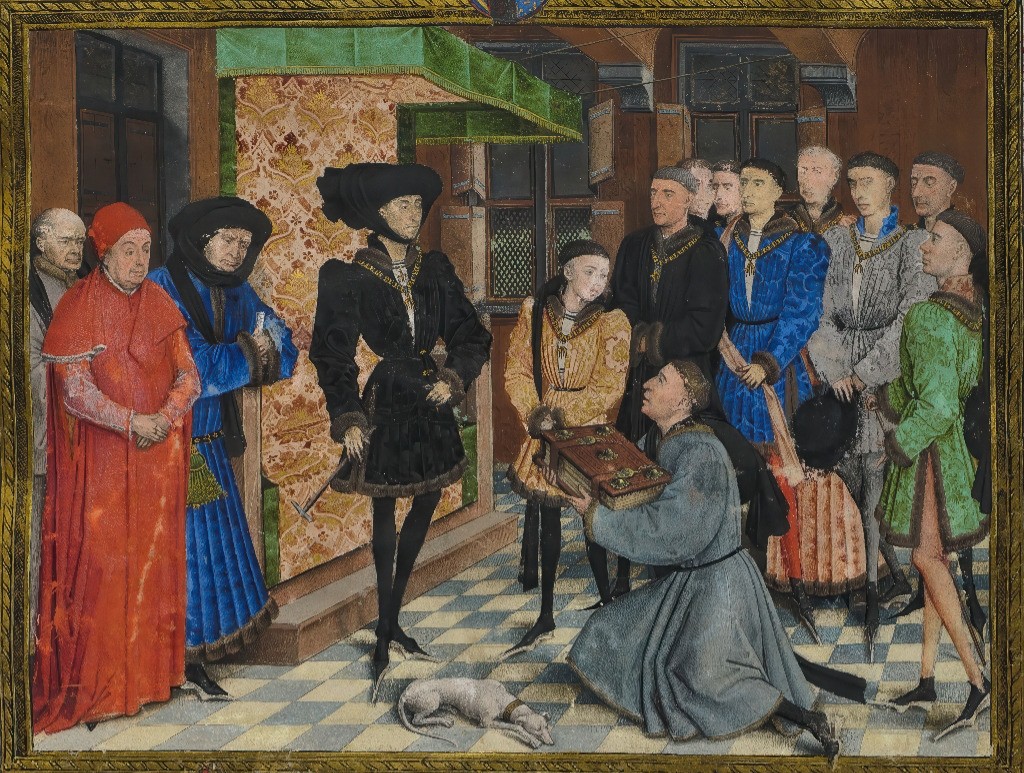
Jean Wauquelin Presenting the Chroniques de Hainaut to Philip the Good is one of the most important manuscript images connected with Rogier van der Weyden's name. The KBR record describes the miniature on folio 1r of MS 9242 as generally attributed to Rogier van der Weyden. [1]
The image is usually dated around 1447-1448 and belongs to a manuscript produced in the Southern Low Countries, around Mons and Brussels. [1] That regional setting makes it especially valuable for the Rogier cluster because it links the artist not only to panel painting, but also to Burgundian court culture and manuscript presentation.
At a Glance
- ArtistGenerally attributed to Rogier van der Weyden in the KBR record
- TitleJean Wauquelin Presenting the Chroniques de Hainaut to Philip the Good
- DateAround 1447-1448
- Shelfmark leadKBR MS 9242, fol. 1r
- Current locationKBR / Royal Library of Belgium, Brussels
- ManuscriptVolume I of Jean Wauquelin's French version of Jacques de Guise's chronicle
Contents
- Introduction
- At a Glance
- A Burgundian Presentation Scene
- KBR And Regional Authority
- Portraits At Court
- Rogier And Illumination
- Manuscript, Panel And Court
- Hainaut, Memory And Power
- Attribution And Design
- A Different Kind Of Court Image
- Why It Matters
- FAQs
A Burgundian Presentation Scene
The miniature shows Wauquelin presenting his French translation of the Chroniques de Hainaut to Philip the Good. Philip's son Charles, later Charles the Bold, appears nearby, and the courtly group includes important Burgundian figures. [1] [2]
The image is therefore more than a book illustration. It is a staged act of political memory.
A presentation miniature is not just a picture of someone handing over a book. It visualizes a relationship between author, translator, patron, court and territory. In this case, the book helps frame Hainaut within Burgundian ambition, while the miniature makes Philip's authority visible in a carefully ordered court interior.
The scene also helps explain the power of books at court. A chronicle could support dynastic identity, regional history and political legitimacy. The act of presenting the book becomes a ceremony of knowledge and power.
KBR And Regional Authority
KBR is a crucial source for this page because it keeps the object close to the world that produced it. The record identifies the manuscript as MS 9242, volume I of Jean Wauquelin's French translation or copy of Jacques de Guise's chronicle, made in the Southern Low Countries around 1447-1448. It gives the support as parchment, records the manuscript's dimensions, and notes that the manuscript contains 41 miniatures. [1]
Those details make the page stronger than a generic discussion of a famous image. The manuscript is a physical object: parchment, folios, miniatures, a shelfmark and a collection history. Rogier's possible role belongs inside that material context.
The regional source also adds authenticity. Rogier's art is often encountered today in Madrid, London, Washington, New York and Berlin. This page brings the cluster back to Brussels and the Burgundian-Netherlandish world of manuscripts, patrons and court ceremony.
Portraits At Court
The figures in the miniature are often discussed as portraits or portrait-like court images. Philip the Good, Charles the Bold, Nicolas Rolin, Jean Chevrot and members of the Order of the Golden Fleece all help place the image within Burgundian power culture. [1] [2]
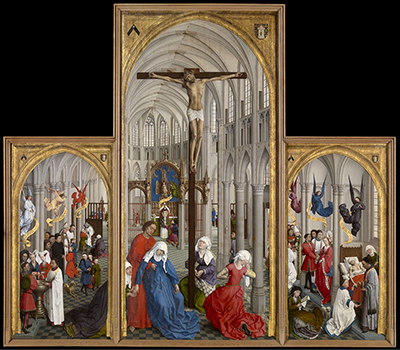
The court figures also make this a useful page for explaining Rogier's network. Rolin appears in the orbit of the Beaune Altarpiece. Chevrot is connected with the Seven Sacraments Altarpiece. Philip the Good anchors the Burgundian court.
This network matters because Rogier's art was not made in isolation. It moved through civic, courtly and devotional environments. The miniature gives readers a way to see the same world from the side of manuscript culture.
Rogier And Illumination
Rogier is known primarily as a panel painter, but the guild and workshop environment of Tournai and Brussels did not separate media as sharply as modern museum categories do. The Chroniques de Hainaut miniature is usually discussed in relation to Rogier, but the safest wording keeps the workshop and design question visible. It may be by Rogier himself, by his workshop, or made from his design. [1] [5]
That caution does not weaken the page. It makes it more useful. The miniature lets readers think about invention, design, workshop translation and the relationship between panel painting and manuscript illumination.
It also broadens Rogier's reputation. He was not only a maker of devotional panels. His name is connected with a courtly manuscript image that stages political authority, book culture and portrait-like presence.
Manuscript, Panel And Court
The page should be read beside the biography, workshop-and-influence page and the Beaune Altarpiece. Together they show Rogier moving through civic, devotional and courtly worlds.
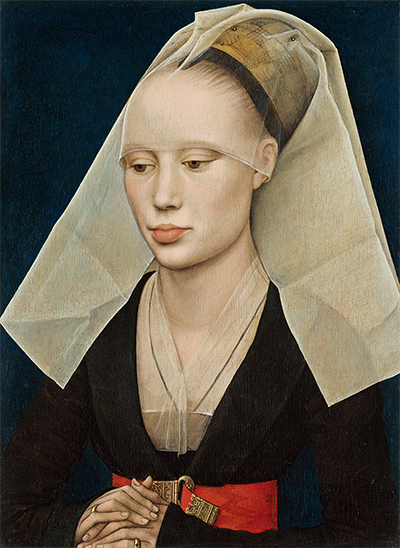
The Chroniques de Hainaut miniature also belongs with the portrait pages. It is not a single portrait, but it uses recognisable court figures to build authority. That makes it a useful comparison with Portrait of Philippe de Croy and Portrait of Francesco d'Este, where elite identity is concentrated in individual sitters.
The difference is format. A portrait panel isolates a person. A presentation miniature stages a social order. Rogier's possible involvement in both kinds of image helps explain his importance to Burgundian visual culture.
Hainaut, Memory And Power
The subject of the manuscript matters. A chronicle of Hainaut was not neutral decoration at the Burgundian court. It helped organise regional history in a form useful to rulers, courtiers and readers. Presenting the book to Philip the Good becomes a symbolic act: local history enters ducal possession and courtly memory.
That makes the miniature a powerful companion to Rogier's panel paintings for elite patrons. The Beaune Altarpiece joins charity, judgement and donor memory. The Seven Sacraments Altarpiece links theology, ritual and high-ranking patronage. The Chroniques de Hainaut miniature links book culture, territorial memory and ducal authority.
The page therefore helps readers see that Rogier's world was not divided neatly into art and politics. Devotional images, portraits, chronicles and court ceremony all helped shape how power was seen.
Attribution And Design
The safest discussion keeps several possibilities open. The miniature may be by Rogier, by a member of his workshop, or after a design associated with him. [1] [5] Each option has a different meaning.
If by Rogier, it broadens his direct practice into manuscript illumination. If by a workshop hand, it shows how his visual language could be translated into another medium. If after his design, it reveals his importance as an inventor whose ideas could structure images beyond panel painting.
In all cases, the image belongs in the cluster because it shows the reach of Rogier's name inside Burgundian visual culture. The point is not to force certainty, but to explain why the KBR attribution matters.
A Different Kind Of Court Image
The miniature also helps distinguish different kinds of court imagery. Portrait of Philippe de Croy and Portrait of Francesco d'Este focus on individual sitters. The Chroniques de Hainaut miniature focuses on presentation, hierarchy and ceremony.
That difference matters. Rogier's world included private devotion, public altarpieces, civic commissions and courtly images. A presentation miniature shows court culture as an event: people gathered, a book displayed, a ruler receiving history.
It also gives the cluster a different visual rhythm. Instead of a single saint, sitter or sacred episode, the reader encounters a whole courtly group. The page therefore expands the range of what "Rogier's world" can mean.
Why It Matters
This page matters because it broadens the cluster beyond panel painting. It connects Rogier's name with Burgundian manuscript culture, court presentation, Brussels collections and the difficult boundary between autograph work, workshop practice and design.
It also gives the cluster one of its strongest regional institutional anchors. KBR's record places the manuscript in the Southern Low Countries and identifies the miniature's general attribution to Rogier. That makes the page a valuable bridge between local history, courtly ceremony and art-historical caution.
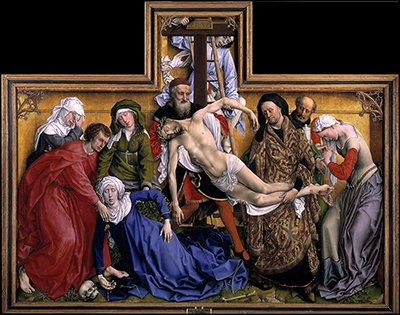
For readers who know Rogier mainly through the Descent from the Cross, this manuscript page changes the scale of the artist's world. It shows that the same name can lead from painted grief to courtly books, from chapel imagery to ducal ceremony, and from individual devotion to political memory.
FAQs
It is in the Royal Library of Belgium / KBR in Brussels, in MS 9242, folio 1r. [1]
Jean Wauquelin presents the book to Philip the Good, with Charles the Bold and other Burgundian court figures nearby. [1] [2]
The KBR record says the miniature is generally attributed to Rogier van der Weyden. The page should keep that wording cautious rather than presenting the attribution as beyond question. [1]
It connects Rogier with Burgundian manuscript culture, court presentation and the visual politics of Philip the Good's world.
Discussion
How should this presentation miniature be used in the Rogier cluster: as court culture, manuscript context, workshop attribution, or Burgundian image-making?
Reader Insights
The image opens a route into Burgundian ceremony and literary patronage, even where Rogier's personal role needs careful wording.
Manuscript and panel painting should not be collapsed into one story, but comparing them helps readers understand courtly visual habits.
This page is a good reminder that the cluster must distinguish documented works, attributed works and broader visual context.
Join the Conversation
Have a thought or observation about Jean Wauquelin Presenting the Chroniques de Hainaut? Share it below. Thoughtful responses may be added to this section as the Rogier van der Weyden cluster develops.
References
- KBR OPAC, Chroniques de Hainaut, vol. I, ms. 9242, accessed 2026-07-11. https://opac.kbr.be/Library/doc/SYRACUSE/16995140/chroniques-de-hainaut-vol-i-ms-9242
- Wikipedia, Jean Wauquelin presenting his Chroniques de Hainaut to Philip the Good, KBR MS 9242, accessed 2026-07-11. https://en.wikipedia.org/wiki/Jean_Wauquelin_presenting_his_%27Chroniques_de_Hainaut%27_to_Philip_the_Good
- Wikipedia (French), Chroniques de Hainaut, accessed 2026-07-11. https://fr.wikipedia.org/wiki/Chroniques_de_Hainaut
- KBR museum / Royal Library of Belgium context page, accessed 2026-07-11. https://www.kbr.be/
- Lorne Campbell, "Rogier van der Weyden and Manuscript Illumination," in Flemish Manuscript Painting in Context, Getty Publications, 2006/2007.