

 by Tom Gurney
Tom Gurney BSc (Hons) is an art history expert with over 20 years experience
Published on June 19, 2020 / Updated on July 30, 2026
Email: tomgurney1@gmail.com / Phone: +44 7429 011000
Saint Columba Altarpiece by Rogier van der Weyden: Introduction
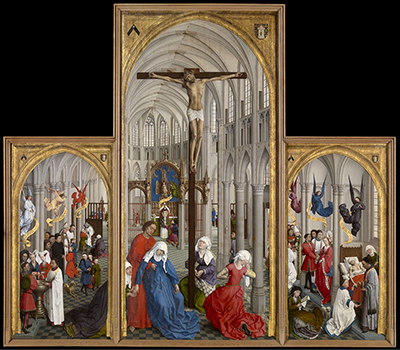
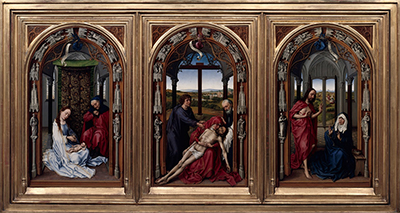
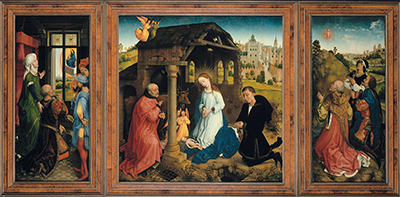
Rogier van der Weyden's Saint Columba Altarpiece is one of the great late triptychs of Early Netherlandish painting. Now in the Alte Pinakothek, Munich, it brings together three scenes from the early life of Christ: the Annunciation, the Adoration of the Kings and the Presentation in the Temple. The panels combine courtly richness, precise detail, religious symbolism and architectural imagination, all held together by Rogier's grave, controlled figure style. [1] [2] [3]
The Pinakothek records the left panel as Columba-Altar: Verkuendigung, the central panel as Columba-Altar: Anbetung der Koenige and the right panel as Columba-Altar: Darbringung im Tempel. All three are dated around 1455, attributed to Rogier van der Weyden, painted on oak and released on the museum site with CC BY-SA 4.0 image terms. [1] [2] [3]
This is also a geographically important page. The altarpiece takes its name from the Marian chapel of St Columba in Cologne, where the retable originally stood.
At a Glance
- ArtistRogier van der Weyden
- TitleSaint Columba Altarpiece / Columba-Altar
- DateAround 1455
- Medium/supportOak panel
- Current locationAlte Pinakothek, Munich / Bayerische Staatsgemaeldesammlungen
- Left panelAnnunciation, WAF 1190, 139.4 x 72.9 cm
- Centre panelAdoration of the Kings, WAF 1189, 139.5 x 152.9 cm
- Right panelPresentation in the Temple, WAF 1191, 139.2 x 72.5 cm
- Original settingMarian chapel of St Columba, Cologne
- Key themesNativity cycle, Marian devotion, Cologne patronage, triptych design, typology, courtly splendour, architectural space
Contents
- Introduction
- At a Glance
- The Three Panels
- Annotated Details
- The Annunciation Panel
- The Adoration of the Kings
- The Presentation in the Temple
- Cologne, St Columba and Patronage
- Courtly Splendour and Religious Symbolism
- Rogier's Late Triptych Design
- How to Look at the Altarpiece
- Why It Matters
- Frequently Asked Questions
The Three Panels
The triptych reads from left to right as a sequence of sacred revelation. On the left, the Annunciation marks the moment when the angel Gabriel announces to the Virgin Mary that she will bear Christ. At the centre, the Adoration of the Kings shows Christ revealed to the Magi. On the right, the Presentation in the Temple places the child within Jewish ritual and prophetic recognition.
This structure gives the altarpiece a clear devotional rhythm. It moves from promise to recognition to offering. The three scenes are separate, but they are not isolated. Rogier uses architecture, scale, colour and figure placement to make the panels feel like parts of one unfolding meditation on the Incarnation.
The Pinakothek summary stresses courtly splendour, detailed realism, religious symbolism and typological allusions. It also notes the deep seriousness of Rogier's figures and his careful handling of human faces. [1] [2] [3] Those phrases are useful because they name the special balance of the altarpiece: luxurious surface and disciplined feeling.
The triptych is not three independent pictures merely placed beside one another. Its power comes from the way the panels cooperate. Each scene gives a different kind of access to Christ's early life, and each places sacred history inside an architectural world that feels both believable and symbolic.
Annotated Details from the Saint Columba Altarpiece
These numbered details read the triptych panel by panel, following Rogier's sequence from the private Annunciation to the public homage of the Magi and the ritual Presentation in the Temple. The three views preserve the scale and shape of each panel while still treating the altarpiece as one devotional argument. [1] [2] [3]
Left Panel: The Annunciation
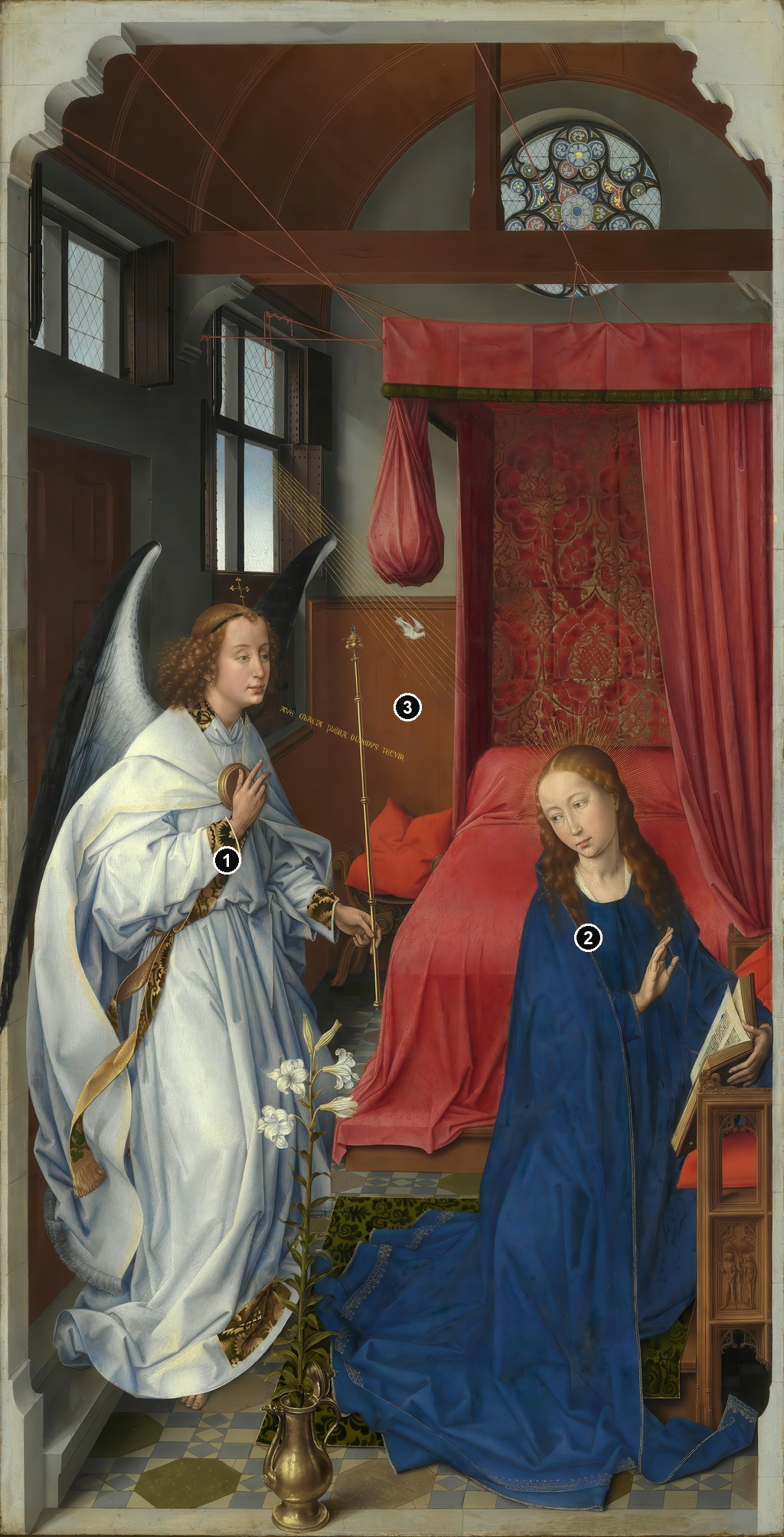
The left wing turns the Annunciation into an intimate fifteenth-century interior, where Gabriel's message enters a chamber filled with furniture, fabric, light and devotional signs.
Centre Panel: The Adoration of the Kings
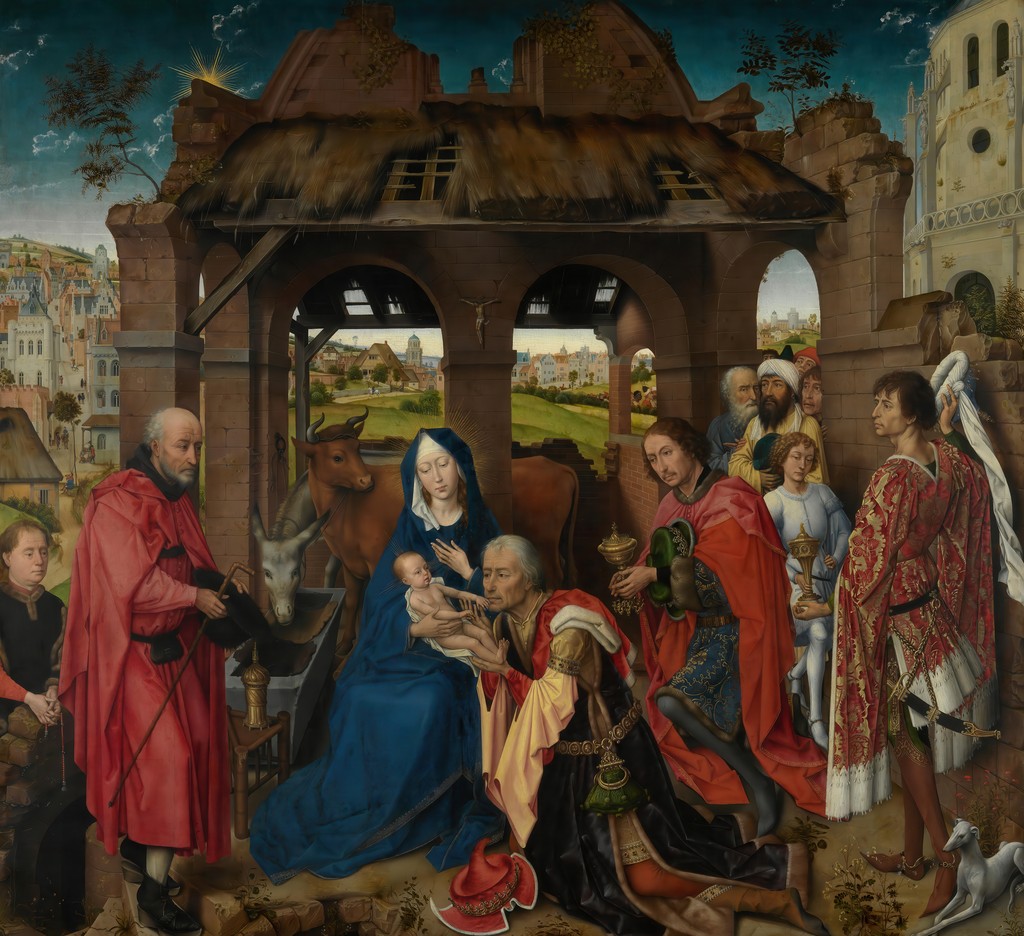
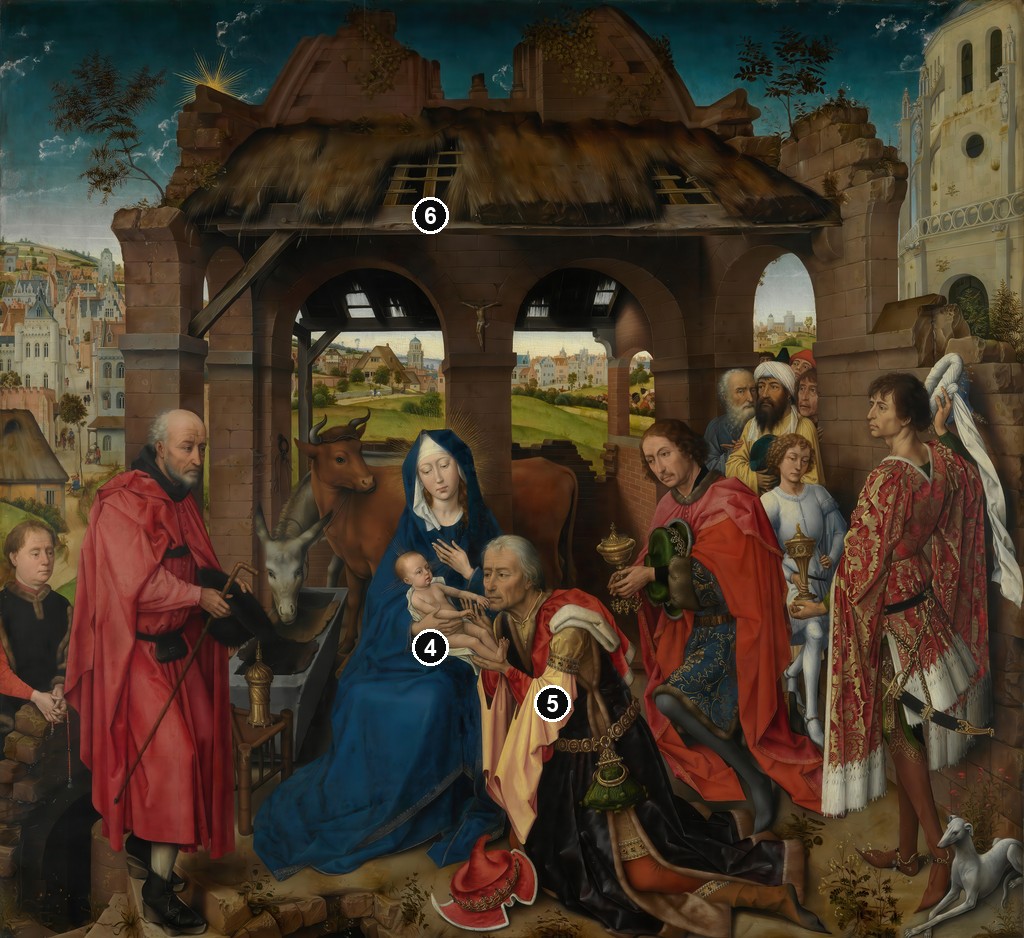
The central panel gives the triptych its ceremonial heart, arranging rich costumes, gifts, ruins and distant landscape around the Christ Child.
Right Panel: The Presentation in the Temple
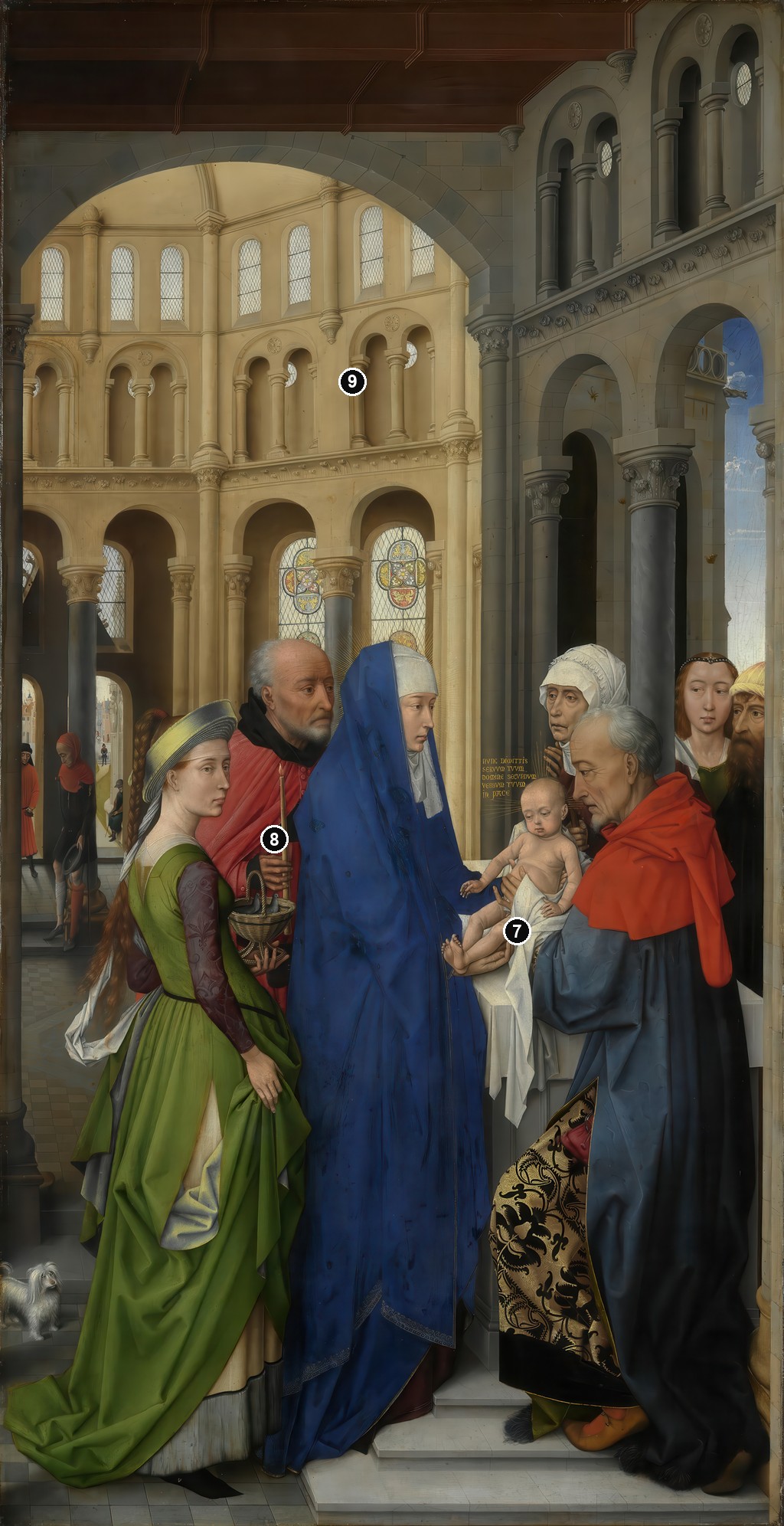
The right wing shifts the story into a temple interior, where ritual, prophecy and architecture give the altarpiece its solemn conclusion.
Details from SAINT COLUMBA ALTARPIECE
Close looking reveals how domestic space, courtly splendour and temple architecture work together across the triptych.
Left Panel: The Annunciation
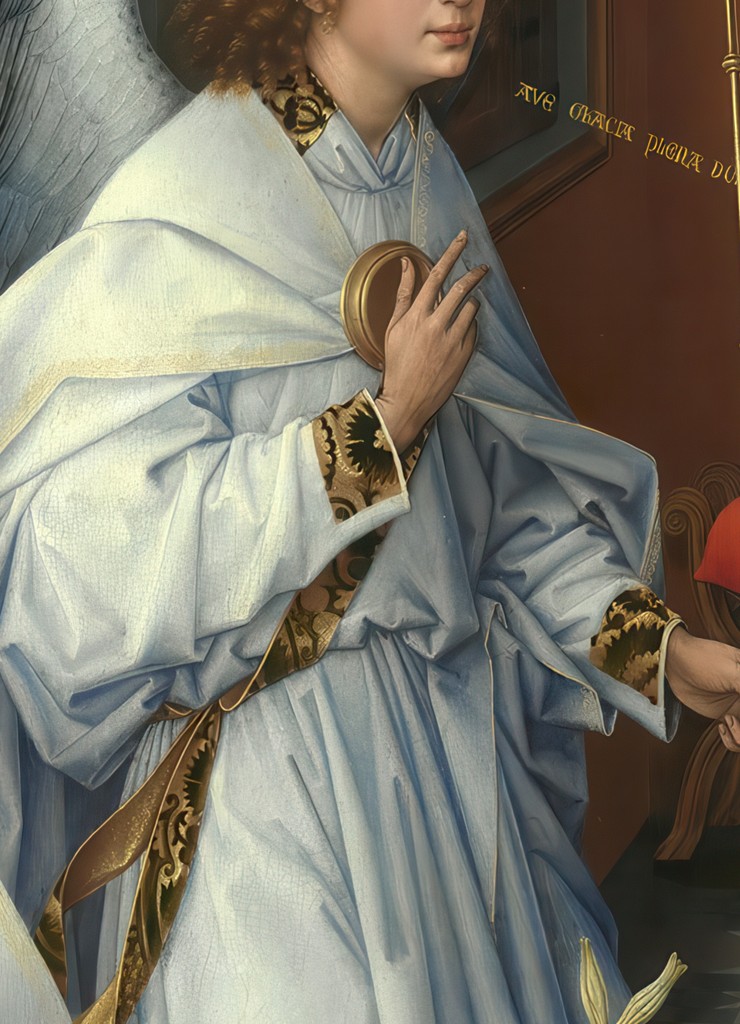
Gabriel enters the chamber
Gabriel's white robe, dark wing and gold staff make the angel both courtly and supernatural. His controlled gesture sets the tone for the whole triptych.
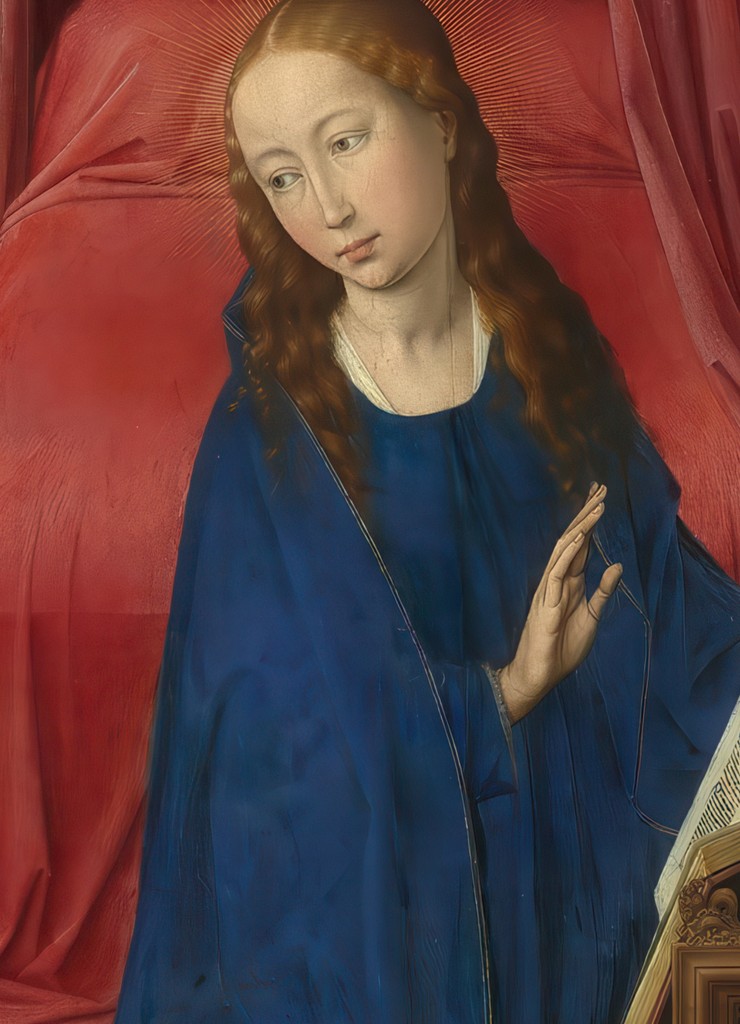
Mary at her book
The Virgin turns from reading toward the angel. Rogier makes reception and inward attention visible through posture, lowered gaze and the opened book.
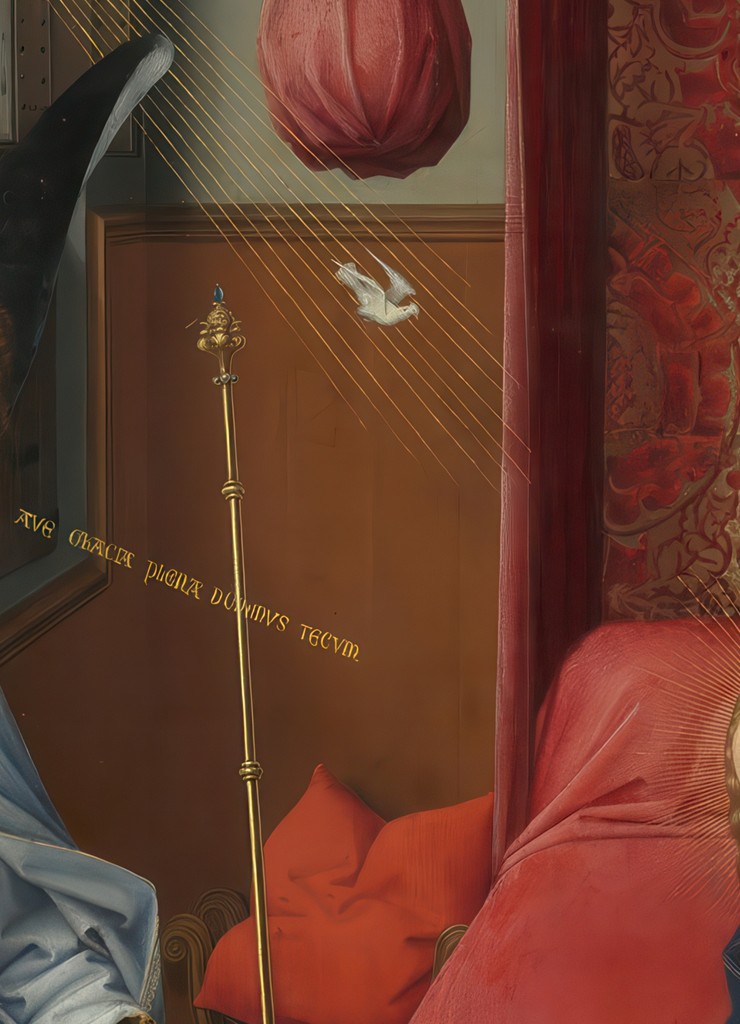
Light, dove and bedchamber
The descending rays, dove, staff and red bed translate Incarnation symbolism into a domestic space that feels materially precise. [1]
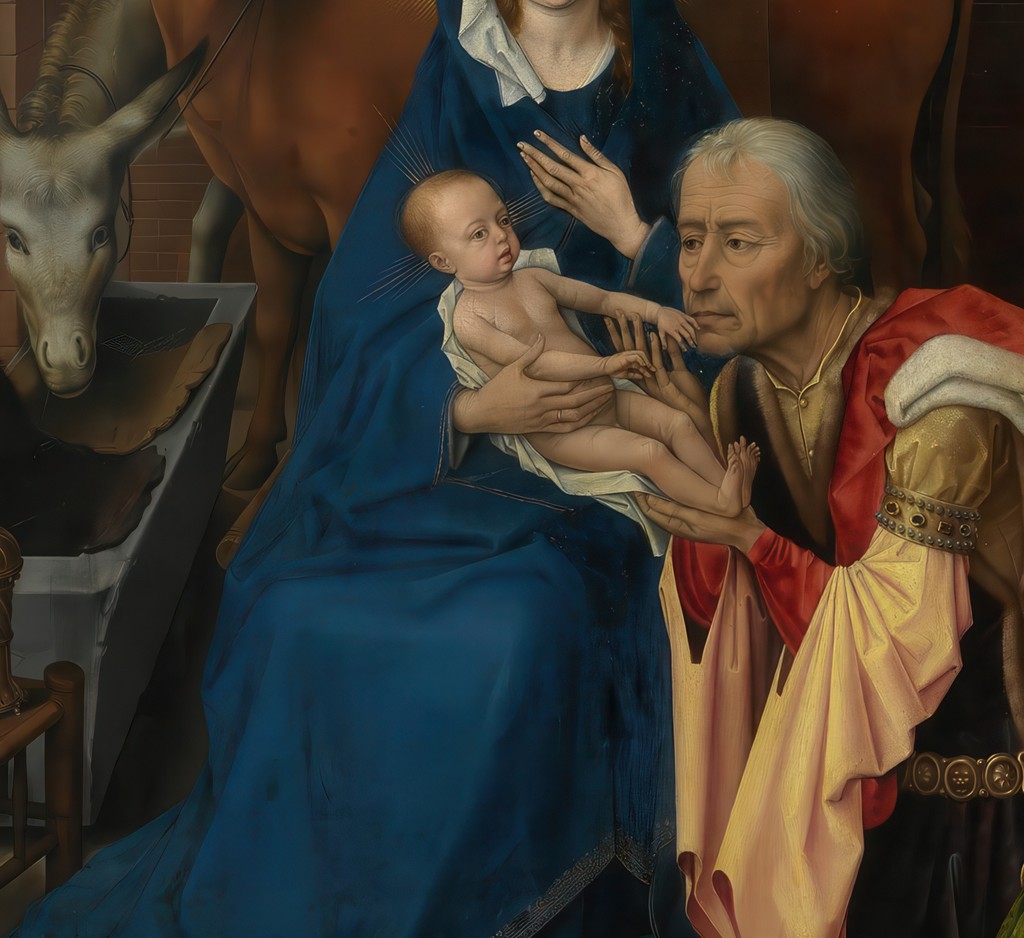
Centre Panel: The Adoration of the Kings
Virgin and Child at the centre
Mary's blue mantle and the exposed Christ Child form the devotional centre of the crowded scene, drawing courtly display into an act of recognition.
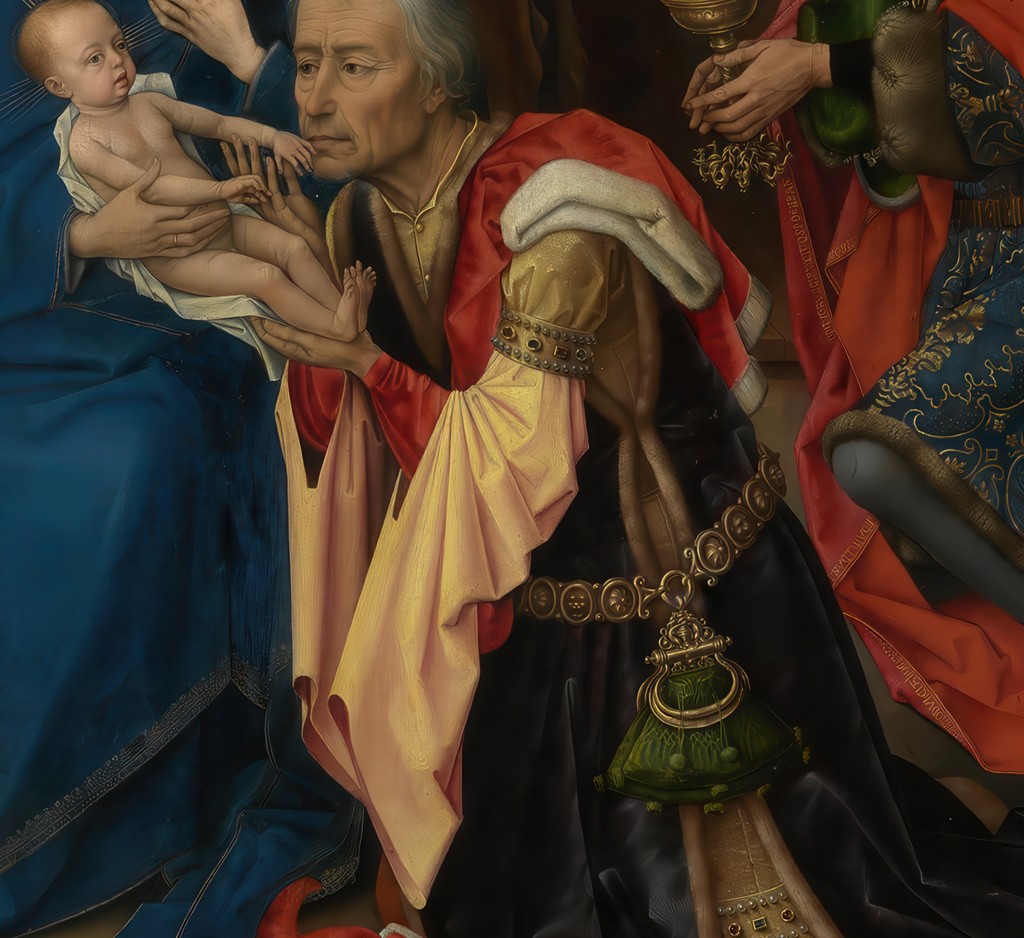
The kneeling king and gift
The eldest king kneels low before the child, turning worldly rank into humility. His hands and gift focus the panel's theme of homage.
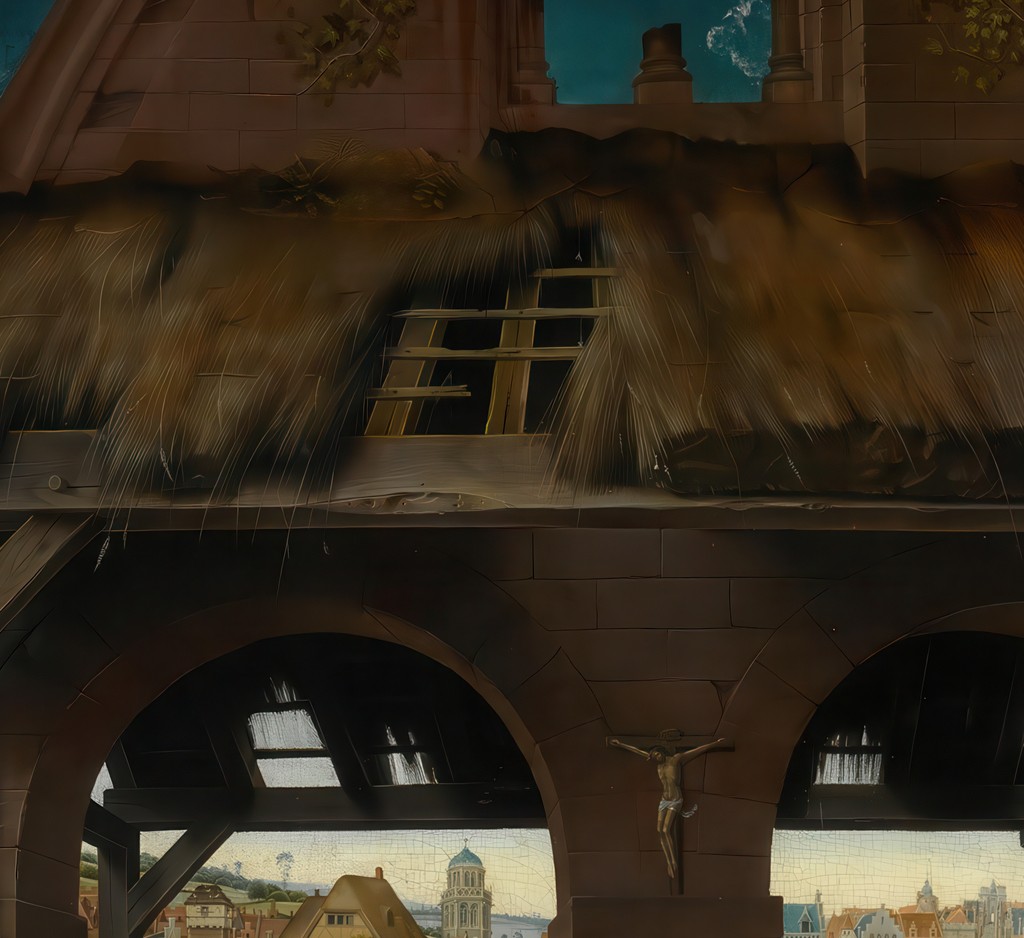
Ruined stable and town views
Broken masonry, thatch, small windows and glimpsed town views widen the scene beyond the figures, joining typological symbolism to Rogier's precise landscape imagination.
Right Panel: The Presentation in the Temple
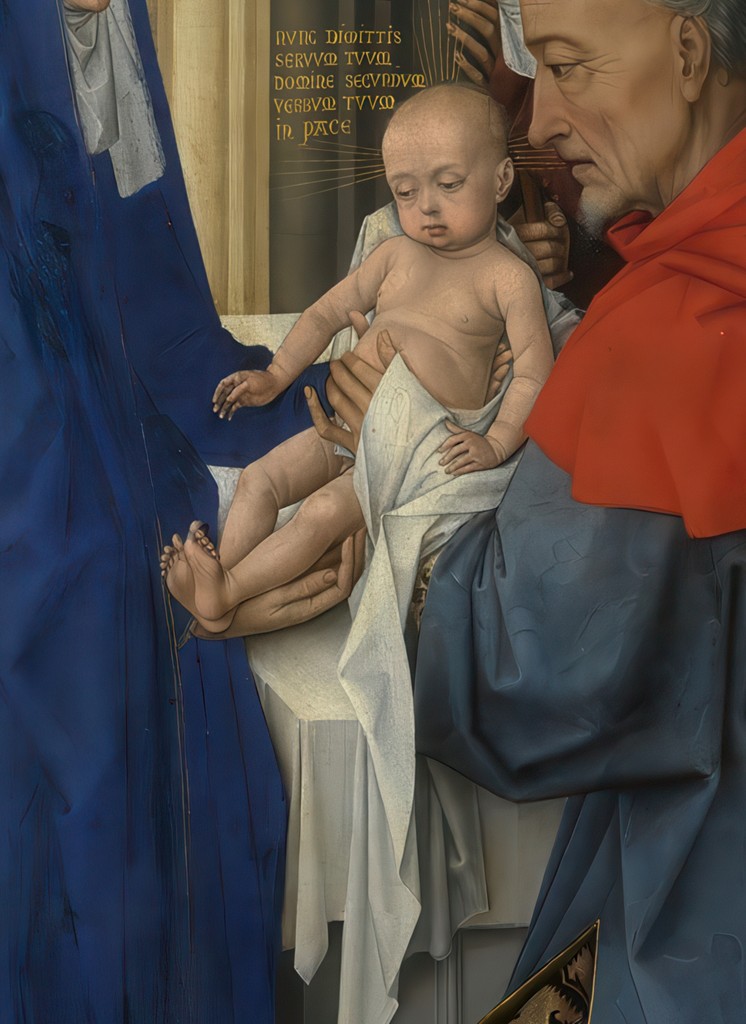
Simeon receives Christ
Simeon's bent head and covered hands make the Presentation both tender and ceremonial, placing the infant within a ritual act of recognition.
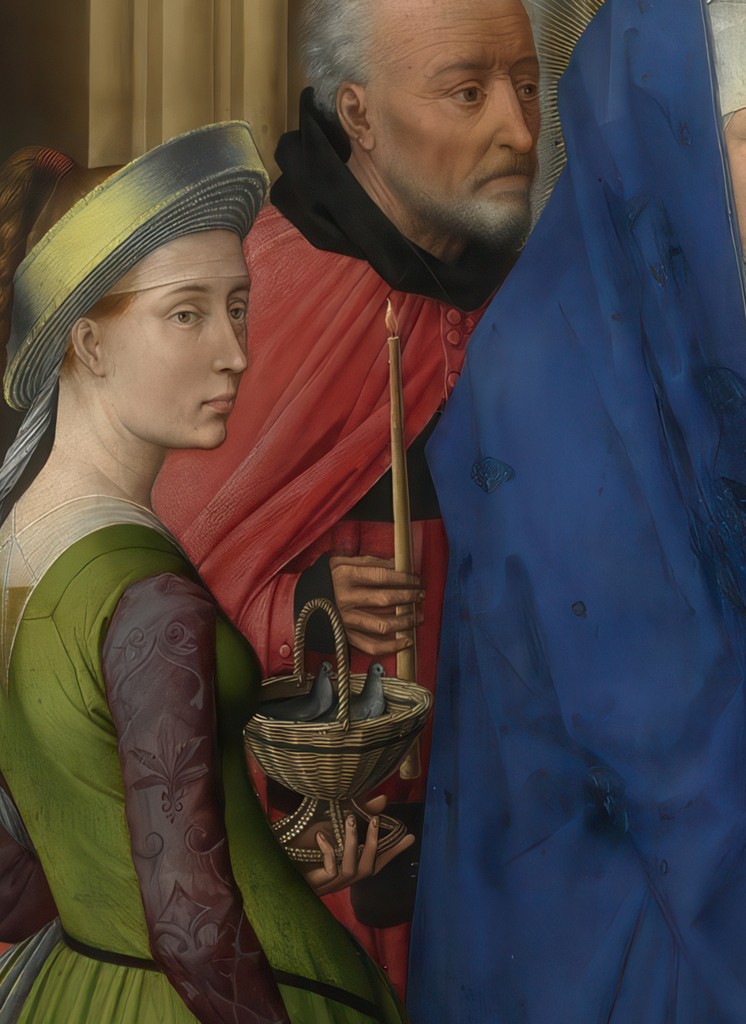
Offering basket and family group
Joseph's red robe, Mary's blue mantle and the basket of birds gather family, offering and law into one tightly observed group.
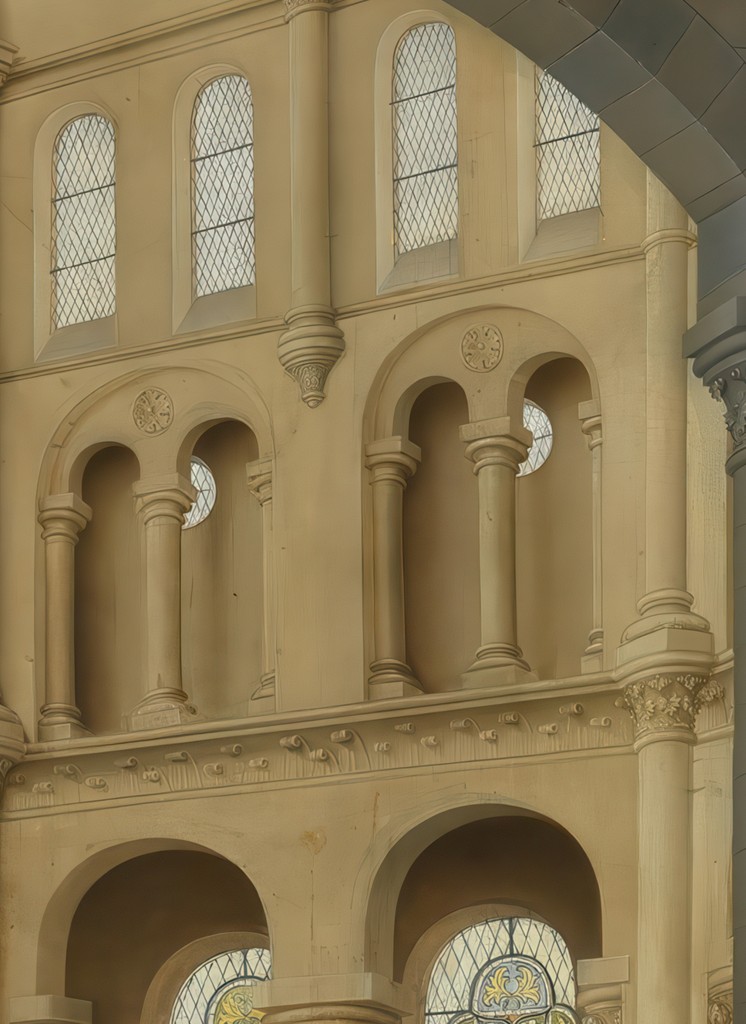
Temple architecture and sacred order
The high arches, columns and windows make the temple more than a setting. Architecture structures the sacred episode and links this panel back to the central scene.
The Annunciation Panel
The Annunciation panel, inventory WAF 1190, measures 139.4 x 72.9 cm and is recorded by the Pinakothek as oak panel, around 1455. [1] The scene is set in an interior that the museum describes as offering a view into a bourgeois bedroom, like one that might be found in the houses visible in the background. [1]
That domestic setting is important. Rogier does not place the Annunciation in an abstract heavenly zone. He translates the event into a recognisable fifteenth-century room. The sacred message enters an ordered interior of beds, walls, furniture and surfaces.
The domestic space also helps the viewer understand the humility of the event. The Incarnation begins not with spectacle but with a message received in an intimate room. Rogier's figures carry the seriousness that the Pinakothek identifies as characteristic of his art, while the setting grounds the scene in the material world.
The Adoration of the Kings
The central panel, inventory WAF 1189, measures 139.5 x 152.9 cm and is the largest part of the triptych. [2] Its position is appropriate: the Adoration of the Kings is the public, ceremonial heart of the altarpiece.
The subject allows Rogier to display courtly splendour without losing devotional gravity. The Magi bring gifts, rich garments, processional dignity and worldly magnificence to the Christ Child. Yet the scene is not simply a parade of luxury. The richness is directed toward recognition. Kings and attendants bend before the infant, and worldly power acknowledges sacred authority.
It carries the widest scene and can introduce readers quickly to the altarpiece's scale, colour and narrative centre.
The central panel also helps explain the altarpiece's Cologne setting. A wealthy church environment could make strong use of a scene in which donors, patrons and viewers understood the relationship between status and humility. Rogier does not reject splendour; he orders it toward worship.
The Presentation in the Temple
The right panel, inventory WAF 1191, measures 139.2 x 72.5 cm and shows the Presentation in the Temple. [3] The Pinakothek notes that Rogier skilfully connects the temple interior of this scene with the exterior view on the central panel. [1] [2] [3]
That spatial connection is one of the triptych's most interesting features. The right panel does not merely close the narrative. It expands the architectural intelligence of the work. Rogier uses the temple to make sacred history feel structured, ritualised and public, while also tying the scene back to the central Adoration.
The Presentation is also thematically rich. It places Christ within the Temple, where ritual offering, prophecy and recognition intersect. The scene naturally complements the Annunciation and Adoration: Mary receives the message, the Magi recognise the child, and the Temple receives him into sacred order.
This panel also belongs in the eventual style page because it shows how Rogier handles architecture as more than setting. Architecture becomes a system for moving the viewer through meaning.
Cologne, St Columba and Patronage
The altarpiece's name comes from St Columba in Cologne. The Pinakothek states that the retable originally stood in the Marian chapel of St Columba, and that Johann Rinck, an important patron of that Cologne church, built the chapel between 1458 and 1464. The museum adds that he is not, however, the donor represented in the painting. [1] [2] [3]
This caution matters. It is tempting to turn every known patron into the depicted donor, but the Pinakothek specifically resists that simplification. Johann Rinck is essential to the chapel history, but not securely the donor in the altarpiece.
Rogier worked in the Burgundian Netherlands, but his art travelled and mattered across northern Europe. A Cologne altarpiece by the leading Brussels painter shows how devotional painting circulated through regional networks of patrons, churches and collectors.
Courtly Splendour and Religious Symbolism
The Pinakothek describes the altarpiece as a display of courtly splendour joined to detail realism, religious symbolism and typological allusions. [1] [2] [3] That combination is a good framework for reading the work.
Courtly splendour appears most obviously in the Adoration of the Kings: textiles, gestures, gifts and formal display. But Rogier does not let richness become decorative excess. The luxury is disciplined by devotional purpose. It is splendour in service of recognition.
Detail realism appears in the domestic and architectural settings: the Annunciation interior, the structured temple, the visible connection between spaces, and the carefully worked faces. These details do not simply show technical skill. They bring sacred events into a world that viewers could imagine inhabiting.
Typology is the most demanding layer for a general reader. In simple terms, Rogier's altarpiece links New Testament scenes with wider patterns of prophecy, ritual and fulfilment. The Presentation in the Temple is especially important here, because it places the infant Christ inside inherited religious forms that point beyond themselves.
Rogier's Late Triptych Design
At around 1455, the Saint Columba Altarpiece belongs to Rogier's mature period. It shows an artist capable of combining multiple sacred scenes into a coherent triptych without flattening their differences.
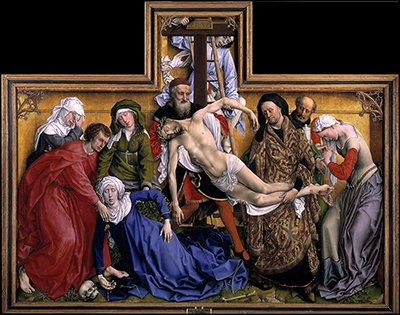
The design is less brutally compressed than the Descent from the Cross. Instead of one intense shallow box, Rogier gives the viewer a sequence of spaces. Yet the same discipline remains. Figures are grave, gestures are controlled, and the viewer's attention is guided with great care.
Compared with The Magdalen Reading, the Saint Columba Altarpiece shows the difference between fragment and intact sequence. The Magdalen fragment preserves one absorbed figure from a lost whole. The Columba triptych gives us a more complete sense of how Rogier could make panels speak to one another across a larger devotional structure.
It links to The Magdalen Reading for the problem of lost altarpieces, to Bladelin Altarpiece and Miraflores Altarpiece for triptych comparison, and to Style and Technique for painted architecture and figure construction.
How to Look at the Altarpiece
Begin with the centre panel. The Adoration of the Kings gives the triptych its ceremonial heart. Notice how worldly splendour is arranged around the Christ Child rather than treated as an end in itself.
Then move to the left panel. The Annunciation is quieter and more interior. Its domestic setting brings the sacred event into a recognisable fifteenth-century room.
Next, move to the right panel. The Presentation in the Temple changes the mood again, turning from private announcement and public homage to ritual offering and sacred architecture.
Then step back and look for connections across the panels. Rogier uses architecture, figure gravity and colour to make three scenes feel like one devotional argument.
Finally, remember the Cologne setting. This was not a museum sequence when it was made. It was a retable for a Marian chapel, meant to shape devotion in a church space.
Why It Matters
The Saint Columba Altarpiece matters because it shows Rogier van der Weyden working at full triptych scale late in his career. It combines narrative clarity with architectural invention, courtly display with devotional seriousness, and regional Cologne history with Brussels painting.
The altarpiece also helps readers understand that Rogier's influence was not confined to one city or one type of object. His art moved through churches, patrons, collectors and later museums across northern Europe.
Frequently Asked Questions
The three panels are in the Alte Pinakothek, Munich, in the Bayerische Staatsgemaeldesammlungen. [1] [2] [3]
The left panel shows the Annunciation, the centre shows the Adoration of the Kings, and the right panel shows the Presentation in the Temple. [1] [2] [3]
It is named after St Columba in Cologne. The Pinakothek records that the retable originally stood in the Marian chapel of that church. [1] [2] [3]
The Pinakothek states that Johann Rinck was an important patron connected with the chapel, but also says that he is not the donor shown in the painting. [1] [2] [3]
Discussion
How does the Saint Columba Altarpiece hold together Annunciation, Adoration and Presentation while still letting each panel breathe?
Reader Insights
The work shows Rogier's mature ability to make three scenes feel connected without making them visually identical.
Its Cologne history is a useful reminder that Rogier's Netherlandish art travelled through patrons, churches and regional devotion.
Set it against Miraflores and Bladelin to see how Rogier uses architecture and sequence differently from one altarpiece to another.
Join the Conversation
Have a thought or observation about Saint Columba Altarpiece by Rogier van der Weyden? Share it below. Thoughtful responses may be added to this section as the Rogier van der Weyden cluster develops.
References
- Sammlung Pinakothek / Bayerische Staatsgemaeldesammlungen, Columba-Altar: Verkuendigung, WAF 1190, accessed 2026-07-11. https://www.sammlung.pinakothek.de/de/artwork/A0GOlar4dp
- Sammlung Pinakothek / Bayerische Staatsgemaeldesammlungen, Columba-Altar: Anbetung der Koenige, WAF 1189, accessed 2026-07-11. https://www.sammlung.pinakothek.de/de/artwork/jWLpO7nxKY
- Sammlung Pinakothek / Bayerische Staatsgemaeldesammlungen, Columba-Altar: Darbringung im Tempel, WAF 1191, accessed 2026-07-11. https://www.sammlung.pinakothek.de/de/artwork/53470Zmx9e
- Lorne Campbell and Jan Van der Stock, eds., Rogier van der Weyden: 1400-1464. Master of Passions, Leuven, Davidsfonds, 2009.
- Dirk de Vos, Rogier van der Weyden: The Complete Works, Harry N. Abrams, 2000.