 by Tom Gurney
Tom Gurney BSc (Hons) is an art history expert with over 20 years experience
Published on June 19, 2020 / Updated on September 28, 2026
Email: tomgurney1@gmail.com / Phone: +44 7429 011000
About the painting
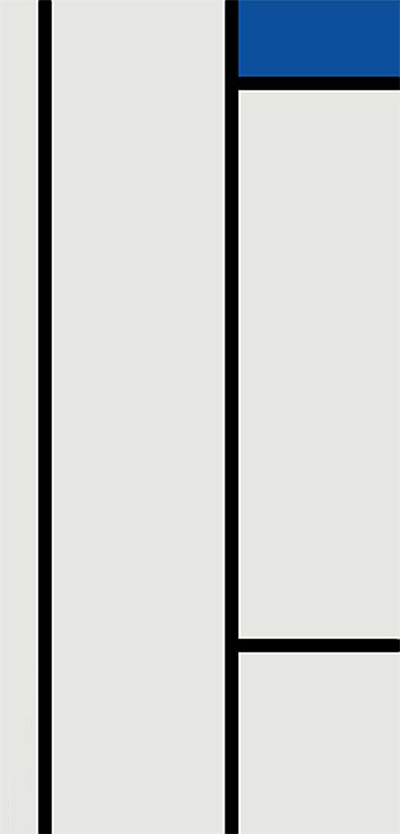
Piet Mondrian's Composition in White and Blue gives a single blue rectangle a remarkably large role. It sits near the upper right of a tall, narrow canvas, with black vertical and horizontal lines dividing the surrounding white. The work belongs to the Kunstsammlung Nordrhein-Westfalen in Düsseldorf, which calls it Komposition mit Blau und Weiß and dates the completed painting to 1936. Its collection number is 0146 and its catalogue raisonné number is B244. The picture on this page matches the museum's reproduction of that object.[1][2]
At a glance
- ArtistPiet Mondrian (1872–1944)
- TitleComposition in White and Blue; museum title Komposition mit Blau und Weiß
- Date1936 for the completed painting; RKD also records a 1934 state
- MediumOil on canvas
- Dimensions121.3 × 59 cm, image/canvas
- CollectionKunstsammlung Nordrhein-Westfalen, Düsseldorf, inventory 0146
- Catalogue numberJoosten/Welsh B244[1][2]
The Düsseldorf painting among Mondrian's mature abstractions
Contents
- What is happening in the painting?
- Why is the vertical format important?
- Was it made in 1934 or 1936?
- How did it reach Düsseldorf?
What is happening in the painting?
The proportions are the first surprise. The painted rectangle is more than twice as tall as it is wide. A strong black vertical just right of the centre runs almost the full height, but stops before the lower edge. Another vertical sits close to the left edge. The broad white interval between them makes the centre feel open, even though the lines are dark and firm. On the right, shorter horizontals divide the space into unequal parts. Near the top, a bright blue plane occupies the right side of the composition, its colour enclosed by black boundaries and the canvas edge.
Look at how much white surrounds that blue. The large white area on the left is interrupted by a long horizontal near the bottom; the right-hand white fields are smaller and differently shaped. White is therefore not a single undifferentiated background. The lines make it into a sequence of spaces, some open and some compressed. Blue can seem to pull the eye upward, while the long dark vertical draws it down again. This is a description of the reproduced image, not a measurement of the painting's pigment or present surface.
The blue rectangle is the only coloured plane. It is visually emphatic partly because the rest of the painting is so restrained. Mondrian did not need to distribute red and yellow around it to create balance. Instead, the unequal white areas and the two black verticals counter its weight. The blue also meets the outer edge, so the canvas boundary participates in the design rather than merely framing a central motif. The painting asks the viewer to compare proportions and intervals instead of searching for a depicted object.
Why is the vertical format important?
Many familiar Mondrian compositions approach a square. This one is markedly upright: the museum gives 121.3 × 59 cm for the image, while listing a much larger framed measurement separately. Those figures should not be confused. The narrow support changes the pace of looking. The left vertical has little room beside it, the central white strip stretches upward, and the blue at the top right is small in area but commanding in position.[1]
A vertical emphasis also distinguishes this canvas from a simple diagram of equal squares. Its divisions are deliberately unequal. The upper blue does not mirror a blue field at the bottom, and the lower horizontal does not turn the canvas into a regular stack of bands. A visitor can test the balance by covering the blue: without it, the black divisions and broad white spaces still establish an arrangement, but the upper right loses its point of concentration.
Fondation Beyeler grouped this painting with Mondrian's earlier depictions of vertical buildings in its Mondrian room guide, describing the 1936 work as an abstract vertical composition. That is a useful way to notice the unusual proportions. It does not mean the blue rectangle depicts a specific building or that the painting has a documented architectural source. Here the lines, colour and canvas shape operate as an abstract composition.[3]
Watch: Piet Mondrian
See his studio, the move toward geometric abstraction and the rhythms of his New York paintings.
Piet Mondrian: Abstract Painting as We Know It
Curator Michael White explores the paintings and Mondrian’s studio as an abstract space.
Watch on YouTubeWas it made in 1934 or 1936?
The museum dates the painting 1936. It records the signature “PM 36” at the lower right and a handwritten inscription on the back of the stretcher that includes Composition (blanc et bleue). The museum says Mondrian sent it to New York immediately after its creation in 1936. These details make 1936 the appropriate date for the finished work shown here.[1]
The RKD catalogue places B244 in its 1931–34 sequence and labels a 1934 state Composition no. I. The museum's bracketed title also preserves Composition No. I, Composition C. and a French title referring to white and blue. The dates therefore describe the painting's earlier catalogue state and its signed 1936 finish, not two unrelated works. The museum's 1936 date and the RKD's earlier state can be read together without replacing one with the other.[1][2]
This title history matters because Composition C is not unique in Mondrian's output. The site also has a page for the different Composition C associated with a later state and a different collection. A title alone can conceal such differences. For this canvas, B244, 0146, its narrow dimensions and its Düsseldorf collection identify the object reliably.
How did it reach Düsseldorf?
According to the Kunstsammlung's provenance, Mondrian sent the completed painting to the Valentine Gallery in New York in 1936, during a one-year contract. The gallery sold it to Walter P. Chrysler Jr. that year. It appeared in the sale of Chrysler's collection at Parke-Bernet Galleries in March 1945. The museum says the painting presumably passed to Harry Holtzman through that sale and remained with him until 1963. The word “presumably” is important: the museum presents that step with a qualification rather than as a fully documented direct transfer.[1]
In 1963, the Kunstsammlung Nordrhein-Westfalen acquired the work from Marlborough Fine Art. Its online record lists later exhibitions including Mondrian Evolution at Fondation Beyeler in 2022 and at the Düsseldorf museum in 2022–23. These are records of particular exhibitions, not a promise that the painting is continuously on display. The museum's collection record is the best source for current collection details.[1]
The journey from a Paris studio to a New York dealer, a private collection and finally a public collection in Düsseldorf is unusually well outlined for a painting whose visual means are so spare. The ownership record gives the blue-and-white canvas a concrete history without supplying a fixed narrative for its abstract forms. Its force still lies in the precise relation of the single blue field to the vertical lines and differently sized whites.
Mondrian artworks directory
Frequently asked questions
Where is Composition in White and Blue?
It is in the collection of the Kunstsammlung Nordrhein-Westfalen, Düsseldorf, as inventory 0146. The museum catalogues it as B244.[1]
When was it painted?
What are its dimensions?
The museum gives 121.3 × 59 cm for the image/canvas and lists the frame separately. It is oil on canvas.[1]
Is this the same as every painting called Composition C?
Discussion
Does the blue plane or the tall central black line first hold your attention?
Reader Insights
Follow the long black vertical from the blue plane downward. Where does your eye stop?
Which white field most strongly balances the blue rectangle?
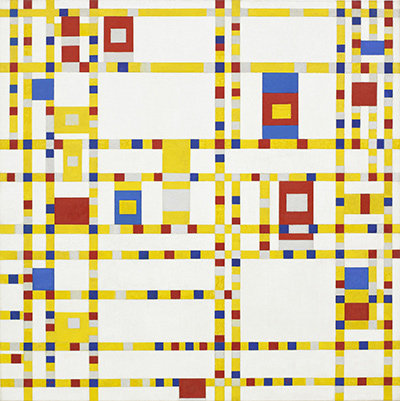
How does this narrow Düsseldorf canvas differ from the later Broadway Boogie Woogie?
Join the Conversation
Share what you notice in this painting below.
References
- Kunstsammlung Nordrhein-Westfalen, Komposition mit Blau und Weiß, online collection record 0146, object facts, inscription, provenance and exhibitions. View source.
- RKD – Netherlands Institute for Art History, digital Mondrian catalogue raisonné, Paris 1931–34 sequence, B244 Composition no. I. View source.
- Fondation Beyeler, Mondrian exhibition room guide, Composition with Blue and White, 1936. View source.
- Lead image credit. Piet Mondrian, Composition in White and Blue, completed 1936, oil on canvas, 121.3 × 59 cm, B244; Kunstsammlung Nordrhein-Westfalen 0146.
 The Red Tree Piet Mondrian.jpg)