


 by Tom Gurney
Tom Gurney BSc (Hons) is an art history expert with over 20 years experience
Published on June 19, 2020 / Updated on July 28, 2026
Email: tomgurney1@gmail.com / Phone: +44 7429 011000
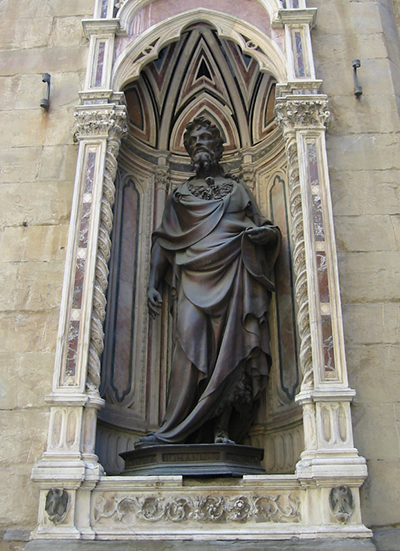
Lorenzo Ghiberti's St Stephen was the third monumental bronze he made for Orsanmichele and the last of the group. Commissioned for the Arte della Lana, Florence's wool guild, it replaced an older marble saint associated with Andrea Pisano. Funds were assigned in 1427, and the bronze was installed in its niche by 1429. The original is now protected inside the Museo di Orsanmichele, while a replica occupies the exterior setting.[3]
Contents
- A new saint for the wool guild
- Bronze, vestment and identity
- Comparing Ghiberti's three saints
- The niche and the viewer
- Original and replica
- St Stephen within Ghiberti's career
A new saint for the wool guild
Orsanmichele's exterior niches turned guild patronage into a public competition of materials, scale and artistic distinction. The Arte di Calimala had commissioned Ghiberti's bronze St John the Baptist, and the Arte del Cambio followed with his larger St Matthew. The Arte della Lana's decision to replace its older marble St Stephen with bronze placed the guild within this sequence of expensive civic statements.
The national catalogue records that money for the sculpture was allocated in 1427 and that it had been definitively placed by 1429. This documentary range is more secure than trying to assign every stage of modelling, casting and finishing to a single undocumented date.[1]
Bronze, vestment and identity
Stephen is represented as a deacon. His long dalmatic is therefore both clothing and an identifying attribute. It gives Ghiberti a broad surface across which folds, borders and ornamental detail can organize the figure. The garment does not merely conceal the body; it establishes the statue's frontal presence and carries visual information that could be read from the street.
The national record describes the work as cast and chased bronze and gives dimensions of 237 centimetres high, 105 wide and 70 deep. Different catalogues sometimes publish different heights, probably because bases, measurement conventions or the complete ensemble are treated differently. The national object record supplies the most appropriate working measurement for this page.
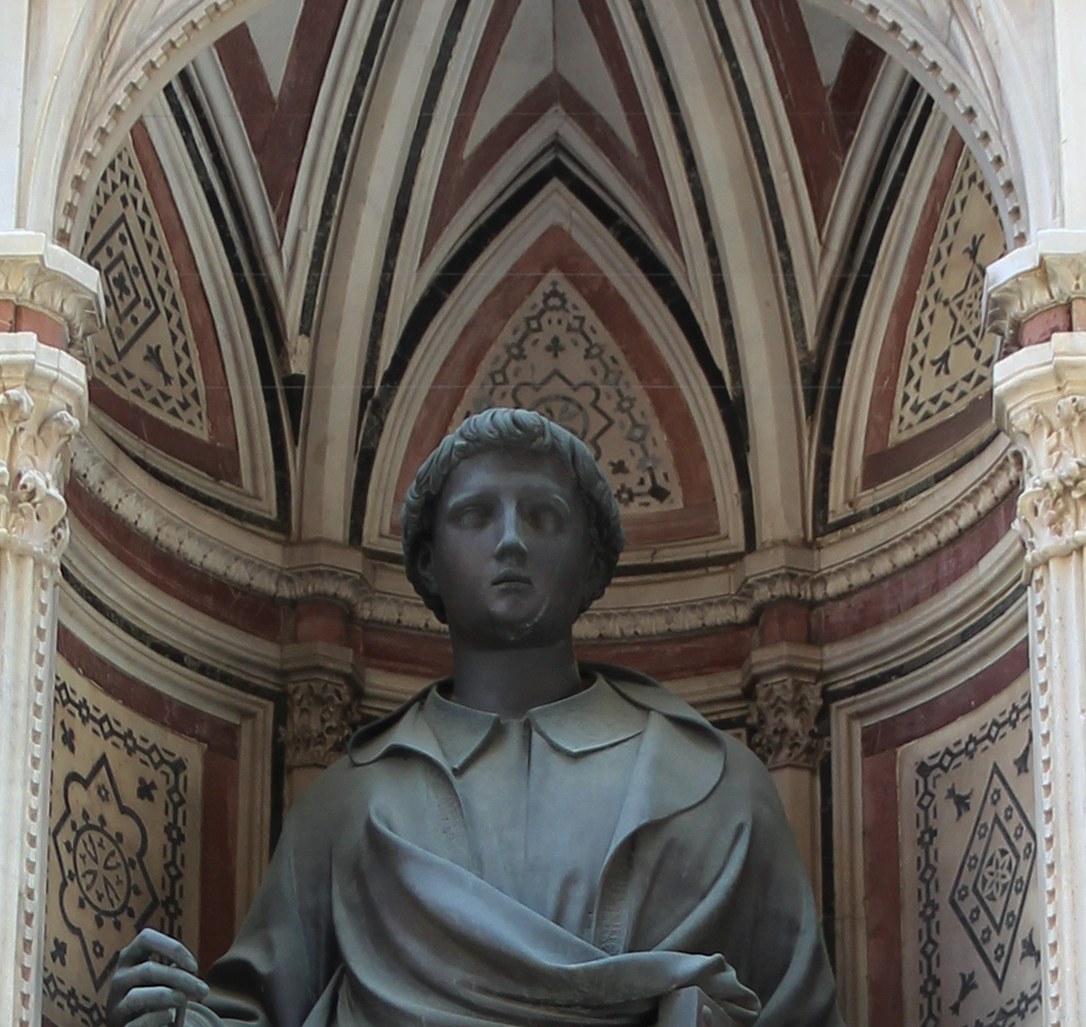
Stephen's youthful head is framed by patterned hair and a calm, concentrated expression. The face and decorated vestment reward close looking, while the long fall of the robe creates a simpler silhouette at architectural distance. These two scales of attention—street-level recognition and detailed surface—belong to the original niche function.
Comparing Ghiberti's three saints
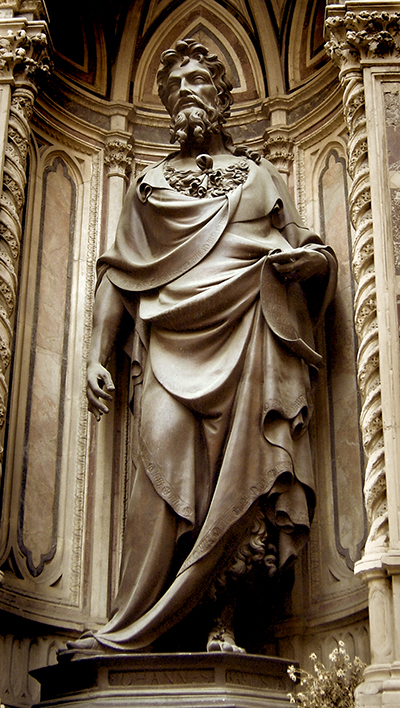
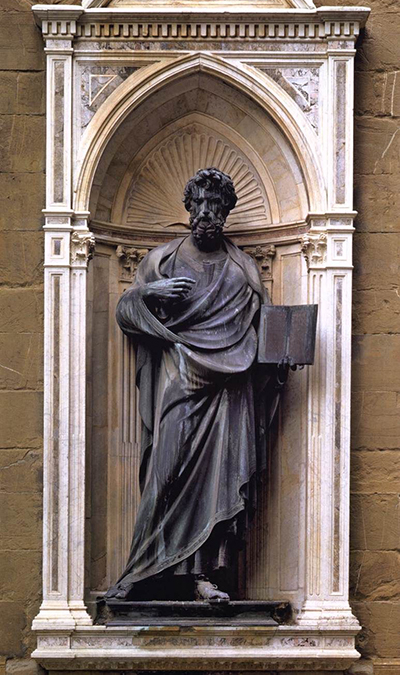
The three Orsanmichele bronzes should not be arranged as a simple story of constant progress. St John the Baptist emphasizes elongated contours and richly flowing surfaces. St Matthew uses greater bodily mass, an open Gospel and a speaking gesture to command the niche. St Stephen returns to a more enclosed frontal structure, with much of its movement carried by the dalmatic.
Richard Krautheimer discussed St Stephen within a broader assessment of Ghiberti's large-scale sculpture and compared its execution unfavourably with St Matthew. That judgement has influenced later catalogue writing, but it is an interpretation rather than an object fact. The work can instead be approached as a deliberate negotiation between the inherited image it replaced, the requirements of a deacon saint and Ghiberti's continuing investment in ornamental surface.[2]
Piero Morselli's dedicated study of the statue's proportions connects it with debates around Vitruvius and Alberti. Such scholarship makes the figure more than a supposedly conservative endpoint: its bodily and architectural ratios can be examined as considered design choices, even where their success remains open to debate.[4]
The niche and the viewer
Museum display brings the bronze close to eye level, but the statue was designed for an elevated exterior niche. Its frontal alignment, enlarged scale and long vertical folds respond to that setting. The tabernacle concentrates the figure against an architectural background, while the guild context identifies the commission as part of a larger urban programme.
Looking upward also changes the relation between head, torso and feet. Details that appear restrained in a museum photograph could read more forcefully when seen from below, surrounded by stone architecture and changing daylight. Any stylistic judgement should therefore consider the original viewing conditions rather than treating the statue as an isolated gallery object.
Original and replica
The Orsanmichele museum protects the original sculptures, and copies now stand in the exterior niches. This distinction is essential when interpreting photographs. An exterior view records the original architectural relationship but normally shows the modern replica; a museum view shows Ghiberti's bronze but removes it from street height and weather.
The annotated close reading prepared for this page uses a high-resolution photograph of the exterior replica. It can accurately explain pose, gesture, drapery and niche placement, but it must not be used as evidence for the original bronze's present surface, chasing or conservation condition.
St Stephen within Ghiberti's career
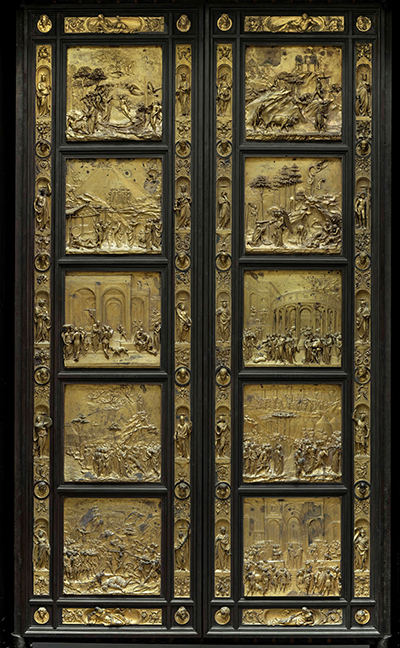
Ghiberti made St Stephen while the Gates of Paradise were under way. The contrast between the projects is instructive. On the doors, dozens of figures move through landscapes and imagined buildings at many relief depths. At Orsanmichele, one standing body had to sustain attention within a fixed niche.
The statue completes Ghiberti's response to three different guilds and three monumental saints. Its value lies not only in ranking it against St John or St Matthew, but in seeing how bronze, vestment, proportion and architecture were adjusted to a distinct patron and sacred identity.
Annotated Close Reading of St Stephen
Image note: this photograph shows the exterior replica in Ghiberti’s original Orsanmichele niche; the conserved original bronze is displayed indoors.
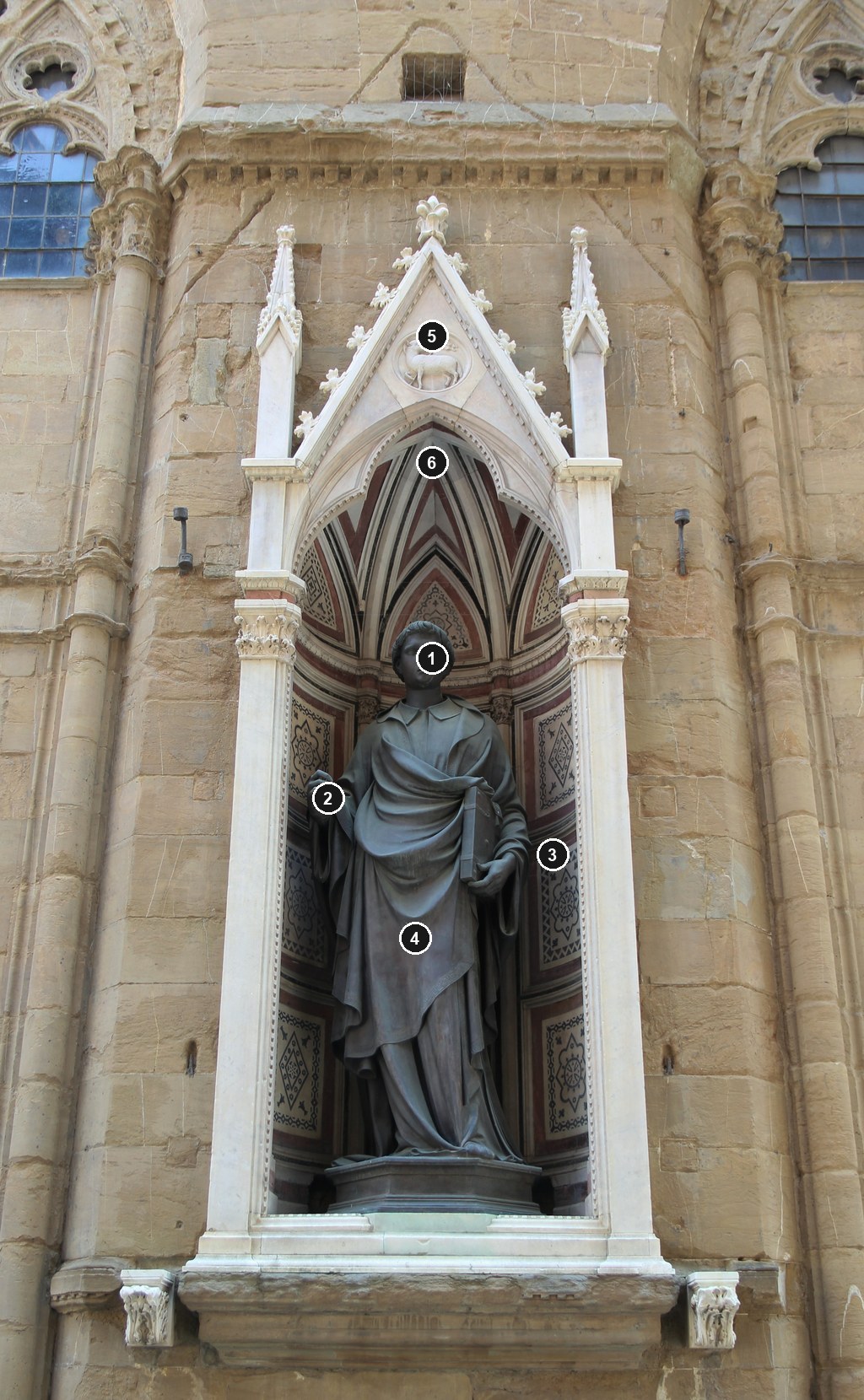
Youthful head
Stephen’s youthful, beardless face distinguishes him from Ghiberti’s older Orsanmichele saints.
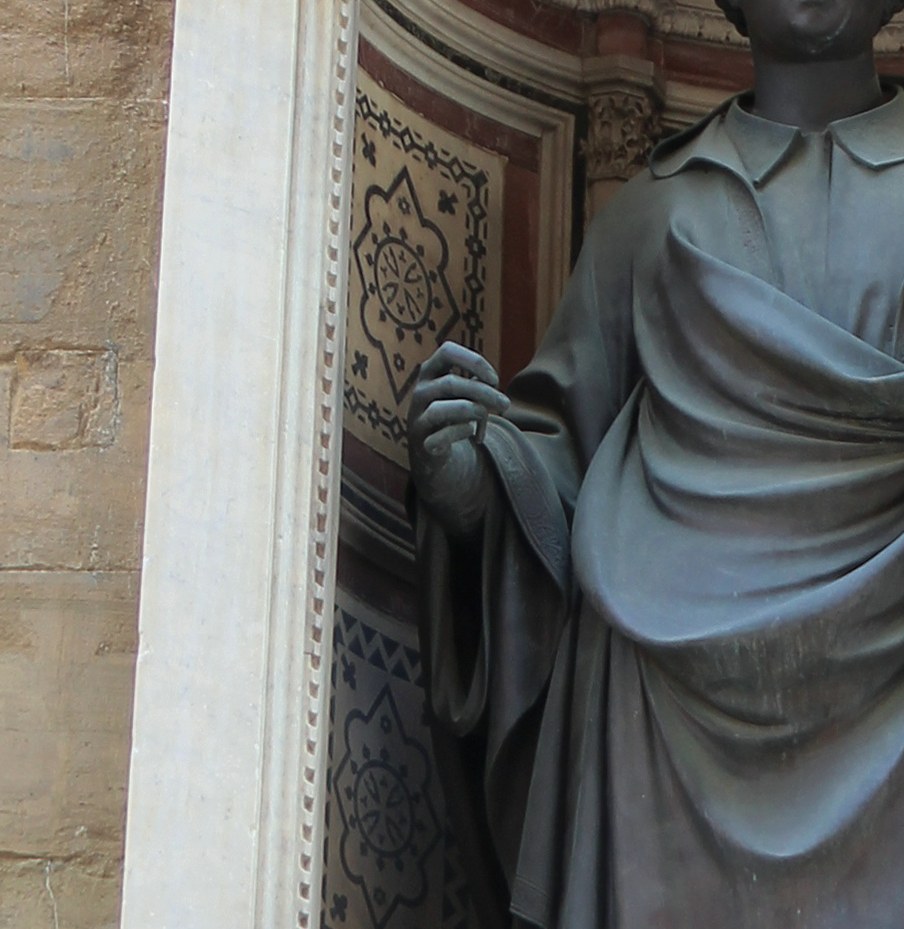
Raised right hand
The small raised gesture projects beyond the drapery and helps animate the frontal pose.
Martyr’s palm
The long palm identifies Stephen as a martyr and creates a strong vertical beside the body.
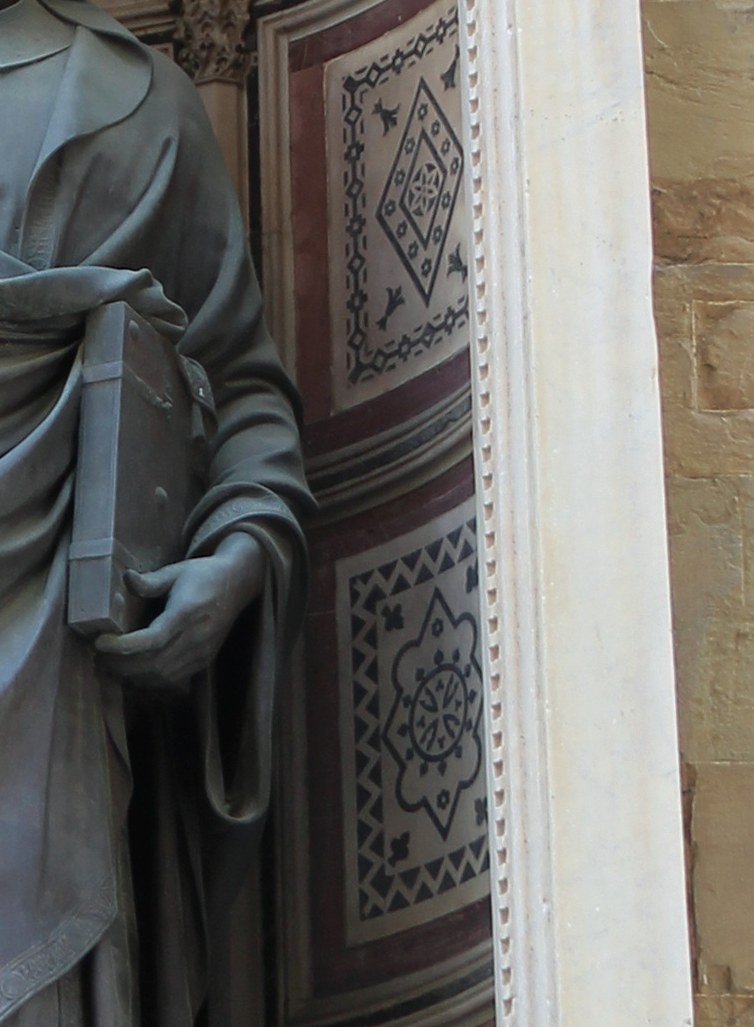
Layered dalmatic
Overlapping folds and the deacon’s garment organize the narrow, upright figure.
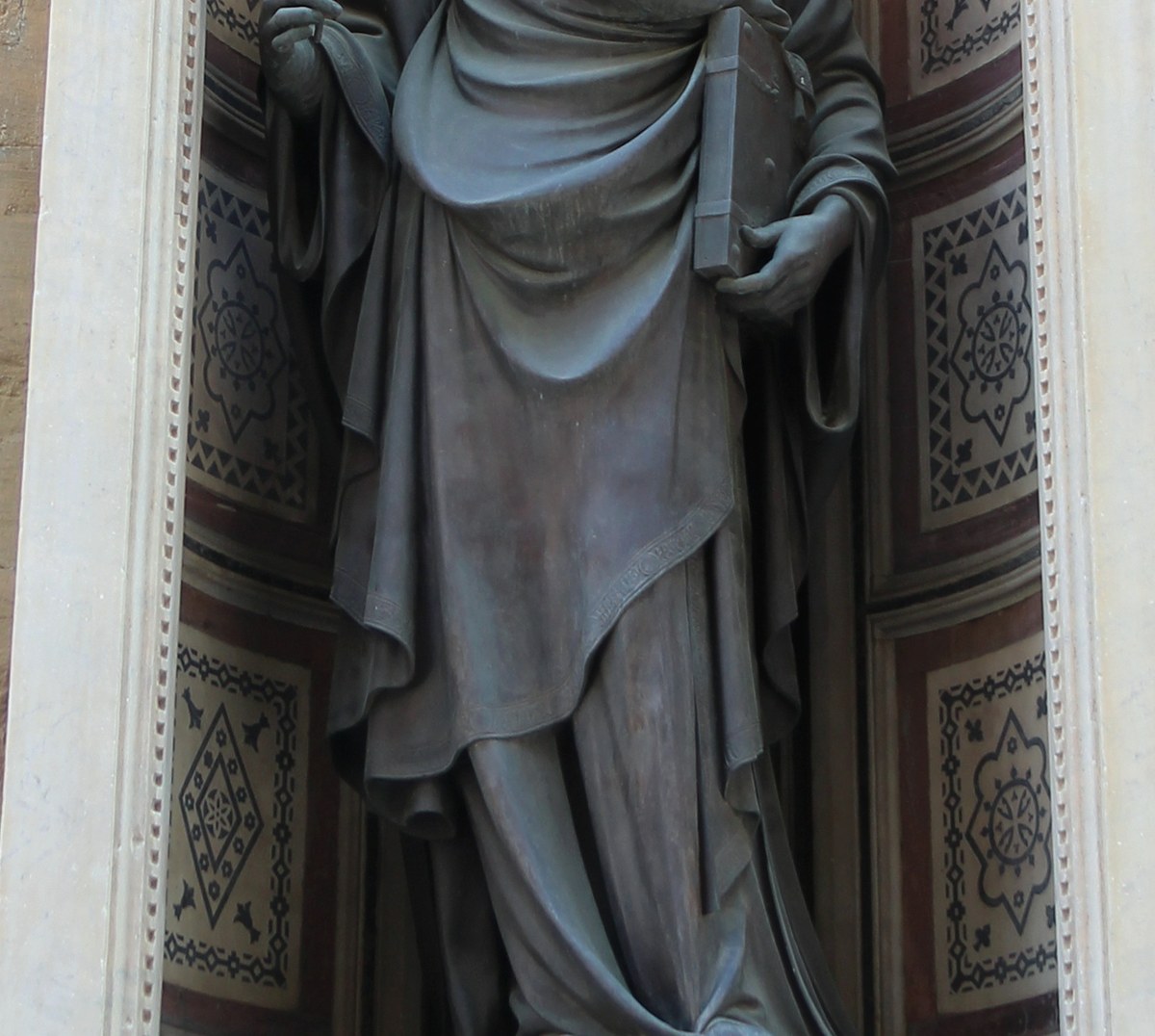
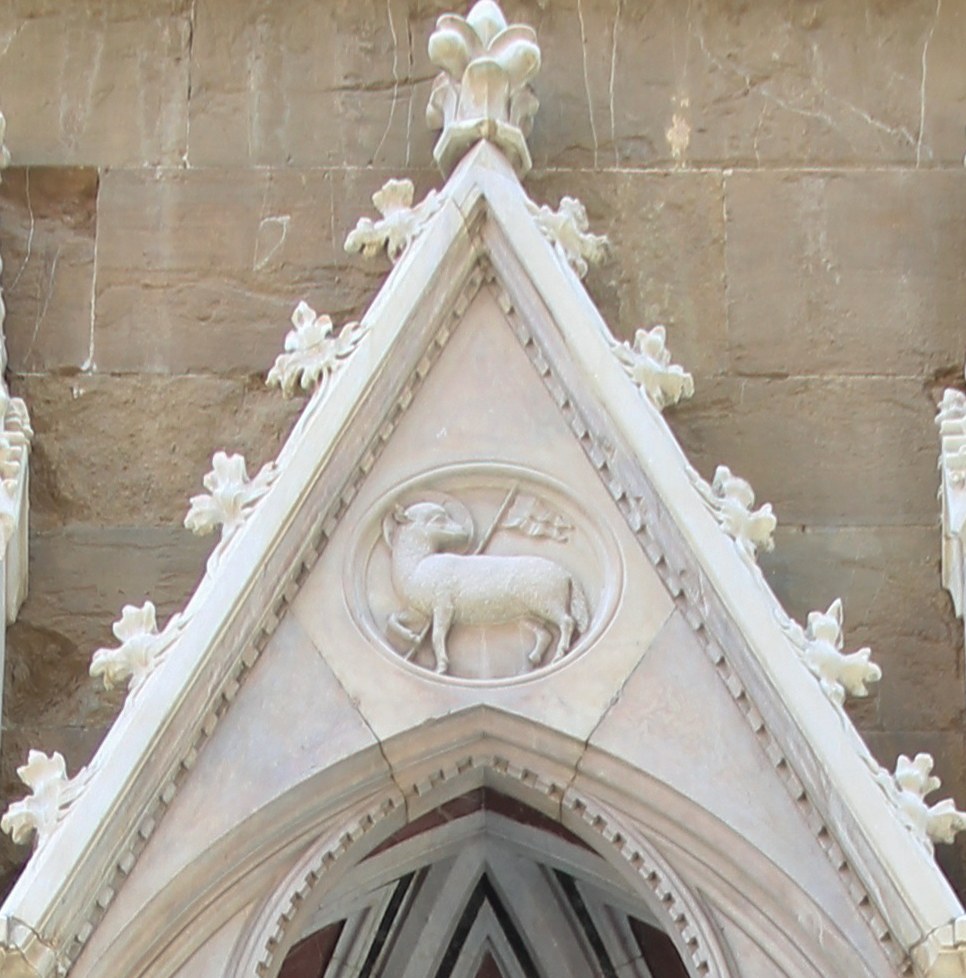
Lamb of the Arte della Lana
The lamb emblem in the gable identifies the wool guild responsible for the commission.
Gothic tabernacle ensemble
Pinnacles, pointed arch and patterned recess show the replica within the original architectural setting.
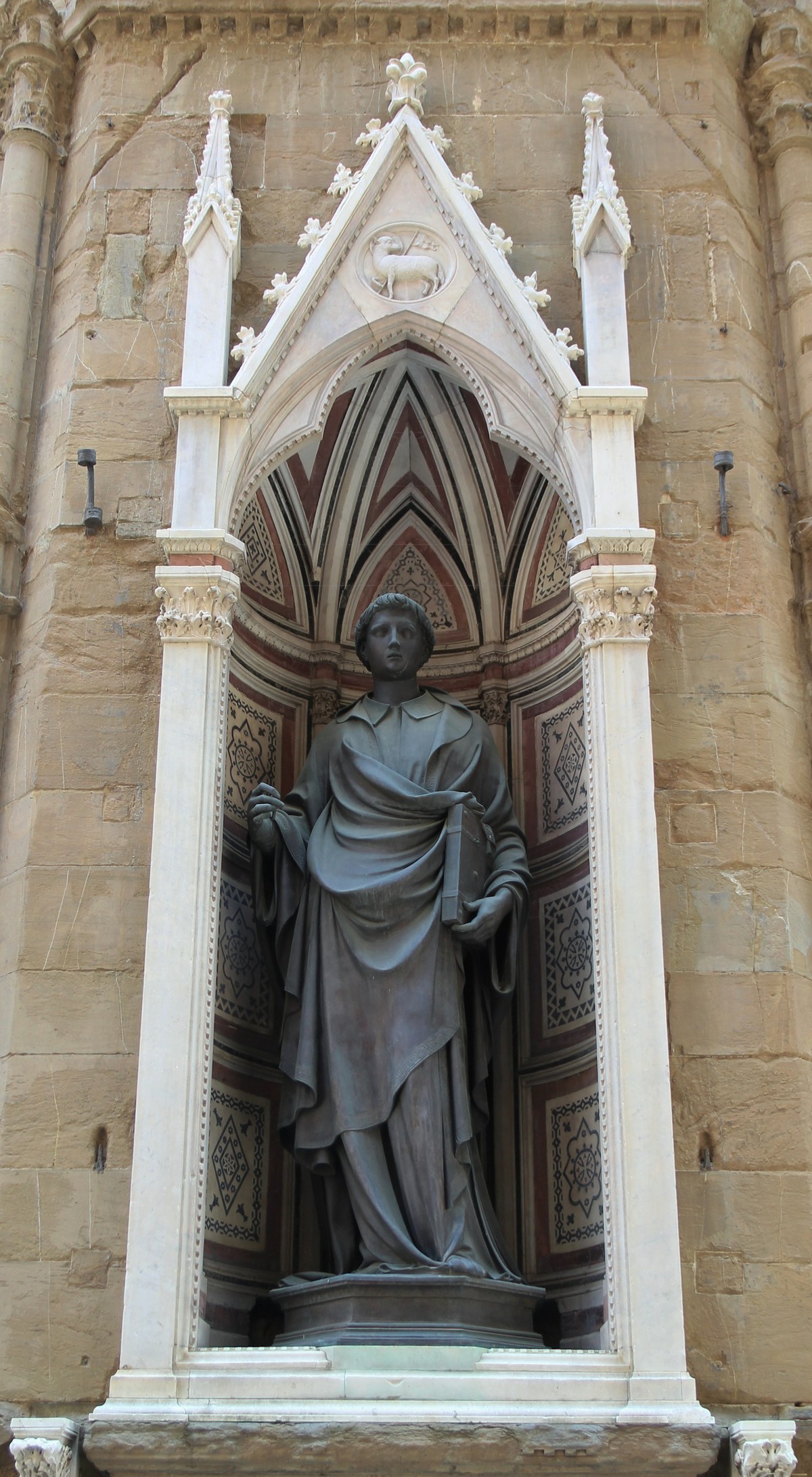
Photograph by Björn S…, CC BY-SA 2.0, via Wikimedia Commons; Commons version adjusted; annotated and cropped. Source. CC BY-SA 2.0.
Discussion
Ghiberti rewards slow looking: relief, gilding, narrative structure, workshop practice and conservation evidence can all change how a work is read.
Join the Conversation
Have an observation about St Stephen, a source to add, or a comparison that sharpens the reading? Share it below.
References
- Italian national catalogue, St Stephen (in Italian)
- Fondazione Federico Zeri, St Stephen catalogue record (in Italian)
- Musei del Bargello, Orsanmichele
- Piero Morselli, “The Proportions of Ghiberti's Saint Stephen: Vitruvius's De Architectura and Alberti's De Statua,” The Art Bulletin 60.2 (1978), pp. 235–241.
.jpg)