

 by Tom Gurney
Tom Gurney BSc (Hons) is an art history expert with over 20 years experience
Published on June 19, 2020 / Updated on July 28, 2026
Email: tomgurney1@gmail.com / Phone: +44 7429 011000
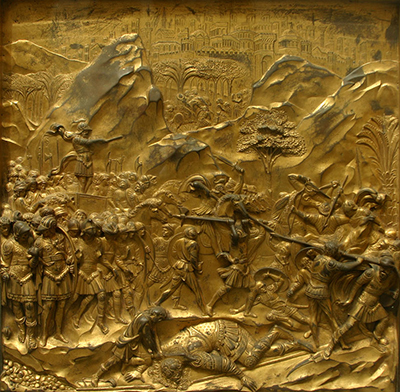
Lorenzo Ghiberti's David and Goliath panel contains far more than the famous duel. A battle spreads across a mountain valley; Saul commands from his chariot; David beheads the defeated Goliath in the foreground; and a distant procession carries the victory towards Jerusalem. Changes in scale, relief and terrain turn these simultaneous actions into a hierarchy of conflict, decision and public triumph.
Contents
- The ninth panel of the Gates
- Battle in the valley
- Saul and command
- David and Goliath in the foreground
- The procession towards Jerusalem
- Mountains, scale and relief
- Workshop and attribution
- How to follow the panel
The ninth panel of the Gates
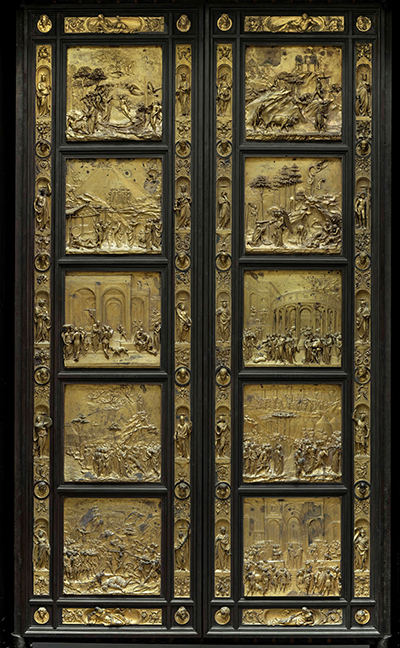
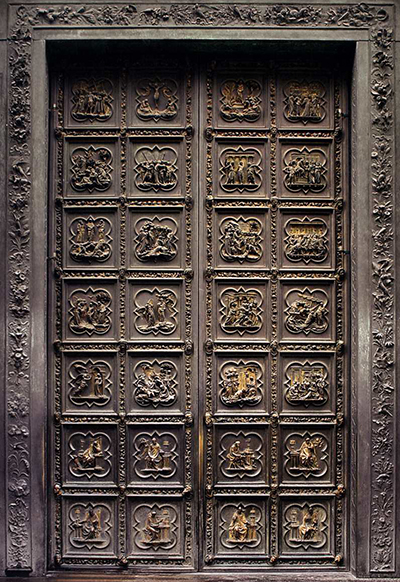
The relief is the ninth of the ten narrative panels on the Gates of Paradise, made between 1425 and 1452. It follows the stories of Joshua and precedes the meeting of Solomon and the Queen of Sheba. The original gilded bronze is displayed in the Museo dell'Opera del Duomo, while the Baptistery exterior has replica doors.[1][2]
The Met's 2007 exhibition presented the David panel alongside Adam and Eve and Jacob and Esau. Its institutional account identifies the principal episodes and records the panel at approximately 31.5 inches square. The compact dimensions make the apparent breadth of the battlefield especially striking.[3][4]
Battle in the valley
The middle and distance are filled with opposing forces. Soldiers, weapons and horses create a densely patterned conflict at the foot of steep mountains. The battle does not form a flat band. Troops diminish as they move into the valley, while ridges and slopes separate groups without breaking the landscape into compartments.
Armour catches light differently from flesh, rock and cloth. Across a gilded surface, repeated helmets and weapons could create flashes that animate the crowd as viewing conditions change. The effect makes material surface part of the representation of military movement.
Saul and command
Saul appears in his chariot urging the Israelite forces forward. The chariot identifies authority and sets command apart from hand-to-hand fighting. Yet Saul is not the largest figure in the composition. His importance depends on position, attribute and relation to the troops rather than on a simple scale hierarchy.
This distinction allows Ghiberti to distribute several kinds of action across the panel. Saul directs; soldiers fight; David performs the decisive act; and the later procession converts private courage into public celebration.
David and Goliath in the foreground
David beheads Goliath near the front edge. Their bodies project more strongly than many of the distant combatants, giving the episode physical immediacy. The fallen giant forms a broad horizontal mass, while David's active posture and raised weapon concentrate the decisive movement.
The scene represents the conclusion rather than the instant of the sling's impact. Ghiberti chooses an action that makes victory unmistakable and connects readily with the later display of Goliath's head. The foreground is therefore both an ending to the duel and a beginning for the triumphal narrative.
The procession towards Jerusalem
In the distance, David's victory is celebrated as he proceeds uphill with Goliath's head. The movement away from the foreground is also movement forward in time. The same protagonist appears at different scales because he occupies different moments and distances.
Jerusalem rises beyond the procession. Opera del Duomo's panel record notes interpretations that compare the imagined city with Florence. Such a comparison can illuminate the relief's civic reception, but it should remain attributed. The visible city first serves the biblical story as the destination of public triumph.
Mountains, scale and relief
The landscape is not a decorative backdrop. Mountains funnel armies into the valley, separate battle from procession and provide the rising route towards the city. Their sharp profiles also contrast with the rounded bodies and repeated arcs of shields and helmets.
Ghiberti's Commentarii describes the Gates' shallow relief and the use of measure so that remote figures appear smaller. In this panel, the transition from projecting foreground bodies to minute distant troops is unusually dramatic. Very small differences in bronze depth support the illusion of a much larger world.[5]
Workshop and attribution
The Gates were a workshop production under Ghiberti's direction. Later scholarship has proposed contributions by Benozzo Gozzoli to parts of the David relief. Opera del Duomo's catalogue records that attribution history without turning it into a complete map of individual hands.
The safest wording recognizes Ghiberti's authorship and workshop direction while treating specific assistant attributions as scholarly proposals. Visual resemblance alone cannot identify who modelled every soldier, mountain or architectural detail.
How to follow the panel
Begin with David and the fallen Goliath in the foreground. Move back into the valley battle, locate Saul and his chariot, then follow the distant procession uphill towards Jerusalem. This route moves from decisive act to collective struggle and finally to civic celebration, although the biblical chronology partly runs in another direction.
That productive tension is central to the panel. Ghiberti does not make time a single straight line. He arranges moments so that the viewer can compare cause, action and consequence within one field.
Discussion
Ghiberti rewards slow looking: relief, gilding, narrative structure, workshop practice and conservation evidence can all change how a work is read.
Join the Conversation
Have an observation about David and Goliath, a source to add, or a comparison that sharpens the reading? Share it below.
References
- Opera del Duomo, Stories of Saul and David (in Italian)
- Opera del Duomo, Gates of Paradise
- Metropolitan Museum of Art, The Gates of Paradise
- Metropolitan Museum of Art, exhibition object gallery
- Lorenzo Ghiberti, I Commentarii, ed. Julius von Schlosser (Berlin, 1912), printed pp. 48–50.