

 by Tom Gurney
Tom Gurney BSc (Hons) is an art history expert with over 20 years experience
Published on June 19, 2020 / Updated on July 28, 2026
Email: tomgurney1@gmail.com / Phone: +44 7429 011000
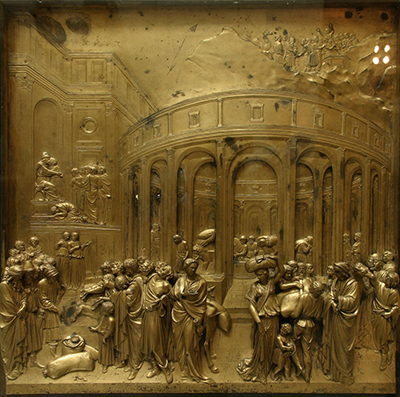
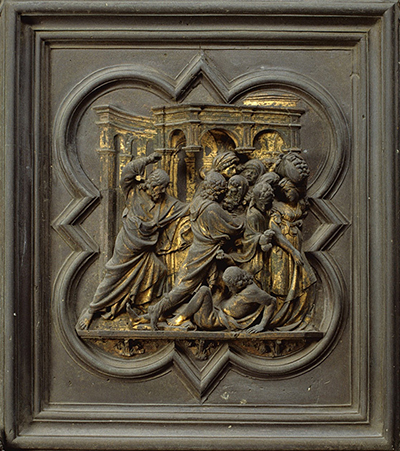
Lorenzo Ghiberti turns the Expulsion of the Money-Changers into a study of compressed force. Christ drives into a tightly packed group; bodies twist, kneel and recoil; temple architecture fills the upper field. The crowd seems to press against the quatrefoil itself, making sacred authority visible through disruption of an enclosed human mass.
Contents
- Position on the North Door
- Christ entering the crowd
- Compression and recoil
- Temple architecture
- Reading force through response
Position on the North Door
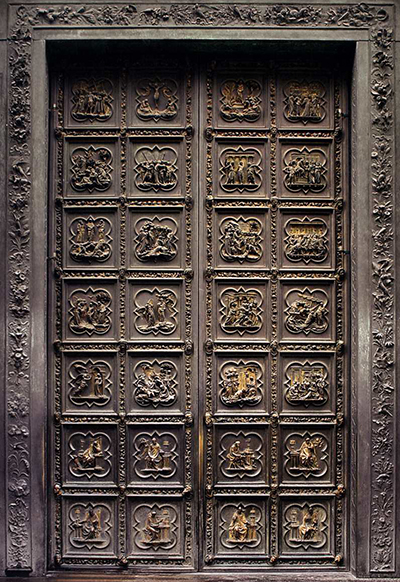
The panel is on the right leaf of the North Door and is paired in the programme with Christ Walks upon the Water. Both scenes present manifestations of Christ's authority, but one uses a crowded architectural interior and the other an unstable boat and open water.
The North Door was made between 1403 and 1424. The original is in the Museo dell'Opera del Duomo, while a copy stands outside on the Baptistery. Opera del Duomo reports this panel within a proposed phase around 1415–1420, based on Krautheimer's stylistic reconstruction rather than a documented individual date.[1][2]
Christ entering the crowd
Christ does not occupy a calm, isolated centre. His movement penetrates the group and causes a chain of reactions. Nearby bodies turn away, lower themselves or collide with others. Authority is communicated through what happens around him.
The Gospel accounts in Matthew 21:12–13, Mark 11:15–17, Luke 19:45–46 and John 2:13–22 identify the cleansing of the Temple. The relief concentrates on expulsion and response rather than offering a literal inventory of every exchanged object.[3]
Compression and recoil
The crowd's density is crucial. Overlapping figures leave little neutral ground, so every turn appears to affect another body. Kneeling and twisting poses break a stable horizontal line and send movement through the lower lobes of the frame.
This compression differs from the communal density of the Last Supper. There, bodies gather around a shared table; here, proximity becomes disorder. Similar formal means can therefore carry opposite social meanings.
Temple architecture
Architecture fills the upper field and establishes the sacred setting. Its relatively regular lines contrast with the disturbed figures below. Yet the building also encloses the crowd, making their lack of escape more palpable.
The temple should not be read as an archaeological reconstruction. It provides institutional setting and compositional pressure. Human action takes place beneath a fixed structure whose order has been violated and is being asserted again.
Reading force through response
Begin with Christ and follow the directions of the closest bodies. Identify who turns, who lowers, and where the group is pushed toward the frame. Then compare that restless lower zone with the architecture above.
The panel's distinctive subject is not violence in isolation but the visible transmission of authority through a crowd. Ghiberti makes a compact quatrefoil feel congested, then uses gesture and bodily recoil to clear a moral and narrative path through it.
Discussion
Ghiberti rewards slow looking: relief, gilding, narrative structure, workshop practice and conservation evidence can all change how a work is read.
Join the Conversation
Have an observation about Expulsion of the Money-Chang, a source to add, or a comparison that sharpens the reading? Share it below.
References
- Opera del Duomo scientific catalogue, North Door
- Opera del Duomo, North Door
- Matthew 21:12–13; Mark 11:15–17; Luke 19:45–46; John 2:13–22.