

 by Tom Gurney
Tom Gurney BSc (Hons) is an art history expert with over 20 years experience
Published on June 19, 2020 / Updated on July 28, 2026
Email: tomgurney1@gmail.com / Phone: +44 7429 011000
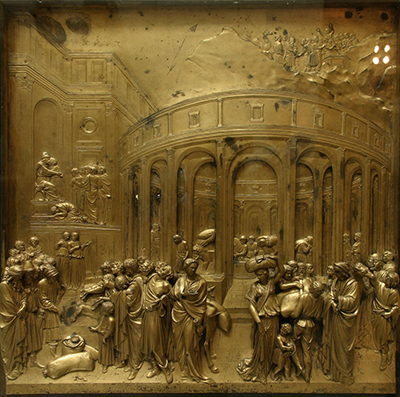
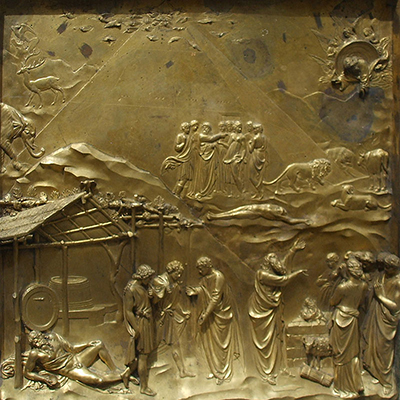
The relief traditionally called Drunkenness of Noah is a complete Noah cycle rather than an isolated image of his exposure. Lorenzo Ghiberti includes animals entering the ark, Noah's sacrifice after the Flood, and the episode in which his sons respond differently to their father's drunkenness. A sharply geometric ark organizes these widely separated moments within one landscape.
Contents
- Position and subject
- The ark as visual anchor
- Sacrifice after the Flood
- Noah and his sons
- Geometry, nature and time
Position and subject
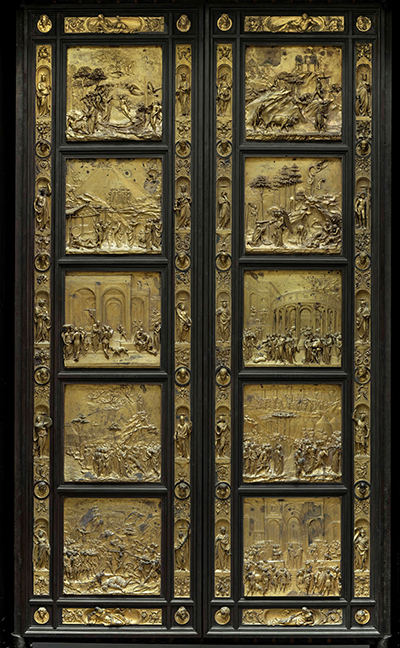
The panel is on the left of the second register from the top of the Gates of Paradise, paired with the Abraham and Isaac relief. Cast, chased and gilded in bronze, it measures about 80 by 79 centimetres according to the Opera del Duomo catalogue.[1]
The original Gates are now displayed in the Museo dell'Opera del Duomo; replicas stand on the Baptistery's eastern exterior.[2]
The familiar modern title points to the prominent foreground episode, but the institution's broader title, Stories of Noah, better describes its scope. Genesis 7–9 supplies the narrative route: survival through the Flood, sacrifice and covenant are followed by cultivation, wine and a divided family response.[3]
The ark as visual anchor
The ark's pyramidal form gives the panel an unusually strong geometric centre. It is both an object within the story and a device for organizing the relief. Animal groups approach or enter it, turning the crowded preparations for the Flood into controlled movement around a stable mass.
Ghiberti's ark is not merely a backdrop. Its converging planes establish direction and make the surrounding figures easier to locate. Against the irregular forms of animals, people and landscape, the structure acts almost like a piece of architecture in one of the later Gates panels.
Sacrifice after the Flood
Noah's sacrifice appears as a separate action within the same field. This episode marks survival and renewed relations between humanity and God. Its placement allows the viewer to move from the ark's protective geometry toward ritual action without encountering a hard frame.
The transition depends on scale, relief depth and changes in ground. Principal figures project more strongly, while shallower passages bind events into the bronze surface. The method creates distance but also makes different moments coexist—a visual form of continuous narrative.
Noah and his sons
In the foreground, Noah reclines after drinking wine. His sons' gestures distinguish their responses: Shem and Japheth cover him while avoiding exposure; Ham's conduct leads to the curse directed at Canaan. The scene brings the monumental story of the Flood down to a tense encounter within a family.
This contrast is central to the panel. The upper and middle zones concern collective survival, animals and sacrifice; the foreground concerns vulnerability, shame and division. Ghiberti does not allow the covenant to become a simple triumphant conclusion. The narrative continues into imperfect human life.
Geometry, nature and time
The relief can first be read by following the biblical order, but another viewing should compare its types of form. The ark is sharply constructed; the animal groups are varied and mobile; the sacrifice creates a ritual focus; Noah's body introduces a low horizontal weight in the foreground.
These contrasts keep the episodes distinct without breaking the panel apart. The ark unifies the composition, yet it does not erase changes in time or mood. That is why the narrow title is useful only as an entry point. The relief moves from gathering and preservation through worship to an unsettling domestic aftermath, using geometry and landscape to hold the cycle together.
Discussion
Ghiberti rewards slow looking: relief, gilding, narrative structure, workshop practice and conservation evidence can all change how a work is read.
Join the Conversation
Have an observation about Drunkenness of Noah, a source to add, or a comparison that sharpens the reading? Share it below.
References
- Opera del Duomo scientific catalogue, Stories of Noah
- Opera del Duomo, Gates of Paradise
- Genesis 7:1–9:27.