

 by Tom Gurney
Tom Gurney BSc (Hons) is an art history expert with over 20 years experience
Published on June 19, 2020 / Updated on July 28, 2026
Email: tomgurney1@gmail.com / Phone: +44 7429 011000
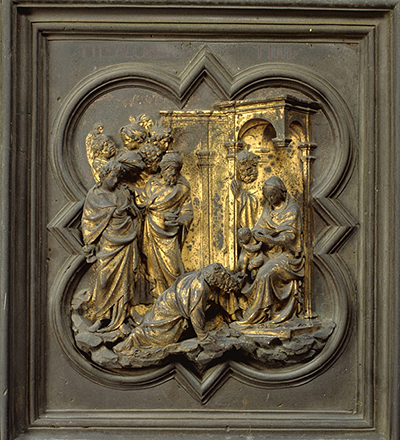
In Lorenzo Ghiberti's Adoration of the Magi, an approaching procession meets a stable enthroned group. The Virgin and Child sit at the right beneath an architectural canopy. The eldest Magus kneels before them, while two standing kings and their attendants gather from the left. Differences of height, gesture and selective gilding turn approach into an ordered statement of rank and devotion.
Contents
- Position on the North Door
- The enthroned group
- The kneeling Magus
- Rank and procession
- From movement to encounter
Position on the North Door
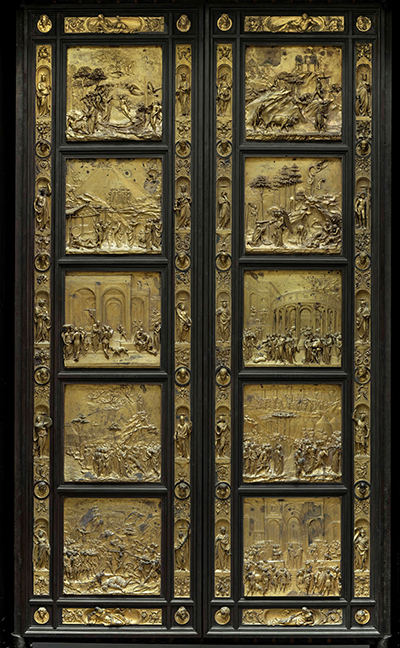
The relief is on the right leaf of the North Door, paired with Christ among the Doctors and horizontally aligned with the Annunciation and Nativity on the opposite leaf. Together, these four panels form the infancy level of the twenty-scene narrative programme.
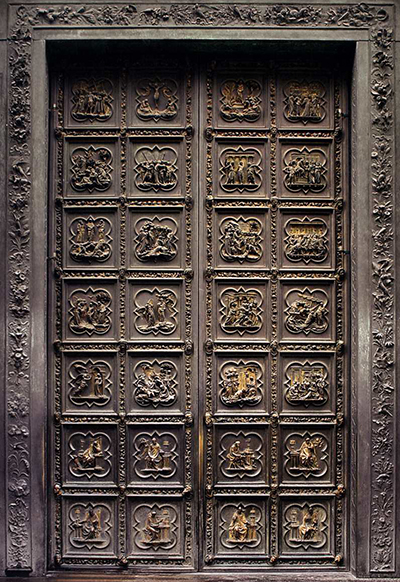
Ghiberti's North Door was made between 1403 and 1424. The original is preserved in the Museo dell'Opera del Duomo; the exterior door on the Baptistery is a copy. Opera del Duomo reports the Adoration within a proposed early stylistic phase around 1403–1407. This is Krautheimer's scholarly reconstruction, not a documented individual date.[1][2]
The enthroned group
Mary and the Child occupy the right side beneath a gilded architectural canopy. Their seated stability gives the procession a fixed destination. The structure does more than signal dignity: its vertical and horizontal lines hold the group in place against the movement arriving from the left.
The Child becomes the focus through gesture and proximity rather than size alone. The kneeling king reaches toward him, closing the physical and symbolic distance between visitor and sacred figure.
The kneeling Magus
The eldest Magus lowers himself in the foreground. His reduced height distinguishes him from the standing kings behind and makes devotion visible as a change of bodily level. The offered gift occupies the space of encounter between the two groups.
This kneeling figure is the composition's hinge. He belongs to the procession but has already entered the Virgin's immediate zone. His posture converts forward movement into homage.
Rank and procession
Two standing Magi and attendants cluster at the left. Their bodies, clothing and gifts create an approaching sequence rather than an undifferentiated crowd. Matthew 2:1–12 establishes the visit and offerings, while later visual tradition identifies the visitors as three kings. The relief uses their relative positions to make seniority and stage of approach legible.[3]
Selective gilding intensifies courtly clothing, gifts and architecture. Gold does not cover every form equally. It catches particular surfaces and helps distinguish ceremonial splendour from the darker bronze ground.
From movement to encounter
Begin a close reading at the left with the standing figures, then follow their direction toward the kneeling king. From his gesture, move to the Child and finally to the canopy around Mary. This route passes from crowd to individual, standing to kneeling, and movement to stillness.
The relief differs from the adjacent Christ among the Doctors, where listeners form a responsive intellectual assembly around a central teacher. Here, authority is approached from one direction and acknowledged through gift and lowered posture. Ghiberti fits procession and enthronement into the quatrefoil by giving each group a separate side, then joining them through one decisive act of reaching.
Discussion
Ghiberti rewards slow looking: relief, gilding, narrative structure, workshop practice and conservation evidence can all change how a work is read.
Join the Conversation
Have an observation about Adoration of the Magi, a source to add, or a comparison that sharpens the reading? Share it below.