 by Tom Gurney
Tom Gurney BSc (Hons) is an art history expert with over 20 years experience
Published on August 21, 2026 / Updated on October 23, 2026
Email: tomgurney1@gmail.com / Phone: +44 7429 011000
About The Hostile Powers in Gustav Klimt's Beethoven Frieze
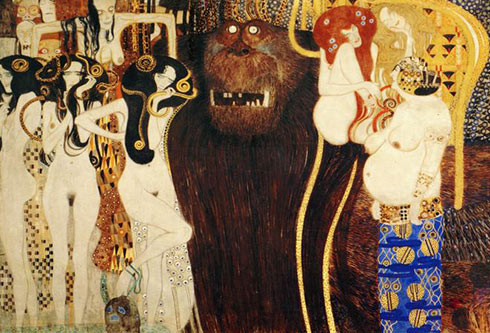
The wall begins as a crush of bodies and ends with one body alone. Around the dark mass of Typhoeus, nude women press close, faces hover above and ornament competes with flesh. Farther right, the crowd falls away. An emaciated figure crouches before the monster's long serpent body, folding her arms around herself. The 1902 exhibition catalogue calls her Gnawing Grief.[1][2]
Together these figures form The Hostile Powers, also translated by the Vienna Secession and other institutions as The Hostile Forces. The titles refer to the same group on the short wall of Gustav Klimt's Beethoven Frieze. They do not name a separate painting.[1][3]
The catalogue supplies a formidable list: Typhoeus the Giant; his daughters, the three Gorgons; Sickness, Madness and Death; Lust, Unchastity or Lechery, and Intemperance; Gnawing Grief. Klimt turns those abstractions into different kinds of bodies. Threat may be huge or skeletal, seductive or withdrawn, outwardly confrontational or inwardly consuming.[4]
The group is often summarised as evil defeated during humanity's search for happiness. Yet no defeat is shown. The armoured figure on the preceding wall does not enter the scene. Human yearning passes through the architectural turn and reappears beyond the group, moving towards Poetry and the Arts. The hostile powers remain present even as the allegory continues.[1][4]
At a Glance
- ArtistGustav Klimt
- Public titleThe Hostile Powers; institutional English also uses The Hostile Forces
- German programme titleDie feindlichen Gewalten
- Date made1901; first shown at the Vienna Secession's Beethoven Exhibition in 1902[1]
- MonumentBeethoven Frieze, a three-wall allegorical cycle
- LocationShort/end wall between the first and third phases of the frieze
- Named figuresTyphoeus; three Gorgons; Sickness, Madness, Death; Lust, Unchastity/Lechery, Intemperance; Gnawing Grief[4]
- Current physical recordAdjacent sections documented as panels 5 and 6, not two independently conceived pictures[3][5]
- MaterialsGraphite/drawing pencil, water-soluble casein, stucco relief, gilding and selective applied glass, mother-of-pearl and other components on plaster/mortar[3][4]
- Programme sourceAn anonymous text in the 1902 exhibition catalogue, shaped in relation to Richard Wagner's interpretation of Beethoven's Ninth Symphony[1][4]
- Current displayVienna Secession, on permanent loan from the Belvedere[1][5]
Reading the Catalogue and the Wall
The figures did not arrive with permanent labels written beside them. Their identities come from the short programme published for the 1902 exhibition. Its wording explains a scene that visible appearance alone cannot fully decode.[4]
Typhoeus can be recognised as a monster through scale, hybrid anatomy and staring eyes. The titles of the women are less self-evident. A nude body with luxuriant hair does not inherently mean Lust. A large belly does not universally mean Intemperance. The catalogue assigns those ideas within a historically specific allegory.
That distinction protects the work from two opposite errors. The first is to ignore the programme and invent identities from modern intuition. The second is to treat the catalogue as if it exhausts what the bodies communicate.
Klimt's figures exceed their names. The Gorgons are sensuous as well as threatening. The personification of Death is skeletal yet rhythmically integrated with surrounding limbs. Gnawing Grief can be understood through posture even before the title is known. Words establish the plan; form produces the encounter.
“Hostile Powers” and “Hostile Forces” are simply different English translations of feindliche Gewalten. “Unchastity,” “Lechery” and “Wantonness” similarly reflect translation choices for a period concept. Using the alternatives openly is more accurate than pretending that one English vocabulary came directly from Klimt.
The Shape of the Group
Klimt divides hostility spatially. The left and central part of the short wall is compressed. Typhoeus's heavy torso anchors a cluster whose bodies overlap and rise. The rightward stretch opens, leaving Gnawing Grief exposed before the monster's extended lower body and wings.[2][3]
The crowded passage operates vertically as well as laterally. The Gorgons stand together beside the monster. Above them hover Sickness and Madness, while the angular, depleted body identified as Death reaches across the upper zone. Several levels of threat occupy nearly the same width.
To Typhoeus's other side gather Lust, Unchastity and Intemperance. Their exposed bodies and jewellery differ from the mask-like heads above the Gorgons, yet the three-person arrangement creates a visual rhyme. The monster becomes an axis between two female clusters.
Gnawing Grief breaks that order. She neither confronts the viewer nor joins the display of bodies. Her compact posture reduces scale and closes attention inward. The blank interval around her makes isolation visible.
Above and beyond her, a small floating head resumes the current of human yearning. The placement prevents the short wall from ending in despair. Passage continues, but it does so over rather than through the crouching figure.[3]
The current object record divides the short-wall composition into adjacent panels. Secession documents panel 5 at 215 by 314 centimetres and panel 6 at 215 by 315.5 centimetres.[3] These are present sections created through the work's removal and preservation history. Klimt designed one wall encounter in which monster, crowd and isolation depended on one another.
Typhoeus as the Centre
Typhoeus provides the wall's physical scale. A dark gorilla-like front, blue wings and snake-shaped body spread across nearly the entire surface. Mother-of-pearl eyes face the viewer, and two skulls appear in a paw.[3][4]
The monster's body also connects otherwise unlike personifications. Gorgons, appetites and Grief do not share one action. They share proximity to Typhoeus. His mass makes the catalogue's list into a group.
Klimt draws on the ancient name without preserving standard Greek genealogy or anatomy. Hesiod calls Typhoeus a child of Gaia and Tartarus and describes numerous serpent heads before Zeus defeats him. The frieze instead gives him an ape-like torso and uses him as the centre of a modern allegory.[6]
Typhoeus carries a much larger history in Greek myth and in Klimt's possible visual sources. Within this wall, however, his immediate work is organisational. He establishes an overwhelming exterior force against which the surrounding bodies define other forms of danger.
The Gorgons appear to one side as a joined family. Appetites gather on the other. Grief contracts before the continued serpent body. Typhoeus is less the commander of a literal army than the wall's dark gravitational field.
The Three Gorgons
The Gorgons stand close together, exposed and elaborately animated through contour, hair and gaze. Klimt's treatment departs sharply from the glaring faces, tusks, snakes and winged monstrosity common in archaic Greek images. He makes beauty and danger difficult to separate.[7]
The 1902 catalogue calls them Typhoeus's daughters. That relationship belongs to the programme, not to the best-known ancient genealogy. In Hesiod, the three Gorgons—Stheno, Euryale and mortal Medusa—are daughters of the sea deities Phorcys and Ceto. Typhoeus has different parents, Gaia and Tartarus.[6][7]
The discrepancy is revealing. Klimt and the anonymous programme author did not assemble an archaeological family tree. They drew mythological beings into a new allegorical household so that the group could read as one hostile force.
Drawings show how carefully Klimt prepared the trio. Albertina's catalogue raisonné records numerous 1901 studies in which small changes of stance, hair, head position and gaze generate different degrees of exposure and menace.[8]
The Leopold Museum preserves a pencil drawing on packing paper, 44.6 by 30.6 centimetres, probably related to the middle Gorgon. A woman's head rests with her chin supported by both hands. The sheet is less an inventory of monstrous attributes than a psychological experiment in how an intense face can emerge from a compact gesture.[9]
Klimt's final trio depends on such transformations. Individually observed bodies become a repeated group. Natural pose becomes allegorical presence. Hair becomes linear energy capable of joining figures without eliminating their separate gazes.
Sickness, Madness and Death
Above the Gorgons, several heads and an angular depleted body occupy a narrow band. The catalogue identifies them as Sickness, Madness and Death.[4]
Their position matters. They do not stand independently on the ground line. They press down from above and complicate the upper edge of the cluster. Bodily and mental damage appear less as approaching characters than as conditions already suspended over the group.
Death is the most anatomically complete. The figure's thin body and sharply bent arms convert fragility into a hard sign. Albertina scholarship notes that Klimt studied older and younger, male and female possibilities before arriving at the final emaciated woman. The angular arm also echoes Typhoeus's gesture.[8]
Sickness and Madness are more mask-like. Their relative lack of bodies can make them feel disembodied, yet the catalogue anchors them to physical and mental states. Klimt does not provide medical symptoms from which a diagnosis could be made.
Modern viewers should resist turning these personifications into clinical claims. They belong to an allegorical vocabulary of 1902, not a scientific chart of illness. Their power comes from compression, gaze and proximity to Death rather than diagnostic accuracy.
Lust, Unchastity and Intemperance
On Typhoeus's right, three female figures personify appetite and excess. Institutional translations call them Lust, Unchastity or Lechery, and Intemperance. The titles frame female sexuality and bodily abundance as dangers within the quest for happiness.[2][3]
The figures are neither ashamed nor visually defeated. They display themselves with directness. Their hair, jewellery, colour and contour make them among the wall's most commanding presences. The allegory condemns them, while Klimt's design grants them visual authority.
An Albertina sheet catalogued as a Study for Lust dates to 1901 and uses black chalk on paper. At 45.1 by 31.1 centimetres, it isolates the head of the model Maria Helene Jamrich rather than the complete group. The museum's object text connects that face closely with the finished Unchastity figure.[10] The title and commentary therefore preserve different stages of classification instead of proving that one sitter supplied every part of one named allegory.
Intemperance is identified partly through her abundant body and rich applied decoration. Secession's digital account specifically notes glass stones attached to her figure.[2] That material claim should remain individual. It does not prove that every woman in the group carries the same glass components.
The wall exposes a period contradiction. Female nudity could be idealised in academic art, yet Klimt's assertive bodies provoked charges of obscenity. What disturbed critics was not nakedness alone. It was the mixture of erotic display, simplified anatomy, frontal address and decorative matter that refused the safe distance of a classical nude.[1]
Gnawing Grief
Gnawing Grief sits apart. Her body is thin, knees drawn in, shoulders folded and arms wrapped around the torso. Long hair hides or encloses the face. Unlike the figures beside Typhoeus, she does not look out.[2][5]
The pose makes emotion bodily without depending on facial expression. The arms offer self-protection, but they also seal the figure within her distress. Grief becomes a condition in which the body cannot extend towards anyone else.
Albertina research traces many discarded solutions. Klimt considered crouching, standing, clothed, half-clothed, young, old, male and female figures before choosing the final emaciated woman.[8] The sequence shows that allegorical identity did not dictate one automatic appearance.
Her relative lack of decoration strengthens the contrast with Intemperance and the Gorgons. The wall moves from abundance and display towards deprivation and withdrawal. Hostility is no longer an attractive temptation or giant external enemy; it has become suffering consumed from within.
The long body of Typhoeus continues behind her, but Grief is not simply another daughter clustered at his side. Empty space gives her a separate emotional register. She forms the wall's quietest and perhaps most severe obstruction.
Materials That Separate the Figures
The 1902 catalogue summarised Klimt's technique as casein colour, applied stucco and gilding. Conservation later identified a wider range across the frieze: graphite on dry plaster, water-soluble casein, opalescent and coloured glass, mirror fragments, mother-of-pearl buttons, metal rings and several forms of gilding.[4]
These substances are not spread evenly. Matte casein makes reflective insertions appear brighter. Stucco brings selected details forward. Gold can form a field, edge or accent. Glass supplies concentrated colour and shine.
The short wall uses those differences to distinguish bodies. Typhoeus's pearl eyes are hard points inside dark mass. Intemperance's glass stones make excess materially abundant. Pale, comparatively spare Grief withdraws from such glitter.[2][3]
Material therefore participates in meaning without acting as a codebook. Glass does not always mean temptation, and matte colour does not always mean sorrow. Substance controls attention first; interpretation follows from where and how it is used.
One caution is especially important. Aluminium foil has been identified in the knight's sword elsewhere in the frieze.[4] It should not be transferred to this wall merely because a list of conservation findings includes it. Object-specific material history is more illuminating than an undifferentiated catalogue of luxury.
The Scandal of the Short Wall
Contemporary criticism concentrated on the Hostile Powers. The Secession's history records attacks on Sickness, Madness, Death and Gnawing Grief as pathological distortion, while the naked Gorgons and figures of sexual appetite drew accusations of obscenity.[1]
The reaction reveals expectations placed on monumental allegory. Critics wanted elevated bodies and legible moral order. Klimt supplied a wall where moral danger could look beautiful, suffering could look deformed and applied glass could share status with drawing and paint.
The labels did not make the scene safe. Knowing that one figure meant Lust did not neutralise her gaze or bodily presence. In fact, the catalogue may have sharpened discomfort by naming sexuality as hostile while Klimt rendered it attractive.
The accusations also belong to their time. Repeating them without context would reproduce sensationalism. Their historical value lies in showing how radically the wall unsettled divisions between fine and applied art, beauty and illness, ideal nude and modern body.
Gender and the Allegory of Danger
Many hostile abstractions take female form. The three Gorgons, the personifications of illness and death, the sexual appetites and Grief surround one male-coded monster. On the preceding wall, a man in armour carries strength.
This division invites criticism. It draws on a long tradition in which women embody both desirable ideals and feared bodily forces. The right-hand trio makes female sexuality an obstacle, while Intemperance turns body size into moral evidence.
Yet the full frieze does not assign one value to all female figures. Women also embody Compassion, Ambition, Poetry, the Arts, yearning and choral joy. The final ideal realm is overwhelmingly carried through female bodies.[1][4]
That broader distribution does not erase the short wall's gender politics. It makes them inconsistent rather than simple. Klimt relies on women to materialise nearly every invisible state, whether praised or condemned.
The figures also exceed the system. Lust can command more attention than the allegory wishes to grant her. The Gorgons' beauty complicates danger. Grief produces empathy rather than moral rejection. Form gives each body an afterlife beyond its label.
Passage Without Defeat
The Hostile Powers occupy the architectural turn between appeal to strength and the realm of Poetry. They appear to require combat, but the frieze shows no battle.
At the top right, human yearning resumes. The movement passes beyond the hostile wall and meets Poetry on the next long side. Art, not a visible act of killing, provides the path towards fulfilment.[1][3]
This structure does not claim that danger vanishes. Typhoeus remains standing, the Gorgons remain exposed and Grief remains closed upon herself. The narrative continues in their presence.
For the viewer, turning the corner becomes the decisive action. The body in the gallery performs a transition that no painted hero completes. Hostile powers are encountered, not tidily eliminated.
Artist Up Close
Klimt built the wall through contrasts of scale, spacing and bodily openness. Typhoeus expands. The Gorgons align. Lust and her companions display. Death angles. Grief contracts. The same high strip of architecture holds incompatible postures without losing sequence.
The preparatory drawings show how this complexity grew from close attention to individual bodies. A model's head, hair or knee could be tested repeatedly before entering an allegorical group. Reduction did not mean indifference. Klimt simplified after observation.[8][9][10]
He also understood that ornament could increase rather than suppress disturbance. Glass stones make Intemperance more physically present. Pearl makes the monster stare. Linear hair joins the Gorgons into a rhythm that is both beautiful and threatening.
Most importantly, he denied the wall a single visual definition of hostility. Danger is not always ugly, active or external. It can seduce, overwhelm, waste away or turn inward. The group remains powerful because its catalogue names are clear while its bodies refuse to become simple illustrations.
Frequently Asked Questions
References
Accessed August 2026.
- Vienna Secession, “Beethoven Frieze,” official account of the programme, wall sequence, contemporary criticism, restoration and current display. View source.
- Vienna Secession / Google Arts & Culture, “Beethoven Frieze,” institutional digital story, group arrangement, Intemperance's glass stones and Gnawing Grief. View source.
- Vienna Secession / Google Arts & Culture, “Beethoven Frieze: ‘The Hostile Powers’ — Panels 5 and 6,” current panel identities, measurements, material summaries and spatial descriptions. Panel 5; Panel 6.
- Gustav Klimt Database, “The Golden Knight and Femmes Fatales, 1901–1903,” catalogue identities, chronology, materials and relation to the complete frieze. View source.
- Belvedere, Vienna, “Beethoven Frieze: The Hostile Powers — Panel 2, End Wall,” object date, material, dimensions, Gnawing Grief description, ownership and Secession loan. View source.
- Hesiod, Theogony, lines 820–852, translated by Hugh G. Evelyn-White, Perseus Digital Library, Typhoeus's birth from Gaia and Tartarus, monstrous body and defeat by Zeus. View source.
- The Metropolitan Museum of Art, Dangerous Beauty: Medusa in Classical Art, classical Gorgon genealogy, bodies and iconographic traditions. View source.
- Alice Strobl / Albertina Museum, “Beethoven Frieze, ‘Goldfish,’” catalogue raisonné essay on the Gorgons, Death, Lust, Intemperance and Gnawing Grief study sequences. View source.
- Leopold Museum, Vienna, “Female Head, Her Chin Resting in Her Hands: Study for the Gorgons in the Beethoven Frieze,” 1901, object record, materials, dimensions and attribution to the middle Gorgon. View source.
- Albertina Museum, “Study for Lust in the Beethoven Frieze,” 1901, object record, medium, dimensions, sitter identification and commentary connecting the head with Unchastity. View source.
Discussion
The Hostile Powers in Gustav Klimt's Beethoven Frieze rewards close attention to source context, object identity and careful reproduction boundaries.