 by Tom Gurney
Tom Gurney BSc (Hons) is an art history expert with over 20 years experience
Published on August 21, 2026 / Updated on October 23, 2026
Email: tomgurney1@gmail.com / Phone: +44 7429 011000
About Still Pond: A Morning by the Pond
The Gustav Klimt painting often called Still Pond is the Leopold Museum's A Morning by the Pond (Ein Morgen am Teiche), inventory 2007. Painted in 1899, it is a signed oil on canvas measuring 75.2 centimetres square. Stiller Weiher, literally “Still Pond,” belongs to the work's historical naming rather than identifying a second canvas. Rudolf Leopold acquired the painting under that title in 1976; the museum now uses A Morning by the Pond.[1][2]
The present name also restores the picture's location. For years the water was associated with Schloss Kammer Park on the Attersee. Research in the 1990s instead identified the site as the Eglsee, or Egelsee, near Golling bei Hallein in Salzburg, where Klimt stayed with the Flöge family in 1899. This is not an early Kammer view transported backwards in the chronology.[2][3]
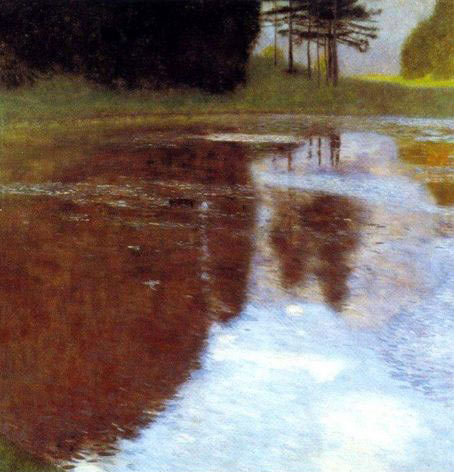
Its most important fact is visible before any biography is supplied. A narrow green bank sits high in the square, while water occupies almost everything below. The sky itself is outside the frame, yet its pale light and clouds reappear across the pond. Klimt turned reflection from a secondary landscape effect into the principal field of the painting. That reversal helped make the canvas a decisive early square landscape.[1][3]
At a Glance
- ArtistGustav Klimt
- Current titleA Morning by the Pond (Ein Morgen am Teiche)
- Historical titleStill Pond (Stiller Weiher)
- Date1899
- MaterialsOil on canvas
- Dimensions75.2 × 75.2 × 2.2 centimetres
- SignatureGUSTAV KLIMT, lower left
- SubjectThe Eglsee/Egelsee near Golling bei Hallein, Salzburg
- First public presentationSeventh Vienna Secession exhibition, 1900
- InventoryLeopold Museum 2007
- CollectionLeopold Museum Private Foundation, Vienna, from 1994
- Current accessDisplayed on OG4 as of 10 August 2026; verify before travelling[1]
Still Pond and A Morning by the Pond
The two English names encourage different ways of looking. “Still Pond” emphasises the calm surface. “A Morning by the Pond” adds time and light, directing attention to the delicate illumination that reaches the viewer through reflection. Neither title creates a different version or state.
The Leopold Museum's exact measurements, signature, image, inventory and provenance all belong to one object.[1] The historical name remains worth preserving because it formed part of the canvas's documented twentieth-century life. The Leopold/Klimt Centre record states that Rudolf Leopold obtained it in 1976 as Stiller Weiher.[2] A familiar translation can therefore be acknowledged without overriding the current institutional identity.
“Morning” should not be made more precise than the evidence allows. The holder identifies an early light, and the surface contains pale bluish-pink reflections and muted colours broken with white.[1] That supports an account of dawn-like or morning illumination. It does not supply an exact hour, temperature or dated outdoor session.
The distinction matters because the canvas does not present a literal weather report. Klimt selected a quiet body of water, a high shore and a reflected atmosphere, then fitted them into an equal-sided field. The title helps describe that experience; it is not permission to reconstruct every condition under which the painting was made.
The Signed Square Canvas
The physical record is unusually clear. The painting is oil on canvas, 75.2 centimetres high and wide and 2.2 centimetres deep, signed GUSTAV KLIMT at lower left.[1] Its modest size distinguishes it from the 110-centimetre-square landscapes that Klimt would paint later, but the support already establishes the square as a complete pictorial problem rather than a cropped fragment of a wider panorama.
The signature occupies one of the few comparatively firm zones in the image. It sits close to the narrow bank rather than floating in the reflected expanse. That placement does not prove a symbolic opposition between land and water, but it reinforces a basic formal difference: the upper strip offers ground, trees and shore; most of the canvas gives those certainties over to liquid light.
No retained object report identifies a preparatory drawing, working photograph, transfer grid, X-radiograph, infrared image, pigment analysis or complete layer sequence for this painting. Its oil medium should therefore remain exactly that. White-broken colour and luminous water do not imply metal, gold leaf, casein or a technical recipe borrowed from another Klimt landscape.
Visible handling can still be discussed. The narrow bank is assembled from light green and darker vertical or clustered forms. Across the pond, bluish, pinkish and greyed passages interrupt one another without becoming a hard-edged map of reflected objects. Their variation allows the surface to remain recognisably watery while carrying a displaced sky.
Eglsee near Golling, Not Schloss Kammer Park
The topographic correction changes more than a label. Klimt spent part of the summer of 1899 with members of the Flöge family at Golling bei Hallein. The pond is the nearby Eglsee, also spelled Egelsee, in the Salzburg region.[1][3][4] Its place in the artist's career comes before the sustained Attersee summers that began the following year.
Older literature connected the view to Schloss Kammer Park. The Leopold/Klimt Centre account explains that this association persisted until research in the 1990s identified the Golling site.[2] The correction concerns the geography attached to the same painting. It does not reveal a lost Kammer canvas, a hidden second state or an independent pond with an identical design.
That boundary separates the work from On Lake Attersee, painted in 1900, and from the later Kammer landscapes. It is also distinct from MoMA's The Park, whose dense canopy, hedge and lake opening pose a different problem. Shared water, vegetation or square format cannot transfer their locations, dates, technical evidence or ownership histories to inventory 2007.
The exact point from which Klimt observed the Eglsee has not been secured. Nor has a dated photograph been linked as preparation. The site's identification supports the subject and the 1899 Golling context, not a metre-by-metre reconstruction of where the painter stood.
Klimt's correspondence does offer a narrow glimpse of working conditions. In a postcard of 31 August 1899, he complained that the weather was obstructing his painting; another communication refers to returning home at the end of the month.[2][4] These documents confirm that outdoor work was vulnerable to changing conditions during the Golling stay. They do not identify the pond as the canvas he was handling on either date, establish how many sessions it required or prove that a defined portion was completed later in Vienna.
That limit is useful. The painting's tranquil title and surface should not be mistaken for a continuous record of calm weather. A finished morning effect could depend on observation, memory and continued adjustment without allowing the surviving correspondence to recover an exact schedule. The letters strengthen the seasonal context while leaving the canvas's individual making sequence open.
A High Shore and a Low Field of Water
The upper bank is narrow enough to seem almost like a heading above the pond. Its pale greens establish a strip of land, while darker plants or trees create an irregular vertical rhythm. The water begins high and extends to the lower and side edges, making reflected atmosphere the viewer's principal encounter.
This distribution resists the conventional division of landscape into foreground, middle ground and distant sky. There is a shore, but little open land from which to enter the scene. There is sky, but mostly as an image carried by water. The pond becomes both subject and visual mechanism: it receives forms located beyond or above the frame and turns them into colour on its surface.
The Leopold/Klimt Centre description identifies reflected white clouds and parkland, budding water-lily leaves, the Tennengebirge dissolving in mist and a bright yellow-green area towards the upper right.[2] These details do not need to be converted into a botanical inventory. Their importance lies in how differently they declare themselves. The bank is relatively concentrated; mountains, clouds and plants become partial, softened or interrupted as reflection and atmosphere.
The high horizon also changes the viewer's imagined position. Instead of looking across water towards a low distant line, one looks down into an extensive surface. Depth does not disappear, but it is made ambiguous. The pond can be read as recession into space and, simultaneously, as a broad plane of shifting marks.
That double reading is central to Klimt's later landscapes, yet here it appears with unusual economy. Architecture, figures and narrative incident are absent. A shore and its reflected surroundings are sufficient to make depth, surface and light compete throughout the square.
Where the Sky Has Gone
The painting's calm depends on an apparent omission. Klimt gives almost no direct sky. The viewer discovers it indirectly in pale regions spread across the water. Contemporary critic Ludwig Hevesi noticed the effect when he described smooth water with “very much sky in it.”[2]
The phrase is exact because the pond does not merely mirror a neatly bounded cloud. Atmospheric colour seems distributed through the entire lower field. White-broken pastels soften transitions, while muted secondary tones prevent the reflection from becoming a bright decorative mosaic.[1] Water remains a continuous substance even as its surface breaks into many small differences.
Reflection is not literal symmetry. The narrow bank above does not simply repeat upside down below. Some forms can be related to shore or foliage; others are absorbed into light, cloud and movement. The painted pond therefore mediates between observed place and a field that can be explored for colour independently of topographic recognition.
Calling that field abstract would be too simple. The image still depends on a real site, legible water and reflected surroundings. But the conventional hierarchy has changed. The solid objects no longer command the greatest area or detail; their unstable appearance in water does.
Nor does this displacement prove a private spiritual programme. The pond can invite contemplation without becoming evidence of transcendence, romance, foreboding or death. Its strongest interpretive claim remains pictorial: Klimt made the absent sky active by placing its image beneath the viewer.
Klimt's First Square Landscape
The Leopold Museum calls A Morning by the Pond Klimt's first square landscape.[1] The Klimt Database places it among his first square nature pictures and identifies it as the beginning of a sustained investigation of reflection.[3] These formulations are compatible when their scope is preserved.
The claim does not make the work Klimt's first landscape, first oil painting or first square object in every medium. It identifies a turning point within his painted landscapes. The equal sides refuse the easy lateral expansion offered by a panoramic lake view. Shore, water and reflected sky must coexist inside a compact field with no dominant horizontal direction.
The square also makes the high shoreline unusually forceful. In a wider support, the bank might extend as a scenic strip and invite movement from side to side. Here it caps the pond while the lower expanse presses equally towards both lateral edges. The result feels self-contained even though much of the represented world—the actual sky, most surrounding ground and the full mountains—is outside the frame.
That paradox became productive for Klimt. The format could isolate a selected portion of nature while allowing marks and colour relationships to acquire unusual autonomy. Yet the achievement should be understood through this particular canvas before it is generalised into a formula for every later landscape.
Khnopff, Monet and the Viewfinder
The Klimt Database relates the composition to Fernand Khnopff's Unmoved Water: The Pond of Menil, a work of about 1894 shown in Vienna in 1898. Its still water, high division and reflective quiet offered a close contemporary precedent. Specialist research describes Klimt's painting as a response to that example rather than an accidental resemblance.[3][6]
Response does not mean tracing or exact copying. The Eglsee canvas belongs to a different place and transforms its reflected atmosphere through Klimt's own square organisation and white-broken colour. No document states that Khnopff's work sat beside the canvas as Klimt painted.
Claude Monet provides a broader comparison. His experiments with square formats, water and reflections demonstrate how European painters were allowing unstable surfaces to carry more of a landscape's visual structure.[3] This context is useful because it clarifies a shared problem, not because a specific Monet has been proved as the template for every passage.
Klimt's use of a cardboard viewfinder with a square opening is documented in an autograph account of his landscape practice.[3] Such a device could help isolate a section from a much wider visual field, and it offers a plausible context for the strict selection seen here. But no surviving viewfinder has been tied to this exact pond, position and day. The evidence supports a working habit, not a mechanical reconstruction.
Together, these comparisons show an artist learning from a contemporary visual culture of selection and reflection. They do not reduce the painting to borrowed sources. Its distinctive decision was to make a small Salzburg pond carry almost an entire sky inside a square.
The Seventh Secession Exhibition
Klimt first presented the painting publicly at the seventh Vienna Secession exhibition, held from March to June 1900.[2][3] It appeared with other landscapes and with Philosophy, the Faculty Painting that attracted fierce attention. That shared setting is chronologically useful, but the pond does not need to become another chapter in the university controversy.
Hevesi discussed three of Klimt's mood landscapes and singled out the reflective effect of the smooth water.[2] His response shows that contemporary viewers recognised the apparent simplicity of the motif and the sophistication with which it displaced the sky.
The exhibition also marked an early market success. The Klimt Database records that the landscapes shown with it found buyers, while A Morning by the Pond entered private ownership.[3] A quiet nature painting could therefore be read and purchased on its own terms even while the artist's monumental commission provoked institutional conflict.
The secure sequence is concise: painted in 1899, first exhibited in 1900, then placed in a private collection. The exhibition date should not be used to redraft the canvas as a 1900 work, just as its later Attersee loans do not change the Golling subject.
Fritz Waerndorfer and the Herrenzimmer
Specialist accounts identify Fritz Waerndorfer as the early owner. A major supporter of Viennese modernism and later co-founder of the Wiener Werkstätte, he assembled works by Klimt and other contemporary artists.[3][5]
The pond painting was installed in the Herrenzimmer of Villa Waerndorfer, an interior designed by Josef Hoffmann. It appeared there with two other early Klimt landscapes.[2] This setting matters because it shows the canvas operating as part of a deliberately modern domestic environment rather than only as an exhibition object.
Nothing in that placement proves that Klimt painted the work on commission for the room. The canvas already had its Golling subject and Secession history. Waerndorfer's installation was an act of collecting and arrangement, joining landscape, furniture and interior design after the work's creation.
The room should also remain proportionate within this account. Its wider decorative programme and Waerndorfer's full patronage network belong to broader histories. For this object, the high-value fact is more focused: an experimental square landscape found an early home inside one of Vienna's notable modern interiors.
Galerie Miethke and Hermine Lasus
The Leopold Museum's live provenance records Galerie Miethke on 5 October 1911 and Hermine Lasus from 1912.[1] The Leopold/Klimt Centre folder describes the gallery mediating the change of ownership in 1912 for 3,000 crowns.[2]
These dates can be reconciled without inventing two transactions. The 1911 entry marks the gallery record, while 1912 marks the transition into Lasus's ownership described by the later account. Both attach to the same canvas and to one movement through Miethke.
Lasus retained the painting until 1954 according to the current object record.[1] The dates should not be expanded into an object-specific persecution or restitution narrative that the holder does not publish. Family histories associated with other works cannot supply a forced sale, seizure or wartime movement for this one.
This restraint is not a claim that the wider period was uneventful. It preserves the difference between known provenance and conjecture. Here the secure statement is ownership by Hermine Lasus from 1912 to 1954; the current record does not document an involuntary wartime transfer of the canvas.
From the Danilowatz Family to Rudolf Leopold
Marko Danilowatz held the work from 1954 until 1971. It then passed to Bibiane Preisinger, née Danilowatz, who retained it until 1975. In that year George McGuire and Rudolf Leopold jointly acquired it.[1] A spelling variant of McGuire's name in supporting literature does not indicate another owner.
In 1976 Martin Ackermann took McGuire's half-share, and Rudolf Leopold obtained full ownership later that year. It was at this point that the painting was documented under Stiller Weiher.[1][2] The title history and ownership history meet here: the name familiar in English reflects a genuine catalogue layer, even though the museum now favours A Morning by the Pond.
Leopold held the canvas until 1994, when it was contributed to the Leopold Museum Private Foundation.[1] That transfer established its present institutional home and inventory 2007. Past international exhibitions and a 2013 presentation at the Klimt Centre on the Attersee widened access, but they did not relocate the subject from Golling or convert a loan venue into permanent ownership.[2]
As of 10 August 2026, the live Leopold record marked the painting displayed on OG4.[1] Because works can move for loans, conservation or rehanging, visitors should confirm its status shortly before travelling.
Why A Morning by the Pond Matters
The painting joins a precise place with an unusually selective act of seeing. Eglsee supplies the bank, pond, distant mountains and reflected sky. Klimt's square suppresses most surrounding geography and makes water the dominant bearer of the landscape.
Its title history reveals how easily a calm image can acquire a generic identity. “Still Pond” describes the subject persuasively, but A Morning by the Pond restores the current institutional name and directs attention towards light. The geographical correction works similarly: it replaces an appealing Kammer association with the better-supported Golling site.
The canvas also clarifies what innovation can look like without spectacular materials or narrative. There is no documented gold, monumental figure or elaborate allegory. Shore, reflection and format are enough. The square contains little direct sky, yet the viewer experiences sky almost everywhere.
That is why the work occupies an important position between Klimt's early landscapes and his sustained later engagement with lakes, gardens, orchards and woods. It does not announce a single formula for them all. It demonstrates one durable possibility: a landscape can become most expansive when the visible world is tightly selected and its atmosphere is encountered indirectly.
Frequently Asked Questions
References
- Leopold Museum, “A Morning by the Pond,” online collection, inventory 2007, accessed 10 August 2026, https://onlinecollection.leopoldmuseum.org/en/object/2148-a-morning-by-the-pond/.
- Leopold Museum and Klimt Centre, Ein Morgen am Teiche, object folder, 2013, accessed 10 August 2026, https://www.leopoldmuseum.org/media/file/335_GKZ_Folder_Ein_Morgen_am_Teiche_2013.pdf.
- Gustav Klimt Database, “Cradle of Modernism: 1898–1900,” accessed 10 August 2026, https://www.klimt-database.com/en/klimts-artworks/1898-1900/cradle-of-modernism/.
- Gustav Klimt Database, “Salzkammergut,” accessed 10 August 2026, https://www.klimt-database.com/en/network-vienna-1900/places/salzkammergut/.
- Gustav Klimt Database, “Fritz Waerndorfer,” accessed 10 August 2026, https://www.klimt-database.com/en/network-vienna-1900/benefactors/fritz-waerndorfer/.
- Gustav Klimt Database, “Fernand Khnopff,” accessed 10 August 2026, https://www.klimt-database.com/en/network-vienna-1900/colleagues/fernand-khnopff/.
Discussion
Still Pond: A Morning by the Pond rewards close attention to source context, object identity and careful reproduction boundaries.