 by Tom Gurney
Tom Gurney BSc (Hons) is an art history expert with over 20 years experience
Published on August 21, 2026 / Updated on October 23, 2026
Email: tomgurney1@gmail.com / Phone: +44 7429 011000
About Maria Munk by Gustav Klimt: Portrait of Ria Munk III
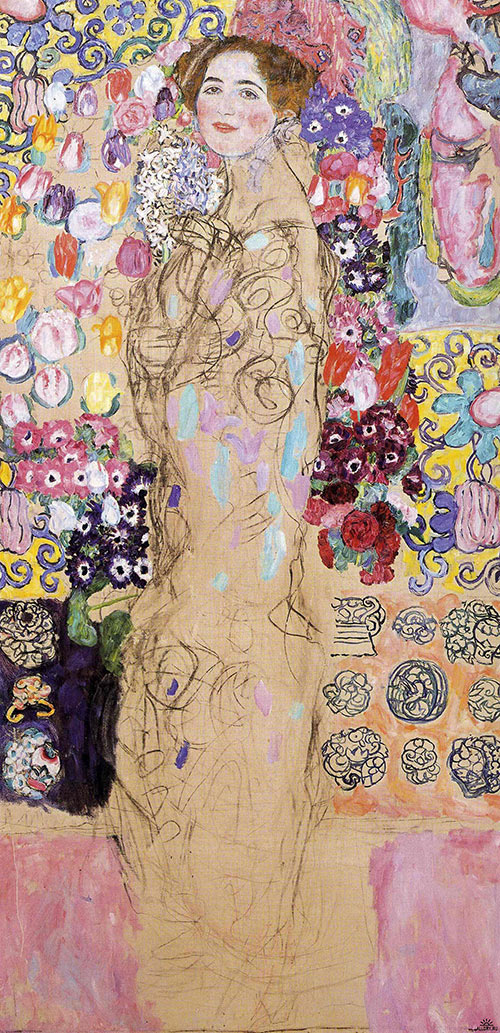
The painting often introduced simply as Maria Munk is Gustav Klimt's unfinished Frauenbildnis, conventionally known as Portrait of Ria Munk III. Maria Munk was called Ria. The Roman numeral identifies this tall canvas as the third portrait associated with her family's posthumous commission; it does not mark a third state of one painting or appear as a title inscribed by Klimt.[1][2]
Klimt began the work in 1917 and left it unfinished when he died in February 1918. Christie's records the surviving object as oil and charcoal on canvas, 180.7 × 89.9 centimetres, and dates it 1917–18. The Klimt Database uses the single year 1917. These are catalogue conventions for the same canvas, now credited to The Lewis Collection.[1][2]
The painting's incompletion is not a minor condition note. A comparatively resolved face and head rise above passages where charcoal remains exposed and clothing, floor and surrounding ornament are still being negotiated. The surface preserves a working relation between drawing and paint that a finished portrait would normally conceal. Yet it does not reveal exactly how Klimt intended to complete every open area.[1]
Its identity requires equal care. Ria died in 1911, aged twenty-four, so she could not have sat for Klimt in 1917. Family commission history, the sequence of portraits and long-standing scholarship support the title Ria Munk III. Christie's nevertheless cautioned that the precise identity of the represented woman is unknown. The responsible account preserves both facts rather than inventing a substitute sitter or a photographic-transfer process.[1][2]
At a Glance
- ArtistGustav Klimt
- Governing titlePortrait of Ria Munk III
- Other title layersFrauenbildnis, Portrait of a Lady (Ria Munk) and Posthumous Portrait of Ria Munk III
- Subject's nameMaria Munk, called Ria
- Date1917–18; the Klimt Database uses 1917
- MediumOil and charcoal on canvas
- Dimensions180.7 × 89.9 centimetres
- StateUnfinished at Klimt's death in February 1918
- Commission contextThe third portrait associated with Alexander and Aranka Munk's posthumous memorial commission for their daughter
- Recorded early ownerAranka Munk, Vienna and Bad Aussee
- Former public collectionNeue Galerie der Stadt Linz, later Lentos Kunstmuseum, inventory 149
- RestitutionReturned to Aranka Munk's heirs in June 2009
- 2010 sale£18,801,250 at Christie's London on 23 June 2010
- Current collection creditThe Lewis Collection, private; no public display is verified for August 2026[1][2][3][7]
Maria, Called Ria
Maria Munk was born in 1887 to the Viennese industrialist Alexander Munk and Aranka Pulitzer Munk. Within the family she was known as Ria. Aranka's sister Serena had married August Lederer, one of Klimt's most important collectors, and current research considers it likely that the Lederers helped connect the Munks with the painter.[2]
Ria died by suicide on 28 December 1911. She was twenty-four. That fact explains why the later pictures are posthumous commissions, but it should not become a sensational key to every colour, flower or unfinished contour. The painting is evidence of a family's repeated effort to secure a memorial image; it is not a complete biography of Ria's death or a confession by the artist.
The title history reflects the difficulty. Earlier catalogues often used the descriptive German Frauenbildnis or Damenbildnis, meaning a portrait of a woman. Modern sources add Ria's name and the numeral III. The form Portrait of Ria Munk III is therefore a scholarly identification that connects the object to the commission sequence. It should not be mistaken for a wording visibly painted on the canvas.
Christie's placed an important qualification beside that established usage. Its 2010 catalogue stated that the woman's exact identity was unknown, although the picture had long been regarded as Klimt's last portrait of Maria Munk.[1] That is not a reason to detach the painting from the Munk history. It is a reason to distinguish a well-supported commission identity from absolute certainty that every visible facial feature reproduces Ria's appearance.
The distinction matters because posthumous portraiture can draw on several kinds of evidence: previous images, family memory, related studies and the artist's own reformulation of a likeness. No cited record proves that Klimt used a particular photograph, and no documented woman has emerged as a replacement model. A face painted in 1917 cannot be evidence of a live sitting by Ria.
One Canvas, Several Title and Date Conventions
The German and English names do not describe multiple surviving paintings. Frauenbildnis, Portrait of a Lady (Ria Munk) and Portrait of Ria Munk III all govern the same narrow full-length canvas. The “III” places it after two other portrait attempts; it does not mean that Klimt revised this canvas through three numbered states.[1][2]
Christie's object record supplies the most exact measurements: 70 1/8 by 35 3/8 inches, or 180.7 by 89.9 centimetres. Lentos and recent exhibition material sometimes round these figures to 180 by 90 centimetres. The difference is one of published precision, not evidence of trimming or a second object.[1][9]
The 1917–18 date likewise describes one work. Klimt began it during 1917, and it remained in progress at his death in February 1918. The Klimt Database's 1917 convention emphasises the documented starting year; the broader range acknowledges that the unfinished canvas remained among the artist's late works into 1918.[1][2]
Its documented medium is oil and charcoal on canvas. Charcoal is not merely preparatory information buried beneath the colour. It remains visible because the painting never reached a final, fully painted state. No source attached to the exact object establishes gold leaf, silver, applied textile or metallic ornament. Patterned passages must therefore be described as painting and drawing, not as physically attached fabric.
A Figure Built for a Narrow Vertical Field
The support is approximately twice as high as it is wide. Klimt uses that proportion to make the woman and her surrounding ornament rise together. She stands in profile or near profile through the body, while her head turns outward towards the viewer. The turn prevents the tall figure from becoming a purely lateral silhouette.[1]
The head occupies the most pictorially settled zone. Hair, face, eyes and mouth have received enough modelling and colour to establish a specific presence. A slight smile or softened mouth meets the viewer rather than withdrawing into the surrounding patterns. Yet even here, completion should be expressed comparatively: the face is more resolved than much of the lower canvas, not certified as the last word Klimt intended.
Below the neck, certainty begins to shift. The garment gathers patterned forms and curved lines, but passages remain open. Some contours are carried by charcoal; some ornament has been tried in colour; other areas have not been integrated into a continuous final surface. The transition is gradual rather than a neat border between a finished upper half and an untouched lower half.
The lower field is especially revealing. It contains a developing arrangement of dress, surrounding motifs and floor-like space, but its parts do not settle into a fully closed environment. The figure's lower body is less firmly established than her face. Charcoal marks retain alternative possibilities that later paint might have clarified, covered or reoriented.
The woman is therefore not simply placed in front of a completed background. Figure, clothing and setting are being made together. Floral clusters and arabesque-like patterns gather around the body, while ornamental zones begin to absorb its edges. The canvas shows Klimt seeking the point at which a represented person and a decorative field could remain distinct without becoming separable.[1][5]
The narrow format intensifies this problem. There is little lateral room for furniture, architectural depth or a conventional domestic setting. Instead, the woman's height supplies the main axis. Pattern spreads vertically around her, and the unfinished lower part makes the act of extending that axis visible.
This is a formal fact before it is a psychological symbol. The open charcoal does not prove grief, spiritual disappearance or deliberate fragmentation. Nor does the incomplete body imply that Klimt wished the subject to remain permanently immaterial. Those readings may be prompted by a posthumous portrait, but the object gives firmer evidence of interrupted work than of a fixed allegorical programme.
What the Unfinished Surface Reveals
Christie's described the face and head as virtually complete while noting that the dress and floor still required substantial design.[1] The contrast makes the portrait unusually informative about working method. Finished late portraits can make dense ornament look instantaneous. Here the viewer can see that arrangement continuing across both paper-like drawing marks and painted decisions on canvas.
Klimt did not merely colour inside a fixed full-scale outline. Exposed charcoal shows that contours could be made, reconsidered and strengthened while the painting developed. Painted passages sometimes secure a decision; elsewhere drawing remains the more legible structure. The relation between the two media is active rather than chronological in a simple “drawing first, colour second” formula.
The visible state does not permit a complete sequence of strokes. A charcoal line may precede adjacent paint, survive because Klimt had not reached it, or remain as part of a decision still under review. Without technical evidence tied to every passage, the page should not announce which hand, fold or floral unit came first.
Nor should incompletion be confused with damage. The open lower areas are historically meaningful because Klimt stopped working when he died, not because paint was later scraped away. Their incompleteness belongs to the making of the canvas. Later loss, overcleaning or deliberate removal is not needed to explain what is visible.
At the same time, the work is more than a raw beginning. The resolved head, coloured motifs and vertical arrangement show prolonged thought. The canvas had advanced far enough for Klimt's integration of face, dress and field to become legible. Calling it an oil sketch would understate its scale, commitment and developed passages.
The work's title and state can easily invite the idea that absence itself is a memorial symbol. That interpretation must remain bounded. Klimt did not choose to present the painting unfinished, and no source records that he considered it complete. Its poignancy now arises partly from historical interruption, but that later experience should not be projected backwards as his proven intention.
Three Portrait Attempts, Not Three States
The first Munk commission produced Portrait of Ria Munk on Her Deathbed in 1912. It is a separate, small horizontal oil in private ownership. It depicts Ria after death and belongs to an earlier memorial convention. Its date, orientation and composition distinguish it immediately from the tall unfinished canvas begun five years later.[2][9]
Surviving correspondence indicates that the commission was difficult. Klimt was relieved when delivery of the first portrait could be delayed. In a later message he described the Munk portrait as a painful problem because he could not achieve the likeness.[2] The remarks document frustration; they do not prove which visible passages of Ria III caused it or establish a day-by-day chronology for all three paintings.
Current research proposes a second full-length portrait effort around 1916/17. It is commonly connected with the painting now known as The Dancer. According to family testimony, an unsatisfactory Munk portrait may have been transformed into the visible dancer. The Klimt Database and recent Lentos material retain that relationship as a hypothesis rather than a completed forensic demonstration.[2][9]
That proposed second attempt must remain separate from Ria III. The Dancer has its own visible figure, now associated through a related drawing with the dancer Johanna Jusl, and its own unfinished lower passages. No published X-ray has revealed an intact hidden Ria portrait beneath it. It is not a first state of the Lewis Collection canvas.
Ria III is the third attempt in this commission history. It was made on another support and remained recognisable as an unfinished portrait. Its sequence number records the family's repeated request and Klimt's renewed effort; it does not convert the three pictures into stages that can be superimposed.
The progression also resists a simple story of improvement. The deathbed portrait, the proposed transformed second commission and the final unfinished full-length image answer different visual problems. One memorialises the deceased body, one may survive only through a later transformation, and one preserves an interrupted attempt to represent Ria upright and vividly present.
A Posthumous Likeness without a Live Sitting
The central evidentiary limit follows from the dates. Ria died in 1911; this canvas began in 1917. A “study for Ria Munk III” can therefore be securely related to the composition without documenting Ria herself drawing breath before Klimt's pencil.
Institutional titles often name the intended painting rather than certify the identity of the model on a sheet. Klimt could explore a head angle, torso turn or blouse for a posthumous portrait by working with another person, adapting earlier visual material or testing an imagined solution. The surviving records do not establish which mechanism he used in each case.
Christie's caution about the painted woman's identity protects this distinction.[1] Facial resemblance to the 1912 image and the commission's ownership support the Ria association. They do not identify an undocumented substitute sitter, prove that Klimt transferred a photograph or settle how the family judged the likeness.
The lack of a live sitting does not make the picture a generic fantasy portrait. It was accepted into Aranka Munk's possession after Klimt's death and remained tied to her daughter in family and museum records. Posthumous subject identity and visible model identity are related questions, but they are not identical.
Drawings as a Field of Possibilities
The Leopold Museum reports that Alice Strobl associated more than ten head studies with the full-length portrait.[5] That is a scholarly group, not a count of Ria's sittings. It also should not be expanded into a claim that every sheet was transferred directly to the canvas.
One particularly close drawing is Leopold Museum inventory 1295, Bust Portrait of a Lady with Ornamented Blouse. Dated circa 1917, it is pencil with white chalk and blue and red crayon on Japanese paper, measuring 50.2 × 32.5 centimetres. Klimt signed the sheet in pencil at lower right.[5]
The museum regards it as the closest known head study to the painting. Both show an oval half profile, rounded chin and smiling mouth, while the direction of the upper body is reversed: it turns right in the drawing and left in the canvas. That difference is valuable. It shows a relation strong enough to illuminate development without making the sheet a mechanical cartoon.[5]
The coloured crayons and white heightening give the study a painterly quality. Its ornamented blouse also anticipates arabesques found in the canvas, although Klimt never fully elaborated the garment there. The drawing can demonstrate how line, colour accent and dress pattern were tested together. It cannot prove that its unnamed model was Ria.
Albertina inventory 22396 offers another exact anchor. Catalogued as Study for Portrait of Ria Munk III, circa 1917, it is pencil on paper, 49.8 × 32.2 centimetres, and belongs to the institution's Ria Munk portfolio. The Albertina records it as Strobl 2617 and notes its acquisition in 1920 through a dedication from Otto Nirenstein, later Otto Kallir.[6]
The Albertina title secures the sheet's scholarly relation to this painting. It does not turn all nearby late drawings into Ria studies, nor does it overcome the six-year gap between Ria's death and the canvas. Representative sheets show Klimt testing alternative contours and poses around the commission rather than following one fixed template.
Christie's in 2010 referred to a larger body of half- and full-length sketches.[1] The exact total varies with the scope of attribution. The safest conclusion is that Klimt worked through numerous drawings while continuing to revise in charcoal on the canvas itself. Preparation did not eliminate invention during painting.
The study record also prevents a false reconstruction of one decisive sitting. Different orientations, levels of finish and combinations of pencil, chalk and coloured crayon show a problem being reconsidered across sheets. They can clarify how a turned head, rounded chin or patterned blouse entered the portrait's development, but they cannot be arranged into a complete calendar of sessions. Most importantly, a 1917 sheet catalogued for Ria III documents work towards the memorial painting; it does not overturn Ria's 1911 death or prove that the woman drawn was the person named in the title.
Aranka Munk and the Unfinished Portrait
After Klimt's death, the unfinished canvas passed to Aranka Munk. Christie's records her in Vienna and Bad Aussee as acquiring it from the artist; Lentos provenance research places the picture in her villa at Bad Aussee.[1][3] No surviving record cited here supplies a completed purchase contract, estate-sale price or formal acceptance of the painting as finished.
Aranka's ownership gives the Ria identification substantial historical weight. The canvas did not circulate immediately as an anonymous studio remnant. It entered the household of the mother who, with Alexander Munk, had sought portraits of their deceased daughter.
That custody also links the object to the persecution of the family after Austria's annexation by Nazi Germany. Aranka and her daughter Christine, called Lola, were deported to the Łódź ghetto in 1941. Aranka was murdered after deportation; Lola was murdered at Chełmno in 1942. Family property in Vienna and Bad Aussee was seized.[2][3][9]
The history should be stated without turning the painting into a surrogate for every loss the Munks suffered. Aranka and Lola were people, not provenance labels. Their persecution explains why ordinary assumptions about voluntary transfer cannot be made, while the object record must still identify exactly what is and is not documented.
Lentos research says the trace of Ria's portrait disappears after Aranka's deportation.[3] That break is the central custody problem. The painting later appeared with the dealer and collector Wolfgang Gurlitt, but the circumstances by which he obtained it have not been established.
Older accounts offered a more continuous story, sometimes describing seizure of the villa and a direct passage to Gurlitt. The museum's later provenance finding is more cautious: after Aranka lost control, the trail goes dark; no known record proves whether Gurlitt obtained the work through a sale, gift, confiscation or another transfer. Uncertainty about the mechanism does not diminish the documented persecution.
Wolfgang Gurlitt, Linz and the Missing Transfer
Wolfgang Gurlitt was active as a dealer and collector before, during and after the Nazi period. He helped form the collection of the Neue Galerie der Stadt Linz, the institution that eventually became Lentos Kunstmuseum. The city acquired significant groups of works from him in the 1950s and later subjected those holdings to systematic provenance research.[3]
For Ria Munk III, the key documented event is Gurlitt's 1956 sale to the City of Linz. The painting entered the Neue Galerie as inventory 149.[1][3] What happened immediately before that transaction remains unresolved.
The gap cannot be repaired by calling the 1956 museum purchase illicit in itself, nor by treating it as proof that Gurlitt held good title. It means that a public institution acquired an object whose passage from a persecuted owner to its dealer source was unexplained. That is precisely the kind of discontinuity provenance research is meant to test.
While in Linz, the painting became publicly visible and travelled to many exhibitions. Christie's records loans beginning in 1957 and continuing through major Klimt presentations in Europe, Japan and the United States.[1] Museum visibility, however, did not resolve the earlier transfer. A work can be widely published and still have a broken ownership history.
Recent Lentos material adds a revealing physical distinction. The canvas was restituted, but its original frame remained at Lentos.[9] Frame custody should not be confused with ownership of the painting. Nor should photographs of the formerly framed work be taken as evidence that the canvas is still in Linz.
The 2009 Restitution
Lentos and the City of Linz investigated the provenance of works acquired from Gurlitt. In Ria Munk III's case, the city acknowledged Aranka Munk's persecution and the unresolved circumstances by which the portrait had left her control. It restituted the canvas to her heirs in June 2009.[1][3][4]
The return was completed; it is not an open claim. The word “restitution” matters because the museum did not simply deaccession a surplus painting or sell it to the family. It restored possession to the heirs after research connected the custody gap with Aranka's persecution.
The case also demonstrates why gaps must remain visible in public object histories. Restitution did not depend on inventing a precise undocumented transaction with Gurlitt. The established facts—the family ownership, deportation, subsequent disappearance of the portrait's trace, later Gurlitt possession and the absence of a legal transfer record—were sufficient for the city to recognise the claim.[3]
The painting's incomplete surface and incomplete provenance are different kinds of absence. One is visible evidence of Klimt's interrupted work. The other is a documentary rupture produced in the context of persecution. They may feel connected to a modern viewer, but they should not be turned into one aesthetic metaphor.
Sale, Loans and Current Private Status
The heirs offered the painting at Christie's in London on 23 June 2010. It sold for £18,801,250.[7] The figure records one dated transaction. It does not establish the painting's current value, rank it against every Klimt portrait or identify the beneficial buyer.
Current specialist and exhibition sources credit The Lewis Collection.[2][8][9] That is a collection credit, not permission to infer a person's name, city of residence or ownership structure. The picture is privately held.
The work has appeared publicly since restitution. It was included in the Metropolitan Museum of Art's 2016 exhibition Unfinished: Thoughts Left Visible at the Met Breuer, where its open charcoal and developed painted passages directly served the exhibition's inquiry into unfinished art.[8] That historical loan does not establish continuous museum access.
As of 10 August 2026, no current public display has been verified. Digital images, the 2010 auction record and documentation of past loans provide ways to study the composition, but they do not locate the physical canvas today. The surviving original remains distinct from its auction photographs and from the separate frame at Lentos.
Why Portrait of Ria Munk III Matters
Ria Munk III is at once a portrait, a memorial commission and an unusually exposed record of Klimt's late working practice. Its face carries enough resolution to sustain the encounter expected of portraiture. Its dress and lower field preserve uncertainty, correction and ornament still in formation.
That working state complicates the conventional image of Klimt as a painter who simply covered prepared figures with finished decoration. Drawing continued on the canvas. Pattern developed through revision. The relation between body and surrounding field was built rather than applied as an afterthought.
The painting also tests what a portrait title can mean. “Ria Munk” names the deceased daughter whom the family wanted remembered. It does not prove a live sitting or remove Christie's doubt about the visible woman's precise identity. The title is strongest when treated as a historically grounded commission identity, not as more evidence than the record can bear.
Finally, its provenance prevents the work from being isolated as an aesthetic fragment. Aranka's ownership, persecution and murder; the unexplained Gurlitt passage; Linz acquisition; museum research; restitution; and later private sale all determine how the canvas became visible, disappeared from public custody and became visible again.
The portrait remains unfinished, but its responsible history need not be. A full account preserves the open surface without completing it in words, maintains the difference between Ria and an unknown live model, and leaves the Gurlitt gap open rather than covering it with a convenient transaction.
Frequently Asked Questions
References
- Christie's, Frauenbildnis (Portrait of Ria Munk III), lot 34, 23 June 2010; exact title, 1917–18 date, oil-and-charcoal medium, dimensions, unfinished state, identity caution, provenance, exhibition history and restitution record. View source. Accessed 10 August 2026.
- Gustav Klimt Database, “The Munks”; Maria-called-Ria identity, Munk and Lederer family connection, three-portrait commission sequence, 1917 convention, Aranka ownership, persecution, restitution and Lewis Collection credit. View source. Accessed 10 August 2026.
- Lentos Kunstmuseum Linz, Provenance Research at Lentos: Interim Report, October 2019; Aranka's Bad Aussee custody, deportation and murder, disappearance of the portrait's trace, unresolved Wolfgang Gurlitt transfer, 1956 city purchase and 2009 restitution. View source. Accessed 10 August 2026.
- Lentos Kunstmuseum Linz, “The Collection”; museum history, Wolfgang Gurlitt collection context, provenance-research programme and completed restitutions. View source. Accessed 10 August 2026.
- Leopold Museum, Bust Portrait of a Lady with Ornamented Blouse: Study for Portrait of Ria Munk III, inventory 1295; circa-1917 date, exact mixed drawing medium and dimensions, signature, more-than-ten associated head studies and relationship to the painting. View source. Accessed 10 August 2026.
- Albertina, Study for Portrait of Ria Munk III, inventory 22396; circa-1917 pencil-on-paper object, dimensions, Strobl 2617, portfolio identity and 1920 acquisition. View source. Accessed 10 August 2026.
- Christie's, “10 Things to Know about Gustav Klimt”; exact £18,801,250 result in London on 23 June 2010 and restatement of the painting's medium, measurements and date. View source. Accessed 10 August 2026.
- Metropolitan Museum of Art, Unfinished: Thoughts Left Visible exhibition material; 2016 Met Breuer presentation, Posthumous Portrait of Ria Munk III identity and Lewis Collection credit. View source. Accessed 10 August 2026.
- Lentos Kunstmuseum Linz, The Journey of the Paintings exhibition guide, 2024; Munk commission variants, 2009 restitution, Lewis Collection credit, rounded dimensions and original-frame custody at Lentos. View source. Accessed 10 August 2026.
Discussion
Maria Munk by Gustav Klimt: Portrait of Ria Munk III rewards close attention to source context, object identity and careful reproduction boundaries.