



 by Tom Gurney
Tom Gurney BSc (Hons) is an art history expert with over 20 years experience
Published on August 21, 2026 / Updated on October 23, 2026
Email: tomgurney1@gmail.com / Phone: +44 7429 011000
About Portrait of Mäda Primavesi
Gustav Klimt's Mäda Primavesi refuses the quiet conventions often imposed on portraits of children. The nine-year-old sitter does not perch obediently inside a domestic interior or dissolve into a dream of innocence. She stands at the very front of a large canvas with her feet set apart, one hand at her hip and the other arm drawn behind her. A blue bow holds its own against the angular movement of her elbow. Her expression is direct, unsmiling and alert.
Around this firm human centre, the painting behaves with extraordinary freedom. A white dress blossoms into coloured flowers. The surrounding field divides into zones that suggest rug, wall, garden and decorative screen without settling into one ordinary room. Birds, fish, a dog and other animal-like forms inhabit the lower area. Floral motifs cross the boundary between clothing and setting. The result is neither a small adult in formal costume nor a sentimental emblem of childhood. It is a portrait of a known girl whose physical impatience, self-possession and changing outfits were tested across repeated sittings and many drawings before Klimt arrived at this monumental image.[1][2][3]
At a Glance
- ArtistGustav Klimt
- Current holder titleMäda Primavesi (1903–2000)
- Common explanatory titlePortrait of Mäda Primavesi
- Date1912–13; the Gustav Klimt Database uses 1913
- MediumOil on canvas
- Dimensions149.9 × 110.5 centimetres
- SignatureSigned at lower right
- SitterEugenia Franziska Primavesi, called Mäda, born in Olomouc in 1903
- AgeNine when commissioned in spring 1912; probably eight when work began
- CommissionersHer parents, Otto and Eugenia Primavesi
- Object numberMetropolitan Museum of Art 64.148
- Current displayOn view at The Met Fifth Avenue, Gallery 800, as documented on 9 August 2026[1][3][4]
Annotated Details from Mäda Primavesi
The child portrait gains force from stance, dress and setting rather than from an adult portrait formula.
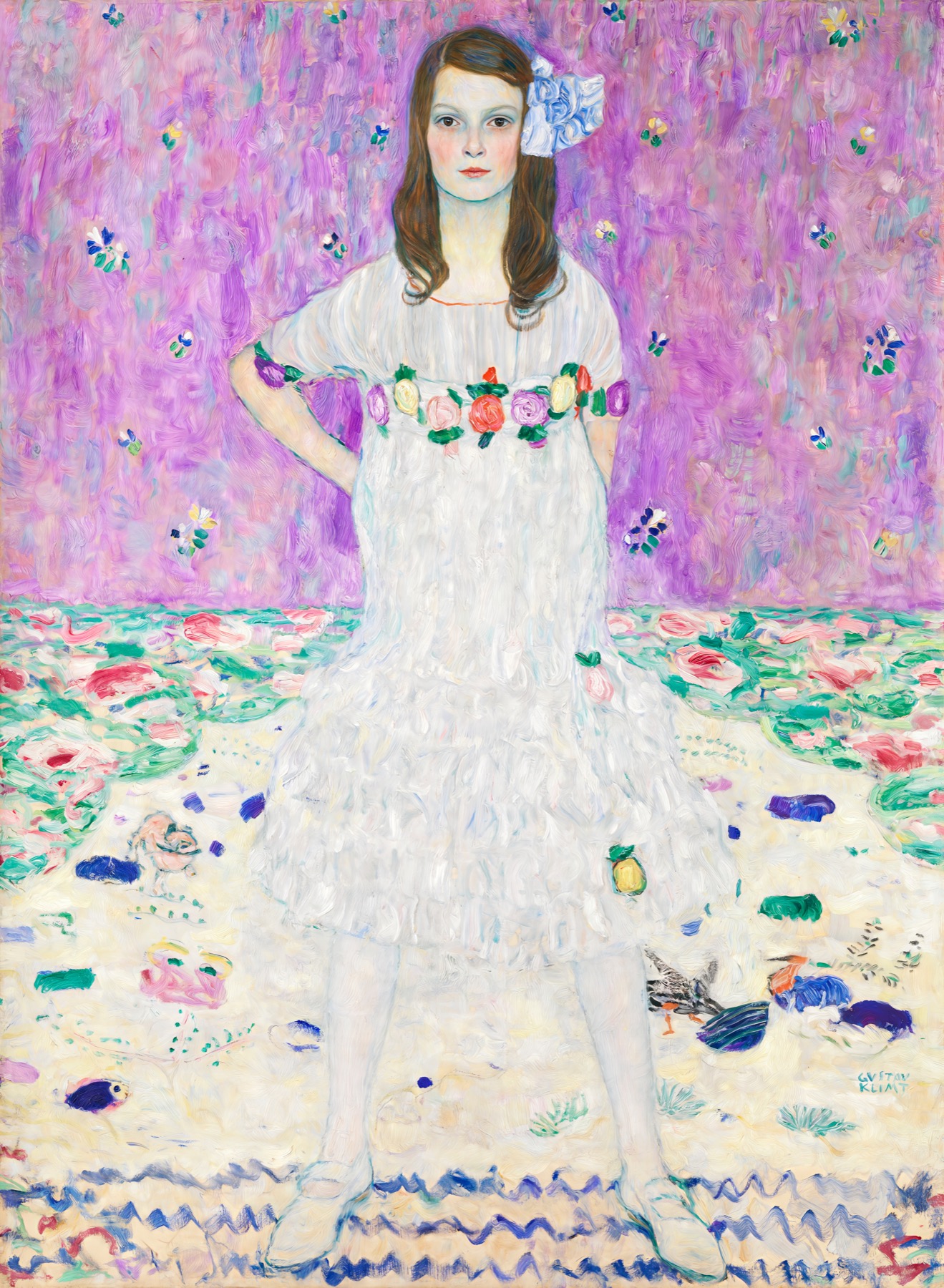
Details from MÄDA PRIMAVESI
These close views use the high-resolution public-domain source while keeping annotation markers in CSS rather than in the image file.
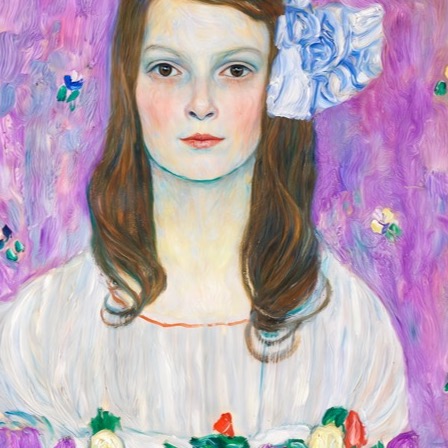
Face
Mäda's face is direct without turning the child into an adult sitter.
Broad stance
The stance gives the small body unusual pictorial authority.
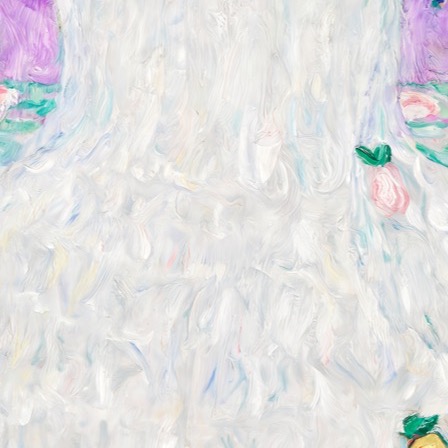
Flowered dress
The dress connects child, pattern and field while remaining a represented garment.
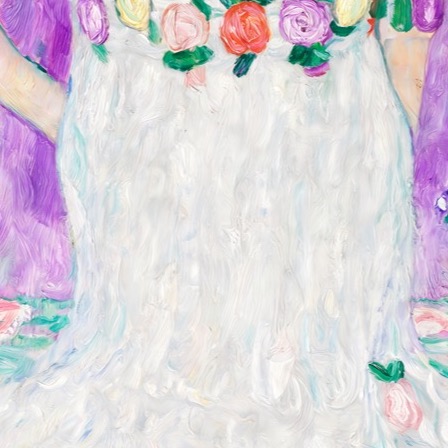
Animal side
The animal and floral setting complicates the portrait without becoming a fixed allegory.
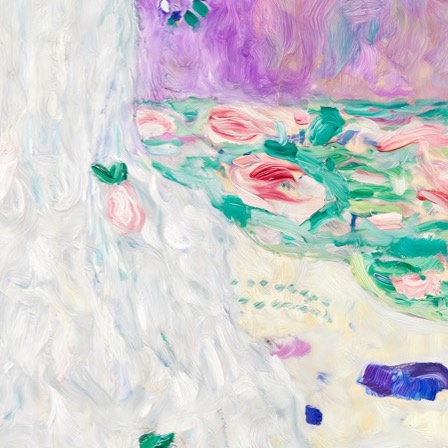
Lower field
The lower field reinforces the square portrait's decorative and bodily balance.
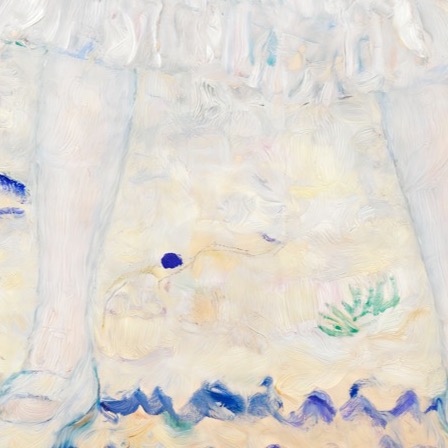
Arms
The arms hold the pose open and frontal, reinforcing the child's controlled self-presentation.
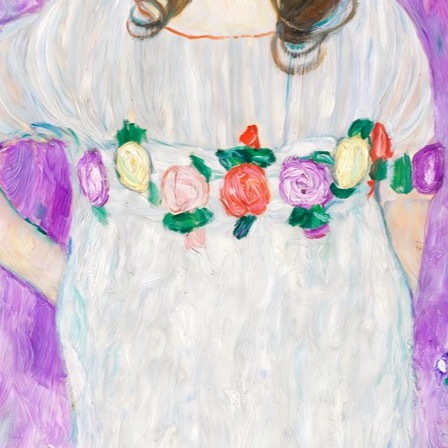
Floral field
The divided floral setting supports the portrait without becoming a literal garden record.
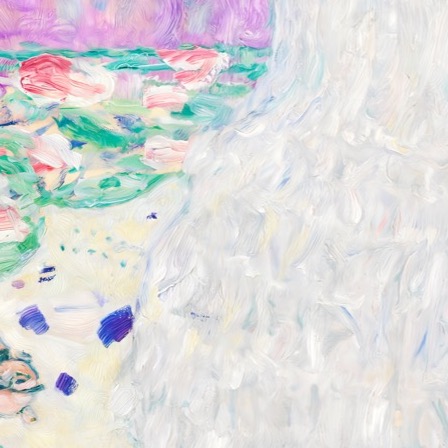
One Child, Two Catalogue Dates
The Metropolitan Museum of Art dates the portrait 1912–13. The Gustav Klimt Database uses 1913. These are compatible cataloguing conventions for one painting, not evidence of two versions. The commission began in spring 1912, the drawing process occupied many sittings, and the canvas was ready for international exhibition in 1914. “1912–13” best preserves that span; “1913” reasonably identifies the year of completion.[1][2][3]
Historical exhibition titles add another layer without changing the object. In Rome it appeared as Ritratto di fanciulla, or Portrait of a Girl. Other records used equivalents such as Kinderbildnis and Mädchenbild. Those generic labels did not make the sitter anonymous. The current title restores the identity that was always central to the commission.
The physical record is exact: oil on canvas, nearly a metre and a half high, signed at the lower right. The painting's flowers, bead-like details and golden-looking touches are represented in oil. No source used here identifies applied beads, gold leaf or another metal on the support.[1]
Which Mäda Primavesi?
The child in the painting was Eugenia Franziska Primavesi, born in Olomouc in 1903 and known throughout her life as Mäda. Her mother was also named Eugenia and also called Mäda. The elder Eugenia had been an actress and became an energetic patron of modern art and design. Klimt painted her separately in 1913–14; that adult portrait is now in the Toyota Municipal Museum of Art.[3][4]
This duplication of names has repeatedly invited confusion. The New York painting shows the daughter, not the mother. Its title includes the daughter's life dates, 1903–2000. The Toyota canvas represents the elder Eugenia in a different pose, dress and setting. They were connected commissions but remain two physical works.
Young Mäda was the daughter of banker and industrialist Otto Primavesi and Eugenia Primavesi. The family lived in Olomouc, then known in German as Olmütz, while maintaining close ties with Vienna's progressive cultural circles. Their relationship with Klimt grew within a wider network that included Josef Hoffmann, Anton Hanak and the Wiener Werkstätte. The parents' patronage explains how the commission arose; it does not turn their child into an advertisement for a design company.[3][4]
A Commission for Two Family Portraits
Eugenia and Otto Primavesi commissioned their daughter's portrait in spring 1912. Work on the mother's likeness followed while Klimt was still developing the child's image. A receipt dated 18 June 1913 records an advance of 15,000 crowns for the two paintings together.[2][4]
That plural matters. The full sum was not a price paid solely for Mäda's portrait, and it cannot be divided into two equal fees without further evidence. It marks a substantial family commission whose financial terms joined the mother and daughter while the paintings developed at different rates.
The Primavesis became shareholders in the financially troubled Wiener Werkstätte in 1914 and later took on a major supporting role. Their houses, social world and collecting linked fine art to modern architecture and applied design. Yet those later commitments should not be projected backwards as the only meaning of the child's dress or setting. Klimt's portrait is specific to Mäda's body, temperament and sittings even as it belongs to a sophisticated patronage environment.[3][4]
A Stance Built Across the Canvas
Mäda stands close to the bottom edge. Her feet are separated under the wide fall of the dress, giving the composition a broad base. Her right hand presses against her hip; her left arm moves behind her body. One elbow therefore projects while the other disappears. The pose is asymmetrical, but the painting does not feel off balance.[1][3]
The blue bow near the side-parted hair answers the outward thrust of the elbow. The dress widens toward the floor, and the triangular patterned zone behind the legs repeats that expansion. Body, costume and background work together to turn a child's stance into the main architecture of the image.
The Met describes Mäda as strong-willed and active and sees remarkable confidence in her bearing. The Gustav Klimt Database likewise emphasizes how self-possessed she appears. Those judgements agree with the visible pose and with the sitter's later memories. They are still descriptions of pictorial effect and recollection, not a complete diagnosis of a nine-year-old personality.[1][3]
Her posture retains something less ceremonious than an adult society portrait. The feet are set with blunt decisiveness; the hidden arm makes the shoulders slightly awkward; the bow and projecting elbow pull in different directions. Klimt monumentalises her without ironing out the bodily energy of childhood.
Face, Gaze and Likeness
The head occupies a comparatively calm area. Dark eyes, brows and hair stand against pale flesh and a relatively open surround. Mäda looks straight out rather than turning into profile or lowering her gaze. The mouth is closed, and the expression does not perform a smile for the viewer.[1]
The Met compares the portrait with photographs of Mäda and regards it as a strong likeness. That evidence supports recognition, but the canvas is not a neutral photographic transcription. Klimt simplifies and intensifies. The broad silhouette of the hair, the blue bow and the frontal eyes give the head a graphic force capable of surviving the activity around it.
Words such as “confident,” “determined” and “self-assured” name effects created by this relation between gaze and stance. They need not become predictions of the adult she would be. Nor does the absence of a smile prove defiance. The portrait's achievement is to let the sitter look socially present without reducing her to either compliant sweetness or precocious rebellion.
The White Flowered Dress
Mäda's final garment is white, with bright flowers scattered across its surface. The Met describes the blossoms as beaded and states that the dress was custom-made by Emilie Flöge at Klimt's suggestion. In the painting, however, every bead and flower is paint. The physical garment, whatever its embroidery and construction, is distinct from the oil surface.[1][2]
The costume emerged only after other options were tried. The Met's detailed study of the portrait distinguishes three stages: an ordinary day dress, a stiff party dress that Mäda disliked, and the final outfit associated with Schwestern Flöge. Surviving drawings record different clothes as well as different postures. It would therefore be wrong to assume that every study shows the white floral dress seen in the canvas.[2]
Flöge's role is object-specific. The current Met record supports her association with the final garment; Mäda's retrospective account of being taken to the salon adds personal memory. Neither point makes the portrait a general history of the Schwestern Flöge business, and neither establishes that Mäda designed the dress herself.
Klimt uses the costume as more than biographical evidence. White gives the figure a luminous mass, but the coloured blossoms interrupt any smooth, ceremonial purity. Flowers cluster differently across the torso and skirt. Their changing density helps the dress feel both like fabric on a body and like a painted field approaching abstraction.
A Setting Divided into Zones
The background is neither continuous wall nor conventional landscape. A strong diagonal separates the pale upper field from the denser patterned area below. Behind Mäda's legs, a triangular, carpet-like form presses upward. Its angle reinforces the widened skirt and the stance beneath it.[3]
This division gives the figure a peculiar spatial condition. She stands on or before something rug-like, yet depth never opens into a room that could be measured. The lower motifs climb toward her, while the pale upper zone leaves air around her head. The canvas alternates between stage, textile and garden without becoming any one of them.
Klimt had already used divided patterned fields in portraits such as Adele Bloch-Bauer II. Here the device changes because the sitter is a child and because her white dress becomes a bright central wedge. The comparison clarifies a formal development; it does not make the two women, commissions or histories interchangeable.[3]
The setting also resists the notion that ornament simply erases the body. Its main triangle strengthens Mäda's base. Open space protects her face. Dense motifs gather where they can energise the skirt and legs. Pattern is arranged around her rather than spread evenly across everything.
Flowers, Birds, Fish and a Dog
The lower field contains an animated assortment of natural forms. The Met identifies flowers, birds, fish and even a dog. Some creatures are easy to recognise; others hover between animal, leaf and coloured mark. Their scale is not governed by ordinary perspective.[1]
Flowers on the dress rhyme with blossoms outside it. At moments the boundary between garment and setting becomes uncertain, yet the body remains anchored by the stance and the clear head. This exchange allows youth and growth to be suggested without turning the child into a botanical allegory.
The Gustav Klimt Database relates the animal motifs to an Asian vocabulary of forms used in Klimt's post-Golden-Period portraits. That is a useful attributed source context. It should not be expanded into a claim that every bird or fish copies one identifiable Japanese model. The immediate visual fact is a lively field of creatures and plants organised for this composition.[3]
Nothing in the design requires a fixed code in which one animal equals one trait of Mäda's character. The dog need not mean fidelity, the fish need not predict fate, and the flowers need not make her an emblem of innocence. They establish variety, movement and a scale of looking different from the measured likeness above.
Drawing a Pose into Existence
Klimt did not arrive at the final stance in one attempt. The Met reports numerous sketches exploring posture, setting and costume. Its 2005 study uses the surviving evidence to infer at least four or five preliminary sittings. That is a reasoned minimum, not a complete count of appointments.[1][2]
The drawings test Mäda standing, seated, turned and differently dressed. Some concentrate on the set of the shoulders and elbows; others consider the width of a skirt or the relation between hands and hips. Their variety shows that preparation did not simply mean copying a settled arrangement onto paper before enlarging it.
A group of ten small composition sketches once belonged to Emilie Flöge and was recorded in 1942. They were subsequently destroyed. Their documented existence expands the known process, but a lost group cannot be inspected as if it survived, and its ten sheets should not be added casually to every later catalogue total.[2]
The safest formulation is therefore “numerous studies.” Surviving exact sheets, historical records of destroyed material and an inferred number of sittings describe different kinds of evidence. Together they reveal prolonged selection; they do not yield one final lifetime total.
Two Exact Albertina Sheets
Albertina inventory 30444 is a 1912–13 pencil drawing on paper measuring 56.8 by 37.1 centimetres. Catalogued as Alice Strobl 2125, it shows Mäda standing slightly toward the left with her hands on her hips. The line is light and mobile, sensitive to balance rather than weighted like a traced contour.[6]
A second Albertina sheet, inventory 30446, measures 56 by 37.6 centimetres and belongs to the same 1912–13 study context. Its separate inventory and pose evidence matter: it is another autonomous work on paper, not a duplicate impression or a second state of the painting.[7]
The Gustav Klimt Database stresses the reduced pencil pressure and fleeting quality of this drawing group. Such sheets are preparatory because they arise from portrait sittings and test solutions, but they also possess independent rhythmic life. None is a one-to-one cartoon for the canvas. The final pose was assembled through looking, rejection and adjustment rather than mechanical transfer.[3][6][7]
Mäda Remembered the Sittings
Decades later, Mäda recalled periodic journeys to Vienna, stays of about ten days and the effort of remaining still while Klimt worked. She remembered becoming impatient and the artist coaxing her to continue for a few more minutes. The account agrees with the drawn evidence of repeated experiments.[2][3]
Memory recorded long afterwards is not a verbatim studio transcript. It cannot date every sheet or prove the order in which costumes were tried. It does, however, return bodily duration to a painting that can look instantly resolved. A child travelled, changed clothes, held poses, tired of stillness and came back.
That remembered impatience helps explain why the final posture feels active. The painting does not depict Mäda moving, but it gives immobility tension: one arm held back, a hand planted at the waist, feet separated beneath the dress. The discipline of sitting and the impulse to break the pose coexist in the finished arrangement.
Rome, 1914: Portrait of a Girl
From February to June 1914, the second International Art Exhibition of the Secession took place in Rome. The Austrian Artists' League received two rooms designed by Dagobert Peche. Klimt was represented by only one painting.[5]
The catalogue listed number 12 as Ritratto di fanciulla. Catalogue reproduction and two installation photographs allow the Gustav Klimt Database to identify it securely as Mäda's portrait. The generic Italian label is part of exhibition history, not evidence that modern identification is speculative.[5]
Its solitary status gave the canvas unusual responsibility: rather than appearing among a large Klimt survey, it represented his current painting by itself. The child portrait could communicate his new reliance on brilliant colour, divided fields and open ornamental space without the gold that still dominated his popular reputation.
Berlin, 1916: Present but Not Catalogued
The documentary situation in Berlin is more complex. The Vienna Kunstschau at the Berlin Secession ran from 8 January to 20 February 1916. Mäda's portrait does not appear in its catalogue, yet a monochrome reproduction and contemporary newspaper descriptions identify it as present. The likely explanation is a late, unplanned addition.[5]
One report described an approximately ten-year-old girl in white. Another critic praised the colourful blossoms on her dress. A review complained that what it regarded as perhaps the best painting had been placed in a remote corner. The two critical voices nevertheless agreed on the portrait's high quality.[5]
Absence from the catalogue should not be turned into absence from the exhibition. Nor should press identification be described as equivalent to a numbered catalogue entry. Here the object is secured by a convergence of reproduction, visible description and reception. The imperfect paper record tells us something about how exhibitions actually changed after catalogues went to press.
Later appearances, including Stockholm in 1917 and the 1928 Klimt memorial exhibition, extended the painting's public life. They matter chiefly because they help trace its movement from the Primavesi family into the interwar art market and later ownership.[2]
From the Primavesis to Jenny Steiner
The first owners were Otto and Eugenia Primavesi, the commissioners. The adult sitter Mäda did not simply keep her childhood portrait throughout life. Financial difficulties connected with the family's bank and its support of the Wiener Werkstätte contributed to the dispersal of the collection.[2][4]
The Met's provenance research places ethnologist and collector Hugo Bernatzik and Vienna's Neue Galerie in the chain by 1928. Its wording allows that the painting may have been sold or consigned at the dealer stage; current evidence does not justify converting every transition into a documented outright purchase. By the 1930s the work belonged to Jenny Pulitzer Steiner.[1][2]
Jenny was a collector and textile-business heir whose household and art collection were targeted after Nazi Germany annexed Austria in 1938. The portrait's next movements cannot be described as an ordinary succession of market choices.
Seizure and the 1941 Museum Purchase
National Socialist persecution stripped Jenny Steiner of control over her property. The portrait was seized, and in 1941 the Vienna City History Museum bought it at auction. The fact that a municipal institution paid at auction does not make the preceding dispossession voluntary or erase the coercive system that brought the work to sale.[1][8]
This distinction is essential. “Purchased by the museum” describes the immediate mechanism in 1941. “Seized from Jenny Steiner” describes why the object was available. A responsible provenance account needs both statements.
The painting survived the war in Vienna while Jenny, who had escaped Austria, pursued the recovery of works from her collection after 1945. Her claim was not a decorative appendix to the object's history. It determined the legal and ethical reversal of the museum's wartime possession.[8]
Why Sources Say 1950 and 1951
The Austrian Provenance Research Lexicon records that the City of Vienna voluntarily returned Mäda Primavesi to Jenny Steiner in 1950, after the Restitution Commission had ruled against return. The Met summarizes the painting as restituted in 1951.[1][8]
These dates need not be forced into a false contradiction. They can mark successive parts of one process: the city's return decision and physical relinquishment in 1950, followed by completed restitution and export documentation in 1951. The safest concise statement is that the portrait was returned in 1950 and the restitution sequence was completed by 1951.
The apparent one-year discrepancy reveals why provenance research depends on the type of record being dated. A commission decision, municipal action, handover, export licence and later museum summary may not all carry the same year. Precision means preserving that difference, not choosing whichever date produces the smoothest sentence.
The 1964 Gift to The Met
After return, the painting remained within Jenny Steiner's family. It passed to her daughter Clara Mertens and son-in-law André Mertens. In 1964 they gave it to the Metropolitan Museum of Art in Jenny's memory. The museum's object number is 64.148.[1][2][8]
The credit line is therefore not a purchase from Mäda Primavesi, the Primavesi family or the Steiner heirs. It is a family memorial gift shaped by the work's confiscation and recovery. Naming Jenny in that credit restores the collector from whom the canvas had been taken.
This provenance also separates Mäda's portrait from seemingly similar histories. It was not part of the Lederer impoundment chain, and it was not returned through the 2006 Bloch-Bauer arbitration. Each Klimt painting subjected to Nazi persecution requires its own owners, documents, institutions and legal sequence.
Mäda After the Portrait
The painted child lived until 2000. Albertina records that she trained in infant and child care, served with the Red Cross during the Second World War, emigrated to Canada and founded a children's home. She died in Montreal.[7]
These later facts return a measure of adulthood to someone permanently visible in museums at nine. They should not be used to decode the flowers as a prophecy of care work or the stance as a sign of a predetermined life. The portrait could not know that future.
Mäda's later testimony nevertheless contributes to the object's history. Her memories clarify the travel, costumes, repeated posing and impatience behind the image. She was both its child subject and an adult witness to its making.
Current Display at The Met
As of 9 August 2026, The Met lists Mäda Primavesi (1903–2000) on view at Fifth Avenue in Gallery 800. That live record supplies the current holder title, 1912–13 date, medium, dimensions and gallery location.[1]
Gallery placements can change even when ownership does not. Visitors travelling specifically for the painting should check the current object record close to their visit. The Metropolitan Museum's ownership and 1964 accession are permanent collection facts; Gallery 800 is a dated access statement.
How to Look at Mäda Primavesi
Begin at the floor. Find the distance between the feet under the dress, then follow the skirt's widening contour and the triangular field behind it. The apparent confidence of the portrait is built from this broad geometry before it becomes a claim about character.
Move to the arms. One hand creates a visible angle at the hip; the other arm is withheld. Compare that imbalance with the blue bow on the opposite side of the head. Klimt makes small asymmetries hold a large figure steady.
Next, trace the flowers. Notice where blossoms clearly belong to the dress, where they occupy the surrounding field and where the two populations approach one another. The body is never lost, but its clothing and setting communicate.
Then identify animals without insisting that every form resolve. A bird, fish or dog can remain a visual event before becoming a symbol. The liveliness of the lower zone depends partly on the eye's movement between recognition and uncertainty.
Finally, compare the completed stance with the Albertina studies. The drawings preserve alternatives and hesitation. The canvas makes one solution feel commanding, but that authority was produced through repeated sittings, discarded costumes and adjustments rather than discovered whole.
A Monument without a Miniature Adult
Klimt gives Mäda Primavesi the scale and frontal presence of a major society portrait without pretending that childhood is merely adulthood in smaller form. Her body carries the trace of impatience. Her dress changes painting into a flowered surface. Her setting refuses domestic explanation and fills itself with animals, plants and angled fields.
The known process strengthens this reading. Different outfits, numerous sheets, lost composition sketches and at least four or five sittings show how carefully the final directness was constructed. Mäda's adult memory adds duration without turning recollection into a perfect transcript.
The canvas then acquired another history beyond the Primavesi commission. Its passage through Jenny Steiner's collection, Nazi seizure, municipal acquisition, 1950–51 return and memorial gift to The Met changes how public custody must be described. The child remains visually immediate, but the object around her carries the consequences of patronage, persecution, recovery and remembrance.
Frequently Asked Questions
References
Accessed August 2026.
- The Metropolitan Museum of Art, New York, “Mäda Primavesi (1903–2000),” live object record and audio: current title, 1912–13 date, oil medium, dimensions, signature, object number, sitter age and bearing, dress, natural motifs, seizure, restitution, 1964 gift and dated Gallery 800 display. View source.
- Katharine Baetjer, “About Mäda,” Metropolitan Museum Journal 40 (2005): Primavesi commission, sitter's recollections, outfit sequence, inferred sittings, surviving and destroyed studies, exhibition history and expanded provenance. View source.
- Gustav Klimt Database, “Expressive Blaze of Colors,” exact-period account: spring 1912 commission, sitter identity, 1913 dating, stance, divided background, floral and animal motifs, East Asian source context, sitting memory and drawing analysis. View source.
- Gustav Klimt Database, “The Primavesi Family,” patron record: family identities, Olomouc home, two-portrait commission, 15,000-crown joint advance and Wiener Werkstätte involvement. View source.
- Gustav Klimt Database, “The Final Years,” exhibition account: 1914 Rome catalogue and installation identification; 1916 Berlin catalogue absence, monochrome reproduction, press descriptions, hanging and reception. View source.
- Albertina, Vienna, “Study for Portrait of Mäda Primavesi,” 1912–13 pencil sheet: inventory 30444, 56.8 × 37.1 centimetres, standing pose and Strobl 2125 catalogue identity. View source.
- Albertina, Vienna, “Study for Portrait of Mäda Primavesi,” 1912–13 pencil sheet: inventory 30446, 56 × 37.6 centimetres and concise account of the sitter's later life. View source.
- Austrian Commission for Provenance Research, “Steiner, Jenny,” Lexicon of Austrian Provenance Research: persecution and collection seizure, 1941 Vienna City History Museum purchase, 1950 voluntary return and later Mertens gift. View source.
Discussion
Portrait of Mäda Primavesi rewards close attention to source context, object identity and careful reproduction boundaries.


