 by Tom Gurney
Tom Gurney BSc (Hons) is an art history expert with over 20 years experience
Published on August 21, 2026 / Updated on October 23, 2026
Email: tomgurney1@gmail.com / Phone: +44 7429 011000
About Love
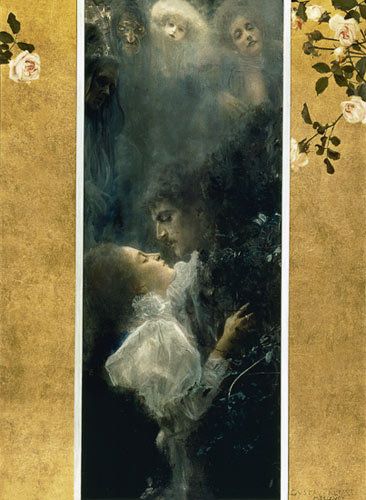
Gustav Klimt's Love places an embracing couple inside a world that will not leave them alone. Their faces and bodies fill the lower centre of a narrow vertical canvas. Flowers rise along one edge. Above them, partly released from darkness, appear other human presences: a child, older faces and a bald old man. The title promises an allegory of intimacy, but the composition brings youth, age and uncertainty into the same compressed space.[1][4]
Painted in 1895, the work belongs to the Wien Museum and is officially titled “Liebe” (Vorlage für: Gerlach & Schenk, Allegorien N.F. Nr. 46). That extended title identifies both the subject and the painting's practical role. This is an original oil on canvas, not a print. Klimt made it as the model for plate 46 in Allegorien. Neue Folge, a publisher's portfolio intended to circulate modern examples of allegorical design.[1][3]
The distinction changes how the painting should be seen. Love was designed with reproduction in mind, yet it is a physical work with its own scale, surface, frame and museum history. It also marks a turning point. Klimt retained the convincing modelling learned through academic training while allowing darkness, ornament and unexplained figures to weaken ordinary space. The result is neither a conventional emblem nor a rehearsal for The Kiss. It is an early Symbolist statement in which intimacy acquires meaning through the pressures around it.[2][7]
At a Glance
- ArtistGustav Klimt
- Wien Museum title“Liebe” (Vorlage für: Gerlach & Schenk, Allegorien N.F. Nr. 46)
- English titlesLove and Allegory of Love
- Date1895
- Object typeOriginal oil painting made as a publication model
- MediumOil on canvas
- Image dimensions62.5 × 46.5 centimetres
- Frame dimensions79 × 53 × 4 centimetres
- InscriptionLower right, transcribed by the museum as “GVSTAV . KLIMT . MDCCCVC”
- Inventory number25005
- ModelsThe embracing couple and child are unidentified; Johann Mayerbäuerl is named only on a related study for an old head
- Publication roleModel for plate 46 of Gerlach & Schenk's Allegorien. Neue Folge
- Current collectionWien Museum, Vienna
- Current accessThe live museum record confirms collection ownership but did not provide a current gallery location when checked in August 2026[1]
Which Work Is Klimt's Love?
The original is Wien Museum inventory 25005, an oil painting on canvas dated 1895. The painted image measures 62.5 by 46.5 centimetres; its recorded frame measures 79 by 53 by 4 centimetres. At lower right, the museum transcribes an inscription as “GVSTAV . KLIMT . MDCCCVC.” The unusual Roman sequence should be reported as the holder records it rather than silently regularised into a different date.[1]
The museum's German title includes the word Vorlage, meaning a model, design or original prepared for another use. That function does not make the oil a preparatory scrap or later reproduction. It is the surviving original from which the design for number 46 of the Gerlach & Schenk portfolio was derived.[1][3]
The two published measurements answer different questions. The smaller pair describes the painted image; the larger three-part record includes the frame and its depth. That frame measurement helps a viewer imagine the present museum object, but it does not by itself establish who designed the frame, whether it accompanied the canvas in 1895 or what appeared around the printed plate. Object, housing and reproduction remain distinct.
The printed plate is therefore a separate object. Its paper, printing process and dimensions should not be assigned to Klimt's canvas. Photographs, scans and commercial reproductions are separate again. They can convey the composition, but they cannot replace the museum record when establishing the painting's material, size or present ownership.
This identity also separates Love from later paintings of lovers. It is not an early state of The Kiss, and the portfolio title Allegory of Love does not rename every Klimt embrace as the same work. One oil, one inventory number and one publication function govern its identity.[1]
A Painting Designed to Travel as an Image
Martin Gerlach's publishing projects offered artists, architects and applied designers extensive visual repertories. Allegorien. Neue Folge—the “new series” of allegories—followed the earlier Allegorien und Embleme and presented original designs by prominent modern artists with explanatory text. Klimt contributed four subjects: Love, Junius, Sculpture and Tragedy.[2][3]
Such portfolios occupied a space between fine art and practical design culture. A painter could make a resolved original while the publisher multiplied its composition for artists and applied designers. Klimt's model thus had two audiences: viewers of the physical oil and users of the printed collection.
That double purpose helps explain the composition's immediate organisation. A central group, a vertical format and distinct surrounding motifs remain legible when reproduced. At the same time, the transitions within the oil—from warm flesh to dark obscurity, from modelled heads to decorative flowers—depend upon painterly relations that a printed version can translate but not duplicate.
Klimt did not paint directly onto a portfolio page. Nor was the publication simply a record made after an unrelated easel picture happened to exist. The Wien Museum title binds original and purpose together: the canvas is an independent painting made to serve as a publication model.[1]
The Embracing Couple
The young man bends towards the woman and draws close to her face. She receives or returns that proximity within an enclosure formed by arms, shoulders, hair and clothing. The couple occupies a relatively shallow zone; little ordinary setting separates them from the viewer or explains where the encounter occurs.[1][4]
Klimt makes physical relation clearer than narrative. The figures are lovers because the title and their embrace establish intimacy, but the painting does not identify them, state whether they are married, or illustrate a documented episode. Their expressions can support readings of desire, absorption or tenderness without revealing a private history.
The man's position creates a protective arc, yet “protection” is not the only possible effect. His body also closes the space around the woman. Her upward turn and his downward inclination make the meeting directional rather than symmetrical. The painting holds nearness and unequal posture together without supplying enough story to settle the emotional balance.
This is why biographical identification would be especially misleading. No secure source names the embracing models. Calling the woman Emilie Flöge or another person from Klimt's life would convert an allegorical construction into an unsupported confession. The painting's intimacy is represented, not documented as autobiography.
Faces Above the Lovers
The upper part of Love prevents the embrace from becoming self-contained. Human heads emerge through shadow: a child occupies the upper centre, while older faces gather around it. The Wien Museum describes these background presences as menacing and as a melancholy counterweight to the lovers' happiness. Albertina research connects the child and old-man studies with stages of life.[4][7]
The sequence invites a temporal reading. Youthful love exists beneath infancy, maturity and old age, or within the same human course. Yet the heads do not form a neat chart. They overlap darkness rather than lining up as numbered stages, and their relations remain less physically coherent than the central embrace.
The difference in clarity is crucial. The lovers feel immediate because their bodies meet. The upper group feels mental, visionary or emblematic because its members emerge without a shared setting. “Visionary” describes their pictorial condition; it does not prove a dream, memory, afterlife or supernatural event.
Age also brings the possibility of loss without requiring one fixed death symbol. The old face can remind viewers that youth changes, while the surrounding darkness can make intimacy appear temporary. Neither feature allows a universal equation in which every elderly figure in Klimt means death. Here meaning arises from the specific pressure exerted upon this couple.
Flowers at the Edge
A vertical congregation of flowers gives the dark field colour and movement. The Wien Museum includes flowers among the work's visible subjects, but its record does not provide a complete botanical identification or symbolic key.[1]
Their position matters more securely than an invented species list. The blossoms form an ornamental edge, answer the vertical rise of the upper heads and give the lower group an organic counterweight. They can suggest growth and living abundance because flowers visibly grow and bloom, but the painting does not force each petal to signify fertility, fidelity or grief.
Klimt is beginning to make ornament carry structural weight. The flowers are not a natural garden rendered in deep space. They belong to a compressed field where plant form, border and colour approach decoration without becoming detachable embellishment.
This is still an oil painting only. Warm yellow or gold-coloured effects must not be turned into gold leaf, metal powder or applied foil. The Wien Museum records oil on canvas, and the physical splendour of Klimt's later Golden Period should not be projected backwards onto the material of this 1895 work.[1]
Darkness, Light and Compressed Space
The lovers' faces and bodies are modelled with enough tonal variation to retain volume. Around them, spatial confidence recedes. Darkness absorbs transitions, heads appear without fully described bodies, and flowers behave as both visible forms and decorative ordering devices.[2][7]
That instability distinguishes Love from an academic allegory in which every person, attribute and setting contributes to a readily explained programme. Klimt gives the title plainly, then complicates it. Love is not personified by one isolated figure holding a standard attribute; it is enacted by a couple while other ages look on.
Light creates hierarchy. It gives the central encounter bodily immediacy, releases selected upper faces from obscurity and leaves connections between them unresolved. The viewer does not move through measurable depth so much as between degrees of visibility.
The dark field should not be confused with damage or an unfinished state. Nothing in the current object record classifies the painting as incomplete. Nor can the obscurity prove a literal night scene. It is a designed condition that allows naturalistic bodies and symbolic presences to coexist.
Two Exact Studies
Drawings held by the Albertina show Klimt working separately on heads that would enter the upper group. They provide unusually precise evidence because their institutional records identify both object and relation without requiring every nearby sheet to become a direct study for Love.[4][5][6]
Albertina inventory 36561 is a bust-length study of a child made in 1895. Klimt used pencil heightened with white on packing paper; the sheet measures 44.4 by 31 centimetres and is catalogued as GKZ or Strobl 261. The museum relates it to the child at the upper centre of the allegory.[5]
Hatching establishes the head's rounded form, while white heightening brings light forward from the toned support. The sheet investigates a face, not the whole composition. Its packing paper, pencil and white accents belong to the drawing and must not be transferred into the medium of the oil.
Inventory 32516 studies a bald old man. Dated 1895 and catalogued as GKZ or Strobl 260, it uses pencil and black chalk heightened with white on paper and measures 43 by 31.2 centimetres. An inscription on the sheet names Johann Mayerbäuerl and records an address.[6]
That inscription establishes a study model, not a character identity. Mayerbäuerl should not be called the embracing man, the father or grandfather of the lovers, or a person whom Klimt meant viewers to recognise. The head was observed from an individual and then incorporated into an allegorical arrangement.
Together the sheets show a method of transformation. Klimt studied age-specific physiognomy with close attention, then relocated the heads into a dark field where they contribute to a broader meditation on time. They are neither mechanical transfer cartoons nor proof of the order in which every part of the canvas was painted.
From Academic Allegory towards Symbolism
The Gerlach works stand at an important junction in Klimt's development. He had built his career through technically assured theatre decoration, portraits and allegorical commissions. By the mid-1890s, figures remained convincingly modelled, but the environments around them increasingly resisted conventional narrative and perspective.[2]
Klimt Database and Albertina research place this shift in relation to international Symbolism, including the example of Fernand Khnopff and Jan Toorop. Those artists demonstrated ways of making a visible figure carry states of thought, desire or uncertainty through compressed design and ambiguous surroundings.[2][3]
The comparison is contextual rather than genealogically exact. The institutional scholarship does not identify a single Khnopff or Toorop work that Klimt copied to make Love. What can be seen is a shared departure from transparent academic storytelling: sharply present figures coexist with patterns and presences whose connection must be felt before it can be explained.
Klimt's transition was not a sudden rejection of skill. The studies reveal disciplined observation, and the lovers retain bodily volume. Modernity enters through organisation—the dark interval, the unsteady depth and the ornamental edge—not through an inability to draw.
The 1896 Künstlerhaus Reception
Klimt's Gerlach designs were presented at the Vienna Künstlerhaus in 1896. A contemporary response preserved by the Klimt Database found the “mystic” Love peculiar yet good and anticipated both applause and opposition. The language captures uncertainty before Klimt's new direction had hardened into the public controversies of the following decade.[2]
This was not a scandal on the scale of the University Ceiling Paintings. There was no equivalent faculty dispute, state commission crisis or long campaign over institutional suitability. The response instead records a change in expectation. Viewers recognised high ability while struggling with an allegory whose atmosphere and emotional ambiguity exceeded a conventional explanatory programme.
“Mystic” should be understood as reception language, not proof that Klimt belonged to a specific occult school or encoded a secret doctrine. The painting itself provides no written programme beyond its title and publication setting.
The mixed prediction—approval as well as resistance—also cautions against a tidy myth of instant rejection. Klimt's change attracted interest precisely because it remained visibly connected to the technical command for which he was already known.
Before The Kiss, but Not a Preliminary Version
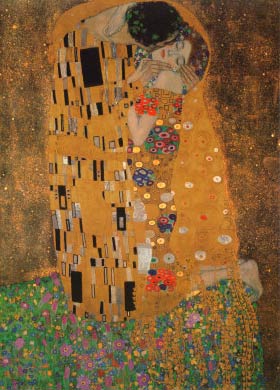
It is tempting to read every Klimt embrace as a step towards The Kiss. The two paintings do share a concern with bodily enclosure and the transformation of intimacy through pattern. Their differences are more important for understanding Love on its own terms.
The 1895 canvas is a narrow publication model in oil. Its lovers exist beneath multiple age presences and beside a floral edge. The Kiss, painted more than a decade later, is a large square exhibition picture whose oil, gold and silver medium and dense patterned garments belong to a distinct object and material history.
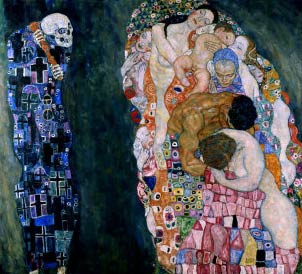
Likewise, the upper heads in Love do not anticipate the exact nine-person group of Death and Life. Klimt returned to relations among intimacy, age and mortality, but recurring human themes do not turn separate canvases into versions of one composition.
An earlier allegory such as Fable can help locate Klimt's changing field of activity, yet Love requires no miniature survey of all his allegorical work. Its particular innovation lies in placing a direct embrace within an atmosphere that makes time and threat present without fully personifying either.
Collection and Access
The original painting belongs to the Wien Museum under inventory number 25005. The live collection record supplies its current title, date, classification, medium, measurements, inscription and catalogue cross-references. It does not publish a complete early ownership or acquisition chain.[1]
That silence should remain visible. The work's Gerlach publication history does not prove that the publisher owned the oil until a documented transfer date, and no seller, price or intermediary should be invented. Nor is there a basis for attaching a Nazi-era seizure or restitution history merely because other Klimt paintings passed through persecution-era transfers.
A Wien Museum publication from 2012 described Love as normally present in the permanent collection at that time. The live record consulted in August 2026, however, did not state a current room or displayed/not-displayed status. Historical display practice is not a promise of present access.[8]
Anyone planning a visit should check with the museum. The digital collection page provides reliable online access to the object record, but museum ownership and continuous gallery display are different facts.
Why Love Matters
Love is a work about concentration and interruption. The embracing pair appears absorbed in physical nearness, yet flowers and disembodied ages prevent their moment from filling the whole painting. Intimacy is made central without being made permanent.
The work also shows Klimt changing before the familiar markers of his later fame. There is no documented gold leaf, no vast mosaic-like field and no need to treat the canvas as an immature preview of a masterpiece to come. Oil, darkness, observed heads and compressed design are enough to make an academic subject psychologically and spatially uncertain.
Its publication function intensifies that achievement. Klimt designed an image meant to circulate as an example, but he refused the simple legibility an example might seem to require. The title names love. The visible structure asks what love looks like when childhood, age and obscurity remain close.
That question is not answered through one symbol. It is sustained through relations: one body leaning towards another, a child held above them, an old face returning the gaze, flowers rising against darkness. The painting's enduring force lies in allowing those relations to remain intimate, beautiful and uneasy at once.
Frequently Asked Questions
References
Accessed August 2026.
- Wien Museum, Online Collection, “Liebe” (Vorlage für: Gerlach & Schenk, Allegorien N.F. Nr. 46): exact title, 1895 date, oil-on-canvas classification, image and frame dimensions, inscription, inventory 25005, publication function and catalogue references. View source.
- Gustav Klimt Database, “Symbolism in Klimt's Oeuvre”: the Gerlach portfolio, Klimt's Symbolist transition, Khnopff and Toorop context, 1896 Künstlerhaus presentation and contemporary reception of Love. View source.
- Albertina, Digital Publications, “Gerlach's Mappenwerke”: purpose and structure of the Gerlach portfolios, Klimt's four contributions and related study group. View source.
- Albertina / Google Arts & Culture, “Klimt's Studies for the Allegory Love”: the child and old-man drawings, their relation to the upper figures, drawing technique and the stages-of-life interpretation. View source.
- Albertina, Collection Online, “Brustbild eines Kindes (Studie für ‘Allegorie der Liebe’)”: inventory 36561, exact 1895 pencil-and-white-heightening medium, packing-paper support, dimensions and relation to the child at upper centre. View source.
- Albertina, Collection Online, “Brustbild eines kahlköpfigen alten Mannes”: inventory 32516, exact medium and dimensions, Johann Mayerbäuerl inscription, catalogue number and relation to the upper old head. View source.
- Wien Museum / Google Arts & Culture, “Gustav Klimt: Allegories 1882–1897”: institutional account of Klimt's changing allegorical language, the lovers, background presences, flowers and melancholy pressure of age. View source.
- Wien Museum, “Gustav Klimt: The Wien Museum Collection” (2012 press information): historical permanent-display statement for Love and the museum's distinction between collection holdings and works on paper. View source.
Discussion
Love rewards close attention to source context, object identity and careful reproduction boundaries.