 by Tom Gurney
Tom Gurney BSc (Hons) is an art history expert with over 20 years experience
Published on August 21, 2026 / Updated on October 23, 2026
Email: tomgurney1@gmail.com / Phone: +44 7429 011000
About Hope I
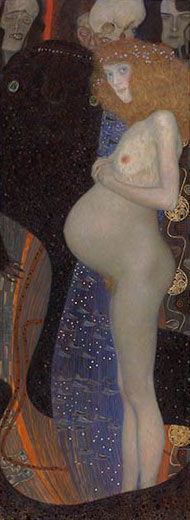
A naked pregnant woman stands at the front of an exceptionally narrow canvas. Her body turns in profile, making the abdomen unmistakable, yet her face comes back towards the viewer. Both hands meet near the pregnancy. Behind her, a skull-headed figure, a dark scaled creature and three grimacing faces press into the remaining space.
The painting now known as Hope I refuses to place anticipated life in safety. Gustav Klimt surrounds pregnancy with embodiments of death, sickness and mental disturbance, but he does not make the woman collapse beneath them. Her direct look is the picture's strongest interruption: she can be seen, but she also sees.
That confrontation was created through revision. The National Gallery of Canada dates the oil painting to 1903; the Klimt Database uses 1903/04. A witness who visited Klimt's studio in November 1903 recorded his intention to exchange a landscape for patterned carpet and add explanatory heads. Klimt made those changes in 1904.[1][2]
The present title also belongs to a later act of distinction. In the securely documented 1909 Vienna exhibition catalogue, this canvas was Die Hoffnung—Hope. Nearby was Vision, the work subsequently called Hope II. The Roman numeral identifies the earlier painting in relation to its successor; it does not turn the two canvases into a planned pair.[2][3]
At a Glance
- ArtistGustav Klimt
- Current titleHope I
- Historical exhibition titleDie Hoffnung (Hope)[3]
- Date1903 according to the National Gallery of Canada; also catalogued 1903/04 because Klimt revised it in 1904[1][2]
- MediumOil on canvas[1]
- Dimensions189.2 × 67 centimetres[1]
- CollectionNational Gallery of Canada, Ottawa
- Accession number16579[1]
- AcquisitionPurchased in 1970[1]
- Principal imageryA nude pregnant woman, Death, a scaled monster and three threatening heads
- Documented first conceptionPregnant figure or couple in a landscape, before the revised patterned field and additional heads[2][4][5]
- Planned 1903 displayWithdrawn from Klimt's collective exhibition after an intervention prompted by propriety concerns[2]
- Private setting by 1905Fritz Waerndorfer's villa, behind doors designed by Koloman Moser[2]
- Secure 1909 public recordShown as Die Hoffnung in room 22 of the Internationale Kunstschau in Vienna, beside Vision[3]
- Current accessOwned by the National Gallery of Canada as of 9 August 2026; visitors should confirm live display status before travelling[1]
Why the Number “I” Came Later
Nothing in the documented 1903 conception requires the title Hope I. The National Gallery of Canada now uses that name because Klimt later painted a second pregnancy allegory. In the catalogue of the 1909 Internationale Kunstschau, the earlier work appears simply as Die Hoffnung.[3]
That same catalogue lists Vision two entries before it in room 22. Vision would eventually become Hope II. The sequence therefore runs from two independently titled paintings to the paired names by which museums and readers now distinguish them.
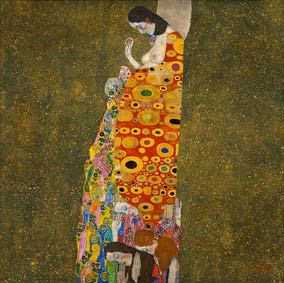
The title history matters. A Roman numeral can make the objects sound like consecutive panels in a single programme, but their formats, dates, media and state histories are different. The earlier work is tall, nude and populated by figures that menace from behind. The later canvas is square, clothed and constructed with oil, gold and platinum around a bowed woman, a death's head and smaller female chorus.
“Hope” still directs interpretation. Pregnancy is the most evident promise of a future in the picture. Yet the word does not guarantee a safe birth or defeat the figures of mortality. It names the pressure under which the woman stands.
A Body Nearly as Tall as a Person
At 189.2 centimetres high and only 67 centimetres wide, Hope I has the proportions of a vertical passage rather than a conventional room. The pregnant body occupies almost its full height. A viewer encounters her at close to human scale, while the format restricts lateral escape.[1]
Klimt places the figure in profile so that the swelling abdomen becomes the contour's decisive event. Her breasts, belly, hips and legs are exposed without mythological clothing or an idealising veil. The National Gallery identifies this audacity as a violation of contemporary propriety.[1]
The body nevertheless avoids the static impersonality of an anatomical plate. The head turns, the hair rises in a bright mass, and the hands gather at the abdomen. The pose joins presentation and protection without fixing either. Hands near a pregnancy may imply care, awareness or defence, but they cannot disclose the woman's thoughts.
Her nudity is not evidence of a named model's identity or of a private scene with Klimt. It is a pictorial decision that removes social costume while intensifying the contrast between living flesh and the figures behind it.
The Gaze That Comes Back
Although the body is seen side-on, the face turns outward. The National Gallery describes the woman as steady and unperturbed amid the surrounding monstrosities.[1][6] The gaze can support that reading, but it should not be made emotionally omniscient.
She may appear calm, wary, self-possessed or separated from the danger behind her. What the painting establishes securely is reciprocity. The spectator cannot inspect pregnancy without meeting a person who looks in return.
This matters in an image that contemporary viewers could regard as improper. The woman is not arranged as if unaware of public scrutiny. Her returned look makes the act of viewing part of the encounter and complicates any easy division between vulnerable subject and powerful observer.
Klimt also refuses theatrical panic. There is no raised arm, flight or contorted struggle. Threat gathers in the shallow field, while the figure's balance and frontal address of the head remain intact. Her apparent composure is a visual relationship, not proof that she does not perceive the danger.
Death at Her Shoulder
Immediately behind the pregnant woman is a skeletal or skull-headed personification of Death. A translucent-looking blue covering descends beside the body and carries tooth-like shapes in the National Gallery's account.[6] Bone, shroud and repeated teeth turn mortality into an adjacent presence rather than a remote destination.
Death does not touch the abdomen in the way the smaller skull does in Hope II. Here the figure occupies the narrow strip behind the woman, close enough to seem attached to her passage through the canvas. Pregnancy and mortality advance together.
The contrast is not between a realistic woman and one isolated symbol. Klimt surrounds her with several kinds of threat: skeletal, monstrous and mask-like. Death is the most immediately legible, but it belongs to an ensemble whose precise identities are less stable.
That instability prevents a simple moral diagram. The woman does not perform one action against a labelled enemy. She inhabits a field where new life is exposed to forces that cannot all be named or controlled.
The Dark Scaled Creature
A heavy, serpentine form curves around the figure group. The National Gallery describes it as a dark, scaly sea monster with a claw-like hand and dull eyes, and relates it to Typhon or Typhoeus in Klimt's Beethoven Frieze.[6]
The comparison is persuasive at the level of visual family. Only a year earlier, Klimt had used a massive gorilla-like Typhoeus, wings and serpent forms to organise the frieze's Hostile Powers. In Hope I, the dark creature again gives danger a hybrid body that cannot be reduced to an ordinary animal.
It is not a fragment physically transferred from the frieze, and the full mythological programme does not move with it. The painting uses a related vocabulary of menace in a different setting, where a solitary pregnancy rather than suffering humanity occupies the foreground.
The creature also helps close the space. Its curved mass works less like a beast approaching across a landscape than an enclosing pressure. Pattern and monster become difficult to separate, making ornament itself feel potentially hostile.
A Possible Beardsley Echo
The Klimt Database proposes that the snake-like creature may have been inspired by Aubrey Beardsley's third tableau for the Rhinegold cycle of 1896.[7] The wording must remain conditional.
Beardsley's black-and-white illustrations were influential in European Art Nouveau, and Fritz Waerndorfer assembled an important collection of his work. Yet the same institutional account says there is no evidence proving that Klimt studied Waerndorfer's sheets or encountered the relevant design in a publication.[7]
The comparison is useful because both artists could turn a curving silhouette into something at once decorative, erotic and grotesque. It does not establish copying or explain the entire monster. Klimt's recent Typhoeus imagery supplies an equally immediate context.
Possible sources should therefore enlarge the act of looking, not replace it. The creature's secure function lies in its visible relation to the woman: it darkens, encloses and disturbs the narrow field.
Three Faces Above
Three additional heads loom in the upper background. The National Gallery's interpretive account calls one Gorgon-like and says two have been understood as Sickness and Madness.[6] A Leopold Museum discussion gives a related but not identical list that includes death, sickness, old age and insanity.[5]
Those differences warn against presenting the heads as a universally settled cast. The faces are funereal, grotesque and emphatically watchful. Their grimaces oppose the woman's smoother skin and concentrated expression, but a visible contrast is more secure than an exact one-to-one label.
They also change the social structure of the image. Early compositional sketches could place the pregnant figure with a partner or among other women. The final canvas replaces companionship with hostile witnesses. The body remains singular while the background multiplies faces.
Unlike anonymous decorative masks, the heads seem to look, judge or threaten. They intensify the pressure already created by the spectator's encounter with the woman's returned gaze. Seeing in Hope I is never neutral.
The First Landscape Conception
The surviving canvas is not identical to Klimt's earliest plan. Representative drawings and the 1903 studio report point to an initial setting in a landscape. One Leopold sheet shows a pregnant woman embraced by a man; the museum explains that Klimt subsequently imagined her alone within a landscape before introducing the final frightening allegories.[5]
Hans Koppel visited Klimt in November 1903 and described the latest painting as almost complete apart from small matters. He nevertheless recorded two substantial intentions: Klimt would change the landscape background to patterned carpet and add characteristic heads that clarified the work's thought.[2]
“Almost complete” therefore cannot mean identical to the Ottawa surface. The witness captures a painting at a threshold: the main pregnant body was established, while the environment and symbolic company remained open to revision.
No colour photograph records that first landscape. Drawings and written testimony support broad structure, not a complete reconstruction of foliage, horizon or palette. The first conception should remain an evidential state, not a second fully recoverable masterpiece.
Pattern Replaces Distance
Klimt revised the composition in 1904, substituting pattern for landscape and adding heads.[2] The change transformed how danger operates.
A landscape normally permits distance. Figures can stand within an environment, and threats can approach from elsewhere. The revised field compresses body, Death, monster and faces onto the same shallow surface. Pattern does not give the woman a world through which to escape.
The adjustment also brings the picture closer to Klimt's developing use of ornament as structure. Decorative forms do not merely embellish a finished narrative. They determine what kind of space exists and how securely a body can occupy it.
This is why the patterned ground should not be treated as a detachable “beautiful background.” It removes ordinary depth and makes the allegory immediate. The woman's light body projects against darkness, yet the surrounding forms remain close enough to invade her outline.
The Planned 1903 Exhibition and Withdrawal
Klimt intended to show Hope I in the collective exhibition devoted to his work at the Vienna Secession in November 1903. Berta Zuckerkandl later reported that Education Minister Wilhelm von Hartel feared another scandal over a nude pregnant figure, following the disputes around the Faculty Paintings. Klimt withdrew the canvas at Hartel's request.[2]
The event should be described precisely. The painting was not destroyed, legally banned for all future viewing or rejected by the Secession as an institution. An official intervention shaped one planned appearance, and Klimt complied by removing it from that exhibition.
The National Gallery summarises the episode more strongly as a violation of contemporary standards of propriety that forced withdrawal.[1] Read together, the sources show how bodily subject and institutional memory interacted. A nude was familiar in art; a visibly pregnant nude returning the viewer's gaze crossed a different social boundary.
The withdrawal also occurred before the 1904 revisions. The public did not miss exactly the same surface that survives in Ottawa. Reception history and state history must stay connected without being collapsed.
Private Viewing at Villa Waerndorfer
After making his changes, Klimt sold the painting to Fritz Waerndorfer, industrialist, collector and co-founder of the Wiener Werkstätte. Waerndorfer asked Koloman Moser to design a protective piece of furniture with double doors for the canvas.[2]
Ludwig Hevesi described encountering it at Villa Waerndorfer on 25 November 1905. The doors were closed over the picture until a deliberate act of viewing. Hevesi called the work famous—or notorious—and treated it as a masterpiece now made private after its exclusion two years earlier.[2]
This setting did more than hide nudity. It controlled timing. Opening the doors turned looking into an event and made concealment part of the painting's domestic life. The cabinet belonged to Moser's design, however, not to Klimt's painted medium.
Nor does the enclosure prove embarrassment on Waerndorfer's part. He purchased the controversial work and arranged an emphatic presentation for it. Protection from casual sight and committed collecting could coexist.
The Secure 1909 Vienna Presentation
The 1909 Internationale Kunstschau gives the first public presentation securely used here. The surviving catalogue database places Vision as Klimt's number 4 and Die Hoffnung as number 6 in room 22.[3] Viewers could therefore compare the two pregnancy paintings before either was routinely numbered.
That record is stronger than an undated claim that the work was simply “first shown” somewhere. It identifies exhibition, catalogue title, room and neighbouring Klimt works. The 1905 Hevesi account remains a private villa encounter, not a public museum or exhibition display.
The six-year interval changed what viewers saw. The withdrawn 1903 conception still contained a landscape plan awaiting revision; the 1909 canvas had the patterned field and expanded company of threatening heads.
Exhibition history thus confirms both persistence and alteration. Klimt did not abandon the disturbing subject after official concern. He transformed it, placed it with an adventurous private collector and eventually presented it beside his second treatment of pregnancy.
A Close Profile Study
The Leopold Museum holds a circa-1902 black-chalk drawing on brown paper measuring 44.3 × 30.6 centimetres. Its standing pregnant nude, seen from the left with hands at her belly, comes close to the final figure.[4]
One difference is especially revealing. In the drawing the woman's gaze turns downward; in the painting she looks directly towards the beholder. The change alters the ethics of the encounter without requiring a different model. A self-contained study becomes an image that addresses public sight.
The sheet is preparatory evidence, not a tracing cartoon. Proportion, placement and direction could continue to change between paper and canvas. Its chalk line isolates the body before the painted environment supplies Death and the surrounding pressure.
This degree of relation is more useful than an inflated total for all associated drawings. One exact sheet can show which decisions were retained and which were revised.
Four Pregnant Women and Three Nuns
Two small compositional sketches share the right side of the same Leopold sheet. The upper design places four pregnant women together; the lower presents three women dressed as nuns.[4]
Alice Strobl proposed that the juxtaposition might oppose vita activa and vita contemplativa—active and contemplative life. The Leopold Museum reports that suggestion as an interpretation, not an identified programme written by Klimt.[4]
These alternatives reveal how widely the composition could have developed. Pregnancy might have become a collective state rather than one exposed body. The nuns might have placed bodily generation beside a religious mode of life. Neither group entered the finished canvas as drawn.
The surviving painting retains plurality only in the threatening background. Its pregnant protagonist stands alone. The abandoned sketches therefore clarify a choice: Klimt concentrated anticipated life in one body and relocated collective presence to the forces surrounding it.
The Embraced Couple
A second Leopold drawing, circa 1902, uses red chalk and opaque white on brown paper. It measures 45 × 30.7 centimetres and shows a man wrapping an arm around the pregnant woman.[5]
The museum calls this an early concept and observes that the embrace centres the abdomen while binding the pair formally. It also notes similarities with the lovers in the Beethoven Frieze. The sheet is securely associated with Hope I, but it does not identify the man, woman or their private relationship.
Removing the partner radically changes the finished image. A protective human arm gives way to the woman's own hands, while Death and grotesque figures occupy the space of companionship. The pregnancy remains visibly hers rather than becoming a portrait of a couple's happiness.
This abandoned embrace has encouraged biographical reading, especially after the loss of Klimt's young son. It can support the idea that the composition moved from intimacy towards danger. It cannot prove why Klimt made that movement.
Anatomy, Death and the Medicine Boundary
Emil Zuckerkandl, professor of anatomy at the University of Vienna, allowed Klimt to observe dissections. The Klimt Database connects sketches made in that setting with both the destroyed Faculty painting Medicine and Hope I.[8]
That access helps explain the picture's refusal to idealise mortality. A clothed skeleton study associated with Hope I and the skeletal Death in the painting belong to a period when Klimt examined bodies at their most materially vulnerable.[8][9]
The connection does not turn Hope I into a Faculty allegory. It contains no university commission, medical faculty, Hygieia or river of bodies. The anatomy context is relevant because pregnancy and death are rendered with bodily force, not because the painting illustrates a clinical lesson.
Nor should observation be confused with diagnosis. Nothing in the object record specifies an illness, foetal condition or cause of death within the painted scene. Anatomical knowledge gives symbolic figures credibility without making them patients.
Otto Zimmermann: A Possible Biographical Pressure
Klimt and Maria Zimmermann's infant son Otto was born on 22 June 1902 and died on 11 September, three months later. Klimt drew the dead child, and surviving family correspondence records the loss.[10]
The dates place the tragedy immediately before the drawing and painting campaign. Both the National Gallery and Klimt Database note that Hope I has often been connected to Otto's death.[1][2] The movement from an embraced couple in a landscape to a solitary pregnant woman surrounded by death makes the association understandable.
It remains an association. The National Gallery says Klimt's changes “may” have reacted to the loss; the database notes that the subject is “often associated” with it. No surviving statement by Klimt declares the painting a memorial or decodes each threatening figure through that event.
Biographical restraint does not drain the picture of grief. It distinguishes a historically plausible pressure from a recoverable private programme. Pregnancy and infant mortality were not Klimt's experience alone, and the painting reaches beyond one household precisely because it does not supply names.
Maria Zimmermann Was Not Proven as the Model
Maria Zimmermann posed for Klimt and was the mother of Otto, but those facts do not identify her as the woman in Hope I. The Klimt Database states that there is no proof she posed for the pregnant nude and adds that the facial features are not hers.[10]
This is an important correction to an alluring circular story. If Otto's death influenced the composition, viewers may assume that his mother must be the painted subject. Influence and model identity are separate questions.
The drawings likewise remain anonymous. They document Klimt's repeated study of heavily pregnant bodies, profile contours and alternative pairings. None of the representative sheets used here carries a secure sitter name.[4][5][9]
The figure can therefore be specific without being a portrait. Her body, gaze and gesture are carefully differentiated; her personal identity is not recoverable from those visual facts.
Hope I and Hope II
When Hope I and Vision appeared in the same Vienna room in 1909, recurrence became visible. Both paintings bring pregnancy into proximity with death, and both resist uncomplicated celebration.[3]
Their solutions differ sharply. The earlier canvas is almost twice as tall as it is wide. Its protagonist is fully nude, upright and looking outward. A skeletal figure, dark monster and heads occupy the background. The later work is square, its central woman clothed and bowed, its death's head placed against the garment above three smaller women.
The material distinction is equally important. Ottawa records Hope I as oil on canvas. MoMA records oil, gold and platinum for Hope II. No precious metal should be inferred in the earlier painting merely because Klimt used it in the later one.[1]
The comparison explains numbering without erasing independence. Hope I makes pregnancy an exposed passage through a corridor of threats. Hope II builds a patterned enclosure in which mortality is already embedded.
From Waerndorfer to Ottawa
The early ownership is secure: after the 1904 revision Klimt sold the painting to Fritz Waerndorfer, whose villa setting was described in 1905.[2] The present endpoint is equally secure: the National Gallery of Canada purchased the work in 1970 and assigned accession number 16579.[1]
The institutional records used here do not establish every intervening transfer. A responsible provenance account should preserve that gap rather than supplying an apparently seamless chain from unsourced summaries.
No claim of wartime seizure, restitution or continuous public display follows from the documented endpoints. Those histories belong only where object-specific evidence supports them.
As of 9 August 2026, Hope I belongs to the National Gallery of Canada in Ottawa. Ownership does not guarantee that the canvas hangs every day; visitors should consult the museum's current display information before planning a journey.
How to Look at Hope I
Begin with the dimensions. Imagine a field almost 1.9 metres high but only 67 centimetres across. The narrowness is not incidental: it forces the living body and its threats into one vertical passage.
Next follow the woman's outline from hair to feet. Notice how the profile makes pregnancy legible, then how the face breaks that profile to meet the viewer. Compare her hands with the partner's arm in the early couple drawing; the final figure holds her own bodily centre.
Then separate the background presences. Find skeletal Death, trace the dark scaled creature and count the three upper heads without assigning every one a fixed name. Their differences matter as much as their combined menace.
Finally look for the spatial consequence of pattern. Ask what was lost when landscape disappeared: distance, air and an ordinary place. The revised field makes hope and danger neighbours on the surface.
Hope Without Protection
The title does not tell viewers that everything will be well. Nothing in the painting resolves Death, dismisses the monster or quiets the faces. The promise of new life remains inseparable from the possibility of loss.
Yet Klimt refuses to make the pregnant woman only an emblem of helplessness. Her scale dominates the canvas. Her body is luminous against the dark company, and her face redirects attention towards those who would look at her.
The early drawings make that final independence more visible. A male partner, a landscape and groups of other women were all possible. Klimt removed those kinds of support and constructed a harsher, more concentrated encounter.
Hope in this painting is therefore neither innocence nor victory. It is bodily persistence under knowledge of danger: a future carried in the same narrow space as death, met with an outward gaze that remains difficult to defeat.
Frequently Asked Questions
References
Accessed August 2026.
- National Gallery of Canada, “Gustav Klimt, Hope I,” current title, 1903 date, oil medium, dimensions, purchase, accession number, propriety context and interpretive summary. View source.
- Gustav Klimt Database, “The Golden Knight and Femmes Fatales,” Hope I: 1903/04 convention, 1903 withdrawal, Hans Koppel's studio report, 1904 revision, sale to Fritz Waerndorfer, Koloman Moser's protective cabinet, Ludwig Hevesi's 1905 account, 1909 presentation and study context. View source.
- University of Vienna, Database of Modern Exhibitions, “Internationale Kunstschau Wien,” 1909 catalogue entries for Vision and Die Hoffnung in room 22. View source.
- Leopold Museum, Vienna, “Standing Naked Pregnant Woman from the Left, Two Compositional Sketches to the Right. Study for Hope I,” circa-1902 black-chalk sheet, dimensions, gaze difference, four-pregnant-women and three-nuns alternatives, and Alice Strobl's attributed interpretation. View source.
- Leopold Museum, Vienna, “Standing Naked Pregnant Woman from the Left, Embraced by a Man. Study for Hope I,” circa-1902 red-chalk sheet, dimensions, early couple concept, landscape stage and final threatening figures. View source.
- National Gallery of Canada, “Hope I,” institutional visual story: Death, scaled monster, Typhoeus comparison, upper figures and Ludwig Hevesi's contemporary response. View source.
- Gustav Klimt Database, “Aubrey Beardsley,” documented uncertainty over Klimt's access to Beardsley's work and the possible Rhinegold source for the snake-like creature. View source.
- Gustav Klimt Database, “The Zuckerkandl Family,” Emil Zuckerkandl's anatomy teaching, Klimt's access to dissections and the relation of resulting studies to Medicine and Hope I. View source.
- Albertina, Vienna, “Skeleton in a Long Garment. Study for Hope I,” circa-1902 black-chalk sheet, object identity and study relation. View source.
- Gustav Klimt Database, “The Zimmermanns,” Otto Zimmermann's birth and death, Klimt's response, Maria Zimmermann's documented modelling elsewhere and explicit lack of proof that she posed for Hope I. View source.
Discussion
Hope I rewards close attention to source context, object identity and careful reproduction boundaries.