 by Tom Gurney
Tom Gurney BSc (Hons) is an art history expert with over 20 years experience
Published on August 21, 2026 / Updated on October 23, 2026
Email: tomgurney1@gmail.com / Phone: +44 7429 011000
About Garden Path with Hens
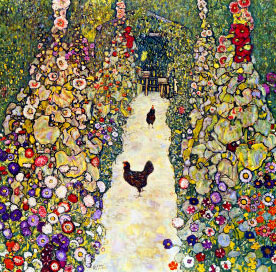
Gustav Klimt's Garden Path with Hens survives as an image, not as a viewable oil painting. The canvas known in German as Gartenweg mit Hühnern belonged to August and Serena Lederer. Nazi authorities expropriated their collection, displayed this painting without meaningful owner consent in 1943 and sent it into wartime storage. Current specialist records consider the original destroyed at Schloss Immendorf in May 1945, although the exact circumstances of the fire remain incompletely documented.[3][4][5]
Photographs and a posthumous colour print preserve the composition. Two birds stand on a narrowing path between tall hollyhocks and abundant flowering growth. At the rear, the route reaches an arbor or shaded retreat rather than opening into a distant panorama. These records allow the organisation of the picture to be examined, but they do not supply the oil's present colour balance, paint texture, condition or physical survival.[1][6]
The current Gustav Klimt Database dates the painting to 1916, Klimt's final summer at Lake Attersee. An older Clark Art Institute photograph record uses 1917. The difference concerns one lost canvas, not two versions. “Garden Path with Hens” and the specialist translation “Garden Path with Chickens” are likewise English title layers for Gartenweg mit Hühnern.[1][2][7]
At a Glance
- ArtistGustav Klimt
- German titleGartenweg mit Hühnern
- English titlesGarden Path with Hens and Garden Path with Chickens
- Current date1916; an older documentary record uses 1917
- MediumOil on canvas
- Dimensions110 × 110 centimetres in the retained catalogue record
- Recorded inscriptionLower left on the path, according to an older study-photograph record; the lost original cannot now be checked
- Documented early ownersAugust and Serena Lederer
- Wartime historyExpropriated collection; shown under Nazi control in 1943; presumably transferred to Schloss Immendorf
- Present conditionOriginal considered destroyed in the May 1945 Immendorf fire
- Current accessDocumentary images and reproductions only; no surviving oil is available to visit[1][3][4][5][7]
One Lost Painting, Two English Titles
The German word Hühnern is commonly rendered as “chickens” or “hens.” The current Klimt Database uses Garden Path with Chickens, while the familiar page title is Garden Path with Hens. Both refer to the same square painting.[1]
The translation does not prove the sex of each visible bird. In close description, “chickens” or simply “birds” is therefore safer than turning the English title into a zoological finding. Their number and position are more secure: two small birds occupy the path and help establish its scale.
The title also identifies the garden route as the organising subject. Flowers occupy far more area than the path, yet the opening through them gives the composition direction. The birds convert that light-coloured opening from an abstract wedge into ground that can be inhabited and crossed.
The Date: 1916 or 1917?
Current specialist chronology places Gartenweg mit Hühnern in 1916 and relates it to Klimt's final summer on the Attersee.[1][2] A Clark Art Institute Library study photograph instead catalogues the painting as 1917 and notes an inscription at lower left on the path.[7]
The discrepancy should remain visible without multiplying the work. No source used here identifies a 1916 first state and a 1917 revision, a second canvas or a date written into the signature. The 1916 date is the most responsible public baseline because it comes from the current corpus record; 1917 remains part of the documentary history.
The lower-left inscription requires similar restraint. The Clark metadata preserves its reported location, but the original cannot be examined to expand or verify the lettering. It would be unsafe to supply an exact transcription from an indistinct reproduction.
What the Surviving Image Preserves
The documentary image shows a path advancing from the lower portion into a richly planted garden. Its edges are neither mechanically straight nor fully open. Flowering growth presses inward, while taller plants rise like columns on both sides.[1][6]
Two birds interrupt the route near the foreground. Farther back, an arbor or enclosed retreat sits beneath darker foliage. The path therefore moves from light into shade and from relative openness towards shelter. It does not culminate in a lake, sky or distant mountain.
Current specialist description identifies the tall plants as hollyhocks. Other blossoms can be discussed as abundant growth without reconstructing a complete planting list. Later gardens inspired by Klimt's landscapes are not botanical replicas of the 1916 site and cannot establish every species.
The image also transmits colour relationships, especially the contrast between bright flowers, pale path and darker outlines. Yet any colour statement belongs to a reproduced witness. It cannot prove the original pigments, varnish, fading, retouching or current condition.
A Path That Both Recedes and Returns
The path offers one of the painting's clearest depth cues. It narrows towards the rear, passes between planted borders and disappears beneath the arbor. Its direction invites the viewer to imagine moving into the garden.
Other elements resist that movement. Tall hollyhocks create lateral barriers, while dark contours connect flowers and foliage across the surface. Current Klimt scholarship describes these outlines as a feature of his late manner: they rhythmise bright colour while drawing forms back towards the picture plane.[1]
The result is not the elimination of space. Birds remain on traversable ground, plants overlap one another and the arbor occupies a farther zone. Instead, recession is continually checked by a dense, connected surface. The viewer follows the path and then becomes aware of how strongly the garden is held together as an image.
This is different from saying that Klimt “turned nature into a mosaic.” No mosaic material is involved, and the phrase would obscure the specific negotiation among narrowing route, upright plants, birds and contour.
A Square Enclosed from All Sides
The 110-centimetre-square format gives the path no broad lateral escape. Plants rise near both side edges, flowering growth presses against the lower boundary and dark foliage gathers above the destination. The route is therefore legible within a field that seems to close around it.[1][7]
That enclosure makes the slight widening near the foreground especially important. It provides just enough open ground for the birds and establishes the viewer's side of the scene. As the path contracts, flowers take an increasing share of the available space. Movement into depth becomes a gradual transfer from clear ground to dense vegetation.
The arbor does not break the enclosure. Its darkness concentrates it. A conventional garden prospect might place an opening, lake or bright horizon beyond a path; Klimt instead gives the eye a sheltered end point whose interior cannot be surveyed. The composition offers access without a vista.
The square also prevents any single direction from dominating. Hollyhocks pull upward, the path moves inward and spreading flowers carry the eye sideways. Their competing pressures keep the garden active even though no weather event, human action or expansive background supplies drama.
Two Birds and a Note of Humour
The chickens are small compared with the flower growth, but they change the tone of the composition. They interrupt the path's formal recession with an ordinary incident. One cannot imagine the route solely as a solemn passage into nature once two domestic birds occupy it.
The Klimt Database calls the conception “almost humorous.”[1] That is a useful attributed reading, not evidence of a recoverable joke or personal anecdote. The birds need not symbolise fertility, cowardice, domestic order or wartime escape.
Their reliable function is visual. They give the path scale, establish the foreground as usable ground and slow the imagined movement towards the arbor. Their compact forms also answer the taller, more continuous growth around them.
An earlier Klimt painting, After the Rain (Garden with Chickens in St. Agatha) of 1898, also includes birds within a garden setting.[1] The shared motif does not make the late canvas a new version. Garden Path with Hens has its own route, enclosure, date, ownership and destruction history.
Hollyhocks as Garden Architecture
The hollyhocks rise above surrounding flowers and make the sides of the path feel constructed. Their vertical stalks operate almost like posts, but their irregular blossoms prevent them from becoming rigid architecture.[1]
Because they stand on both sides, they intensify the transition from foreground to enclosed rear space. The viewer does not look across an undifferentiated flower field; the plants organise a corridor whose boundaries remain porous.
The arbor reinforces this effect. Specialist interpretation connects it with the retreat near the forester's lodge environment where Klimt stayed during his last Attersee summer.[1][2] Resemblance does not secure an exact structure. It should not be identified as a surviving gazebo, Klimt's studio or a precisely mapped part of the lodge.
What the composition establishes is a shaded destination. A garden path conventionally promises access, but this one ends in further enclosure. The eye reaches the back only to encounter darker foliage and shelter.
The Final Attersee Summer
Klimt spent the summer of 1916 at Weißenbach on the Attersee, and current chronology associates Garden Path with Hens with that final stay.[2] This compact setting is enough to explain why a garden route, dense planting and arbor could enter the work.
The painting should not become an account of Klimt's complete holiday routine or relationships. Nor does the location prove a precise footprint. No garden plan, working photograph or preparatory drawing has been securely assigned to the composition in the evidence used here.
Its late date does not make it unfinished. The current record treats it as an independent painting, and historical owners and exhibition organisers did the same. Because the physical surface is lost, one also cannot use reproductive blur or open-looking areas to diagnose its final state.
Photograph, Print and Original Oil
At least two kinds of documentary witness matter. Study photographs record the painting in monochrome, preserving its layout and historical cataloguing. Max Eisler's posthumous 1931 publication Gustav Klimt. Eine Nachlese reproduced it as plate 26 in a colour-light print.[6][7]
Neither object is the original. The photograph has photographic support and processing; the 1931 plate has its own paper, ink and production history. Those materials cannot be assigned to Klimt's oil painting. The publication is also not an original print designed or pulled by Klimt.
The colour plate is valuable because it records how the work was transmitted before its wartime loss. It helps distinguish bright flowers, path and dark foliage. It cannot establish the precise appearance of the paint in 1916, its condition in 1943 or whether the printed hues correspond exactly to Klimt's pigments.
Modern scans and online reproductions add another layer of mediation. They widen access to the composition but may alter crop, contrast and colour. A reader can study the picture's structure through them without claiming to have viewed the canvas itself.
The witnesses answer different questions. A monochrome photograph can clarify placement, tonal division and the relation of the path to surrounding growth without supplying chromatic evidence. The 1931 print preserves an early interpretation of colour before the wartime loss, but its printing process mediates every hue. Agreement between them strengthens confidence in the composition; differences should not be mistaken automatically for repainting or distinct states.
Neither witness provides the information that modern conservation might extract from a surviving painting. There is no object-specific X-ray, infrared image, pigment analysis or support examination to establish hidden drawing, revisions or a sequence of paint layers. Visible-looking thickness in a reproduction cannot replace that evidence.
August and Serena Lederer
August and Serena Lederer assembled the most important private collection of Klimt's work in Vienna. Garden Path with Hens formed part of that collection, although the retained records do not establish its original acquisition date, price or terms.[4]
The painting's later history must retain the owners as people rather than reduce “Lederer collection” to a label. After the Nazi seizure of power, the Jewish family was persecuted, its property was controlled and dispersed, and Serena attempted from exile to preserve influence over the collection.[3][4]
There is no evidence that the family freely placed this landscape into a neutral state exhibition programme. Its public appearance in 1943 occurred after expropriation and amid official control of the Lederer works.
The Coerced 1943 Exhibition
In 1943, Nazi authorities organised a Klimt retrospective in the former Vienna Secession building on Friedrichstraße. Paintings from the secured Lederer collection, including Garden Path with Hens, were shown while the owners' identities were suppressed.[3][6]
The exhibition proves that the painting remained available and recognisable during the war. It does not demonstrate voluntary lending, lawful custody, unchanged condition or a celebratory recovery of Klimt detached from persecution.
Its use also formed part of the object's movement through institutions controlled by the regime. Describing the display simply as a successful retrospective would erase the circumstances that made the Lederer paintings available.
The exhibition record is the secure wartime public anchor. The sources used here do not establish an exact lifetime debut for Garden Path with Hens, so none should be supplied by analogy with other 1916 landscapes.
Transfer to Schloss Immendorf
Current Klimt Database research says the painting was presumably among the works delivered to Schloss Immendorf on 3 April 1943.[3] “Presumably” is essential: the documentary network is strong, but no complete receipt follows every canvas into a particular room.
The castle became a wartime repository for cultural objects. Later records, including a March 1945 rescue or salvage list, help establish the presence and endangered status of works connected with the Lederer collection.[3][5]
Storage history should not be confused with ownership. Moving the expropriated painting away from Vienna did not convert the state into its legitimate proprietor, and it did not end the Lederer family's claim. It placed the canvas in the location associated with its probable destruction.
What Is Known about the Immendorf Loss
Specialist and museum research considers Garden Path with Hens destroyed in the May 1945 fire at Schloss Immendorf.[1][3][5] The original has not resurfaced, and no authenticated fragment or postwar physical sighting has been established.
The fire's exact events are less certain than the painting's loss. Postwar narratives describe explosions, deliberate ignition and the involvement of German or SS units in different ways. MAK's recent research stresses that direct eyewitness documentation is lacking and the complete circumstances remain unresolved.[5][6]
Responsible language therefore distinguishes the conclusion from the mechanism. The canvas is considered destroyed at Immendorf; the exact sequence by which the castle burned cannot be narrated as settled fact. Later allegations of pre-fire plundering likewise do not prove that this painting was removed.
There is no known surviving oil to restitute, sell or display. Speculation about a secret collection would transform a general uncertainty around the fire into an unsupported claim about one object.
What Can Be Seen Today
As of 10 August 2026, the original canvas could not be visited. Its physical absence is different from a museum work temporarily in storage. No current owner, condition report or exhibition itinerary exists for the lost oil.
Documentary access remains meaningful. Archive photographs, the 1931 colour-light print and current specialist research preserve the painting's composition and history.[1][5][6][7] They make it possible to understand the path, birds, hollyhocks and arbor while maintaining the boundary between evidence and object.
That distinction is the page's central discipline. Reproductions prevent the image from vanishing, but they do not reverse destruction. They transmit a visual record while leaving paint surface, precise colour, physical scale and material presence irrecoverable.
Why Garden Path with Hens Matters
The painting gives a modest garden incident a complex structure. A path moves inward, two birds pause on it, tall flowers form porous walls and an arbor closes the far end. Depth remains readable, yet contour and colour reconnect the scene across the surface.
Its documentary history reveals a second kind of complexity. The Lederers' ownership, Nazi expropriation, coerced exhibition and probable Immendorf transfer can be established with different degrees of precision. The destruction conclusion is strong; an exact fire narrative is not.
Keeping those levels separate does not weaken the account. It allows the work to be understood both as a distinctive late landscape and as an object whose physical loss followed persecution and state control. The surviving image can still disclose Klimt's organisation, while the absent canvas sets firm limits on what anyone can claim to see.
Frequently Asked Questions
References
- Gustav Klimt Database, “The Final Years: 1914–1918”; current 1916 identity, title, loss baseline, hollyhocks, two birds, arbor, humour and contour/depth analysis. View source. Accessed August 2026.
- Gustav Klimt Database, “Biography”; final Attersee summer and the 1916 chronology of Garden Path with Chickens. View source. Accessed August 2026.
- Gustav Klimt Database, “Posthumous Fame and Legend: 1919–1945”; Lederer expropriation, coerced 1943 display, presumed 3 April 1943 Immendorf transfer, wartime custody and limits of the fire evidence. View source. Accessed August 2026.
- Gustav Klimt Database, “The Lederer Family”; collection membership, family persecution and the fate of the Lederer Klimt holdings. View source. Accessed August 2026.
- MAK – Museum of Applied Arts, “Gustav Klimt, the MAK, and Immendorf Castle: Burnt, Destroyed, Vanished?”; current research into the expropriated works, wartime storage, loss conclusions and incompletely clarified fire. View source. Accessed August 2026.
- Klimt Villa and MAK, “Klimt Lost,” Google Arts & Culture; the 1931 Eine Nachlese colour-light print, plate 26, the coercive 1943 collection context and qualified Immendorf account. View source. Accessed August 2026.
- Clark Art Institute Library, study photograph of Garden Path with Hens; older 1917 date, translated title, 110 × 110 centimetre dimensions and lower-left inscription metadata. View source. Accessed August 2026.
Discussion
Garden Path with Hens rewards close attention to source context, object identity and careful reproduction boundaries.