 by Tom Gurney
Tom Gurney BSc (Hons) is an art history expert with over 20 years experience
Published on August 21, 2026 / Updated on October 23, 2026
Email: tomgurney1@gmail.com / Phone: +44 7429 011000
About Portrait of Fritza Riedler
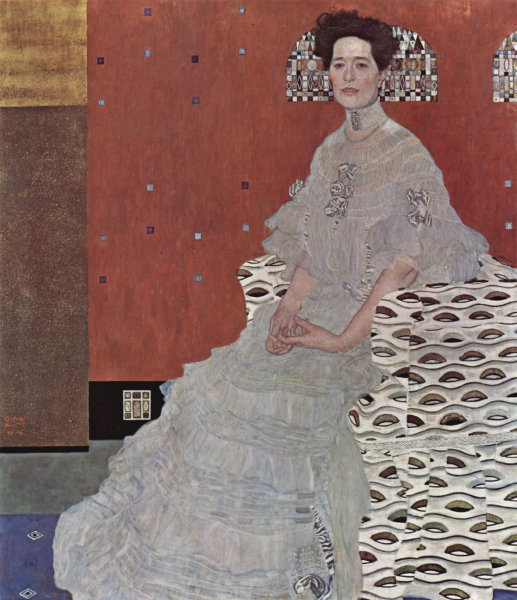
Gustav Klimt's Fritza Riedler turns a society portrait into a contest between a living body and an ordered decorative system. Fritza sits almost frontally in a broad armchair, her pale face sharply framed by dark hair. A white dress descends in ruffles, flounces and bows. Around her, the chair's curved upholstery, repeated eye-like forms, a bell-shaped field behind the head and the squared divisions of the wall make the room appear at once deep and flat. Everything has been arranged, yet not everything has become ornament.
Painted in 1906, the canvas stands near the beginning of Klimt's Golden Period. Belvedere identifies it as oil on canvas, and its object scholarship specifically records gold leaf among the decorative means. But the portrait is not merely a rehearsal for more famous golden works. Its achievement is structural. Soft fabric meets strict geometry; a triangular seated figure interrupts an orthogonal ground; naturalistically painted flesh remains visible within an environment that threatens to absorb it.[1][2]
The sitter's reserve has often encouraged biographical storytelling. Current research supports less certainty. No known contemporary photograph permits a simple likeness comparison, and the origin of the commission remains undocumented. Even basic identity facts have recently been corrected: Fritza was born in Töpliz, now Toplice in present-day Slovenia, not Berlin. A responsible account therefore begins with the painting's visible construction and the records that survive, without turning stillness into proof of her private character.
At a Glance
- ArtistGustav Klimt
- Current titleFritza Riedler; Portrait of Fritza Riedler is a clear English descriptive form
- Date1906
- MediumOil on canvas, with gold-leaf accents identified by Belvedere
- Dimensions153 × 133 centimetres
- Signature and dateGUSTAV / KLIMT / 1906, placed vertically along the left side
- SitterFriderica Ludovica Maria “Fritza” Riedler, born Langer (1860–1927)
- BirthplaceTöpliz/Toplice, part of Sagor and now within Zagorje ob Savi, Slovenia
- CommissionOrigin unknown; no surviving letters or other located documents establish the circumstances
- Study evidenceA substantial 1904/05 campaign testing seated and standing poses, views, hands and dress
- First exhibitionMannheim Jubilee Exhibition, 1907
- Later early presentationsKunstschau Wien 1908; eighteenth Berlin Secession exhibition, 1909
- ProvenanceFritza Riedler; Aloys Riedler; Emilie Barbara Langer; purchased by the Austrian Gallery in December 1937
- Current collectionBelvedere, Vienna, inventory 3379
- Current locationUpper Belvedere, as listed on 9 August 2026[1][2][7]
Who Was Fritza Riedler?
Belvedere's current archival research identifies the sitter as Friderica Ludovica Maria Langer, born on 9 September 1860 in Töpliz, or Toplice, a locality within Sagor on the Sava. The area is now part of Zagorje ob Savi in Slovenia. Her familiar name was Fritza. Other records use Friederike, and her grave identifies her as Franziska. These are historical naming conventions for one person, not evidence for several sitters.[1]
This correction matters because older accounts sometimes called her Berlin-born. Berlin belonged to her married life, not her birth. In 1881 she married Aloys, also written Alois, Riedler, a Graz-born mechanical engineer and university teacher. His appointments took the couple through Munich, Aachen and Berlin. They moved to Vienna after his retirement in 1921. Fritza died there on 11 April 1927, without children.[1][3]
The professional biography of her husband helps explain the couple's movement and public position, but it does not define Fritza's face. The current sources preserve only limited information about her own activities. That scarcity must not be converted into passivity. It simply marks an archival imbalance: a professor's career generated more records than the life of the woman Klimt painted.
A Commission Whose Origin Is Unknown
The portrait clearly served a representative function. Its size, costly execution and formal presentation belong to elite society portraiture. Yet Belvedere states that the origin of the commission remains unresolved because no letters or other documents have been located. No known photograph of Fritza provides a separate contemporary likeness.[1]
It is therefore unsafe to say that Aloys commissioned the painting, chose Klimt, determined the dress or fixed the desired message. Those possibilities may sound plausible for a married couple of their position, but plausibility is not documentation. The fee and exact schedule are also unknown.
The absence does not make the picture mysterious in every respect. Studies began in 1904/05, the canvas bears the date 1906, and it was publicly exhibited in 1907. Fritza owned it afterward. These facts define a working and ownership sequence without supplying a contract. A portrait can be securely identified even when the negotiations that produced it have disappeared.
A Nearly Square Monument
At 153 by 133 centimetres, Fritza Riedler is tall but close enough to square for height and width to compete. The format gives a seated body substantial scale while leaving room for a designed environment. Unlike a narrow standing portrait, it can spread the chair, skirt and wall laterally. Unlike a true horizontal composition, it preserves the sense of elevation associated with a public likeness.[1][2]
Klimt organises the background through verticals and horizontals. Rectangular wall fields, patterned zones and dark divisions create an orthogonal scaffold. Within it, Fritza and the chair form a broad triangle or pyramid. Her head supplies the apex; dress and furniture widen below. Geometry is not merely applied decoration. It governs how a body occupies the canvas.[1]
The opposition is never complete. The dress is stepped and ordered, while the wall includes curved or irregular ornamental forms. The figure can look stable, but chair and skirt blur together at their edges. Klimt makes categories collide: architecture behaves like surface design, furniture becomes an emblem, and fabric alternates between tactile substance and compositional shape.
The Seated Pose and the Limits of Psychology
Fritza sits upright, facing the viewer with only slight adjustments of head and body. Her arms are held in conspicuously arranged positions. The hands do not fall casually; they seem installed within the composition. Dark hair frames a pale, carefully modelled face, and jewellery intensifies the zone around the neck.[1][2]
Words such as reserved, majestic, aloof or still describe effects made by the portrait. They are not diagnoses. The formal pose, limited facial movement and symmetrical setting can create distance, but no source establishes that Fritza was unhappy, submissive, bored or emotionally cold. Nor can the absence of a photograph prove that Klimt transformed her beyond recognition.
The artificiality is purposeful. A society portrait usually promises both likeness and social bearing. Klimt preserves enough naturalism in face and flesh to identify a person, then openly stages the rest. The sitter appears less caught in a private moment than placed within a visual order. Her presence depends on resisting that order just enough to remain human.
Face, Hair and Jewellery
The head carries an exceptional amount of tonal contrast. Fritza's face is pale and comparatively continuous, while the dark mass of hair forms a firm outer boundary. This opposition separates her from the surrounding wall before the bell-shaped ornament begins to enlarge the silhouette again. Recognition is first concentrated, then ceremonially extended.
Klimt gives eyes, nose and mouth enough modelling to sustain likeness, but he avoids the animated glance and mobile facial surface found in some earlier portraits. The face appears held. That effect comes from paint, pose and framing together; it cannot be treated as a neutral record of how Fritza habitually looked.
The jewellery mediates between flesh and design. A closely fitted multistranded band circles the neck, while a pearl necklace supplies a second, looser sequence of repeated pale forms. The ornaments answer the dress's tiers and the surrounding geometric field without erasing the neck or chin. Their value in the composition lies less in advertising an itemised fortune than in controlling the passage from face to gown.
The White Dress
The dress is bright without being a uniform white. Broken pale tones allow its surface to carry shadows, reflected colour and differences of texture. Ruffles, flounces and bows descend in tiers. Their softness contrasts with the rigid wall, yet their repetition also submits fabric to a rhythm.[1][2]
Near the torso and shoulders, Klimt keeps the construction comparatively legible. Lower down, folds accumulate into broader bands. The dress is tactile: one can imagine the weight and rustle of layered material. At the same time, the ordered tiers make it resemble an architectural element, a sequence of ledges or steps beneath the face.
No cited object record identifies the designer or maker. The garment must not be assigned to Emilie Flöge, Schwestern Flöge or the Wiener Werkstätte merely because those names belong to Klimt's wider design circle. Its pictorial relation to geometry is secure; its workshop origin is not.
The jewellery remains concentrated rather than ostentatiously dispersed. A multistranded choker and a pearl necklace gather detail near the face. They connect the naturalistically painted head to the repeated forms surrounding it, but they do not establish a symbolic programme or a complete inventory of Fritza's possessions.[2]
An Armchair Becoming Pattern
The upholstered chair is essential and strangely difficult to isolate. Its broad curved form supports Fritza and helps create the pyramidal volume of the seated group. Yet the upholstery is covered by wavy lines and almond- or eye-like shapes. As those motifs repeat, the chair begins to behave less like furniture receding in depth and more like an ornamental plane.[1][2]
The transformation is not total. Curved arms and the sitter's weight still make the object readable as a chair. Klimt asks the viewer to hold two experiences together: a body is seated in three-dimensional furniture, and a painted pattern spreads across the same area. The result is an oscillation, not an error in perspective.
Belvedere classifies the upholstery forms as ancient Egyptian eye motifs. Other scholarship has related them more specifically to the Eye of Horus. The broader institutional description is the safer public baseline. An eye-like pattern can suggest watchfulness or sacred symbolism, but no object-specific evidence establishes one universal meaning for every form. The motifs first organise the chair and repeat the act of looking within a portrait.[1][2]
The Bell-Shaped Field Behind the Head
A pale, ornamented field rises behind Fritza's head. It has been described as bell-, fan- or semicircle-like, and a related shape appears elsewhere on the wall. Because it surrounds the head, it can look like a halo. Because it broadens beside the dark hair, it can also merge with the silhouette of an elaborate coiffure.[1][2]
No religious subject requires a halo here. The form produces ceremonial emphasis without turning Fritza into a saint. It separates the face from the rectilinear wall, expands the head's visual scale and establishes a centre within the busy surface.
The ambiguity between setting and bodily extension is deliberate. The field may belong to architectural decoration, yet it behaves like part of the sitter's presentation. Klimt does not merely paint a woman in front of a wall; he coordinates person and surrounding until the boundary becomes unstable.
A Bounded Contrast with Sonja Knips
Belvedere itself contrasts this portrait with Klimt's earlier Sonja Knips. Both are large, close-to-square depictions of seated named women, yet their energies diverge. Sonja leans toward action within a dark, spatially uncertain field. Fritza is stabilised by a frontal arrangement, tiered white fabric and a wall whose divisions insist on order.[1]
The comparison identifies choices rather than personalities. It does not prove that Sonja was lively and Fritza passive in life. Klimt made one pose feel provisional and the other ceremonial. In the earlier canvas, atmosphere loosens the room; in the 1906 work, geometry disciplines it. The contrast shows how far his portrait language changed without turning either sitter into a psychological type.
Gold Leaf, Oil and the Golden Period
Belvedere's concise object field lists oil on canvas. Its scholarly essay also identifies the use of gold leaf. The accurate formulation is therefore oil on canvas with object-specific gold-leaf accents. No equally specific evidence used here authorises silver, platinum, mother-of-pearl or a broader metal recipe for this painting.[1]
Gold supports the picture's emphasis on surface, but it does not cover everything or explain the portrait by itself. The white dress, dark hair, pale face and patterned chair remain decisive. Reflective accents interact with real light, while painted whites and yellows can imitate brightness without being metal.
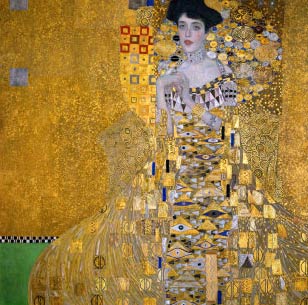
The portrait belongs at the threshold of Klimt's Golden Period because it develops a method: naturalistic flesh is set against increasingly abstract geometry and material ornament. A short comparison with Portrait of Adele Bloch-Bauer I, shown with it in Mannheim in 1907, reveals how much further that method could go. But Fritza's painting should not be treated as an incomplete Adele. Its cooler wall, tiered dress and dominant chair create a separate pictorial problem.[1][2]
The Wiener Werkstätte Connection
Squares, diamonds, wave lines, eye-like motifs and a mosaic-like arrangement connect the portrait to the visual culture of the Wiener Werkstätte. Belvedere notes that Klimt was officially listed as a collaborator from 1905. The connection concerns shared design principles and networks; it does not mean that the Workshop manufactured the canvas, upholstery or depicted wall.[1]
A 1906 armchair designed by Josef Hoffmann and made by the Wiener Werkstätte survives from Klimt's studio and is now held on permanent loan at the Leopold Museum. It has a semicircular relationship between back and arms. The museum says Klimt used that motif in Fritza Riedler, but in strongly modified form.[5]
That wording prevents an attractive comparison from becoming false identification. The surviving chair differs in shape and materials, and no evidence establishes it as the exact furniture on which Fritza sat. It demonstrates how a design idea could travel between real furniture and painting. Klimt did not simply transcribe the object; he transformed a semicircular motif into a broader ornamental support.
Studies from 1904/05
Klimt began preparing the portrait in 1904/05. The associated studies test standing and seated positions, frontal and side views, hand placement, bent arms and details of clothing. Belvedere cites a sequence in Alice Strobl's catalogue, but a permanent total would be misleading as attribution and digital catalogues continue to develop.[1][2]
The drawings concentrate on body and furniture rather than fully specifying the final geometric room. This suggests that pose, dress and chair were worked through before the painted setting reached its elaborate form. It does not prove that the background was invented in one late burst or that none of it was planned on paper now lost.[2]
One Albertina sheet shows Fritza seated facing left while turning her face toward the viewer. Dated 1904/05, it is black chalk on paper, 44.8 by 31.7 centimetres, inventory 34553. Albertina sees in it the emerging monumentality of the portrait. The body already has elevation and control, but the canvas's eye-patterned chair and orthogonal wall are absent.[3]
Wien Museum holds another exact study from 1904–05, a pencil drawing on packing paper measuring 45.6 by 31.4 centimetres, inventory 96482/2. Its humbler material reminds us that careful preparation did not require precious support.[4]
Neither sheet is a one-to-one cartoon. Together with other variations, they show choice: Klimt compared poses, redirected limbs and adjusted how the dress met the chair. The final stillness was constructed through alternatives rather than simply discovered at the first sitting.
Velázquez and the Infanta Comparison
Belvedere and Klimt Database compare the field behind Fritza's head, the formal bearing and the artificial containment of the body to Velázquez's Infanta María Teresa, painted around 1652/53 and held in Vienna's Kunsthistorisches Museum. The earlier portrait shows court representation making person, clothing and dynastic display inseparable.[1][2][6]
Klimt had opportunities to know Velázquez's art. The Vienna painting was locally accessible, and Erich Lederer later recalled that Klimt studied Velázquez during a London visit in spring 1906. Klimt's much-repeated praise of the Spanish master also comes through later testimony. These strands make the comparison substantial, but not mechanically provable as a traced quotation.[2]
The differences are as important as the resemblance. Velázquez describes a seventeenth-century court dress and dynastic sitter; Klimt paints a modern married woman in soft white layers within a geometric field. Fritza's head surround evokes the breadth of an infanta coiffure without copying its costume. The relation concerns the pictorial production of rank and artifice across time.
The comparison was part of a wider early-twentieth-century fascination with Velázquez, not a private code possessed by Klimt alone. It helps explain why the portrait can feel courtly without proving that Fritza or her family requested an infanta role.
An Earlier State Preserved in Reproduction
Klimt Database notes that a reproduction published in the 1918 portfolio Das Werk von Gustav Klimt preserves a different state of the portrait. The small square containing the signature and date is absent, while some wall squares and details of the head surround differ. The publication date of the plate does not mean Klimt revised the canvas in 1918; the reproduction transmitted an earlier photographic state.[2]
The institution proposes that Klimt added or adjusted these details for, or after, the 1907 Mannheim presentation. “Proposes” matters. The evidence secures difference between documented states, while the precise timing remains inferred. It is safer to say that the final signature field and selected ornament entered after the recorded earlier state than to invent the order of every brushstroke.
This evidence also clarifies the 1906 date. The inscription belongs to the final canvas but may itself have been added after the year it names. A painted date can declare the work's identity without functioning as a timestamp for its last physical change.
Mannheim, Vienna and Berlin
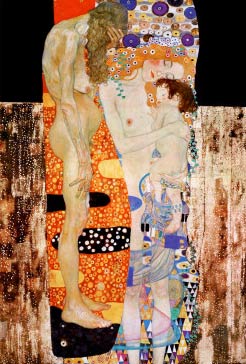
The portrait was first exhibited at the Mannheim Jubilee Exhibition in 1907. It appeared with The Three Ages of Woman, Portrait of Adele Bloch-Bauer I and drawings in a room Josef Hoffmann designed for the Wiener Werkstätte. The setting placed Klimt's portrait practice within a coordinated environment of painting and modern design.[1][2]
In 1908 the canvas appeared at the Kunstschau Wien under a title identifying the sitter as the wife of a privy councillor. The historical label reflects social convention; it does not replace the current title or erase Fritza's name. In 1909 it was shown at the eighteenth Berlin Secession exhibition as Damenbildnis, or portrait of a lady.[1][7]
These changing labels belong to one work. Mannheim established its public debut; Vienna brought it into Klimt's independent exhibition project; Berlin returned it to a city where Fritza had lived for many years. The sequence demonstrates mobility without requiring a new canvas or state at each presentation.
Family Ownership and the 1937 Belvedere Purchase
Fritza owned the portrait from 1906 until her death in 1927. Her husband Aloys then inherited it and retained it until his death in 1936. Fritza's unmarried sister Emilie Barbara Langer became the next owner, although Belvedere notes that the exact moment at which she first took control—after Fritza's death or only after Aloys's—has not been established.[1]
The Austrian Gallery approached the family in autumn 1937. Fritza's brother Alfons held the canvas on Emilie's behalf and agreed to its delivery for discussion. In December the museum purchased it from Emilie Langer for 4,000 schillings. She imposed a condition that the work was neither to be sold nor exchanged out of the gallery.[1]
The date matters. This was a documented family sale completed before the March 1938 Anschluss. Nothing in the cited provenance identifies a Nazi seizure, forced transfer or wartime confiscation. Precision does not minimise the violence that followed in Austria; it prevents that history from being attached to the wrong transaction.
The portrait remains in the Belvedere collection as inventory 3379. On 9 August 2026 the live object record listed its location as the Upper Belvedere.[1] Displays can change, so prospective visitors should confirm the museum's current information.
How to Look at Fritza Riedler
Start with the simplest geometry. Find the vertical and horizontal divisions of the wall, then trace the broad triangle formed by head, shoulders, chair and skirt. The figure is stable because those two systems oppose and reinforce one another.
Move next from face to dress. The pale skin and dark hair create concentrated likeness. The white garment widens below through tactile ruffles, yet its tiers also become a formal sequence. Notice where cloth looks soft and where it begins to resemble architecture.
Then isolate the chair. Follow its curved outline, wavy upholstery and eye-like repeats. Ask when it reads as furniture and when it flattens into pattern. The painting's spatial intelligence lies in making both readings persist.
Study the field behind the head last. It can appear as wall decoration, halo, fan or enlarged coiffure. The Velázquez comparison explains one historical association, but the form remains active even without a single name. It gives Fritza a ceremonial scale while exposing how representation is constructed.
Keep interpretation tied to what the portrait can bear. Stillness is visible; unhappiness is not. The commission existed; its instigator and price are unknown. Gold leaf is documented; a larger mosaic recipe is not. The surviving studies show alternatives, not a complete chronology. These boundaries allow the painting's real complexity to emerge without filling its archives with invention.
A Person Installed Within Design
Fritza Riedler makes representation look deliberately artificial. Klimt does not pretend that social bearing is spontaneous. He builds it from posture, chair, dress, jewellery, wall, signature and reflective material. The portrait's reserve is an artistic result rather than a transparent discovery about the sitter.
Yet Fritza does not disappear. Her face and gaze interrupt the surrounding system; the softness of her dress contests the wall; bodily weight keeps the chair from becoming pure diagram. Gold and geometry bring the canvas toward Klimt's celebrated Golden Period, but the human tension gives it a character of its own.
The corrected biography and precise provenance deepen that encounter. A woman born in Toplice, later resident in Berlin and Vienna, owned the picture for the rest of her life. Her sister's documented 1937 sale brought it into the Austrian Gallery under a condition meant to keep it there. The canvas survives not as an anonymous “Klimt woman,” but as a named portrait whose visual certainty and archival limits deserve equal respect.
Frequently Asked Questions
References
Accessed August 2026.
- Belvedere, Vienna, “Fritza Riedler,” live collection record and Alexander Klee/Monika Mayer essays: current sitter correction, object data, unknown commission, composition, gold leaf, study context, exhibitions, family ownership, December 1937 acquisition terms and current location. View source.
- Gustav Klimt Database, “The Klimt Affair Surrounding the Faculty Paintings,” current period account: study development, dress and jewellery, geometric portrait method, eye-motif literature, Velázquez context, documented earlier state and Mannheim presentation. View source.
- Albertina, Vienna, “Study for the Portrait of Fritza Riedler: Seated Facing Left, Her Face Turned toward the Viewer,” current catalogue record: 1904/05 date, black-chalk medium, exact dimensions, inventory, sitter and monumentality. View source.
- Wien Museum, “Study for the Portrait of Fritza Riedler,” live collection entry: 1904–05 pencil drawing on packing paper, exact dimensions, inventory and catalogue identity. View source.
- Leopold Museum, “Armchair from Gustav Klimt's Studio,” object record: Josef Hoffmann/Wiener Werkstätte authorship, 1906 object data and the strongly modified use of its semicircular motif in the Riedler portrait. View source.
- Kunsthistorisches Museum, Vienna, “Infanta María Teresa,” collection record: Velázquez authorship, circa-1652/53 date, canvas, dimensions, inventory and long-standing Vienna provenance of the comparative portrait. View source.
- Gustav Klimt Database, “Berlin Secession,” institutional exhibition history: Klimt's participation and the 1909 presentation of Fritza Riedler at the eighteenth Berlin Secession exhibition. View source.
Discussion
Portrait of Fritza Riedler rewards close attention to source context, object identity and careful reproduction boundaries.