 by Tom Gurney
Tom Gurney BSc (Hons) is an art history expert with over 20 years experience
Published on August 21, 2026 / Updated on October 23, 2026
Email: tomgurney1@gmail.com / Phone: +44 7429 011000
About Church in Cassone
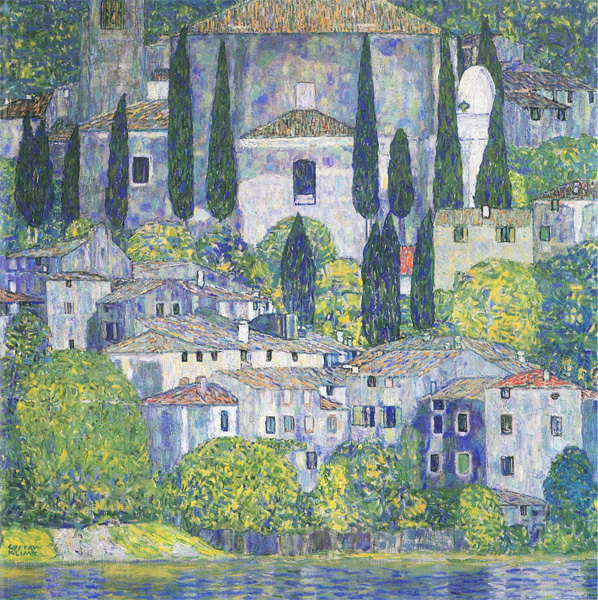
In Gustav Klimt's Church in Cassone, a Lake Garda village becomes a close-packed field of architecture, trees and colour. Pale and blue-grey buildings gather around a church tower. Ochre roofs step through the square, while dark cypresses rise between the structures like strong vertical dividers. There is no broad foreground from which to survey the settlement and little room for an expansive sky. Cassone seems both distant enough to be seen across space and near enough to press against the canvas.
Klimt made the painting in 1913 during his journey to Lake Garda. The surviving canvas measures 110 × 110 centimetres, is signed at the lower left and is recorded simply as oil on canvas.[1] Its exact German title, Kirche in Cassone (Landschaft mit Zypressen), joins location and visual structure: Church in Cassone (Landscape with Cypresses).
The painting's history gives unusual weight to questions of ownership as well as looking. Acquired from Klimt by Viktor and Paula Zuckerkandl, it later belonged to Amalie Redlich. After Nazi persecution disrupted her life and property, the canvas disappeared from a shipping company's depot and eventually entered another private collection. Decades later, a voluntary agreement with her heir allowed it to be sold at Sotheby's in 2010.[1][3] The present owner and location have not been publicly established in the retained records.
At a Glance
- ArtistGustav Klimt
- German titleKirche in Cassone (Landschaft mit Zypressen)
- English titleChurch in Cassone (Landscape with Cypresses)
- Date1913
- SignatureGustav Klimt, lower left
- MediumOil on canvas
- Dimensions110 × 110 centimetres
- Location representedCassone on Lake Garda, Italy
- Current collectionPrivate collection
- Documented early ownersViktor and Paula Zuckerkandl; later Amalie Redlich
- Most recent public sale in the cited recordSotheby's, London, 3 February 2010
- Current accessNo verified public display or disclosed present location as of 10 August 2026
Which Painting Is Church in Cassone?
The governing object is the signed 1913 square sold by Sotheby's as lot 13 on 3 February 2010. It is an oil painting measuring 110 centimetres in both directions, signed Gustav Klimt at the lower left. The German title and its English translation describe one canvas, not a church painting plus a separate Landscape with Cypresses.[1]
The work depicts Cassone, a settlement on the eastern side of Lake Garda. It is not Church in Unterach on Lake Attersee, Klimt's 1915/16 painting now in the Horten Collection. It is also unrelated to the erroneous 1931 Church on Lake Wolfgang caption that was attached to a reproduction of the Unterach image. Similar English titles and church towers cannot override their different locations, dates and ownership records.
The date 1913 connects Cassone with Klimt's Lake Garda journey. It does not indicate that the canvas was exhibited or sold in that year. The first ownership is documented by 1914, while later exhibition and reproduction records belong to subsequent stages in the object's history.[1][2]
The medium is oil on canvas. Bright roofs, luminous walls and dense colour may recall the precious effects of Klimt's better-known figure paintings, but neither Sotheby's nor the Klimt Database records gold leaf, metal or mixed media for this object.[1][2] The cypresses and architecture are built in paint, not mosaic or metallic foil.
A Village Constructed from Intervals
Cassone is recognisable as a settlement, yet Klimt does not arrange it as a continuous architectural inventory. Buildings appear in clusters, separated and reconnected by dark trees. Some walls read clearly as façades; others become pale blocks whose exact distance is difficult to fix. Roofs overlap, rise and descend through the square without producing one uninterrupted street.
The church supplies the most legible landmark. Its tower rises above the surrounding buildings, but it does not stand alone against a broad sky. Neighbouring roofs and vegetation keep it embedded in the village. The painting therefore preserves the church's identifying role while resisting a picturesque hierarchy in which every other structure merely frames it.
Horizontal and vertical forces organise the density. Roofs and walls create short lateral steps. Cypresses cross those movements with narrow, upright forms. The square format prevents either direction from becoming dominant: upward growth is checked by the frame, while lateral spread remains concentrated within equal height and width.
This structure rewards looking before interpretation. A dark cypress may initially seem like a simple divider, then begin to join the tonal masses on either side. A pale wall may appear to advance because of its brightness, while overlapping roofs place it farther back. Klimt allows colour and shape to support depth without making perspective the sole authority.
The result is neither a flat pattern nor a conventional panorama. The eye can enter the village through overlap and tonal difference, but it is repeatedly returned to the relationships among coloured areas on the surface. Cassone remains a real place precisely as its buildings are reorganised into a painted system.
The Cypresses
The cypresses named in the parenthetical title are central to that system. Their dark verticals interrupt the pale architecture, close some gaps and open others. They prevent the village from becoming one continuous block while also binding dispersed buildings through repetition.
Their scale is significant. Several trees rise to heights comparable with the tower and taller houses. Built and natural forms therefore share the task of organising the skyline. A tree can function almost like an architectural pier, while a roof can become a horizontal colour plane among foliage.
Cypresses can carry funerary or sacred associations in European art, especially when they appear near churches. No object-specific source cited here establishes a fixed symbolic programme for Klimt's canvas. The more secure account begins with species, placement and visual effect. Dark foliage establishes contrast, gives the pale settlement rhythm and locates the motif within a southern landscape.[2]
The title's mention of cypresses does not reduce the rest of the vegetation to generic green filling. Shrubs, trees and denser areas of foliage produce different textures and weights. Together they keep architecture from sealing the square and make the village appear inseparable from its terrain.
Colour, Impasto and Southern Light
The Klimt Database describes blue-grey houses, ochre roofs, strongly contrasting values and a liberal use of impasto.[2] Those features distinguish Cassone from an architectural diagram. Walls are not neutral containers; their colours determine how firmly or softly each form occupies the field.
Warm roofs form a sequence across cooler architecture. Dark cypresses provide strong pauses, while brighter passages create flashes among the compressed structures. The contrasts allow Klimt to simplify descriptive detail without losing the separateness of buildings. A façade can remain legible through its relation to a roof, tree or adjacent wall even where windows and masonry are abbreviated.
Impasto makes colour physical. Thicker passages catch light and assert the material surface of the painting. Yet the current public records do not supply a complete pigment analysis or technical map. It would be misleading to invent named pigments, underlayers or a precise order of application from visual effect alone.
Nor does intensity establish metal. The medium remains oil on canvas.[1][2] “Golden” or “jewel-like” may describe how ochres and concentrated colours appear, but such adjectives cannot add gold leaf, bronze powder or mosaic material to the object record.
The southern setting matters without becoming a climatic formula. Klimt's 1913 Lake Garda paintings respond to unfamiliar vegetation, architecture and light, but Cassone is not simply “brighter” than every Attersee work. Its distinctiveness comes from the exact way cool walls, warm roofs and dark cypresses are compressed within this square.
Depth under Pressure
The village occupies uneven terrain, and the painting retains signs of recession. Buildings overlap, roof lines change height and vegetation passes before and behind walls. The church tower rises from within the settlement rather than sitting on a single flat strip. These relations keep the image spatially intelligible.
At the same time, distance is under pressure. The lack of a conventional foreground removes a measured entry into the scene. Architectural blocks are stacked tightly, and colour contrasts often seem as important as perspective. The viewer can recognise depth while feeling that the village has been brought forward.
Institutional scholarship describes the work as an activated, flattened expanse with emphatic impasto.[2] “Flattened” should not be understood as depthless. It names the competition between represented space and a surface whose square shape, repeated verticals and coloured planes remain conspicuous.
This competition differentiates Cassone from a photographic record. The painting does not promise that every building occupies its exact measured relation or that one could reconstruct the view solely from the canvas. Klimt selected, compressed and balanced what he saw. The result conveys the visual density of a settlement rather than serving as a cadastral map.
Where Was Klimt Looking From?
The painting's apparent distance from Cassone has encouraged efforts to recover Klimt's viewpoint. The Klimt Database says the village was probably viewed from the western shore of Lake Garda and reports proposed positions associated with Villa Gruber, Dosso Ferri and Val di Sogno.[2] Sotheby's 2010 catalogue preserves an older reconstruction connecting the view with a position near Villa Gruber and the possible use of a powerful telescope.[1]
These proposals are informative, but they are not equivalent to a labelled working photograph or an autograph note recording a precise location. Even the travel narrative varies. Current Klimt Database research places Klimt and his companions at the Albergo Morandi in Tremosine on the western side of the lake, whereas the older Sotheby's account describes lodging on a small peninsula near Malcesine.[1][2]
The secure core is narrower: Klimt travelled to Lake Garda in 1913, Cassone supplied the motif, and the finished composition suggests observation across significant distance. A western-shore view is probable under current research. The exact building from which he looked, the route taken that day and the magnification of any optical aid remain hypotheses.
Klimt's known interest in telescopes, binoculars and framing devices makes optical isolation plausible as period practice. It does not prove that this canvas reproduces a ten-times view or that mechanical magnification determined every compression. The visible painting is the result of selection and painting, whatever aid may have preceded it.
No exact preparatory drawing or working photograph has been identified in the cited object records. That is an archive limit, not proof that Klimt worked without sketches. The strong organisation of the square can support an argument for careful preparation without producing a specific lost sheet as fact.
The Lake Garda Group
Cassone belongs to a small group of landscapes associated with Klimt's 1913 Lake Garda journey. The Klimt Database discusses it alongside Malcesine on Lake Garda and Italian Garden Landscape.[2] Each is a separate canvas rather than a state or alternate title of the same work.
Malcesine provides the closest architectural comparison, but its later destruction or loss prevents direct examination of a surviving original. Cassone therefore carries particular importance as the surviving Lake Garda village composition. That status should not be inflated into a claim that it is the only surviving landscape from the journey, since Italian Garden Landscape remains a separate surviving work.
The group clarifies Klimt's response to place. Cassone concentrates architecture and cypresses; Malcesine addressed another lakeside settlement; the garden painting turns towards vegetation. The journey supplied related conditions, not one formula repeated three times.
A brief comparison also guards against confusing Cassone with Klimt's Attersee churches and houses. Lake Garda is not merely a generic “southern Attersee.” Its vegetation, settlement forms and viewing distances posed different visual problems. Cassone's cypresses and compressed blue-grey architecture belong to that specific encounter.
The 1918 Das Werk Reproduction
The image circulated after Klimt's death through Das Werk Gustav Klimts. A surviving picture board now recorded by the MAK reproduces Church in Cassone as plate 50. The object is dated 1918, published by Hugo Heller and classified as a heliogravure on paper.[5]
That printed board is not the original painting. Its image dimensions, sheet dimensions, paper and printing process describe a reproduction. The oil canvas remains the signed 1913 object measuring 110 centimetres square.[1][5]
The distinction is especially important because high-quality portfolio reproductions can acquire object-like authority of their own. They document how the painting was selected, titled and circulated, but they cannot establish the original's impasto, current colour, condition or precise ownership at every later date.
The plate also belongs to posthumous publication history. It does not prove that Klimt personally printed the sheet or supervised its 1918 production. His authorship concerns the reproduced composition; the later publisher and print process concern the portfolio object.
The Zuckerkandl and Redlich Families
Viktor and Paula Zuckerkandl acquired Church in Cassone from Klimt by 1914.[1] The record does not establish a commission, an intended room or an exact purchase price. “Acquired from the artist” is sufficient and should not be embellished into a private story of why the couple chose this particular village.
After Viktor and Paula died, the painting passed in 1928 to Paula's sister Amalie Redlich. She received it from their estates and held it at least into 1939.[1] This family sequence is well documented enough to identify the owners without turning the canvas into a portrait of their relationships.
The painting appeared in the 1928 Vienna Secession memorial exhibition for Klimt under a Lake Garda landscape title.[1] Generic catalogue wording should not be treated as evidence for an additional work. It reflects how a known canvas could be described by region or motif before the fuller Cassone title became standard.
Later presentations provide further identity anchors without closing the ownership gaps. The canvas was shown in Graz in 1962, in the Belvedere's Klimt landscape exhibition of 2002–03 and at New York's Neue Galerie in 2007–08.[1] These appearances document periods of public visibility under private ownership; none establishes a sale or permanent institutional home.
Amalie Redlich was Jewish and became a victim of Nazi persecution. Her property history cannot be separated from that violence. At the same time, accuracy requires distinguishing what is known about this exact canvas from the broader fate of the family's collections.
Theft from Storage and the Missing Passage
An official Austrian parliamentary response describes the painting as having been stored with a shipping company and stolen from the depot.[3] The theft severed the documented family chain. The surviving public record does not supply every person or transaction by which the canvas later reached the art market and a Graz collection.
Galerie Welz in Vienna had the painting by 1947. It subsequently passed to Hans Fritz of Gerlitzen and was in a private collection in Graz by 1962.[1] These are published anchors, not a complete route. No evidence cited here proves who took the work from storage, who first sold it afterwards or whether every intermediary knew its history.
The Austrian record describes the later owner as having acquired the canvas in good faith.[3] That legal and historical characterisation should be retained without allowing it to erase Amalie Redlich's loss. A good-faith later purchase and a persecuted family's claim can coexist within the same object history.
It would also be wrong to assign the original theft to Galerie Welz merely because the gallery is the first named postwar holder. Chronological proximity is not proof of participation. The gap between storage-depot loss and documented reappearance must remain a gap.
A Private Voluntary Agreement
Because Church in Cassone was privately owned, Austria's federal Art Restitution Law did not provide the mechanism for its return. The parliamentary response explains that the later private owner nevertheless reached a voluntary agreement with Amalie Redlich's heir, identified in the auction provenance through Mathilde Jorisch and the family succession.[1][3]
This distinction matters. The resolution was not a state museum restitution, court judgment or confiscation from a bad-faith possessor. It was a private agreement made in recognition of the historical claim. Sotheby's later described the work as a notable example of private restitution in Austria.[4]
The Austrian authority also treated the voluntary return or settlement as a compelling factor when approving export.[3] Export permission should not be confused with a declaration that every provenance question had been answered. It concerned the legal movement of the painting after the agreement, not the reconstruction of its missing wartime and postwar chain.
The arrangement allowed the canvas to be offered publicly with the rights of the heir and current owner reconciled. The exact financial terms of the private agreement were not supplied in the retained sources and should not be invented.
The 2010 Sotheby's Sale
Sotheby's offered Church in Cassone in London on 3 February 2010. It sold for £26,921,250.[1] That sum records one transaction at a particular date. It should not be converted into a permanent valuation, present insurance figure or claim that the work still holds a specific market rank.
The sale made the painting publicly visible through a detailed catalogue and brought its provenance into wider discussion. It did not make the auction house its permanent location. The buyer was not named in the cited record, and no secure current city, residence or storage site has been published.
The Klimt Database continues to classify the work as privately held.[2] Private ownership does not prove that the canvas can never be lent or exhibited again, but no live public display was verified as of 10 August 2026. Prospective viewers should not assume that an older exhibition or auction venue still holds it.
The unknown current location is best stated plainly. Speculation about the buyer's identity, nationality, motives, condition of the painting or possible resale would add narrative without evidence.
Why Church in Cassone Matters
The canvas makes architecture vivid without treating it as an inventory of buildings. Church, houses and roofs remain legible, but cypresses divide them and colour changes their spatial force. Klimt allows the village to be specific and reconstructed at the same time.
Its square format is not a neutral container. Equal height and width give vertical trees, tower and stacked roofs comparable pressure. Distance survives through overlap, yet the compressed field continually reminds the viewer that space has been arranged on a surface.
The painting's history adds another form of layered vision. A 1918 heliogravure preserves and circulates the image while remaining physically different from the oil. Published ownership anchors secure parts of the canvas's path while leaving the storage theft and subsequent transfer unresolved. A voluntary private agreement acknowledges historical loss without pretending to recover every missing fact.
Cassone therefore rewards two kinds of exactness. Looking requires attention to the differences among architecture, vegetation, depth and painted surface. Historical understanding requires equal attention to the differences among acquisition, theft, good-faith possession, private settlement, export and sale.
Frequently Asked Questions
References
- Sotheby's, “Gustav Klimt, Kirche in Cassone (Landschaft mit Zypressen),” Impressionist and Modern Art Evening Sale, lot 13, 3 February 2010. View source. Accessed August 2026.
- Gustav Klimt Database, “Expressive Blaze of Colors: 1910–1913,” object chronology and research chapter. View source. Accessed August 2026.
- Austrian Parliament, response concerning Church in Cassone, private ownership, theft, voluntary agreement and export reasoning. View source. Accessed August 2026.
- Sotheby's, “Impressive Auction Highlights from Austrian Collectors,” private-restitution and sale overview. View source. Accessed August 2026.
- MAK – Museum of Applied Arts / Google Arts & Culture, “Church in Cassone (after Gustav Klimt), Plate 50, The Work of Gustav Klimt,” 1918 heliogravure record. View source. Accessed August 2026.
Discussion
Church in Cassone rewards close attention to source context, object identity and careful reproduction boundaries.