


 by Tom Gurney
Tom Gurney BSc (Hons) is an art history expert with over 20 years experience
Published on June 19, 2020 / Updated on October 23, 2026
Email: tomgurney1@gmail.com / Phone: +44 7429 011000
An 1898 drawing for Ver Sacrum
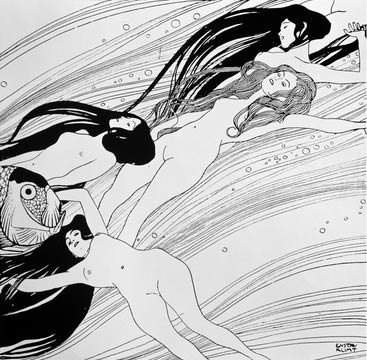
Gustav Klimt's Blood of Fish, also translated as Fish Blood, is the black-and-white drawing Fischblut, made in 1898. Four nude women drift diagonally through a square field of currents, bubbles and streaming hair, with a large fish entering from the left. The ALBERTINA's digital catalogue identifies the original as pencil and black ink on paper, measuring 40 × 40.3 cm, and records the lower-right signature as “GVSTAV | KLIMT”. Its catalogue number is Strobl 675.[1]
The composition appeared on page 6 of the March 1898 issue of Ver Sacrum. That printed illustration is not the same physical object as the handmade drawing: the magazine carried the image to readers, while the original remained a separately collectable sheet. Nor is this a small oil painting rendered monochrome in a photograph. Its economy of black and white belongs to the design itself.[1]
Much of its appeal lies in a productive contradiction. The women seem almost motionless, yet everything around them flows. Their bodies have weight and recognisable anatomy, but no shore, bed or floor supports them. Broad sweeps of hair connect them to an environment that is less a depicted stretch of water than a system of moving lines. Klimt makes the drawing feel simultaneously intimate and remote, bodily and ornamental.
How the figures move across the square
The figures do not gather around a central event. Instead, they form an oblique procession, with bodies and limbs continuing towards the edges. The woman nearest the bottom spreads her arms across the lower part of the composition; higher up, other arms echo that extension. These repeated gestures establish a loose rhythm without turning the figures into identical units. A tilted head, a different bend or a change in hair density interrupts each recurrence.
Cropping is crucial. Rather than enclosing every body comfortably within the border, Klimt allows the picture to cut across them. This gives the group an existence beyond the visible square. The eye can imagine the stream continuing, even though the paper supplies no measurable distance into which it could recede. The composition feels expansive without needing a horizon or a deep landscape setting.
The pale-haired figure offers a particularly clear pause within that movement. Her hair is described with fine internal lines, unlike the broad black masses nearby. Her lifted face and curving torso stand out between darker passages, but she is not isolated as the heroine of a story. The surrounding currents pass her as they pass the others. She remains one variation within the larger arrangement.
The fish supplies a different sort of presence. Its prominent eye, patterned head and compact shape contrast with the long, open contours of the women. It gives the otherwise elusive space an aquatic inhabitant. Yet its proximity need not be made into a chase: the image does not show a bite, wound or struggle. The title draws attention to an association between human bodies and fish without explaining that association as a literal incident.
Hair and water in black and white
Hair is the drawing's most emphatic material. In places it forms a nearly continuous black shape; elsewhere, white streaks break through it like channels. Its edges mingle with the surrounding linear currents, making it difficult to decide where a bodily attribute ends and the water begins. This is one reason the women appear to belong to the environment rather than simply occupy it.
The white areas are equally active. They describe exposed bodies, but also the intervals through which currents travel. A contour can distinguish an arm from the surrounding space without filling that arm with modelling. Small marks register facial features or anatomical changes while leaving much of the surface open. The result is not an absence of drawing: it is a carefully controlled difference between areas that need definition and areas that can remain quiet.
Rows of bubbles interrupt the longer curves with small, rounded accents. They make the water legible without supplying a scientifically consistent underwater view. We can read a current, a suspended body and a floating strand of hair together, although the picture avoids the rippled reflections and shifting light expected in an observed bathing scene. Its unity is graphic rather than optical.
At a distance, the black passages hold the square together. Close up, the fine lines diversify that first impression. The image therefore works at two scales: as a bold arrangement immediately grasped on a printed page, and as a more intricate network in which the eye can linger. This balance helps explain why the composition survives reduction so effectively, although a reproduction cannot reveal every quality of the original paper and pencil.
Why the magazine mattered
Ver Sacrum was the Vienna Secession's journal, first published in January 1898. It offered the association a means of bringing its artistic ideas before a wider readership. The Klimt Foundation places Fischblut among the contributions made specifically for this publishing context, alongside the magazine's broader use of illustrations, initials and reproduced artworks.[2]
That purpose gives the drawing a different setting from a private figure study. The completed design had to communicate through a page. Black masses, spare contours and a recognisable overall movement could remain forceful when printed; the image did not depend on coloured flesh or a painterly surface. Looking at it as illustration brings its selective handling into focus without reducing it to decoration around somebody else's text.
The square also becomes more than a neutral container. Long curves press against its straight edges, and the repeated bodies refuse to settle into a stable upright arrangement. The border restrains the movement but does not explain it. Even the small signature at the lower right belongs to a relatively quiet interval, away from the more crowded upper passage.
Alice Strobl proposed graphic precedents in August von Meissl and Aubrey Beardsley. Her comparison with Beardsley concerns such features as black-and-white contrast, contour and the treatment of floating hair; she also drew attention to a Rhine-daughters illustration. These are scholarly proposals about visual relationships, not proof that Fischblut illustrates Wagner or copies a particular published page.[3]
Studies and changing attributions
The smooth appearance of the finished image should not obscure Klimt's preparatory work. Strobl related studies numbered 676–679 to the poses of its left-hand and central figures. She also connected the development of the floating bodies with research for Medicine. The relationship concerns a vocabulary of figures and movement, not an assertion that the illustration is a surviving fragment of the university painting.[3]
A separate sheet in Wien Museum provides a more tangible comparison. Two Female Nudes, inventory 96482/1 and Strobl 1380, is dated 1897–98 and explicitly catalogued as a study for Fischblut. It is a pencil drawing on packing paper, 30 × 45.8 cm. Those measurements and materials belong to the study, not to the finished, almost square ink composition.[4]
This distinction matters when comparing Klimt's drawings. A study can investigate the relationship between bodies without containing the final fish, surrounding currents or entire arrangement. It is neither a second version of the finished work nor necessarily a template transferred directly to it. The final illustration makes individual poses serve a larger pattern, a task different from observing a body on a separate leaf.
Two pages in the red sketchbook formerly owned by Sonja Knips require greater caution. Nebehay and Strobl associated their paired women and fish with Fischblut. In Belvedere's essay on the book, Markus Fellinger questions that connection: the sketches might instead relate to Moving Water, and their relation to either composition is loose. He points out that one figure is clearly reclining in an armchair. The leaves should therefore not be treated as a securely dated, step-by-step record of this illustration's invention.[5]
The dispute is useful because it prevents a resemblance from doing more work than it can bear. A fish and two bodies may suggest a shared imaginative territory, but they do not establish an exact sequence of preparation. The securely catalogued Wien Museum study and the debated sketchbook pages offer different kinds of evidence and should be understood accordingly.
Intimacy without a fixed story
The women's proximity, exposed bodies and closed or averted eyes give the composition an unmistakably sensual character. They occupy a shared space without addressing the spectator directly. Hair links areas that the contours of the bodies keep separate, producing an impression of continuity even where the figures do not visibly embrace. That is a more precise starting point than assigning every curve a fixed sexual meaning.
No named sitter is established for these figures in the governing catalogue. Their expressions do not supply a private biography, and their nudity does not identify a particular myth. Likewise, Blood of Fish contains no visible flowing blood. Its enigmatic title is best held alongside the cool monochrome image rather than expanded into an undocumented explanation of violence, eternal life or the artist's beliefs.[1]
The closest useful comparison is the separate 1898 oil Moving Water. The Klimt Foundation describes the drawing as anticipating that painting's swimming or floating procession. This makes Fischblut important in the development of Klimt's aquatic imagery, but not a monochrome version of the oil. The later Water Serpents I is another distinct work; its materials and paired composition should not be used to explain this sheet by substitution.[2]
Exhibition history and the private original
The 1903 Klimt exhibition at the Vienna Secession included Fischblut as number 72 in room IX. The contemporary catalogue calls it a pen drawing and lists it among other works on paper. This anchors the image in an exhibition history beyond its first journal appearance, while preserving the distinction between a drawing displayed in a gallery and an impression bound into a magazine.[6]
Older literature described the original as missing after its early sale. The current ALBERTINA record instead documents later exhibitions, including the Belvedere's 2015–16 presentation. It records Galerie St. Etienne in March 2013 and names David Lachenmann, Zürich, citing the 2015–16 exhibition catalogue. These are published ownership anchors, not a complete account of every transfer.[1]
As checked on 23 October 2026, the record does not establish a current public hanging or visitor-access arrangement. ALBERTINA's catalogue entry is a research resource, not evidence that the drawing is owned or displayed by that museum. For most viewers, the printed and digital image remains the point of contact: a remarkably economical design in which a few dark masses and flowing contours make an entire aquatic world.
References
- ALBERTINA, Fischblut, GKZ675 / Strobl 675, digital catalogue of Gustav Klimt's drawings. German. Accessed 23 October 2026. View source.
- Klimt Foundation, Cradle of Modernism, sections on Moving Water and Ver Sacrum. Accessed 23 October 2026. View source.
- Alice Strobl, »Fischblut«, »Bewegtes Wasser«, »Irrlichter«, »Daphne« 1898–1903, Band I, reproduced in ALBERTINA's digital catalogue. German. Accessed 23 October 2026. View source.
- Wien Museum, Zwei Frauenakte, inventory 96482/1, collection record. German object text. Accessed 23 October 2026. View source.
- Markus Fellinger / Belvedere, Rotes Skizzenbuch, inventory 8508, collection essay, discussion of pages 57 and 59. German. Accessed 23 October 2026. View source.
- Vienna Secession, Kollektiv-Ausstellung Gustav Klimt, eighteenth exhibition, 1903, printed page 16, room IX, no. 72; digitised by Heidelberg University Library. German. Accessed 23 October 2026. View source.