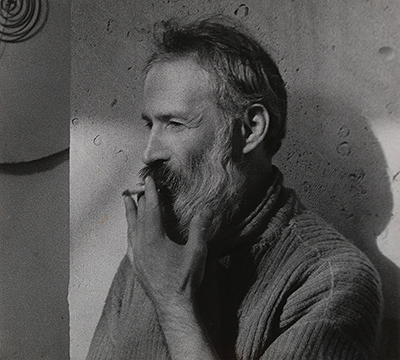
 by Tom Gurney
Tom Gurney BSc (Hons) is an art history expert with over 20 years experience
Published on June 19, 2020 / Updated on November 5, 2026
Email: tomgurney1@gmail.com / Phone: +44 7429 011000
Constantin Brancusi Biography
Constantin Brâncuși’s life brought together two worlds that remained visible in his sculpture: the craft traditions of rural Romania and the restless artistic experimentation of Paris. A pair of embracing lovers could become a compact block; a portrait could rest on its cheek like an egg; a bird could stretch into a slender shaft of reflected light. Each transformation depended on decisions about material, proportion and surface. His career also changed the relationship between a sculpture and everything around it, from its pedestal to the light entering a room. [17]
Born in 1876, Brâncuși settled in Paris in 1904 and died there in 1957. Across those years he repeatedly returned to a small family of subjects, finding fresh possibilities within heads, birds, columns and embraces. To follow his biography is to watch those forms develop, while the studio around them gradually becomes one of his most ambitious creations. [17]
At a Glance
Brâncuși and modern sculpture
Constantin Brâncuși
1876–1957 [1]Auguste Rodin
1840–1917 [18]Fernand Léger
1881–1955 [19]Contents
- From Hobița to Paris
- Discovering a language of his own
- Portraits between likeness and memory
- Birds, polish and the work of a series
- New York and the argument over modern art
- A studio made for sculpture
- Photography as another way of seeing
- From the carved column to Târgu Jiu
- The final years and the studio bequest
From Hobița to Paris
Brâncuși was born on 19 February 1876 in Hobița, a village in Romania’s Oltenia region. His formal training began at the School of Arts and Crafts in Craiova, which he attended from 1894 to 1898. He then entered the School of Fine Arts in Bucharest. The progression matters: the sculptor who would make such radical departures from academic sculpture had first received sustained instruction in both craft and art. [1]
The Centre Pompidou traces his early education through sculpture and woodcarving workshops. Working with timber would remain part of his artistic vocabulary, even as he became known for immaculate marble and reflective metal. His Romanian background offered a continuing resource of materials, structures and stories. It was a foundation that he could reshape in contact with other art, rather than a style he simply carried intact into France. [3]
He reached Paris in 1904 and enrolled at the École des Beaux-Arts in 1905. There he studied with Antonin Mercié, continuing an education grounded in the human figure. His work appeared at the Salon d’Automne in 1906, where he encountered Auguste Rodin. For an ambitious young sculptor, Rodin represented extraordinary achievement and influence. [1] [2]
In 1907 Brâncuși briefly worked in Rodin’s studio, leaving after approximately a month. The practical turning point was his search for an independent approach, increasingly centred on carving directly into stone and wood. He had absorbed the lessons of several schools; now he needed to discover what he could make on his own. [3]
Discovering a language of his own
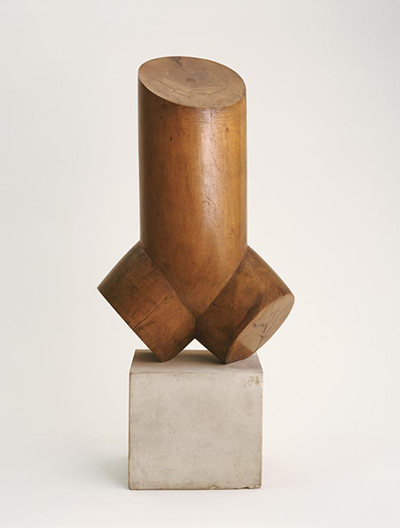
Direct carving brought the sculptor into immediate contact with the resistance and structure of a block. In Pompidou’s account, Brâncuși allowed the qualities of his material to help determine the emerging form. This is a useful starting point for understanding his apparent simplicity. A block could retain its compactness; wood could retain a palpable sense of cutting and grain. The material was active in the work’s effect. [2]
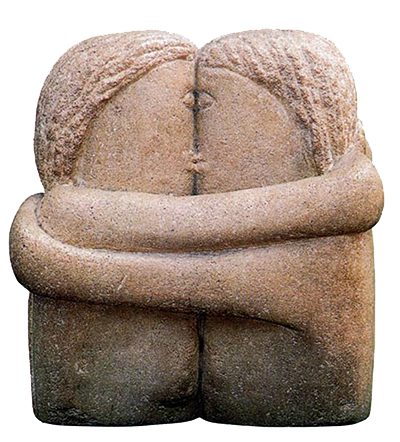
The transformation is especially clear in The Kiss. The Philadelphia Museum of Art’s 1916 sculpture is the fourth version of this theme. Its lovers share an almost continuous outline. Their eyes meet to form an oval, their hair describes a single arch, and their arms wrap around the squared mass. Two bodies remain distinguishable, but their embrace binds the whole sculpture together. The emotional subject is immediately legible through a remarkably economical arrangement of incisions and volumes. [4]
Brâncuși’s attention extended to its display. He recommended a simple presentation on its own base, saying that “it is the complete thing that counts.” The phrase captures a concern that would grow throughout his career. The sculpture’s meaning depended on the way the parts belonged together, including the support beneath it. Later, its American collectors Walter and Louise Arensberg placed the work on a low bench by Brâncuși, showing how his objects could enter new relationships beyond the studio. [4]
Portraits between likeness and memory
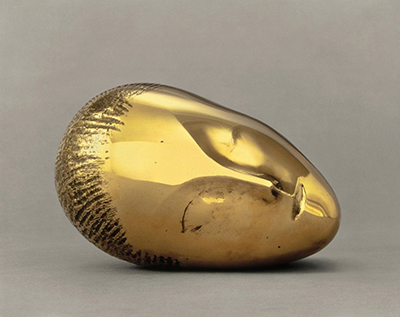
Human presence remained central to Brâncuși’s art even when individual features became sparse. Sleeping Muse grew from sittings with Baroness Renée Irana Frachon between 1908 and 1910. Earlier, more realistic studies led towards the detached head, first realised in marble and subsequently explored in bronze. The head lies horizontally, with its neck and shoulders removed. That change lets the whole oval carry the sensation of repose. [5]
In the polished bronze given by Frachon to the French national collection in 1963, fine marks in the hair retain a darker patina against the shining face. The nose forms a narrow ridge; the eyelids and mouth scarcely interrupt the surface. Curator Marielle Tabart describes a process in which the portrait becomes increasingly abstract while retaining its human resonance. She also records small differences between versions in their dimensions, symmetry and finish. Repetition offered Brâncuși opportunities for continued adjustment. [5]
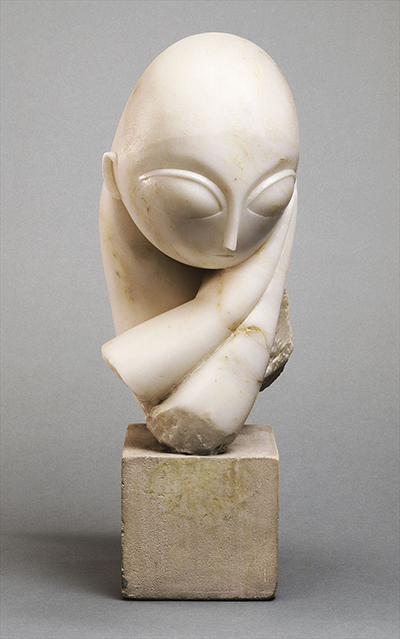
A different encounter produced Mlle Pogany. Margit Pogany, a Hungarian artist studying painting in Paris, sat for him in 1910 and 1911. After she returned to Hungary, he carved her portrait from memory. A plaster mould taken from the marble enabled further versions, including MoMA’s bronze of 1913, made after the marble of 1912. [6]
Here the enormous almond-shaped eyes dominate the oval face. Dark patina marks the hair and the gathered chignon behind the head. These selective features make a distinctive image without returning to conventional portrait modelling. The route from sitter to memory, and from marble through plaster to bronze, reveals how much work could lie behind a form that appears effortless. It also shows why direct carving cannot describe every stage of his practice: casting and surface treatment were equally consequential. [6]
Birds, polish and the work of a series
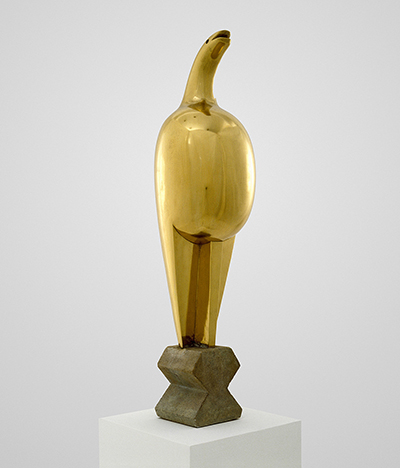
Around 1910 Brâncuși began the bird theme that would occupy him for decades. The early Maiastra takes its title from a marvellous bird in Romanian folklore. In the Peggy Guggenheim Collection’s example, dated about 1912, the raised chest, arched neck and open beak still suggest an identifiable creature. The alternating curves and edges give it an alert, poised character. Its position on a toothed base strengthens the sense of a bird perched above the ground. [7]
The collection identifies that sculpture as polished brass on limestone. Such precision matters because the golden appearance of Brâncuși’s metal birds can encourage loose descriptions. Different examples require their own material identifications. Here, the reflective finish gives the legendary bird an appropriate radiance; at the same time, slight shifts of axis and taper hold the object in a delicate visual balance. The series developed through decisions about those relationships, not through a single leap from naturalism into abstraction. [7]
By 1923, with the first marble Bird in Space, the bird’s body had become far more concentrated. MoMA explains how later metal versions emerged through a sequence of operations: Brâncuși took a plaster cast from a marble, altered the plaster’s proportions, then had the result cast in bronze. Changes to one dimension required changes throughout the form. His short assertion, “I never make reproductions,” expresses the importance he attached to these differences. [8]
Seen this way, a series is a record of continuing research. A bronze bird can share a family resemblance with an earlier marble while establishing its own balance, height and relationship to its support. Polishing adds another stage. It affects the way light crosses the contour and the extent to which surrounding space appears within the surface. A finished outline alone cannot account for the sculpture’s full appearance. [8]
The Peggy Guggenheim Collection’s Bird in Space, dated 1932–40, is polished brass on a limestone base. Its slender, rising shape has shed the conspicuous chest and beak of Maiastra. An irregular stem gives the soaring body a small point of attachment below. The collection interprets the work as conveying flight itself. Its surface gathers so much reflected light that the material can appear to lose some of its weight. The physical object remains rooted to its base while the eye follows its upward movement. [9]
New York and the argument over modern art
Brâncuși’s reputation developed internationally while he continued to live in Paris. Five sculptures appeared in the New York Armory Show of 1913. Alfred Stieglitz organised his first solo exhibition at the 291 gallery the following year. These early American presentations established an audience for work whose simplified shapes could still be disconcerting. [1]
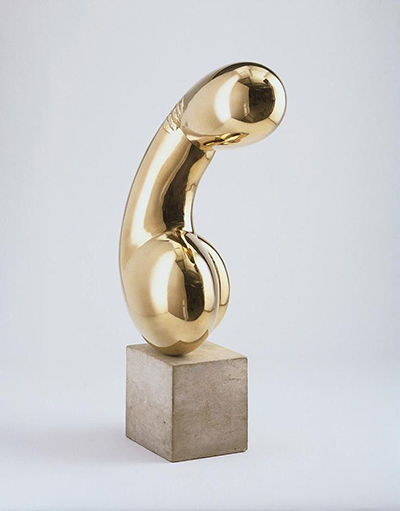
That difficulty became a legal dispute when a bronze Bird in Space was sent to New York for the Brummer Gallery exhibition of 1926. Marcel Duchamp organised the exhibition. American customs officials refused to admit the bird as duty-free art and assessed a tariff of 40 per cent of its value. Their understanding of sculpture depended on imitation of recognisable natural subjects; the smooth metal form challenged that definition. [10]
The ensuing case brought artists, collectors and specialists into the discussion. Edward Steichen, who owned the contested sculpture, testified, as did sculptor Jacob Epstein and Brooklyn Museum director William Henry Fox. The question moved beyond whether the object resembled a bird towards whether abstraction could qualify as sculpture. In 1928 the court found in Brâncuși’s favour. The episode made unusually public the problem his work posed: a subject could remain present through movement, rhythm and suggestion even after its familiar anatomy had disappeared. [10] [1]
A studio made for sculpture
Brâncuși moved to the impasse Ronsin in 1916. His premises changed over the years, including a move from number 8 to number 11 after flooding in 1928. He removed partitions and added neighbouring spaces as he needed more room. The workshop became a place to live, carve, receive visitors and present finished work. Ariane Coulondre’s history of the studio describes an environment shaped almost entirely by his hands, from its limestone fireplace to its wooden stools and circular plaster tables. [11]
These objects could cross between furniture and sculpture. A stool or table might also serve as a base. The studio brought rough wood, pale plaster, stone and shining metal into a sustained conversation. [11]
Pompidou describes Brâncuși’s changing arrangements as “mobile groups”. Bases moved between sculptures, and sculptures found new neighbours. In 1926 he even exhibited five bases independently at the Brummer Gallery. His studio practice allowed the work to remain open to revision after carving and polishing were complete: moving an object changed its intervals, alignments and relation to the room. [12]
The workroom also had a lively social existence. Artists, writers and collectors visited for conversation, meals and music. Pompidou’s 2024 exhibition account recalls Lizica Codreano dancing in 1922 to Erik Satie’s Gymnopédies in a costume designed by Brâncuși. Its record of his musical interests ranges from Romanian folk music to jazz and flamenco. These encounters place him firmly within an international network of friendships. [13]
He remained independent of organised movements, although his friends included Duchamp, Fernand Léger and Man Ray. That independence did not shield him from controversy. Princess X was removed from the Salon des Indépendants in 1920 because its shape was judged obscene. The polished, ambiguous sculpture disturbed expectations about the portrayal of a woman. Its reception helps explain his increasing preference for presenting his work in the environment he controlled. [13] [11]
Photography as another way of seeing
Photography gave Brâncuși a means of exploring what happened between sculpture, light and space. His experiments began soon after his arrival in Paris. In 1907 he accompanied Steichen during nocturnal photography of Rodin’s Balzac at Meudon. Later, with advice from Man Ray, he developed his own photographic working arrangements; Pompidou dates the installation of a photographic workshop within his studio to 1921. [14] [3]
His images do more than inventory completed objects. They show the changing illumination of reflective surfaces, the drama of cast shadows and the effects of different viewpoints. Some are blurred or unusually exposed. These qualities can make a familiar sculpture appear unstable, suggesting a succession of visual states instead of one definitive image. [14]
The setting was carefully constructed. Coloured backgrounds intensified reflections, and the placement of the birds and columns controlled their relationship to the light. The photographs therefore belong to the same investigation as the studio arrangements. Carving established a volume; polishing changed its response to illumination; photography tested and transformed the way that volume could be seen. Each activity extended his understanding of the work. [14]
From the carved column to Târgu Jiu
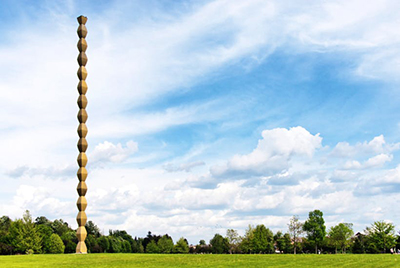
Brâncuși’s experiments with supports also generated an independent sculptural theme. MoMA’s oak Endless Column of 1918 is the earliest surviving version. A doubled pyramid, previously used in bases, repeats vertically to establish a continuous rhythm. Its cut surfaces retain visible marks of making. Looking upward, the eye can imagine the sequence continuing beyond the wood’s actual end. [15]
This is a different kind of simplification from the polished bird. The column depends on repetition and modular structure, while its material remains emphatically tangible. What had supported another object becomes the subject in its own right. The idea could also grow: Brâncuși returned to the column on different scales and eventually brought it into a public landscape. [15]
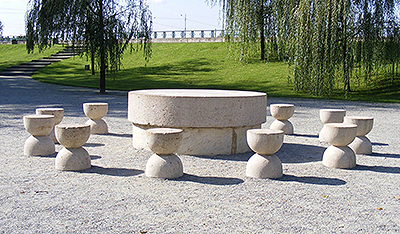
His monumental ensemble at Târgu Jiu was created in 1937–38 to commemorate those who died defending the city during the First World War. Across a conceptual axis about 1,500 metres long, the Table of Silence, the Alley of Chairs, the Gate of the Kiss and the Endless Column establish a sequence through the city. Two parks, the Avenue of Heroes and a pre-existing church form part of that setting. [16]
The project drew long-standing sculptural concerns into a new experience of movement. Visitors encounter intervals, changes of scale, different textures and the contrast between horizontal landscape and rising column. Familiar themes acquired a collective memorial purpose without requiring conventional statues of soldiers. UNESCO, which inscribed the ensemble on its World Heritage List in 2024, stresses the integration of sculpture, landscape, engineering and urban planning. [16]
The final years and the studio bequest
Brâncuși continued working in Paris after 1939. The Peggy Guggenheim Collection dates his last sculpture, the plaster Grand Coq, to 1949. He became a French citizen in 1952. In his later years the arrangement and preservation of existing sculptures increasingly occupied his attention. When a work left the studio, a plaster or bronze version could take its place, maintaining the ensemble’s relationships. [1] [11]
In 1956 he bequeathed the studio and its contents to the French state, requiring its reconstruction. He died in Paris on 16 March 1957. The gift encompassed finished works, unfinished pieces, tools, furniture and the objects surrounding his working life. Preserving those relationships was the culminating gesture of an artist who had made presentation inseparable from creation. [1] [3] [12]
A partial reconstruction opened at the Palais de Tokyo in 1962, followed by a reconstruction opposite the Centre Pompidou in 1977. After flooding forced its closure in 1990, a new building by Renzo Piano opened in 1997. The repeated effort to preserve the studio reflects the unusual nature of Brâncuși’s legacy. His individual sculptures changed modern art, while their shared environment showed how a life’s work could extend into the space between them. [12]
Four phases of Brâncuși’s career
Artworks directory
Individually documented sculptures, drawings and a photograph with pencil measurements. Casts, versions and the recto or verso of a sheet are identified separately. A dash marks an undated object. Additional Tate entries preserve the museum’s unmaintained October 2014 catalogue snapshot. This is a selection, not an inventory of all surviving work. [20]
Frequently Asked Questions
He was born in Romania in 1876, settled in Paris in 1904 and died there in 1957. [1]
He repeatedly rearranged sculptures and bases, treating their surroundings as part of the work. His bequest required the studio’s reconstruction. [12]
Discussion
Compare the solid carved block, the polished metal surface and the changing arrangements of the studio.
Reader Insights
Which material most changes your experience of a Brâncuși subject?
When does a base become part of a sculpture?
What can a studio arrangement reveal that an isolated object cannot?
Join the Conversation
Share a detail, comparison or question about Constantin Brancusi Biography below.
References
- Peggy Guggenheim Collection, “Constantin Brancusi: artist biography”. English. Education, exhibitions, later career and life dates. View source.
- Centre Pompidou, “L’artiste et son œuvre: training, materials and modernity”. French; paraphrased in English. View source.
- Centre Pompidou, “Constantin Brancusi: illustrated chronology”, pp. 2–5, 11 and 15. French PDF; paraphrased in English. View source.
- Philadelphia Museum of Art, “The Kiss, 1916: collection interpretation”. English. View source.
- Marielle Tabart, Centre Pompidou, “La Muse endormie, 1910, AM 1374 S: collection analysis”, catalogue excerpt from Collection art moderne, 2007. French analysis on an English-interface record; paraphrased in English. View source.
- Museum of Modern Art, “Mlle Pogany, version I, 1913 (after a marble of 1912)”, collection record and 2019 label. English. View source.
- Peggy Guggenheim Collection, “Maiastra, about 1912: folklore and sculptural form”. English. Material taken from the object-details field. View source.
- Museum of Modern Art, “Bird in Space, about 1941: casting and proportion”, collection record and 2019 label. English. View source.
- Peggy Guggenheim Collection, “Bird in Space, 1932–40: collection interpretation”. English. View source.
- MaryKate Cleary, Museum of Modern Art, “‘But Is It Art?’ Constantin Brancusi vs. the United States”, 24 July 2014. English. View source.
- Ariane Coulondre, Centre Pompidou, “L’atelier de Brancusi, matrice de tout son œuvre”, 26 March 2024; excerpt from the 2024 exhibition catalogue. French; paraphrased in English. View source.
- Centre Pompidou, “L’atelier Brancusi: mobile groups, bases and reconstruction”. French; paraphrased in English. View source.
- Centre Pompidou, “Brancusi: exhibition audio-tour transcript”, 2024, sections 4 and 6. With Ariane Coulondre and André Avril. French PDF; paraphrased in English. View source.
- Centre Pompidou, “Brancusi et la photographie: experiments with light and space”. French; paraphrased in English. View source.
- Museum of Modern Art, “Endless Column, version I, 1918: collection record and labels”. English. View source.
- UNESCO World Heritage Centre, “Brâncuși Monumental Ensemble of Târgu Jiu”, description and statement of Outstanding Universal Value. English. View source.
- Museum of Modern Art, Constantin Brancusi Sculpture: exhibition brochure, 2018, introduction and materials sections. Exhibition organised by Paulina Pobocha with Mia Matthias. English PDF. View source.
- Musée d’Orsay, Auguste Rodin, artist authority record 21020, 1840–1917. Record updated 28 September 2026; accessed 28 October 2026. View source.
- Musée national Fernand Léger, Fernand Léger — Biographie, 1881–1955. Artist chronology, accessed 28 October 2026. View source.
- Tate, Tate Collection metadata, artwork_data.csv, October 2014 snapshot, released under CC0. Repository readme states that this dataset is no longer maintained. Downloaded and artist rows inspected 28 October 2026. View source.