


 by Tom Gurney
Tom Gurney BSc (Hons) is an art history expert with over 20 years experience
Published on June 19, 2020 / Updated on November 5, 2026
Email: tomgurney1@gmail.com / Phone: +44 7429 011000
Chardin Drawings and Pastels
Chardin's works on paper bring us unusually close to the act of looking. In his late portraits, strokes of colour gather into faces that seem solid, alert and present. Yet anyone hoping to follow his whole career through sketchbooks and preparatory studies encounters a much thinner record. The Metropolitan Museum of Art describes him as an artist who made few, if any, preparatory drawings. His finished pastels therefore deserve a place of their own: they are a remarkable late achievement, rather than a convenient substitute for a missing archive of sketches. [1]
The distinction helps us understand what survives. An early charcoal study can reveal a figure taking shape for a painting; a pastel self-portrait offers a complete encounter with the artist. Both belong to Chardin's work on paper, but they served different purposes. Looking at them together reveals the distance between the practical business of preparing a composition and the expressive possibilities he eventually found in coloured marks.
At a Glance
Contents
The rare early drawings
A small double-sided sheet in the Getty collection offers concrete evidence of Chardin drawing before his celebrated late portraits. The museum's catalogue publishes it as Study for a Seated Man, with a Study of a Male Nude on the reverse. It is executed in charcoal and white chalk and measures 25.6 by 16.7 centimetres. The attribution is credited to Pierre Rosenberg, an important qualification for an unsigned work. [2]
The seated figure is connected with the man at the far right of The Game of Billiards, an early painting in the Musée Carnavalet. The catalogue places the drawing around 1720–25, alongside the painting, and compares its vigorous dark lines and white accents with La Vinaigrette in Stockholm's Nationalmuseum. It also identifies a further Stockholm study for the billiards picture. [2]
On the Getty sheet's reverse, the fragmentary nude belongs to the tradition of academic figure study. The catalogue suggests that Chardin reused an older training drawing, cutting the paper down when he needed it again. This remains an explanation proposed by the catalogue, rather than a documented account of his actions. Even so, the sheet gives a valuable glimpse of working material that could have more than one life. [2]
These examples caution against turning scarcity into a claim that Chardin never drew. Equally, they cannot support an imagined sequence of studies behind every still life and domestic scene. The Met's emphasis on the small preparatory record leaves much of that process out of reach. The surviving paintings may be carefully organised without a corresponding body of paper studies available for us to consult. [1]
Explore two pastel self-portraits
Self-Portrait with Spectacles (1771)
Louvre, INV 25206. Public-domain reproduction.
Self-Portrait with a Visor (Chicago)
About 1776, 1984.61. Art Institute of Chicago; public domain.
A new subject in a new medium
By the 1770s, pastel had become the medium of Chardin's major late portraits. Neil Jeffares reproduces an account written by Charles-Nicolas Cochin in 1780, shortly after the painter's death. Cochin linked the change with infirmities that had reduced Chardin's work in oils, and described his new subjects as life-size heads of people of different ages and characters. He also stressed the thought behind their apparently easy execution. [3]
Ill health forms part of this testimony, but the pictures need more than a medical explanation. Jeffares discusses Eik Kahng's interpretation of the late pastels as a demonstration of continuing ambition and ability. The two perspectives need not be collapsed into a single motive. What the works establish is an artist exploring portraiture with considerable freedom at the end of a long career. [3]
Pastel also carried a different set of practical possibilities. A stroke could remain plainly visible while contributing to a convincing cheek, forehead or fold of cloth. In Chardin's hands, the finished face and the marks constructing it stay closely connected. The viewer can move between recognition and an awareness of the coloured surface without either experience cancelling the other. [3]
The self-portrait of 1771
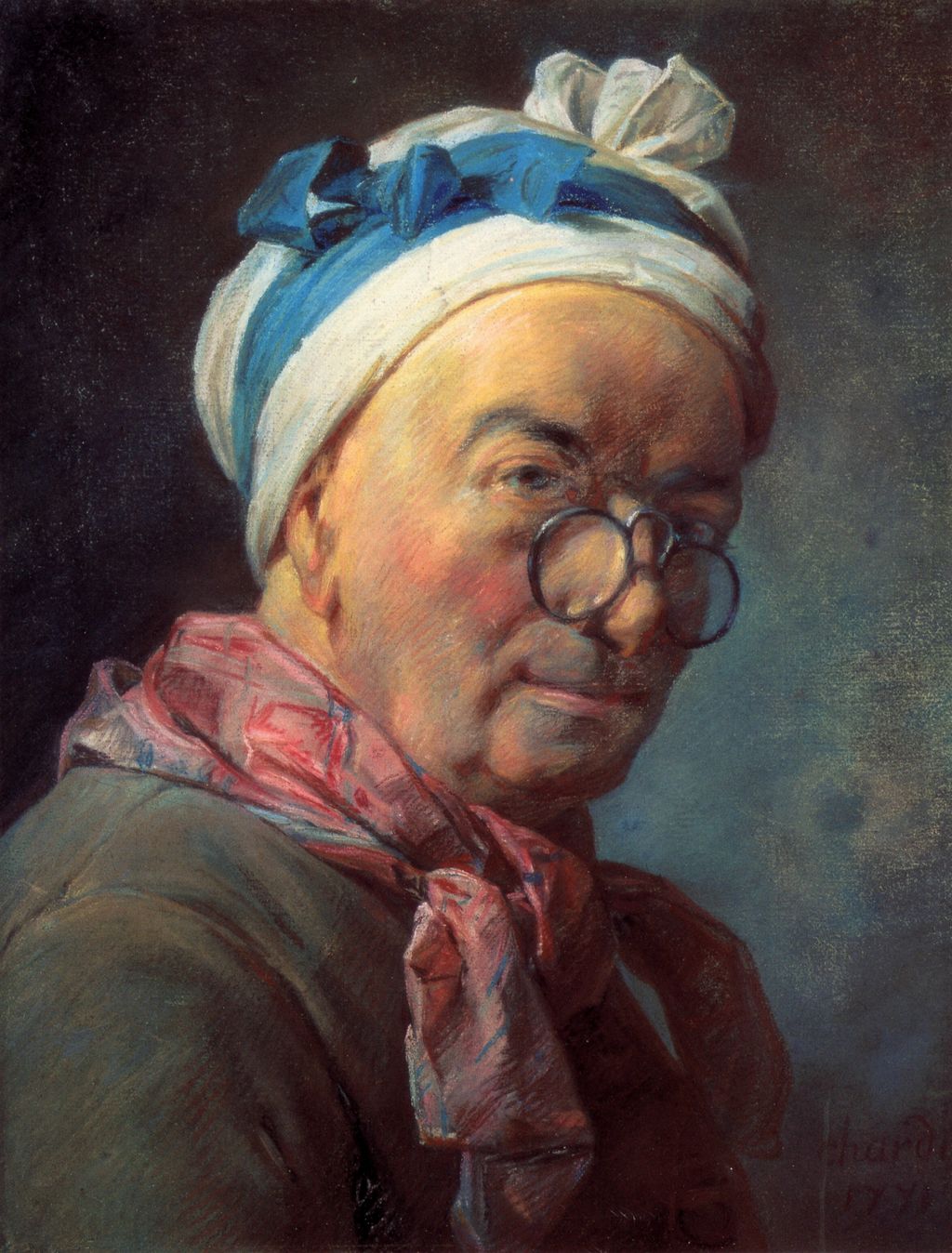
The Louvre's Self-Portrait with Spectacles is signed and dated 1771. Measuring 46.4 by 37.7 centimetres, it is pastel on grey-blue paper attached to a canvas-covered stretcher. It was shown at the Salon that year among three pastel heads. Its support and exhibition history place it securely among finished works intended to be seen and judged. [4]
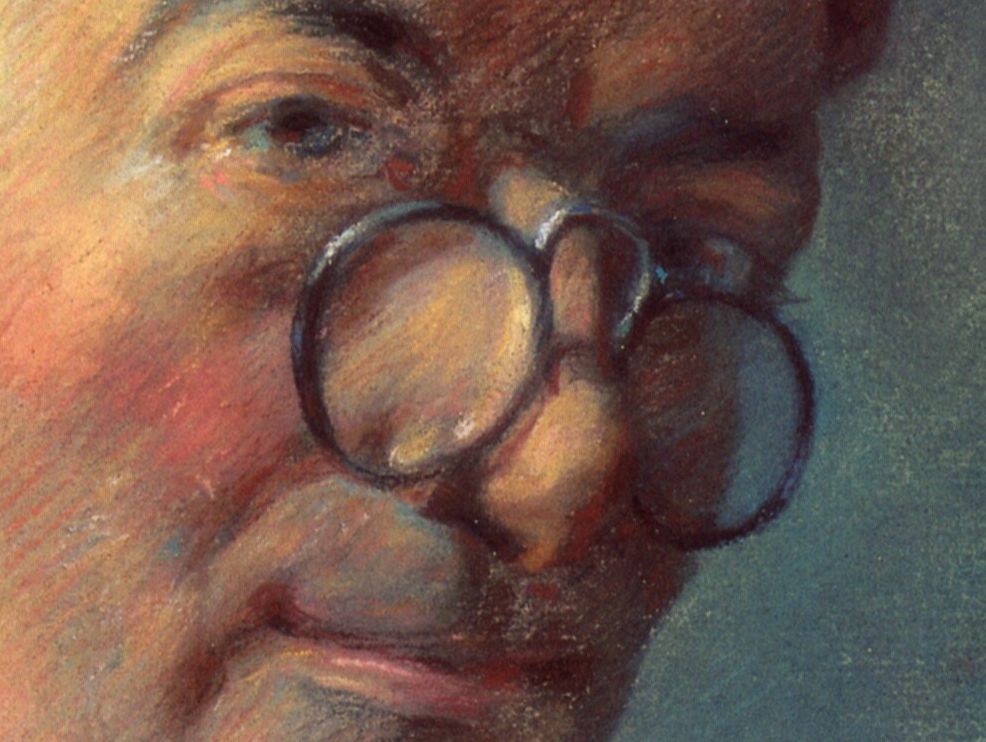
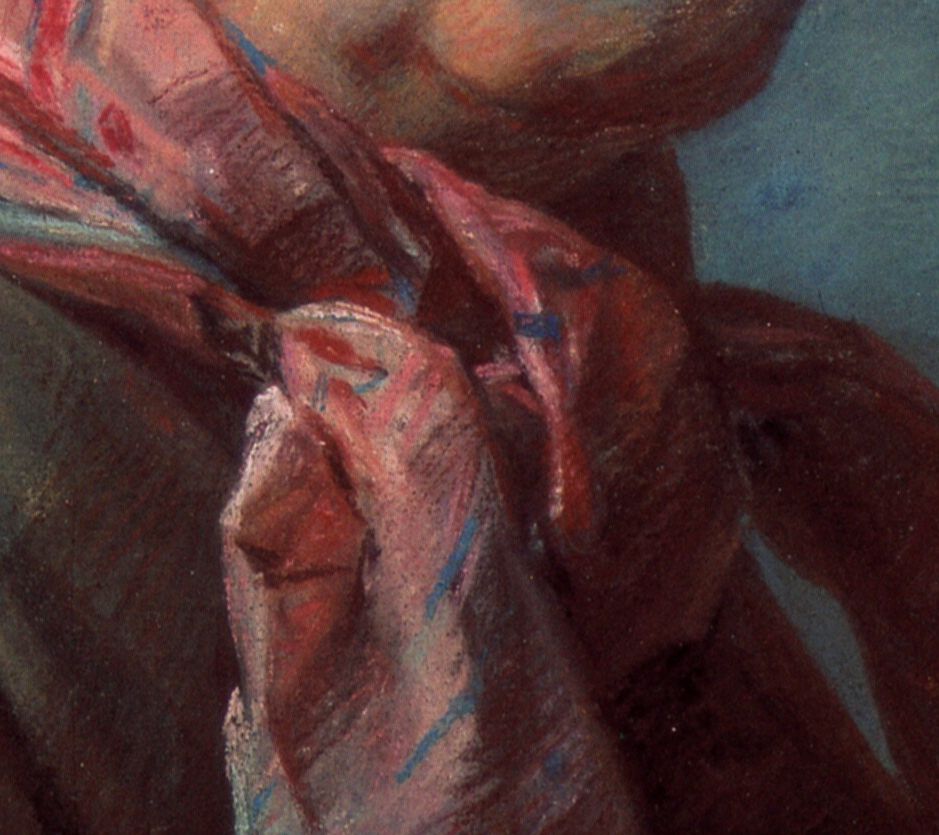
The artist turns towards us in a white head covering tied with blue ribbon. A patterned scarf gathers at his neck, and round spectacles sit low enough for his eyes to look over their upper rims. The ribbon has an almost jaunty prominence above the ageing face. At the neck, its cooler colour answers the warmer folds of the scarf; neither accessory feels incidental to the arrangement. [4]
The clothing creates an intimate register without requiring a story about his mood. The gaze is attentive, the mouth restrained, the face carefully differentiated from the cloth around it. We recognise age through particular features, while the turn of the head makes the encounter feel immediate. There is little setting to distract from that exchange. [4]
Annotated Details from Self-Portrait with Spectacles
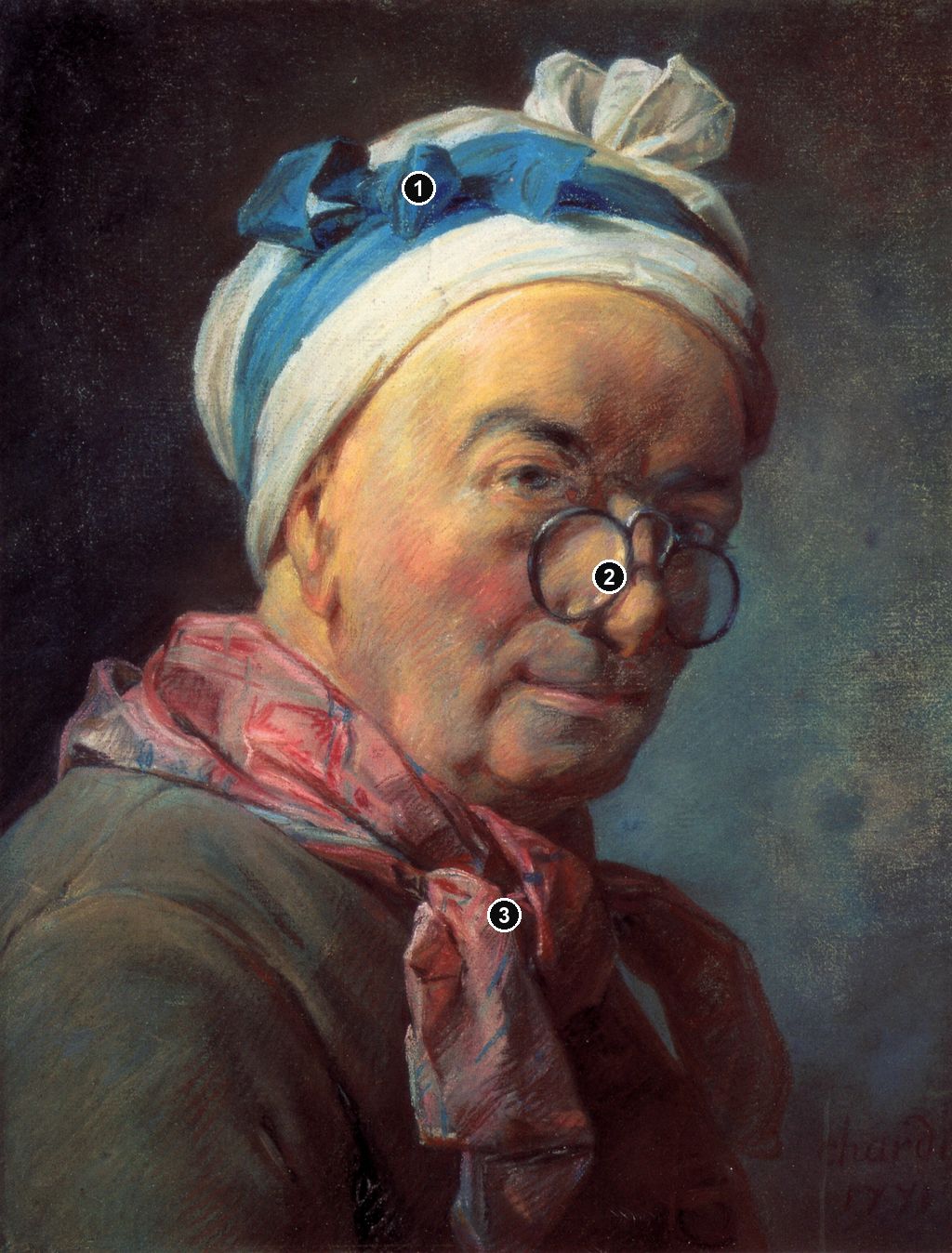
Follow three passages in the Louvre’s 1771 portrait: the blue ribbon, the gaze above the spectacles and the turning folds of the scarf.
Details from SELF-PORTRAIT WITH SPECTACLES
Details from Louvre INV 25206, Recto. Public-domain reproduction via Wikimedia Commons.
A ribbon above the face
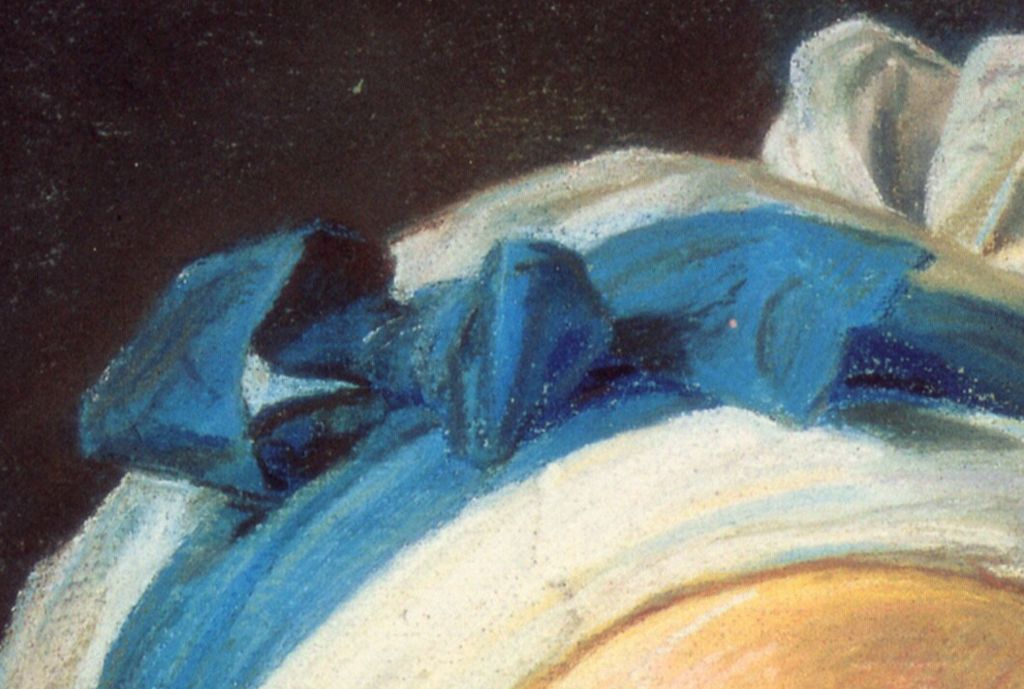
The blue ribbon crosses the white head covering in broad, angular passages. Its cooler colour gives the upper part of the portrait a clear accent. [4]
Looking over the spectacles
The circular frames interrupt the face, while the eyes look above their upper rims. Follow the small shifts of colour around the bridge and cheeks. [4]
The turn of the scarf
Warmer folds gather below the face and turn across the chest. The scarf’s changing direction makes a different rhythm from the level band of blue above. [4]
Colour that keeps its marks
Suzanne Folds McCullagh's account of eighteenth-century French pastel portraiture gives a useful way into Chardin's handling. Discussing the later Chicago portraits, she emphasises their layered, largely unblended colour and the relatively limited use of stumping, or rubbing the pastel to soften its marks. This distinguishes their surface from the more vaporous or elaborately finished effects available within the medium. [5]
The point is not that Chardin lacked finish. His finish allows the individual mark to remain active. A face can have weight and coherence while its colours resist dissolving into an even skin. The visible work of the hand contributes to the impression of a living person, especially when a change of viewing distance allows separate accents to settle into a broader form. [5]
McCullagh compares this layering with the substantial touch of oil paint. That comparison helps explain why these portraits belong so naturally beside Chardin's paintings. Paper changes the means of construction, but the colour still has a material presence. It asks us to notice how a picture is made as well as whom it represents. [5]
A visor and a direct gaze
In the Louvre's second major self-portrait, dated 1775, a green visor projects across the forehead above the spectacles. The museum records pastel on grey-blue paper stretched over a canvas-covered support, measuring 46.4 by 38.2 centimetres. This portrait was also exhibited at the Salon, among the three pastel heads listed under Chardin's name in 1775. [6]
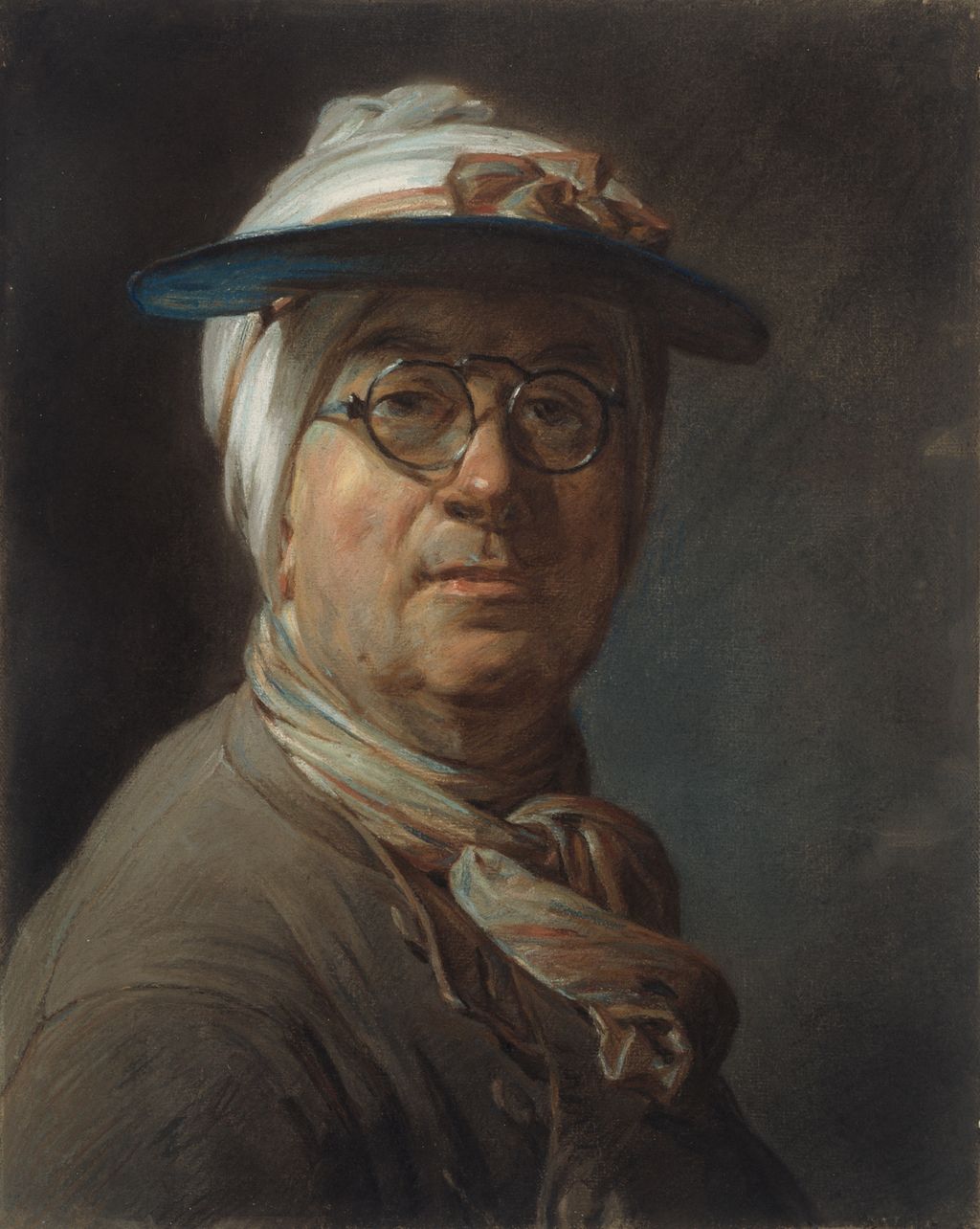
Its broad, horizontal shade makes a strong counterweight to the face below. The artist faces us more directly than in the 1771 portrait, while his body turns away. A pale headcloth descends beside the cheek, and the scarf spreads into loose folds over the chest. The clothes frame the face through contrasting bands, curves and diagonals. [6]
The visor gives the picture its distinctive silhouette, but the spectacles remain equally arresting: their circular frames interrupt the face without obscuring the gaze. These are ordinary accessories brought into a carefully balanced portrait. They make a memorable public image out of the painter's informal appearance. [6]
Madame Chardin
Chardin's wife, Françoise-Marguerite Pouget, offered another familiar face for his late work. Her Louvre portrait was exhibited with his in 1775; the museum considers the two probably conceived as pendants, or companion pictures. Contemporary commentary noticed the contrast between her fresh colouring and the stronger tones of his face. The pairing encouraged viewers to see their differences together. [7]
Her head turns towards the left, with the eyes directed beyond the edge of the picture. The white head covering closes around her face and gathers into a blue ribbon at the crown. Below it, pale cloth at the throat separates warm skin from the darker mass of her clothing. Those changes of colour and material create a clear structure without elaborate accessories. [7]
The dark garment has its own richness. Its folds catch subdued light and open around the lighter centre of the chest, giving the portrait breadth below the closely enclosed head. Her composed expression invites sustained attention. Nothing in that expression requires us to invent a private conversation or assign a particular memory to the sitter. [7]
Repetition and attribution
The Art Institute of Chicago owns another Self-Portrait with a Visor, dated about 1776, on blue laid paper mounted on canvas. It measures 45.7 by 37.4 centimetres. The museum associates it with its portrait of Madame Chardin, a later pair repeating the Louvre compositions. The two Chicago portraits were reunited in the collection after a long separation. [8]
Such repetition is important when comparing reproductions. A change in a scarf, a face or the breadth of a mark may belong to a different version, rather than to an unreliable photograph. Location, dimensions and support help identify the object under discussion. A title alone cannot distinguish every appearance of the familiar visor portrait. [8]
The scholarly history makes the issue more interesting still. In their 1985 study, McCullagh and Rosenberg explain that Chicago's self-portrait is unsigned and undated, whereas its companion bears the date 1776. Their argument for treating them as a pair includes their matching supports and close dimensions. The approximate date of the self-portrait follows evidence about the relationship between the objects. [10]
They also trace a changing attribution: the self-portrait had been accepted, questioned and reconsidered before its acquisition by Chicago. This history shows why an artist's own repetition and a later copy require individual examination. Familiarity with the image does not remove the need to establish the status of a particular sheet. [10]
Heads beyond the family
The late pastels extend beyond Chardin and his wife. A Portrait of a Young Girl, signed and dated 1777, appeared in the Metropolitan Museum's 2009 exhibition of drawings from the Jean Bonna collection. The museum records it beside a portrait of a younger boy and explains that the two were exhibited together at the Salon of 1777. Critics admired their warmth and spirited handling. [9]
These young faces broaden the emotional range of the group. They also make clear that the description “head study” need not mean preparation for another picture. Heads could be exhibited, collected and appreciated as complete works. Chardin's late practice embraced different ages and appearances within the concentrated format of the portrait. The young girl belongs to that public achievement alongside the more familiar images of the elderly painter. [9]
The artist at his easel
A third Louvre self-portrait brings the act of making into view. In Self-Portrait at the Easel, Chardin holds a red pastel beside the upright edge of his work. The museum places it in his final years and discusses a possible appearance at the Salon of 1779, while leaving that identification uncertain. Its earlier ownership is not documented before 1885. [11]
The hand changes the encounter. We see the face looking out, but also the implement that could make such a face appear on paper. The narrow strip of easel at the right gives the figure a place to work without opening the scene into a detailed studio interior. His spectacles, headcloth and blue ribbon connect it visually with the earlier self-portrait, while the raised hand gives it another purpose. [11]
Here, the surviving works on paper offer something beyond evidence of preparation. They let Chardin's scrutiny become their subject. Looking at a sitter, looking at himself and laying down colour meet in a portrait that holds the artist and his working material within the same small field. [11]
Artworks directory
A selection of paintings, drawings and pastels documented in collection records and catalogues. Different portrait versions have separate entries. Dates and attributions retain the qualifications of the collection records; a dash means that no date is supplied here.
Frequently Asked Questions
Discussion
Compare the finished portraits with the much smaller surviving record of working drawings.
Reader Insights
Where does a coloured mark become part of a face?
How do the spectacles change the encounter with the sitter?
What distinguishes the two visor portraits?
Join the Conversation
Share a detail, comparison or question about Chardin Drawings and Pastels below.
References
- Metropolitan Museum of Art. “Chardin.” Exhibition overview, exhibition held 27 June–3 September 2000. English. Museum exhibition text. Accessed 28 October 2026. View source.Splash image: Self-Portrait with Spectacles, 1771. Louvre, INV 25206. Louvre; reproduction via Wikimedia Commons, public domain
- George R. Goldner, with the assistance of Lee Hendrix and Gloria Williams. European Drawings 1: Catalogue of the Collections. Malibu: J. Paul Getty Museum, 1988, cat. 66, p. 152. “Study for a Seated Man; Study of a Male Nude.” English. Getty collection catalogue. Actual catalogue PDF consulted 28 October 2026. View source.
- Neil Jeffares. “Chardin, Jean-Siméon.” Dictionary of Pastellists before 1800, online edition, updated 10 September 2026, pp. 1–2 and catalogue entries. English, with contemporary French texts. Specialist catalogue and criticism. Accessed 28 October 2026. Cochin and Kahng discussed through Jeffares. View source.
- Musée du Louvre. “lAutoportrait aux besicles.” Collection record, INV 25206, Recto, 1771. French, English interface. Louvre object record. Text and object reproduction consulted 28 October 2026. View source.
- Suzanne Folds McCullagh. “‘A Finesse of the Crayon’: Eighteenth-Century French Portraits in Pastel.” Art Institute of Chicago Museum Studies 32, no. 2 (2006), especially p. 87. English. Museum scholarly publication. Actual PDF text consulted 28 October 2026. View source.
- Musée du Louvre. “Autoportrait à l'abat-jour et aux lunettes.” Collection record, INV 25207, Recto, 1775. French, English interface. Louvre object record. Text and object reproduction consulted 28 October 2026. View source.
- Musée du Louvre. “Portrait de Françoise Marguerite Pouget, deuxième femme de l'artiste (1707–1791).” Collection record, INV 25208, Recto. French, English interface. Louvre object record. Text and object reproduction consulted 28 October 2026. View source.
- Art Institute of Chicago. “Self-Portrait with a Visor.” Collection record, 1984.61; Essential Guide text, 2013, p. 312. English. Museum collection record. Accessed 28 October 2026. View source.
- Metropolitan Museum of Art. “Portrait of a Young Girl,” in Raphael to Renoir: Drawings from the Collection of Jean Bonna, exhibition photo gallery, 2009. English. Museum exhibition entry. Accessed 28 October 2026. View source.
- Suzanne Folds McCullagh and Pierre Rosenberg. “‘The Supreme Triumph of the Old Painter’: Chardin's Final Work in Pastel.” Art Institute of Chicago Museum Studies 12, no. 1 (Fall 1985), pp. 43–59, especially pp. 44–45. English. Museum scholarly study. Actual PDF text consulted 28 October 2026. View source.
- Musée du Louvre. “Autoportrait de Chardin à son chevalet.” Collection record, RF 31748, Recto. French, English interface. Louvre object record. Text and object reproduction consulted 28 October 2026. View source.


