 by Tom Gurney
Tom Gurney BSc (Hons) is an art history expert with over 20 years experience
Published on June 19, 2020 / Updated on November 5, 2026
Email: tomgurney1@gmail.com / Phone: +44 7429 011000
Chardin Biography
A boy balancing playing cards, a servant drawing water, a mound of strawberries and an elderly man looking through spectacles: Chardin made these modest subjects carry an extraordinary weight of attention. His paintings invite us to notice how people occupy a room and how light changes the character of things. The same patient scrutiny runs through a career that moved from still life to domestic scenes, back to still life and finally into pastel portraiture. [1]
Jean-Siméon Chardin was born in Paris on 2 November 1699 and died there on 6 December 1779. The longer name Jean-Baptiste-Siméon, still encountered in books and museum records, arose from an error in his posthumous inventory, according to the specialist Neil Jeffares. His working life belonged overwhelmingly to Paris, where recognition brought him membership of the Royal Academy and eventually rooms in the Louvre. Behind the apparent simplicity of his pictures lay a long professional career, sustained by collectors, public exhibitions and the judgment of fellow artists. [2] [3]
At a Glance
Chardin and his artistic world
Contents
A Parisian apprenticeship
Chardin was the son of a carpenter. He trained with Pierre-Jacques Cazes and assisted Noël-Nicolas Coypel, passing through the Académie de Saint-Luc before entering the more prestigious Académie royale de peinture et de sculpture. These beginnings placed him within the practical world of Parisian workshops, where learning meant acquiring the ability to represent convincing bodies, surfaces and space. The National Gallery identifies seventeenth-century Dutch domestic painting as a major source for his subsequent work. [1]
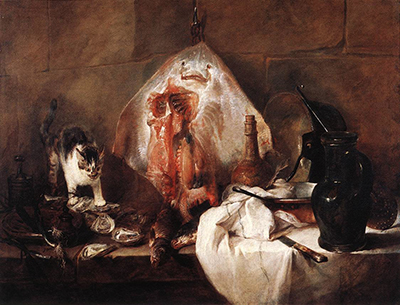
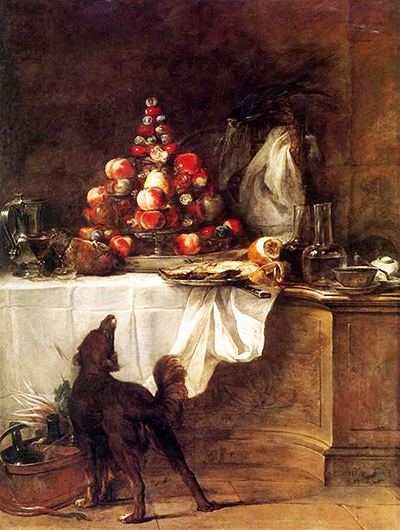
His breakthrough came in 1728, when the Royal Academy accepted him with two still lifes, The Ray and The Buffet. Both had been exhibited that year in the Place Dauphine. The choice of these pictures matters: Chardin entered the institution through his command of animals, food and household objects, subjects that would remain central to his reputation. The Buffet, signed and dated 1728, is an ambitious vertical canvas, almost two metres high. Its scale alone challenges any assumption that his art was always small or retiring. [4]
The Ray, now in the Louvre, makes an equally forceful introduction. A gutted ray hangs above a kitchen table shared by fish, oysters, a cat and cooking vessels. The French national collections record dates the painting to about 1727 and identifies it as a reception piece in 1728. The scene puts the soft, perishable substance of food beside the harder surfaces of utensils. The cat introduces a living presence into an arrangement dominated by things awaiting preparation or consumption. Chardin's early still lifes could be arresting, even disquieting, as well as beautifully observed. [5]
Making paint feel like things
The early Silver Tureen, painted about 1728–30 and now at the Metropolitan Museum of Art, shows how much could happen within a still life. The museum draws attention to its balances between living and dead, raw and cooked, and to the distinctive treatment of fur, feathers, orange rind and silver. These surfaces remain persuasive while the paint itself retains a rough, tangible character. Looking becomes a double pleasure: we recognise the substance of an object and also enjoy the means by which a painter has suggested it. [6]
That relationship between material and illusion helps explain the enthusiasm of Denis Diderot, Chardin's celebrated eighteenth-century admirer. In the words quoted by the Met, the painter seemed to grind “the very substance” of things into his pigments. The phrase is brief but exact in its response to the pictures: their force comes from making an object feel present through colour and touch. [6]
These concerns continued in the domestic interiors. A glint of copper or the weight of a jug could help establish the human action. Objects give his figures something to hold, arrange or study, connecting his still lifes with his paintings of people. [7]
Work, learning and play
From the early 1730s into the early 1750s, domestic scenes became the principal part of Chardin's output. Their subjects include education, household work and the absorbed occupations of children. They draw on Dutch precedents while giving these activities a particular intimacy and gravity. [1]
In The Water Cistern, a servant bends to fill a jug from a large copper vessel. At the right, an open doorway reveals another servant with a child. The National Gallery's version is dated 1733 or later, possibly 1737–39; the museum cautions that its relationship to an earlier Stockholm version and to an engraving is not entirely settled. What remains clear is the painting's attention to domestic labour. The woman's extended arm suggests the burden of the jug, while small reflections distinguish the metal objects in the dim scullery. [7]
The room also reveals a difference of social position. Chardin's affluent collectors could own pictures of work undertaken by servants below stairs. The National Gallery makes this contrast explicit. It gives the scene a sharper historical setting than the familiar description of Chardin as a painter of peaceful homes might suggest. The painting brings the labour behind domestic comfort into view. [7]
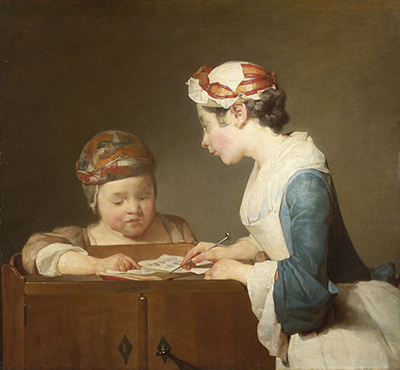
The Young Schoolmistress, painted about 1737, brings us to a private lesson. An older girl points towards an open book while a smaller child follows her gesture. Their relationship is uncertain; the older figure is probably a relative teaching at home, and the younger child's sex cannot be established conclusively. The National Gallery associates the scene with the value placed on literacy in the increasingly prosperous middle-class world that admired Chardin's work. [8]
He gives that social subject a tender, particular form. A pointer and the pupil's small hand bring the two figures together around the page. The purpose of the lesson matters, but so does the act of sharing attention. Even the indistinct marks on the paper play a part: we can follow the exchange without being able to read over the children's shoulders. [8]
Children absorbed in their own worlds
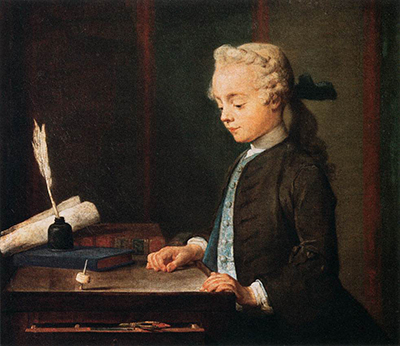
Play could command the same seriousness as study. The National Gallery's House of Cards, painted about 1740–41, depicts Jean-Alexandre Le Noir, whose father was a cabinetmaker and furniture dealer. Jean-Jacques Le Noir commissioned several pictures from Chardin and became a close friend, witnessing the artist's marriage in 1744. The picture belongs to a network of personal relationships and patronage, as well as to Chardin's recurring interest in childhood. [9]
The boy leans over a table covered in green baize, preparing to add to his fragile structure. Chardin painted four identified versions of the subject; the London picture was probably shown at the Salon of 1741. The National Gallery explains that houses of cards carried familiar associations with the uncertainty of human endeavours, and moralising verses accompanied an engraving of the composition. Yet the child's immediate task has its own attraction. His concentration makes a precarious arrangement of paper feel substantial and absorbing. [9]
Soap Bubbles, painted about 1733–34, explores a similarly fleeting occupation. In the Metropolitan Museum's version, a young man blows a translucent bubble as a child watches from behind the ledge. Earlier northern European images had used bubbles to suggest life's brevity; the Met emphasises how Chardin brings the subject into everyday experience. The gleaming sphere holds the figures' attention, while the handling of jacket, hair and skin makes their physical presence convincing. Later versions survive in Los Angeles and Washington. Repeating a successful composition was part of his practice, allowing an apparently single, arrested moment to exist in several carefully worked forms. [10]
The Academy, the Salon and the Louvre
Chardin's restrained subjects should not obscure his participation in the institutions of French art. He exhibited regularly at the Salon from 1737 and attended Academy meetings over many decades. He also undertook administrative service, including work as its treasurer, and took responsibility for arranging paintings at the Salon. Such duties placed him among other artists and made him an active participant in the way contemporary painting reached its public. [3]
In 1757 Louis XV granted him a studio and living accommodation in the Louvre. Before that move he had lived near Saint-Sulpice on the Left Bank. His personal life included bereavement: his first wife died young, and both his daughters died in childhood. These losses belong to his biography, although the surviving domestic pictures should not be turned into direct illustrations of his family life. Their figures and actions require attention on their own terms. [3]
By the 1750s he was concentrating chiefly on still life again. The Louvre describes this renewed work as more pared back, although many arrangements retained an artful freedom. His reputation extended across Europe, and royal commissions included still lifes for Choisy in 1765 and Bellevue in 1767. The range is revealing: the artist who painted kitchen utensils also supplied ambitious decorative pictures for royal residences. [11]
Still life renewed
The Basket of Strawberries, exhibited at the Salon in 1761, offers a particularly clear example of his later economy. Fruit rises into a red pyramid beside a glass of water, with flowers and a few scattered fruits across the tabletop. The Louvre's account calls attention to the balance between the dense yet transparent glass and the apparently fragile heap of berries. The arrangement feels immediate, but its distribution of colour and weight is carefully judged. [11]
In the Getty's Still Life with Peaches, a Silver Goblet, Grapes, and Walnuts, dated about 1760, a different group of ordinary things receives equally close attention. The museum's education account explains how successive applications of paint and the play of light distinguish peach fuzz, brittle walnut shells, translucent grapes and the cold metal vessel. This is a useful way to look at Chardin: consider how each substance answers the light, then notice how the different objects hold together within one composition. [12]
His interest in kitchen subjects continued late into his oil painting career. The Getty's Still Life with Fish, Vegetables, Gougères, Pots, and Cruets on a Table, dated 1769, gathers a remarkably varied meal on a stone tabletop. A round of soft cheese rests on straw; behind it, a metal tray holds cruets of red vinegar and greenish-yellow oil. Pastries and covered pots stand beside vegetables whose fine roots trail over the ledge. Above them hang two mackerels, one catching the light while the other remains in shadow. The contrast gives this kitchen arrangement a striking vertical accent. [13]
A late life in pastel
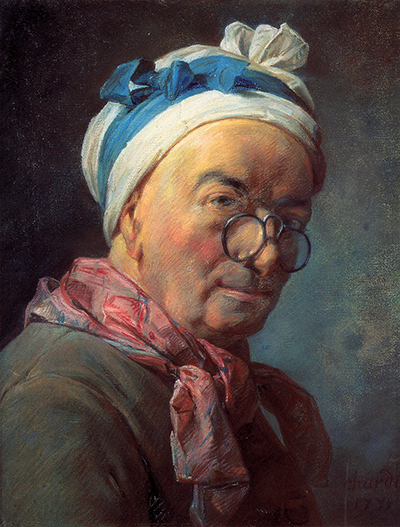
During his final years Chardin made pastel portraits, including the Self-Portrait with Spectacles of 1771 in the Louvre. The museum records pastel heads shown at the Salons of 1771, 1773, 1775, 1777 and 1779. The late work therefore reached contemporary viewers through the same exhibition culture in which he had long participated. [14]
The self-portrait brings us close to an elderly face beneath an informal white head covering tied with blue ribbon. Round spectacles sit low on the nose, and a patterned scarf gathers at the neck. Colour gives the face its warmth without smoothing away age. The image feels direct because the sitter looks back with such alertness; the elaborate description of his surroundings has become unnecessary. [14]
Jeffares describes Chardin's pastel technique as a construction of separate strokes of colour that combine in the viewer's eye at a distance. He also discusses differing explanations for the change of medium. Ill health forms part of the evidence, but artistic ambition deserves consideration too. It is more rewarding to see these works as a substantial final invention than to explain them entirely through physical decline. [2]
Chardin died in the Louvre in December 1779. Later painters continued to study his work. Lucian Freud selected The Young Schoolmistress for his 1987 National Gallery exhibition and later made paintings and etchings after it. Across changes of subject and medium, Chardin found pictorial interest in ordinary tasks. Freud's sustained attention offers a fitting response to an artist who gave those moments time. [2] [8]
Four phases of Chardin’s career
Recognition through still life
The Ray and The Buffet marked his reception into the Royal Academy in 1728. [4]
Work, learning and play
Domestic scenes became the main focus of his output during these years. [1]
An economy of arrangements
He returned to still life, painting fruit, vessels and kitchen provisions. [11]
A late invention
Pastel heads appeared at the Salons of 1771, 1773, 1775, 1777 and 1779. [14]
Artworks directory
A selection of paintings, drawings and pastels documented in collection records and catalogues. Different portrait versions have separate entries. Dates and attributions retain the qualifications of the collection records; a dash means that no date is supplied here.
Frequently Asked Questions
His career was centred on Paris. He received rooms and a studio in the Louvre in 1757. [3]
He also painted domestic scenes and made late pastel portraits. [1]
Discussion
Look across the changes of subject and medium, from early still life to the late pastel portraits.
Reader Insights
Which ordinary object holds your attention longest?
How does Chardin give work and play a similar gravity?
What changes when he turns from oils to pastel?
Join the Conversation
Share a detail, comparison or question about Chardin Biography below.
References
- National Gallery, London. “Jean-Siméon Chardin.” Artist biography, undated. English. (accessed 28 October 2026). View source.
- Neil Jeffares. “Chardin, Jean-Siméon.” Dictionary of Pastellists before 1800, online edition, updated 10 September 2026, especially p. 1. English, with historical French quotations. (accessed 28 October 2026). View source.
- Metropolitan Museum of Art. “Chardin.” Exhibition overview, exhibition held 27 June–3 September 2000. No individual author credited. English. (accessed 28 October 2026). View source.
- Musée du Louvre. “Le Buffet.” Collection record, INV 3198; MR 1326, undated. French text within English interface. (accessed 28 October 2026). View source.
- Ministère de la Culture, POP / Joconde, with Musée du Louvre collection data. “La Raie.” Notice 000PE000411, updated 21 May 2025. French. (accessed 28 October 2026). View source.
- Metropolitan Museum of Art. “The Silver Tureen.” Collection record, 59.9, undated. No individual author credited. English. (accessed 28 October 2026). View source.
- National Gallery, London. “Jean-Siméon Chardin: The Water Cistern (‘La Fontaine’).” Collection overview and in-depth text, NG1664, undated. No individual author credited for web narrative; page identifies provenance text as extracted from Humphrey Wine, The Eighteenth Century French Paintings (2018). English. (accessed 28 October 2026). View source.
- National Gallery, London. “Jean-Siméon Chardin: The Young Schoolmistress.” Collection overview and in-depth text, NG4077, undated. No individual author credited for web narrative; provenance text attributed on page to Humphrey Wine (2018). English. (accessed 28 October 2026). View source.
- National Gallery, London. “Jean-Siméon Chardin: The House of Cards.” Collection overview and in-depth text, NG4078, undated. No individual author credited for web narrative; provenance text attributed on page to Humphrey Wine (2018). English. (accessed 28 October 2026). View source.
- Metropolitan Museum of Art. “Soap Bubbles.” Collection record, 49.24, undated. No individual author credited. English. (accessed 28 October 2026). View source.
- Musée du Louvre. Acquisition du Panier de fraises de Chardin: 14e campagne d’appel au don « Tous mécènes ! ». Press dossier for campaign dated 7 November 2023–28 February 2024, pp. 2–3. Institutional text; introductory statement by Laurence des Cars. French. (accessed and pages visually read 28 October 2026). View source.
- J. Paul Getty Museum / J. Paul Getty Trust. “Still Life with Peaches, a Silver Goblet, Grapes, and Walnuts.” When Art Talks, background information, 2012. No individual author credited. English. (accessed 28 October 2026). View source.
- Getty Research Institute / J. Paul Getty Trust. “Still Life with Fish, Vegetables, Gougères, Pots, and Cruets on a Table.” Cultural Objects Names Authority, full record 700007741, undated; descriptive note credited to the J. Paul Getty Museum collections database. English. (full record accessed and read 28 October 2026). View source.
- Musée du Louvre. “lAutoportrait aux besicles.” Collection record, INV 25206, Recto, undated. No individual author credited. French text within English interface. (accessed 28 October 2026). View source.
- National Gallery of Art, Washington, “François Boucher,” artist biography, based on Philip Conisbee et al., French Paintings of the Fifteenth through the Eighteenth Century (2009), pp. 11–12. English; life dates and opening discussion of Rococo actually read 28 October 2026. View source.
- National Gallery of Art, Washington, “Jean-Baptiste Greuze,” artist record, English; life dates actually read 28 October 2026. View source.
- Rijksmuseum, “Rococo,” collection subject essay, English; emergence in the 1720s and continued prevalence into the 1770s, actually read 28 October 2026. Timeline band is approximate. View source.
- Victoria and Albert Museum, “Neoclassicism,” collection introduction, English; emergence in Britain and France in the 1750s, actually read 28 October 2026. View source.