


Artemisia Gentileschi Drawings
Artemisia Gentileschi's drawings need a careful kind of attention. They are not a neat, abundant category in the way her paintings are. There is no large secure group of finished sheets that can be lined up as a settled drawing catalogue. Instead, the subject opens onto a thinner but revealing record: studio practice, design habits, attribution questions, and one especially striking drawing made of Artemisia rather than by her.
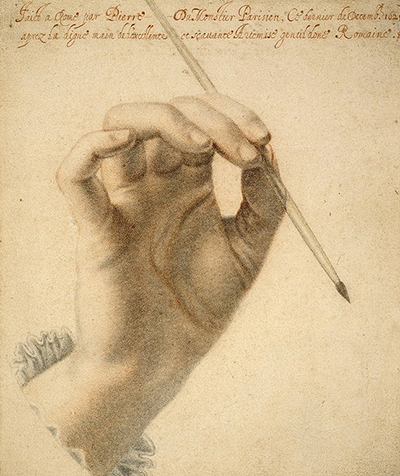
That drawing is Pierre Dumonstier II's Right hand of Artemisia Gentileschi holding a brush, made in 1625 and now in the British Museum. It shows the hand of a painter as a subject in itself, using black and red chalk on paper, and identifies Artemisia through the hand that made her art. The sheet is not evidence that Artemisia drew it herself. Its value lies elsewhere: it tells us that her professional identity could be captured, admired and circulated through the image of her working hand.
Image reference: British Museum, Pierre Dumonstier II, Right hand of Artemisia Gentileschi holding a brush.
At a Glance
- Page FocusArtemisia Gentileschi drawings, works on paper and drawing-related evidence
- Main ObjectPierre Dumonstier II, Right hand of Artemisia Gentileschi holding a brush, 1625
- Important CautionThe Dumonstier sheet is a drawing of Artemisia's hand, not a drawing by Artemisia
- MediumBlack and red chalk on paper
- CollectionBritish Museum, London, museum number Nn,7.51.3
- Reader PathTraining, design, studio practice, reputation and attribution caution
A Thin Record, Not an Empty One
Many famous painters can be followed through drawings that show how they prepared compositions, studied figures or tested details before painting. Artemisia is different. Her reputation rests above all on paintings, documents and later reception. The surviving record around drawings is thinner, and that has to shape the way the subject is discussed.
A thin record is not the same as an empty one. Artemisia trained in a Roman painting household, worked for patrons in several cities, and produced complex compositions that required planning. Drawing belonged to that artistic world even when individual sheets cannot be securely assigned to her. A responsible drawings page therefore asks what works on paper can tell us without pretending that every attractive sheet near her name is firmly by her hand.
The safest starting point is to separate three things: drawings securely about Artemisia, drawings or studies that may relate to her working methods, and later prints or paper objects that circulated her painted inventions. Keeping those categories apart makes the evidence more useful, not less interesting.
Artemisia's Hand as a Subject
The most memorable drawing connected with Artemisia is Dumonstier's 1625 study of her right hand holding a brush. The British Museum identifies it as a work by Pierre Dumonstier II and records it as black and red chalk on paper. Its subject is not a generic painter's hand but Artemisia's own hand, named through inscription and later collection history.
The image is unusually direct. It does not show Artemisia's face, studio or finished work. It isolates the hand that paints. That focus gives the sheet a quiet force: Artemisia's professional identity is compressed into touch, grip and control. The brush is held with firmness, and the hand becomes a form of portraiture.
This matters because Artemisia's fame has often been discussed through biography, courtroom history and dramatic subject matter. Dumonstier's drawing points to something more practical and more professional. It presents her as an artist known by the hand that made paintings. For a woman painter in the seventeenth century, that was not a neutral statement. It made skill visible.
Drawing, Training and the Studio
Artemisia's early training took place in the studio world of her father, Orazio Gentileschi. That context helps explain why drawing matters even when securely attributed sheets are scarce. A painter learned through copying, observation, figure construction, workshop routine and the translation of design into paint. Drawing was part of that environment, whether or not many individual pages survived under Artemisia's name.
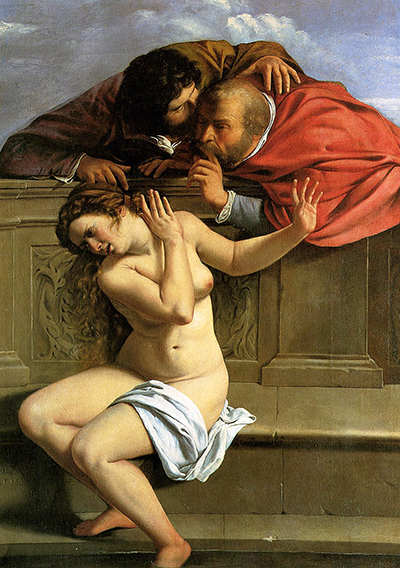
Her finished paintings also show a mind trained to organize bodies, gestures and narrative pressure. Works such as Susanna and the Elders, the two Judith Slaying Holofernes versions, and Judith and Her Maidservant depend on carefully staged movement. The viewer sees finished paint, but beneath it lies a culture of design, rehearsal and revision.
That is why works on paper can help readers ask better questions. They encourage attention to process: how a hand turns, how fabric carries weight, how light clarifies a gesture, and how a dramatic moment is built from smaller decisions.
Drawings and Attribution
Drawing attribution can be especially fragile. Paper is portable, often unsigned, and easily separated from its original context. A sheet may be connected to a workshop, a follower, a copyist, a later collector's label or a composition known through painting. Those links are valuable, but they are not all the same kind of evidence.
For Artemisia, that caution is essential. Her paintings have also faced questions of attribution, versions and workshop relation, so drawings should not be treated with less care. The responsible question is not simply, "Is this by Artemisia?" It is also: who recorded it, what object does it relate to, what collection history supports the claim, and how directly does it connect to her known work?
The Dumonstier drawing is helpful partly because its authorship and subject can be described separately. It is by Dumonstier and about Artemisia. That distinction keeps the page honest while still allowing the object to deepen the reader's understanding of her reputation.
Works on Paper After Artemisia
Works on paper connected with Artemisia also include printed and reproductive afterlives. Some later prints and illustrated references helped paintings circulate beyond the place where the originals were kept. Those objects belong to the history of reception rather than to Artemisia's own hand, but they still matter for understanding how her images travelled.
This is why the Drawings page sits near the Prints page rather than replacing it. Drawings invite questions about process, studio evidence and attribution. Prints invite questions about circulation, copying and public memory. Both should be handled with source-specific language.
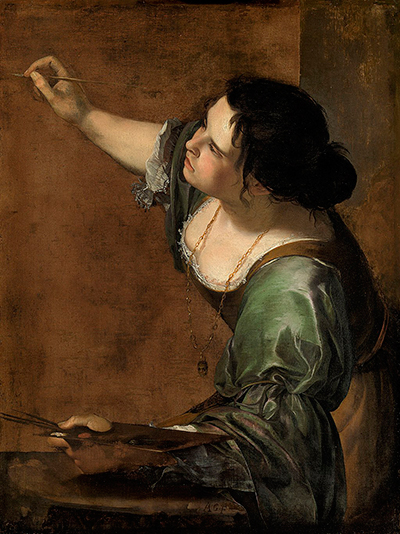
Readers moving from this page into Artemisia's paintings should keep that distinction in mind. A painting such as Self-Portrait as the Allegory of Painting makes the act of painting central to its meaning. Dumonstier's drawing of Artemisia's hand does something related from outside her own authorship: it turns the painter's working body into a subject worthy of attention.
How to Keep Reading
Start with the British Museum record for Dumonstier's drawing, because it fixes the object identity, maker, medium and museum number. Then read the broader artist biographies and exhibition materials that place Artemisia within seventeenth-century painting, patronage and reception. The most useful reading keeps the paper evidence close to the object record rather than using it as decoration.
From there, move back to the major paintings. Artemisia's drawings record may be thin, but her painted works make the discipline of design visible. Her figures act with compressed purpose; their hands, faces and bodies often carry the drama of the whole scene. That is the bridge between drawings and paintings: not a simple list of sheets, but an attention to how an image is made.
Frequently Asked Questions
No large secure corpus of drawings by Artemisia is generally treated as settled. The subject is best approached through careful object records, workshop context and drawing-related evidence.
No. The British Museum records the sheet as a drawing by Pierre Dumonstier II. Its subject is Artemisia's hand holding a brush.
They point toward training, studio practice, design and reception. Even when a sheet is not by Artemisia, it can still show how her professional identity and painted inventions were understood.
They should be read through object records, collection history, relation to known works and the exact wording used by museums or scholars. Similarity to Artemisia's paintings is not enough on its own.
Discussion / Reader Insights
Use this space to share careful questions about Artemisia Gentileschi drawings, works on paper, attribution and source records.
What to Look For
- Clear distinctions between drawings by Artemisia, drawings about Artemisia and later works on paper after her paintings.
- Object records that identify maker, medium, date and collection.
- How hands, gestures and design choices connect drawings culture with her painted compositions.
Join the Conversation
Have you found a museum record or catalogue entry that changes how this drawings evidence should be understood? Add the source details below so the page can remain object-led.
References
- British Museum, Right hand of Artemisia Gentileschi holding a brush, museum number Nn,7.51.3.
- National Gallery, Artemisia Gentileschi artist biography.
- National Gallery, Artemisia exhibition press release archive.
- Royal Collection Trust, Self-Portrait as the Allegory of Painting (La Pittura).
- National Gallery, Self-Portrait as Saint Catherine of Alexandria.
- A&AePortal, Right Hand of Artemisia Gentileschi Holding a Brush.
- Wikimedia Commons, file page for Pierre Dumonstier II's drawing of Artemisia's hand.
 Artemisia Gentileschi.jpg)
 Artemisia Gentileschi.jpg)

.jpg)