

 by Tom Gurney
Tom Gurney BSc (Hons) is an art history expert with over 20 years experience
Published on June 19, 2020 / Updated on September 6, 2026
Email: tomgurney1@gmail.com / Phone: +44 7429 011000
The Birth of Saint John the Baptist by Artemisia Gentileschi
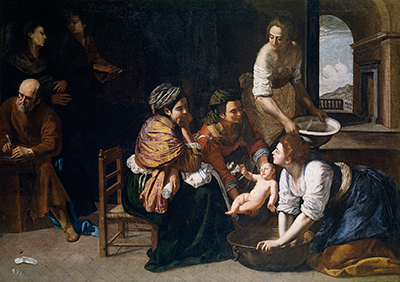
Artemisia Gentileschi's The Birth of Saint John the Baptist is one of the clearest reminders that her mature career was not limited to scenes of confrontation. The painting is now in the Museo Nacional del Prado, which identifies it as an oil on canvas from around 1635, measuring 184 x 258 cm and carrying the inventory number P000149. [1]
The subject is sacred, but the room feels practical and human. At the centre, women attend to the newborn John. To one side, Zechariah and Elizabeth belong to the larger biblical story, while architecture opens the scene outward. Artemisia gives the birth of a prophet the weight of domestic work: washing, support, conversation, fatigue and care. [2]
This article focuses on the Prado painting only. It should be read beside Artemisia's Judith, Susanna, Esther and Magdalene pages, but it has its own rhythm. Its drama lies not in a single violent act, but in the careful arrangement of bodies around a child whose future matters before he can speak.
Image reference: Museo Nacional del Prado.
At a Glance
- ArtistArtemisia Gentileschi
- TitleThe Birth of Saint John the Baptist [1]
- Datec. 1635 [1]
- Mediumoil on canvas [1]
- Dimensions184 x 258 cm [1]
- CollectionMuseo Nacional del Prado, Madrid [1]
- Inventory numberP000149 [1]
- Series contextpart of a group from the life of Saint John the Baptist connected with the Buen Retiro Palace commission [1]
- Main figuresthe infant John, women attending the birth, Elizabeth and Zechariah [2]
- Key themesbirth, domestic labour, sacred history, Naples, Spanish patronage, Baroque narrative
Contents
- A Sacred Birth in an Ordinary Room
- The Prado Object
- The Series for the Buen Retiro
- Reading the Composition
- Women at the Centre
- Zechariah, Elizabeth and the Story's Edge
- Artemisia in Naples
- A Different Kind of Baroque Drama
- How to Read the Painting Today
A Sacred Birth in an Ordinary Room
The Gospel story behind the painting is the birth of John the Baptist, the child who will become the forerunner of Christ. Many artists treated the subject as a scene of holy announcement or dynastic meaning. Artemisia's version begins from the room itself. The infant is small, the women are busy, and the sacred event arrives through ordinary care.
The Prado's easy-to-read record helps identify the core action: the baby John is at the centre, surrounded by four women who wash and tend him. Zechariah and Elizabeth appear at the left, while an archway, balcony and landscape open the right side of the composition. [2]
That arrangement gives the painting its special tone. Artemisia does not isolate a single heroine. She paints a network of bodies, gestures and responsibilities. The birth is not private in the modern sense, but it is intimate: a sacred future begins in the handling of cloth, water and a newborn body.
This makes the painting a useful counterweight to the more violent Artemisia pages. Her art can be severe, but here the pressure is quieter. The central action is care.
The Prado Object
The Prado identifies the work as The Birth of Saint John the Baptist, painted by Artemisia Gentileschi around 1635. The object record gives the medium as oil on canvas, the dimensions as 184 x 258 cm, and the inventory number as P000149. [1]
Those facts matter because this page is not a general account of Saint John imagery. It is a page about a specific Prado painting. The scale is broad and horizontal, giving Artemisia room to separate clusters of action while keeping the room visually connected.
The museum record also places the painting within a larger series from the life of Saint John the Baptist. The series context helps explain why the canvas is so expansive. Artemisia is not making a small devotional scene for solitary viewing; she is contributing to a larger narrative project shaped by courtly and religious patronage. [1]
The current Prado record is therefore the anchor for title, date, medium, size, inventory and collection context. The page should stay close to that object identity whenever it moves into interpretation.
The Series for the Buen Retiro
The Prado connects the painting with a series from the life of Saint John the Baptist commissioned for the hermitage chapel at the Buen Retiro Palace in Madrid. The series included works by several artists, and the Prado record places Artemisia's canvas within that wider decorative and devotional programme. [1]
This setting changes how the painting should be read. Artemisia was working within an international courtly system, not only within a private market for dramatic heroine pictures. A subject from the life of Saint John could serve religious devotion, royal display and the prestige of Italian painting at once.
The commission also places the painting inside Artemisia's mature Neapolitan world. Naples was under Spanish rule, and major commissions could connect local painters with Spanish royal projects. The Prado's account makes that connection part of the painting's history. [1]
For readers, this is one reason the work deserves attention. It shows Artemisia as a participant in a large courtly-religious project, not simply as a solitary maker of famous individual images.
Reading the Composition
The composition moves horizontally. The central group of women bends around the infant, creating a low area of attention near the foreground. Their bodies, sleeves, hands and cloths make the scene feel active without becoming chaotic.
The baby is the narrative centre, but Artemisia does not make him dominate the painting visually. Instead, he gathers the gestures around him. The women look, reach, wash, support and organise. Their movements turn the birth into a shared task.
The right side opens into architecture and distance. The archway and balcony keep the domestic room from feeling sealed off. Sacred history is happening inside a household, but the world beyond remains present.
That balance between interior and exterior is subtle. Artemisia lets the viewer feel the intimacy of the room while also remembering that this child belongs to a larger story.
Women at the Centre
One of the painting's strongest choices is the placement of women's work at the centre. The scene is not built around a single heroic pose. It is built around care, labour and coordination. Artemisia makes washing and tending a child worthy of a large Baroque canvas.
That decision belongs naturally within her wider art. Artemisia often painted women at moments of pressure: Susanna resisting coercion, Judith acting with force, Esther risking herself before a king, Lucretia confronting violence and honour. Here the pressure is different. The women do not fight, plead or recoil. They sustain life.
The result is not sentimental. The women are practical and absorbed. Their gestures give the painting its structure. In a scene about a male prophet's birth, Artemisia lets female labour carry the sacred event into visibility.
That is one reason the painting feels quietly radical without needing to announce itself. It takes an episode often treated as a prelude to a man's future and shows the physical community that makes the beginning possible.
Zechariah, Elizabeth and the Story's Edge
Zechariah and Elizabeth appear at the left of the composition, connected to the biblical narrative but not allowed to absorb all of the viewer's attention. Their presence gives the scene its named family and theological frame. [2]
Zechariah's role in the story is especially important because John receives his name through a moment of writing and recognition. Artemisia does not need to narrate every detail explicitly. By placing the older parents within the room, she lets the viewer understand that this is not any birth, but the birth of a child whose identity has already been marked by divine promise.
Elizabeth's presence also matters. She is the mother, but Artemisia does not reduce the scene to a single maternal icon. The birth is distributed across the room. The older mother, the newborn child, the women attending him and the architectural opening all share the narrative field.
This edge-of-story structure is characteristic of Artemisia's intelligence as a narrator. She knows where the theological meaning lies, but she also knows that painting can make supporting actions central.
Artemisia in Naples
The painting belongs to Artemisia's mature career, when Naples became one of her main bases. The Prado artist record connects her with dramatic colour and light and with the transformation of Neapolitan painting in the 1630s. [3]
This matters because Artemisia is sometimes imagined mainly through Rome, Florence and the aftermath of the 1612 trial. The Birth of Saint John the Baptist belongs to a later and broader professional world. It shows her working at large scale, for important patrons, within a city tied to Spanish power and rich artistic exchange.
The painting also shows adaptability. The artist who could make Judith's action feel brutally immediate could also organise a many-figure religious scene around tenderness and work. The Baroque intensity is still there, but it is filtered through domestic ritual rather than through violence.
In that sense, the Prado canvas is essential to a balanced Artemisia cluster. It gives readers a late-career religious commission that cannot be reduced to biography or to the best-known heroine subjects.
A Different Kind of Baroque Drama
The drama of this painting is quiet, but it is still drama. Artemisia stages a moment when several forms of time meet: the immediate care of a baby, the age of Zechariah and Elizabeth, the future ministry of John, and the long biblical story that will move toward Christ.
A painter could have made the scene entirely ceremonial. Artemisia instead gives it bodily credibility. The baby needs washing. The women need to bend and reach. The room needs to hold noise, movement and attention. Sacred history arrives through ordinary acts.
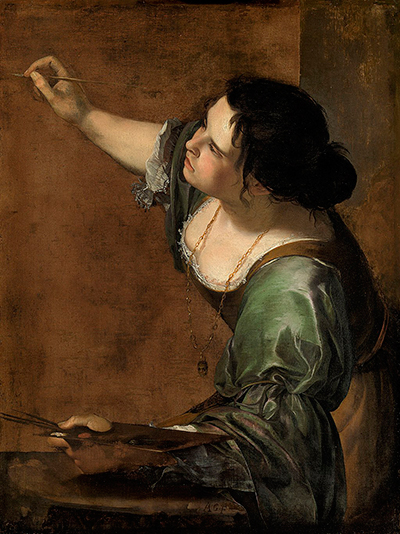
That slower drama is one reason the page belongs in the Artemisia cluster. It prevents the artist's career from being narrowed to a few famous images of crisis. The Judith pages are essential. So are Susanna, Esther, Lucretia, the Magdalene works and the self-portraits. But Artemisia's achievement also includes a painting like this: large, collaborative in context, domestic in setting, religious in subject and subtle in emotional temperature.
The canvas proves that Artemisia's strength was not a single mood. It was the ability to make inherited subjects feel newly embodied.
How to Read the Painting Today
Begin with the centre. Notice how the women gather around the child and how their gestures make a rhythm of care. The newborn John is small, but everything turns toward him.
Then move outward. Look at Zechariah and Elizabeth on the left, and at the architecture and landscape on the right. Artemisia lets the story breathe across the width of the canvas rather than locking it into one emblematic pose.
Look also at scale. A domestic birth scene has been made large enough for a royal religious project. That shift is crucial. It tells us that ordinary care can carry public and sacred meaning.
Finally, place the painting within Artemisia's whole career. The Birth of Saint John the Baptist does not cancel the force of Judith, Susanna or Lucretia. It completes the picture of an artist who could paint violence, courage, devotion, self-fashioning and domestic sacred history with equal seriousness.
Related Pages
- Artemisia Gentileschi
- Artemisia Gentileschi Biography
- Artemisia Gentileschi Paintings
- Annunciation
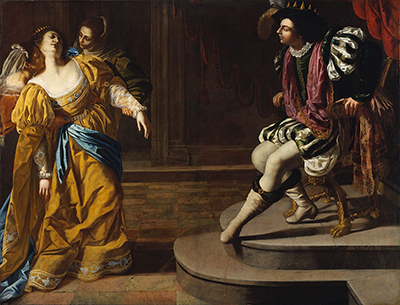
- Esther before Ahasuerus
- Lucretia
- Susanna and the Elders
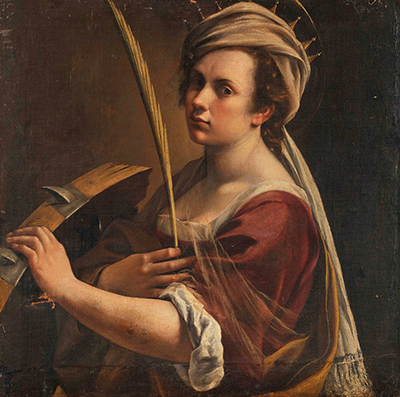
- Self-Portrait as Saint Catherine of Alexandria
- Baroque Artists
Frequently Asked Questions
Discussion
What should readers notice when looking closely at Artemisia Gentileschi's The Birth of Saint John the Baptist?
Reader Insights
How does Artemisia make washing and tending the child feel central rather than secondary?
What changes when a domestic birth scene is painted at the scale of a major courtly canvas?
How does this quieter religious scene alter the way you read Artemisia's more dramatic heroine paintings?
Join the Conversation
Share your reading of this painting below.
References
- Museo Nacional del Prado, The Birth of Saint John the Baptist. Object record for title, artist, c. 1635 date, oil-on-canvas medium, 184 x 258 cm dimensions, inventory P000149 and series context.
- Museo Nacional del Prado, The Birth of Saint John the Baptist. Artemisa Gentileschi. Easy-to-read artwork route for subject identification and scene layout.
- Museo Nacional del Prado, Artemisia Gentileschi. Artist record for career context and Neapolitan painting significance.
 Artemisia Gentileschi.jpg)
 Artemisia Gentileschi.jpg)