 by Tom Gurney
Tom Gurney BSc (Hons) is an art history expert with over 20 years experience
Page Created on August 31, 2026 / Page Updated on November 6, 2026
Email: tomgurney1@gmail.com / Phone: +44 7429 011000
William Merritt Chase: Introduction
William Merritt Chase (1849–1916) made virtuosity itself one of his subjects. Across portraits, still lifes, studio interiors, city parks, Long Island landscapes and pastels, he changed key without surrendering the dark tonal knowledge learnt in Munich. His art belongs to an international exchange that included old masters, modern European painting and a rapidly professionalising American art world. “Impressionist” describes an important part of that achievement, but never the whole of it.[1]
At a Glance
- Born1 November 1849 in Williamsburg, Indiana
- Died25 October 1916 in New York City[2]
- TrainingIndianapolis, New York’s National Academy of Design and the Royal Academy in Munich
- Principal mediaOil and pastel, handled across portraits, still lifes, landscapes and interiors
- Important settingsThe Tenth Street Studio Building, New York parks and Shinnecock Hills
- Teaching careerFrom the Art Students League to the Shinnecock Hills Summer School and other major American art schools
William Merritt Chase in context
Munich School
c. 1850–1900Aesthetic Movement
c. 1860–1900American Impressionism
c. 1885–1920Ten American Painters
1898–1919James McNeill Whistler
1834–1903Frank Duveneck
1848–1919William Merritt Chase
1849–1916John Henry Twachtman
1853–1902John Singer Sargent
1856–1925Childe Hassam
1859–1935Keying Up – The Court Jester
1875Portrait of Dora Wheeler
1882–83Terrace, Prospect Park
c. 1887A Friendly Call
1895Shinnecock Hills
c. 1895Still Life: Fish
by 1908Contents
- Introduction
- Why Chase Matters
- Munich and an International Education
- The Tenth Street Studio as Artwork and Stage
- Parks, Pastel and Changing Light
- Shinnecock: Landscape, School and Community
- Portraits and Still Lifes: The Persistence of Dark Colour
- How to Explore the Works
Why Chase Matters
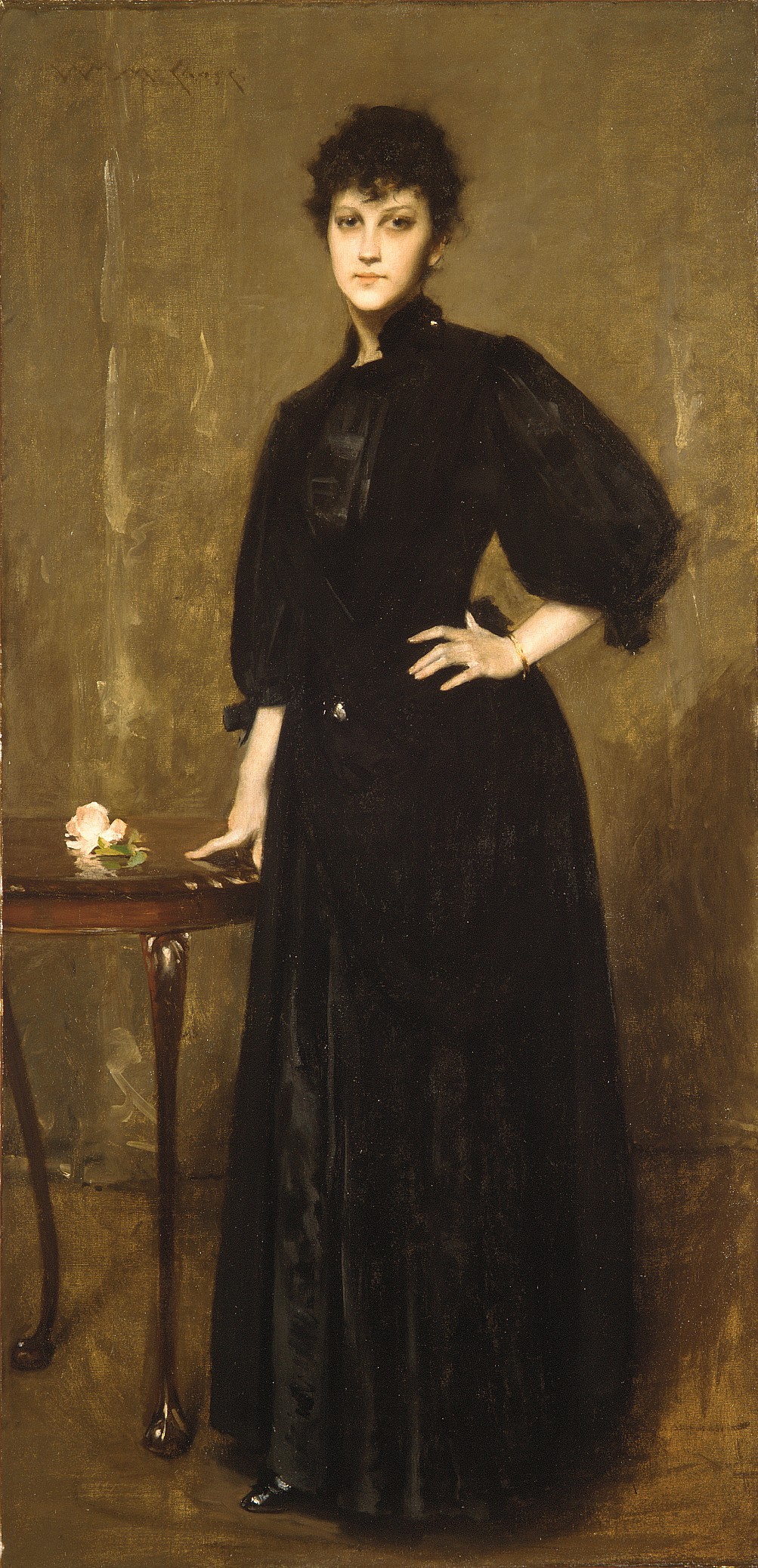
Chase’s range was not a collection of disconnected experiments. It was a working method. He could use shadow, compressed colour and bravura brushwork to give a fish still life physical weight, then turn to an airy landscape in which pale grasses and moving clouds seem to dissolve firm outlines. Portraiture demanded yet another negotiation: the sitter had to remain an individual, but costume, furnishing and colour could also make the picture an aesthetic performance.
That ability to move between modes made Chase unusually responsive to the international art of his time. A major retrospective organised by American and European institutions emphasised his stylistic experimentation, varied subjects and place within international art circles.[3] Yet “eclectic” should not mean passive borrowing. Chase selected, combined and displayed his sources. The recurrent tension between dark and light, old and new, private work and public performance is central to his art.
The variety also makes his career a revealing account of how an American artist could operate around 1900. Chase was simultaneously a working painter, sought-after portraitist, collector, host, exhibitor and teacher. Each role affected how art was made and encountered. His influence therefore lies both in surviving objects and in the settings where looking, instruction and sociability met.
Munich and an International Education
Chase’s early formation began with Barton S. Hays in Indianapolis and continued at the National Academy of Design in New York. After professional still-life work in St Louis, patrons supported his European study. He entered Munich’s Royal Academy in 1872, choosing a city whose training and painterly culture differed from the Parisian route followed by many Americans.
In Munich, Chase absorbed dramatic tonal contrasts, vigorous handling and a close engagement with old masters including Frans Hals and Peter Paul Rubens. These resources did not disappear when his palette later brightened. They remained especially useful in portraits and still lifes, where dark grounds could sharpen flesh, fabric, metal or wet scales. This continuity matters: the later landscapes do not record a simple abandonment of Munich darkness for Impressionism.
Chase also worked in Venice alongside American painters including Frank Duveneck and John Twachtman. Travel gave him a network as well as an education. When he returned to New York in 1878, he brought home a conspicuously international artistic identity and immediately began teaching at the Art Students League.[1] The fuller biography and the study of his path from Munich to Tenth Street trace how training became a public career.
The Tenth Street Studio as Artwork and Stage
From 1878, Chase occupied space in the Tenth Street Studio Building in Greenwich Village. He eventually transformed its large gallery into an elaborate environment crowded with textiles, metalwork, ceramics, paintings and other collected objects. The studio provided room to paint, but it also framed receptions, display and social encounters. Chase relinquished the costly space in 1895.
His 1880 oil The Tenth Street Studio turns that environment into a carefully organised spectacle. The Saint Louis Art Museum identifies the work as accession 48:1933 and stresses that possessing—and being seen to appreciate—such objects carried social meaning for artists and patrons.[4] Visible details support that interpretation: figures, pictures and furnishings share the scene, so the act of looking becomes part of what is pictured.
The studio also reveals how Chase fashioned a professional persona. Decoration was not mere background. It made cosmopolitan taste tangible and gave visitors an experience of art before they examined any single canvas. At the same time, the painted studio is selective. Its apparently abundant interior is a composed image, not an impartial inventory, and should be read as one of Chase’s most ambitious statements about the artist’s place in modern New York.
Parks, Pastel and Changing Light
Between the mid-1880s and about 1890, Chase repeatedly painted New York parks. These were designed civic landscapes rather than untouched nature, and they offered a modern subject close to home. Paths, terraces, planted areas and small figures let him balance urban order against flickering visual incident. Instead of monumental drama, he often chose the passing rhythms of leisure.
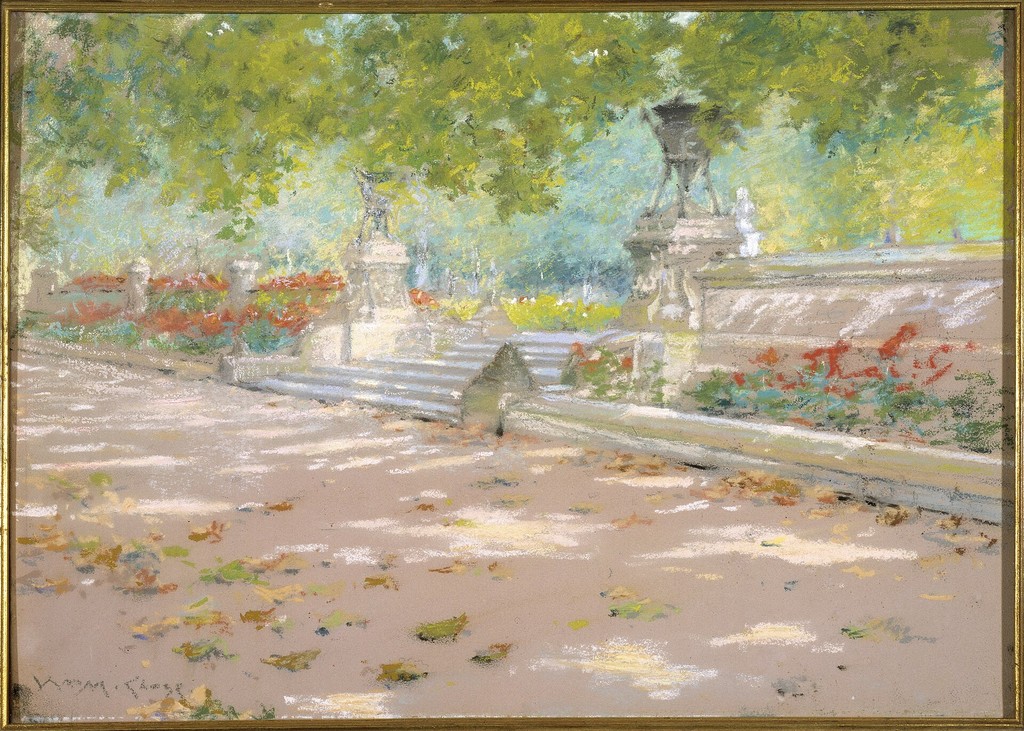
Pastel was essential to this investigation. Chase treated it as a finished painterly medium, capable of dense colour as well as quick transitions. Terrace, Prospect Park, about 1887, is a pastel measuring only 23.3 by 35.2 centimetres. The Smithsonian American Art Museum classifies it as a drawing and records it as accession 1929.6.12.[5] Its scale and material encourage close looking: steps, foliage and open air are held together by coloured marks rather than laborious finish.
These park scenes complicate any neat stylistic timeline. Their lighter colour and outdoor setting reflect Chase’s engagement with contemporary European art, yet their pictorial order remains deliberate. The subject may feel immediate, but selection governs the view. That balance—fresh observation disciplined by arrangement—continues in the New York park scenes and across Chase’s pastels and works on paper.
Shinnecock: Landscape, School and Community
From 1891 to 1902, Chase directed the Shinnecock Hills Summer School of Art near Southampton. The school adopted plein-air study, while Chase worked nearby and spent summers with Alice and their growing family. The Parrish Art Museum presents the venture within the development of Southampton as a summer resort and notes that women consistently outnumbered men in its classes.[6]
Those facts cannot be separated from place. The school, family household and resort economy operated on ancestral and present Shinnecock land. Parrish research records sustained relationships between the Chases, summer colonists and members of the Shinnecock Nation, including the community’s labour and provision of food to the seasonal settlement.[7] Chase’s landscapes therefore show selected views within an inhabited, worked and contested environment; they are not visions of empty dunes.
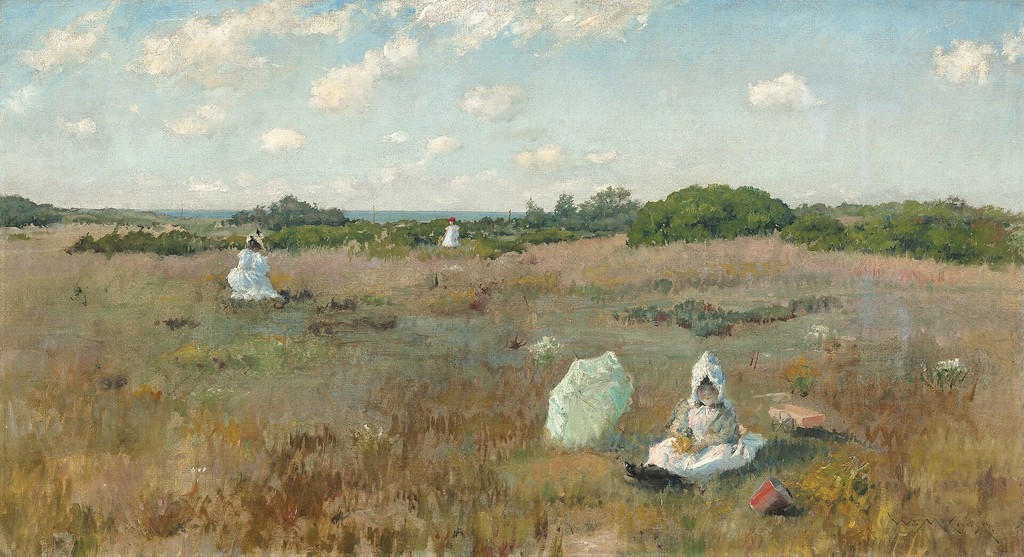
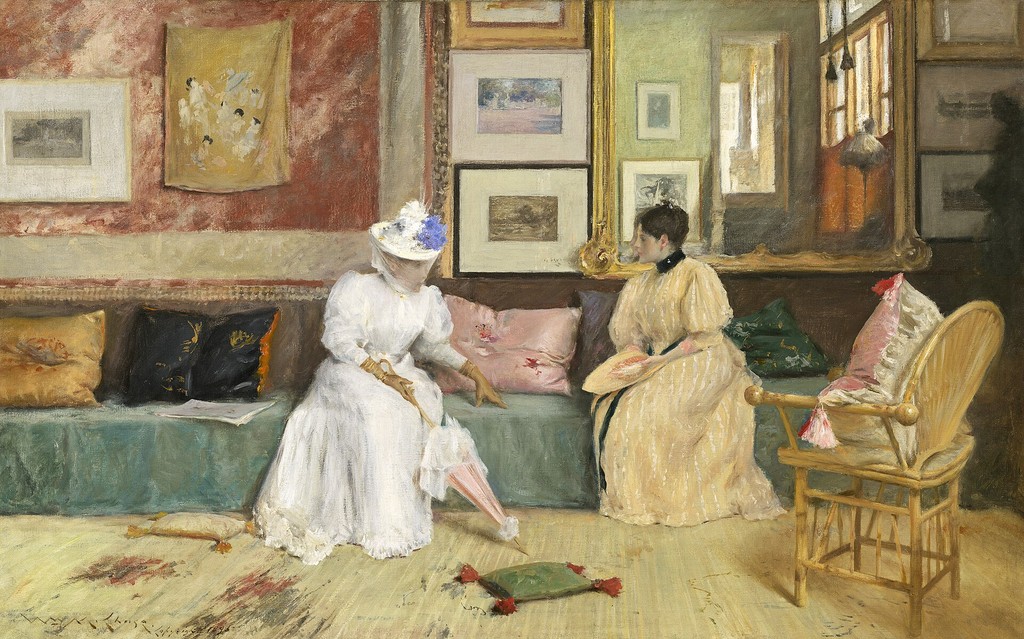
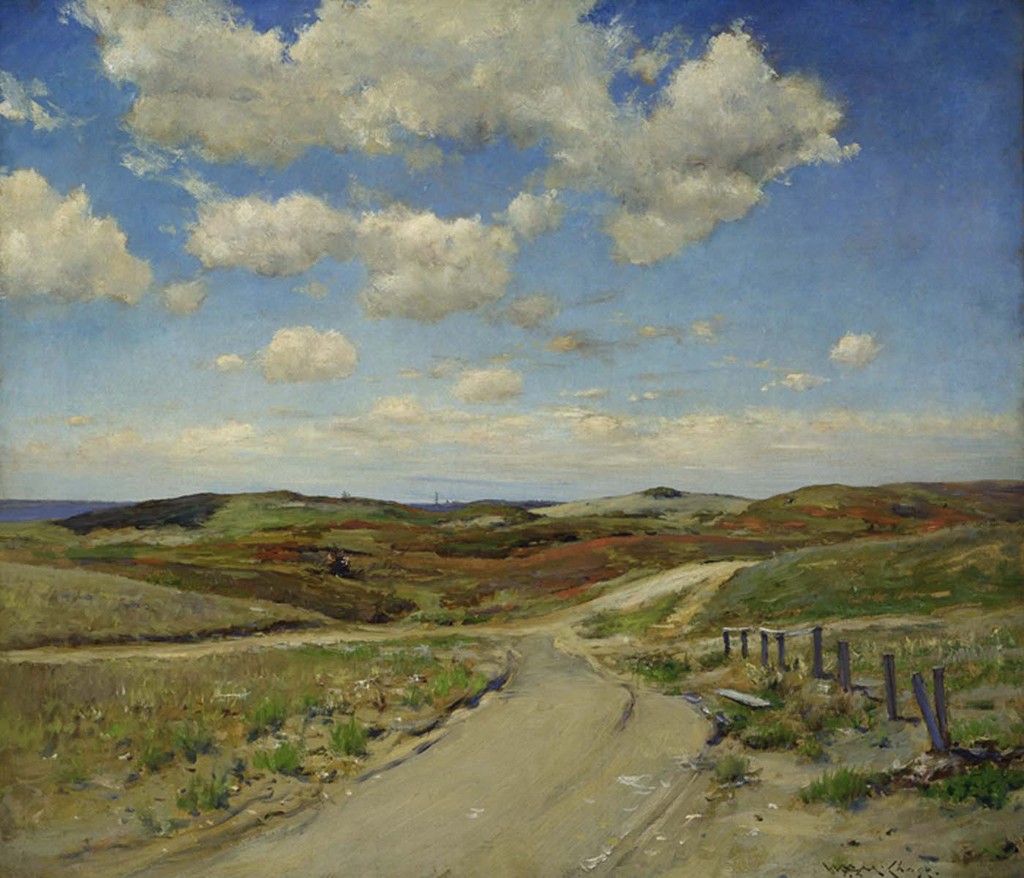
In the oil Shinnecock Hills, about 1895, a road carries the eye through low coastal ground. The Smithsonian American Art Museum records the exact work as accession 1909.7.11.[8] Its broad sky and restrained landmarks produce openness, but historical context changes how that openness is understood. A Friendly Call, also painted in 1895, moves indoors. In this oil, accession 1943.1.2 at the National Gallery of Art, Alice Chase and a visitor sit within the family’s carefully decorated Shinnecock house; mirrors and rectangular furnishings turn polite conversation into a study of pictorial structure.[9]
Together, the landscape and interior resist a narrow definition of the Shinnecock years. They encompass teaching, family life, social hierarchy, designed domestic space and an artistic response to the outdoors. The dedicated account of Shinnecock landscapes and teaching keeps those relationships in view.
Portraits and Still Lifes: The Persistence of Dark Colour
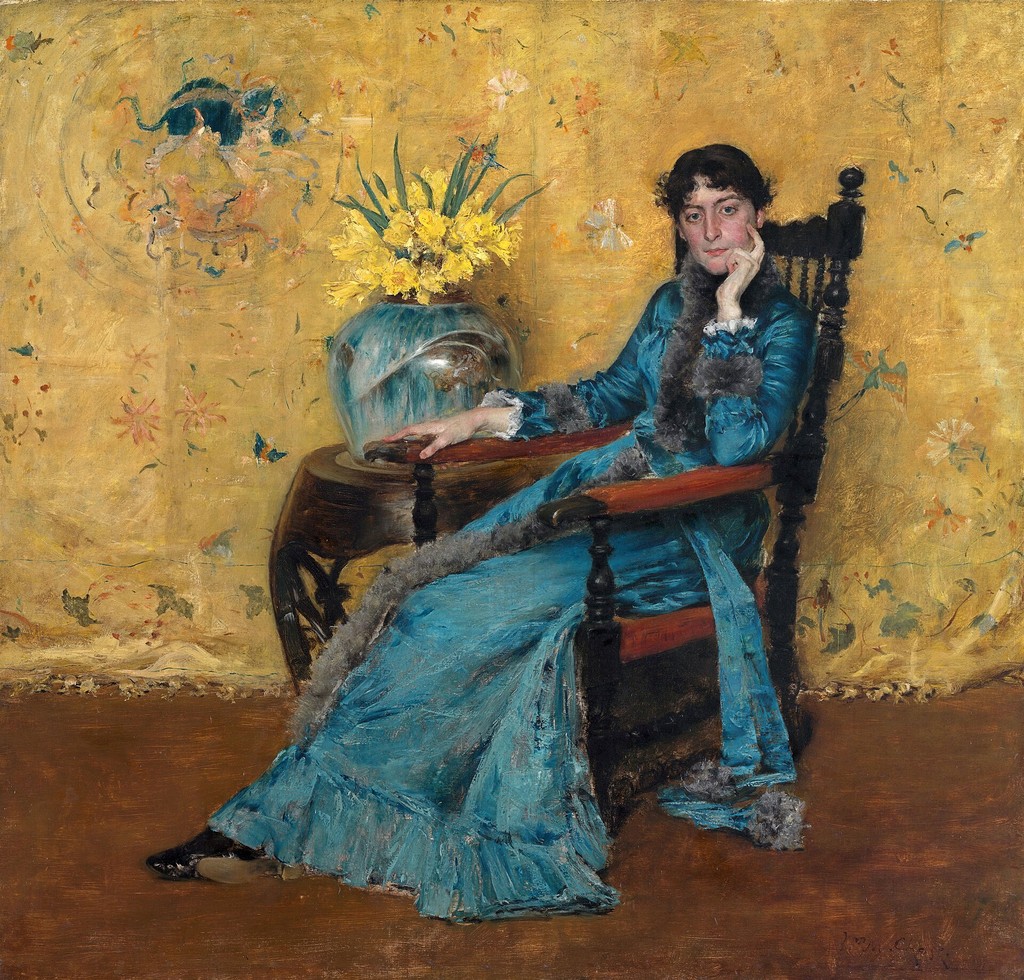
Chase’s portraits could join observation to intricate display. Portrait of Dora Wheeler, painted in 1882–83, presents its sitter against a textile connected to her work as a designer. The Cleveland Museum of Art notes that Wheeler had studied with Chase and later worked in a successful decorating firm established with her mother. The oil, accession 1921.1239, thus makes fabric meaningful rather than incidental: professional identity and ornamental design occupy the same visual field.[10]
Still life allowed Chase to test equally demanding material effects without a sitter. The active Still Life: Fish is the Metropolitan Museum of Art’s oil painted by 1908, accession 08.139.2. Its dark setting and forceful handling sustain the Munich inheritance late in his career.[11] Other Chase fish paintings have similar titles, but they are separate objects; title alone cannot make them interchangeable.
These works show why a single label fails. The dark register was not an early obstacle discarded on the way to brighter landscape. Chase retained it because it remained expressive and technically productive. The broad paintings and artworks guide brings portraits, still lifes, interiors and landscapes together without flattening their differences.
How to Explore the Works
Begin with contrasts. Compare the social theatre of The Tenth Street Studio with the domestic reserve of A Friendly Call. Set the small pastel Terrace, Prospect Park beside the larger oil Shinnecock Hills and notice how medium, scale and place alter Chase’s treatment of open air. Then compare Dora Wheeler’s portrait with the Met fish painting: both command attention through surface, but one entwines a sitter with decorative design while the other makes texture and tonal weight the event.
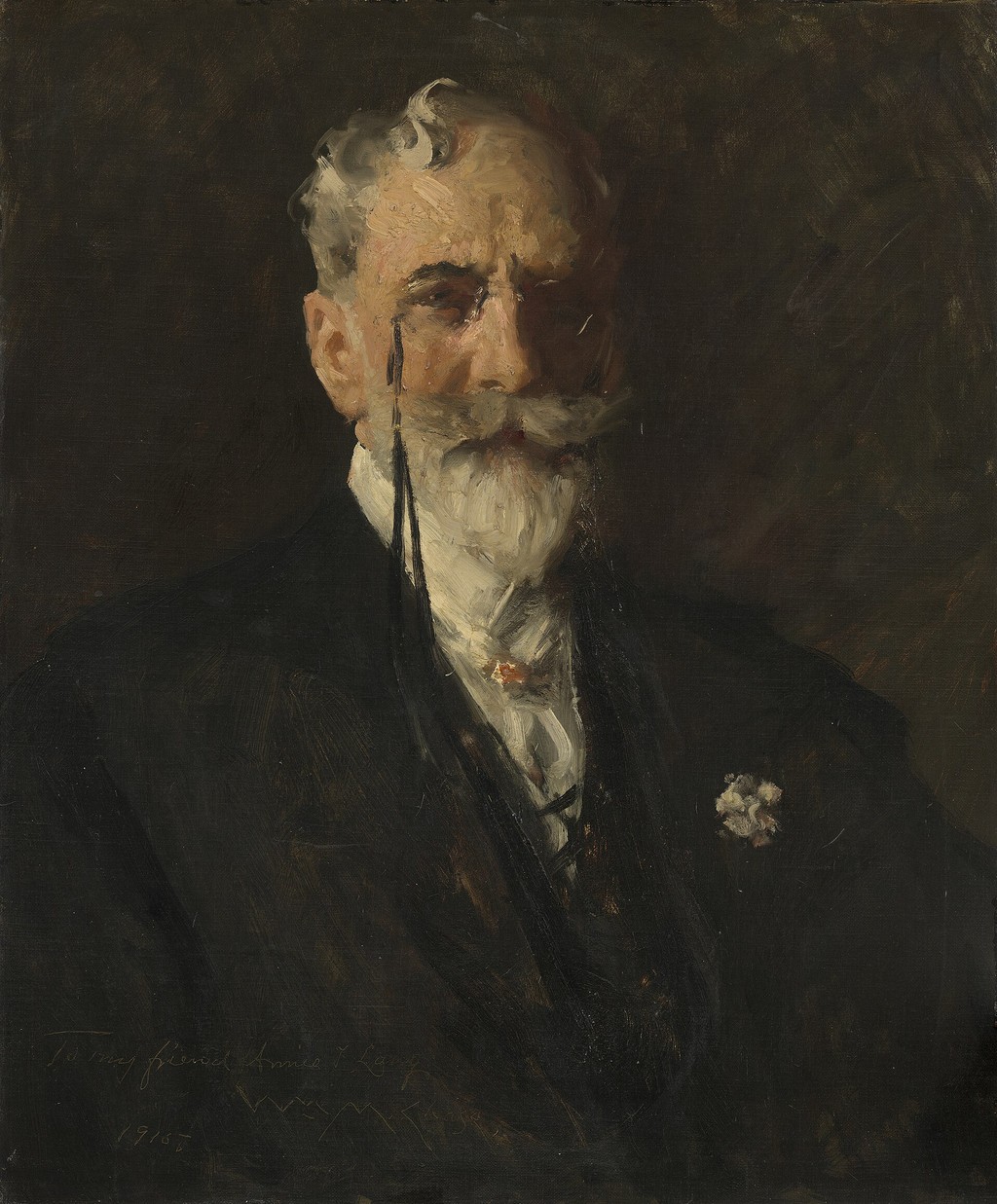
Chase’s 1915 Self-Portrait, an oil now at the National Gallery of Art, offers a late point of return. Its dark clothing and ground, loose edges and direct gaze compress many of his continuing concerns into a single figure; the museum records it as accession 2014.136.15.[12] It is better read as evidence of continuity than as a summary of everything he made.
The researched online works census contains 208 distinct records assembled from creator-statement data. It is a discovery tool, not a catalogue raisonné or a claim to completeness. Repeated titles remain separate, and museum records should govern exact object identification.
Follow William Merritt Chase's career through four stages
Indiana, New York, St Louis and Munich
Early lessons in Indianapolis and New York led to professional still-life work in St Louis and patron-supported study at the Munich Royal Academy. Dark tonal structures, vigorous handling and old-master study remained durable resources after Chase returned to New York in 1878.
Teaching, display and a public artistic identity
Chase began teaching at the Art Students League and made the Tenth Street Studio Building both workplace and social setting. Portraits, interiors and carefully staged display established a cosmopolitan public identity without limiting his practice to one subject or manner.
Open air, pastel, family and summer teaching
New York park scenes and painterly pastels joined the Shinnecock landscapes and summer school. From 1891 to 1902 Chase taught on ancestral and present Shinnecock land within a growing summer-colony economy, while family and working life entered both interiors and open-air pictures.
The Ten, international schools and persistent range
After joining the Ten American Painters in 1902, Chase continued exhibiting and teaching through several institutions and summer programmes. Late portraits and fish still lifes retained controlled tonal force alongside lighter landscape and pastel practices.
Essential works
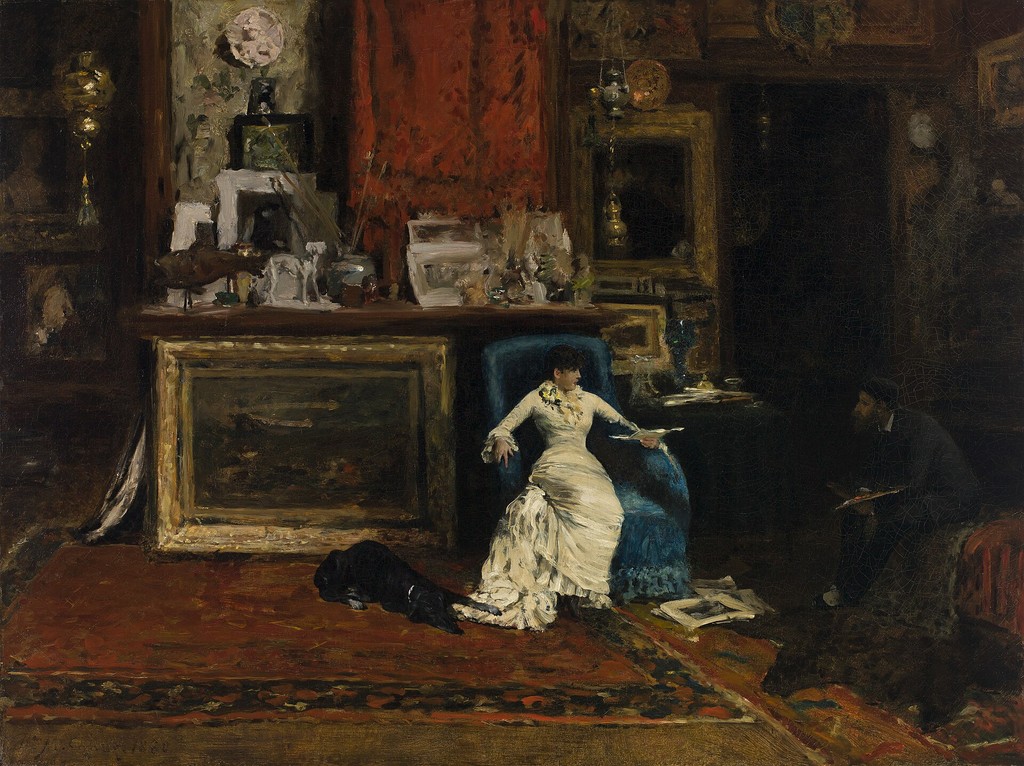
The Tenth Street Studio
1880 · A densely staged interior turns Chase's workplace into an image of display, sociability and artistic self-fashioning.
Portrait of Dora Wheeler
1882–83 · Scale, pattern and saturated colour present the artist and designer Dora Wheeler as a commanding creative presence.
Terrace, Prospect Park
c. 1887 · A compact finished pastel uses layered colour and quick-looking marks to organise modern public park space.
A Friendly Call
1895 · Two women, an asymmetrical room and a bright doorway make cultivated sociability deliberately open to interpretation.
Shinnecock Hills
c. 1895 · A broad road, low horizon and pale light show the selections through which Chase pictured ancestral and present Shinnecock land.
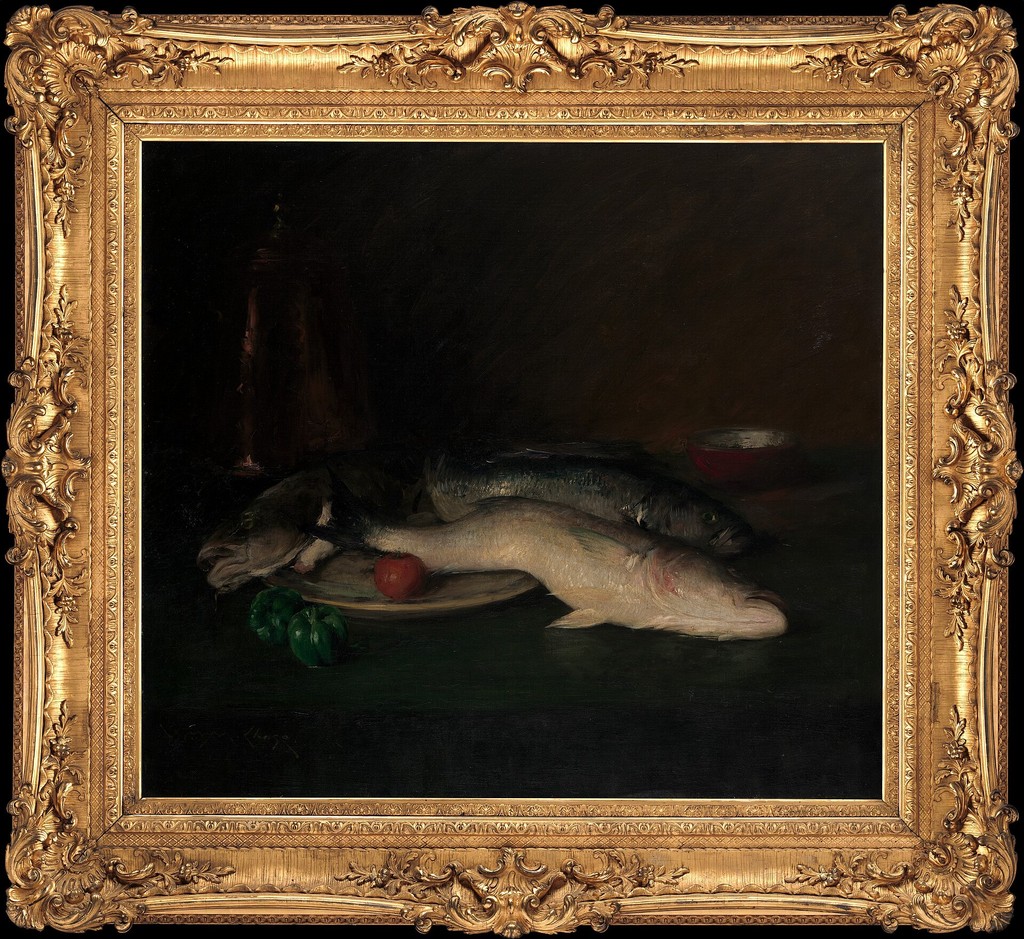
Still Life: Fish
by 1908 · Wet highlights, compressed space and dark tonal structure reveal the control beneath Chase's celebrated speed.
Researched works directory
This searchable evidence census contains 208 distinct records assembled from public collection data and a reproducible Wikidata snapshot. It is not a catalogue raisonné, not a claim of complete oeuvre coverage, and it keeps works with repeated titles as separate objects.
| Name | Date | Medium |
|---|---|---|
| A City Park | 1887 | Painting |
| A Corner of My Studio | Date unknown | Painting |
| A Dutch Landscape | 1884 | Painting |
| A Friendly Call | 1895 | Painting |
| A Gray Day | 1886 | Painting |
| A Modern Magdalen | 1888 | Painting |
| A Spanish Gypsy | 1905 | Painting |
| Albert Harkness (1822–1907) | 1908 | Painting |
| Alice | 1892 | Painting |
| An Afternoon Stroll | 1895 | Painting |
| An English Cod | 1904 | Painting |
| At the Seaside | 1890 | Painting |
| August B. Loeb | 1905 | Painting |
| Baron Hugo von Habermann | 1875 | Painting |
| Beach | 1895 | Painting |
| Bessie Potter | 1895 | Painting |
| Big Copper Kettle and Fish (Fish) | Date unknown | Painting |
| Bildnis Hugo von Habermann | 1875 | Painting |
| Brass Kettle and Catfish | Date unknown | Painting |
| Carmencita | 1890 | Painting |
| Courtyard in Venice | 1877 | Painting |
| Crucifixion | 1875 | Painting |
| Der japanische Holzschnitt | 1888 | Painting |
| Dieudonnée | 1899 | Painting |
| Dorothy | 1902 | Painting |
| Dr. Eduardo San Giovanni | 1906 | Drawing |
| Duveneck Painting "The Turkish Page | 1876 | Painting |
| Edward Everett Hale (1822-1909) | 1884 | Painting |
| Edward Guthrie Kennedy | 1895 | Painting |
| Edward Steichen | 1903 | Painting |
| Female Figure Study (front view) | Date unknown | Painting |
| Female Figure Study (side view) | Date unknown | Painting |
| First Touch of Autumn | 1898 | Painting |
| Fish | 1910 | Painting |
| Fish and Still Life | 1906 | Painting |
| Fish and Still Life | 1908 | Painting |
| Florence | 1907 | Painting |
| For the Little One | 1896 | Painting |
| Garden of the Orphanage, Haarlem, Holland | 1883 | Painting |
| Gathering Autumn Flowers | 1894 | Painting |
| Gathering Flowers, Shinnecock, Long Island | 1897 | Drawing |
| Girl at a Bureau | Date unknown | Painting |
| Girl in a Japanese Costume | 1890 | Painting |
| Girl in Ciociaro costume | 1876 | Painting |
| Girl in White | 1890 | Painting |
| Girl with Doll | 1910 | Painting |
| Gray Day on the Bay | 1886 | Painting |
| Gray Day on the Lagoon | 1913 | Painting |
| Harbor Scene, Brooklyn Dock | 1886 | Painting |
| Harriet Hubbard Ayer | 1880 | Painting |
| Head of a Man | 1875 | Painting |
| Hide and Seek | 1888 | Painting |
| I Think I'm Ready Now | 1883 | Painting |
| Idle Hours | 1894 | Painting |
| In the Park (A By-path) | 1889 | Painting |
| In the Studio Corner | 1881 | Painting |
| In Venice | 1877 | Painting |
| James Abbott McNeill Whistler | 1885 | Painting |
| John Butler Talcott | 1900 | Painting |
| Just Onions (Onions; Still Life) | Date unknown | Painting |
| Keying Up" - The Court Jester | 1875 | Painting |
| Keying Up: The Court Jester | 1875 | |
| L'Éventail de plumes | Date unknown | Painting |
| Lady in Black | 1888 | Painting |
| Lady Playing Guitar | Date unknown | Painting |
| Landscape- Shinnecock, Long Island | 1896 | Painting |
| Long Island Landscape after a Shower of Rain (After the Shower) | 1889 | Painting |
| Lydia Field Emmet | 1892 | Painting |
| Man Wearing Gold Rimmed Glasses | 1892 | Painting |
| Marine | 1888 | Painting |
| Monkeying with Literature | 1877 | Painting |
| Moses Swaim | Date unknown | Painting |
| Mother and Child (The First Portrait) | 1887 | Painting |
| Mrs. Charles Scott | Date unknown | Painting |
| Mrs. Chase | 1890 | Painting |
| Mrs. Chase in Prospect Park | 1886 | Painting |
| Mrs. William Clark | 1915 | Painting |
| Mrs. William Merritt Chase | 1890 | Painting |
| My Little Daughter Dorothy | 1894 | Painting |
| My Palette | 1875 | Painting |
| Myra Reynolds | 1898 | Painting |
| Near the Beach, Shinnecock | 1895 | Painting |
| Near the Beach, Shinnecock | Date unknown | Painting |
| North River Shad | 1910 | Painting |
| Nude | 1901 | Painting |
| Open Air Breakfast | 1888 | Painting |
| Outskirts of Madrid | 1882 | Painting |
| Pablo de Sarasate: Portrait of a Violinist | 1875 | Painting |
| Park Bench | 1890 | Painting |
| Peace, Fort Hamilton | 1888 | Painting |
| Pink Azalea—Chinese Vase | 1885 | Painting |
| Portrait Head | 1882 | Painting |
| Portrait of a Boy in Van Dyck Costume | 1875 | Painting |
| Portrait of a Child | 1884 | Painting |
| Portrait of a Lady in Black | 1895 | Painting |
| Portrait of a Lady in Black (Annie Traquair Lang) | 1911 | Painting |
| Portrait of a Lady in Pink | Date unknown | Painting |
| Portrait of a Man | 1874 | Painting |
| Portrait of a Man | 1875 | Painting |
| Portrait of a Woman | Date unknown | Painting |
| Portrait of Artist Beck Wenzell | 1900 | Painting |
| Portrait of Baroness Ida-Gro van Dahlerup | 1907 | Painting |
| Portrait of Dora Wheeler | 1882 | Painting |
| Portrait of Lavinia Borden Cook | Date unknown | Painting |
| Portrait of Louis Betts | Date unknown | Painting |
| Portrait of Master Otis Barton and his Grandfather | 1903 | Painting |
| Portrait of Miss D. | Date unknown | Painting |
| Portrait of Mrs. C. (Lady with a White Shawl) | 1893 | Painting |
| Portrait of Mrs. George B. Ely (Caroline Boies Ely) | Date unknown | Painting |
| Portrait of My Daughter Alice | 1895 | Painting |
| Portrait of My Father (David Hester Chase) | Date unknown | Painting |
| Portrait of My Mother (Sarah Swaim Chase) | 1892 | Painting |
| Portrait of William Francklyn Paris | Date unknown | Painting |
| Portrait of William Gurley Munson | 1868 | Painting |
| Ready for the Ride | 1877 | Painting |
| Red Snapper | Date unknown | Painting |
| Robert Frederick Blum | Date unknown | Painting |
| Roland | 1902 | Painting |
| Roses | 1883 | Drawing |
| Seaside Flowers | 1897 | Painting |
| Selbstbildnis | 1875 | Painting |
| Selbstporträt | 1915 | Painting |
| Self-Portrait | 1909 | Drawing |
| Self Portrait | 1914 | Painting |
| Self-Portrait | 1915 | Painting |
| Self-portrait dressed as Johan Claesz Loo by Frans Hals | 1903 | Painting |
| Seventeenth Century Lady | 1895 | Painting |
| Shell Beach at Shinnecock | 1892 | Painting |
| Shinnecock Hills | 1892 | Painting |
| Shinnecock Hills | 1893 | Painting |
| Shinnecock Hills | 1895 | Painting |
| Shinnecock Hills | 1895 | Painting |
| Shinnecock Hills Landscape | 1890 | Painting |
| Shinnecock Studio Interior | 1892 | Drawing |
| Sketch for a Picture--Columbus before the Council of Salamanca (A) (Christopher Columbus before the Council of Salamanca) | 1876 | Painting |
| Sketch for a Picture--Columbus before the Council of Salamanca (B) (Christopher Columbus before the Spanish Council) | 1876 | Painting |
| Sketch of a Child:Helen | 1898 | Painting |
| St. Jerome | 1875 | Painting |
| Still Life | 1912 | Painting |
| Still Life | Date unknown | Painting |
| Still Life | Date unknown | Painting |
| Still Life | Date unknown | Painting |
| Still Life (Brass Bowl) | Date unknown | Painting |
| Still Life (Brushes, Books and Pottery) | 1904 | Painting |
| Still Life: Fish | 1900 | Painting |
| Still Life: Fish | 1903 | Painting |
| Still Life: Fish | 1908 | Painting |
| Still Life: Fish | 1912 | Painting |
| Still-life: Fish and Bowl | 1895 | Painting |
| Still Life (Fruit and Copper Pot) | Date unknown | Painting |
| Still Life (Fruit and Pottery) | Date unknown | Painting |
| Still Life--Striped Bass | 1907 | Painting |
| Still Life with Fish | 1800 | Painting |
| Still Life with Fish | 1910 | Painting |
| Still Life with Fish | 1912 | Painting |
| Still Life with Fish | Date unknown | Painting |
| Still life with fruit | 1871 | Painting |
| Still Life with Hummingbird | 1870 | Painting |
| Still Life with Watermelon | 1869 | Painting |
| Studio Interior | 1882 | Painting |
| Study Head | Date unknown | Painting |
| Study of a Girl in Japanese Dress | 1895 | Painting |
| Study of a Young Woman | 1883 | Painting |
| Study of Flesh Color and Gold | 1888 | Drawing |
| Summer at Shinnecock Hills | 1891 | Painting |
| Sunlight and Shadow, Shinnecock Hills | 1893 | Painting |
| Tenth Street Studio | 1880 | Painting |
| Terrace at the Mall | 1890 | Painting |
| Terrace, Prospect Park | 1887 | Drawing |
| The Antiquary Shop | 1879 | Painting |
| The Apprentice (Boy with Apple) | 1876 | Painting |
| The Big Brass Bowl | Date unknown | Painting |
| The Blue Kimono | 1915 | Painting |
| The Boat Harbor (Gowanus Pier) | 1888 | Painting |
| The Coast of Holland | 1884 | Painting |
| The Emerald Lady | Date unknown | Painting |
| The Family Cow (Calf's Head) | 1869 | Painting |
| The Keynote | 1915 | Painting |
| The Kimono | 1895 | Painting |
| The Mirror | 1900 | Painting |
| The Model | 1888 | Drawing |
| The Moorish Warrior | 1878 | Painting |
| The Old Road to the Sea | 1893 | Painting |
| The Patrician | 1875 | Painting |
| The Song | 1907 | Painting |
| The Stately Model | 1898 | Painting |
| The Tenth Street Studio | 1880 | Painting |
| The Tow Path | 1880 | Painting |
| The Turkish Page (Unexpected Intrusion) | 1876 | Painting |
| The Whistling Boy | 1875 | Painting |
| The Wounded Poacher | 1878 | Painting |
| The Yield of the Waters | 1878 | Painting |
| The Young Orphan | 1884 | Painting |
| Thomas E. Kirby | 1900 | Painting |
| Thomas Moran | Date unknown | Painting |
| Under a French Sky | 1882 | Painting |
| Venetian Lace Making | Date unknown | Drawing |
| View from Central Park | 1889 | Painting |
| View near Polling | 1875 | Painting |
| William A. Clark | 1915 | Painting |
| William Andrews Clark | 1915 | Painting |
| William Nimick Frew | 1915 | Painting |
| William Rockhill Nelson | 1907 | Painting |
| Wind-Swept Sands | 1894 | Painting |
| Woman in White | 1902 | Painting |
| Woman Seated | 1885 | Drawing |
| Woman Standing in a Landscape | Date unknown | Painting |
| Worthington Whittredge | 1890 | Painting |
Frequently Asked Questions
Chase participated in American Impressionism and used bright colour and open-air handling in many park and Shinnecock landscapes. But the term covers only part of his practice. Dark Munich-derived tonal structures continued in portraits, interiors and still lifes throughout his career.
He returned in 1878 after studying in Munich and working in Venice. He then began teaching at the Art Students League and established himself in the Tenth Street Studio Building.
It joined workplace, exhibition setting and social stage. Chase arranged art and collected objects there to demonstrate cosmopolitan taste, receive visitors and shape the public identity of a modern professional artist.
The summer school centred on painting outdoors and attentive study of the local landscape. Its history also belongs to the resort economy on Shinnecock land and to relationships between the summer community and the Shinnecock Nation.
Compare unlike subjects rather than searching for one signature style. A studio interior, park pastel, Shinnecock landscape, portrait and fish still life reveal how Chase adapted colour, handling and composition while retaining a recognisable concern with painterly display.
Discussion
Use this evidence-led guide as a starting point for close looking rather than a final verdict.
Share an observation about William Merritt Chase or a source that adds useful context.
Reader Insights
Which work most clearly complicates the familiar label of American Impressionist?
Where do training, display, family, place or teaching most productively alter your reading?
Which source or surviving object would you investigate next?
Join the Conversation
Add your reading below, keeping observations specific and evidence clear.
References
- William Merritt Chase (1849–1916) — Metropolitan Museum of Art, accessed 31 August 2026, accessed 31 August 2026.
- American Paintings of the Nineteenth Century, Part I — National Gallery of Art, accessed 31 August 2026, accessed 31 August 2026.
- William Merritt Chase: A Modern Master — Terra Foundation for American Art, accessed 31 August 2026, accessed 31 August 2026.
- The Tenth Street Studio — Saint Louis Art Museum, accessed 31 August 2026, accessed 31 August 2026.
- Terrace, Prospect Park — Smithsonian American Art Museum, accessed 31 August 2026, accessed 31 August 2026.
- William Merritt Chase: The Shinnecock Years — Parrish Art Museum, accessed 31 August 2026, accessed 31 August 2026.
- William Merritt Chase and His Neighbors — Parrish Art Museum, accessed 31 August 2026, accessed 31 August 2026.
- Shinnecock Hills — Smithsonian American Art Museum, accessed 31 August 2026, accessed 31 August 2026.
- A Friendly Call — National Gallery of Art, accessed 31 August 2026, accessed 31 August 2026.
- Portrait of Dora Wheeler — Cleveland Museum of Art, accessed 31 August 2026, accessed 31 August 2026.
- Still Life: Fish — Metropolitan Museum of Art, accessed 31 August 2026, accessed 31 August 2026.
- Self-Portrait — National Gallery of Art, accessed 31 August 2026, accessed 31 August 2026.