 by Tom Gurney
Tom Gurney BSc (Hons) is an art history expert with over 20 years experience
Published on June 19, 2020 / Updated on November 6, 2026
Email: tomgurney1@gmail.com / Phone: +44 7429 011000
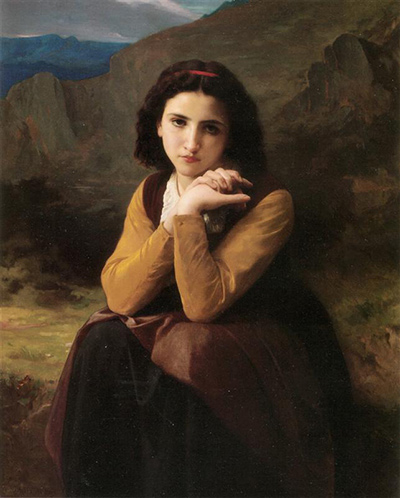
Mignon by William-Adolphe Bouguereau
In William-Adolphe Bouguereau's Mignon, a young woman sits in a rocky landscape with her hands gathered beneath her chin. Her yellow sleeves and dark dress stand out against the earth and stone, but the strongest encounter is with her face. She looks towards the viewer while her body remains enclosed in a compact, inward pose. The painting makes thoughtfulness visible without specifying a single passing emotion.
The title connects the figure to the literary and operatic character Mignon. The Metropolitan Museum of Art identifies an 1869 Bouguereau painting as the source of the wood engraving Mignon Pensive, published in the Illustrated London News. The museum explains that the character comes through the opera based on Goethe's Wilhelm Meister. This connection distinguishes the painting from an anonymous rustic portrait, even though it remains persuasive as an image of a particular young person. [1]
At a Glance
- Date1869
- Related titleMignon Pensive
- SubjectThe literary and operatic character Mignon
Works in context
Contents
A literary title and a painted figure
A title such as Mignon gives the viewer information that the painted surface cannot supply alone. Without it, the figure might be read as a seated girl resting outdoors. With it, the pose acquires associations of displacement, memory and longing connected to the character's story.
Those associations should not be turned into a literal identification of a scene unless the painting supplies the necessary evidence. Bouguereau does not show a stage setting, a clearly named companion or a dramatic incident that fixes an exact moment in an opera. The literary identity frames the figure's mood rather than converting the canvas into an illustrated synopsis.
This creates a productive openness. Viewers familiar with the character can bring that knowledge to the picture; others can still respond to the pose, expression and setting. The painting does not require an external narrative to make its human presence intelligible, but the title changes the range of meanings available.
Hands as a centre of stillness
The hands are essential to the composition. Gathered near the face, they give the head a visual support and compress the upper body into a close group of forms. The fingers are carefully differentiated, yet their overall effect is one of containment. They make the sitter seem absorbed without hiding her face from the viewer.
The elbows and sleeves lead the eye downwards towards the lap. From there, the darker skirt continues the figure's broad shape. This movement gives the seated body weight. The woman does not appear to float before a decorative background; her pose establishes an intelligible relationship with the ground and rock around her.
The compact arrangement also slows the image. A fully extended arm might suggest an action beyond the frame. Here, most of the significant lines return towards the body. The eye is repeatedly brought back to the face and hands, reinforcing the sense of sustained attention rather than sudden movement.
Colour and the mountain setting
The yellow sleeves supply the most immediate colour contrast. They separate the arms from the dark dress and pick up the warmth of the surrounding earth. Small areas of white near the neck offer another register of brightness without dominating the whole figure.
Behind the sitter, the rocky setting opens towards a distant landscape. The change of scale matters. The close rock feels solid and enclosing, while the farther mountains suggest a world that extends beyond the young woman's immediate position. The viewer can read this as a contrast between bodily stillness and imagined distance, although that remains an interpretation rather than a documented statement of the artist's intention.
The landscape is therefore more than neutral scenery. It creates the physical setting against which the face and clothing become legible. Its comparatively subdued colours also allow the sitter's warm complexion and yellow sleeves to remain the main points of attention.
Looking directly without revealing everything
The eyes establish contact, but the expression resists a single explanation. It would be easy to call the figure sad, wistful or resigned. Each word captures something of the effect, yet none can be proved as a factual description of the model's inner state. The painting depends partly on that uncertainty.
Bouguereau's controlled modelling contributes to the ambiguity. The mouth is not opened in speech, the brows are not exaggerated into melodrama and the head does not turn away in a decisive refusal of the viewer. Instead, the features remain composed. The emotional charge comes from small differences in the gaze and from the body's protective arrangement.
The result is an encounter that feels personal while preserving distance. We can see the face clearly without being granted access to an explanation. The title provides a literary framework, but the painted expression continues to exceed any simple label attached to it.
The painting and its printed afterlife
The Metropolitan Museum's wood engraving is a separate object made after Bouguereau. It records how the image circulated beyond the original canvas. The museum links the printed image and its title to a Goupil photograph of the 1869 painting, showing that the route from canvas to public audience could involve more than one reproductive stage. [1]
This history matters when comparing reproductions. A photograph, a wood engraving and a colour image of the painting do not preserve the same information. The engraving translates modelling and colour into a system of black-and-white marks. It can carry the pose and much of the expression while changing the balance between the figure and the background.
The printed title Mignon Pensive also gives a more explicit name to the mood. It encourages the viewer to read the pause as thoughtfulness. That wording belongs to the recorded reproductive object and should be retained as such, rather than assumed to identify an entirely different composition.
Catalogue evidence and identification
Christie's records a signed and dated 1869 Mignon Pensive, measuring 100.4 by 81.3 centimetres, and gives a provenance that includes Goupil and the later Andy Warhol collection sale. These are object-level details useful for distinguishing the composition from other literary figures or paintings of girls by Bouguereau. [2]
A catalogue entry is strongest when its evidence is used precisely. A signature and date concern the recorded canvas; an ownership history concerns its documented passage through collections. Neither automatically identifies the sitter who posed, and neither establishes a current public location.
The painting's achievement remains visible without adding those unsupported claims. Bouguereau joins a literary identity to a closely studied human figure, allowing the familiarity of the face and the remoteness of the story to reinforce one another. The setting opens outwards, the body turns inwards, and the direct gaze holds the two experiences together.
Artworks and records
Selected documented works and records relevant to this article; this is not a complete catalogue.
| Name | Date | Record |
|---|---|---|
| Italian Woman with Tambourine | 1869 | Painting |
| Mignon Pensive | 1869 | Painting |
| Mignon Pensive — print after Bouguereau | Nineteenth century |
Discussion
Share a reading of the figures, materials or relationships discussed in this article.
Reader Insights
Which detail most affects your reading?
Which comparison would you like to explore further?
Join the Conversation
Share a detail, comparison or question about Mignon by William-Adolphe Bouguereau below.
References
- Metropolitan Museum of Art, Mignon Pensive, wood engraving after William Bouguereau, collection record 742409. View source.
- Christie's, William Adolphe Bouguereau, Mignon Pensive, signed and dated 1869. View source.
- Marius Vachon, W. Bouguereau, Paris, 1900, contemporary biography and work catalogue. View source.
- Sotheby’s, Italian Woman with Tambourine, 1869. View source.