 by Tom Gurney
Tom Gurney BSc (Hons) is an art history expert with over 20 years experience
Published on June 19, 2020 / Updated on October 16, 2026
Email: tomgurney1@gmail.com / Phone: +44 7429 011000
Love Takes Off, Flight of Love and L'Amour s'envole
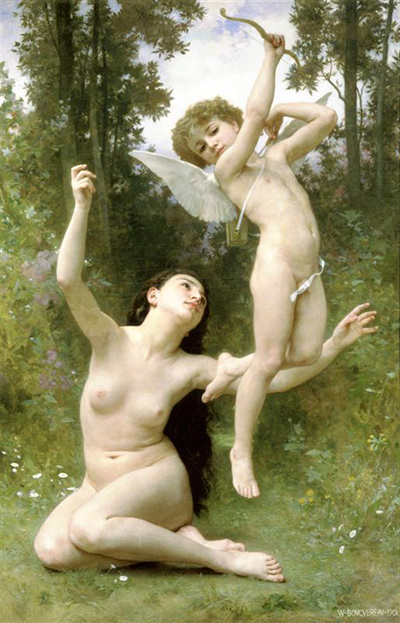
William-Adolphe Bouguereau's Love Takes Off is the protected English route title for an image better governed, in the strongest captured collection source, as Flight of Love. Frye Art Museum identifies the painting under that English title and records Bouguereau as its maker, with a date of 1901. Wikimedia Commons supplies the French title family L'Amour s'envole, while WikiArt preserves the familiar web title Love Takes Off. Those names should be read together, not collapsed into a single unsupported catalogue form. [1][3][4]
The picture shows a winged child figure in motion, carrying the attributes of love away from the viewer's grasp. It belongs to Bouguereau's late mythological and allegorical world, where Cupid-like children could turn an idea into a polished figure subject. The painting is not just a decorative study of a child with wings. It stages love as something active, evasive and difficult to hold.
Frye's object page gives the secure framework for the public page: title Flight of Love, 1901, oil on canvas, dimensions of 63 1/4 by 41 1/4 inches, or 160.66 by 104.78 cm, and accession number 1952.014. The credit line places the work in the Founding Collection as a gift of Charles and Emma Frye. Those facts should govern the page. Commons and WikiArt are useful for title continuity and image circulation, but they should not override the museum record.
At a Glance
- ArtistWilliam-Adolphe Bouguereau
- Protected Route TitleLove Takes Off
- Frye TitleFlight of Love
- French TitleL'Amour s'envole
- Date1901
- MediumOil on canvas
- Dimensions63 1/4 x 41 1/4 in. / 160.66 x 104.78 cm
- Accession1952.014
Contents
- Introduction
- A Late Allegory of Love in Motion
- Frye's Object Record and the Title Problem
- Process Context and the Finished Painting
- Reading Love Takes Off Today
- Related Love and Mythology Pages
- Frequently Asked Questions
- References
A Late Allegory of Love in Motion
Bouguereau returned often to love, desire and mythological childhood. In Love Takes Off, the winged child format allows him to make an abstract idea physically immediate. The figure is small enough to feel playful, but the subject is not trivial. The body twists, the wings animate the silhouette, and the title turns the action into a metaphor: love departs, escapes or refuses to stay still.
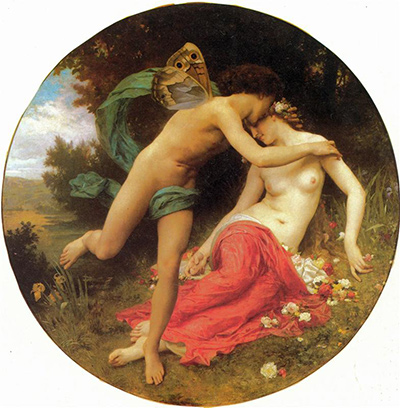
That theme connects the painting with Bouguereau's better-known Cupid and Psyche subjects, but the object identities should stay separate. L'Amour et Psyche, enfants has its own accepted source route and child-figure context. Cupid and Psyche has a different protected-route problem and a copy-after source lineage. Love Takes Off should be read beside those pages as a related mythological theme, not folded into them.
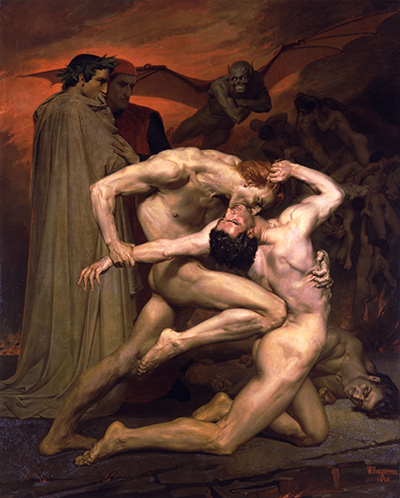
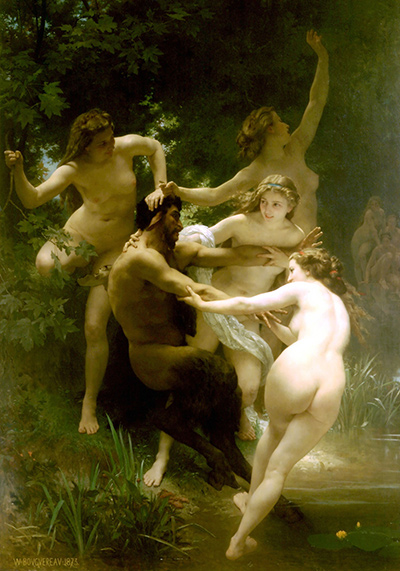
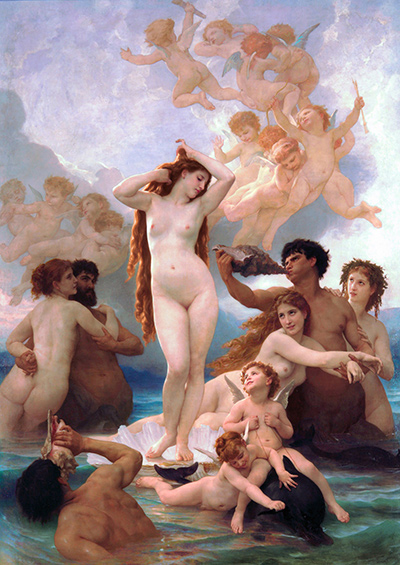
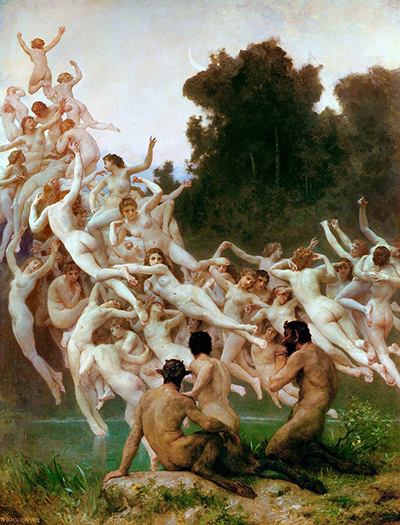
The painting also belongs near larger mythological canvases such as The Birth of Venus, The Oreads and Nymphs and Satyr. Those works are more expansive, but they share Bouguereau's habit of turning classical or allegorical subject matter into idealized bodies, controlled movement and polished surface.
Frye's Object Record and the Title Problem
The title issue is the main thing the page needs to clarify. A reader arriving at the local route expects Love Takes Off, because that is the long-standing page title and the title repeated in some public image databases. Frye, however, gives Flight of Love. Commons gives L'Amour s'envole, a French title that translates naturally toward both flight and departure. A good public page can preserve all three without making them compete.
The safest wording is simple: this page uses Love Takes Off as the protected English route title, while Frye's Flight of Love governs the museum object facts. L'Amour s'envole should be introduced as the French title-family form supported by Commons and related metadata. That discipline prevents the page from treating search-friendly titles as if they were all equally authoritative.
The same caution applies to dimensions and collection facts. Frye's dimensions should govern because Frye is the collection source. WikiArt and reproduction routes can support discovery and title continuity, but they should not be used to settle conflicting measurements. Frye's accession and credit line are enough to anchor the painting without pretending to provide a complete ownership history.
Process Context and the Finished Painting
A later Gazette Drouot study route is useful because it connects a related study with L'Amour s'envole. That can help readers understand the painting as part of a process, but it does not govern the finished canvas. The finished painting's object facts still return to Frye. The study route should be treated as context, not as a replacement object record. [5]
This is especially important for Bouguereau, whose works often circulate through studio studies, reduced versions, prints, public-domain files and auction records. Those routes can be valuable, but they can also blur versions if the page does not keep them in order. For Love Takes Off, the hierarchy is clear: Frye first, Commons and WikiArt second, the study route as process context only.
That structure also keeps the image discussion careful. The painting can be discussed through its visual subject, title family and Frye object record without turning a reproduced file into a rights statement. The image's circulation through Commons and other public routes is useful for recognition, but the authority for the finished painting should still come from Frye.
Reading Love Takes Off Today
Read today, Love Takes Off is compelling because it compresses a large theme into a single figure. Bouguereau does not need a crowded mythological scene. The winged child, the turn of the body and the action implied by the title are enough. Love becomes visible precisely because it is leaving.
The painting also shows the persistence of Bouguereau's Academic language in 1901. Even in a late work, the artist relies on clarity of drawing, smooth finish and a carefully legible pose. The allegory is easy to understand, but the surface remains controlled. The figure is idealized, but the motion keeps the image from feeling static.
The subject is also revealing because it turns departure into charm rather than loss. A winged child might easily become a decorative motif, yet Bouguereau gives the action enough direction to make the title matter. Love is not simply present; it is leaving, lifting away, becoming visible at the moment it escapes. That gives the painting a light but memorable emotional structure in Bouguereau's late career.
Placed within the broader Bouguereau cluster, the page can help readers see the range of his love imagery: Cupid and Psyche subjects, Venus imagery, winged children and allegorical figures all belong to related but distinct strands. Love Takes Off should occupy its own place in that group: a Frye-governed 1901 oil on canvas, known locally by a protected English route title, and tied by its French title to the idea of love in flight.
Handled this way, the page becomes clearer and more useful. It keeps the familiar title that readers search for, respects the museum title that governs the object, and leaves uncertain questions where they belong. The result is a focused reading of a late Bouguereau painting about the charm, movement and elusiveness of love.
Related Love and Mythology Pages
Frequently Asked Questions
Discussion
Love Takes Off rewards close looking at title history, mythological allegory and Bouguereau's late figure language.
Use the prompts below to compare the Frye title route with Bouguereau's broader love imagery.
Reader Insights
How does the reading shift between Love Takes Off, Flight of Love and L'Amour s'envole?
Where does Bouguereau make departure feel charming rather than tragic?
How does this late painting relate to Bouguereau's other Cupid and Psyche subjects?
Join the Conversation
Share your reading of Bouguereau's love imagery, title variants and late Academic finish below.
References
- Frye Art Museum, Flight of Love, accessed 29 July 2026.
- Frye Art Museum, Founding Collection, accessed 29 July 2026.
- Wikimedia Commons, L'Amour s'envole file page, accessed 29 July 2026.
- WikiArt, Love takes off, 1901, accessed 29 July 2026.
- Gazette Drouot, Bouguereau study route connected with L'Amour s'envole, accessed 29 July 2026.