 by Tom Gurney
Tom Gurney BSc (Hons) is an art history expert with over 20 years experience
Published on June 19, 2020 / Updated on October 16, 2026
Email: tomgurney1@gmail.com / Phone: +44 7429 011000
Baigneuse by William-Adolphe Bouguereau: Introduction
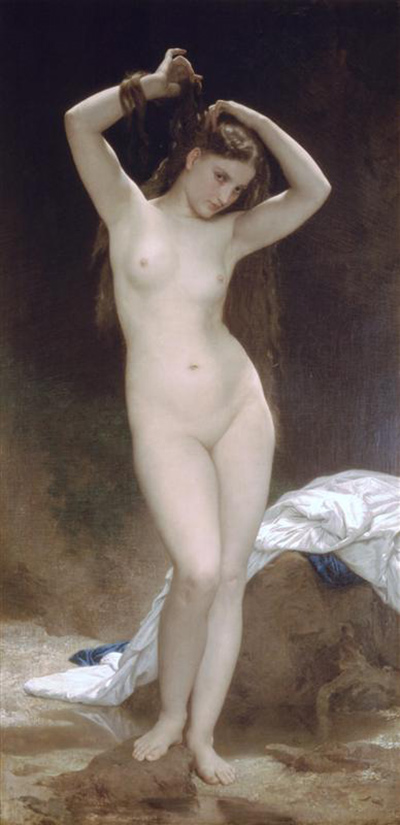
Baigneuse is one of William-Adolphe Bouguereau's clearest statements of the academic bather type. The Fundació Gala-Salvador Dalí identifies the work as Banyista (Bather), by William Adolphe Bouguereau, dated 1870, and records it as a painting executed in oil on canvas. The local French title, Baigneuse, and the official Catalan/English title both point to the same basic subject: a female bather, standing apart from narrative drama and treated as a study of pose, surface, and idealized bodily presence.
That title discipline matters because Bouguereau returned often to bathers, nudes, and ideal female figures. A page called Baigneuse can easily drift into confusion with other works if the object is not kept specific. Here, the governing object is the 1870 painting associated with the Dalí Foundation collection, not the later seated The Bather sold at Christie's and not the separate Les Jeunes Baigneuses type. The simplest way to read the page is therefore as a focused treatment of one standing bather, with the title understood through both the local French name and the official Banyista (Bather) record.
At a Glance
- ArtistWilliam-Adolphe Bouguereau
- Local TitleBaigneuse
- Official TitleBanyista (Bather) [1]
- Date1870 [1]
- Object TypePainting [1]
- TechniqueOil on canvas [1]
- Collection RouteFundacio Gala-Salvador Dali [1]
Contents
- Introduction
- Title and Object Route
- Academic Bather and Figure Study
- Ideal Figure Comparisons
- Why the Painting Matters
Title and Object Route
The subject belongs to a long academic tradition in which the female bather allowed artists to present the nude body outside a fully developed mythological or religious story. Bathing supplied a reason for undress, but the real artistic challenge lay elsewhere: in drawing, proportion, contour, and the management of modesty and display. Bouguereau's reputation depended on precisely those skills. He could make the figure feel finished to an almost porcelain degree, smoothing the body into an image of controlled beauty while still giving the pose enough life to hold the viewer's attention.
In Baigneuse, the figure is not primarily an individual portrait. She is a type, shaped by Bouguereau's academic training and by the market for polished images of ideal beauty. The raised arms, upright body, and isolated setting invite the viewer to look at the construction of the figure: the line of the torso, the balance of the shoulders, the turn of the head, and the way the body is held between stillness and movement. The painting asks to be read as an exercise in figure design as much as a scene of bathing.
Academic Bather and Figure Study
That does not make the work cold. Bouguereau's bathers often depend on a delicate tension between ideal form and immediate physical presence. The scene suggests a private moment, but it is organized for public viewing. The bather appears self-contained, yet the painting is carefully arranged around the viewer's act of looking. Bouguereau's art often works in this space between intimacy and display. He makes the body available as a refined object of study, then softens that study with graceful pose, smooth flesh, and a calm surface that discourages any sense of accident.
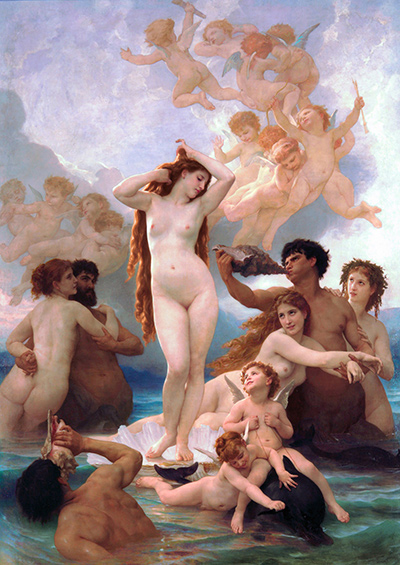
The 1870 date places the painting before some of Bouguereau's most famous mythological nude compositions, including The Birth of Venus. That later painting expands the nude into a grand public myth, with scale, movement, and surrounding figures. Baigneuse is more concentrated. It does not need an elaborate mythological setting to justify the body. Its interest is in a single figure and in the discipline required to make that figure appear complete. Seen this way, the painting is useful for understanding how Bouguereau could move from the studio study of the body to larger images of myth, allegory, and beauty.
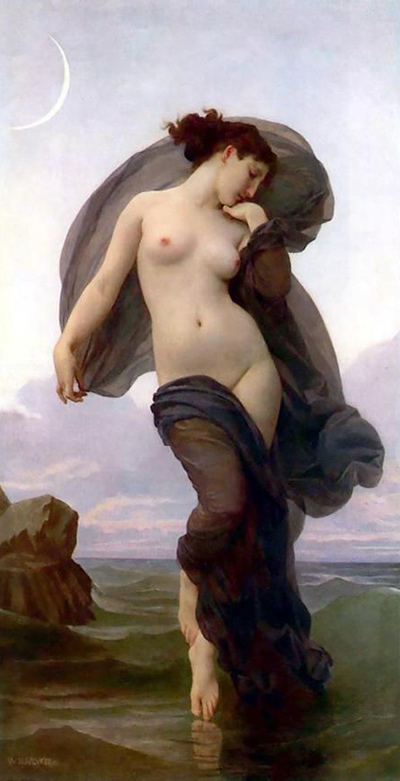
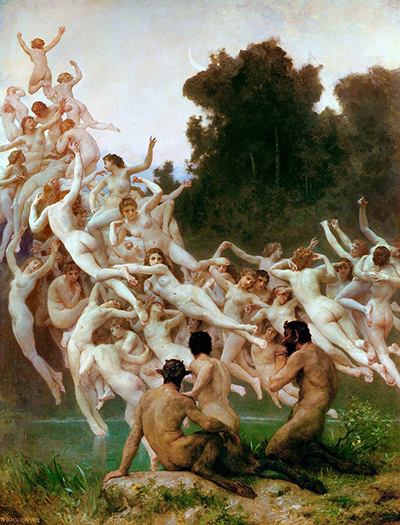
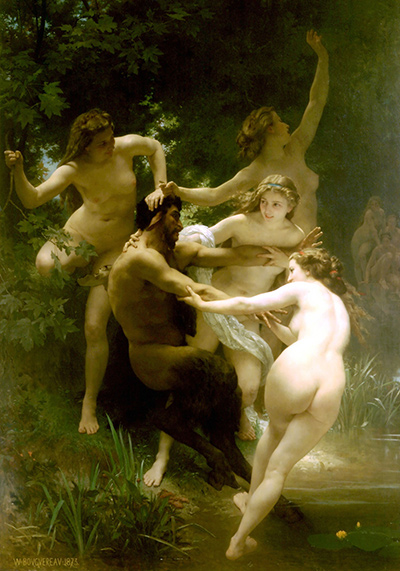
It also belongs beside pages such as Evening Mood, The Oreads, and Nymphs and Satyr. Those works show different versions of Bouguereau's ideal figure: allegorical, mythological, or dramatically grouped. Baigneuse is quieter, but the same artistic values are present. The body is carefully drawn; the surface is polished; the subject is arranged so that sensuality is filtered through academic finish. Bouguereau's critics later found this kind of beauty too controlled, but that control was central to his success. For many nineteenth-century viewers, it was proof of skill, seriousness, and refinement.
Ideal Figure Comparisons
The Dalí Foundation connection adds another layer to the work's modern history. Salvador Dalí's admiration for earlier technical virtuosity and for highly finished illusionistic painting makes Bouguereau's presence in that collection context especially interesting. The Foundation's public material confirms that this 1870 bather belongs within a collection environment shaped by Dalí's own interest in artistic mastery, tradition, and spectacle. That context helps explain why an academic nude by Bouguereau can speak not only to nineteenth-century Salon taste, but also to later debates about skill and modernity.
The painting should therefore be approached with both admiration and caution. Its surface may look effortlessly beautiful, but the image is the result of selection and control. It does not tell us about a named sitter, a specific bathing place, or a documented event. It presents a figure arranged according to Bouguereau's ideals of drawing, finish, and bodily grace. The point is not documentary truth. The point is the transformation of a familiar bather subject into an image of formal poise.
Why the Painting Matters
Baigneuse is valuable within Bouguereau's wider cluster because it shows the artist working at the scale of a single figure rather than a crowded mythological or religious scene. It clarifies how much of his art depends on the persuasive body: drawn with confidence, finished with care, and placed before the viewer as a complete visual argument. Whether one sees that achievement as beautiful, theatrical, conservative, or all three, the painting is a revealing example of Bouguereau's academic language. It shows how a simple bather could become a test of technique, taste, and the nineteenth-century ideal of perfected form.
Related Bouguereau Ideal Figure Pages
Frequently Asked Questions
Discussion
Baigneuse is a useful place to test how Bouguereau turns a single bather into an academic study of pose, surface and ideal form.
Use the prompts below to connect title discipline, the standing figure, the Dali Foundation route and Bouguereau's broader ideal-figure pages.
Reader Insights
How do the raised arms and upright pose organize the viewer's attention?
What changes when the local title Baigneuse is read beside the official title Banyista (Bather)?
How does this single figure compare with The Birth of Venus, Evening Mood or The Oreads?
Join the Conversation
Share your reading of Bouguereau's Baigneuse below.
References
- Fundacio Gala-Salvador Dali, Banyista (Bather), accessed 28 July 2026.
- Fundacio Gala-Salvador Dali, Online Collection, accessed 28 July 2026.
- Fundacio Gala-Salvador Dali, The Dalinian Triangle, accessed 28 July 2026.
- Wikimedia Commons, Baigneuse (Bouguereau, 1870), accessed 28 July 2026.
- Christie's, The Bather, lot 1682923, accessed 28 July 2026.
- TheHistoryOfArt.org, William-Adolphe Bouguereau Biography, accessed 28 July 2026.
- TheHistoryOfArt.org, William-Adolphe Bouguereau Paintings, accessed 28 July 2026.