


 by Tom Gurney
Tom Gurney BSc (Hons) is an art history expert with over 20 years experience
Page Created: / Page Updated:
Email: tomgurney1@gmail.com / Phone: +44 7429 011000
Vilhelm Hammershøi: Introduction
Vilhelm Hammershøi (1864–1916) made rooms, people and Copenhagen buildings seem unfamiliar through measured changes of viewpoint, light and colour. A white door is rarely just a boundary in his art: opened, shut or seen through another doorway, it can organise the whole picture. A solitary figure may anchor an interior without supplying a story. Walls that first appear grey reveal restrained passages of violet, green, brown and warm white. His paintings reward attention because their economy is active rather than empty.
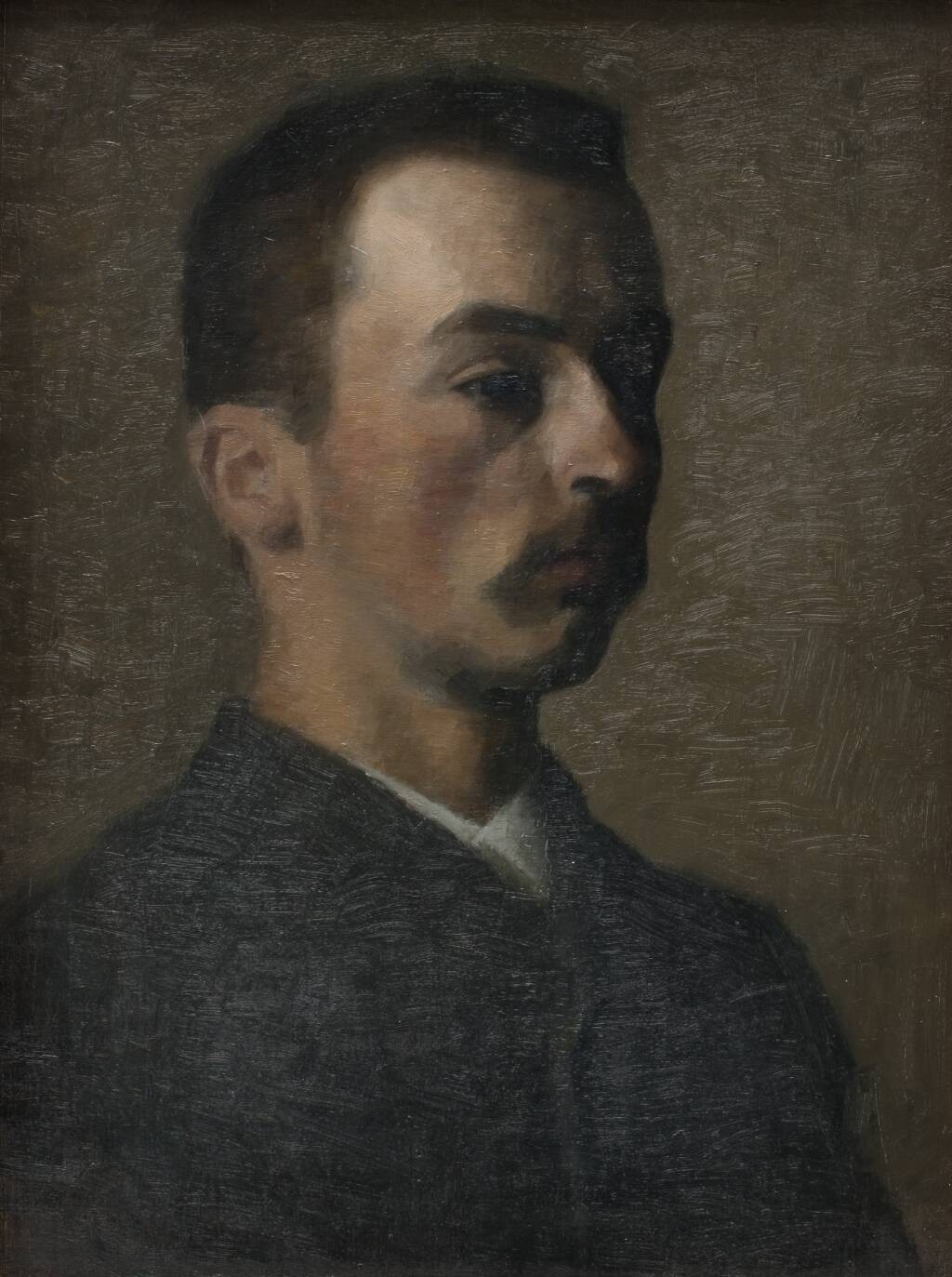
The 1890 Self-Portrait at SMK offers an apt introduction. Hammershøi turns his head across a tightly framed, dark-coated bust; one side of the face receives more light while the surrounding brown-grey field remains visibly brushed. The close format gives us the painter’s likeness, but not a simple key to the meaning of his later rooms.[9] His art is better approached through what can be seen and documented: recurring architectural structures, carefully staged furniture, subdued colour relationships and compositions repeatedly adjusted while he worked.
Born and based in Copenhagen, Hammershøi painted portraits, landscapes and architectural views as well as the interiors for which he is best known.[2][3] He does not fit neatly into a single label. His work developed amid late nineteenth-century Danish debates about academic authority, independent exhibition and international art, while retaining a highly individual concern with proportion, surface and tonal control. Explore his biography for the full chronology, or begin here with the subjects and working decisions that make his paintings distinctive.
At a Glance
- LifeBorn in Copenhagen in 1864; died there in 1916.
- TrainingRoyal Danish Academy of Fine Arts, 1879–84, with additional study under P. S. Krøyer from 1883.
- Principal subjectsDomestic interiors, portraits, landscapes and Copenhagen architecture.
- Recurring settingSeveral homes became studios and motifs, especially Strandgade 30 from 1898 to 1908.
- Frequent sitterHis wife, Ida Hammershøi, appears in portraits and many interior scenes.
- Current researchViHDA combines art history, conservation examination and scientific imaging across approximately 140 paintings.[4]
Vilhelm Hammershøi in context
Danish Golden Age legacy
c. 1830–1860European Realism
c. 1840–1900European Symbolism
c. 1880–1910James McNeill Whistler
1834–1903P. S. Krøyer
1851–1909Vilhelm Hammershøi
1864–1916Peter Ilsted
1861–1933Carl Holsøe
1863–1935Edvard Munch
1863–1944Contents
- Introduction
- Who Was Vilhelm Hammershøi?
- Training, Rejection and Independent Exhibition
- Copenhagen Rooms and Repeated Motifs
- Ida as Recurring Sitter
- Light, Colour and Technical Revision
- Six Essential Works
- Reputation, Research and Looking Slowly
Who Was Vilhelm Hammershøi?
Hammershøi was a Danish painter whose career extended from the 1880s to the First World War. Getty’s authority record preserves the preferred name “Hammershøi, Vilhelm”, alongside historical and transliterated variants; the spelling with ø is the form used here.[1] Institutional accounts agree on the broad outline of his practice: he trained in Copenhagen, exhibited from his early twenties and became especially associated with interiors, while continuing to paint portraits and landscapes.[2][3]
Those categories overlap more than they first appear to. A portrait can be as strongly structured by wall, table and doorframe as a room without a figure. An architectural painting can reduce a recognisable building to broad planes interrupted by windows. A domestic interior may turn a person away from the viewer, giving equal weight to the back of a head, the edge of a chair and the intervals between doors. The connecting concern is not a single mood but an exacting organisation of visible relationships.
Hammershøi also worked from more than one Copenhagen address. The Hirschsprung Collection records seven homes during his lifetime, each serving in different ways as residence, studio and subject.[2] Strandgade 30 in Christianshavn became the source of many celebrated interiors, but it should not absorb the rest of his career. Later paintings were made at Bredgade 25, and he eventually lived at Strandgade 25 beside the old Asiatic Company buildings.[12][14] The changing sites matter because doors, windows, wall panels and furniture were not transferable symbols: they belonged to particular rooms that the painter recomposed.
Training, Rejection and Independent Exhibition
Hammershøi entered the Royal Danish Academy of Fine Arts in 1879, aged fifteen, and studied there until 1884. From 1883 he also attended the Artists’ Independent Study Schools under P. S. Krøyer, adding plein-air work to his academic education.[2][3] His early formation was therefore neither a simple acceptance nor a total rejection of institutional teaching. Drawing, tonal modelling and controlled composition remained fundamental even when his pictures challenged prevailing expectations.
His 1885 exhibition debut was a portrait of his younger sister Anna. The painting failed to win the Academy’s Neuhausen Prize, provoking a written protest signed by forty-one artists. The Hirschsprung Collection connects that dispute to the wider challenge to the Charlottenborg jury system that culminated in the creation of Den Frie Exhibition in 1891.[2] The National Gallery also notes that Hammershøi’s works were rejected in 1888 and that he joined five other artists in forming an independent group two years later.[3]
This history helps explain his position without turning independence into isolation. He exhibited, travelled and encountered art beyond Denmark; the National Gallery identifies an early influence from James McNeill Whistler.[3] Yet his mature work cannot be reduced to one foreign model or movement. Academic discipline, Danish domestic and architectural subjects, and international tonal painting all inform it. The useful question is not whether he was “really” a Realist, Symbolist or modernist, but how each picture converts observed things into a deliberately controlled arrangement.
Copenhagen Rooms and Repeated Motifs
The most productive way to look at a Hammershøi interior is to identify its architecture before inventing a narrative. Where is the light entering? Which doors align, and which interrupt the view? How high is the horizon? What does a dark stove, table or dressed figure do against pale walls? These questions reveal how much variation he drew from apparently limited means.
At Strandgade 30, where Vilhelm and Ida lived from 1898 to 1908, Hammershøi painted around sixty-six interiors from different rooms and angles.[11] Furniture and people could be introduced, removed or shifted; a door might change from open to closed; daylight could turn an adjoining room into a bright rectangle. The apartment was not simply copied. The Hirschsprung Collection describes these scenes as carefully composed and staged, their strong geometry softened by subtly blurred handling.[2] A fuller guide to the address appears in Hammershøi’s Strandgade interiors.
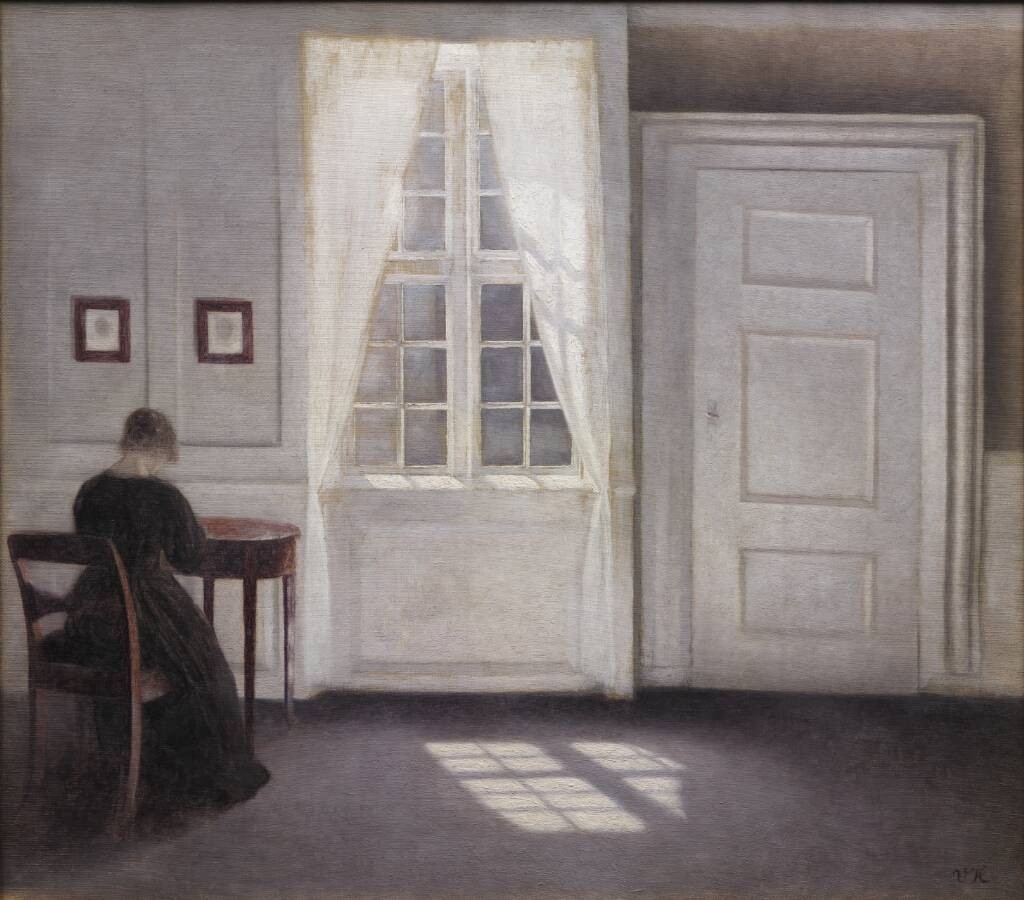
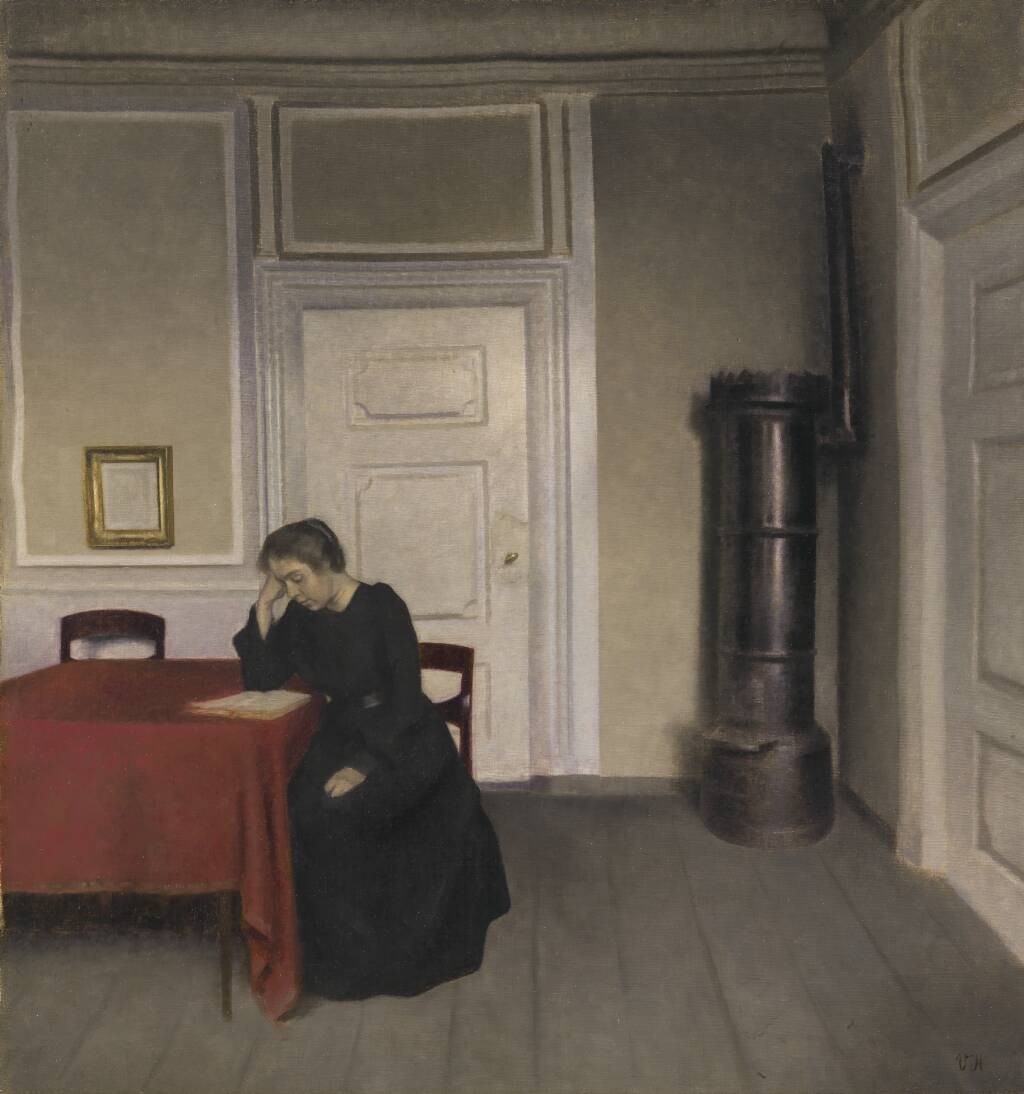
Two paintings show why exact titles and dates matter. In the 1901 sunlight interior at Strandgade 30, a window, a closed door and the angled patch of daylight construct a pale sequence across the room; technical examination suggests that the sunlit reflection was shifted slightly and reduced.[10] The 1902 A Room in the Artist’s Home in Strandgade is a different canvas: Ida sits reading at a table whose brown-red cloth operates as a conspicuous colour marker among the whitish rooms.[11] Similar setting does not mean interchangeable object.
His interest in built space also extended outdoors. Façades and gateways allowed him to work with rectangles, intervals and abrupt framing on a larger scale. The Copenhagen and architecture guide follows this aspect of his practice across addresses and city motifs.
Ida as Recurring Sitter
Ida Ilsted married Vilhelm Hammershøi in 1891 and became his most persistent model.[16] She appears facing the viewer in formal portraits and, in many interiors, turned away or absorbed in reading and household activity. Calling her merely an anonymous woman erases a known identity; treating every appearance as a psychological confession adds evidence the pictures do not provide. Her role as wife and sitter is documented, while her 1916 donation of the teacup portrait to SMK is one concrete part of her stewardship of Hammershøi’s legacy.[15]
In the 1902 Strandgade room, Ida’s bent arm and black dress concentrate the composition around the table without converting the scene into an illustrated plot.[11] In Ida Hammershøi with a Teacup, painted in 1907, she faces out from behind a white-covered table. ViHDA identifies the SMK canvas as the first version of a more finished portrait now at ARoS, while also recording a smaller study whose location is unknown.[15] These distinctions prevent three related works from being collapsed into one. Read more about Ida Hammershøi as sitter and guardian of the legacy.
Light, Colour and Technical Revision
Descriptions of Hammershøi as a painter of grey can obscure the precision of his colour. His interiors contain cool and warm whites, purplish floors, greenish or brown walls, black clothing and occasional concentrated accents. In the 1901 Strandgade interior, conservators recorded cobalt blue, cadmium yellow, lead and zinc whites, black and other materials within a surface that appears restrained at normal viewing distance.[10] Tonal limitation was achieved through selection and relation, not through the absence of pigment.
Nor does stillness mean that the paintings arrived fully resolved. The Vilhelm Hammershøi Digital Archive, or ViHDA, grew from a five-year SMK-led project begun in 2020. Specialists used close visual examination, infrared reflectography, X-radiography, elemental mapping and other analytical methods on approximately 140 paintings to investigate supports, ground layers, pigments, underdrawing and changes.[4][6][7] These methods reveal evidence beneath or within the visible surface; they do not disclose the artist’s private thoughts.
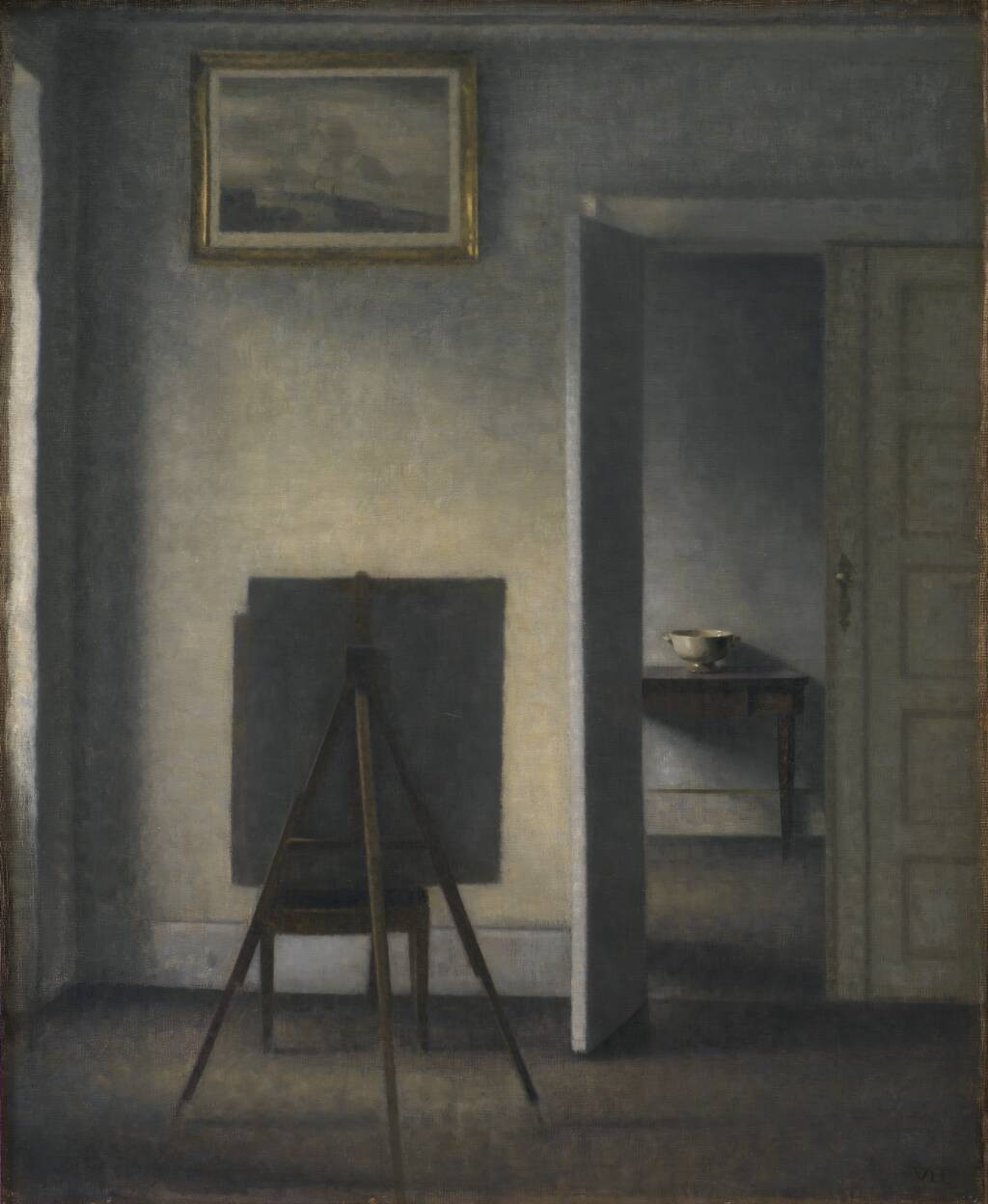
The findings repeatedly show adjustment. In Interior with the Artist’s Easel, the original plan placed the left-hand door and table farther towards the centre before Hammershøi moved them, while the easel may have entered late in the process.[12] In Interior. Artificial Light, he built the room largely from dark to light and added the foreground table after establishing other elements.[13] In the teacup portrait, changes to the neckline and hand remain detectable, and the shape of a sugar bowl can be discerned beneath the pale tablecloth.[15] The light, colour and technique guide explains how such observations refine close looking.
Six Essential Works
These six SMK paintings offer a compact route through Hammershøi’s interiors, portraiture and architecture. They are individual objects, not generic examples:
-
Interior in Strandgade, Sunlight on the Floor (1901). Window, closed door, curtain and floor reflection make light itself a geometric event. The thin, largely wet-in-wet paint and visible corrections complicate any impression of effortless simplicity.[10]
-
A Room in the Artist’s Home in Strandgade, Copenhagen, with the Artist’s Wife (1902). Ida reads at a table, and the muted red cloth punctuates the room. SMK records the canvas as 63.5 × 60 centimetres, while ViHDA gives 63.9 × 60 centimetres; both measurements belong to this same object.[11]
-
Interior with the Artist’s Easel (1910). Made during the Bredgade 25 period, it places the working apparatus of painting inside a rigorously ordered room. Related versions at the Getty and Lillehammer are separate canvases, not alternative titles for the SMK work.[12]
-
Interior. Artificial Light (1909). Two candles replace the directional daylight familiar from many Strandgade scenes. The birchwood sofa, tables and illuminated wall become a study in close-valued darks; Ida sold the painting in 1918, and SMK acquired it in 2012.[13]
-
The Buildings of the Asiatic Company, seen from St. Annæ Street, Copenhagen (1902). This large architectural canvas is an unfinished preliminary work for another picture. Exposed underpainting and drawn masts and yards preserve the planning stage; they must not be mistaken for a deliberately finished cityscape.[14]
-
Ida Hammershøi, the Artist’s Wife, with a Teacup (1907). Ida’s frontal presence and the table’s horizontal edge make this markedly different from the back-turned interior figures. She donated this first version to SMK in 1916.[15]
Together they demonstrate that restraint was not a recipe. Daylight and candlelight, an inhabited room and an incomplete façade, a face presented directly and a figure seen from behind each required a different pictorial solution. The broader guide to Hammershøi’s paintings places them among portraits, landscapes and other architectural subjects.
Reputation, Research and Looking Slowly
Hammershøi’s popular reputation often rests on words such as quiet, lonely or mysterious. They may describe a viewer’s response, but they should not be confused with established facts about the depicted people. The paintings offer firmer ground: repeated viewpoints, measured intervals, modest shifts in furniture, softened edges and unexpected colour within low-key harmonies.
ViHDA makes that ground unusually rich. Its present works listing contains 133 researched painting records, a platform census rather than a complete catalogue raisonné.[8] Faithful artwork reproductions are marked as public domain, while technical images carry a separate open licence requiring attribution and share-alike reuse.[5] The distinction matters because visible images, research data and historical interpretation answer different questions. Looking slowly means allowing them to work together without asking one kind of evidence to do the job of another.
Follow Vilhelm Hammershøi's career through four stages
Academy study, portrait training and an early challenge to official taste
Born in Copenhagen, Hammershøi entered the Royal Danish Academy of Fine Arts in 1879 and also studied with P. S. Krøyer. Early portraits and figure studies established the restrained tonal language that drew attention even when official juries rejected important works.
Independent display, marriage to Ida and encounters beyond Denmark
Exhibitions, rejection controversies and the independent context around Den Frie shaped Hammershøi's public position. He married Ida Ilsted in 1891, travelled with her and developed portraits, architecture, landscapes and rooms into closely related fields of experiment.
One apartment becomes a changing system of doors, walls, light and figures
At Strandgade 30, Hammershøi repeatedly rearranged a small set of rooms and furnishings. Daylight, open and closed doors, bare walls and Ida's recurring presence generated dozens of distinct interiors rather than records of an unchanging home.
Bredgade rooms, architectural motifs and a final period of revision
Later interiors at Bredgade and other Copenhagen subjects continued the serial method with altered scale, furniture and illumination. The artist worked until illness curtailed production; after his death in 1916, Ida helped preserve and transfer important works and records.
Essential works
Interior in Strandgade, Sunlight on the Floor
1901 · A seated figure, curtained window and angled floor light turn a modest room into a precise study of duration and geometry.
A Room in the Artist's Home in Strandgade
1902 · Ida, a red-covered table, a stove and aligned doorways make colour and domestic activity part of an exact spatial sequence.
Interior with the Artist's Easel
1910 · An easel, chair, bowl and doorway turn a Bredgade room into a revised image of painting within the home.
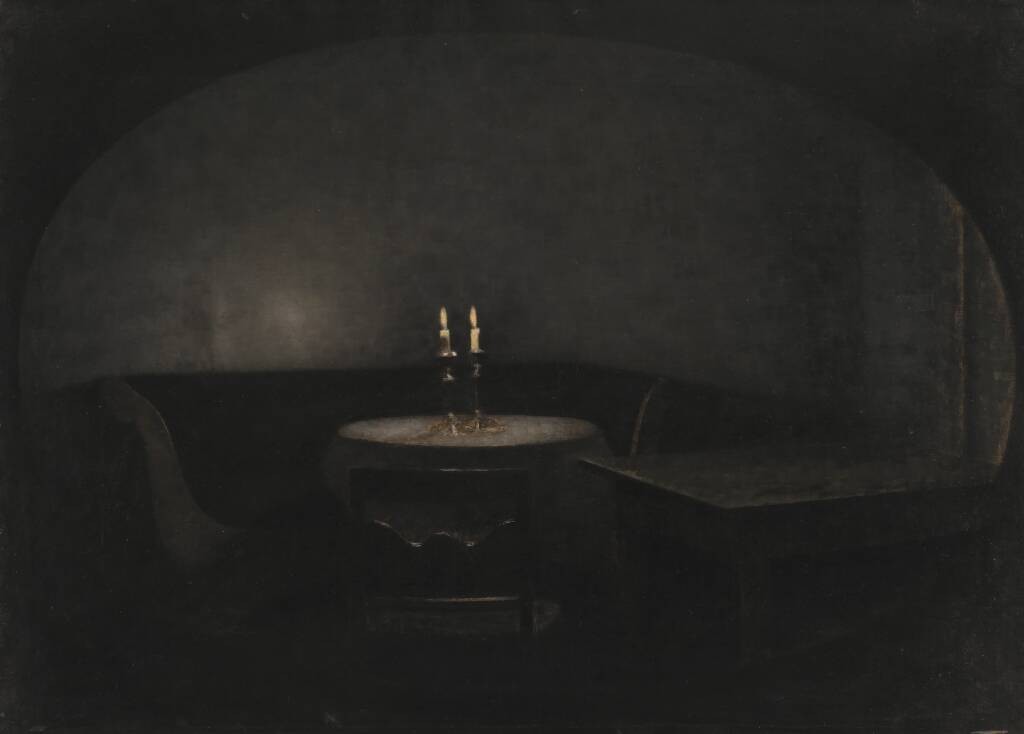
Interior. Artificial Light
1909 · Two candle flames articulate pale furniture and dark space, while a late-added foreground table changes the room's depth.
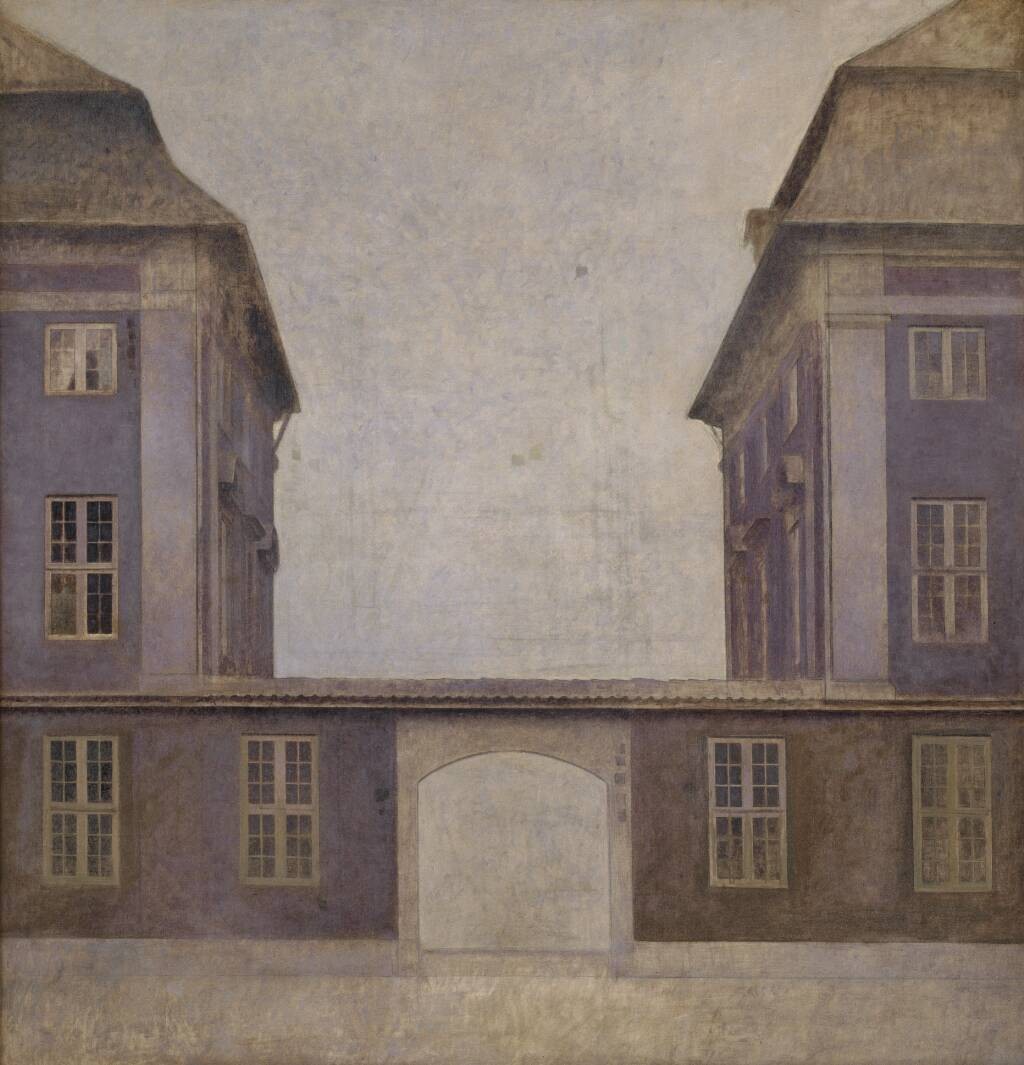
The Buildings of the Asiatic Company
1902 · Paired harbour buildings and an open central interval survive in a monumental preliminary painting whose omissions remain visible.
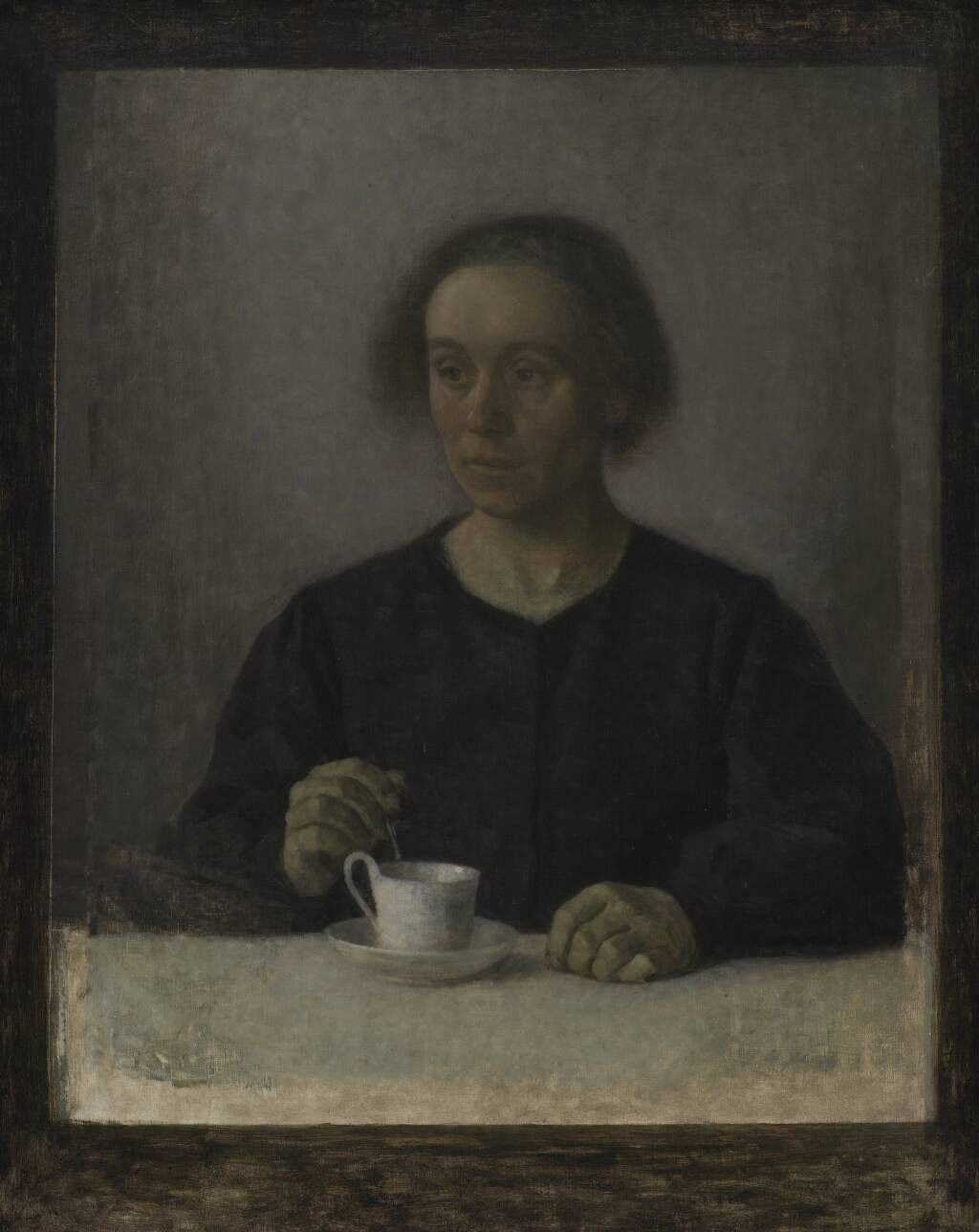
Ida Hammershøi with a Teacup
1907 · The first teacup portrait combines Ida's concentrated pose with a painted border and revisions beneath the finished surface.
Researched works directory
This directory covers the 133 paintings currently published by the Vilhelm Hammershøi Digital Archive (ViHDA). It is a researched platform census, not a complete catalogue raisonné of the artist's oeuvre.
| Name | Date | Medium |
|---|---|---|
| A Bakery Shop. Study | 1888 | Painting |
| A Greek Relief. Louvre | 1892 | Painting |
| Amalienborg Square | 1896 | Painting |
| An Ancient Relief. Study | 1878 – 1881 | Painting |
| An Old Woman | 1886 | Painting |
| An Old Woman Standing by a Window | 1885 – 1886 | Painting |
| Artemis | 1893 – 1894 | Painting |
| Bedroom | 1890 | Painting |
| Church of Christiansborg Palace, Copenhagen | 1910 | Painting |
| Church of Sankt Petri, Copenhagen | 1906 | Painting |
| Double Portrait. Vilhelm and Ida Hammershøi | 1892 | Painting |
| Evening in the Drawing Room. Strandgade 30 | 1904 | Painting |
| Evening in the Sitting Room. | 1904 | Painting |
| Evening Interior. Artificial Light. Ida and Frederikke Hammershøi | 1891 | Painting |
| Farm. Refsnæs | 1900 | Painting |
| Five Portraits. Study | 1901 | Painting |
| Frederiksborg Castle | 1893 | Painting |
| From Christianshavns Canal | 1905 | Painting |
| From Frederiksholms Kanal | 1893 | Painting |
| From Kvæsthusbroen | 1908 | Painting |
| From the British Museum. London, Winter | 1906 | Painting |
| From the Church Santo Stefano Rotondo in Rome | 1902 – 1903 | Painting |
| From The Greenlandic Trade Dock. Christianshavn | 1908 | Painting |
| From the Old Christiansborg Palace | 1907 | Painting |
| Hammershøi's palette | Uncertain/Unknown | Painting |
| Head of a Woman. Study for Artemis | 1893 | Painting |
| Houses. Arresødal near Frederiksværk | 1904 | Painting |
| Interior | 1898 | Painting |
| Interior in Louis Seize style. Rahbeks Allé | 1897 | Painting |
| Interior. 'The Four Rooms'. Strandgade 25 | 1914 | Painting |
| Interior. A Young Man Reading | 1898 | Painting |
| Interior. Artificial Light | 1909 | Painting |
| Interior. Attic Room with Table and Chair | 1883 – 1885 | Painting |
| Interior. Frederikke and Anna Hammershøi | 1884 | Painting |
| Interior. From The Great Hall of Lindegården | 1909 | Painting |
| Interior. Ida Hammershøi at a Sewing Table | Uncertain/Unknown | Painting |
| Interior. Living Room in Louis-Seize-Style. Rahbeks Allé 26 | 1893 – 1896 | Painting |
| Interior. Looking out on the Exterior. Strandgade 30 | 1905 | Painting |
| Interior. Strandgade 30 | 1901 | Painting |
| Interior. Strandgade 30 | 1902 | Painting |
| Interior. Strandgade 30 | 1905 | Painting |
| Interior. Study in Sunlight. Strandgade 30 | 1906 | Painting |
| Interior. Sunshine in the Drawing Room III | 1903 | Painting |
| Interior. The Music Room. Strandgade 30 | 1908 | Painting |
| Interior. The Old Stove. Albertinelyst | 1888 | Painting |
| Interior. The Tall Windows | 1913 | Painting |
| Interior. With Empire Sofa. Strandgade 30 | 1907 | Painting |
| Interior. With Four Etchings. Strandgade 30 | 1904 | Painting |
| Interior. With Table, Cupboard and Windsor Chair. Strandgade 25 | 1913 | Painting |
| Interior. With the Artist's Easel | 1910 | Painting |
| Interior. With the Artist's Easel. Bredgade 25 | 1912 | Painting |
| Interior. Woman knitting | 1889 | Painting |
| Interior. Woman Reading | 1910 | Painting |
| Interior. Woman Reading. Bredgade 25 | Uncertain/Unknown | Painting |
| Interior. Woman Sitting Behind a Table | 1910 | Painting |
| Interior. Woman Sweeping | 1899 | Painting |
| Job | 1887 | Painting |
| Job. Study | 1887 | Painting |
| Landscape. At Lyngby Lake | 1888 | Painting |
| Landscape. Early Spring | 1909 | Painting |
| Landscape. Gentofte | 1906 | Painting |
| Landscape. Grønsund, Falster | 1890 | Painting |
| Landscape. Gundsømagle near Roskilde | 1885 | Painting |
| Landscape. Gundsømagle near Roskilde | 1886 | Painting |
| Landscape. Kongevejen near Gentofte. Study | 1892 | Painting |
| Landscape. Near Fortunen | 1901 | Painting |
| Landscape. Near Lejre | 1905 | Painting |
| Landscape. Ryet near Farum Lake | 1896 – 1897 | Painting |
| Landscape. Summer. Near Lejre | 1905 | Painting |
| Landscape. Søndermarken Park in Winter | 1895 – 1896 | Painting |
| Landscape. The Rowan Avenue at Snekkersten | 1906 | Painting |
| Landscape. With a Farmhouse | 1878 – 1879 | Painting |
| Landscape. Young Forest, Trørød, Summer | 1907 | Painting |
| Morning Toilette. Study. Strandgade 25 | 1914 | Painting |
| Nude Female Model | 1884 | Painting |
| Nude Female Model | 1910 | Painting |
| Open Doors. Strandgade 30 | 1905 | Painting |
| Portrait of a Young Girl. Anna Hammershøi | 1885 | Painting |
| Portrait. Anna Hammershøi | 1883 | Painting |
| Portrait. Anna Hammershøi. Profile | Uncertain/Unknown | Painting |
| Portrait. Daniel Jacobson Salter | 1901 | Painting |
| Portrait. Elisabeth Dorothea Rentzmann | Uncertain/Unknown | Painting |
| Portrait. Elisabeth Wandel | 1890 | Painting |
| Portrait. Fini Henriques | Uncertain/Unknown | Painting |
| Portrait. Frederikke Hammershøi | Uncertain/Unknown | Painting |
| Portrait. Frederikke Hammershøi. Study | 1894 | Painting |
| Portrait. Henry Madsen. Study | 1904 | Painting |
| Portrait. Henry Madsen. Study | 1904 | Painting |
| Portrait. Ida Hammershøi | 1894 | Painting |
| Portrait. Ida Hammershøi with a Teacup | 1907 | Painting |
| Portrait. Ida Ilsted | 1890 | Painting |
| Portrait. Ida Ilsted. Study | 1890 | Painting |
| Portrait. Ida Ilsted. Study | 1890 | Painting |
| Portrait. J.F. Willumsen. Study for Five Portraits | 1901 | Painting |
| Portrait. J.F. Willumsen. Study for Five Portraits | 1901 – 1902 | Painting |
| Portrait. Karen Malm | 1914 | Painting |
| Portrait. Karl Madsen | 1890 | Painting |
| Portrait. Kristian Zahrtmann | 1889 | Painting |
| Portrait. Kristian Zahrtmann | 1889 | Painting |
| Portrait. Svend Hammershøi | 1881 | Painting |
| Portrait. Svend Hammershøi | 1892 | Painting |
| Portrait. Svend Hammershøi | 1903 – 1904 | Painting |
| Portrait. Svend Hammershøi. Study for Five Portraits | 1901 | Painting |
| Portrait. Thora Bendix, née Anne Victoria Sundberg | 1896 | Painting |
| Portrait. Thora Bendix. Study | 1896 | Painting |
| Portrait. Thorvald Bindesbøll. Study | 1904 | Painting |
| Portrait. Woman. Possibly Frederikke Juncker-Jensen | 1878 – 1881 | Painting |
| Portrait. Woman. Profile | 1888 | Painting |
| Seated Female Nude | 1889 | Painting |
| Self- Portrait | 1891 | Painting |
| Self-Portrait | 1890 | Painting |
| Self-Portrait | 1914 | Painting |
| Self-Portrait. Spurveskjul, Frederiksdal | 1911 | Painting |
| Self-Portrait. Spurveskjul, Frederiksdal | 1911 | Painting |
| Standing Female Model | 1909 – 1910 | Painting |
| Street in London. Montague Street at the British Museum | 1905 – 1906 | Painting |
| Study of a Model. A Woman seen from the Back | 1888 | Painting |
| Sunbeams or Sunshine. "Dust motes dancing in the sunbeams" | 1900 | Painting |
| The Buildings of the Asiatic Company, seen from St. Annæ Street | 1902 | Painting |
| The Cello Player. Henry Bramsen | 1893 | Painting |
| The Coin Collector. Strandgade 30 | 1904 | Painting |
| The Garden Room. Frederiksberg Allé | 1887 | Painting |
| The Tuesday Forest | 1893 | Painting |
| Three Sailing Boats. Christianshavns Canal | 1905 | Painting |
| Tree Trunks. Arresødal near Frederiksværk | 1904 | Painting |
| View of Christiansborg Palace. Late Autumn | 1890 – 1892 | Painting |
| View of Gentofte Lake . 'Sunshower' | 1903 | Painting |
| View of Gentofte Lake . 'Sunshower'. Study | 1903 | Painting |
| View of Jægersborg Allé. Study | 1892 | Painting |
| White Doors. Strandgade 30 | 1899 | Painting |
| Woman Knitting. Frederikke Hammershøi | 1889 | Painting |
| Young Beechwood. Arresødal near Frederiksværk | 1904 | Painting |
| Young Girl Sewing. Anna Hammershøi | 1887 | Painting |
Frequently Asked Questions
He is best known for sparsely furnished interiors, especially those painted at Strandgade 30 in Copenhagen. Many use open or closed doors, windows, dark furniture and a single figure to organise pale rooms. Portraits, landscapes and architectural views remain substantial parts of his work, so the interiors are central rather than exhaustive.[2][3]
English approximations vary because Danish ø has no exact English equivalent. The important written distinction is that Vilhelm Hammershøi is the preferred public form; “Hammershoi”, “Hammershoei” and other variants are useful for searching historical records, not replacements for his name.[1]
The rooms offered changing structures of light, doorway, wall and furniture. Some are unoccupied, while others include Ida or another sitter. Evidence shows that he staged and recomposed interiors across multiple Copenhagen homes; it does not establish that empty rooms were literal records of loneliness.[2]
Symbolist readings can illuminate the suggestive restraint of some paintings, but the label is not a complete classification. His work also engages observational painting, portraiture, landscape, architecture, academic training and independent exhibition. It is more accurate to state the evidence for a particular picture than to make one movement explain his entire career.
Discussion
Use this evidence-led guide as a starting point for close looking rather than a final verdict.
Share an observation about Vilhelm Hammershøi or a source that adds useful context.
Reader Insights
Which work most clearly turns an ordinary room, face or building into a newly measured pictorial structure?
Where do Copenhagen, Ida, training or exhibition history productively alter your reading?
Which source or surviving object would you investigate next?
Join the Conversation
Add your reading below, keeping observations specific and evidence clear.
References
- Getty Research Institute, “ULAN 500000827: Hammershøi, Vilhelm”, accessed 31 August 2026.
- The Hirschsprung Collection, “Vilhelm Hammershøi”, accessed 31 August 2026.
- The National Gallery, London, “Vilhelm Hammershøi (1864–1916)”, accessed 31 August 2026.
- SMK, Vilhelm Hammershøi Digital Archive, “About the Project”, accessed 31 August 2026.
- SMK, Vilhelm Hammershøi Digital Archive, “Use This Data”, accessed 31 August 2026.
- SMK, “ViHDA”, accessed 31 August 2026.
- SMK, “Groundbreaking New Research Sheds Light on Vilhelm Hammershøi’s Materials and Working Methods”, accessed 31 August 2026.
- SMK, Vilhelm Hammershøi Digital Archive, current researched works listing, accessed 31 August 2026.
- SMK Open, “KMS6692: Self-Portrait”, accessed 31 August 2026.
- SMK, Vilhelm Hammershøi Digital Archive, “Interior. Strandgade 30” (1901), survey 230, accessed 31 August 2026.
- SMK, Vilhelm Hammershøi Digital Archive, “Interior. Strandgade 30” (1902), survey 238, accessed 31 August 2026.
- SMK, Vilhelm Hammershøi Digital Archive, “Interior. With the Artist’s Easel”, survey 341, accessed 31 August 2026.
- SMK, Vilhelm Hammershøi Digital Archive, “Interior. Artificial Light”, survey 325, accessed 31 August 2026.
- SMK, Vilhelm Hammershøi Digital Archive, “The Buildings of the Asiatic Company, seen from St. Annæ Street”, survey 237, accessed 31 August 2026.
- SMK, Vilhelm Hammershøi Digital Archive, “Portrait. Ida Hammershøi with a Teacup”, survey 297, accessed 31 August 2026.
- SMK, Vilhelm Hammershøi Digital Archive, “Double Portrait, Vilhelm and Ida Hammershøi”, survey 104, accessed 31 August 2026.