



 by Tom Gurney
Tom Gurney BSc (Hons) is an art history expert with over 20 years experience
Published on June 19, 2020 / Updated on November 5, 2026
Email: tomgurney1@gmail.com / Phone: +44 7429 011000
Cookham
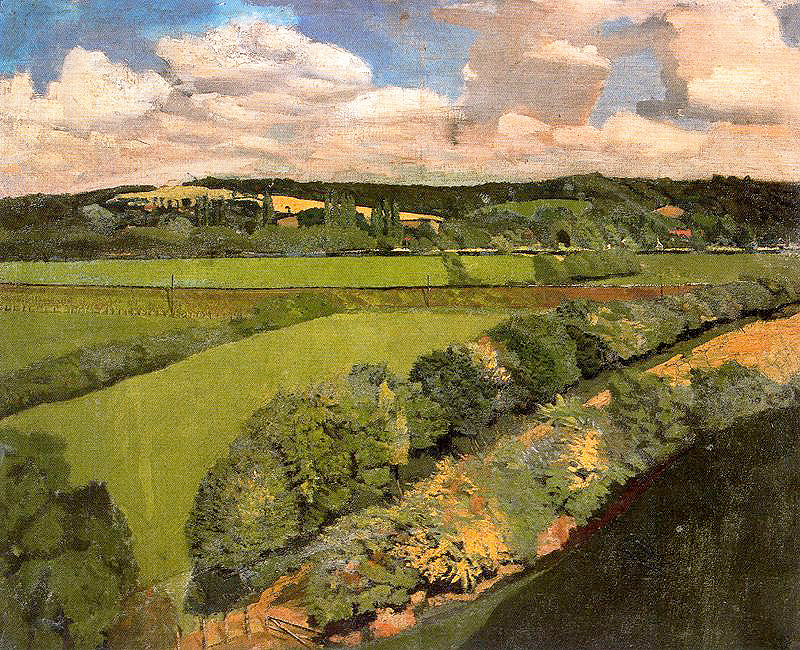
A gate sits almost at our feet, while a great bank of clouds rides above the distant fields. Between those two extremes, Stanley Spencer builds a landscape out of boundaries: hedges, field edges, a railway line and the dark ridge against the sky. The 1914 oil painting looks from Terry's Lane towards Winter Hill and Rowborough; Spencer painted it from nature, according to the Contemporary Art Society. [1]
At a Glance
Two ways of looking across Cookham
Contents
Looking across the fields
The foreground feels close enough to touch. A low gate, reddish earth and a tangle of plants occupy the bottom of the picture. From there a long, irregular hedge climbs towards the right edge. Its leaves catch yellow light in some places and sink into deep green shadow in others. Behind it lies a broad, comparatively smooth field. This contrast gives the eye two different kinds of pleasure: the immediate intricacy of growth beside the gate and the sweep of open ground beyond.
Spencer makes that hedge do more than divide one piece of land from another. It is the strongest diagonal in the painting, cutting across the lower half and setting its gentle movement against the almost horizontal strips farther away. Follow it upwards and the view seems to open; follow it down and you return to the gate. The composition offers a way into the countryside, then draws attention back to the threshold where looking begins.
The elevated position lets us see the field surfaces rather than merely their edges. Each plot has its own extent and shape. Some boundaries run straight across; others converge or bend, making the ground feel worked and divided without requiring a conspicuous human figure. The nearest green field widens towards us, creating a generous space between the tightly packed foreground planting and the distant settlement. It gives the painting room to breathe.
At the bottom right, a great dark wedge interrupts the illuminated vegetation. Its broad, relatively unbroken surface helps the smaller bright marks along the hedge stand out. Across the picture, Spencer repeatedly places complicated shapes beside simpler ones. The eye can linger over leaves and branches, then rest on a stretch of grass or shadow. That alternation keeps a busy landscape clear.
A railway in the countryside
Across the middle distance, a thin, straight line carries a different rhythm from the hedge. The Contemporary Art Society identifies the railway crossing the scene and the small red mark below the horizon as a signal. Its account also connects the railway with the area's development as a summer resort. [1] Once noticed, the signal changes the way we look at the far side of the field: this is countryside connected to movement and visitors.
The railway is easy to overlook because its scale is so modest. It occupies only a narrow band, while the sky and fields claim much larger areas. Yet its straightness matters. Where trees form uneven masses and bushes spill over boundaries, the line cuts firmly across the view. Spencer accommodates that structure within the landscape's pattern. It becomes one more horizontal, helping to establish the distance between our high foreground position and the houses beyond.
Small upright forms sharpen this distant zone. Slender trees rise in groups, and posts punctuate the field edges. Their vertical accents prevent the bands of land from becoming too even or passive. Roofs and pale patches interrupt the dark vegetation below the ridge. None needs to be large to register: after the open green of the central field, even a tiny warm mark attracts attention.
There is no need to imagine a train outside the frame, or to turn the view into a statement about industry, to appreciate this balance. The visible landscape already brings cultivated land, transport and settlement together. Its quietness comes from the way those elements are spaced. The railway belongs to the view as securely as the hedge, though each produces a different kind of line.
Clouds, colour and the raised viewpoint
The sky is far from empty. Cream and yellow clouds spread across blue, their darker undersides giving them considerable weight. Some stretch laterally; others build into taller masses. Their rounded forms answer the clumps of trees below, but on a much larger scale. The dark land at the horizon acts as a dividing strip, holding the luminous sky apart from the bright fields.
Look particularly at the relationship between the warm clouds and the yellow touches in the foreground. Colour links places that are separated by a long distance. The eye can move from a patch of illuminated foliage to a sunlit field on the far slope, then upwards into the clouds. Those scattered warm passages make the picture cohere without flattening its changing terrain into a single colour.
Green also varies considerably. The central grass is clear and open; the hedge is dense and mottled; the farther trees approach a dark band. These differences allow Spencer to distinguish surfaces and distances within a palette dominated by vegetation. He does not have to describe every blade of grass to make the field feel different from the shrubs beside it. The spacing and size of the marks help carry that distinction.
The Contemporary Art Society suggests a Pre-Raphaelite connection in the high viewpoint and brilliant colour. [1] This is a useful comparison when looking at the firm divisions and attentive treatment of near and distant things. It need not imply that the picture copies a particular earlier work. Its appeal lies in the sustained visibility of the whole prospect: the nearest gate remains interesting, but so do the trees and sunlit patches close to the horizon.
The raised view also limits how completely we can enter the scene. We look down across its boundaries rather than walking along a clearly continuous road. The gate offers a familiar point of contact, but the landscape beyond unfolds as a pattern to be explored by sight. That combination of physical closeness and visual breadth is one of the painting's most engaging effects.
Familiar ground early in a career
Cookham was already central to Spencer's identity before he painted this view. The Stanley Spencer Gallery records his arrival at the Slade School of Fine Art in 1908, his teaching under Henry Tonks and his inclusion in Roger Fry's Second Post-Impressionist Exhibition in 1912. His attachment to his home village, together with his habit of returning there after classes, earned him the nickname “Cookham”. [2] The title of this landscape names both a subject and a place with which his fellow students associated him.
The connection was practical as well as affectionate. According to the Contemporary Art Society's account of Gilbert Spencer's recollections, the brothers often walked along Terry's Lane and to the railway bridge in childhood. [1] Familiarity provides a valuable context for the specificity of the view. The gate, field boundaries and distant buildings belong to a landscape encountered repeatedly, rather than a collection of interchangeable rural motifs.
Spencer's biography can make it tempting to read every Cookham scene as a religious vision. Here, looking closely offers a firmer starting point. The painting's activity lies in the arrangement of land, vegetation, buildings and clouds. Its interest survives without assigning a spiritual identity to the hedge or inventing a symbolic meaning for the railway. The intensity is already visible in the attention given to ordinary things.
A later garden view
A useful comparison is Garden View, Cookham Dene of 1938, reproduced and discussed by Mary Kisler in the museum catalogue Everyday Miracles. Kisler draws attention to its precisely observed plants and the opening through the trees towards the landscape beyond. [3] In that later painting, vegetation surrounds the view much more closely: a large tree fills the right side, while clipped hedges, paths and a flower border structure the foreground.
Placed beside it, Cookham feels notably expansive. The earlier picture gives a large area to open fields and sky; the later garden makes distance something glimpsed through enclosing growth. Both invite us to move our attention between nearby plants and a farther prospect. The comparison reveals continuity in Spencer's interest in looking across boundaries, even as he changes the balance between enclosure and openness.
Justin Paton, writing in the same catalogue, challenges a rigid division between Spencer's observed landscapes and his imaginative figure paintings. [3] For this early view, that broader argument is best approached through the painting itself. The landscape is carefully observed, yet observation involves choices: a high position, an emphatic hedge, an expansive sky, and small bright interruptions of distant darkness. Spencer gives familiar ground a distinctive shape in paint.
From a private collection to Carlisle
Sir Edward Marsh bought Cookham in 1914, bequeathing it to the Contemporary Art Society in 1953. The society presented it to Tullie House Museum & Art Gallery, Carlisle, in 1954, accession 1954.102.2. [1] That sequence places the painting's first recorded purchase in the year of its making and explains its later home in a public collection far from Berkshire.
Its title remains disarmingly simple. Yet Spencer gives this particular stretch of Cookham the density of an individual encounter: rough ground at the gate, a hedge brightened by light, fields carrying the eye outwards, and clouds that seem almost as substantial as the land. The more slowly we look, the less this countryside feels like background. Its divisions, textures and distances become the subject.
Artworks directory
Selected landscapes and shipbuilding works documented in the cited museum records and catalogues. Burners is one painting made from three canvases; the Plumbers study is a separate drawing. A dash means that no individual object date is supplied here. Additional Tate entries retain the museum’s unmaintained October 2014 catalogue snapshot. This selection is not a complete catalogue. [4]
| Name | Date | Medium |
|---|---|---|
| Cookham (Tullie) | 1914 | Painting |
| Garden View, Cookham Dene | 1938 | Painting |
| Shipbuilding on the Clyde: The Furnaces | 1946 | Painting |
| Shipbuilding on the Clyde: Burners (three canvases) | 1940 | Painting |
| Plumbers (study) | about 1944 | Drawing |
| Shipbuilding on the Clyde: Plumbers | 1944–45 | Painting |
| Shipbuilding on the Clyde: Welders | — | Painting |
| Shipbuilding on the Clyde: Riveters | — | Painting |
| Shipbuilding on the Clyde: Riggers | — | Painting |
| Shipbuilding on the Clyde: The Template | — | Painting |
| Shipbuilding on the Clyde: Bending the Keel Plate | — | Painting |
| Christ Carrying the Cross (Tate N04117) | 1920 | Painting |
| The Resurrection, Cookham (Tate N04239) | 1924–7 | Painting |
| Camouflaged Grenadier. Verso: Two Composition Studies for Burghclere Chapel (Tate N04245) | 1922–3 | Drawing |
| Terry’s Lane, Cookham (Tate N04678) | c.1932 | Painting |
| Turkeys (Tate N04800) | 1925 | Painting |
| The Robing of Christ (Tate N04925) | 1922 | Painting |
| The Disrobing of Christ (Tate N04926) | 1922 | Painting |
| Rickett’s Farm, Cookham Dene (Tate N04942) | 1938 | Painting |
| Daphne (Tate N05148) | 1940 | Painting |
| The Sword of the Lord and of Gideon (Tate N05321) | 1921 | Painting |
| The Bridge (Tate N05393) | 1920 | Painting |
| The Roundabout (Tate N05556) | 1923 | Painting |
| P.J. Spencer (Tate N05607) | c.1932 | Drawing |
| ‘Man Goeth to his Long Home’ (Tate N05608) | 1911 | Drawing |
| Apple Gatherers (Tate N05663) | 1912–3 | Painting |
| Mr Joe Buchanan, Charge Hand Blacksmith (Tate N05732) | 1943–4 | Drawing |
| William McBrearty, Sawyer (Tate N05733) | 1943–4 | Drawing |
| Study for ‘The Bridge’ and other works (Tate N05775) | 1912–20 | Drawing |
| The Resurrection: Port Glasgow (Tate N05961) | 1947–50 | Painting |
| Tree and Chicken Coops, Wangford (Tate N06150) | 1925 | Painting |
| Self-Portrait (Tate N06188) | 1914 | Painting |
| Study for ‘Apple Gatherers’ (Tate N06233) | c.1912 | Drawing |
| Retrieving a Ball (Tate P11032) | 1954 | |
| Study for ‘Joachim among the Shepherds’ (Tate T00048) | 1912 | Drawing |
| Dinner on the Hotel Lawn (Tate T00141) | 1956–7 | Painting |
| The Centurion’s Servant (Tate T00359) | 1914 | Painting |
| Swan Upping at Cookham (Tate T00525) | 1915–9 | Painting |
| Mending Cowls, Cookham (Tate T00530) | 1915 | Painting |
| St Francis and the Birds (Tate T00961) | 1935 | Painting |
| Turk’s Boatyard Cookham (Tate T01207) | c.1931 | Painting |
| Jacob and Esau (Tate T01769) | 1910–1 | Drawing |
| Double Nude Portrait: The Artist and his Second Wife (Tate T01863) | 1937 | Painting |
| Early Sketch for ‘Resurrection: Rejoicing’ (Tate T03035) | date not known | Drawing |
| Drawing for the Left Panel of ‘Resurrection: Rejoicing’ (Tate T03036) | date not known | Drawing |
| Drawing for Centre Panel of ‘Resurrection: Rejoicing’ (Tate T03037) | date not known | Drawing |
| Drawing for Right Panel of ‘Resurrection: Rejoicing’ (Tate T03038) | 1944 | Drawing |
| Drawing for the Right Hand Section of ‘Resurrection: Port Glasgow’ (Tate T03039) | date not known | Drawing |
| Drawing for Left Section of ‘Resurrection: Port Glasgow’ (Tate T03040) | date not known | Drawing |
| Drawing for Centre Section of ‘Resurrection: Port Glasgow’ (Tate T03041) | date not known | Drawing |
| Drawing for Right Section of ‘Resurrection: Port Glasgow’ (Tate T03042) | date not known | Drawing |
| Drawing for Left Panel of ‘Resurrection: Waking Up’ (Tate T03043) | 1944 | Drawing |
| Drawing for Right Panel of ‘Resurrection: Waking Up’ (Tate T03044) | date not known | Drawing |
| Drawing for Left Panel of ‘Resurrection: Reunion’ (Tate T03045) | 1945 | Drawing |
| Drawing for Centre Panel of ‘Resurrection: Reunion’ (Tate T03046) | date not known | Drawing |
| Drawing for Right Panel of ‘Resurrection: Reunion’ (Tate T03047) | 1944 | Drawing |
| Drawing for Left Panel of ‘Resurrection: Tidying’ (Tate T03048) | 1944 | Drawing |
| Drawing for Right Panel of ‘Resurrection: Tidying’ (Tate T03049) | 1944 | Drawing |
| Mother and Children (Tate T03050) | date not known | Drawing |
| Figures on Either Side of a Window (Tate T03061) | date not known | Drawing |
| Trumpet Player with Other Figures (Tate T03062) | date not known | Drawing |
| Self-Portrait (Tate T03335) | 1959 | Painting |
| Study for ‘Christ Carrying the Cross’ (Tate T03336) | 1920 | Drawing |
| Portrait of Louis Behrend (Tate T03337) | date not known | Drawing |
| Study for Double Nude Portrait: the Artist and his Second Wife (Tate T05525) | c.1937 | Drawing |
| Study for the Resurrection of Soldiers: Burghclere Chapel (Tate T05526) | 1927–8 | Drawing |
| Study for Double Nude Portrait: the Artist and his Second Wife (Tate T05527) | c.1937 | Drawing |
| Farm Pond, Leonard Stanley (Tate T05762) | 1940 | Painting |
| Zacharias and Elizabeth (Tate T07486) | 1913–4 | Drawing |
| Woman Feeding a Calf (Tate T07794) | date not known | Drawing |
| The New Shawl (Tate T07795) | date not known | Drawing |
| Kissing Patricia’s Hand (Tate T11919) | c.1936–8 | Drawing |
| Self-Portrait (Tate T11974) | 1913 | Drawing |
| The Woolshop (Tate T12548) | 1939 | Painting |
Frequently Asked Questions
In 1914, in oil on canvas. [1]
Tullie House Museum & Art Gallery, Carlisle, accession 1954.102.2. [1]
Discussion
Follow the hedge from the close gate to the open fields, then look for the small railway signal near the horizon.
Reader Insights
Which boundary first leads you into the view?
How do the clouds answer the forms of the land?
What changes when you notice the railway?
Join the Conversation
Share a detail, comparison or question about Cookham below.
References
- Contemporary Art Society, Cookham (1914): collection record, interpretation, provenance and reproduction, Stanley Spencer, Tullie House Museum & Art Gallery, accession 1954.102.2. Accessed 28 October 2026. View source.Splash image: Cookham, 1914. The early landscape now at Tullie House Museum & Art Gallery, Carlisle.
- Stanley Spencer Gallery, Stanley Spencer: the artist — A short biography, opening biography and pre-war career. Accessed 28 October 2026. View source.
- Mary Kisler and Justin Paton, Everyday Miracles: The Art of Stanley Spencer, Dunedin Public Art Gallery and Auckland Art Gallery Toi o Tāmaki, 2003, ISBN 0-908910-33-9. Justin Paton's discussion of landscape and imaginative painting, printed p. 12 (PDF p. 14); Mary Kisler, Garden View, Cookham Dene, printed pp. 38–39 (PDF pp. 40–41). View source.
- Tate, Tate Collection metadata, artwork_data.csv, October 2014 snapshot, released under CC0. Repository readme states that this dataset is no longer maintained. Downloaded and artist rows inspected 28 October 2026. View source.


