


 by Tom Gurney
Tom Gurney BSc (Hons) is an art history expert with over 20 years experience
Published on June 19, 2020 / Updated on August 9, 2026
Email: tomgurney1@gmail.com / Phone: +44 7429 011000
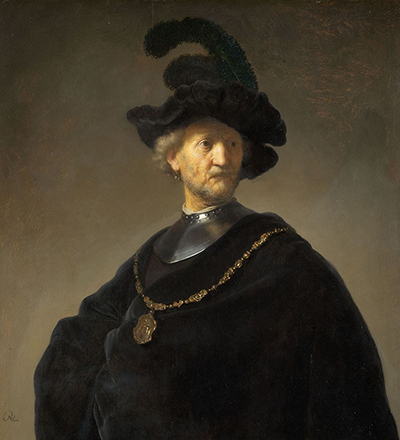
The Art Institute of Chicago holds this early Rembrandt character study from around 1631
This elderly man holds a display of subtle wealth in this portrait which is highly typical of his work during the 1640s. The facial features of the aging offered Rembrandt an opportunity to display his stunning technical skills with regards lighting and also a supreme realism relatively unseen previously.
His model, whom he used on several occasions, is dressed with a gold chain, steel gorget and plumed beret which was ideal for quickly putting together a feeling of wealth, without complex dresses or adornments as seen in some of his other portraits.
The artwork itself is large, considering the half-length portraits that it depicts, it can be considered around life-size. The model's hands are carefully tidied away under sleeves which are designed to blend with the torso. A small amount of light allows us to pick out the stomach line, but all attention is meant to be on his face and reflective adornmnents.
The Art Institute of Chicago contains significant work by other famous artists including Edward Hopper's Nighthawks, Grant Wood's American Gothic, Mary Cassatt's The Child's Bath plus other contributions by Henri Matisse, Claude Monet, Gustave Caillebotte and Pierre-Auguste Renoir to name just a few. It ranks as amongst the most important art institutions within the state.
Object Notes and Research Context
The Art Institute of Chicago identifies the painting as an oil on panel dated 1631 and records the monogram at lower left as RHL. That date matters because it places the work at the turning point between Rembrandt's Leiden formation and his Amsterdam ambitions. It is not a conventional named portrait in the later civic sense, but a character study in which costume, light and physiognomy help the artist demonstrate what he could do with a single figure.
The gold chain, steel gorget and plumed beret are therefore not just decorative props. They move the sitter towards the world of historical or military distinction, while the weathered face remains intensely observed. Recent technical and provenance scholarship has also drawn attention to a highly exacting copy after the Art Institute panel, probably made in Rembrandt's workshop in the early 1630s. That workshop relationship is useful for readers because it shows how a striking head could become a model for repetition, learning and display.
The sitter should not be identified too confidently. Older tradition connected similar heads with Rembrandt's father, but the stronger modern reading is that the man was a recurring model from the artist's early circle rather than a securely named family member.
The Art Institute record also helps clarify why costume matters in this picture. Rembrandt was not painting a modern military commander in contemporary dress; he was using studio armour, an orientalising cap and a heavy chain to create a figure who could stand near ancient history, civic honour or soldierly memory without becoming a named historical portrait. That flexibility is typical of his early tronies and character heads, where costume allowed the painter to study age, light and role at the same time.
The Cambridge/Hamilton Kerr discussion of the exact copy is worth mentioning because it opens the workshop question without weakening the Chicago panel itself. If a follower or pupil could repeat the image so closely, the painting must have had practical value inside the studio: it could teach handling, provide a saleable variant, or preserve a successful invention. That makes this page useful for the broader workshop-and-attribution route.
The image can be compared carefully with traditions around Rembrandt's father and early self-portraits. Similar elderly heads have often attracted family identifications, but the stronger value lies in Rembrandt's use of aged models for expression, costume and light. That caution keeps the interpretation useful without overstating biography.
Further Rembrandt Context
This shorter legacy page remains part of the Rembrandt archive. For fuller context, use the refreshed Rembrandt pages below, which explain the artist's biography, media, technique, attribution issues and major works in greater depth.
For secure object data, attribution and collection history, compare Old Man with a Gold Chain with the relevant museum or catalogue record before treating older page text as final.
 Rembrandt.jpg)
Discussion
What feels most useful when looking at Old Man with a Gold Chain: the subject, the handling of light, the medium, the attribution history, or its place within Rembrandt's wider painting output?
Reader Insights
Set this page beside the refreshed Rembrandt hubs before relying on older summaries alone.
Rembrandt pages often need museum records, catalogue history and attribution caution, especially where older sources use broader labels.
Which detail would you most want clarified next: date, medium, collection, attribution, subject, condition or comparison with another Rembrandt work?
Join the Conversation
Have a thought or observation about Old Man with a Gold Chain? Share it below. Thoughtful responses may be added as the Rembrandt archive continues to be reviewed.