

 by Tom Gurney
Tom Gurney BSc (Hons) is an art history expert with over 20 years experience
Published on June 19, 2020 / Updated on August 21, 2026
Email: tomgurney1@gmail.com / Phone: +44 7429 011000
Raphael's Theological Virtues belongs to a wall about justice, but its principal figures do not behave like judges. Fortitude rests beside a lion and an oak; Prudence studies herself with the aid of a mirror; Temperance controls a bridle. Around them, winged children bring the theological virtues of Faith, Hope and Charity into the same luminous field. Moral life becomes a sequence of bodies, glances and objects before it becomes law.[1]
The fresco occupies the lunette above a window in the Stanza della Segnatura, the former library and private office of Pope Julius II. Below it, two smaller historical scenes represent the delivery of civil and canon law. The arrangement is essential: virtue presides over legal authority. Raphael joins habits of character, gifts directed toward God, and institutions that order society without reducing any one of them to the others.[1][2]
At a Glance
- ArtistRaphael and workshop
- Common titleTheological Virtues; also discussed as the Cardinal and Theological Virtues
- Dateabout 1511
- LocationStanza della Segnatura, Vatican Palace, Vatican City
- Positionlunette above the window on the wall corresponding to Justice
- Monumental female figuresFortitude, Prudence and Temperance
- Accompanying theological virtuesFaith, Hope and Charity
- Legal scenes belowdelivery of the Pandects to Justinian and delivery of the Decretals to Gregory IX
- PatronPope Julius II
- Mediumfresco
Contents
- The wall of Justice
- Cardinal and theological virtue
- Fortitude: strength under direction
- Prudence: knowledge turned inward and outward
- Temperance: the art of measure
- Faith, Hope and Charity in motion
- The laws below
- Julius II and the moral image of patronage
- Bodies that think
- Fresco, design and workshop
The wall of Justice
The Vatican Museums call the complete wall Cardinal and Theological Virtues and the Law. It stands opposite Parnassus and corresponds to Justice within the room's programme. The lunette contains the six virtues; beneath it, at either side of the window, are the legal episodes.[1] What is often treated as one independent image is therefore the upper register of a carefully stratified wall.
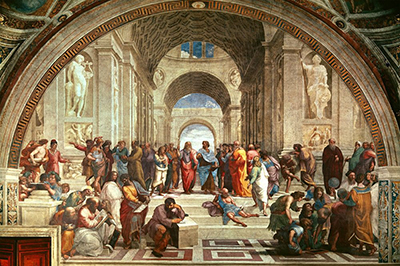
The Stanza's larger scheme places two forms of Truth on facing walls: supernatural revelation in the Disputation over the Most Holy Sacrament and rational inquiry in the School of Athens. Beauty appears in Parnassus, while Good belongs to this conjunction of virtue and law. On the ceiling, personifications of Theology, Philosophy, Poetry and Justice correspond to the subjects below.[2][3][13] The Justice wall must perform a particularly complex task because it joins universal qualities to named historical events.
Raphael solves that task through scale. The virtues above the window are monumental, inhabiting a shallow zone close to the viewer's world. The law scenes below are smaller and more crowded, like episodes from history. The upper figures do not illustrate a single moment. They endure, while the ceremonies beneath show principles entering civic and ecclesiastical institutions.
This vertical order does not imply that law is unimportant. On the contrary, it gives legal action a moral horizon. The delivery of texts can create public order only when judgement is supported by strength, foresight and self-command and directed by faith, hope and love. The fresco makes this argument without a written proposition. The viewer reads it by moving between upper and lower fields.
Cardinal and theological virtue
The title brings together two traditional groups. The cardinal virtues are Fortitude, Prudence, Temperance and Justice. “Cardinal” derives from the idea of a hinge: these are pivotal habits around which ethical life turns. In Raphael's wall, Justice presides as the larger faculty identified in the room and on its ceiling, while Fortitude, Prudence and Temperance appear in the lunette.[2][17]
The theological virtues are Faith, Hope and Charity. Christian teaching distinguishes them because their source and end are God rather than only the regulation of conduct through human reason. Raphael does not isolate the two sets in separate diagrams. The smaller winged figures associated with Faith, Hope and Charity move among the monumental cardinal virtues, creating a network of physical and spiritual relation.[1]
That difference in scale is not a measure of importance. The children are mobile agents. They lean, reach, point and carry attributes. Their actions animate the seated women and prevent the lunette from looking like a static catalogue. Theological virtue appears as energy entering moral life.
Justice itself is both present and absent. No fourth monumental woman labelled Justice sits beside the other three in the lunette because Justice governs the entire wall and has its ceiling correspondence. Its operation is visible below in the paired traditions of civil and canon law.[1][2] The missing fourth member therefore helps create the wall's structure.
Fortitude: strength under direction
Fortitude occupies the left portion of the lunette. Her robust body and emphatic presence make strength immediately visible, yet Raphael avoids showing violence. A lion, long associated with courage, appears near her. The oak branch provides another language of durability and also carries a patronal resonance: the rovere, or oak, was the emblematic tree of Julius II's Della Rovere family.[1][4]
The combination changes the meaning of power. Lion and oak suggest force, endurance and rootedness, but Fortitude sits within a moral ensemble. Strength is valuable when governed, not when released as appetite. Her position near figures identified with charity further turns physical capacity toward protective and generous ends.
The oak can be read at more than one level. It belongs naturally to the virtue's imagery as a sign of firmness, while its leaves and acorns could also acknowledge the pope who commissioned the room. Raphael repeatedly made heraldic and political signs function within a subject rather than sit on top of it. Here patronage enters the ethics of the wall through a living emblem.
The figure's scale matters when seen from below. Seated high over the window, Fortitude must remain legible across a furnished room. Raphael gives her an expansive silhouette and attributes that can be grasped at distance. Close viewing reveals the softer exchanges with adjacent children; distance restores the monumental sign.
Prudence: knowledge turned inward and outward
Prudence occupies the central position. Traditionally, Prudence is more than caution. It is practical wisdom: the capacity to judge circumstances, remember experience, foresee consequences and choose fitting means. Mirror imagery often belongs to her because self-knowledge is a condition of sound judgement.[4][7]
Raphael makes seeing central to the figure. The mirror introduces a doubled gaze, and traditional readings of Prudence's imagery stress the relation between self-examination and foresight. She does not stare outward with the fixed confidence of an emblem. Her identity unfolds through an act of looking.
This inward turn is appropriate to the centre of the Justice wall. Law cannot anticipate every circumstance through rules alone. Judgement requires reflection and attention to particulars. By placing Prudence between Fortitude and Temperance, Raphael suggests that courage and restraint both depend on intelligent discrimination.
The central figure also stabilises the lunette's curved field. Bodies and putti move on either side, but Prudence provides a vertical and psychological anchor. The window below opens a real void in the wall; above it, the measured concentration of Prudence holds the composition together.
Printed and drawn versions of the virtues helped later audiences isolate such attributes from the architectural ensemble.[5][6][7] Those records are valuable evidence of reception, yet they can make the work seem like three detachable allegories. In the room, Prudence's mirror participates in a chain of glances and gestures spanning the lunette.
Temperance: the art of measure
Temperance occupies the right. Her bridle is an especially concise attribute. A bridle does not destroy the strength of a horse; it directs it. Temperance likewise regulates desire, anger and impulse through measure. The image complements Fortitude: one virtue supplies the capacity to act, the other prevents capacity from becoming excess.[4][5]
Raphael turns restraint into graceful action rather than denial. Temperance's body is substantial, her drapery ample and her setting generous. Nothing about her looks diminished. Self-command is represented as poise—the ability to hold opposing energies in a productive balance.
That balance extends across the wall. A judicial order requires enforcement, but also limits; conviction, but also proportion. Temperance's bridle therefore speaks to the legal ceremonies beneath even without pointing directly toward them. Civil and canon law both claim to guide conduct, not merely punish it after the fact.
The position on the outer side of the lunette helps complete a rhythmic arc. Fortitude's mass, Prudence's concentrated centre and Temperance's controlled movement differ in character, while their seated forms share a common scale. Raphael designs an ethical triad through bodily variety.
Faith, Hope and Charity in motion
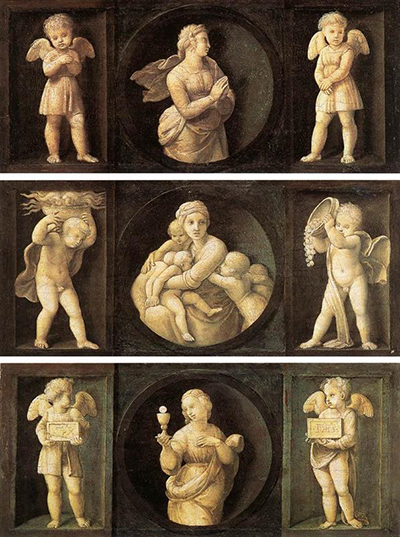
The Vatican record securely names Faith, Hope and Charity among the figures in the lunette, but short institutional descriptions do not always assign every putto and attribute in detail.[1] Traditional readings connect the winged children and the objects they carry with the three theological virtues. The important visual fact is that these virtues are not enthroned as three additional monumental women. They circulate.
Faith concerns trust in and assent to divine truth. Hope directs desire toward promised fulfilment. Charity, or love, orders the relation to God and neighbour. In the fresco, their smaller embodiments create contact: they approach the seated figures, occupy intervals and convert the large allegories into an active community.
This treatment has theological as well as compositional force. Fortitude, Prudence and Temperance can be understood within classical ethical traditions, but Raphael places them inside a Christian programme. Faith, Hope and Charity do not erase natural virtue; they accompany and redirect it. The room's celebrated dialogue between antiquity and Christianity is therefore present even on a wall without ancient philosophers.
The children's wings remove the action from ordinary history, while their youthful bodies convey potential and immediacy. They are serious without becoming solemn adults in miniature. Their play-like movement softens the authority of the seated women and creates emotional access to a dense doctrinal subject.
Later engravings and reproductions often clarify, rearrange or label allegorical attributes for new audiences.[5][6] Such afterlives show how readily Raphael's inventions could move from a papal room into print culture. They also remind viewers to distinguish the original fresco's relational language from the simplified identities a reproductive image may impose.
The laws below
To the lower left, the Delivery of the Pandects to the Emperor Justinian represents civil law. The Pandects, or Digest, formed a central part of the Justinianic compilation of Roman law. To the lower right, the Delivery of the Decretals to Pope Gregory IX represents canon law, the legal tradition of the Church.[1][8][10]
The pairing is symmetrical in idea but not identical in execution or political resonance. Related drawing and legal-history records help preserve the distinct identities of the Pandects and Decretals subjects.[9][11][12] The Vatican Museums attribute the Pandects scene to Lorenzo Lotto.[1] In the Decretals scene, Gregory IX bears the features of Julius II; nearby stand Giovanni de' Medici, the future Leo X, and Alessandro Farnese, the future Paul III.[1] The wall thus joins late-antique imperial law, medieval papal law and contemporary Vatican portraiture.
Above them, the virtues create common ground. Civil and canon law have different authorities and histories, but both are judged against the Good. Raphael does not represent shelves of statutes or the machinery of courts. He chooses ceremonial transfer: law becomes visible as a text received and authorised within a community.
The window between the scenes is crucial. It prevents the lower episodes from merging into one continuous history and gives each a distinct side. At the same time, the single lunette spans both. Virtue unites what architecture and jurisdiction divide.
Julius II and the moral image of patronage
Julius II is present on the wall in more than one way. His features transform Gregory IX in the canon-law scene, and the oak associated with the Della Rovere name appears in the upper allegory.[1] These references do not make the fresco a private compliment detached from its subject. They place the patron within the moral and institutional order he commissioned.
The effect is ambitious. Julius II can appear as heir to papal law, as the oak-like source of patronage and as the occupant of a library whose decoration claims an encompassing vision of knowledge. Yet the virtues above also establish standards by which power should be understood. Fortitude alone is insufficient; it requires prudence and temperance, faith, hope and charity.
Raphael's papal art often balances celebration with structure. The patron may be honoured through portrait, heraldry and historical analogy, but he enters a world whose meanings exceed personal fame. In the Stanza, Julius II's identity is woven into an account of truth, beauty and good that aims to be universal.[2][16]
Bodies that think
Allegory can become inert when a figure merely holds a label-like object. Raphael avoids that danger by making attributes part of action. Prudence looks; Temperance handles; Fortitude occupies space beside signs of courage and endurance. The putti reach and respond. Meaning lies in verbs as much as nouns.
The seated women's bodies possess the amplitude associated with Raphael's Roman style. Drapery establishes weight without obscuring anatomy. Heads turn at different angles, so the figures belong to one shallow field but do not repeat a single pose. The curve of the lunette is answered by a controlled rise and fall of bodies.
This bodily intelligence connects the virtues to the other walls. Philosophers in the School of Athens reveal modes of thought through stance and gesture. Theologians in the Disputation show belief and argument through attention. Poets on Parnassus listen and recite. On the Justice wall, ethical qualities become visible through disciplined physical action.
Raphael's achievement is therefore not simply to make doctrine attractive. He makes it observable, an ability continuous with the broader visual language of his Vatican work.[15] A viewer does not need to recall a scholastic definition before sensing the difference between force, reflection and restraint. Learned identification deepens the work, but composition begins the explanation.
Fresco, design and workshop
The virtues were created as part of a large wall-painting campaign. Fresco requires design to be translated onto fresh plaster in manageable sections. Preparatory drawings, cartoons and transferred outlines allow a composition to survive changes of scale, while assistants can participate under the master's direction.[14][16]
That process is important for Raphael, whose Roman workshop expanded rapidly. Authorship in such a setting includes invention, correction, supervision and the capacity to make different hands serve a coherent surface. The Stanza della Segnatura generally preserves a stronger sense of Raphael's close control than some later projects, but simple claims that every passage is exclusively autograph are rarely helpful.
Works on paper and later prints preserve related designs, attributes or interpretations rather than acting as transparent copies of the wall.[4][5][12] A drawing may record a stage before the final fresco; an engraving may reverse the image, sharpen contours or adapt it to a new format. Together, these objects reveal how Raphael's allegories became a visual vocabulary studied far beyond the Vatican.
The fresco's architectural life should remain primary. Curved plaster, changing room light and the distance above the window condition every decision. A reproduction can offer detail, but only the wall explains why the figures possess their particular scale and why their composition arches as it does.
How to look at the Theological Virtues
First identify the wall's levels. Look at the ceiling relation to Justice, the virtues in the upper lunette, and the two law scenes below. This vertical scan makes the programme visible before individual attributes take over.[1][2]
Then compare the three large women. Fortitude's physical assurance, Prudence's reflective gaze and Temperance's controlled handling are deliberately distinct. Notice how Raphael avoids making ethical qualities into identical queens with different props.
Follow the putti next. Their movement carries the eye across gaps and binds the cardinal virtues to Faith, Hope and Charity. Where an attribute's precise allocation is uncertain, stay with what the body does. Reaching, supporting and turning are meaningful even before a label is attached.
Finally, look down. The historical scenes are not an appendix. Ask how the ethical qualities above change the meaning of law's delivery. The wall proposes that institutions require formed human judgement, and that moral aspiration requires forms through which it can act in history.
Why the fresco matters
The Theological Virtues shows Raphael converting an abstract system into a humane visual order. Six named virtues and two legal traditions might have produced a rigid programme. Instead, monumental calm coexists with childlike movement; traditional attributes become actions; papal symbols enter without overwhelming the ethical subject.
The fresco also completes the logic of the Stanza della Segnatura. The room is sometimes remembered almost entirely through philosophy and theology, above all the School of Athens. The Justice wall reveals that Raphael's synthesis includes conduct and institutions. Knowledge matters because human beings must choose, govern and live together.
Its subtle political language remains important. Julius II is honoured through family emblem and portrait analogy, but papal authority is placed under a canopy of virtues. Power receives splendour and obligation at once. This double movement is characteristic of Raphael's ability to serve a patron while producing images larger than praise.
The lunette has also enjoyed a long independent afterlife. Prints, drawings and illustrated histories detached the virtues from the window and legal episodes, allowing Fortitude, Prudence and Temperance to circulate as models of allegorical invention.[4][5][6][13] That portability helped establish Raphael's authority for later artists, but it can narrow the original meaning. In the Vatican, the figures are not a free-standing trio: theological companions animate them, Justice governs them, and two traditions of written law depend upon them.
Their continuing appeal rests on this combination of immediate clarity and unresolved depth. A lion or bridle can identify a virtue quickly, while the glances among women and children resist a merely diagrammatic reading. Raphael gives viewers enough structure to enter the subject and enough human interaction to keep interpretation alive.
Artist Up Close
Look at how Raphael differentiates scale. The cardinal virtues are monumental and settled; the putti associated with theological virtues are smaller and active; the law scenes below are historical and ceremonial. Three scales produce three kinds of time: enduring quality, spiritual animation and recorded event.
Notice the window as well. It divides civil from canon law, yet the lunette bridges the opening. Architecture becomes part of the argument that virtue can span distinct jurisdictions.
Most of all, watch the figures use their attributes. A mirror, bridle, lion or oak is not a caption. Each participates in a bodily relation, making ethical thought visible through action.
Frequently Asked Questions
Discussion
What detail most changes how you read Theological Virtues?
Reader Insights
Which source detail gives the page its strongest anchor?
Which visual or historical distinction should readers keep in mind?
How does this page change the wider picture of Raphael's career?
Join the Conversation
Share your reading below.
References
- Vatican Museums, “Cardinal and Theological Virtues and the Law,” official object record. View source.
- Vatican Museums, “Room of the Segnatura,” official room record. View source.
- Vatican Museums, “Ceiling,” Room of the Segnatura, official object record. View source.
- Royal Collection Trust, “The Three Cardinal Virtues,” Raphael drawings and collection record. View source.
- Universidad Nacional de Colombia, Biblioteca Digital, reproductive print record for Raphael's virtues. View source.
- Wellcome Collection, “Three women personifying the cardinal virtues,” collection record. View source.
- British Museum, “Prudence,” Tarocchi series, collection record. View source.
- Harvard Law School Library, Ames Foundation, introduction to the Corpus Iuris Civilis. View source.
- Städel Museum, “The Handing Over of the Pandects to Emperor Justinian,” drawing record. View source.
- Library of Congress, “The Civil Law System,” legal research guide. View source.
- Library of Congress, materials on Raymond of Peñafort and Gregory IX's Decretals. View source.
- Städel Museum, “The Handing Over of the Decretals to Pope Gregory IX,” drawing record. View source.
- British Museum, “Plate 12: the wall with the Cardinal and Theological Virtues,” collection record. View source.
- The Metropolitan Museum of Art, “The Materials and Techniques of Renaissance Art,” Heilbrunn Timeline of Art History. View source.
- The Metropolitan Museum of Art, thematic resources on Raphael and the Vatican frescoes. View source.
- Vatican Museums, “Raphael in Rome: Style, Technique, Conservative Issues,” research and conference publication page. View source.
- Harvard Law School Library, Ames Foundation, Corpus Iuris Civilis resources and definition of justice in Justinian's Institutes. View source.