

 by Tom Gurney
Tom Gurney BSc (Hons) is an art history expert with over 20 years experience
Published on June 19, 2020 / Updated on August 21, 2026
Email: tomgurney1@gmail.com / Phone: +44 7429 011000
The Stanza della Segnatura is not merely the room that happens to contain several of Raphael's most celebrated paintings. It is the work that makes them an ensemble. Across its four walls, theology, philosophy, poetry, moral virtue and law become fields of human knowledge arranged around a real chamber once used by Pope Julius II as a library and private office. Above them, the ceiling supplies a second system of allegories and correspondences. Doors interrupt two walls, windows divide the other two, and every great composition turns those obstacles into part of its argument.[1][2]
Painted between 1508 and 1511, the room was Raphael's first Vatican commission and one of the defining achievements of his Roman career. Its present name can be misleading if taken as an original title: the supreme papal tribunal known as the Segnatura Gratiae et Iustitiae met here only around the middle of the sixteenth century. For Julius II, this was a more private place for books, work and counsel. The paintings belong first to that environment, even though the room's later history has permanently shaped how it is known.[1]
At a Glance
- ArtistRaphael, with workshop participation in parts of the decoration
- PatronPope Julius II
- Date1508–1511
- LocationVatican Palace, Vatican City
- Original functionJulius II's library and private office
- Later source of the room's namethe Segnatura Gratiae et Iustitiae, a supreme court of the Holy See
- Principal wall frescoesDisputation over the Most Holy Sacrament, School of Athens, Parnassus, and Cardinal and Theological Virtues and the Law
- Ceiling facultiesTheology, Philosophy, Poetry and Justice
- Broad programmesupernatural and rational Truth, Good, and Beauty
- Mediumfresco and related wall-painting techniques
Contents
- A room before it was a monument
- Beginning in Rome
- The ceiling as a map
- Supernatural Truth: the Disputation
- Rational Truth: the School of Athens
- Beauty: Parnassus
- Good: virtue and law
- Four walls in conversation
- Architecture, openings and the viewer
- From Julius II to the Segnatura
A room before it was a monument
The modern visitor usually enters the Stanza della Segnatura as part of a procession through the Vatican's Raphael Rooms. The experience can encourage a museum-like habit: face one masterpiece, turn to another, and treat each wall as a self-contained picture. Yet the chamber was not planned as a neutral gallery. Its paintings were conceived for a working papal interior whose openings, furnishings, books and patterns of movement mattered. Julius II occupied the room before the court that later gave it the name by which it is now universally known.[1]
That original function clarifies why the programme brings different kinds of authority into such deliberate relation. A library holds texts that disagree in language, period and purpose; an office is a place where ideas become judgement and action. On Raphael's walls, revelation and sacrament face ancient philosophy; inspired poetry faces the field of justice, virtue and law. The arrangement does not collapse these subjects into sameness. It gives each an appropriate visual world while proposing that all belong within an ordered intellectual life.[1][9]
The Vatican describes the programme through three great categories of the human spirit: Truth, Good and Beauty. Supernatural Truth appears in the Disputation over the Most Holy Sacrament; rational Truth in the School of Athens; Good in the wall of the cardinal and theological virtues and the law; Beauty in Parnassus. On the ceiling, Theology, Philosophy, Justice and Poetry mark corresponding faculties.[1][2] The difference between three categories and four faculties is useful. Truth has two modes in the room, religious and rational, occupying opposed walls rather than being forced into a single image.
No surviving document identifies with certainty the individual who devised every element of this learned scheme. The Vatican record judges that a theologian certainly helped establish it, but that does not license the confident naming of one author behind the whole invention.[1] Julius II's court brought together scholars, clerics, poets, legal minds and antiquarians; Raphael's achievement was to turn a learned structure into images that remain intelligible even when their most recondite allusions are disputed.
Beginning in Rome
Raphael arrived in Rome with a reputation founded on work in Umbria, Florence and Urbino, but the Vatican commission changed the scale of his practice. The papal apartments demanded sustained planning across architecture, large figure groups, multiple subject traditions and the physical discipline of fresco. The Room of the Segnatura was the beginning of his work in the Vatican and, in the Vatican Museums' formulation, marks the beginning of the High Renaissance there.[1][9]
The chronology within the room has been reconstructed through style, preparatory drawings and the practical sequence of wall painting. The Disputation is generally placed early, followed by the School of Athens, while Parnassus and the Justice wall brought the campaign toward completion. The ceiling necessarily entered the planning of the ensemble from an early stage, though parts of its existing decoration and the division of labour have generated long scholarly discussion.[2][9] What matters for viewing is not a rigid march from first to last, but Raphael's increasingly assured command of how figures could occupy the chamber's irregular fields.
In fresco, the painter normally works on areas of fresh lime plaster that can be completed before the surface sets. Large compositions therefore emerge in successive sections rather than through one uninterrupted act. Full-scale cartoons and transferred outlines help control the design; adjustments, additions made after drying and work by assistants complicate any simple story of a single hand.[10] The Stanza is at once a unified invention and the product of a busy Roman workshop learning how to realise Raphael's designs on an architectural scale.
Raphael's authority within that process rests not on having personally touched every centimetre, but on the extraordinary consistency with which composition, gesture, setting and intellectual theme answer one another. Later rooms would require still more delegation. Here, the sense of a mind testing and mastering the possibilities of the papal chamber remains especially strong.[9]
The ceiling as a map
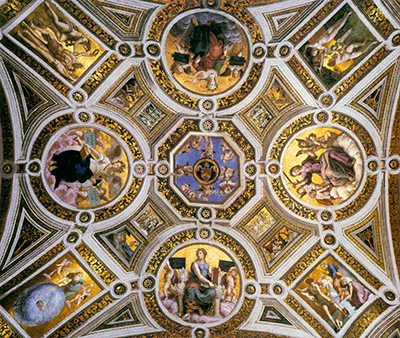
The ceiling is the room's intellectual compass. Four female personifications—Theology, Philosophy, Poetry and Justice—occupy roundels corresponding to the walls below. Between them appear narrative or emblematic scenes that develop the same fields of meaning, while smaller compartments, ornament and the central device bind the surface into a decorative whole.[2]
Looking upward therefore changes how one reads the walls. Philosophy is not only the assembly of ancient thinkers in the School of Athens; it is an abstract faculty identified above. Theology is not reducible to the crowded ecclesial vision of the Disputation. Poetry exists both as an enthroned or inspired capacity overhead and as the gathering of Apollo, the Muses and poets on Parnassus. Justice presides over the wall where moral dispositions and legal transmission are joined.[1][2]
The ceiling also solves a spatial problem. Four wall compositions differ radically in format: one spreads around a window, another is cut by a doorway, another rises on an artificial mountain around a real opening, and the Justice wall separates its upper virtues from two lower legal scenes. The roundels provide stable headings for fields that the architecture forces into different shapes. They make the chamber legible without making it monotonous.
Ancient-looking ornament contributes to this coherence. Raphael's Roman years were nourished by encounters with antiquity—not simply freestanding statues but reliefs, architecture, coins, inscriptions and the recently admired painted interiors associated with ancient sites.[8][12] In the Stanza, classical form is not restricted to the philosophy wall. It is a language of order available to Christian theology, poetic inspiration and papal justice as well.
Supernatural Truth: the Disputation
The wall commonly called the Disputation is officially described by the Vatican as the Disputation over the Most Holy Sacrament. Its apparent architecture is cosmic rather than earthly. Christ, the Virgin and John the Baptist occupy the heavenly register beneath God the Father, while saints and biblical figures extend across clouds. Below, theologians and churchmen gather around an altar bearing the Eucharist.[5]
The window is not an inconvenience concealed by paint. It helps separate and connect zones of the composition. The altar above the opening's axis anchors the lower assembly, and the vertical sequence from sacrament to Christ and the Father turns the wall into a structure of mediation. Circles recur—in haloes, cloud arrangements and the radiant heavenly field—so that doctrinal order becomes visible geometry.[5]
As the room's image of supernatural Truth, the fresco does not present truth as a lone thinker's possession. It is revealed, embodied, worshipped, debated and transmitted within a community extending across time. Historical figures may appear among saints and church fathers, but the fresco's essential drama is collective attention. Books, pointing hands and changing postures show minds responding to a centre that is materially small yet theologically immense.
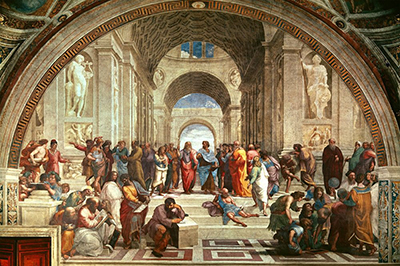
Seen from across the room, the Disputation faces the School of Athens. Their opposition has often been simplified into Christianity versus paganism. Raphael's design is more subtle. Each wall gives knowledge a community, a focal structure and a history. One is organised around sacrament and revelation; the other around inquiry, demonstration and exchange. Their architectural worlds differ, but their human beings share the energy of thought.[4][5]
Rational Truth: the School of Athens
The School of Athens places ancient philosophers and learned figures within a vast classical building. Plato and Aristotle advance at the centre, distinguished by gesture, books, age, clothing and philosophical orientation. Around them, groups read, calculate, dispute, listen and write. The famous setting is imaginary, yet its monumental vaults speak directly to Renaissance Rome and to architectural ambitions associated with the rebuilding of St Peter's.[4][8]
Its power depends on plurality. The fresco has inspired generations of attempts to name every figure, but not all identifications are equally secure. The central philosophers and several surrounding groups are more firmly recognised; others remain traditional, plausible or contested. That uncertainty is not a defect. Raphael produced recognisable types of intellectual activity as well as portraits or historical likenesses. A viewer can understand geometry, solitary thought, oral argument and textual study without possessing a complete cast list.[4][11]
The composition gathers difference without visual disorder. Steps establish horizontal levels. The central pair commands the principal axis, yet the open foreground permits other centres to form. A bending geometer creates one knot of attention; a brooding seated thinker interrupts the flow; figures at the edges make the assembly seem to continue beyond the painted field. The architecture supplies grandeur, but bodily rhythm makes the space believable.
Raphael's antiquity is active rather than archaeological. Ancient philosophy becomes present within the papal library, and Renaissance faces or visual memories can enter the company of classical sages. The wall thus proposes inheritance as a living exchange. Rational Truth is not a relic retrieved intact from the past; it is sustained by reading, teaching, disagreement and demonstration.[8][12]
Beauty: Parnassus
On the wall of Parnassus, Apollo sits among the Muses and poets. The subject invokes the mythic mountain of poetic inspiration, but Raphael builds that mountain around a window. Painted laurel, sloping ground and figure groups transform a difficult architectural field into an advantage: the opening becomes part of the ascent, and the wall seems to expand into an outdoor realm.[6]
Ancient and more recent poets share this imagined company. Homer, Dante and Virgil are among its most recognisable presences, while other identifications have been debated. Once again the room brings historical periods into simultaneous conversation. Poetry is neither an exclusively pagan survival nor a merely modern accomplishment. It is a lineage of inspired language that crosses cultures and can be renewed.[6]
Apollo's instrument is especially striking because Raphael represents him with a stringed instrument associated with contemporary musical culture rather than simply reproducing an ancient lyre. That choice captures the wall's method: classical subject, Renaissance embodiment. The Muses and poets do not perform antiquity as costume drama. Their gestures, listening and recitation make inspiration a present event.[6]
Parnassus faces the Justice wall. Beauty and Good therefore form another cross-room relation. Poetry may appear spontaneous beside law's gravity, yet both require forms—metre, music, judgement, codification—that turn inspiration or principle into communicable order. The opposition keeps either field from becoming shallow: beauty has discipline, and justice requires an imaginative account of human conduct.
Good: virtue and law
The fourth wall is officially named Cardinal and Theological Virtues and the Law. In the lunette, the cardinal virtues Fortitude, Prudence and Temperance appear with the theological virtues Faith, Hope and Charity. Below, on either side of the window, two episodes represent the transmission of civil and canon law: the delivery of the Pandects to Emperor Justinian at left and the delivery of the Decretals to Pope Gregory IX at right.[7]
The division of the wall is meaningful. The upper zone embodies dispositions needed for right action; the lower scenes show law entering institutional life. Justice is therefore neither an abstract scale floating above society nor a ruler's arbitrary command. It joins personal virtue to received legal order. The painted figures above are larger and more timeless; the scenes below are historical, ceremonial and politically specific.
The papal scene gives Gregory IX the features of Julius II. Cardinals beside him include Giovanni de' Medici and Alessandro Farnese, future Popes Leo X and Paul III.[7] Past, present and future fold together: a medieval act of canon-law authority becomes a portrait of the reigning patron attended by men whose later pontificates would define subsequent chapters of the very room's history.
The companion delivery of the Pandects is assigned by the Vatican Museums to Lorenzo Lotto.[7] This is an important reminder that a decorative ensemble bearing Raphael's name can contain carefully differentiated participation. The unity belongs to the programme and design as much as to execution. It also prevents a common mistake: Lotto's attribution applies to the Justinian scene, not automatically to the whole wall or to the Decretals episode.
Four walls in conversation
The most rewarding way to experience the Stanza is to resist choosing a single wall too soon. Stand near the centre and observe the axes. Theology and philosophy oppose one another as modes of Truth. Poetry and justice oppose one another as Beauty and Good. The ceiling translates the walls into personified faculties. The room becomes a three-dimensional diagram, but never a cold one: every category is populated by bodies, expressions, textiles, landscapes, books and acts of attention.[1][2]
Raphael differentiates the four worlds. The Disputation opens vertically into heaven. The School of Athens recedes through massive architecture. Parnassus breathes in an ideal landscape. The Justice wall combines monumental allegory and compact scenes of legal presentation. These distinctions preserve the character of each subject. Unity comes through proportion, figure scale, colour, rhythmic grouping and the repeated spectacle of knowledge becoming social.
Books circulate throughout the ensemble. Philosophers carry or compose them; theologians read and debate them; poets embody a tradition transmitted in words; legal texts are solemnly delivered. In a papal library, this motif has special force. Yet Raphael does not illustrate shelves or catalogue holdings. He stages what texts do: focus attention, preserve inheritance, provoke interpretation and authorise action.
Gesture is another connective language. Plato's upward finger, Aristotle's level hand, poets' reciting mouths, theologians' pointing arms, allegorical virtues' attributes and the formal offering of legal books all translate ideas into bodies. The chamber's learning is never disembodied. Even its most elevated claims reach the viewer through stance, glance and touch.
The walls also share a productive tension between centre and multiplicity. Each has an organising principle, but none eliminates secondary groups. Raphael mastered the art of making a crowd legible without turning it into a row. Small clusters have their own tempo and emotional climate, while the whole remains comprehensible at room distance. This capacity would become crucial to his later Vatican narratives.[9]
Architecture, openings and the viewer
The real room determines the paintings' shapes. Windows cut into the Disputation and Justice walls. A doorway occupies the lower field of the School of Athens, and another opening complicates Parnassus. Raphael's response was not to pretend that the architecture disappeared. Painted space grows from it. Steps, ledges, hills, parapets and ceremonial platforms negotiate the boundary between actual wall and represented world.
This negotiation changes as the visitor moves. Seen straight on, the School of Athens can feel like a complete architectural vision. Seen obliquely while entering or leaving, the painted building and actual doorway compete. The fresco asks the spectator to find an ideal position but also survives the imperfect views inevitable in a functioning chamber.
The windows introduce real light into walls devoted to sacrament and justice. Conditions vary over the day, altering colour and visibility. Raphael could not control this light as a painter controls illumination within an easel picture. Instead, broad masses, decisive silhouettes and monumental figure groups keep the designs legible. Close inspection yields details; distance restores the large intellectual order.
The lower walls once met furnishings very different from what viewers see today. That fact matters because modern photographs often isolate frescoed fields as if their present frame were original. Julius II's room contained the material apparatus of use. Under Leo X, new wooden wainscot by Fra Giovanni da Verona replaced the original furnishings, except on the Parnassus wall, where comparable decoration was painted because space made woodwork impractical.[1]
After the Sack of Rome in 1527, that wooden wainscot was probably destroyed. During Paul III's pontificate, Perin del Vaga painted chiaroscuro wainscot in its place.[1] The chamber is therefore a layered historical object. Raphael's upper programme remains dominant, but its lower boundary, furniture and function have all changed.
From Julius II to the Segnatura
Julius II's death in 1513 did not freeze the room. His successor Leo X used it as a small study and music room and kept musical instruments there.[1] That use gives an unexpectedly concrete resonance to Parnassus, where poetry and music are inseparable, although the fresco was not painted as an illustration of Leo's later arrangement.
Around the middle of the sixteenth century, the Segnatura Gratiae et Iustitiae met in the chamber. The room took its enduring name from this highest court of the Holy See.[1] Because one wall already treated virtue and law, the later judicial association can feel uncannily destined. Chronology must nevertheless remain clear: Raphael's programme was related to Julius II's library and office, not commissioned as decoration for the later tribunal.
This distinction enriches rather than weakens the room. Spaces acquire meanings through reuse. A papal library became a study and music room, then a place associated with supreme judicial authority, and eventually part of a museum itinerary. Each phase directs attention differently. The name “Stanza della Segnatura” is itself evidence of historical memory selecting one chapter to stand for the whole.
Raphael and the work of synthesis
The Stanza's intellectual range can tempt interpretation into a search for one secret key. The paintings have been connected to particular texts, court circles, theological traditions, philosophical programmes and contemporary politics. Some proposals illuminate details; others ask the imagery to carry more precision than the evidence allows. The room's success does not depend on solving every identity or reconstructing a lost written script.
Raphael's synthesis works visually before it works as a code. He makes philosophy architectural and conversational; theology hierarchical and sacramental; poetry lyrical and genealogical; justice ethical and institutional. The ceiling supplies labels, but the walls transform categories into different modes of experience. Their opposition encourages comparison without declaring an easy victor.
This ability was rooted in Raphael's extraordinary receptivity. He absorbed Florentine lessons in figure grouping, Leonardo's psychological connections, Michelangelo's bodily force, Bramante's architectural language and Rome's ancient remains, yet produced an art whose clarity is unmistakably his own.[8][9] Influence in the Stanza is not passive borrowing. It is selection, rebalancing and conversion into a shared visual grammar.
The commission also reveals a modern problem of authorship. A project of this size involves assistants, specialists and a staged process. Raphael designed, revised and directed; other hands helped transfer and execute. The named participation of Lorenzo Lotto on the Justice wall is unusually specific, while other divisions remain debated.[7][9] Recognising collaboration does not diminish Raphael. It shows the organisational intelligence through which Renaissance invention became durable public form.
Colour, surface and restoration
The room is often encountered through reproductions that flatten its surfaces and equalise its light. In place, colour helps separate registers and guide the eye. The cool, open monumentality of the School of Athens differs from the radiant heavenly zones of the Disputation, the airy landscape of Parnassus and the weighty allegories of the Justice wall. Garments create local accents within large figure systems.
Fresco ages as architecture ages. Plaster responds to moisture, structural movement, deposits, past interventions and the conditions of a heavily visited site. Technical study and conservation help distinguish original passages, later additions and altered surfaces, although every restoration also belongs to a history of interpretation.[10] The startling visibility of the Stanza today should not be mistaken for timeless immobility.
The ceiling's mixed decorative fields and the walls' different campaigns make close technical comparison especially valuable. A seam in plaster may reveal a working day; transferred lines can preserve stages of design; a passage added after the wall dried may indicate correction or a detail unsuited to wet plaster. Such traces return labour to images whose intellectual confidence can otherwise make them seem effortless.[10]
Portraits, likeness and historical time
Several frescoes invite the recognition of contemporary likenesses within subjects set in antiquity, sacred history or the Middle Ages. This was not simply an exercise in hiding famous faces. A recognisable individual could bind the distant past to Julius II's Rome, while the historical role could enlarge the meaning of the portrait. The device makes the room's claim to inheritance visible: knowledge is received by living people, not preserved in an unreachable age.
The safest identifications are those supported by strong institutional or scholarly evidence. The Justice wall offers a clear example because the Vatican Museums expressly identify Gregory IX's features as those of Julius II and name Giovanni de' Medici and Alessandro Farnese beside him.[7] Elsewhere, some Renaissance portrait identifications have become famous through repetition without acquiring the same degree of certainty. Raphael's crowds should not be treated as a puzzle in which every face must correspond to a court celebrity.
Even without a name, individuality matters. Heads differ in age, concentration and temperament. Listeners are not duplicates; they lean into a shared event from distinct psychological positions. This variety helps Raphael represent traditions as communities extended through time. Historical authority is collective, yet never faceless.
The Stanza consequently creates several kinds of simultaneity. Heaven and earth coexist in the Disputation. Ancient thinkers share one impossible academy in the School of Athens. Poets separated by many centuries gather on Parnassus. Gregory IX receives law through Julius II's likeness, attended by future popes. The room does not abolish chronology. It reorganises it around enduring fields of knowledge.
This temporal structure suits a library. Books bring absent voices into a present room, allowing authors who never met to stand beside one another in a reader's mind. Raphael gives that ordinary miracle of reading monumental form. His assemblies are imagined, but their coexistence describes what intellectual inheritance does.
The Stanza within the Raphael Rooms
The Room of the Segnatura is the first of Raphael's Vatican rooms in both fame and the history of his commission, but it forms part of a larger suite. Later campaigns addressed different papal concerns through miracle, intervention, deliverance, court history and the validation of ecclesiastical authority.[3] Their narratives often unfold with greater drama and require increasing workshop participation.
Against those later rooms, the Segnatura appears unusually balanced and contemplative. Its great events are acts of thought, worship, inspiration and transmission. Even the busiest assemblies are held within lucid structures. This character reflects the chamber's library function as well as Raphael's particular stage of development.
The comparison also reveals why the room should not be used as a generic label for all Vatican work by Raphael. Each chamber has its own patronal circumstances, chronology, architecture and programme. The Segnatura establishes a model of synthesis; later rooms adapt rather than merely repeat it.[3][9]
For the visitor, moving onward can make this evolution tangible. Monumental calm gives way to nocturnal liberation, divine intervention, fire, coronation and historical ceremony. Returning mentally to the first room clarifies its special ambition: before telling the story of papal power through episodes, Raphael built a world in which that power located itself among the faculties of the human spirit.
How to look at the Stanza della Segnatura
Begin with the room rather than a list of names. Locate the window walls and the door walls. Look upward to match each ceiling personification with its subject below. Then trace the two principal oppositions: theology with philosophy, poetry with justice. This orientation takes only a few moments and prevents the famous frescoes from dissolving into separate postcard images.
Next, compare structures. Notice the vertical ascent of the Disputation, the deep central recession of the School of Athens, the lateral hill of Parnassus and the stacked organisation of virtues above law. Ask how each composition uses its interruption. Raphael's solutions are different because the subjects and architectural problems are different.
Only then move closer to individual figures. Watch how small gestures create chains of attention: a reader turns toward a speaker; a pointing hand redirects the eye; a child supports an attribute; a book passes between legal authority and ruler. Some identities remain uncertain, but the actions are precise.
Finally, step back again. The room's deepest claim lies in coexistence. Revelation does not erase reason; reason does not empty poetry; beauty does not make justice unnecessary. Julius II's library becomes a place where fields of knowledge retain their distinctiveness while entering a common order.
Why the room changed art
The Stanza della Segnatura offered a model for monumental intellectual painting. Its scale is public, but its organisation remains lucid. It can carry courtly learning, religious doctrine, classical revival, portraiture and political presence without becoming a diagram pasted onto architecture. Ideas inhabit convincing bodies and spaces.
For Raphael, it established a new Roman authority. The young master from Urbino demonstrated that he could rival the most ambitious artists of the papal city while creating an alternative to overwhelming force: capacious order, social intelligence and compositional grace. The later Raphael Rooms grew from that success, as did the enlarged workshop able to serve popes and an international network of patrons.[9]
Its influence also lies in the autonomy of its parts. The School of Athens became a universal image of philosophy; the Disputation a major statement of Eucharistic theology; Parnassus a canon of poetic inheritance. Yet their fame can obscure the reciprocal design that made them possible. Returning them to the room restores meanings lost in isolation.
Artist Up Close
Raphael's most consequential decision may be the simplest: he gave each field of knowledge its own social world. Philosophers do philosophy through discussion, calculation and reflection. Theologians orient themselves around sacrament and revelation. Poets listen, recite and receive inspiration. Virtues act through attributes, while law is formally transmitted.
Look also for the intelligence with which he handles obstruction. A window becomes an axis, a doorway opens beneath imaginary architecture, and a cramped lower field becomes a pair of legal ceremonies. The building does not merely contain the art. Its inconveniences provoke invention.
Above all, compare centres. Raphael supplies strong focal points but rarely allows them to become lonely. Authority is surrounded by response. That balance between hierarchy and community is one reason the Stanza feels ordered without feeling inert.
Frequently Asked Questions
Discussion
What detail most changes how you read Stanza della Segnatura?
Reader Insights
Which source detail gives the page its strongest anchor?
Which visual or historical distinction should readers keep in mind?
How does this page change the wider picture of Raphael's career?
Join the Conversation
Share your reading below.
References
- Vatican Museums, “Room of the Segnatura,” official room record. View source.
- Vatican Museums, “Ceiling,” Room of the Segnatura, official object record. View source.
- Vatican Museums, “Raphael's Rooms,” official collection introduction. View source.
- Vatican Museums, “The School of Athens,” official object record. View source.
- Vatican Museums, “Disputation over the Most Holy Sacrament,” official object record. View source.
- Vatican Museums, “Parnassus,” official object record. View source.
- Vatican Museums, “Cardinal and Theological Virtues and the Law,” official object record. View source.
- Ingrid D. Rowland, “Raphael and the Rediscovery of Antiquity,” The Metropolitan Museum of Art, Heilbrunn Timeline of Art History. View source.
- Linda Wolk-Simon, “Raphael at the Metropolitan: The Colonna Altarpiece,” The Metropolitan Museum of Art, with discussion of Raphael's career and Vatican work. View source.
- Vatican Museums, “Raphael in Rome: Style, Technique, Conservative Issues,” research and conference publication page. View source.
- Vatican Museums, The School of Athens: A Catalogue of the Exhibition, 2025 exhibition publication page. View source.
- The Metropolitan Museum of Art, “Raphael and His Circle,” collection and thematic resources. View source.