

 by Tom Gurney
Tom Gurney BSc (Hons) is an art history expert with over 20 years experience
Published on June 19, 2020 / Updated on August 21, 2026
Email: tomgurney1@gmail.com / Phone: +44 7429 011000
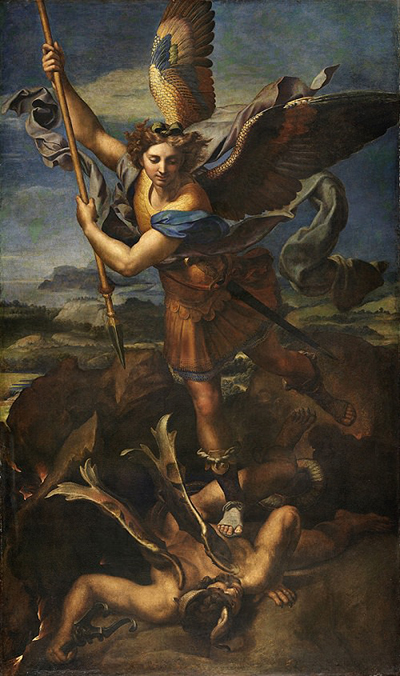
Raphael's Great Saint Michael fills a towering vertical field with one irreversible action. The winged archangel advances through the air and plants a foot upon Satan. His sword remains ready, a long weapon cuts across the composition, and his draperies stream around a body that seems at once weightless and commanding. The demon below writhes against rock and darkness.[1][2]
Painted in 1518 for François I of France, the picture is nearly 2.7 metres high. It belongs not to private devotion but to royal representation. The French king received an image of the patron of his own chivalric order, made under Pope Leo X at a moment when Medici marriage diplomacy sought to strengthen relations with the French Crown.[2]
The scale, destination and date distinguish it completely from Raphael's Small Saint Michael of about 1503–05. That early poplar panel places the archangel inside a Dantean underworld. The Great Saint Michael reduces the story to an immense collision of two bodies and two realms: blue and gold above, earth and shadow below.
At a Glance
- ArtistRaphael
- Louvre titleSaint Michel terrassant le démon, dit Le Grand Saint Michel
- English titleSaint Michael Vanquishing Satan, also called the Great Saint Michael
- Date1518
- Medium/supportoil; originally on wood and transferred to canvas in 1751
- Dimensions268 × 160 cm
- Subjectthe archangel Michael trampling and defeating Satan
- Signature/dateon the border of Michael's tunic, naming Raphael of Urbino and 1518
- CommissionerPope Leo X
- Intended recipientFrançois I, King of France
- Diplomatic settingthe marriage of Lorenzo de' Medici and Madeleine de La Tour d'Auvergne
- Related worka squared modello attributed with reservation to Gianfrancesco Penni or Raphael's studio, Louvre INV 4050
- Collection historyFrench Crown from 1518
- Current homeMusée du Louvre, Department of Paintings
- Inventory numbersINV 610; MR 431
Contents
- Michael and the fall of the dragon
- A body spanning the picture
- Sword, lance and the geometry of judgement
- Blue and gold against earth
- Satan underfoot
- Armour in an antique mode
- An official image for François I
- Leo X and Medici marriage diplomacy
- The inscription and the year 1518
- The Penni modello
Michael and the fall of the dragon
The scriptural foundation is Revelation 12. Michael and his angels fight the dragon, identified with the serpent, devil and Satan; the rebellious power is defeated and cast down from heaven.
Raphael eliminates the angelic armies and makes the cosmic struggle bodily. Michael descends as the agent of judgement. Satan occupies the lowest register, forced against the earth by the archangel's foot.[2]
The reduction has enormous visual force. There is no uncertainty about who rules the scene. The vertical format itself becomes a hierarchy: open air and luminous colour belong to Michael, while rock, shadow and contortion belong to the defeated adversary.
Yet the combat is not frozen into a heraldic badge. Michael's turn, the crossing weapons and the motion of fabric make the victory unfold before the viewer. Satan's resistance remains visible even though its outcome is fixed.
The painting therefore joins theological certainty with dramatic suspense. Evil has lost, but Raphael lets the final movement continue.
A body spanning the picture
Michael's figure occupies almost the full height of the painted field. His wings expand the shoulders, his legs open into a stride and his garments coil around the moving torso.[2]
This dominance makes the archangel feel larger than the space containing him. Landscape survives at the sides and below, but it no longer competes with the principal body.
The pose combines opposing forces. One leg presses downward; the upper body turns and seems to move forward. Wings imply flight, while the foot creates contact and weight.
Raphael had long studied how a figure could be intelligible through silhouette. Here the need was acute. A royal-scale picture had to read across a large room as well as reward closer attention.
The solution is both simple and complex: one bright body crosses a dark adversary, but every limb participates in a different vector. Monumentality comes from coherence under pressure.
Sword, lance and the geometry of judgement
Michael carries the familiar weapons of a celestial warrior. The sword signals the impending conclusion, while the long lance or spear forms a powerful diagonal across the vertical design.[2]
Weapons extend the body. They allow the archangel's authority to reach beyond hands and shoulders and structure the surrounding air.
The long diagonal also prevents the upright format from becoming static. It crosses the broader movement of wings and drapery, tying the upper brilliance to the defeated creature below.
Satan's body answers with compressed curves. Where Michael's weapons create direction, the demon's limbs fold back into confinement.
The contrast expresses more than physical advantage. Raphael opposes purposeful line to tangled form, a judgement that is clear in both theology and design.
Blue and gold against earth
The Louvre's 2012 exhibition account emphasised the economy and force of Raphael's colour division: luminous blue and gold govern the heavenly figure, while earthy hues are reserved for the infernal world.[1][2]
Blue expands Michael into air. Gold catches the authority of armour and ornament. Together they give the archangel the visual value of precious materials without flattening him into decoration.
Below, browns and darker tones bind Satan to rock. The creature seems made from the damaged world onto which he has fallen.
Colour therefore carries spatial and moral meaning. The upper zone feels open even though Michael fills it; the lower zone feels closed even where landscape continues.
The division is not absolute. Michael's foot enters the dark register, while the demon is exposed by the light above. Victory occurs precisely where the two colour worlds meet.
Satan underfoot
The adversary is not a second heroic nude. Raphael bends him into a grotesque counter-form, his face grimacing and his body trapped beneath Michael.[2]
This physical inequality matters. A balanced duel would imply comparable powers. Instead, the picture presents rebellion already reduced to deformity.
Satan's position also makes Michael's apparent lightness credible. The foot supplies resistance against which the archangel's long figure can turn and advance.
The demon remains necessary to the image. Without him, Michael might seem merely to float or dance. His compressed mass gives consequence to the celestial motion.
At royal scale, the act of trampling carries political force as well as religious meaning. The king receiving the work could see divine order personified through the defeat of a rebellious enemy, while the specific saint addressed his own institutional identity.
Armour in an antique mode
The French national collection record describes Michael in armour of an antique character.[2] Raphael does not present him as a contemporary French knight in exact equipment.
The classicising costume separates the archangel from passing fashion and connects his body with the ideal forms of ancient heroic art. Christianity and antiquity are made compatible rather than opposed.
The short tunic allows the stride to remain visible. Armour defines the torso, while fabric around it supplies rhythm and colour.
This balance suits Raphael's mature Roman language. The figure carries the authority of sculpture but belongs unmistakably to painting through its moving light, airborne textiles and chromatic atmosphere.
The result is not archaeological reconstruction. It is a timeless court image, designed to make sacred military power intelligible through the most prestigious visual language available in Rome.
An official image for François I
The French Ministry of Culture records that Pope Leo X commissioned the painting in 1518 as a gift for François I.[2] The Louvre likewise identifies the king with the work from that year and records its place in the former Crown collection.[1]
This was direct address. François was head of the Order of Saint Michael, founded by Louis XI in 1469. An image of the archangel could honour the king's office, his chivalric community and the French monarchy's claim to Christian defence.
The subject required no portrait likeness to become personal. Patron saint and institutional emblem made the connection.
Raphael's signature added another form of prestige. A work by Rome's most celebrated painter arrived as an object worthy of exchange between pope and king.
The painting was therefore sacred art, diplomatic gift and assertion of cultural authority at once. None of those functions cancels the others.
Leo X and Medici marriage diplomacy
The gift is connected with the marriage of Leo X's nephew Lorenzo de' Medici, Duke of Urbino, to Madeleine de La Tour d'Auvergne, a French noblewoman related to François I.[2]
The union formed part of Medici efforts to establish dynastic security and French alliance. Paintings sent to the court transformed political agreement into durable visible honour.
Michael was an exceptionally apt choice. He could praise François without depicting the living monarch, and he expressed victory through a saint already embedded in French royal ceremony.
The commission also shows how rapidly Raphael's art crossed borders. Designed and painted in Rome, the work was conceived from the outset for reception in France.
Its meaning consequently belongs to more than one court. Papal intention, Medici family strategy and French kingship converge in the archangel's downward step.
The inscription and the year 1518
The painting bears Raphael's name and the date 1518 on the border of Michael's garment.[2] Published transcriptions vary slightly in their Latin verb and punctuation, but the essential declaration is stable: Raphael of Urbino names himself and the year.
Integrating the inscription into clothing keeps authorship within the image. The letters follow a moving edge rather than occupying a separate plaque.
The date matters because Raphael's studio was then carrying an exceptional load: papal rooms, tapestry-related work, architecture, portraits and major paintings moved through an organised system of design and execution.
Signing did not mean that no assistant participated. It declared responsibility for a work issued under Raphael's name and directed to a sovereign recipient.
For modern viewers, the inscription anchors the painting amid competing later stories. Whatever debates surround hands and materials, the object presents itself as Raphael's work of 1518.
The Penni modello
The Louvre preserves a highly finished drawing related to the composition, INV 4050. It measures 41.6 by 27.7 centimetres and uses pen, brown ink and wash, black chalk and white heightening on beige-washed paper.[3]
Black-chalk squaring crosses the sheet. Such a grid could help move a design from the drawing's compact scale toward a much larger surface.
The Louvre attributes the sheet to Gianfrancesco Penni, but the history is complex. Earlier owners called it Raphael; later scholarship has treated Penni only with reservation or preferred a broader studio attribution. The museum describes it as a modello used with variations for the Great Saint Michael.[3]
A modello is a resolved presentation design, not simply a first thought. Penni was especially important in translating Raphael's ideas into such finished preparatory forms.
Differences between sheet and painting demonstrate that the design remained active. The drawing was a stage in decision-making, not a mechanical miniature of the final result.
Raphael and an organised studio
By 1518, Raphael directed collaborators with specialised capacities. Some developed full-scale cartoons, some executed finished sections, and some prepared refined drawings that could communicate an invention to patrons or other workers.
The Great Saint Michael belongs to that environment. Its associated sheet makes collaboration visible, but it does not by itself identify every hand on the painted surface.[3]
Older scholarship has proposed varying degrees of participation by Giulio Romano or Raphael's wider studio; the French collection record preserves those former attributions while cataloguing the picture to Raphael.[2]
Two errors should be avoided. One is to imagine Raphael working in isolation on every centimetre. The other is to treat studio organisation as evidence that the named artist contributed only a distant idea.
For a signed royal commission, design, supervision, revision and final responsibility were themselves substantial forms of authorship. Exact execution remains a question for technical and connoisseurial study.
From wood to canvas
The Louvre's current materials field says oil on canvas.[1] The French national record adds the crucial history: the paint was transferred from wood to canvas in 1751.[2]
These descriptions refer to different moments in the same object's life. Raphael painted on a wooden panel; the painted layers were later separated from that support and attached to fabric.
Transfer was once used when a panel was thought unstable or damaged. It radically altered an object's physical structure even when the visible composition remained.
The distinction explains why some catalogues call the work oil on canvas while specialist accounts describe wood transferred to canvas. Neither phrase should be used without the temporal qualification.
At 268 by 160 centimetres, the original panel was a major material undertaking. Its present fabric support is part of the painting's eighteenth-century conservation history, not Raphael's initial choice.
Crown collection and Louvre identity
The Great Saint Michael entered François I's possession in 1518 and remained within the French royal collection.[1][2] It did not need the long dealer-and-collector journey followed by many Louvre paintings.
That continuity strengthened its association with French monarchy. Later viewers could connect Raphael's prestige with the foundational Renaissance collecting of François I.
The work now carries the Louvre number INV 610 and the alternate number MR 431. When checked, the museum listed it on view in Room 710 of the Denon wing.[1]
Its title includes Le Grand Saint Michel because scale and collection history demand distinction from the earlier INV 608.
The two pictures can now be seen within the same museum, but they reached the Crown by different paths. The Great work arrived for François I in 1518; Louis XIV bought the Small work from Mazarin's heirs in 1665.
Small and Great: what changed
The early Small Saint Michael is an intricate panel of about 30.9 by 26.5 centimetres. Its infernal landscape contains punishments adapted from Dante, and scholarship connects it cautiously with Urbino around 1503–05.
The Great Saint Michael is almost nine times as tall. Its setting recedes before the archangel's body, and its documented first recipient was François I.[1][2]
The change is not a simple progression from immature to mature. Each work solves a different problem. The small panel rewards private inspection and literary recognition; the later picture must announce itself across a royal interior.
The archangel changes accordingly. Early Michael is slender and jewel-like within a populous terrain. Late Michael dominates an elemental field through weight, colour and scale.
Together, they show Raphael returning to one subject when circumstances, audience and his own resources had transformed.
How to look at the Great Saint Michael
Stand far enough away to see the main opposition: one extended bright body above one compressed dark body.
Follow the long diagonal of the weapon, then observe how wings and cloth carry that energy into the surrounding air.
Move closer to the tunic border and locate the signed date. Authorship becomes part of costume and movement.
Compare Michael's planted foot with Satan's twisting anatomy. Contact is the hinge between celestial flight and earthly defeat.
Finally, remember the lost wooden support beneath the present canvas. The visible image has survived a profound material transformation.
Why the painting matters
The Great Saint Michael is one of Raphael's clearest demonstrations that a religious image could perform international politics without sacrificing visual power.
Its subject praised a French king through the patron of his order. Its maker represented papal Rome at the height of his fame. Its arrival accompanied a Medici-French marriage alliance.
The composition converts those circumstances into a universal form: luminous authority passes over contorted rebellion.
The associated Penni drawing opens a view into Raphael's studio, where a master's invention could be clarified, squared, varied and enlarged through collective expertise.
The later transfer from panel to canvas adds another history. The painting is not only a surviving design of 1518 but a physically altered object whose endurance depended upon later choices.
Artist Up Close
Start with the foot pinning Satan. It gives the airborne figure the force of gravity.
Trace the weapon across the tall format and notice how it keeps the body from becoming merely upright.
Separate the palette into blue-gold and earth-dark zones, then look for the boundary where Michael enters the lower realm.
Find the garment inscription and consider how a named painter addressed a named king through the body of a saint.
Frequently Asked Questions
Discussion
What detail most changes how you read Saint Michael Vanquishing Satan: The Great Louvre Painting?
Reader Insights
Which source detail gives the page its strongest anchor?
Which visual or historical distinction should readers keep in mind?
How does this page change the wider picture of Raphael's career?
Join the Conversation
Share your reading below.
References
- Musée du Louvre, “Saint Michel terrassant le démon, dit Le Grand Saint Michel,” INV 610. View source.
- Ministère de la Culture, POP: Plateforme ouverte du patrimoine, “Saint Michel terrassant le démon; dit Le Grand Saint Michel,” Joconde 000PE026976. View source.
- Musée du Louvre, Département des Arts graphiques, “Saint Michel terrassant le démon,” attributed to Gianfrancesco Penni, INV 4050 recto. View source.